Q1041.Q starts from Point P and drives 2 km towards the south. He then takes a right turn, drives 3 km, turns right and drives 11 km. He then takes a right turn and drives 4 km, turns left and drives 3 km. He then takes a right turn and drives 2 km. He takes a final right turn, drives 12 km and stops at Point O. How far (shortest distance) and towards which direction should he drive in order to reach Point P again? (All turns are 90 degree turns only unless specified.)
Q बिंदु P से आरंभ करता है और दक्षिण की ओर 2 km गाड़ी चलाता है। फिर वह दाएँ मुड़ता है, 3 km गाड़ी चलाता है, दाएँ मुड़ता है और 11 km गाड़ी चलाता है। फिर वह दाएँ मुड़ता है और 4 km गाड़ी चलाता है, बाएँ मुड़ता है और 3 km गाड़ी चलाता है। फिर वह दाएँ मुड़ता है और 2 km गाड़ी चलाता है। वह अंतिम बार दाएँ मुड़ता है, 12 km गाड़ी चलाता है और बिंदु O पर रुकता है। पुनः बिंदु P तक पहुँचने के लिए उसे कितनी दूरी (न्यूनतम दूरी) तक और किस दिशा में गाड़ी चलानी चाहिए? (जब तक निर्दिष्ट न किया जाए, सभी मोड़ केवल 90 डिग्री के मोड़ हैं।)
- A7 km towards the northउत्तर की ओर 7 km
- B5 km towards the southदक्षिण की ओर 5 km
- C3 km towards the eastपूर्व की ओर 3 km
- D3 km towards the westपश्चिम की ओर 3 km
Show answer
Concept: Track net East-West and North-South movement.
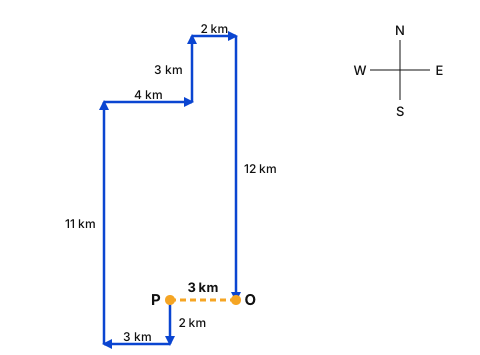
- South 2 → right (West) 3 → right (North) 11 → right (East) 4 → left (North) 3 → right (East) 2 → right (South) 12.
- North-South: .
- East-West: → O is 3 km East of P.
- So from O he must drive 3 km towards the West.
Trick: Net vertical = 0 means P and O are on the same horizontal line; just add east-west moves.
Answer: (D) 3 km towards the west
अवधारणा: कुल पूर्व-पश्चिम और उत्तर-दक्षिण दूरी निकालें।
- दक्षिण 2 → दाएँ (पश्चिम) 3 → दाएँ (उत्तर) 11 → दाएँ (पूर्व) 4 → बाएँ (उत्तर) 3 → दाएँ (पूर्व) 2 → दाएँ (दक्षिण) 12।
- उत्तर-दक्षिण: ।
- पूर्व-पश्चिम: → O, P से 3 km पूर्व में है।
- अतः O से 3 km पश्चिम की ओर जाना होगा।
ट्रिक: ऊर्ध्व कुल = 0 हो तो P और O एक ही क्षैतिज रेखा पर हैं; केवल पूर्व-पश्चिम जोड़ें।
उत्तर: (D) 3 km पश्चिम की ओर
RRB NTPC Graduate CBT 1General Intelligence and ReasoningDirection and DistanceRRB NTPC Graduate CBT 1 2024 · 11 Jun Shift 1
Q1042.Each of C, D, E, F, S, T and U has an exam on a different day of a week starting from Monday and ending on Sunday of the same week. S has the exam on Thursday and T has the exam on Saturday. F has the exam immediately before U. C has the exam on one of the days after E. D has the exam immediately after U. Who has the exam on the last day of the week?
C, D, E, F, S, T और U में से प्रत्येक की परीक्षा एक ही सप्ताह के सोमवार से आरंभ होकर रविवार को समाप्त होने वाले सप्ताह के एक अलग-अलग दिन है। S की परीक्षा गुरुवार को है और T की परीक्षा शनिवार को है। F की परीक्षा U से ठीक पहले है। C की परीक्षा E के बाद के दिनों में से किसी एक दिन है। D की परीक्षा U के ठीक बाद है। सप्ताह के अंतिम दिन किसकी परीक्षा है?
- AE
- BD
- CC
- DT
Show answer
Concept: Fix the given days, then place the consecutive block F–U–D.
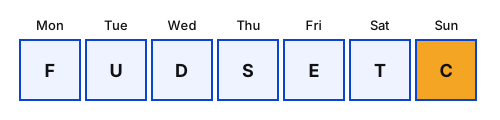
- S = Thursday, T = Saturday.
- F, U, D are on three consecutive days. Only Mon–Tue–Wed is free in a row (Fri–Sat and Wed–Thu are blocked).
- So F = Mon, U = Tue, D = Wed.
- Left: Friday and Sunday for E and C; C is after E → E = Friday, C = Sunday.
Trick: Place the longest consecutive block first – it usually has only one fit.
Answer: (C) C
अवधारणा: दिए गए दिन तय करें, फिर लगातार F–U–D का ब्लॉक रखें।
- S = गुरुवार, T = शनिवार।
- F, U, D लगातार तीन दिन हैं। केवल सोम–मंगल–बुध लगातार खाली हैं।
- अतः F = सोमवार, U = मंगलवार, D = बुधवार।
- शेष शुक्रवार और रविवार E व C के लिए; C, E के बाद → E = शुक्रवार, C = रविवार।
ट्रिक: सबसे लंबा लगातार ब्लॉक पहले रखें – प्रायः एक ही स्थान बचता है।
उत्तर: (C) C
RRB NTPC Graduate CBT 1General Intelligence and ReasoningScheduling puzzleRRB NTPC Graduate CBT 1 2024 · 11 Jun Shift 1
Q1043.A, B, C, D, R, S and T are sitting around a circular table facing the centre of the table. Only four people sit between B and D when counted from the right of B. B sits third to the left of C. T sits third to the left of R. S is an immediate neighbour of both D and C. How many people sit between A and S when counted from the right of A?
A, B, C, D, R, S और T एक वृत्ताकार मेज़ के चारों ओर मेज़ के केंद्र की ओर मुख करके बैठे हैं। B के दाएँ से गिनने पर B और D के बीच केवल चार लोग बैठे हैं। B, C के बाएँ से तीसरे स्थान पर बैठा है। T, R के बाएँ से तीसरे स्थान पर बैठा है। S, D और C दोनों का निकटतम पड़ोसी है। A के दाएँ से गिनने पर A और S के बीच कितने लोग बैठे हैं?
- AThreeतीन
- BOneएक
- CFourचार
- DTwoदो
Show answer
Concept: Facing the centre, a person's left is clockwise and right is anticlockwise.
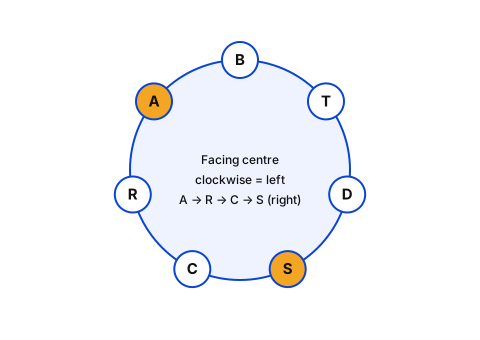
- Four between B and D from B's right → D is 2 places to B's left. B is third to the left of C → C is 4 places to B's left.
- S neighbours both D and C → S sits between them. Clockwise from B: B, _, D, S, C, _, _.
- T third to the left of R fits only with R and T at the two remaining sides: clockwise B, T, D, S, C, R, A.
- From A's right (anticlockwise): R, C, then S → 2 people between.
Trick: In a 7-seat circle, '4 between on one side' = '1 between on the other side'.
Answer: (D) Two
अवधारणा: केंद्र की ओर मुख होने पर व्यक्ति का बायाँ = दक्षिणावर्त (clockwise), दायाँ = वामावर्त।
- B के दाएँ से B और D के बीच चार → D, B के बाएँ 2 स्थान पर। B, C के बाएँ तीसरा → C, B के बाएँ 4 स्थान पर।
- S, D और C दोनों का पड़ोसी → S उनके बीच। B से दक्षिणावर्त: B, _, D, S, C, _, _।
- T, R के बाएँ तीसरा – केवल यह क्रम बनता है: B, T, D, S, C, R, A (दक्षिणावर्त)।
- A के दाएँ (वामावर्त) से: R, C, फिर S → बीच में 2 व्यक्ति।
ट्रिक: 7 सीटों के वृत्त में 'एक ओर 4 बीच में' = 'दूसरी ओर 1 बीच में'।
उत्तर: (D) दो
RRB NTPC Graduate CBT 1General Intelligence and ReasoningCircular seatingRRB NTPC Graduate CBT 1 2024 · 11 Jun Shift 1
Q1044.MBKF is related to OGMK in a certain way based on the English alphabetical order. In the same way, QLOP is related to SQQU. To which of the given options is UVSZ related, following the same logic?
अंग्रेज़ी वर्णमाला क्रम के आधार पर MBKF एक निश्चित प्रकार से OGMK से संबंधित है। उसी प्रकार, QLOP, SQQU से संबंधित है। समान तर्क का अनुसरण करते हुए, UVSZ दिए गए विकल्पों में से किससे संबंधित है?
- AVBUD
- BWAUE
- CXZVF
- DWBTD
Show answer
Concept: Find the shift of each letter position.
- MBKF → OGMK: M+2, B+5, K+2, F+5.
- Check: QLOP → SQQU: Q+2, L+5, O+2, P+5 ✓.
- UVSZ: U+2 = W, V+5 = A (wrap: ), S+2 = U, Z+5 = E.
- Answer: WAUE.
Trick: Pattern +2, +5, +2, +5; after Z start again from A.
Answer: (B) WAUE
अवधारणा: प्रत्येक अक्षर के स्थान का अंतर निकालें।
- MBKF → OGMK: M+2, B+5, K+2, F+5।
- जाँच: QLOP → SQQU: Q+2, L+5, O+2, P+5 ✓।
- UVSZ: U+2 = W, V+5 = A (), S+2 = U, Z+5 = E।
- उत्तर: WAUE।
ट्रिक: पैटर्न +2, +5, +2, +5; Z के बाद फिर A से गिनें।
उत्तर: (B) WAUE
RRB NTPC Graduate CBT 1General Intelligence and ReasoningLetter analogyRRB NTPC Graduate CBT 1 2024 · 11 Jun Shift 1
Q1045.If 14 : A :: A : 56, find the positive value of A.
यदि 14 : A :: A : 56 है, तो A का धनात्मक मान ज्ञात कीजिए।
- A29
- B31
- C28
- D26
Show answer
Concept: If , then (mean proportional).
- .
- .
Trick: , – a doubling chain.
Answer: (C) 28
अवधारणा: यदि तो (मध्यानुपाती)।
- ।
- ।
ट्रिक: , – दोगुनी शृंखला।
उत्तर: (C) 28
RRB NTPC Graduate CBT 1General Intelligence and ReasoningNumber analogy (mean proportional)RRB NTPC Graduate CBT 1 2024 · 11 Jun Shift 1
Q1046.What should come in place of the question mark (?) in the given series?
51 87 121 153 183 211 ?
दी गई शृंखला में प्रश्नचिह्न (?) के स्थान पर क्या आना चाहिए?
51 87 121 153 183 211 ?
- A237
- B249
- C241
- D253
Show answer
Concept: Check the differences between consecutive terms.
- Differences: 36, 34, 32, 30, 28 – decreasing by 2.
- Next difference .
- .
Trick: First differences forming an AP → just continue the AP.
Answer: (A) 237
अवधारणा: क्रमागत पदों का अंतर देखें।
- अंतर: 36, 34, 32, 30, 28 – हर बार 2 कम।
- अगला अंतर ।
- ।
ट्रिक: अंतर समांतर श्रेणी में हों तो उसी को आगे बढ़ाएँ।
उत्तर: (A) 237
RRB NTPC Graduate CBT 1General Intelligence and ReasoningNumber seriesRRB NTPC Graduate CBT 1 2024 · 11 Jun Shift 1
Q1047.Seven people, I, J, K, L, O, P and Q are sitting in a row, facing north. Only two people sit to the left of P. Only three people sit between P and I. Only one person sits between I and O. Q sits to the immediate left of K. J is not an immediate neighbour of I. How many people sit to the right of L?
सात व्यक्ति, I, J, K, L, O, P और Q उत्तर की ओर मुख करके एक पंक्ति में बैठे हैं। P के बाईं ओर केवल दो व्यक्ति बैठे हैं। P और I के बीच केवल तीन व्यक्ति बैठे हैं। I और O के बीच केवल एक व्यक्ति बैठा है। Q, K के ठीक बाईं ओर बैठा है। J, I का निकटतम पड़ोसी नहीं है। L के दाईं ओर कितने व्यक्ति बैठे हैं?
- AThreeतीन
- BOneएक
- CFourचार
- DTwoदो
Show answer
Concept: All face north, so left and right are the viewer's left and right. Number seats 1 to 7 from the left.
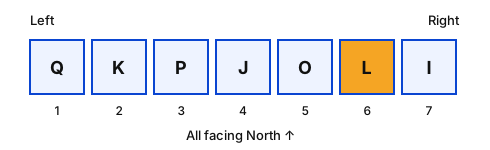
- Two people to the left of P → P = 3. Three between P and I → I = 7.
- One between I and O → O = 5.
- Q immediately left of K: free seats 1, 2, 4, 6 → only Q = 1, K = 2.
- J not next to I → J = 4, L = 6. Right of L: only I → 1 person.
Trick: Facing north: left = your left; count seats from the left end.
Answer: (B) One
अवधारणा: सभी उत्तर की ओर मुख किए हैं, अतः बायाँ-दायाँ हमारे जैसा। बाएँ से सीट 1 से 7।
- P के बाएँ दो व्यक्ति → P = 3। P और I के बीच तीन → I = 7।
- I और O के बीच एक → O = 5।
- Q, K के ठीक बाएँ: खाली सीटें 1, 2, 4, 6 → केवल Q = 1, K = 2।
- J, I का पड़ोसी नहीं → J = 4, L = 6। L के दाएँ केवल I → 1 व्यक्ति।
ट्रिक: उत्तर मुख: बायाँ = आपका बायाँ; बाएँ छोर से गिनें।
उत्तर: (B) एक
RRB NTPC Graduate CBT 1General Intelligence and ReasoningLinear seatingRRB NTPC Graduate CBT 1 2024 · 11 Jun Shift 1
Q1048.What should come in place of the question mark (?) in the given series based on the English alphabetical order?
WOM CVS ICY OJE ?
अंग्रेज़ी वर्णमाला क्रम के आधार पर दी गई शृंखला में प्रश्नचिह्न (?) के स्थान पर क्या आना चाहिए?
WOM CVS ICY OJE ?
- AUKQ
- BKUQ
- CUQK
- DKQU
Show answer
Concept: Track each letter position separately (A = 1 … Z = 26, wrap after Z).
- 1st letters: W, C, I, O → +6 each → U.
- 2nd letters: O, V, C, J → +7 each → Q.
- 3rd letters: M, S, Y, E → +6 each → K.
- Next term = UQK.
Trick: W(23)+6 = 29 → 29 − 26 = 3 = C: subtract 26 after Z.
Answer: (C) UQK
अवधारणा: हर स्थान के अक्षर अलग-अलग देखें (A = 1 … Z = 26, Z के बाद फिर A)।
- पहले अक्षर: W, C, I, O → हर बार +6 → U।
- दूसरे अक्षर: O, V, C, J → हर बार +7 → Q।
- तीसरे अक्षर: M, S, Y, E → हर बार +6 → K।
- अगला पद = UQK।
ट्रिक: W(23)+6 = 29 → 29 − 26 = 3 = C: Z के बाद 26 घटाएँ।
उत्तर: (C) UQK
RRB NTPC Graduate CBT 1General Intelligence and ReasoningLetter seriesRRB NTPC Graduate CBT 1 2024 · 11 Jun Shift 1
Q1049.In a certain code language, ‘FAST’ is coded as ‘2468’ and ‘SLOW’ is coded as ‘1327’. What is the code for ‘S’ in the given code language?
एक निश्चित कूट भाषा में, ‘FAST’ को ‘2468’ के रूप में और ‘SLOW’ को ‘1327’ के रूप में कूटबद्ध किया जाता है। दी गई कूट भाषा में ‘S’ का कूट क्या है?
- A7
- B6
- C2
- D1
Show answer
Concept: A letter common to two words takes the digit common to their codes.
- FAST → 2468; SLOW → 1327.
- Common letter: S. Common digit: 2.
- So S = 2.
Trick: Match common letters with common digits; order of digits does not matter.
Answer: (C) 2
अवधारणा: दो शब्दों में उभयनिष्ठ अक्षर का कोड, उनके कोडों का उभयनिष्ठ अंक होता है।
- FAST → 2468; SLOW → 1327।
- उभयनिष्ठ अक्षर: S। उभयनिष्ठ अंक: 2।
- अतः S = 2।
ट्रिक: उभयनिष्ठ अक्षर ↔ उभयनिष्ठ अंक; अंकों का क्रम मायने नहीं रखता।
उत्तर: (C) 2
RRB NTPC Graduate CBT 1General Intelligence and ReasoningCoding-decoding (common letters)RRB NTPC Graduate CBT 1 2024 · 11 Jun Shift 1
Q1050.Study the given Venn diagram carefully and answer the question that follows.
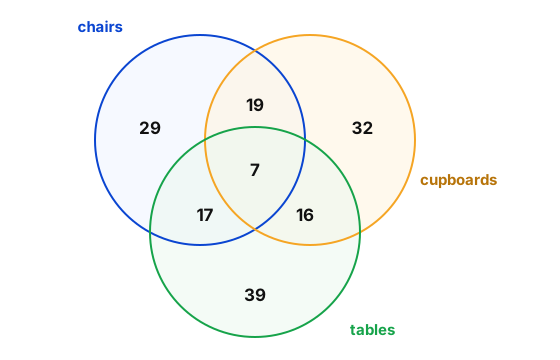
The numbers in different sections indicate the number of pieces of furniture. How many chairs are there which are also cupboards but not tables?
दिए गए वेन आरेख का ध्यानपूर्वक अध्ययन कीजिए और नीचे दिए गए प्रश्न का उत्तर दीजिए।
विभिन्न खंडों में दी गई संख्याएँ फर्नीचर के नगों की संख्या दर्शाती हैं। ऐसी कितनी कुर्सियाँ हैं जो अलमारियाँ भी हैं लेकिन मेज़ नहीं हैं?
- A17
- B19
- C29
- D7
Show answer
Concept: Pick the region inside two circles and outside the third.
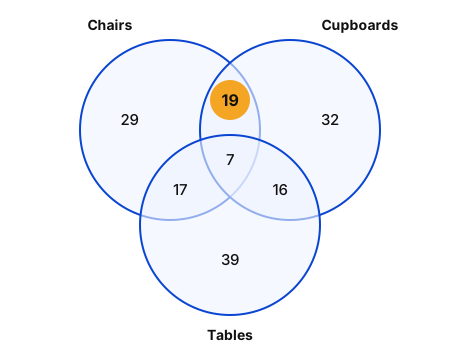
- Chairs ∩ Cupboards = 19 + 7 (7 is also inside Tables).
- Exclude Tables → only the region 19.
- Answer = 19.
Trick: 'But not' removes the centre (all-three) region.
Answer: (B) 19
अवधारणा: दो वृत्तों के अंदर और तीसरे के बाहर वाला भाग चुनें।
- कुर्सियाँ ∩ अलमारियाँ = 19 + 7 (7 मेज़ों में भी है)।
- मेज़ों को हटाएँ → केवल भाग 19।
- उत्तर = 19।
ट्रिक: 'पर नहीं' से केंद्र (तीनों वाला) भाग हटता है।
उत्तर: (B) 19
RRB NTPC Graduate CBT 1General Intelligence and ReasoningVenn diagramRRB NTPC Graduate CBT 1 2024 · 11 Jun Shift 1
Q1051.Which of the following letter-clusters should replace # and % so that the pattern and relationship followed between the letter-cluster pair on the left side of :: is the same as that on the right side of ::?
# : ONJ :: VUQ : %
निम्नलिखित में से कौन-से अक्षर-समूह # और % को प्रतिस्थापित करने चाहिए ताकि :: के बाईं ओर के अक्षर-समूह युग्म के बीच अनुसरण किया गया पैटर्न और संबंध, :: के दाईं ओर के अक्षर-समूह युग्म के समान हो?
# : ONJ :: VUQ : %
- A# = UIM, % = STN
- B# = RQM, % = SRN
- C# = RIO, % = ASN
- D# = RYM, % = PRN
Show answer
Concept: Find the rule on the right pair and apply it to the left.
- Try option B: RQM → ONJ: R−3 = O, Q−3 = N, M−3 = J.
- VUQ → SRN: V−3 = S, U−3 = R, Q−3 = N ✓.
- Same rule (−3 each letter) on both sides.
Trick: Test the '%' part of each option first – only SRN gives a clean −3 from VUQ.
Answer: (B) # = RQM, % = SRN
अवधारणा: दाईं ओर के जोड़े का नियम निकालकर बाईं ओर लगाएँ।
- विकल्प B: RQM → ONJ: R−3 = O, Q−3 = N, M−3 = J।
- VUQ → SRN: V−3 = S, U−3 = R, Q−3 = N ✓।
- दोनों ओर समान नियम (हर अक्षर −3)।
ट्रिक: पहले हर विकल्प का '%' भाग जाँचें – केवल SRN, VUQ से −3 देता है।
उत्तर: (B) # = RQM, % = SRN
RRB NTPC Graduate CBT 1General Intelligence and ReasoningLetter-cluster analogyRRB NTPC Graduate CBT 1 2024 · 11 Jun Shift 1
Q1052.A group of numbers and symbols is coded using letter codes as per the codes given below and the conditions that follow. Study the given codes and conditions and answer the question that follows.
Note: If none of the conditions apply, then codes for the respective number/symbol are to be followed directly as given in the table.
| Letter | F | T | E | P | A | U | X | R |
|---|
| Code | 7 | $ | @ | 9 | 2 | % | 6 | 4 |
|---|
Conditions:
1. If the 1
st letter is a vowel and the last letter is a consonant, their codes are to be interchanged.
2. If the 2
nd letter is a vowel and the last letter is a consonant, both are to be coded as ‘W’.
3. If the 3
rd and 4
th letters are consonants, both are to be coded as the code for the 3
rd letter.
4. If the 1
st and 2
nd letters are vowels, then both are to be coded as ‘Q’.
What will be the code for the following group?
TAEX
संख्याओं और प्रतीकों के एक समूह को नीचे दिए गए कूटों और उसके बाद दी गई शर्तों के अनुसार अक्षर कूटों का उपयोग करके कूटबद्ध किया जाता है। दिए गए कूटों और शर्तों का अध्ययन कीजिए और नीचे दिए गए प्रश्न का उत्तर दीजिए।
नोट: यदि कोई भी शर्त लागू नहीं होती है, तो संबंधित संख्या/प्रतीक के लिए तालिका में दिए गए कूटों का सीधे अनुसरण किया जाना है।
शर्तें:
1. यदि पहला अक्षर स्वर है और अंतिम अक्षर व्यंजन है, तो उनके कूट आपस में बदल दिए जाने हैं।
2. यदि दूसरा अक्षर स्वर है और अंतिम अक्षर व्यंजन है, तो दोनों को ‘W’ के रूप में कूटबद्ध किया जाना है।
3. यदि तीसरा और चौथा अक्षर व्यंजन हैं, तो दोनों को तीसरे अक्षर के कूट के रूप में कूटबद्ध किया जाना है।
4. यदि पहला और दूसरा अक्षर स्वर हैं, तो दोनों को ‘Q’ के रूप में कूटबद्ध किया जाना है।
निम्नलिखित समूह के लिए कूट क्या होगा?
TAEX
- A$ 2 2 6
- B$ @ @ 6
- C$ W @ W
- D$ 2 @ 6
Show answer
Concept: Check each condition against the letter group; apply only the one that fits.
- TAEX: T = $, A = 2, E = @, X = 6 (from table).
- Condition 1: first letter T is not a vowel – no. Condition 4: T not a vowel – no.
- Condition 2: 2nd letter A is a vowel and last letter X is a consonant – applies, so A and X both become W.
- Condition 3: 3rd letter E is a vowel – no. Code = $ W @ W.
Trick: Test conditions quickly by marking vowels (A, E, I, O, U) in the word first.
Answer: (C) $ W @ W
अवधारणा: हर शर्त को अक्षर-समूह पर जाँचें; केवल लागू होने वाली शर्त अपनाएँ।
- TAEX: T = $, A = 2, E = @, X = 6 (तालिका से)।
- शर्त 1 व 4: पहला अक्षर T स्वर नहीं – लागू नहीं।
- शर्त 2: दूसरा अक्षर A स्वर और अंतिम X व्यंजन – लागू, अतः A और X दोनों W।
- शर्त 3: तीसरा अक्षर E स्वर है – लागू नहीं। कोड = $ W @ W।
ट्रिक: पहले शब्द में स्वरों (A, E, I, O, U) को चिह्नित कर लें।
उत्तर: (C) $ W @ W
RRB NTPC Graduate CBT 1General Intelligence and ReasoningCoding-Decoding (Conditions)RRB NTPC Graduate CBT 1 2024 · 10 Jun Shift 3
Q1053.Each of the digits in the number 6954381 is arranged in the descending order from left to right. Which of the following digits will be third from the right?
संख्या 6954381 के प्रत्येक अंक को बाएँ से दाएँ अवरोही क्रम में व्यवस्थित किया जाता है। निम्नलिखित में से कौन-सा अंक दाएँ से तीसरा होगा?
- A5
- B6
- C3
- D4
Show answer
Concept: Arrange the digits in descending order and count from the right end.
- Digits of 6954381: 6, 9, 5, 4, 3, 8, 1.
- Descending: 9 8 6 5 4 3 1.
- From right: 1st = 1, 2nd = 3, 3rd = 4.
Trick: Third from right in descending order = third smallest digit = 4.
Answer: (D) 4
अवधारणा: अंकों को घटते क्रम में लगाकर दाएँ छोर से गिनें।
- 6954381 के अंक: 6, 9, 5, 4, 3, 8, 1।
- घटता क्रम: 9 8 6 5 4 3 1।
- दाएँ से: पहला = 1, दूसरा = 3, तीसरा = 4।
ट्रिक: घटते क्रम में दाएँ से तीसरा = तीसरा सबसे छोटा अंक = 4।
उत्तर: (D) 4
RRB NTPC Graduate CBT 1General Intelligence and ReasoningDigit ArrangementRRB NTPC Graduate CBT 1 2024 · 10 Jun Shift 3
Q1054.DTUH is related to BQWK in a certain way based on the English alphabetical order. In the same way, ZNYN is related to XKAQ. To which of the given options is VHCT related, following the same logic?
अंग्रेज़ी वर्णमाला क्रम के आधार पर DTUH एक निश्चित प्रकार से BQWK से संबंधित है। उसी प्रकार, ZNYN, XKAQ से संबंधित है। समान तर्क का अनुसरण करते हुए, VHCT दिए गए विकल्पों में से किससे संबंधित है?
- ASFEV
- BSEDX
- CUDFX
- DTEEW
Show answer
Concept: Find the positional shift of each letter in the given pairs.
- DTUH → BQWK: D−2=B, T−3=Q, U+2=W, H+3=K.
- Check: ZNYN → XKAQ: Z−2=X, N−3=K, Y+2=A, N+3=Q ✔.
- VHCT: V−2=T, H−3=E, C+2=E, T+3=W → TEEW.
Trick: Pattern ; count backward past A wraps to Z.
Answer: (D) TEEW
अवधारणा: दिए गए युग्मों में प्रत्येक अक्षर का स्थानीय खिसकाव ज्ञात करें।
- DTUH → BQWK: D−2=B, T−3=Q, U+2=W, H+3=K।
- जाँच: ZNYN → XKAQ: Z−2=X, N−3=K, Y+2=A, N+3=Q ✔।
- VHCT: V−2=T, H−3=E, C+2=E, T+3=W → TEEW।
ट्रिक: पैटर्न ; Z के बाद फिर A से गिनें।
उत्तर: (D) TEEW
RRB NTPC Graduate CBT 1General Intelligence and ReasoningLetter AnalogyRRB NTPC Graduate CBT 1 2024 · 10 Jun Shift 3
Q1055.Read the given statements and conclusions carefully. Assuming that the information given in the statements is true, even if it appears to be at variance with commonly known facts, decide which of the given conclusion(s) logically follow(s) from the statements.
Statements:
Some nuts are black.
All black are crows.
All crows are pens.
Conclusions:
(I) All nuts are black.
(II) Some black are crows.
दिए गए कथनों और निष्कर्षों को ध्यानपूर्वक पढ़िए। यह मानते हुए कि कथनों में दी गई जानकारी सत्य है, भले ही वह सामान्यतः ज्ञात तथ्यों से भिन्न प्रतीत होती हो, निर्णय कीजिए कि दिए गए निष्कर्षों में से कौन-सा/से निष्कर्ष कथनों का तार्किक रूप से अनुसरण करता है/करते हैं।
कथन:
कुछ मेवे काले हैं।
सभी काले कौवे हैं।
सभी कौवे पेन हैं।
निष्कर्ष:
(I) सभी मेवे काले हैं।
(II) कुछ काले कौवे हैं।
- AOnly conclusion (II) follows.केवल निष्कर्ष (II) अनुसरण करता है।
- BBoth conclusions (I) and (II) follow.निष्कर्ष (I) और (II) दोनों अनुसरण करते हैं।
- CNeither conclusion (I) nor (II) follows.न तो निष्कर्ष (I) और न ही (II) अनुसरण करता है।
- DOnly conclusion (I) follows.केवल निष्कर्ष (I) अनुसरण करता है।
Show answer
Concept: Draw the least-overlap Venn diagram satisfying all statements.
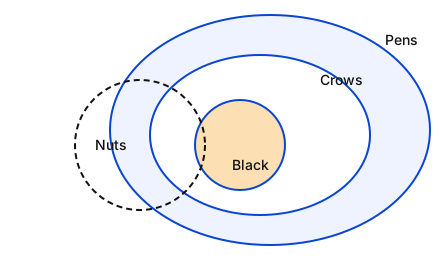
- Some nuts are black → Nuts and Black overlap partly; All black are crows → Black lies inside Crows, which lies inside Pens.
- I: All nuts are black – the diagram shows nuts outside Black too, so not certain ✗.
- II: Some black are crows – since every black is a crow, some black are surely crows ✔.
Trick: "All A are B" always gives "Some A are B" (and "Some B are A").
Answer: (A) Only conclusion (II) follows.
अवधारणा: सभी कथनों को संतुष्ट करने वाला न्यूनतम वेन आरेख बनाएँ।
- कुछ nuts black हैं → Nuts और Black आंशिक रूप से मिलते हैं; सभी black crows हैं → Black, Crows के अंदर और Crows, Pens के अंदर।
- I: सभी nuts black हैं – आरेख में nuts Black के बाहर भी हैं, अतः निश्चित नहीं ✗।
- II: कुछ black crows हैं – हर black crow है, तो कुछ black अवश्य crow हैं ✔।
ट्रिक: "सभी A, B हैं" से "कुछ A, B हैं" हमेशा निकलता है।
उत्तर: (A) केवल निष्कर्ष (II) अनुसरण करता है।
RRB NTPC Graduate CBT 1General Intelligence and ReasoningSyllogismRRB NTPC Graduate CBT 1 2024 · 10 Jun Shift 3
Q1056.Which of the following letter-number clusters will replace the question mark (?) in the given series to make it logically complete?
KN33 JM41 IL49 HK57 ?
निम्नलिखित में से कौन-सा अक्षर-संख्या समूह दी गई श्रृंखला को तार्किक रूप से पूर्ण करने के लिए प्रश्न चिह्न (?) का स्थान लेगा?
KN33 JM41 IL49 HK57 ?
- AGJ65
- BGI66
- CGI65
- DGJ66
Show answer
Concept: Track the two letters and the number separately.
- 1st letters: K, J, I, H → next G (−1).
- 2nd letters: N, M, L, K → next J (−1).
- Numbers: 33, 41, 49, 57 → next .
Trick: Both letters move back by 1, number goes up by 8 → GJ65.
Answer: (A) GJ65
अवधारणा: दोनों अक्षरों और संख्या को अलग-अलग देखें।
- पहला अक्षर: K, J, I, H → अगला G (−1)।
- दूसरा अक्षर: N, M, L, K → अगला J (−1)।
- संख्याएँ: 33, 41, 49, 57 → अगली ।
ट्रिक: दोनों अक्षर 1 पीछे, संख्या 8 आगे → GJ65।
उत्तर: (A) GJ65
RRB NTPC Graduate CBT 1General Intelligence and ReasoningAlphanumeric SeriesRRB NTPC Graduate CBT 1 2024 · 10 Jun Shift 3
Q1057.Based on the English alphabetical order, three of the following four letter-cluster pairs are alike in a certain way and thus form a group. Which letter-cluster pair DOES NOT belong to that group? (Note: The odd one out is not based on the number of
consonants/vowels or their position in the letter cluster)
अंग्रेज़ी वर्णमाला क्रम के आधार पर, निम्नलिखित चार अक्षर-समूह युग्मों में से तीन किसी निश्चित प्रकार से एकसमान हैं और इस प्रकार एक समूह बनाते हैं। कौन-सा अक्षर-समूह युग्म उस समूह से संबंधित नहीं है? (नोट: असंगत अक्षर-समूह, उस अक्षर-समूह में
व्यंजनों/स्वरों की संख्या या उनके स्थान पर आधारित नहीं है।)
- APQ - NO
- BKL - IJ
- CGH - EF
- DMH - IP
Show answer
Concept: Compare the letters of each pair by their alphabet positions.
- PQ − NO: P−2=N, Q−2=O.
- KL − IJ: K−2=I, L−2=J; GH − EF: G−2=E, H−2=F.
- MH − IP: M−4=I, H+8=P – also the first cluster is not consecutive letters.
Trick: Three pairs are consecutive letters shifted back by 2; MH − IP breaks it.
Answer: (D) MH − IP
अवधारणा: प्रत्येक युग्म के अक्षरों की वर्णमाला स्थिति की तुलना करें।
- PQ − NO: P−2=N, Q−2=O।
- KL − IJ: K−2=I, L−2=J; GH − EF: G−2=E, H−2=F।
- MH − IP: M−4=I, H+8=P – और पहला समूह क्रमागत अक्षर भी नहीं है।
ट्रिक: तीन युग्म क्रमागत अक्षर हैं जो 2 पीछे खिसकते हैं; MH − IP अलग है।
उत्तर: (D) MH − IP
RRB NTPC Graduate CBT 1General Intelligence and ReasoningOdd Pair OutRRB NTPC Graduate CBT 1 2024 · 10 Jun Shift 3
Q1058.What should come in place of the question mark (?) in the given series?
301 300 297 292 285 ?
दी गई श्रृंखला में प्रश्न चिह्न (?) के स्थान पर क्या आना चाहिए?
301 300 297 292 285 ?
- A275
- B276
- C273
- D277
Show answer
Concept: Look at successive differences.
- Subtract odd numbers 1, 3, 5, 7, 9 …
- Next:
Trick: Also : → 276.
Answer: (B) 276
अवधारणा: क्रमिक अंतर देखें।
- विषम संख्याएँ 1, 3, 5, 7, 9 … घटाई जा रही हैं।
- अगला:
ट्रिक: या : → 276।
उत्तर: (B) 276
RRB NTPC Graduate CBT 1General Intelligence and ReasoningNumber SeriesRRB NTPC Graduate CBT 1 2024 · 10 Jun Shift 3
Q1059.Refer to the following number and symbol series and answer the question that follows. Counting to be done from left to right only.
(Left) © 2 © # * 6 € 4 5 3 € 1 1 € 6 7 # 7 4 £ 6 € (Right)
How many such numbers are there each of which is immediately preceded by a number and also immediately followed by a number?
निम्नलिखित संख्या और प्रतीक श्रृंखला को देखिए और नीचे दिए गए प्रश्न का उत्तर दीजिए। गिनती केवल बाएँ से दाएँ की जानी है।
(बाएँ) © 2 © # * 6 € 4 5 3 € 1 1 € 6 7 # 7 4 £ 6 € (दाएँ)
ऐसी कितनी संख्याएँ हैं, जिनमें से प्रत्येक के ठीक पहले एक संख्या है और ठीक बाद भी एक संख्या है?
- A3
- B2
- C0
- D1
Show answer
Concept: Find number–NUMBER–number triplets in the series.
- Number runs in the series: "2", "6", "4 5 3", "1 1", "6 7", "7 4", "6".
- A middle number with numbers on both sides needs a run of at least 3 numbers.
- Only "4 5 3" qualifies → the number 5. Count = 1.
Trick: Mark consecutive-number blocks; each block of length gives answers.
Answer: (D) 1
अवधारणा: श्रृंखला में संख्या–संख्या–संख्या वाले त्रिक खोजें।
- संख्याओं के समूह: "2", "6", "4 5 3", "1 1", "6 7", "7 4", "6"।
- बीच वाली संख्या के दोनों ओर संख्या होने के लिए कम-से-कम 3 क्रमागत संख्याएँ चाहिए।
- केवल "4 5 3" → संख्या 5। गिनती = 1।
ट्रिक: क्रमागत संख्याओं के ब्लॉक बनाएँ; लंबाई वाला ब्लॉक उत्तर देता है।
उत्तर: (D) 1
RRB NTPC Graduate CBT 1General Intelligence and ReasoningSymbol-Number SeriesRRB NTPC Graduate CBT 1 2024 · 10 Jun Shift 3
Q1060.TK 14 is related to YH 5 in a certain way. In the same way, MN 5 is related to RK −4. To which of the given options is SV 0 related, following the same logic?
TK 14 एक निश्चित प्रकार से YH 5 से संबंधित है। उसी प्रकार, MN 5, RK −4 से संबंधित है। समान तर्क का अनुसरण करते हुए, SV 0 दिए गए विकल्पों में से किससे संबंधित है?
- AWV −7
- BPR −13
- CXT −11
- DXS −9
Show answer
Concept: Find the rule for each part of the cluster.
- TK 14 → YH 5: T+5=Y, K−3=H, .
- Check MN 5 → RK −4: M+5=R, N−3=K, ✔.
- SV 0 → S+5=X, V−3=S, → XS −9.
Trick: Rule: , , .
Answer: (D) XS −9
अवधारणा: समूह के प्रत्येक भाग का नियम ज्ञात करें।
- TK 14 → YH 5: T+5=Y, K−3=H, ।
- जाँच MN 5 → RK −4: M+5=R, N−3=K, ✔।
- SV 0 → S+5=X, V−3=S, → XS −9।
ट्रिक: नियम: , , ।
उत्तर: (D) XS −9
RRB NTPC Graduate CBT 1General Intelligence and ReasoningAlphanumeric AnalogyRRB NTPC Graduate CBT 1 2024 · 10 Jun Shift 3

