Q1081.A, B, C, D, E and F live on six different floors of the same building. The lowermost floor in the building is numbered 1, the floor above it, number 2 and so on, till the topmost floor is numbered 6. D lives on an odd numbered floor but not 5. The sum of floors on which D and A live is 5. Only 3 people live between A and F. B lives immediately above E. How many people live above B?
A, B, C, D, E और F एक ही इमारत की छह अलग-अलग मंज़िलों पर रहते हैं। इमारत की सबसे निचली मंज़िल की संख्या 1 है, उसके ऊपर वाली मंज़िल की संख्या 2 है और इसी प्रकार आगे, सबसे ऊपरी मंज़िल की संख्या 6 है। D एक विषम संख्या वाली मंज़िल पर रहता है, परंतु 5 पर नहीं। D और A जिन मंज़िलों पर रहते हैं, उनका योग 5 है। A और F के बीच केवल 3 व्यक्ति रहते हैं। B, E के ठीक ऊपर रहता है। B के ऊपर कितने व्यक्ति रहते हैं?
- A3
- B4
- C2
- D1
Show answer
Concept: Fix the fixed clues first (D, A, F), then place the pair B–E in the remaining floors.
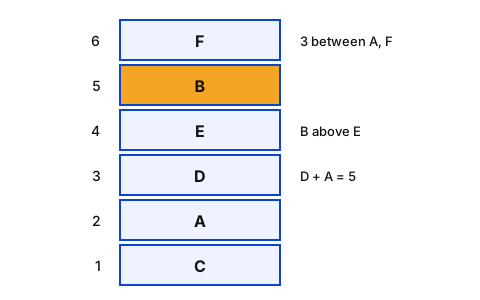
- D is on an odd floor except 5, so D = 1 or 3.
- D + A = 5: if D = 1, A = 4; if D = 3, A = 2.
- Exactly 3 people between A and F: A = 4 gives no valid F (needs 0 or 8), so D = 3, A = 2, F = 6.
- Floors left: 1, 4, 5. B is immediately above E, so E = 4, B = 5 and C = 1.
- Only F (floor 6) is above B, so 1 person.
Trick: In floor puzzles, test both cases of a sum clue; the case that breaks the "gap" clue is rejected at once.
Answer: (D) 1
अवधारणा: पहले निश्चित संकेत (D, A, F) लगाएँ, फिर बची मंज़िलों में B–E की जोड़ी रखें।
- D विषम मंज़िल पर है पर 5 नहीं, अतः D = 1 या 3.
- D + A = 5: D = 1 हो तो A = 4; D = 3 हो तो A = 2.
- A और F के बीच ठीक 3 लोग: A = 4 पर F संभव नहीं, अतः D = 3, A = 2, F = 6.
- बची मंज़िलें 1, 4, 5. B ठीक E के ऊपर है, अतः E = 4, B = 5, C = 1.
- B के ऊपर केवल F (मंज़िल 6) है, यानी 1 व्यक्ति।
ट्रिक: योग वाले संकेत के दोनों केस आज़माएँ; जो केस "बीच में लोग" वाले संकेत को तोड़े, उसे तुरंत हटा दें।
उत्तर: (D) 1
RRB NTPC Graduate CBT 1General Intelligence and ReasoningFloor PuzzleRRB NTPC Graduate CBT 1 2024 · 20 Jun Shift 2
Q1082.Read the given statements and conclusions carefully. Assuming that the information given in the statements is true, even if it appears to be at variance with commonly known facts, decide which of the given conclusion(s) logically follow(s) from the statements.
Statements:
All curtain are screen.
All curtain are blinder.
Some blinder are drape.
Conclusions:
(I) Some drape are curtain.
(II) Some blinder are screen.
दिए गए कथनों और निष्कर्षों को ध्यानपूर्वक पढ़िए। यह मानते हुए कि कथनों में दी गई जानकारी सत्य है, भले ही वह सामान्य रूप से ज्ञात तथ्यों से भिन्न प्रतीत होती हो, निर्णय कीजिए कि दिए गए निष्कर्षों में से कौन-सा/से निष्कर्ष कथनों का तार्किक रूप से अनुसरण करता है/करते हैं।
कथन:
सभी कर्टेन, स्क्रीन हैं।
सभी कर्टेन, ब्लाइंडर हैं।
कुछ ब्लाइंडर, ड्रेप हैं।
निष्कर्ष:
(I) कुछ ड्रेप, कर्टेन हैं।
(II) कुछ ब्लाइंडर, स्क्रीन हैं।
- ANeither conclusion (I) nor (II) followsन तो निष्कर्ष (I) और न ही (II) अनुसरण करता है
- BBoth conclusions (I) and (II) followनिष्कर्ष (I) और (II) दोनों अनुसरण करते हैं
- COnly conclusion (I) followsकेवल निष्कर्ष (I) अनुसरण करता है
- DOnly conclusion (II) followsकेवल निष्कर्ष (II) अनुसरण करता है
Show answer
Concept: Draw the least-overlap Venn diagram; a conclusion follows only if it is true in every possible diagram.
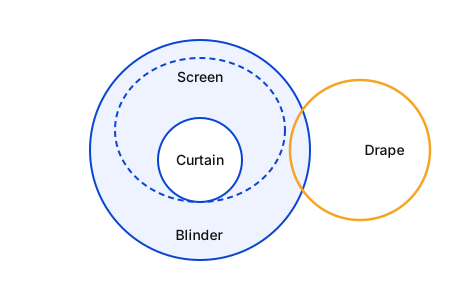
- All curtain are screen and all curtain are blinder, so the curtain circle lies inside both screen and blinder.
- Hence some blinder (the curtain part) are screen – Conclusion II definitely follows.
- Drape only overlaps blinder; it can lie completely outside curtain, so "Some drape are curtain" is not certain – Conclusion I does not follow.
Trick: Two "All" statements with the same subject (All A are B, All A are C) always give "Some B are C".
Answer: (D) Only conclusion (II) follows
अवधारणा: न्यूनतम ओवरलैप वाला वेन आरेख बनाएँ; निष्कर्ष तभी सही है जब वह हर संभव आरेख में सत्य हो।
- सभी curtain, screen हैं और सभी curtain, blinder हैं, अतः curtain का वृत्त screen और blinder दोनों के अंदर है।
- इसलिए कुछ blinder (curtain वाला भाग) screen हैं – निष्कर्ष II निश्चित रूप से सही।
- Drape केवल blinder से जुड़ा है; यह curtain के पूरी तरह बाहर हो सकता है, अतः निष्कर्ष I निश्चित नहीं।
ट्रिक: एक ही subject वाले दो "All" कथन (सभी A, B हैं; सभी A, C हैं) से हमेशा "कुछ B, C हैं" निकलता है।
उत्तर: (D) केवल निष्कर्ष (II) अनुसरण करता है
RRB NTPC Graduate CBT 1General Intelligence and ReasoningSyllogismRRB NTPC Graduate CBT 1 2024 · 20 Jun Shift 2
Q1083.What should come in place of the question mark (?) in the given series?
1012 1010 1000 998 988 ? 976
दी गई श्रृंखला में प्रश्नचिह्न (?) के स्थान पर क्या आना चाहिए?
1012 1010 1000 998 988 ? 976
- A985
- B988
- C987
- D986
Show answer
Concept: Look at the differences between consecutive terms.
- Differences: , , , .
- Pattern alternates ; next is : .
- Check: ✓.
Trick: Alternating differences are common – always verify with the term after the blank.
Answer: (D) 986
अवधारणा: क्रमागत पदों के अंतर देखें।
- अंतर: , , , .
- पैटर्न बारी-बारी; अगला : .
- जाँच: ✓.
ट्रिक: बारी-बारी वाले अंतर आम हैं – रिक्त स्थान के बाद वाले पद से जाँच अवश्य करें।
उत्तर: (D) 986
RRB NTPC Graduate CBT 1General Intelligence and ReasoningNumber SeriesRRB NTPC Graduate CBT 1 2024 · 20 Jun Shift 2
Q1084.This question is based on the five, three-digit numbers given below.
(Left) 983 986 481 941 167 (Right)
(Example- 697 – First digit = 6, second digit = 9 and third digit = 7)
(NOTE: All operations to be done from left to right.)
What will be the resultant if the third digit of the highest number is subtracted from the first digit of the lowest number?
यह प्रश्न नीचे दी गई तीन अंकों वाली पाँच संख्याओं पर आधारित है।
(बाएँ) 983 986 481 941 167 (दाएँ)
(उदाहरण- 697 – पहला अंक = 6, दूसरा अंक = 9 और तीसरा अंक = 7)
(ध्यान दें: सभी संक्रियाएँ बाएँ से दाएँ की जानी हैं।)
यदि सबसे बड़ी संख्या के तीसरे अंक को सबसे छोटी संख्या के पहले अंक में से घटाया जाए, तो परिणाम क्या होगा?
- A−4
- B−2
- C−5
- D−3
Show answer
Concept: Identify the highest and lowest numbers, pick the asked digits, then operate in the stated order.
- Numbers: 983, 986, 481, 941, 167. Highest , lowest .
- Third digit of highest ; first digit of lowest .
- "6 subtracted from 1" means .
Trick: "X subtracted from Y" – read the order carefully.
Answer: (C)
अवधारणा: सबसे बड़ी और सबसे छोटी संख्या पहचानें, माँगे गए अंक लें, फिर बताए क्रम में संक्रिया करें।
- संख्याएँ: 983, 986, 481, 941, 167. सबसे बड़ी , सबसे छोटी .
- सबसे बड़ी का तीसरा अंक ; सबसे छोटी का पहला अंक .
- "1 में से 6 घटाना" .
ट्रिक: "X को Y में से घटाएँ" – क्रम ध्यान से पढ़ें।
उत्तर: (C)
RRB NTPC Graduate CBT 1General Intelligence and ReasoningNumber OperationsRRB NTPC Graduate CBT 1 2024 · 20 Jun Shift 2
Q1085.This question is based on the five, three-digit numbers given below.
(Left) 951 474 717 497 127 (Right)
(Example- 697 – First digit = 6, second digit = 9 and third digit = 7)
(NOTE: All operations to be done from left to right.)
What will be the resultant if the first digit of the highest number is subtracted from the third digit of the lowest number?
यह प्रश्न नीचे दी गई तीन अंकों वाली पाँच संख्याओं पर आधारित है।
(बाएँ) 951 474 717 497 127 (दाएँ)
(उदाहरण- 697 – पहला अंक = 6, दूसरा अंक = 9 और तीसरा अंक = 7)
(ध्यान दें: सभी संक्रियाएँ बाएँ से दाएँ की जानी हैं।)
यदि सबसे बड़ी संख्या के पहले अंक को सबसे छोटी संख्या के तीसरे अंक में से घटाया जाए, तो परिणाम क्या होगा?
- A−4
- B−3
- C−2
- D−1
Show answer
Concept: Identify the highest and lowest numbers, pick the asked digits, then operate in the stated order.
- Numbers: 951, 474, 717, 497, 127. Highest , lowest .
- First digit of highest ; third digit of lowest .
- "9 subtracted from 7" means .
Trick: "X subtracted from Y" ; a negative answer is expected here.
Answer: (C)
अवधारणा: सबसे बड़ी और सबसे छोटी संख्या पहचानें, माँगे गए अंक लें, फिर बताए क्रम में संक्रिया करें।
- संख्याएँ: 951, 474, 717, 497, 127. सबसे बड़ी , सबसे छोटी .
- सबसे बड़ी का पहला अंक ; सबसे छोटी का तीसरा अंक .
- "7 में से 9 घटाना" .
ट्रिक: "X को Y में से घटाएँ" ; यहाँ ऋणात्मक उत्तर अपेक्षित है।
उत्तर: (C)
RRB NTPC Graduate CBT 1General Intelligence and ReasoningNumber OperationsRRB NTPC Graduate CBT 1 2024 · 20 Jun Shift 2
Q1086.If 1 is added to each even digit and 2 is subtracted from each odd digit in the number 9368547, what will be the sum of the digits which are third from the left and third from the right in the new number thus formed?
यदि संख्या 9368547 में प्रत्येक सम अंक में 1 जोड़ा जाए और प्रत्येक विषम अंक में से 2 घटाया जाए, तो इस प्रकार बनी नई संख्या में बाएँ से तीसरे और दाएँ से तीसरे अंकों का योग क्या होगा?
- A8
- B10
- C14
- D12
Show answer
Concept: Apply the rule digit by digit, write the new number, then read positions.
- 9368547 → 9 (odd) , 3 , 6 (even) , 8 , 5 , 4 , 7 .
- New number: 7179355.
- Third from left ; third from right .
- Sum .
Trick: Only the needed positions matter: 3rd from left is 6 → 7, 3rd from right is 5 → 3.
Answer: (B) 10
अवधारणा: प्रत्येक अंक पर नियम लगाएँ, नई संख्या लिखें, फिर स्थान पढ़ें।
- 9368547 → 9 (विषम) , 3 , 6 (सम) , 8 , 5 , 4 , 7 .
- नई संख्या: 7179355.
- बाएँ से तीसरा ; दाएँ से तीसरा .
- योग .
ट्रिक: केवल ज़रूरी स्थानों पर ध्यान दें: बाएँ से तीसरा 6 → 7, दाएँ से तीसरा 5 → 3.
उत्तर: (B) 10
RRB NTPC Graduate CBT 1General Intelligence and ReasoningDigit OperationsRRB NTPC Graduate CBT 1 2024 · 20 Jun Shift 2
Q1087.In a certain code language, ‘FIGS’ is coded as ‘3648’ and ‘ICED’ is coded as ‘1285’. What is the code for ‘I’ in the given code language?
एक निश्चित कूट भाषा में, 'FIGS' को '3648' के रूप में कूटबद्ध किया जाता है और 'ICED' को '1285' के रूप में कूटबद्ध किया जाता है। दी गई कूट भाषा में 'I' के लिए कूट क्या है?
- A1
- B8
- C6
- D5
Show answer
Concept: A letter common to both words gets the digit common to both codes.
- FIGS → 3648 and ICED → 1285.
- The only common letter is I; the only common digit is 8.
- Hence I = 8.
Trick: Common letter ↔ common digit – no need to decode the other letters.
Answer: (B) 8
अवधारणा: दोनों शब्दों में समान अक्षर का कूट दोनों कोडों में समान अंक होता है।
- FIGS → 3648 और ICED → 1285.
- एकमात्र समान अक्षर I है; एकमात्र समान अंक 8 है।
- अतः I = 8.
ट्रिक: समान अक्षर ↔ समान अंक – बाकी अक्षरों को खोलने की ज़रूरत नहीं।
उत्तर: (B) 8
RRB NTPC Graduate CBT 1General Intelligence and ReasoningCoding–DecodingRRB NTPC Graduate CBT 1 2024 · 20 Jun Shift 2
Q1088.Mr. KLM starts from Point A and drives 21 km towards the south. He then takes a left turn, drives 7 km, turns left and drives 26 km. He then takes a left turn and drives 11 km. He takes a final left turn, drives 5 km and stops at Point P. How far (shortest distance) and in which direction should he drive in order to reach Point A again? (All turns are 90- degree turns only unless specified)
श्री KLM बिंदु A से चलना शुरू करते हैं और दक्षिण की ओर 21 km ड्राइव करते हैं। फिर वह बाएँ मुड़ते हैं, 7 km ड्राइव करते हैं, बाएँ मुड़ते हैं और 26 km ड्राइव करते हैं। फिर वह बाएँ मुड़ते हैं और 11 km ड्राइव करते हैं। वह अंतिम बार बाएँ मुड़ते हैं, 5 km ड्राइव करते हैं और बिंदु P पर रुक जाते हैं। बिंदु A पर फिर से पहुँचने के लिए उन्हें कितनी दूरी (न्यूनतम दूरी) तक और किस दिशा में ड्राइव करना चाहिए? (जब तक निर्दिष्ट न किया जाए, सभी मोड़ केवल 90 डिग्री के मोड़ हैं)
- A4 km to the eastपूर्व की ओर 4 km
- B3 km to the westपश्चिम की ओर 3 km
- C7 km to the eastपूर्व की ओर 7 km
- D5 km to the westपश्चिम की ओर 5 km
Show answer
Concept: Track the net east–west and north–south displacement.
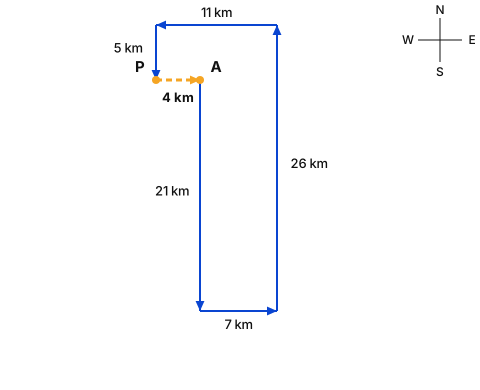
- From A: 21 km south, left → 7 km east, left → 26 km north, left → 11 km west, left → 5 km south.
- North–south: , so P is on the same level as A.
- East–west: , so P is 4 km west of A.
- To return to A he must drive 4 km towards the east.
Trick: Add all east–west moves and all north–south moves separately; the sign tells the direction.
Answer: (A) 4 km to the east
अवधारणा: कुल पूर्व–पश्चिम और उत्तर–दक्षिण विस्थापन निकालें।
- A से: 21 km दक्षिण, बाएँ → 7 km पूर्व, बाएँ → 26 km उत्तर, बाएँ → 11 km पश्चिम, बाएँ → 5 km दक्षिण।
- उत्तर–दक्षिण: , अतः P, A के समान स्तर पर है।
- पूर्व–पश्चिम: , अतः P, A से 4 km पश्चिम में है।
- A तक लौटने के लिए 4 km पूर्व की ओर जाना होगा।
ट्रिक: पूर्व–पश्चिम और उत्तर–दक्षिण की चालें अलग-अलग जोड़ें; चिह्न दिशा बताता है।
उत्तर: (A) 4 km पूर्व की ओर
RRB NTPC Graduate CBT 1General Intelligence and ReasoningDirection and DistanceRRB NTPC Graduate CBT 1 2024 · 20 Jun Shift 2
Q1089.B is the father of C. Q is the sister of C. T is the only sister of Q. T is the child of S. M is the son of S's only son.
How is S related to B?
B, C का पिता है। Q, C की बहन है। T, Q की एकमात्र बहन है। T, S की संतान है। M, S के एकमात्र पुत्र का पुत्र है।
S का B से क्या संबंध है?
- AFather's sisterपिता की बहन
- BWifeपत्नी
- CFather's brotherपिता का भाई
- DWife's motherपत्नी की माँ
Show answer
Concept: Build a family tree from the clues and read the relation.
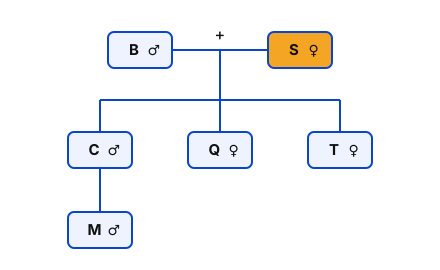
- B is the father of C; Q is the sister of C, and T is Q's only sister – so C, Q, T are siblings and B is their father.
- T is the child of S, so S is also a parent of C, Q and T.
- M is the son of S's only son – S's only son is C, so S is a parent; S is the mother (female) and B is the father.
- Hence S is B's wife.
Trick: Two different parents of the same children (one is "father") → the other is the mother, i.e. the wife.
Answer: (B) Wife
अवधारणा: संकेतों से वंश-वृक्ष बनाएँ और संबंध पढ़ें।
- B, C का पिता है; Q, C की बहन है और T, Q की एकमात्र बहन – अतः C, Q, T भाई-बहन हैं और B उनका पिता।
- T, S की संतान है, अतः S भी C, Q, T का माता/पिता है।
- M, S के एकमात्र पुत्र (C) का पुत्र है; B पिता है, अतः S माता है।
- इसलिए S, B की पत्नी है।
ट्रिक: एक ही बच्चों के दो अलग माता-पिता (एक "पिता") → दूसरा माता, यानी पत्नी।
उत्तर: (B) पत्नी
RRB NTPC Graduate CBT 1General Intelligence and ReasoningBlood RelationRRB NTPC Graduate CBT 1 2024 · 20 Jun Shift 2
Q1090.Mr. I starts from Point M and drives 1 km towards the south. He then takes a right turn, drives 3 km, turns left and drives 3 km. He then takes a left turn and drives 4 km. He takes a final left turn, drives 4 km and stops at Point N. How far (shortest distance) and towards which direction should he drive in order to reach Point M again? (All turns are 90-degree turns only unless specified.)
श्री I बिंदु M से चलना शुरू करते हैं और दक्षिण की ओर 1 km ड्राइव करते हैं। फिर वह दाएँ मुड़ते हैं, 3 km ड्राइव करते हैं, बाएँ मुड़ते हैं और 3 km ड्राइव करते हैं। फिर वह बाएँ मुड़ते हैं और 4 km ड्राइव करते हैं। वह अंतिम बार बाएँ मुड़ते हैं, 4 km ड्राइव करते हैं और बिंदु N पर रुक जाते हैं। बिंदु M पर फिर से पहुँचने के लिए उन्हें कितनी दूरी (न्यूनतम दूरी) तक और किस दिशा की ओर ड्राइव करना चाहिए? (जब तक निर्दिष्ट न किया जाए, सभी मोड़ केवल 90 डिग्री के मोड़ हैं।)
- A1 km towards the westपश्चिम की ओर 1 km
- B2 km towards the southदक्षिण की ओर 2 km
- C4 km towards the eastपूर्व की ओर 4 km
- D4 km towards the northउत्तर की ओर 4 km
Show answer
Concept: Track the net east–west and north–south displacement.
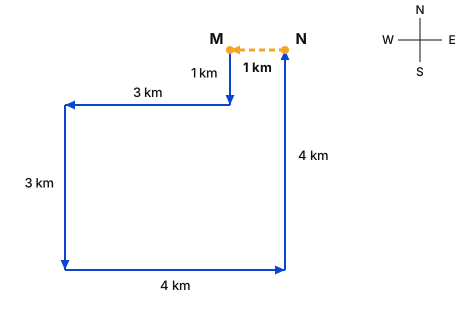
- From M: 1 km south, right → 3 km west, left → 3 km south, left → 4 km east, left → 4 km north.
- North–south: , so N is level with M.
- East–west: , so N is 1 km east of M.
- To reach M he must drive 1 km towards the west.
Trick: Facing south, a right turn means west; facing west, a left turn means south.
Answer: (A) 1 km towards the west
अवधारणा: कुल पूर्व–पश्चिम और उत्तर–दक्षिण विस्थापन निकालें।
- M से: 1 km दक्षिण, दाएँ → 3 km पश्चिम, बाएँ → 3 km दक्षिण, बाएँ → 4 km पूर्व, बाएँ → 4 km उत्तर।
- उत्तर–दक्षिण: , अतः N, M के समान स्तर पर।
- पूर्व–पश्चिम: , अतः N, M से 1 km पूर्व में।
- M तक पहुँचने के लिए 1 km पश्चिम की ओर जाना होगा।
ट्रिक: दक्षिण की ओर मुख हो तो दायाँ = पश्चिम; पश्चिम की ओर मुख हो तो बायाँ = दक्षिण।
उत्तर: (A) 1 km पश्चिम की ओर
RRB NTPC Graduate CBT 1General Intelligence and ReasoningDirection and DistanceRRB NTPC Graduate CBT 1 2024 · 20 Jun Shift 2
Q1091.Seven boxes D, E, F, G, S, T and U are kept one over the other but not necessarily in the same order. Only four boxes are kept between E and D. Only F is kept above E. Only two boxes are kept between T and U. G is kept immediately above S. U is not kept
immediately above G. Which box is kept fourth from the top?
सात बक्से D, E, F, G, S, T और U एक के ऊपर एक रखे गए हैं, परंतु आवश्यक नहीं कि इसी क्रम में हों। E और D के बीच केवल चार बक्से रखे गए हैं। E के ऊपर केवल F रखा गया है। T और U के बीच केवल दो बक्से रखे गए हैं। G, S के ठीक ऊपर रखा गया है। U,
G के ठीक ऊपर नहीं रखा गया है। ऊपर से चौथे स्थान पर कौन-सा बक्सा रखा गया है?
- AF
- BG
- CD
- DT
Show answer
Concept: Number positions 1 (top) to 7 (bottom) and place the definite boxes first.
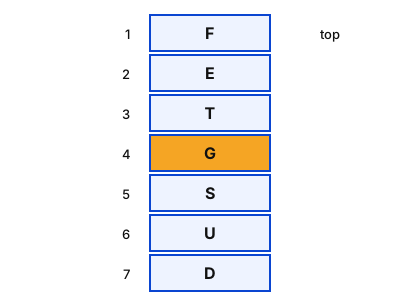
- Only F is above E → F = 1, E = 2. Four boxes between E and D → D = 7.
- Positions 3–6 remain for G, S, T, U. T and U have two boxes between them → T, U take 3 and 6; G, S take 4 and 5 (G immediately above S).
- U is not immediately above G, so U ≠ 3 → U = 6, T = 3.
- Order: F, E, T, G, S, U, D → fourth from top = G.
Trick: A "gap of 2" pair inside a block of 4 must sit at the two ends of that block.
Answer: (B) G
अवधारणा: स्थान 1 (ऊपर) से 7 (नीचे) तक मानें और पहले निश्चित बॉक्स रखें।
- केवल F, E के ऊपर → F = 1, E = 2. E और D के बीच चार बॉक्स → D = 7.
- स्थान 3–6 बचे: G, S, T, U. T और U के बीच दो बॉक्स → T, U स्थान 3 और 6; G, S स्थान 4 और 5.
- U, G के ठीक ऊपर नहीं → U ≠ 3 → U = 6, T = 3.
- क्रम: F, E, T, G, S, U, D → ऊपर से चौथा = G.
ट्रिक: 4 के खंड में "बीच में 2" वाली जोड़ी उस खंड के दोनों सिरों पर ही बैठेगी।
उत्तर: (B) G
RRB NTPC Graduate CBT 1General Intelligence and ReasoningBox ArrangementRRB NTPC Graduate CBT 1 2024 · 20 Jun Shift 2
Q1092.Vinod ranked 36th from the top and 18th from the bottom in his class. How many students are there in his class?
विनोद अपनी कक्षा में ऊपर से 36वें और नीचे से 18वें स्थान पर है। उसकी कक्षा में कितने विद्यार्थी हैं?
- A54
- B53
- C51
- D52
Show answer
Concept: Total rank from top rank from bottom .
- Total .
- students.
Trick: Subtract 1 because Vinod is counted in both ranks.
Answer: (B) 53
अवधारणा: कुल ऊपर से रैंक नीचे से रैंक .
- कुल .
- विद्यार्थी।
ट्रिक: 1 घटाते हैं क्योंकि विनोद दोनों रैंकों में गिना गया है।
उत्तर: (B) 53
RRB NTPC Graduate CBT 1General Intelligence and ReasoningRankingRRB NTPC Graduate CBT 1 2024 · 20 Jun Shift 2
Q1093.Seven people, D, E, F, G, L, M and N, are sitting in a row, facing north. Only M sits to the left of N. Only four people sit between M and L. Only F sits between G and D, and G is not an immediate neighbour of L. Who sits at the extreme right of the line?
सात व्यक्ति, D, E, F, G, L, M और N, उत्तर की ओर मुख करके एक पंक्ति में बैठे हैं। N के बाईं ओर केवल M बैठा है। M और L के बीच केवल चार व्यक्ति बैठे हैं। G और D के बीच केवल F बैठा है, और G, L का निकटतम पड़ोसी नहीं है। पंक्ति के अंतिम दाएँ छोर पर कौन बैठा है?
- AN
- BD
- CE
- DG
Show answer
Concept: Place the people whose positions are fixed first (all face north, so left = left of the line).
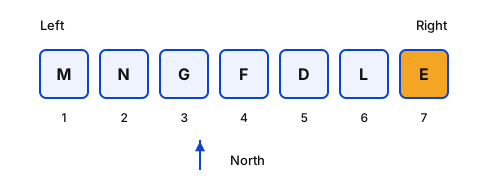
- Only M sits to the left of N → M = 1, N = 2.
- Four people between M and L → L = 6.
- D, E, F, G go to 3, 4, 5, 7. F is between G and D (G _F_ D), and G is not next to L, so G ≠ 5, 7 → G = 3, F = 4, D = 5.
- E = 7, the extreme right.
Trick: When a block of three (G F D) must fit, check which free slots are consecutive.
Answer: (C) E
अवधारणा: पहले निश्चित स्थान वाले व्यक्तियों को बैठाएँ (सभी उत्तर की ओर मुख, अतः बायाँ = पंक्ति का बायाँ)।
- केवल M, N के बाएँ → M = 1, N = 2.
- M और L के बीच चार लोग → L = 6.
- D, E, F, G के लिए 3, 4, 5, 7. F, G और D के बीच है, G, L का पड़ोसी नहीं → G = 3, F = 4, D = 5.
- E = 7, सबसे दाएँ।
ट्रिक: तीन का खंड (G F D) बैठाना हो तो देखें कौन-से खाली स्थान लगातार हैं।
उत्तर: (C) E
RRB NTPC Graduate CBT 1General Intelligence and ReasoningLinear SeatingRRB NTPC Graduate CBT 1 2024 · 20 Jun Shift 2
Q1094.Select the letter-cluster from among the given options that can replace the question mark (?) in the following series.
ENU FLS GJQ ? IFM
दिए गए विकल्पों में से उस अक्षर-समूह का चयन कीजिए जो निम्नलिखित श्रृंखला में प्रश्नचिह्न (?) को प्रतिस्थापित कर सकता है।
ENU FLS GJQ ? IFM
- AHHO
- BHOP
- CHIO
- DHIP
Show answer
Concept: Track each letter position of the clusters separately.
- First letters: E, F, G, ?, I → +1 each → H.
- Second letters: N, L, J, ?, F → −2 each → H.
- Third letters: U, S, Q, ?, M → −2 each → O.
- Missing cluster = HHO.
Trick: Split the clusters into columns and the pattern is visible at once.
Answer: (A) HHO
अवधारणा: प्रत्येक स्थान के अक्षर को अलग से देखें।
- पहले अक्षर: E, F, G, ?, I → +1 → H.
- दूसरे अक्षर: N, L, J, ?, F → −2 → H.
- तीसरे अक्षर: U, S, Q, ?, M → −2 → O.
- लुप्त समूह = HHO.
ट्रिक: समूहों को स्तंभों में बाँटें, पैटर्न तुरंत दिखेगा।
उत्तर: (A) HHO
RRB NTPC Graduate CBT 1General Intelligence and ReasoningLetter SeriesRRB NTPC Graduate CBT 1 2024 · 20 Jun Shift 2
Q1095.Based on the English alphabetical order, three of the following four letter-clusters are alike in a certain way and thus form a group. Which letter-cluster DOES NOT belong to that group?
(Note: The odd one out is not based on the number of consonants/vowels or their position in the letter-cluster.)
अंग्रेज़ी वर्णमाला क्रम के आधार पर, निम्नलिखित चार अक्षर-समूहों में से तीन किसी निश्चित प्रकार से समान हैं और इस प्रकार एक समूह बनाते हैं। कौन-सा अक्षर-समूह उस समूह से संबंधित नहीं है?
(ध्यान दें: असंगत का निर्धारण व्यंजनों/स्वरों की संख्या या अक्षर-समूह में उनकी स्थिति के आधार पर नहीं है।)
- AWQNJ
- BKEBW
- CQKHC
- DFZWR
Show answer
Concept: Use alphabet positions (A = 1 … Z = 26) and find the gaps between consecutive letters (wrap Z → A).
- KEBW: K(11) −6 → E(5) −3 → B(2) −5 → W (wrap).
- QKHC: Q(17) −6 → K(11) −3 → H(8) −5 → C(3). FZWR: F(6) −6 → Z (wrap) −3 → W(23) −5 → R(18).
- WQNJ: W(23) −6 → Q(17) −3 → N(14) −4 → J(10) – last gap is −4, not −5.
Trick: Learn EJOTY (5, 10, 15, 20, 25) to get letter positions fast.
Answer: (A) WQNJ
अवधारणा: अक्षरों के स्थान (A = 1 … Z = 26) लें और क्रमागत अक्षरों का अंतर देखें (Z → A घुमाव सहित)।
- KEBW: K(11) −6 → E(5) −3 → B(2) −5 → W.
- QKHC: Q(17) −6 → K(11) −3 → H(8) −5 → C(3). FZWR: F(6) −6 → Z −3 → W(23) −5 → R(18).
- WQNJ: W(23) −6 → Q(17) −3 → N(14) −4 → J(10) – अंतिम अंतर −4, −5 नहीं।
ट्रिक: EJOTY (5, 10, 15, 20, 25) याद रखें, स्थान जल्दी मिलेंगे।
उत्तर: (A) WQNJ
RRB NTPC Graduate CBT 1General Intelligence and ReasoningOdd One Out – LettersRRB NTPC Graduate CBT 1 2024 · 20 Jun Shift 2
Q1096.Seven friends, I, J, K, L, M, N and R, are sitting in a row facing north. No one sits to the right of M. Only three people sit between M and R. Only two people sit between R and L. K sits third to the left of I. J sits to the immediate right of I. How many people sit between N and L?
सात मित्र, I, J, K, L, M, N और R, उत्तर की ओर मुख करके एक पंक्ति में बैठे हैं। M के दाईं ओर कोई नहीं बैठा है। M और R के बीच केवल तीन व्यक्ति बैठे हैं। R और L के बीच केवल दो व्यक्ति बैठे हैं। K, I के बाईं ओर तीसरे स्थान पर बैठा है। J, I के ठीक दाईं ओर बैठा है। N और L के बीच कितने व्यक्ति बैठे हैं?
- ATwoदो
- BOneएक
- CFourचार
- DThreeतीन
Show answer
Concept: All face north; fix M first, then R, L and finally the I–J–K block.
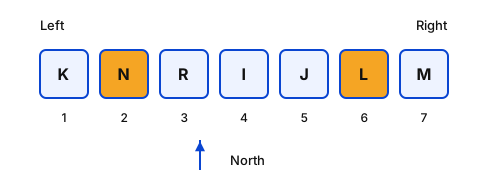
- No one to the right of M → M = 7. Three between M and R → R = 3. Two between R and L → L = 6.
- Free seats: 1, 2, 4, 5. J is immediately right of I, so I–J = 1–2 or 4–5; K is third to the left of I, so I = 4, J = 5, K = 1.
- N = 2. Row: K, N, R, I, J, L, M.
- Between N (2) and L (6): R, I, J → three people.
Trick: People between seats and .
Answer: (D) Three
अवधारणा: सभी उत्तर की ओर मुख; पहले M, फिर R, L और अंत में I–J–K खंड रखें।
- M के दाएँ कोई नहीं → M = 7. M और R के बीच तीन → R = 3. R और L के बीच दो → L = 6.
- खाली स्थान: 1, 2, 4, 5. J, I के ठीक दाएँ; K, I के बाएँ तीसरा → I = 4, J = 5, K = 1.
- N = 2. पंक्ति: K, N, R, I, J, L, M.
- N (2) और L (6) के बीच: R, I, J → तीन लोग।
ट्रिक: स्थान और के बीच व्यक्ति .
उत्तर: (D) तीन
RRB NTPC Graduate CBT 1General Intelligence and ReasoningLinear SeatingRRB NTPC Graduate CBT 1 2024 · 20 Jun Shift 2
Q1097.A group of numbers and symbols is coded using letter codes as per the codes given below and the conditions that follow. Study the given codes and conditions and answer the question that follows.
Note: If none of the conditions apply, then codes for the respective number/symbol are to be followed directly as given in the table.
| Number/symbol | 5 | $ | 7 | 2 | % | * | 3 | ^ | # | 9 | + |
|---|
| Code | A | F | L | B | G | M | C | H | N | D | J |
|---|
Conditions:
i) If the first element is a number and the last a symbol, then the codes for these two (the first and the last elements) are to be interchanged.
ii) If the first and the last elements are odd numbers, then the first and last elements are to be coded as @.
iii) If both the second and third elements are perfect square roots, then the third element is to be coded as the code for the second element.
What will be the code for 5#64%?
संख्याओं और प्रतीकों के एक समूह को नीचे दिए गए कूटों और उसके बाद दी गई शर्तों के अनुसार अक्षर कूटों का उपयोग करके कूटबद्ध किया जाता है। दिए गए कूटों और शर्तों का अध्ययन कीजिए और उसके बाद दिए गए प्रश्न का उत्तर दीजिए।
ध्यान दें: यदि कोई भी शर्त लागू नहीं होती है, तो संबंधित संख्या/प्रतीक के लिए तालिका में दिए गए कूटों का सीधे अनुसरण किया जाना है।
| संख्या/प्रतीक | 5 | $ | 7 | 2 | % | * | 3 | ^ | # | 9 | + |
|---|
| कूट | A | F | L | B | G | M | C | H | N | D | J |
|---|
शर्तें:
i) यदि पहला तत्व एक संख्या है और अंतिम तत्व एक प्रतीक है, तो इन दोनों (पहले और अंतिम तत्वों) के कूट आपस में बदल दिए जाने हैं।
ii) यदि पहला और अंतिम तत्व विषम संख्याएँ हैं, तो पहले और अंतिम तत्वों को @ के रूप में कूटबद्ध किया जाना है।
iii) यदि दूसरा और तीसरा, दोनों तत्व पूर्ण वर्गमूल हैं, तो तीसरे तत्व को दूसरे तत्व के कूट के रूप में कूटबद्ध किया जाना है।
5#64% के लिए कूट क्या होगा?
- AANPKG
- BAKPNG
- CGNPKA
- DGKPNA
Show answer
Concept: Write the direct codes, then check each condition in order on the first, second, third and last elements.
- 5#64%: direct codes 5 → A, # → N, 6 → P, 4 → K, % → G, i.e. A N P K G.
- Condition (i): first element 5 is a number, last element % is a symbol → interchange their codes → G N P K A.
- Condition (ii) fails (last is not an odd number); condition (iii) fails (# is not a number).
- Code = GNPKA.
Trick: Test the conditions on the given string before writing codes – only the matching one changes the result.
Answer: (C) GNPKA
अवधारणा: पहले सीधे कोड लिखें, फिर क्रम से प्रत्येक शर्त पहले, दूसरे, तीसरे और अंतिम तत्व पर जाँचें।
- 5#64%: सीधे कोड 5 → A, # → N, 6 → P, 4 → K, % → G, अर्थात A N P K G.
- शर्त (i): पहला तत्व 5 संख्या, अंतिम % प्रतीक → इनके कोड आपस में बदलें → G N P K A.
- शर्त (ii) लागू नहीं (अंतिम विषम संख्या नहीं); शर्त (iii) लागू नहीं (# संख्या नहीं)।
- कोड = GNPKA.
ट्रिक: कोड लिखने से पहले दिए गए समूह पर शर्तें जाँचें – केवल लागू होने वाली शर्त परिणाम बदलती है।
उत्तर: (C) GNPKA
RRB NTPC Graduate CBT 1General Intelligence and ReasoningCoding with ConditionsRRB NTPC Graduate CBT 1 2024 · 20 Jun Shift 2
Q1098.If 1 is added to each odd digit and 1 is subtracted from each even digit in the number 1865374, which of the following digits will be third from the left in the new number thus formed?
यदि संख्या 1865374 में प्रत्येक विषम अंक में 1 जोड़ा जाए और प्रत्येक सम अंक में से 1 घटाया जाए, तो इस प्रकार बनी नई संख्या में निम्नलिखित में से कौन-सा अंक बाएँ से तीसरा होगा?
- A7
- B3
- C5
- D2
Show answer
Concept: Apply the rule to each digit and read the required position.
- 1865374: 1 (odd) , 8 (even) , 6 , 5 , 3 , 7 , 4 .
- New number: 2756483.
- Third digit from the left .
Trick: Only the third digit matters: 6 is even → .
Answer: (C) 5
अवधारणा: प्रत्येक अंक पर नियम लगाएँ और माँगा गया स्थान पढ़ें।
- 1865374: 1 (विषम) , 8 (सम) , 6 , 5 , 3 , 7 , 4 .
- नई संख्या: 2756483.
- बाएँ से तीसरा अंक .
ट्रिक: केवल तीसरा अंक चाहिए: 6 सम है → .
उत्तर: (C) 5
RRB NTPC Graduate CBT 1General Intelligence and ReasoningDigit OperationsRRB NTPC Graduate CBT 1 2024 · 20 Jun Shift 2
Q1099.Which of the given letter-clusters should replace # and % so that the pattern and relationship followed between the letter-cluster pair on the left side of :: is the same as that on the right side of ::?
# : DZT :: QMG : %
दिए गए अक्षर-समूहों में से कौन-से # और % को प्रतिस्थापित करेंगे, ताकि :: के बाईं ओर के अक्षर-समूह युग्म के बीच का पैटर्न और संबंध, :: के दाईं ओर के अक्षर-समूह युग्म के समान हो?
# : DZT :: QMG : %
- A# = OYV, % = PYT
- B# = YUO, % = VRL
- C# = YPG, % = KUL
- D# = ZTY, % = VMH
Show answer
Concept: Find the rule from the complete pair (or the internal pattern) and test options.
- Inside DZT: D −4 → Z, Z −6 → T; inside QMG: Q −4 → M, M −6 → G. Both clusters use the gaps −4, −6.
- Option B: YUO → Y −4 → U, U −6 → O ✓ and VRL → V −4 → R, R −6 → L ✓.
- Also the pairs match: YUO +5 each → DZT, and QMG +5 each → VRL.
Trick: Pair rule "+5 to each letter" works both sides: Y→D, U→Z, O→T and Q→V, M→R, G→L.
Answer: (B) # = YUO, % = VRL
अवधारणा: पूरी जोड़ी (या आंतरिक पैटर्न) से नियम निकालें और विकल्प जाँचें।
- DZT में: D −4 → Z, Z −6 → T; QMG में: Q −4 → M, M −6 → G.
- विकल्प B: YUO → Y −4 → U, U −6 → O ✓ और VRL → V −4 → R, R −6 → L ✓.
- जोड़ी नियम भी मिलता है: YUO में +5 → DZT, और QMG में +5 → VRL.
ट्रिक: प्रत्येक अक्षर में +5: Y→D, U→Z, O→T तथा Q→V, M→R, G→L.
उत्तर: (B) # = YUO, % = VRL
RRB NTPC Graduate CBT 1General Intelligence and ReasoningLetter AnalogyRRB NTPC Graduate CBT 1 2024 · 20 Jun Shift 2
Q1100.If 1 is added to each odd digit and 2 is subtracted from each even digit in the number 1862547, then what will the difference between the highest and lowest digits in the new number thus formed be?
यदि संख्या 1862547 में प्रत्येक विषम अंक में 1 जोड़ा जाए और प्रत्येक सम अंक में से 2 घटाया जाए, तो इस प्रकार बनी नई संख्या में सबसे बड़े और सबसे छोटे अंकों के बीच का अंतर क्या होगा?
- A7
- B8
- C9
- D6
Show answer
Concept: Apply the rule to each digit, then find the highest and lowest digits.
- 1862547: 1 , 8 , 6 , 2 , 5 , 4 , 7 .
- New number: 2640628.
- Highest , lowest ; difference .
Trick: Watch for 2 → 0: a zero often becomes the lowest digit.
Answer: (B) 8
अवधारणा: प्रत्येक अंक पर नियम लगाएँ, फिर सबसे बड़ा और सबसे छोटा अंक निकालें।
- 1862547: 1 , 8 , 6 , 2 , 5 , 4 , 7 .
- नई संख्या: 2640628.
- सबसे बड़ा , सबसे छोटा ; अंतर .
ट्रिक: 2 → 0 पर ध्यान दें: शून्य अक्सर सबसे छोटा अंक बनता है।
उत्तर: (B) 8
RRB NTPC Graduate CBT 1General Intelligence and ReasoningDigit OperationsRRB NTPC Graduate CBT 1 2024 · 20 Jun Shift 2

