Q1281.Which of the following letter-number clusters will replace the question mark (?) in the given series to make it logically complete?
SPM 8, TQN 14, URO 20, VSP 26, ?
दी गई श्रृंखला को तार्किक रूप से पूर्ण करने के लिए निम्नलिखित में से कौन-सा अक्षर-संख्या समूह प्रश्न चिह्न (?) का स्थान लेगा?
SPM 8, TQN 14, URO 20, VSP 26, ?
- AWQM 30
- BXPM 30
- CWTQ 32
- DXRN 32
Show answer
Concept: Each letter position and the number follow their own step.
- 1st letters: S, T, U, V → W (+1).
- 2nd: P, Q, R, S → T; 3rd: M, N, O, P → Q.
- Numbers: 8, 14, 20, 26 (+6) → 32.
Trick: Every letter +1, number +6 → WTQ 32.
Answer: (C) WTQ 32
अवधारणा: हर अक्षर स्थान और संख्या का अपना नियम है।
- पहले अक्षर: S, T, U, V → W (+1)।
- दूसरे: P, Q, R, S → T; तीसरे: M, N, O, P → Q।
- संख्याएँ: 8, 14, 20, 26 (+6) → 32।
ट्रिक: हर अक्षर +1, संख्या +6 → WTQ 32।
उत्तर: (C) WTQ 32
RRB NTPC Graduate CBT 1General Intelligence and ReasoningLetter-Number SeriesRRB NTPC Graduate CBT 1 2024 · 19 Jun Shift 3
Q1282.Which two numbers should be interchanged to make the following equation correct? (Note: The entire number should be interchanged and not individual digits of a given number.)
24 × 3 + (32 ÷ 4) − 10 × 8 + 26 = 196
निम्नलिखित समीकरण को सही बनाने के लिए किन दो संख्याओं को आपस में बदला जाना चाहिए? (नोट: पूरी संख्या को बदला जाना चाहिए, न कि दी गई संख्या के अलग-अलग अंकों को।)
24 × 3 + (32 ÷ 4) − 10 × 8 + 26 = 196
- A4 and 84 और 8
- B26 and 2426 और 24
- C3 and 83 और 8
- D24 and 3224 और 32
Show answer
Concept: Try each option by swapping the two numbers and applying BODMAS.
- Swap 3 and 8: .
- ✓ (LHS = RHS).
Trick: RHS 196 is large → the big product is a good first guess.
Answer: (C) 3 and 8
अवधारणा: हर विकल्प में दोनों संख्याएँ बदलकर BODMAS लगाएँ।
- 3 और 8 बदलें: ।
- ✓ (बायाँ पक्ष = दायाँ पक्ष)।
ट्रिक: दायाँ पक्ष 196 बड़ा है → वाला गुणनफल पहला अनुमान।
उत्तर: (C) 3 और 8
RRB NTPC Graduate CBT 1General Intelligence and ReasoningMathematical Operations – InterchangeRRB NTPC Graduate CBT 1 2024 · 19 Jun Shift 3
Q1283.Refer to the following number and symbol series and answer the question that follows. Counting to be done from left to right only.
(NOTE: All numbers are single digit numbers only.)
(Left) 4 $ 4 2 2 7 4 1 8 € 6 9 3 £ 3 £ 9 @ % 9 # £ (Right)
How many such numbers are there each of which is immediately preceded by a number and also immediately followed by a symbol?
निम्नलिखित संख्या और प्रतीक श्रृंखला को देखिए और आगे दिए गए प्रश्न का उत्तर दीजिए। गिनती केवल बाएँ से दाएँ की जानी है।
(नोट: सभी संख्याएँ केवल एक अंक वाली संख्याएँ हैं।)
(बाएँ) 4 $ 4 2 2 7 4 1 8 € 6 9 3 £ 3 £ 9 @ % 9 # £ (दाएँ)
ऐसी कितनी संख्याएँ हैं जिनमें से प्रत्येक के ठीक पहले एक संख्या है और ठीक बाद एक प्रतीक भी है?
- A3
- B1
- C2
- D4
Show answer
Concept: Look for the pattern number–NUMBER–symbol and count the middle numbers.
- "1 8 €": 8 is preceded by 1 and followed by € ✓.
- "9 3 £": 3 is preceded by 9 and followed by £ ✓.
- Other numbers before a symbol (3 £, 9 @, 9 #) are preceded by symbols ✗. Count = 2.
Trick: Scan only numbers that stand just before a symbol, then check their left neighbour.
Answer: (C) 2
अवधारणा: संख्या–संख्या–प्रतीक का क्रम खोजें और बीच वाली संख्याएँ गिनें।
- "1 8 €": 8 से पहले 1 और बाद में € ✓।
- "9 3 £": 3 से पहले 9 और बाद में £ ✓।
- प्रतीक से पहले वाली अन्य संख्याएँ (3 £, 9 @, 9 #) प्रतीक के बाद आती हैं ✗। कुल = 2।
ट्रिक: केवल प्रतीक के ठीक पहले वाली संख्याएँ देखें, फिर उनका बायाँ पड़ोसी जाँचें।
उत्तर: (C) 2
RRB NTPC Graduate CBT 1General Intelligence and ReasoningNumber-Symbol SeriesRRB NTPC Graduate CBT 1 2024 · 19 Jun Shift 3
Q1284.Which of the following letter-clusters should replace # and % so that the pattern and relationship followed between the letter-cluster pair on the left side of :: is the same as that on the right side of ::?
# : OSR :: JNM : %
निम्नलिखित में से कौन-से अक्षर-समूह # और % को प्रतिस्थापित करेंगे ताकि :: के बाईं ओर के अक्षर-समूह युग्म के बीच अनुसरित पैटर्न और संबंध वही हो जो :: के दाईं ओर है?
# : OSR :: JNM : %
- A# = ROU, % = GKQ
- B# = IUU, % = GBQ
- C# = UQU, % = GOZ
- D# = RVU, % = GKJ
Show answer
Concept: Find the shift from the given pair and check it on each option.
- Option D: # = RVU → OSR: , , .
- Same rule: JNM → , , → GKJ ✓.
- Other options do not give one consistent shift on both sides.
Trick: Here each letter moves back 3 — test options rather than guessing # first.
Answer: (D) # = RVU, % = GKJ
अवधारणा: दिए युग्म से बदलाव निकालें और हर विकल्प पर जाँचें।
- विकल्प D: # = RVU → OSR: , , ।
- वही नियम: JNM → , , → GKJ ✓।
- अन्य विकल्पों में दोनों ओर एक जैसा बदलाव नहीं बनता।
ट्रिक: यहाँ हर अक्षर 3 पीछे जाता है — विकल्पों से जाँचना तेज़ है।
उत्तर: (D) # = RVU, % = GKJ
RRB NTPC Graduate CBT 1General Intelligence and ReasoningLetter Cluster AnalogyRRB NTPC Graduate CBT 1 2024 · 19 Jun Shift 3
Q1285.This question is based on the five, three-digit numbers given below.
(Left) 514 414 422 875 167 (Right)
(Example- 697 – First digit = 6, second digit = 9 and third digit = 7)
(NOTE: All operations to be done from left to right.)
What will be the resultant if the second digit of the highest number is subtracted from the second digit of the lowest number?
यह प्रश्न नीचे दी गई तीन अंकों वाली पाँच संख्याओं पर आधारित है।
(बाएँ) 514 414 422 875 167 (दाएँ)
(उदाहरण- 697 – पहला अंक = 6, दूसरा अंक = 9 और तीसरा अंक = 7)
(नोट: सभी संक्रियाएँ बाएँ से दाएँ की जानी हैं।)
यदि सबसे बड़ी संख्या के दूसरे अंक को सबसे छोटी संख्या के दूसरे अंक में से घटाया जाए, तो परिणाम क्या होगा?
- A−2
- B2
- C−1
- D0
Show answer
Concept: Identify the highest and lowest numbers, then their second digits.
- Highest = 875 → second digit 7.
- Lowest = 167 → second digit 6.
- Second digit of lowest − second digit of highest .
Trick: "A subtracted from B" means B − A — read the order carefully.
Answer: (C) −1
अवधारणा: सबसे बड़ी और सबसे छोटी संख्या पहचानें, फिर उनके दूसरे अंक।
- सबसे बड़ी = 875 → दूसरा अंक 7।
- सबसे छोटी = 167 → दूसरा अंक 6।
- सबसे छोटी का दूसरा अंक − सबसे बड़ी का दूसरा अंक ।
ट्रिक: "A को B में से घटाना" = B − A — क्रम ध्यान से पढ़ें।
उत्तर: (C) −1
RRB NTPC Graduate CBT 1General Intelligence and ReasoningNumber AnalysisRRB NTPC Graduate CBT 1 2024 · 19 Jun Shift 3
Q1286.A group of numbers and symbols is coded using letter codes as per the codes given below and the conditions that follow. Study the given codes and conditions and answer the question that follows.
Note: If none of the conditions apply, then codes for the respective number/symbol are to be followed directly as given in the table.
| Number/Symbol | 4 | @ | 7 | # | 3 | & | 8 | * | 2 | ^ | 9 |
|---|
| Code | H | A | J | B | K | C | L | D | M | E | N |
|---|
Conditions:
(i) If the first element is a number and the last a symbol, the codes for these two (the first and the last elements) are to be interchanged.
(ii) If the first element is an even number and the last an odd number, the first and last elements are to be coded as $.
(iii) If both the second and third elements are perfect cubes, then the code of the second element will be the code of the third element.
What will be the code for the following group?
348@
संख्याओं और प्रतीकों के एक समूह को नीचे दिए गए कूटों और उसके बाद दी गई शर्तों के अनुसार अक्षर कूटों का उपयोग करके कूटबद्ध किया जाता है। दिए गए कूटों और शर्तों का अध्ययन कीजिए और आगे दिए गए प्रश्न का उत्तर दीजिए।
नोट: यदि कोई भी शर्त लागू नहीं होती है, तो संबंधित संख्या/प्रतीक के लिए तालिका में दिए गए कूटों का सीधे अनुसरण किया जाना है।
| संख्या/प्रतीक | 4 | @ | 7 | # | 3 | & | 8 | * | 2 | ^ | 9 |
|---|
| कूट | H | A | J | B | K | C | L | D | M | E | N |
|---|
शर्तें:
(i) यदि पहला तत्व एक संख्या है और अंतिम तत्व एक प्रतीक है, तो इन दोनों (पहले और अंतिम तत्वों) के कूट आपस में बदल दिए जाने हैं।
(ii) यदि पहला तत्व एक सम संख्या है और अंतिम तत्व एक विषम संख्या है, तो पहले और अंतिम तत्वों को $ के रूप में कूटबद्ध किया जाना है।
(iii) यदि दूसरा और तीसरा दोनों तत्व पूर्ण घन हैं, तो दूसरे तत्व का कूट तीसरे तत्व का कूट होगा।
निम्नलिखित समूह के लिए कूट क्या होगा?
348@
- AKHLA
- BKLHA
- CALHK
- DAHLK
Show answer
Concept: Write the direct codes, then test each condition on the group 348@.
- Direct codes: 3 = K, 4 = H, 8 = L, @ = A → K H L A.
- First element 3 is a number and last element @ is a symbol → condition (i) applies: interchange the first and last codes.
- Condition (ii) fails (last is not an odd number); (iii) fails (4 is not a perfect cube). Result: A H L K.
Trick: Check the first/last element type first – it decides (i) or (ii) at once.
Answer: (D) AHLK
अवधारणा: पहले सीधे कूट लिखें, फिर समूह 348@ पर हर शर्त जाँचें।
- सीधे कूट: 3 = K, 4 = H, 8 = L, @ = A → K H L A।
- पहला 3 संख्या है और अंतिम @ प्रतीक है → शर्त (i): पहले और अंतिम कूट आपस में बदलें।
- शर्त (ii) लागू नहीं (अंतिम विषम संख्या नहीं); (iii) भी नहीं (4 पूर्ण घन नहीं)। परिणाम: A H L K।
ट्रिक: सबसे पहले पहला/अंतिम तत्व संख्या है या प्रतीक — यही (i) या (ii) तय कर देता है।
उत्तर: (D) AHLK
RRB NTPC Graduate CBT 1General Intelligence and ReasoningCoding with conditionsRRB NTPC Graduate CBT 1 2024 · 19 Jun Shift 3
Q1287.Each of the digits in the number 7234169 is arranged in ascending order from left to right. The position(s) of how many digits will remain unchanged as compared to that in the original number?
संख्या 7234169 के प्रत्येक अंक को बाएँ से दाएँ आरोही क्रम में व्यवस्थित किया जाता है। मूल संख्या की तुलना में कितने अंकों का/के स्थान अपरिवर्तित रहेगा/रहेंगे?
- A2
- B1
- C4
- D3
Show answer
Concept: Arrange the digits in ascending order and compare place by place.
- Original: 7 2 3 4 1 6 9
- Ascending: 1 2 3 4 6 7 9
- Same place: 2 (2nd), 3 (3rd), 4 (4th) and 9 (7th) → 4 digits.
Trick: Write both numbers one under the other and tick matching columns.
Answer: (C) 4
अवधारणा: अंकों को आरोही क्रम में लगाकर स्थान-दर-स्थान तुलना करें।
- मूल: 7 2 3 4 1 6 9
- आरोही: 1 2 3 4 6 7 9
- अपरिवर्तित: 2, 3, 4 और 9 → 4 अंक।
ट्रिक: दोनों संख्याएँ एक-दूसरे के नीचे लिखकर मेल खाते स्तंभ गिनें।
उत्तर: (C) 4
RRB NTPC Graduate CBT 1General Intelligence and ReasoningDigit arrangementRRB NTPC Graduate CBT 1 2024 · 19 Jun Shift 3
Q1288.This question is based on the five, three-digit numbers given below.
(Left) 307 485 194 237 937 (Right)
(Example: 697 – First digit = 6, second digit = 9 and third digit = 7)
(Note: All operations to be done from left to right.)
What will be the resultant if the third digit of the highest number is subtracted from the first digit of the lowest number?
यह प्रश्न नीचे दी गई तीन अंकों वाली पाँच संख्याओं पर आधारित है।
(बाएँ) 307 485 194 237 937 (दाएँ)
(उदाहरण: 697 – पहला अंक = 6, दूसरा अंक = 9 और तीसरा अंक = 7)
(नोट: सभी संक्रियाएँ बाएँ से दाएँ की जानी हैं।)
यदि सबसे बड़ी संख्या के तीसरे अंक को सबसे छोटी संख्या के पहले अंक में से घटाया जाए, तो परिणाम क्या होगा?
- A−7
- B−3
- C−6
- D−5
Show answer
Concept: Identify the highest and lowest numbers, pick the asked digits, then subtract in the stated order.
- Numbers: 307, 485, 194, 237, 937. Highest , lowest .
- Third digit of highest ; first digit of lowest .
- Third digit subtracted from first digit: .
Trick: "A subtracted from B" means – read the order carefully.
Answer: (C) −6
अवधारणा: सबसे बड़ी और सबसे छोटी संख्या पहचानें, अंक चुनें और क्रम से घटाएँ।
- सबसे बड़ी , सबसे छोटी ।
- सबसे बड़ी का तीसरा अंक ; सबसे छोटी का पहला अंक ।
- ।
ट्रिक: "A को B में से घटाना" का अर्थ है — क्रम ध्यान से पढ़ें।
उत्तर: (C) −6
RRB NTPC Graduate CBT 1General Intelligence and ReasoningNumber operationsRRB NTPC Graduate CBT 1 2024 · 19 Jun Shift 3
Q1289.Z is the wife of S. M and C are daughters of S. T is the daughter of C. How is M related to T?
Z, S की पत्नी है। M और C, S की पुत्रियाँ हैं। T, C की पुत्री है। M, T से किस प्रकार संबंधित है?
- AMother's sisterमाँ की बहन
- BMother's motherमाँ की माँ
- CBother's wifeभाई की पत्नी
- DMotherमाँ
Show answer
Concept: Draw the family tree from the statements.
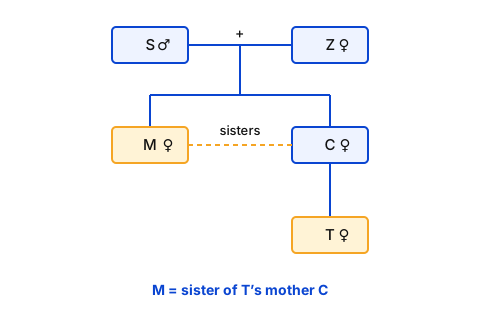
- Z is the wife of S, so S and Z are a couple.
- M and C are daughters of S → M and C are sisters.
- T is the daughter of C → C is T’s mother, so M is T’s mother’s sister (maternal aunt).
Trick: Sister of the mother = mausi = "Mother’s sister".
Answer: (A) Mother's sister
अवधारणा: कथनों से परिवार वृक्ष बनाएँ।
- Z, S की पत्नी है → S और Z दंपति।
- M और C, S की बेटियाँ → M और C बहनें।
- T, C की बेटी है → C, T की माँ; अतः M, T की माँ की बहन (मौसी) है।
ट्रिक: माँ की बहन = मौसी।
उत्तर: (A) माँ की बहन (Mother's sister)
RRB NTPC Graduate CBT 1General Intelligence and ReasoningBlood relationRRB NTPC Graduate CBT 1 2024 · 19 Jun Shift 3
Q1290.NKGO is related to LIEM in a certain way based on the English alphabetical order. In the same way, QNJR is related to OLHP. To which of the given options is TQMU related, following the same logic?
अंग्रेज़ी वर्णमाला क्रम के आधार पर NKGO एक निश्चित प्रकार से LIEM से संबंधित है। उसी प्रकार, QNJR, OLHP से संबंधित है। समान तर्क का अनुसरण करते हुए, TQMU दिए गए विकल्पों में से किससे संबंधित है?
- AORSK
- BROSK
- CROKS
- DORKS
Show answer
Concept: Find the shift applied to each letter of the first pair.
- N→L, K→I, G→E, O→M: each letter moves −2.
- Check: Q→O, N→L, J→H, R→P ✔ (−2 each).
- T→R, Q→O, M→K, U→S → ROKS.
Trick: Same shift on every position → just subtract 2 from each letter.
Answer: (C) ROKS
अवधारणा: पहले जोड़े में हर अक्षर पर लगा अंतर ज्ञात करें।
- N→L, K→I, G→E, O→M: हर अक्षर −2।
- जाँच: QNJR → OLHP ✔।
- TQMU → R O K S।
ट्रिक: हर स्थान पर समान अंतर → हर अक्षर से 2 घटाएँ।
उत्तर: (C) ROKS
RRB NTPC Graduate CBT 1General Intelligence and ReasoningLetter analogyRRB NTPC Graduate CBT 1 2024 · 19 Jun Shift 3
Q1291.Mr. Z starts from Point Y and drives 12 km towards the north. He then takes a left turn, drives 2 km, turns right and drives 1 km. He then takes a left turn and drives 14 km. He takes a final left turn, drives 13 km and stops at Point X. How far (shortest distance) and towards which direction should he drive in order to reach Point Y again? (All turns are 90-degree turns only unless specified.)
श्री Z बिंदु Y से चलना शुरू करते हैं और उत्तर की ओर 12 km गाड़ी चलाते हैं। फिर वे बाएँ मुड़ते हैं, 2 km गाड़ी चलाते हैं, दाएँ मुड़ते हैं और 1 km गाड़ी चलाते हैं। फिर वे बाएँ मुड़ते हैं और 14 km गाड़ी चलाते हैं। वे अंतिम बार बाएँ मुड़ते हैं, 13 km गाड़ी चलाते हैं और बिंदु X पर रुक जाते हैं। पुनः बिंदु Y तक पहुँचने के लिए उन्हें कितनी दूरी (न्यूनतम दूरी) और किस दिशा में गाड़ी चलानी चाहिए? (जब तक निर्दिष्ट न हो, सभी मोड़ केवल 90 डिग्री के हैं।)
- A14 km towards the westपश्चिम की ओर 14 km
- B13 km towards the northउत्तर की ओर 13 km
- C11 km towards the southदक्षिण की ओर 11 km
- D16 km towards the eastपूर्व की ओर 16 km
Show answer
Concept: Track the coordinates of each leg starting from Y at (0, 0).
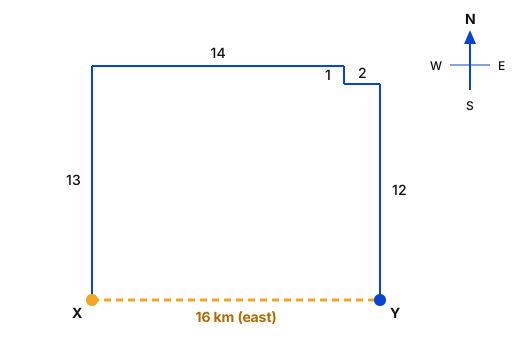
- 12 km north → (0, 12); left = west 2 km → (−2, 12).
- Right = north 1 km → (−2, 13); left = west 14 km → (−16, 13).
- Left = south 13 km → X (−16, 0): X is on the same line as Y, 16 km to its west.
- So he must drive 16 km towards the east.
Trick: North total cancels south ; only the west moves remain.
Answer: (D) 16 km towards the east
अवधारणा: Y को (0, 0) मानकर हर चरण के निर्देशांक लिखें।
- उत्तर 12 km → (0, 12); बाएँ = पश्चिम 2 km → (−2, 12)।
- दाएँ = उत्तर 1 km → (−2, 13); बाएँ = पश्चिम 14 km → (−16, 13)।
- बाएँ = दक्षिण 13 km → X (−16, 0): X, Y से ठीक 16 km पश्चिम में।
- अतः 16 km पूर्व की ओर जाना होगा।
ट्रिक: उत्तर और दक्षिण कट जाते हैं; केवल पश्चिम बचता है।
उत्तर: (D) 16 km पूर्व की ओर
RRB NTPC Graduate CBT 1General Intelligence and ReasoningDirection and distanceRRB NTPC Graduate CBT 1 2024 · 19 Jun Shift 3
Q1292.Each of P, Q, R, S, T, U and V has an exam on a different day of a week starting from Monday and ending on Sunday of the same week. V has the exam on Wednesday. Only one person has the exam after T. P has the exam immediately after R, but not on Tuesday. S has the exam immediately before U.
How many people have exams between P and Q?
P, Q, R, S, T, U और V में से प्रत्येक की परीक्षा एक ही सप्ताह के सोमवार से प्रारंभ होकर रविवार को समाप्त होने वाले सप्ताह के एक अलग दिन है। V की परीक्षा बुधवार को है। T के बाद केवल एक व्यक्ति की परीक्षा है। P की परीक्षा R के ठीक बाद है, परंतु मंगलवार को नहीं। S की परीक्षा U के ठीक पहले है।
P और Q के बीच कितने लोगों की परीक्षाएँ हैं?
- ATwoदो
- BThreeतीन
- COneएक
- DFourचार
Show answer
Concept: Fix the definite clues first, then place the pairs of consecutive days.
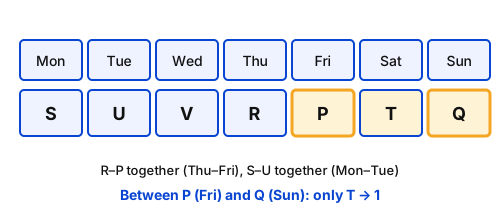
- V = Wednesday; only one exam after T → T = Saturday.
- Free days: Mon, Tue, Thu, Fri, Sun. R–P must be consecutive with P not on Tuesday → R = Thu, P = Fri.
- S–U consecutive → S = Mon, U = Tue; Q = Sun.
- Between P (Fri) and Q (Sun): only T → one person.
Trick: Place "block" clues (two consecutive days) in the only gaps big enough for them.
Answer: (C) One
अवधारणा: पहले निश्चित सूचनाएँ रखें, फिर लगातार दिनों वाले जोड़े।
- V = बुधवार; T के बाद केवल एक → T = शनिवार।
- खाली: सोम, मंगल, गुरु, शुक्र, रवि। R–P लगातार, P मंगल नहीं → R = गुरु, P = शुक्र।
- S–U लगातार → S = सोम, U = मंगल; Q = रवि।
- P (शुक्र) और Q (रवि) के बीच केवल T → एक।
ट्रिक: "जोड़ी" वाली सूचना को उसी खाली जगह रखें जहाँ दो लगातार दिन मिलें।
उत्तर: (C) एक
RRB NTPC Graduate CBT 1General Intelligence and ReasoningScheduling puzzleRRB NTPC Graduate CBT 1 2024 · 19 Jun Shift 3
Q1293.If 1 is added to each odd digit and 2 is subtracted from each even digit in the number 1845637, what will be the sum of the digits that are second from the left and second from the right?
यदि संख्या 1845637 में प्रत्येक विषम अंक में 1 जोड़ा जाए और प्रत्येक सम अंक में से 2 घटाया जाए, तो बाएँ से दूसरे और दाएँ से दूसरे अंकों का योग क्या होगा?
- A6
- B10
- C12
- D8
Show answer
Concept: Change each digit as instructed and then read the required positions.
- 1845637 → 1+1, 8−2, 4−2, 5+1, 6−2, 3+1, 7+1 = 2 6 2 6 4 4 8.
- Second from left = 6; second from right = 4.
- Sum .
Trick: Only the two required digits matter: 8 → 6 and 3 → 4.
Answer: (B) 10
अवधारणा: हर अंक बदलें और माँगे गए स्थान पढ़ें।
- 1845637 → 2 6 2 6 4 4 8।
- बाएँ से दूसरा = 6; दाएँ से दूसरा = 4।
- योग ।
ट्रिक: केवल दो अंक बदलें: 8 → 6, 3 → 4।
उत्तर: (B) 10
RRB NTPC Graduate CBT 1General Intelligence and ReasoningDigit operationsRRB NTPC Graduate CBT 1 2024 · 19 Jun Shift 3
Q1294.UQNV is related to SOLT in a certain way based on the English alphabetical order. In the same way, XTQY is related to VROW. To which of the given options is RNKS related, following the same logic?
अंग्रेज़ी वर्णमाला क्रम के आधार पर UQNV एक निश्चित प्रकार से SOLT से संबंधित है। उसी प्रकार, XTQY, VROW से संबंधित है। समान तर्क का अनुसरण करते हुए, RNKS दिए गए विकल्पों में से किससे संबंधित है?
- APLIQ
- BPLQI
- CLPIQ
- DLPQI
Show answer
Concept: Find the shift for each letter of the example pair.
- U→S, Q→O, N→L, V→T: each −2.
- Check: XTQY → VROW ✔.
- R→P, N→L, K→I, S→Q → PLIQ.
Trick: Uniform −2 shift: subtract 2 from every letter.
Answer: (A) PLIQ
अवधारणा: उदाहरण में हर अक्षर का अंतर ज्ञात करें।
- U→S, Q→O, N→L, V→T: हर अक्षर −2।
- जाँच: XTQY → VROW ✔।
- RNKS → P L I Q।
ट्रिक: हर अक्षर से 2 घटाएँ।
उत्तर: (A) PLIQ
RRB NTPC Graduate CBT 1General Intelligence and ReasoningLetter analogyRRB NTPC Graduate CBT 1 2024 · 19 Jun Shift 3
Q1295.What should come in place of the question mark (?) in the given series?
277, 254, 221, ?, 125, 62
दी गई श्रृंखला में प्रश्न चिह्न (?) के स्थान पर क्या आना चाहिए?
277, 254, 221, ?, 125, 62
- A188
- B158
- C178
- D168
Show answer
Concept: Check the differences between consecutive terms.
- , → differences increase by .
- Next difference : .
- Check: , ✔.
Trick: Differences – an arithmetic pattern.
Answer: (C) 178
अवधारणा: क्रमागत पदों का अंतर देखें।
- , → अंतर से बढ़ रहा है।
- अगला अंतर : ।
- जाँच: , ✔।
ट्रिक: अंतर ।
उत्तर: (C) 178
RRB NTPC Graduate CBT 1General Intelligence and ReasoningNumber seriesRRB NTPC Graduate CBT 1 2024 · 19 Jun Shift 3
Q1296.In a certain code language, ‘CURE’ is coded as ‘3527’ and ‘EATS’ is coded as ‘1246’. What is the code for ‘E’ in the given code language?
एक निश्चित कूट भाषा में, 'CURE' को '3527' के रूप में और 'EATS' को '1246' के रूप में कूटबद्ध किया जाता है। दी गई कूट भाषा में 'E' के लिए कूट क्या है?
- A1
- B2
- C6
- D7
Show answer
Concept: A letter common to both words must have the digit common to both codes.
- CURE → 3527; EATS → 1246.
- Common letter: E. Common digit: 2.
- So E = 2.
Trick: Common letter ↔ common digit.
Answer: (B) 2
अवधारणा: दोनों शब्दों में समान अक्षर का कूट दोनों कोडों में समान अंक होगा।
- CURE → 3527; EATS → 1246।
- समान अक्षर: E; समान अंक: 2।
- अतः E = 2।
ट्रिक: समान अक्षर ↔ समान अंक।
उत्तर: (B) 2
RRB NTPC Graduate CBT 1General Intelligence and ReasoningCoding–decodingRRB NTPC Graduate CBT 1 2024 · 19 Jun Shift 3
Q1297.A, B, C, D, E, F, and G are sitting around a circular table facing the centre.
D sits to the immediate right of B. Only three people sit between D and E when counted from the left of D. Only three people sit between B and C. F sits to the immediate right of A.
How many people sit between A and B when counted from the left of A?
A, B, C, D, E, F और G एक वृत्ताकार मेज़ के चारों ओर केंद्र की ओर मुख करके बैठे हैं।
D, B के ठीक दाएँ बैठा है। D के बाएँ से गिनने पर D और E के बीच केवल तीन व्यक्ति बैठे हैं। B और C के बीच केवल तीन व्यक्ति बैठे हैं। F, A के ठीक दाएँ बैठा है।
A के बाएँ से गिनने पर A और B के बीच कितने व्यक्ति बैठे हैं?
- AOneएक
- BTwoदो
- CThreeतीन
- DFourचार
Show answer
Concept: For people facing the centre, moving to the left means moving clockwise and to the right means anticlockwise.
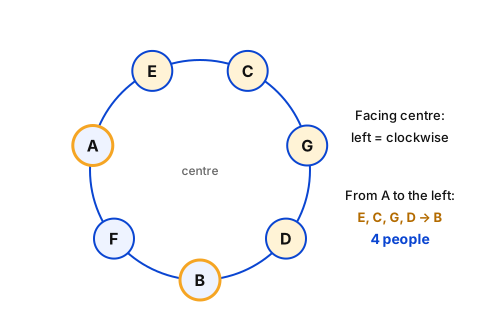
- Place B; D is to B’s immediate right.
- Going left from D, three people are skipped, so E is the 4th seat from D; C is placed with three people between B and C (the other side is taken by E).
- F is immediately right of A: the only free adjacent pair gives F next to B and A next to F; G takes the last seat.
- Order (clockwise): B, F, A, E, C, G, D. Left of A: E, C, G, D then B → four people.
Trick: Draw the circle first and fix one person; for "facing centre", left = clockwise.
Answer: (D) Four
अवधारणा: केंद्र की ओर मुख होने पर बायाँ = दक्षिणावर्त (clockwise), दायाँ = वामावर्त।
- B रखें; D, B के ठीक दाएँ।
- D के बाएँ से तीन व्यक्ति छोड़कर E; B और C के बीच तीन व्यक्ति (दूसरी ओर E है) → C तय।
- F, A के ठीक दाएँ: एकमात्र खाली जोड़ी → F, B के पास और A, F के पास; G अंतिम सीट।
- क्रम (दक्षिणावर्त): B, F, A, E, C, G, D। A के बाएँ से: E, C, G, D फिर B → चार।
ट्रिक: पहले वृत्त बनाकर एक व्यक्ति स्थिर करें; केंद्र की ओर मुख = बायाँ दक्षिणावर्त।
उत्तर: (D) चार
RRB NTPC Graduate CBT 1General Intelligence and ReasoningCircular seatingRRB NTPC Graduate CBT 1 2024 · 19 Jun Shift 3
Q1298.N, I, G, H, T and S live on six different floors of the same building. The lowermost floor in the building is numbered 1, the floor above it, number 2 and so on till the topmost floor is numbered 6. Only H lives below G. Only I lives above S. T lives immediately below S. Who lives on floor numbered 3?
N, I, G, H, T और S एक ही इमारत की छह अलग-अलग मंज़िलों पर रहते हैं। इमारत की सबसे निचली मंज़िल की संख्या 1 है, उसके ऊपर की मंज़िल की संख्या 2 है और इसी प्रकार सबसे ऊपरी मंज़िल की संख्या 6 है। G के नीचे केवल H रहता है। S के ऊपर केवल I रहता है। T, S के ठीक नीचे रहता है। मंज़िल संख्या 3 पर कौन रहता है?
- AT
- BN
- CH
- DS
Show answer
Concept: Use the "only" clues to fix the extreme floors.
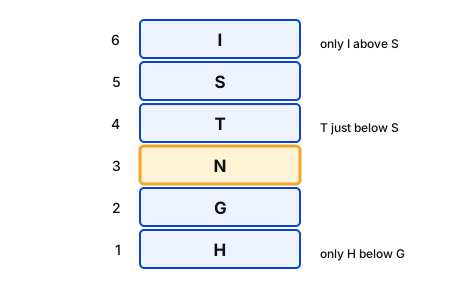
- Only H lives below G → H = 1, G = 2.
- Only I lives above S → I = 6, S = 5.
- T immediately below S → T = 4; remaining N = 3.
Trick: "Only X below Y" puts Y on floor 2 and X on floor 1.
Answer: (B) N
अवधारणा: "केवल" वाली सूचनाओं से किनारे की मंज़िलें तय करें।
- केवल H, G के नीचे → H = 1, G = 2।
- केवल I, S के ऊपर → I = 6, S = 5।
- T, S के ठीक नीचे → T = 4; शेष N = 3।
ट्रिक: "केवल X, Y के नीचे" → Y मंज़िल 2, X मंज़िल 1।
उत्तर: (B) N
RRB NTPC Graduate CBT 1General Intelligence and ReasoningFloor puzzleRRB NTPC Graduate CBT 1 2024 · 19 Jun Shift 3
Q1299.Based on the English alphabetical order, three of the following four letter-clusters are alike in a certain way and thus form a group. Which letter-cluster DOES NOT belong to that group?
(Note: The odd one out is not based on the number of consonants/vowels or their position in the letter-cluster.)
अंग्रेज़ी वर्णमाला क्रम के आधार पर, निम्नलिखित चार अक्षर-समूहों में से तीन किसी निश्चित प्रकार से समान हैं और इस प्रकार एक समूह बनाते हैं। कौन-सा अक्षर-समूह उस समूह से संबंधित नहीं है?
(नोट: असंगत अक्षर-समूह, उस अक्षर-समूह में व्यंजनों/स्वरों की संख्या या उनके स्थान पर आधारित नहीं है।)
- ABURM
- BQJGB
- CHAXS
- DTMJF
Show answer
Concept: Find the position differences between consecutive letters (counting backward, wrapping Z→A).
- QJGB: Q→J −7, J→G −3, G→B −5.
- HAXS: H→A −7, A→X −3 (wrap), X→S −5. BURM: B→U −7 (wrap), U→R −3, R→M −5.
- TMJF: T→M −7, M→J −3, J→F −4 ✘ → odd one.
Trick: Treat the alphabet as a circle; check every gap, the odd one breaks only one gap.
Answer: (D) TMJF
अवधारणा: क्रमागत अक्षरों का स्थानीय अंतर (पीछे की ओर, Z→A चक्रीय) देखें।
- QJGB: −7, −3, −5।
- HAXS: −7, −3, −5; BURM: −7, −3, −5।
- TMJF: −7, −3, −4 ✘ → भिन्न।
ट्रिक: वर्णमाला को चक्र मानें; विषम समूह में केवल एक अंतर बदलता है।
उत्तर: (D) TMJF
RRB NTPC Graduate CBT 1General Intelligence and ReasoningOdd one out – lettersRRB NTPC Graduate CBT 1 2024 · 19 Jun Shift 3
Q1300.Based on the English alphabetical order, three of the following four letter-cluster pairs are alike in a certain way and thus form a group. Which letter-cluster pair DOES NOT belong to that group?
(Note: The odd one out is not based on the number of consonants/vowels or their position in the letter-cluster.)
अंग्रेज़ी वर्णमाला क्रम के आधार पर, निम्नलिखित चार अक्षर-समूह युग्मों में से तीन किसी निश्चित प्रकार से समान हैं और इस प्रकार एक समूह बनाते हैं। कौन-सा अक्षर-समूह युग्म उस समूह से संबंधित नहीं है?
(नोट: असंगत अक्षर-समूह युग्म, अक्षर-समूह में व्यंजनों/स्वरों की संख्या या उनके स्थान पर आधारित नहीं है।)
- AUP – CW
- BJE – RL
- CBW – JD
- DDY – LE
Show answer
Concept: Compare letter positions across the pair (with wrap-around after Z).
- UP – CW: U→C +8, P→W +7. JE – RL: J→R +8, E→L +7.
- BW – JD: B→J +8, W→D +7 (wrap).
- DY – LE: D→L +8 but Y→E +6 ✘ → odd one.
Trick: Check first-letter and second-letter shifts separately; the odd pair breaks one of them.
Answer: (D) DY – LE
अवधारणा: युग्म में अक्षरों के स्थानों की तुलना करें (Z के बाद A से फिर गिनें)।
- UP – CW: +8, +7; JE – RL: +8, +7।
- BW – JD: +8, +7 (चक्रीय)।
- DY – LE: +8 पर Y→E +6 ✘ → भिन्न।
ट्रिक: पहले और दूसरे अक्षर का अंतर अलग-अलग जाँचें।
उत्तर: (D) DY – LE
RRB NTPC Graduate CBT 1General Intelligence and ReasoningOdd one out – letter pairsRRB NTPC Graduate CBT 1 2024 · 19 Jun Shift 3

