Q1301.X, Y and Z invest a sum in the ratio 6 : 59 : 41 respectively. If they earned total profit of ₹3,180 at the end of year, then what is the difference between the share of Y and Z?
X, Y और Z क्रमशः 6 : 59 : 41 के अनुपात में एक राशि का निवेश करते हैं। यदि वर्ष के अंत में उन्होंने ₹3,180 का कुल लाभ अर्जित किया, तो Y और Z के हिस्सों के बीच का अंतर कितना है?
- A₹634
- B₹484
- C₹432
- D₹540
Show answer
Concept: Profit is shared in the ratio of investments (same time).
- Total parts
- 1 part
Trick: Find the value of 1 part, then multiply by the difference of parts.
Answer: (D) ₹540
अवधारणा: समान समय पर लाभ निवेश के अनुपात में बँटता है।
- कुल भाग
- 1 भाग
ट्रिक: 1 भाग का मान निकालें, फिर भागों के अंतर से गुणा करें।
उत्तर: (D) ₹540
RRB NTPC Graduate CBT 1MathematicsPartnershipRRB NTPC Graduate CBT 1 2024 · 6 Jun Shift 1
Q1302.A and B can do a job in 25 days and 18 days, respectively. A works alone for 4 days and leaves. The number of days required by B to complete the remaining job is:
A और B किसी कार्य को क्रमशः 25 दिन और 18 दिन में कर सकते हैं। A अकेले 4 दिन कार्य करता है और छोड़ देता है। शेष कार्य को पूरा करने के लिए B को कितने दिनों की आवश्यकता होगी?
- A
- B
- C
- D
Show answer
Concept: Work done ; A’s rate , B’s rate per day.
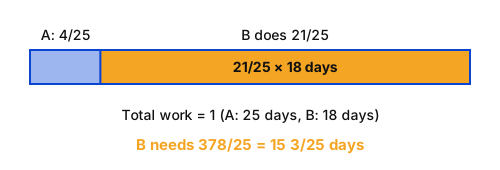
- A in 4 days:
- Remaining:
- B’s time days
Trick: Remaining work × B’s total days = B’s time.
Answer: (A)
अवधारणा: कार्य ; A की दर , B की दर प्रति दिन।
- A का 4 दिन में कार्य:
- शेष:
- B का समय दिन
ट्रिक: शेष कार्य × B के कुल दिन = B का समय।
उत्तर: (A)
RRB NTPC Graduate CBT 1MathematicsTime and workRRB NTPC Graduate CBT 1 2024 · 6 Jun Shift 1
Q1303.The average of 10 observations is 40. It was realised later that an observation was misread as 33 in place of 50. Find the correct average.
10 प्रेक्षणों का औसत 40 है। बाद में ज्ञात हुआ कि एक प्रेक्षण 50 के स्थान पर गलती से 33 पढ़ लिया गया था। सही औसत ज्ञात कीजिए।
- A44.7
- B40.7
- C42.7
- D41.7
Show answer
Concept: Correct sum = wrong sum − wrong value + right value.
- Wrong sum
- Correct sum
- Correct average
Trick: Change in average → .
Answer: (D) 41.7
अवधारणा: सही योग = गलत योग − गलत मान + सही मान।
- गलत योग
- सही योग
- सही औसत
ट्रिक: औसत में परिवर्तन → ।
उत्तर: (D) 41.7
RRB NTPC Graduate CBT 1MathematicsAverage correctionRRB NTPC Graduate CBT 1 2024 · 6 Jun Shift 1
Q1304.Sachin’s salary was first reduced by 16% and subsequently raised by 10%. What percentage was his final salary lower compared to his initial salary?
सचिन के वेतन में पहले 16% की कमी की गई और बाद में 10% की वृद्धि की गई। उसका अंतिम वेतन उसके प्रारंभिक वेतन की तुलना में कितने प्रतिशत कम था?
- A16%
- B10%
- C1.6%
- D7.6%
Show answer
Concept: Net change .
- ,
- So the final salary is 7.6% lower.
Trick: Check: .
Answer: (D) 7.6%
अवधारणा: शुद्ध परिवर्तन ।
- ,
- अतः अंतिम वेतन 7.6% कम है।
ट्रिक: जाँच: ।
उत्तर: (D) 7.6%
RRB NTPC Graduate CBT 1MathematicsSuccessive percentage changeRRB NTPC Graduate CBT 1 2024 · 6 Jun Shift 1
Q1305.The difference between the compound interest, compounded annually and the simple interest if ₹17,700 is deposited at 4% rate of interest per annum for 2 years is:
यदि ₹17,700 को 4% वार्षिक ब्याज दर पर 2 वर्ष के लिए जमा किया जाता है, तो वार्षिक रूप से संयोजित चक्रवृद्धि ब्याज और साधारण ब्याज के बीच का अंतर कितना है?
- A₹27.62
- B₹28.32
- C₹33.42
- D₹18.12
Show answer
Concept: For 2 years: .
Trick: 2-year difference = interest on first year’s interest.
Answer: (B) ₹28.32
अवधारणा: 2 वर्ष के लिए: ।
ट्रिक: 2 वर्ष का अंतर = पहले वर्ष के ब्याज पर ब्याज।
उत्तर: (B) ₹28.32
RRB NTPC Graduate CBT 1MathematicsCI – SI differenceRRB NTPC Graduate CBT 1 2024 · 6 Jun Shift 1
Q1306.If Vishal covers 184 km in a boat in 48 hours against the stream and he takes 12 hours with the stream, then find the speed of the stream.
यदि विशाल एक नाव में धारा के प्रतिकूल 184 km की दूरी 48 घंटे में तय करता है और धारा के अनुकूल उतनी ही दूरी तय करने में 12 घंटे लेता है, तो धारा की चाल ज्ञात कीजिए।
- A13.66 km/hr
- B14.36 km/hr
- C10.64 km/hr
- D5.75 km/hr
Show answer
Concept: Stream speed .
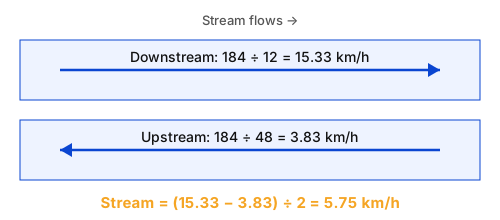
- Upstream
- Downstream
- Stream
Trick: Same distance: stream .
Answer: (D) 5.75 km/hr
अवधारणा: धारा की चाल ।
- ऊर्ध्वप्रवाह
- अनुप्रवाह
- धारा
ट्रिक: समान दूरी: धारा ।
उत्तर: (D) 5.75 km/hr
RRB NTPC Graduate CBT 1MathematicsBoats and streamsRRB NTPC Graduate CBT 1 2024 · 6 Jun Shift 1
Q1307.A vendor bought lemons at 7 for ₹1. How many lemons must he sell for ₹1 to gain 40%?
एक विक्रेता ने ₹1 में 7 की दर से नींबू खरीदे। 40% लाभ प्राप्त करने के लिए उसे ₹1 में कितने नींबू बेचने होंगे?
- A6
- B9
- C5
- D7
Show answer
Concept: For a fixed selling amount, when gain is .
- CP of 1 lemon = ₹.
- For 40% gain, SP of 1 lemon = ₹.
- So for ₹1 he must sell lemons.
Trick: Lemons to sell .
Answer: (C) 5
अवधारणा: लाभ के लिए ।
- 1 नींबू का क्रय मूल्य = ₹।
- 40% लाभ पर 1 नींबू का विक्रय मूल्य = ₹।
- अतः ₹1 में नींबू बेचने होंगे।
ट्रिक: बेचने वाले नींबू ।
उत्तर: (C) 5
RRB NTPC Graduate CBT 1MathematicsProfit and LossRRB NTPC Graduate CBT 1 2024 · 6 Jun Shift 1
Q1308.ABCD is a trapezium in which and . If and , then what is the measure of (in degree)?
ABCD एक समलंब चतुर्भुज है जिसमें और है। यदि और है, तो की माप (डिग्री में) क्या है?
- A4°
- B7°
- C14°
- D10°
Show answer
Concept: Angle sum of a triangle is ; alternate interior angles between parallel lines are equal; angles opposite equal sides are equal.
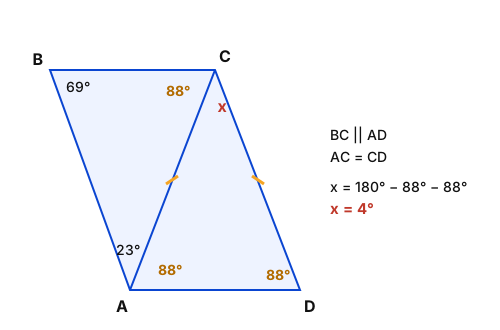
- In : .
- , so (alternate angles).
- , so .
- In : .
Trick: .
Answer: (A)
अवधारणा: त्रिभुज के कोणों का योग ; समांतर रेखाओं के बीच एकांतर कोण बराबर; बराबर भुजाओं के सामने के कोण बराबर।
- में: ।
- , अतः (एकांतर कोण)।
- , अतः ।
- में: ।
ट्रिक: ।
उत्तर: (A)
RRB NTPC Graduate CBT 1MathematicsGeometry – QuadrilateralsRRB NTPC Graduate CBT 1 2024 · 6 Jun Shift 1
Q1309.What is the average of the first 10 prime numbers?
प्रथम 10 अभाज्य संख्याओं का औसत क्या है?
- A15.8
- B14
- C16
- D12.9
Show answer
Concept: .
- First 10 primes: 2, 3, 5, 7, 11, 13, 17, 19, 23, 29.
- Sum .
- Average .
Yaad rakhein: Sum of first 10 primes = 129; of first 25 primes (up to 100) = 1060.
Answer: (D) 12.9
अवधारणा: ।
- पहली 10 अभाज्य संख्याएँ: 2, 3, 5, 7, 11, 13, 17, 19, 23, 29।
- योग ।
- औसत ।
याद रखें: पहली 10 अभाज्य संख्याओं का योग = 129; 100 तक की 25 अभाज्य संख्याओं का योग = 1060।
उत्तर: (D) 12.9
RRB NTPC Graduate CBT 1MathematicsAverage – Prime NumbersRRB NTPC Graduate CBT 1 2024 · 6 Jun Shift 1
Q1310.Find the volume (in cm3) of the largest right circular cone that can be cut out from a cube with an edge of 8 cm.
Use
8 cm किनारे वाले एक घन में से काटे जा सकने वाले सबसे बड़े लंब वृत्तीय शंकु का आयतन (cm3 में) ज्ञात कीजिए।
का प्रयोग कीजिए
- A
- B
- C
- D
Show answer
Concept: The largest cone cut from a cube of edge has and ; .
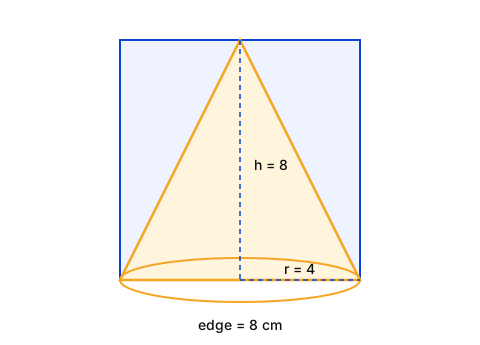
- , so , .
- .
- .
Trick: Largest cone in cube .
Answer: (B)
अवधारणा: भुजा वाले घन से काटे गए सबसे बड़े शंकु में और ; ।
- , अतः , ।
- ।
- ।
ट्रिक: घन में सबसे बड़ा शंकु ।
उत्तर: (B)
RRB NTPC Graduate CBT 1MathematicsMensuration – Cone in CubeRRB NTPC Graduate CBT 1 2024 · 6 Jun Shift 1
Q1311.Simplify: 127 - [7 x (1 - 5 + 4)] ÷ 91
सरल कीजिए: 127 - [7 x (1 - 5 + 4)] ÷ 91
- A135
- B133
- C127
- D118
Show answer
Concept: Follow BODMAS – innermost bracket first.
- .
- , and .
- .
Trick: Spot the zero bracket – the whole term vanishes.
Answer: (C) 127
अवधारणा: BODMAS का पालन करें – सबसे अंदर का कोष्ठक पहले।
- ।
- , और ।
- ।
ट्रिक: शून्य वाला कोष्ठक पहचानें – पूरा पद शून्य हो जाता है।
उत्तर: (C) 127
RRB NTPC Graduate CBT 1MathematicsSimplification – BODMASRRB NTPC Graduate CBT 1 2024 · 6 Jun Shift 1
Q1312.One pipe can fill the tank in 21 minutes while another pipe can empty completely filled tank in 24 minutes. If both the pipes are operated together on empty tank, how long (in minutes) will it take to fill one-fourth of the tank?
एक पाइप टंकी को 21 मिनट में भर सकता है, जबकि दूसरा पाइप पूरी भरी हुई टंकी को 24 मिनट में खाली कर सकता है। यदि दोनों पाइपों को खाली टंकी पर एक साथ चलाया जाए, तो टंकी का एक-चौथाई भाग भरने में कितना समय (मिनट में) लगेगा?
- A42
- B126
- C84
- D168
Show answer
Concept: Net rate = filling rate − emptying rate.
- Net rate per minute of the tank.
- Full tank takes 168 minutes together.
- One-fourth tank takes minutes.
Trick: LCM method: tank = 168 units; filler 8, emptier 7 units per minute → net 1 unit; tank = 42 units = 42 min.
Answer: (A) 42
अवधारणा: शुद्ध दर = भरने की दर − खाली करने की दर।
- प्रति मिनट शुद्ध दर टंकी।
- दोनों साथ में पूरी टंकी 168 मिनट में भरते हैं।
- एक-चौथाई टंकी मिनट।
ट्रिक: LCM विधि: टंकी = 168 इकाई; भरने वाला 8, खाली करने वाला 7 इकाई/मिनट → शुद्ध 1 इकाई; टंकी = 42 इकाई = 42 मिनट।
उत्तर: (A) 42
RRB NTPC Graduate CBT 1MathematicsPipes and CisternsRRB NTPC Graduate CBT 1 2024 · 6 Jun Shift 1
Q1313.6893.5 × 603.3 × 0.3019 is equal in value to:
6893.5 × 603.3 × 0.3019 का मान किसके बराबर है?
- A6.8935 × 6.033 × 301.9
- B6.8935 × 60.33 × 30.19
- C68.935 × 6033 × 3.019
- D689.35 × 603.3 × 301.9
Show answer
Concept: A product stays the same if the total shift of decimal points is zero.
- Option (C): (divided by ), (×10), (×10).
- Net factor → product unchanged ✓.
- (A) and (B) give a net factor ; (D) gives 100.
Trick: Count decimal places: original 1 + 1 + 4 = 6; in (C) 3 + 0 + 3 = 6 – same total.
Answer: (C)
अवधारणा: यदि दशमलव बिंदुओं का कुल खिसकाव शून्य हो तो गुणनफल वही रहता है।
- विकल्प (C): ( से भाग), (×10), (×10)।
- शुद्ध गुणक → गुणनफल अपरिवर्तित ✓।
- (A) और (B) में शुद्ध गुणक ; (D) में 100।
ट्रिक: दशमलव स्थान गिनें: मूल 1 + 1 + 4 = 6; (C) में 3 + 0 + 3 = 6 – कुल समान।
उत्तर: (C)
RRB NTPC Graduate CBT 1MathematicsDecimals – Place ValueRRB NTPC Graduate CBT 1 2024 · 6 Jun Shift 1
Q1314.The arithmetic mean of the observations 28, 31, 40, 63, 57, 37, 34, 70 and 99 is:
प्रेक्षणों 28, 31, 40, 63, 57, 37, 34, 70 और 99 का समांतर माध्य कितना है?
- A55
- B50
- C41
- D51
Show answer
Concept: .
- Sum .
- Number of observations = 9.
- Mean .
Trick: Pair to round numbers: (31 + 99) + (63 + 37) + (70 + 40) + (28 + 57 + 34) = 130 + 100 + 110 + 119 = 459.
Answer: (D) 51
अवधारणा: ।
- योग ।
- प्रेक्षणों की संख्या = 9।
- माध्य ।
ट्रिक: जोड़ियाँ बनाएँ: (31 + 99) + (63 + 37) + (70 + 40) + (28 + 57 + 34) = 130 + 100 + 110 + 119 = 459।
उत्तर: (D) 51
RRB NTPC Graduate CBT 1MathematicsStatistics – MeanRRB NTPC Graduate CBT 1 2024 · 6 Jun Shift 1
Q1315.When x is added to each of 22, 26, 19 and 21, then the numbers so obtained, in this order, are in proportion. Then, if 2x : y :: y : (4x-8), and y > 0, what is the value of y?
जब 22, 26, 19 और 21 में से प्रत्येक में x जोड़ा जाता है, तो इस प्रकार प्राप्त संख्याएँ, इसी क्रम में, समानुपात में होती हैं। तब, यदि 2x : y :: y : (4x-8) और y > 0 है, तो y का मान क्या है?
- A48
- B37
- C46
- D54
Show answer
Concept: If then ; mean proportional of and satisfies .
- .
- (check: 6, 10, 3, 5 are in proportion).
- , ; .
- .
Trick: .
Answer: (A) 48
अवधारणा: यदि तो ; और का मध्यानुपाती हो तो ।
- ।
- (जाँच: 6, 10, 3, 5 समानुपात में हैं)।
- , ; ।
- ।
ट्रिक: ।
उत्तर: (A) 48
RRB NTPC Graduate CBT 1MathematicsRatio and ProportionRRB NTPC Graduate CBT 1 2024 · 6 Jun Shift 1
Q1316.If , then the value of is:
यदि है, तो का मान कितना है?
- A76
- B414
- C420
- D259
Show answer
Concept: .
- Here .
- .
- .
Trick: If , then .
Answer: (A) 76
अवधारणा: ।
- यहाँ ।
- ।
- ।
ट्रिक: यदि , तो ।
उत्तर: (A) 76
RRB NTPC Graduate CBT 1MathematicsAlgebra – IdentitiesRRB NTPC Graduate CBT 1 2024 · 6 Jun Shift 1
Q1317.Manoj has 200 litres of Oil A and 274 litres of Oil B. He fills a number of identical containers with the two types of oil in a manner that each container has only one type of oil, and all containers are completely filled. What can be the maximum volume (in litres) of each container that Manoj uses, so that all the oil that Manoj has, of both the types, can be poured into these containers?
मनोज के पास 200 लीटर तेल A और 274 लीटर तेल B है। वह दोनों प्रकार के तेल से कई एक समान बर्तन इस प्रकार भरता है कि प्रत्येक बर्तन में केवल एक ही प्रकार का तेल हो, और सभी बर्तन पूरी तरह भरे हों। मनोज द्वारा प्रयुक्त प्रत्येक बर्तन का अधिकतम आयतन (लीटर में) कितना हो सकता है, ताकि मनोज के पास उपलब्ध दोनों प्रकार का सारा तेल इन बर्तनों में डाला जा सके?
- A2
- B10
- C8
- D3
Show answer
Concept: The largest container that exactly measures both quantities = HCF of the quantities.
- .
- (137 is prime).
- HCF → maximum volume of each container = 2 litres.
Trick: ; HCF must divide 74 and 200 → only 2 works.
Answer: (A) 2
अवधारणा: दोनों मात्राओं को पूरा-पूरा मापने वाला सबसे बड़ा बर्तन = मात्राओं का HCF।
- ।
- (137 अभाज्य है)।
- HCF → प्रत्येक बर्तन का अधिकतम आयतन = 2 लीटर।
ट्रिक: ; HCF को 74 और 200 दोनों को विभाजित करना होगा → केवल 2।
उत्तर: (A) 2
RRB NTPC Graduate CBT 1MathematicsHCF ApplicationsRRB NTPC Graduate CBT 1 2024 · 6 Jun Shift 1
Q1318.Find roots of
के मूल ज्ञात कीजिए।
- A and और
- B and और
- C and और
- D and और
Show answer
Concept: Simplify, then factorise by splitting the middle term.
- .
- .
- or .
Trick: All coefficients positive → both roots negative; sum and product fit .
Answer: (C) and
अवधारणा: पहले सरल करें, फिर मध्य पद को विभाजित कर गुणनखंड करें।
- ।
- ।
- या ।
ट्रिक: सभी गुणांक धनात्मक → दोनों मूल ऋणात्मक; योग और गुणनफल , जो से मेल खाते हैं।
उत्तर: (C) और
RRB NTPC Graduate CBT 1MathematicsQuadratic EquationsRRB NTPC Graduate CBT 1 2024 · 6 Jun Shift 1
Q1319.Akshay spends 40% of his income. If he saves ₹24,000, then his income (in ₹) is:
अक्षय अपनी आय का 40% खर्च करता है। यदि वह ₹24,000 की बचत करता है, तो उसकी आय (₹ में) कितनी है?
- A9,600
- B40,000
- C41,000
- D39,000
Show answer
Concept: .
- Spends 40% → saves 60% of income.
- of income = ₹24,000.
- Income = ₹40,000.
Trick: 60% = 24,000 → 10% = 4,000 → 100% = 40,000.
Answer: (B) 40,000
अवधारणा: ।
- 40% खर्च → आय का 60% बचत।
- आय का = ₹24,000।
- आय = ₹40,000।
ट्रिक: 60% = 24,000 → 10% = 4,000 → 100% = 40,000।
उत्तर: (B) 40,000
RRB NTPC Graduate CBT 1MathematicsPercentage – Income & SavingsRRB NTPC Graduate CBT 1 2024 · 6 Jun Shift 1
Q1320.If the selling price of a bed is 2-times of initial, then the profit is 11-times of initial. Find the initial profit percentage.
यदि एक पलंग का विक्रय मूल्य प्रारंभिक मूल्य का 2 गुना हो, तो लाभ प्रारंभिक लाभ का 11 गुना हो जाता है। प्रारंभिक लाभ प्रतिशत ज्ञात कीजिए।
- A
- B
- C
- D
Show answer
Concept: Cost price stays the same; .
- Let CP , initial profit , so SP .
- New SP , new profit : .
- .
- Initial profit .
Trick: Doubling SP adds one more SP to profit: .
Answer: (C)
अवधारणा: क्रय मूल्य वही रहता है; ।
- माना क्रय मूल्य , प्रारंभिक लाभ , अतः विक्रय मूल्य ।
- नया विक्रय मूल्य , नया लाभ : ।
- ।
- प्रारंभिक लाभ ।
ट्रिक: विक्रय मूल्य दोगुना करने से लाभ में एक और जुड़ता है: ।
उत्तर: (C)
RRB NTPC Graduate CBT 1MathematicsProfit and LossRRB NTPC Graduate CBT 1 2024 · 6 Jun Shift 1

