Q1321.A group of numbers and symbols is coded using letter codes as per the codes given below and the conditions that follow. Study the given codes and conditions and answer the question that follows.
Note: If none of the conditions apply, then codes for the respective number/symbol are to be followed directly as given in the table.
| Number/Symbol | 3 | 9 | @ | & | 2 | 7 | 5 | % | 1 | 8 | ∆ | 4 | 6 |
| Code | L | C | Z | M | D | W | A | P | R | T | F | B | K |
Conditions:
(i) If the first element is a symbol and the last a number, the codes for these two (the first and the last elements) are to be interchanged.
(ii) If the first element is an odd number and the last an even number, the first and last elements are to be coded as ©.
(iii) If both second and third elements are perfect squares, the third element is to be coded as the code for the second element.
What will be the code for the following group?
@ 9 3 8 5
संख्याओं और प्रतीकों के एक समूह को नीचे दिए गए कूटों और उसके बाद दी गई शर्तों के अनुसार अक्षर कूटों का उपयोग करके कूटबद्ध किया जाता है। दिए गए कूटों और शर्तों का अध्ययन कीजिए और इसके बाद दिए गए प्रश्न का उत्तर दीजिए।
नोट: यदि कोई भी शर्त लागू नहीं होती है, तो संबंधित संख्या/प्रतीक के कूटों का सीधे तालिका में दिए गए अनुसार ही पालन करना है।
| संख्या/प्रतीक | 3 | 9 | @ | & | 2 | 7 | 5 | % | 1 | 8 | ∆ | 4 | 6 |
| कूट | L | C | Z | M | D | W | A | P | R | T | F | B | K |
शर्तें:
(i) यदि पहला तत्व एक प्रतीक है और अंतिम तत्व एक संख्या है, तो इन दोनों (पहले और अंतिम तत्वों) के कूटों को आपस में बदल दिया जाना है।
(ii) यदि पहला तत्व एक विषम संख्या है और अंतिम तत्व एक सम संख्या है, तो पहले और अंतिम तत्वों को © के रूप में कूटबद्ध किया जाना है।
(iii) यदि दूसरा और तीसरा दोनों तत्व पूर्ण वर्ग हैं, तो तीसरे तत्व को दूसरे तत्व के कूट के रूप में कूटबद्ध किया जाना है।
निम्नलिखित समूह के लिए कूट क्या होगा?
@ 9 3 8 5
- AZ C B T A
- BA C B T Z
- CZ B C T A
- DA C L T Z
Show answer
Concept: Check each condition on the given group, then write the codes from the table.
- Codes: @ = Z, 9 = C, 3 = L, 8 = T, 5 = A.
- First element @ is a symbol and last element 5 is a number → condition (i) applies: swap the codes of first and last.
- Condition (iii) fails (3 is not a perfect square); (ii) fails (first is not a number).
- So @ → A, 9 → C, 3 → L, 8 → T, 5 → Z.
Trick: Test only the first, second, third and last elements – the middle ones are always coded directly.
Answer: (D) A C L T Z
अवधारणा: दिए गए समूह पर हर शर्त जाँचें, फिर तालिका से कोड लिखें।
- कोड: @ = Z, 9 = C, 3 = L, 8 = T, 5 = A।
- पहला तत्व @ प्रतीक है और अंतिम 5 संख्या है → शर्त (i) लागू: पहले और अंतिम के कोड आपस में बदलें।
- शर्त (iii) लागू नहीं (3 पूर्ण वर्ग नहीं), (ii) भी नहीं।
- अतः @ → A, 9 → C, 3 → L, 8 → T, 5 → Z।
ट्रिक: केवल पहला, दूसरा, तीसरा और अंतिम तत्व जाँचें – बीच वाले हमेशा सीधे कोड होते हैं।
उत्तर: (D) A C L T Z
RRB NTPC Graduate CBT 1General Intelligence and ReasoningCoding with conditionsRRB NTPC Graduate CBT 1 2024 · 5 Jun Shift 3
Q1322.Refer to the following number and symbol series and answer the question that follows. Counting to be done from left to right only. All numbers are single-digit numbers. (Left) 2 * 3 & @ @ 6 4 $ @ 3 * % 6 2 1 3 9 7 8 2 € (Right)
How many such numbers are there each of which is immediately preceded by a number and also immediately followed by a symbol?
निम्नलिखित संख्या और प्रतीक श्रृंखला को देखिए और इसके बाद दिए गए प्रश्न का उत्तर दीजिए। गिनती केवल बाएँ से दाएँ की जानी है। सभी संख्याएँ एक-अंकीय संख्याएँ हैं। (बाएँ) 2 * 3 & @ @ 6 4 $ @ 3 * % 6 2 1 3 9 7 8 2 € (दाएँ)
ऐसी कितनी संख्याएँ हैं जिनमें से प्रत्येक के ठीक पहले एक संख्या है और ठीक बाद एक प्रतीक भी है?
- A4
- B5
- C3
- D2
Show answer
Concept: Look for the pattern Number – Number – Symbol.
- Series: 2 * 3 & @ @ 6 4 $ @ 3 * % 6 2 1 3 9 7 8 2 €
- 6 4 $ → 4 qualifies.
- 8 2 € → 2 qualifies. No other number has a number before and a symbol after.
Trick: Scan only the symbols: check whether the two elements just before each symbol are both numbers.
Answer: (D) 2
अवधारणा: पैटर्न खोजें: संख्या – संख्या – प्रतीक।
- श्रृंखला: 2 * 3 & @ @ 6 4 $ @ 3 * % 6 2 1 3 9 7 8 2 €
- 6 4 $ → 4 सही।
- 8 2 € → 2 सही। अन्य कोई संख्या शर्त पूरी नहीं करती।
ट्रिक: केवल प्रतीकों को देखें: उनसे ठीक पहले के दोनों तत्व संख्या हैं या नहीं।
उत्तर: (D) 2
RRB NTPC Graduate CBT 1General Intelligence and ReasoningNumber–symbol seriesRRB NTPC Graduate CBT 1 2024 · 5 Jun Shift 3
Q1323.A, B, C, D, E and F live on six different floors of the same building. The lowermost floor in the building is numbered 1, the floor above it, number 2 and so on till the topmost floor is numbered 6. The product of floors on which F and E live is 15. C lives
immediately above B. The sum of floors on which D and E live is 7. How many people live between B and D?
A, B, C, D, E और F एक ही इमारत की छह अलग-अलग मंजिलों पर रहते हैं। इमारत की सबसे निचली मंजिल की संख्या 1 है, उसके ऊपर वाली मंजिल की संख्या 2 है और इसी प्रकार सबसे ऊपरी मंजिल की संख्या 6 है। F और E जिन मंजिलों पर रहते हैं, उनका गुणनफल 15 है। C
B के ठीक ऊपर रहता है। D और E जिन मंजिलों पर रहते हैं, उनका योग 7 है। B और D के बीच कितने व्यक्ति रहते हैं?
- A3
- B2
- C1
- D4
Show answer
Concept: Use the product and sum clues to fix E first.
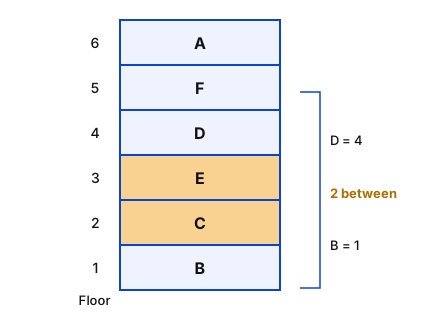
- F × E = 15 → {3, 5}. D + E = 7 → if E = 3, D = 4; if E = 5, D = 2.
- Case E = 5, F = 3, D = 2: free floors 1, 4, 6 – no two consecutive for B, C. Rejected.
- Case E = 3, F = 5, D = 4: free floors 1, 2, 6 → B = 1, C = 2, A = 6.
- Between B (1) and D (4): C and E → 2 people.
Trick: Clue with only two possible values (E) → test both cases and reject the one that breaks 'immediately above'.
Answer: (B) 2
अवधारणा: गुणनफल और योग वाले संकेतों से पहले E तय करें।
- F × E = 15 → {3, 5}। D + E = 7 → E = 3 तो D = 4; E = 5 तो D = 2।
- स्थिति E = 5, F = 3, D = 2: बची मंजिलें 1, 4, 6 – B, C के लिए लगातार मंजिल नहीं। अस्वीकार।
- स्थिति E = 3, F = 5, D = 4: बची 1, 2, 6 → B = 1, C = 2, A = 6।
- B (1) और D (4) के बीच: C और E → 2 व्यक्ति।
ट्रिक: दो संभावित मान वाले संकेत से दोनों स्थितियाँ जाँचें।
उत्तर: (B) 2
RRB NTPC Graduate CBT 1General Intelligence and ReasoningFloor arrangementRRB NTPC Graduate CBT 1 2024 · 5 Jun Shift 3
Q1324.Seven people, I, J, K, L, O, P and Q are sitting in a row, facing north. Only five people sit between L and Q. P sits to the immediate left of Q. Only one person sits between P and I. O sits at some place to the left of K but at some place to the right of J. Who sits third from the left end of the line?
सात व्यक्ति I, J, K, L, O, P और Q एक पंक्ति में उत्तर की ओर मुख करके बैठे हैं। L और Q के बीच केवल पाँच व्यक्ति बैठे हैं। P, Q के ठीक बाईं ओर बैठा है। P और I के बीच केवल एक व्यक्ति बैठा है। O, K के बाईं ओर किसी स्थान पर, किंतु J के दाईं ओर किसी स्थान पर बैठा है। पंक्ति के बाएँ छोर से तीसरे स्थान पर कौन बैठा है?
- AP
- BQ
- CO
- DJ
Show answer
Concept: Five people between L and Q in a row of 7 → they sit at the two ends.
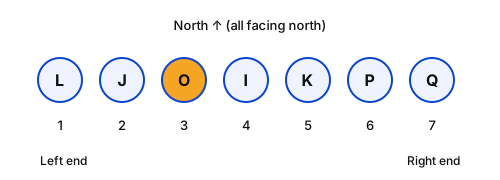
- P is immediately left of Q, so Q cannot be at the left end → Q = 7, P = 6, L = 1.
- One person between P and I → I = 4.
- Positions 2, 3, 5 left for J, O, K with J – O – K order → J = 2, O = 3, K = 5.
- Third from left = O.
Trick: '5 between' in a row of 7 always means extreme ends.
Answer: (C) O
अवधारणा: 7 की पंक्ति में L और Q के बीच 5 व्यक्ति → दोनों छोरों पर।
- P, Q के ठीक बाएँ है, अतः Q बाएँ छोर पर नहीं → Q = 7, P = 6, L = 1।
- P और I के बीच एक व्यक्ति → I = 4।
- शेष 2, 3, 5 पर J, O, K (J – O – K क्रम) → J = 2, O = 3, K = 5।
- बाएँ से तीसरा = O।
ट्रिक: 7 की पंक्ति में '5 बीच में' = दोनों छोर।
उत्तर: (C) O
RRB NTPC Graduate CBT 1General Intelligence and ReasoningLinear seating arrangementRRB NTPC Graduate CBT 1 2024 · 5 Jun Shift 3
Q1325.Based on the English alphabetical order, three of the following four letter-cluster pairs are alike in a certain way and thus form a group. Which letter-cluster pair DOES NOT belong to that group?
(Note: The odd one out is not based on the number of consonants/vowels or their position in the letter-cluster.)
अंग्रेज़ी वर्णमाला क्रम के आधार पर, निम्नलिखित चार अक्षर-समूह युग्मों में से तीन किसी निश्चित प्रकार से एकसमान हैं और इस प्रकार एक समूह बनाते हैं। कौन-सा अक्षर-समूह युग्म उस समूह से संबंधित नहीं है?
(नोट: असंगत अक्षर-समूह, उस अक्षर-समूह में व्यंजनों/स्वरों की संख्या या उनके स्थान पर आधारित नहीं है।)
- ANQ - RM
- BNM - PO
- CSR - UT
- DUT - WV
Show answer
Concept: Compare each letter of the first cluster with the corresponding letter of the second.
- NM – PO: N + 2 = P, M + 2 = O.
- SR – UT: +2, +2; UT – WV: +2, +2.
- NQ – RM: N + 4 = R, Q − 4 = M → different.
Trick: Also inside each cluster: NM, SR, UT are reverse consecutive letters; NQ is not.
Answer: (A) NQ - RM
अवधारणा: पहले समूह के प्रत्येक अक्षर की तुलना दूसरे समूह के संगत अक्षर से करें।
- NM – PO: N + 2 = P, M + 2 = O।
- SR – UT: +2, +2; UT – WV: +2, +2।
- NQ – RM: N + 4 = R, Q − 4 = M → भिन्न।
ट्रिक: NM, SR, UT उल्टे क्रमागत अक्षर हैं; NQ नहीं।
उत्तर: (A) NQ - RM
RRB NTPC Graduate CBT 1General Intelligence and ReasoningLetter-cluster odd one outRRB NTPC Graduate CBT 1 2024 · 5 Jun Shift 3
Q1326.Based on the English alphabetical order, three of the following four letter-cluster pairs are alike in a certain way and thus form a group. Which letter-cluster pair DOES NOT belong to that group? (Note: The odd one out is NOT based on the number of
consonants/vowels or their position in the letter cluster)
अंग्रेज़ी वर्णमाला क्रम के आधार पर, निम्नलिखित चार अक्षर-समूह युग्मों में से तीन किसी निश्चित प्रकार से एकसमान हैं और इस प्रकार एक समूह बनाते हैं। कौन-सा अक्षर-समूह युग्म उस समूह से संबंधित नहीं है? (नोट: असंगत अक्षर-समूह, उस अक्षर-समूह में व्यंजनों/स्वरों की संख्या या
उनके स्थान पर आधारित नहीं है।)
- APS - QT
- BKN - LO
- CGJ - HK
- DDH - FP
Show answer
Concept: Compare the first cluster with the second, letter by letter.
- PS – QT: P + 1 = Q, S + 1 = T.
- KN – LO: +1, +1; GJ – HK: +1, +1.
- DH – FP: D + 2 = F, H + 8 = P → different.
Trick: Inside the first cluster also: PS, KN, GJ have gap +3; DH has gap +4.
Answer: (D) DH - FP
अवधारणा: पहले समूह की तुलना दूसरे से अक्षर-दर-अक्षर करें।
- PS – QT: P + 1 = Q, S + 1 = T।
- KN – LO: +1, +1; GJ – HK: +1, +1।
- DH – FP: D + 2 = F, H + 8 = P → भिन्न।
ट्रिक: पहले समूह में भी PS, KN, GJ में अंतर +3; DH में +4।
उत्तर: (D) DH - FP
RRB NTPC Graduate CBT 1General Intelligence and ReasoningLetter-cluster odd one outRRB NTPC Graduate CBT 1 2024 · 5 Jun Shift 3
Q1327.What should come in place of the question mark (?) in the given series?
1001 1000 997 992 985 ?
दी गई श्रृंखला में प्रश्न चिह्न (?) के स्थान पर क्या आना चाहिए?
1001 1000 997 992 985 ?
- A975
- B976
- C978
- D977
Show answer
Concept: Find the differences between consecutive terms.
- , , ,
- Differences are consecutive odd numbers 1, 3, 5, 7, 9.
- Next
Trick: Odd-number differences → also for : .
Answer: (B) 976
अवधारणा: क्रमागत पदों का अंतर निकालें।
- , , ,
- अंतर क्रमागत विषम संख्याएँ 1, 3, 5, 7, 9 हैं।
- अगला
ट्रिक: पद : ।
उत्तर: (B) 976
RRB NTPC Graduate CBT 1General Intelligence and ReasoningNumber seriesRRB NTPC Graduate CBT 1 2024 · 5 Jun Shift 3
Q1328.L, M, N, O, P, Q, and R are sitting around a circular table facing the centre. M is sitting to the immediate right of Q and immediate left of O. N is sitting to the immediate right of O. P is sitting to the immediate left of L. R is sitting to the immediate right of L and immediate left of Q. The position of how many persons will remain unchanged if all the persons are arranged in alphabetical order in clockwise direction starting from L (including L)?
L, M, N, O, P, Q और R एक वृत्ताकार मेज़ के चारों ओर केंद्र की ओर मुख करके बैठे हैं। M, Q के ठीक दाईं ओर और O के ठीक बाईं ओर बैठा है। N, O के ठीक दाईं ओर बैठा है। P, L के ठीक बाईं ओर बैठा है। R, L के ठीक दाईं ओर और Q के ठीक बाईं ओर बैठा है। यदि सभी व्यक्तियों को L से शुरू करते हुए (L सहित) दक्षिणावर्त दिशा में वर्णानुक्रम में व्यवस्थित किया जाए, तो कितने व्यक्तियों का स्थान अपरिवर्तित रहेगा?
- A4
- B3
- C1
- D5
Show answer
Concept: Facing the centre: a person's left neighbour is clockwise and right neighbour is anticlockwise.
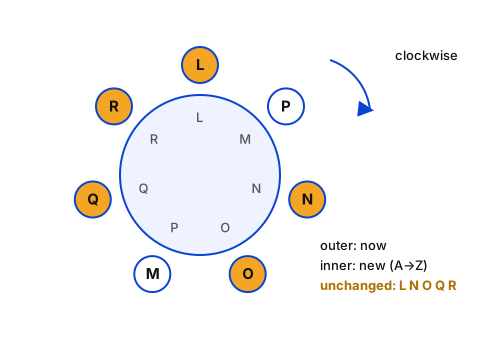
- From the clues, the anticlockwise chain is P – L – R – Q – M – O – N, so clockwise from L: L, P, N, O, M, Q, R.
- New clockwise order from L: L, M, N, O, P, Q, R.
- Compare seat by seat: L, N, O, Q, R stay; P and M swap seats.
- Unchanged = 5.
Trick: Write the present clockwise order starting at L under the alphabet and count matches.
Answer: (D) 5
अवधारणा: केंद्र की ओर मुख: बायाँ पड़ोसी दक्षिणावर्त और दायाँ पड़ोसी वामावर्त होता है।
- संकेतों से वामावर्त क्रम P – L – R – Q – M – O – N; अतः L से दक्षिणावर्त: L, P, N, O, M, Q, R।
- नया दक्षिणावर्त क्रम (L से): L, M, N, O, P, Q, R।
- सीट-दर-सीट मिलान: L, N, O, Q, R अपरिवर्तित; P और M बदलते हैं।
- अपरिवर्तित = 5।
ट्रिक: वर्तमान दक्षिणावर्त क्रम को वर्णमाला के नीचे लिखकर मिलान गिनें।
उत्तर: (D) 5
RRB NTPC Graduate CBT 1General Intelligence and ReasoningCircular seating arrangementRRB NTPC Graduate CBT 1 2024 · 5 Jun Shift 3
Q1329.If ‘A’ stands for ‘÷’, ‘B’ stands for ‘×’, ‘C’ stands for ‘+’, and ‘D’ stands for ‘−’, what will come in place of the question mark (?) in the following equation?
45 B 14 A 21 D 17 C 25 = ?
यदि ‘A’ का अर्थ ‘÷’, ‘B’ का अर्थ ‘×’, ‘C’ का अर्थ ‘+’ और ‘D’ का अर्थ ‘−’ है, तो निम्नलिखित समीकरण में प्रश्न चिह्न (?) के स्थान पर क्या आएगा?
45 B 14 A 21 D 17 C 25 = ?
- A54
- B42
- C36
- D38
Show answer
Concept: Replace letters by signs, then apply BODMAS.
- ,
Trick: → quickly.
Answer: (D) 38
अवधारणा: अक्षरों के स्थान पर चिह्न रखें, फिर BODMAS लगाएँ।
- ,
ट्रिक: सीधे।
उत्तर: (D) 38
RRB NTPC Graduate CBT 1General Intelligence and ReasoningMathematical operationsRRB NTPC Graduate CBT 1 2024 · 5 Jun Shift 3
Q1330.What should come in place of the question mark (?) in the given series based on the English alphabetical order?
SKC WOG ASK EWO ?
अंग्रेज़ी वर्णमाला क्रम के आधार पर दी गई श्रृंखला में प्रश्न चिह्न (?) के स्थान पर क्या आना चाहिए?
SKC WOG ASK EWO ?
- AIAS
- BAIS
- CASI
- DISA
Show answer
Concept: Each letter moves in the alphabet (Z wraps to A).
- 1st letters: S → W → A → E → I
- 2nd letters: K → O → S → W → A
- 3rd letters: C → G → K → O → S
- Next term: IAS
Trick: Positions : S(19) W(23) A(27 = 1) E(5) I(9).
Answer: (A) IAS
अवधारणा: प्रत्येक अक्षर वर्णमाला में आगे बढ़ता है (Z के बाद A)।
- पहले अक्षर: S → W → A → E → I
- दूसरे अक्षर: K → O → S → W → A
- तीसरे अक्षर: C → G → K → O → S
- अगला पद: IAS
ट्रिक: स्थान : S(19) W(23) A(1) E(5) I(9)।
उत्तर: (A) IAS
RRB NTPC Graduate CBT 1General Intelligence and ReasoningLetter seriesRRB NTPC Graduate CBT 1 2024 · 5 Jun Shift 3
Q1331.Each of O, P, Q, R, S, T and U has an exam on a different day of a week starting from Monday and ending on Sunday of the same week. S has an exam on Wednesday. R has an exam on one of the days after P and T has an exam on one of the days before Q. U has an exam immediately after O and S has an exam immediately before O. T has an exam on one of the days after U. How many people have an exam between S and Q?
O, P, Q, R, S, T और U में से प्रत्येक की परीक्षा एक ही सप्ताह के सोमवार से शुरू होकर रविवार को समाप्त होने वाले सप्ताह के एक अलग दिन है। S की परीक्षा बुधवार को है। R की परीक्षा P के बाद के किसी एक दिन है और T की परीक्षा Q से पहले के किसी एक दिन है। U की परीक्षा O के ठीक बाद है और S की परीक्षा O के ठीक पहले है। T की परीक्षा U के बाद के किसी एक दिन है। S और Q के बीच कितने व्यक्तियों की परीक्षा है?
- ATwoदो
- BFourचार
- CFiveपाँच
- DThreeतीन
Show answer
Concept: Start with the fixed day (S = Wednesday) and chain the 'immediately' clues.
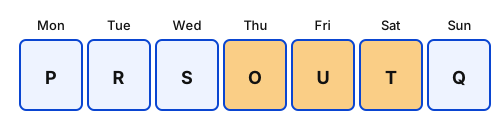
- S Wed → O Thu → U Fri.
- T after U and before Q → T Sat, Q Sun.
- P and R take Mon, Tue with R after P → P Mon, R Tue.
- Between S (Wed) and Q (Sun): O, U, T → three.
Trick: Chain 'immediately after' clues first – they fix several days at once.
Answer: (D) Three
अवधारणा: निश्चित दिन (S = बुधवार) से शुरू कर 'ठीक बाद' वाले संकेत जोड़ें।
- S बुध → O गुरु → U शुक्र।
- T, U के बाद और Q से पहले → T शनि, Q रवि।
- P, R के लिए सोम, मंगल; R, P के बाद → P सोम, R मंगल।
- S (बुध) और Q (रवि) के बीच: O, U, T → तीन।
ट्रिक: 'ठीक बाद' वाले संकेत पहले जोड़ें।
उत्तर: (D) तीन
RRB NTPC Graduate CBT 1General Intelligence and ReasoningScheduling – daysRRB NTPC Graduate CBT 1 2024 · 5 Jun Shift 3
Q1332.This question is based on the words given below.
(Left) BAD FIG ICE NOT (Right)
In each of the words, each vowel is changed to the letter immediately following it in the English alphabetical order and each consonant is changed to the letter immediately preceding in the English alphabetical order. In how many letter clusters thus formed, will no vowel appear?
यह प्रश्न नीचे दिए गए शब्दों पर आधारित है।
(बाएँ) BAD FIG ICE NOT (दाएँ)
प्रत्येक शब्द में, प्रत्येक स्वर को अंग्रेज़ी वर्णमाला क्रम में उसके ठीक बाद वाले अक्षर में बदल दिया जाता है और प्रत्येक व्यंजन को अंग्रेज़ी वर्णमाला क्रम में उसके ठीक पहले वाले अक्षर में बदल दिया जाता है। इस प्रकार बने कितने अक्षर-समूहों में कोई स्वर नहीं आएगा?
- ATwoदो
- BNoneकोई नहीं
- CThreeतीन
- DOneएक
Show answer
Concept: Vowel → next letter; consonant → previous letter.
- BAD → A B C (has A); FIG → E J F (has E)
- ICE → J B F (no vowel)
- NOT → M P S (no vowel)
- Clusters without a vowel: 2
Trick: A new vowel can come only from a consonant just after a vowel (B→A, F→E, J→I, P→O, V→U).
Answer: (A) Two
अवधारणा: स्वर → अगला अक्षर; व्यंजन → पिछला अक्षर।
- BAD → A B C (A है); FIG → E J F (E है)
- ICE → J B F (कोई स्वर नहीं)
- NOT → M P S (कोई स्वर नहीं)
- स्वर-रहित समूह: 2
ट्रिक: नया स्वर केवल B, F, J, P, V से बनता है (पिछला अक्षर स्वर)।
उत्तर: (A) दो
RRB NTPC Graduate CBT 1General Intelligence and ReasoningLetter coding – vowelsRRB NTPC Graduate CBT 1 2024 · 5 Jun Shift 3
Q1333.This question is based on the five, three-digit numbers given below.
(Left) 662 268 547 409 909 (Right)
(Example: 697 – First digit = 6, second digit = 9 and third digit = 7)
(NOTE: All operations to be done from left to right.)
What will be the resultant if the third digit of the highest number is subtracted from the first digit of the lowest number?
यह प्रश्न नीचे दी गई पाँच, तीन-अंकीय संख्याओं पर आधारित है।
(बाएँ) 662 268 547 409 909 (दाएँ)
(उदाहरण: 697 – पहला अंक = 6, दूसरा अंक = 9 और तीसरा अंक = 7)
(नोट: सभी संक्रियाएँ बाएँ से दाएँ की जानी हैं।)
यदि सबसे बड़ी संख्या के तीसरे अंक को सबसे छोटी संख्या के पहले अंक में से घटाया जाए, तो परिणाम क्या होगा?
- A−8
- B−6
- C−4
- D−7
Show answer
Concept: Pick the highest and lowest numbers, then the required digits.
- Highest = 909 → third digit 9.
- Lowest = 268 → first digit 2.
Trick: 'A subtracted from B' means .
Answer: (D)
अवधारणा: सबसे बड़ी और सबसे छोटी संख्या चुनें, फिर अंक लें।
- सबसे बड़ी = 909 → तीसरा अंक 9।
- सबसे छोटी = 268 → पहला अंक 2।
ट्रिक: 'A को B से घटाएँ' = ।
उत्तर: (D)
RRB NTPC Graduate CBT 1General Intelligence and ReasoningThree-digit number operationsRRB NTPC Graduate CBT 1 2024 · 5 Jun Shift 3
Q1334.Each of C, D, E, F, S, T and U has an exam on a different day of a week starting from Monday and ending on Sunday of the same week. F has the exam on Friday. Only two people have their exams between T and F. Only four people have their exams between E and T. S has the exam immediately after U. D does not have the exam on Monday. How many people have their exams before D and after C?
C, D, E, F, S, T और U में से प्रत्येक की परीक्षा एक ही सप्ताह के सोमवार से शुरू होकर रविवार को समाप्त होने वाले सप्ताह के एक अलग दिन है। F की परीक्षा शुक्रवार को है। T और F के बीच केवल दो व्यक्तियों की परीक्षा है। E और T के बीच केवल चार व्यक्तियों की परीक्षा है। S की परीक्षा U के ठीक बाद है। D की परीक्षा सोमवार को नहीं है। D से पहले और C के बाद कितने व्यक्तियों की परीक्षा है?
- AFourचार
- BOneएक
- CTwoदो
- DThreeतीन
Show answer
Concept: Fix F, then T and E from the 'between' clues.
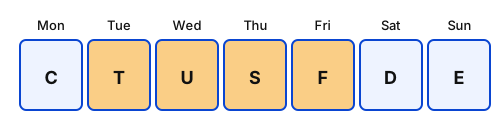
- F = Fri (5). Two between T and F → T = Tue (2).
- Four between E and T → E = Sun (7).
- Free: Mon, Wed, Thu, Sat. U–S consecutive → U Wed, S Thu.
- D not Monday → D Sat, C Mon. Between C (Mon) and D (Sat): T, U, S, F → four.
Trick: Count positions: 'n people between' means a gap of days.
Answer: (A) Four
अवधारणा: F तय करें, फिर 'बीच में' वाले संकेतों से T और E।
- F = शुक्र (5)। T और F के बीच दो → T = मंगल (2)।
- E और T के बीच चार → E = रवि (7)।
- खाली: सोम, बुध, गुरु, शनि। U–S लगातार → U बुध, S गुरु।
- D सोमवार नहीं → D शनि, C सोम। C और D के बीच: T, U, S, F → चार।
ट्रिक: 'n व्यक्ति बीच में' = दिनों में का अंतर।
उत्तर: (A) चार
RRB NTPC Graduate CBT 1General Intelligence and ReasoningScheduling – daysRRB NTPC Graduate CBT 1 2024 · 5 Jun Shift 3
Q1335.Select the pair that follows the same pattern as that followed by the two sets of pairs given below. Both pairs follow the same pattern.
PIL : TMP
NAP : RET
उस युग्म का चयन कीजिए जो उसी पैटर्न का अनुसरण करता है जिसका अनुसरण नीचे दिए गए दो युग्मों के समुच्चय करते हैं। दोनों युग्म एक ही पैटर्न का अनुसरण करते हैं।
PIL : TMP
NAP : RET
- ANLI : JPM
- BSWT : WAX
- CSPL : WLH
- DBGM : GKQ
Show answer
Concept: Find the shift for each letter.
- PIL → TMP: +4, +4, +4; NAP → RET: +4, +4, +4.
- SWT → WAX: S + 4 = W, W + 4 = A, T + 4 = X ✓
- NLI → JPM (−4, +4, +4), SPL → WLH (+4, −4, −4), BGM → GKQ (+5, +4, +4) ✗
Trick: Same +4 to every letter; remember W + 4 wraps to A.
Answer: (B) SWT : WAX
अवधारणा: प्रत्येक अक्षर का खिसकाव ज्ञात करें।
- PIL → TMP: +4, +4, +4; NAP → RET: +4, +4, +4।
- SWT → WAX: S + 4 = W, W + 4 = A, T + 4 = X ✓
- NLI → JPM, SPL → WLH, BGM → GKQ में नियम टूटता है ✗
ट्रिक: हर अक्षर में +4; W + 4 = A (चक्र)।
उत्तर: (B) SWT : WAX
RRB NTPC Graduate CBT 1General Intelligence and ReasoningLetter analogyRRB NTPC Graduate CBT 1 2024 · 5 Jun Shift 3
Q1336.KF 17 is related to HB 6 in a certain way. In the same way, KH 12 is related to HD 1. To which of the following is LP −6 related following the same logic?
KF 17 एक निश्चित प्रकार से HB 6 से संबंधित है। उसी प्रकार, KH 12, HD 1 से संबंधित है। समान तर्क का अनुसरण करते हुए, LP −6 निम्नलिखित में से किससे संबंधित है?
- AHI −18
- BPL −19
- CIL −17
- DMP −13
Show answer
Concept: Apply the same change to each letter and to the number.
- KF 17 → HB 6: K − 3 = H, F − 4 = B, 17 − 11 = 6.
- KH 12 → HD 1: K − 3 = H, H − 4 = D, 12 − 11 = 1.
- LP −6 → L − 3 = I, P − 4 = L, → IL −17.
Trick: Check the number first: only one option gives .
Answer: (C) IL
अवधारणा: प्रत्येक अक्षर और संख्या पर समान परिवर्तन लगाएँ।
- KF 17 → HB 6: K − 3 = H, F − 4 = B, 17 − 11 = 6।
- KH 12 → HD 1: K − 3 = H, H − 4 = D, 12 − 11 = 1।
- LP −6 → L − 3 = I, P − 4 = L, → IL −17।
ट्रिक: पहले संख्या जाँचें: केवल एक विकल्प में है।
उत्तर: (C) IL
RRB NTPC Graduate CBT 1General Intelligence and ReasoningAlphanumeric analogyRRB NTPC Graduate CBT 1 2024 · 5 Jun Shift 3
Q1337.Which of the following letter-clusters should replace # and % so that the pattern and relationship followed between the letter-cluster pair on the left side of :: is the same as that on the right side of ::?
# : LQT :: AJM : %
निम्नलिखित में से कौन-से अक्षर-समूह # और % को प्रतिस्थापित करने चाहिए ताकि :: के बाईं ओर के अक्षर-समूह युग्म के बीच का पैटर्न और संबंध वही हो जो :: के दाईं ओर के अक्षर-समूह युग्म के बीच है?
# : LQT :: AJM : %
- A# = JQM, % = CPK
- B# = JPT, % = CKR
- C# = JRM, % = COP
- D# = JPR, % = CKO
Show answer
Concept: Both sides of :: must follow the same letter shifts.
- Try # = JPR: J + 2 = L, P + 1 = Q, R + 2 = T → pattern +2, +1, +2.
- Apply to AJM: A + 2 = C, J + 1 = K, M + 2 = O → % = CKO ✓
- Other options give different shifts on the two sides.
Trick: Find the rule from one option, then verify it on the other side.
Answer: (D) # = JPR, % = CKO
अवधारणा: :: के दोनों ओर समान अक्षर-खिसकाव होना चाहिए।
- # = JPR लें: J + 2 = L, P + 1 = Q, R + 2 = T → नियम +2, +1, +2।
- AJM पर लगाएँ: A + 2 = C, J + 1 = K, M + 2 = O → % = CKO ✓
- अन्य विकल्पों में दोनों ओर नियम भिन्न है।
ट्रिक: एक विकल्प से नियम निकालें, फिर दूसरी ओर जाँचें।
उत्तर: (D) # = JPR, % = CKO
RRB NTPC Graduate CBT 1General Intelligence and ReasoningLetter-cluster analogyRRB NTPC Graduate CBT 1 2024 · 5 Jun Shift 3
Q1338.Sudeep starts from Point A and drives 3 km towards south. He then takes a left turn, drives 4 km, turns right and drives 4 km. He then takes a left turn and drives 3 km. He takes a final left turn, drives 7 km and stops at Point P. How far (shortest distance) and towards which direction should he drive in order to reach Point A again (all turns are 90° turns only unless specified)?
सुदीप बिंदु A से शुरू करता है और दक्षिण की ओर 3 km ड्राइव करता है। फिर वह बाएँ मुड़ता है, 4 km ड्राइव करता है, दाएँ मुड़ता है और 4 km ड्राइव करता है। फिर वह बाएँ मुड़ता है और 3 km ड्राइव करता है। वह अंतिम बार बाएँ मुड़ता है, 7 km ड्राइव करता है और बिंदु P पर रुक जाता है। बिंदु A पर पुनः पहुँचने के लिए उसे कितनी दूर (न्यूनतम दूरी) और किस दिशा में ड्राइव करना चाहिए (जब तक निर्दिष्ट न किया जाए, सभी मोड़ केवल 90° के मोड़ हैं)?
- A7 km; East7 km; पूर्व
- B6 km; East6 km; पूर्व
- C7 km; West7 km; पश्चिम
- D6 km; West6 km; पश्चिम
Show answer
Concept: Track the net east–west and north–south movement.
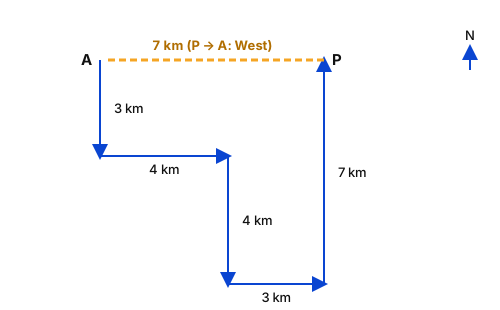
- South 3, left (east) 4, right (south) 4, left (east) 3, left (north) 7.
- North–south: → P is level with A.
- East: km → P is 7 km east of A.
- To return: 7 km towards West.
Trick: Net south and north cancel → distance is just the total east movement.
Answer: (C) 7 km; West
अवधारणा: कुल पूर्व–पश्चिम और उत्तर–दक्षिण विस्थापन निकालें।
- दक्षिण 3, बाएँ (पूर्व) 4, दाएँ (दक्षिण) 4, बाएँ (पूर्व) 3, बाएँ (उत्तर) 7।
- उत्तर–दक्षिण: → P, A की सीध में।
- पूर्व: km → P, A से 7 km पूर्व।
- वापस जाने के लिए: 7 km पश्चिम।
ट्रिक: दक्षिण–उत्तर कट जाते हैं → दूरी = कुल पूर्व गति।
उत्तर: (C) 7 km; पश्चिम
RRB NTPC Graduate CBT 1General Intelligence and ReasoningDirection and distanceRRB NTPC Graduate CBT 1 2024 · 5 Jun Shift 3
Q1339.A group of numbers and symbols is coded using letter codes as per the codes given below and the conditions that follow. Study the given codes and conditions and answer the question that follows.
Note: If none of the conditions apply, then codes for the respective number/symbol are to be followed directly as given in the table.
| Number/Symbol | 2 | @ | 9 | 5 | $ | & | 3 | % | # | 7 | + | 4 | 8 | 6 |
| Code | T | F | A | J | L | E | W | Q | D | P | R | B | U | S |
Conditions:
(i) If the first element is a symbol and the last a number, the codes for these two (the first and the last elements) are to be interchanged.
(ii) If the first element is an odd number and the last an even number, the first and last elements are to be coded as ©.
(iii) If both second and third elements are perfect squares, the third element is to be coded as the code for the second element.
If none of the above conditions are met, then the elements are to be simply coded as per the codes given in the question.
What will be the code for the following group?
@ 2 4 7 +
संख्याओं और प्रतीकों के एक समूह को नीचे दिए गए कूटों और उसके बाद दी गई शर्तों के अनुसार अक्षर कूटों का उपयोग करके कूटबद्ध किया जाता है। दिए गए कूटों और शर्तों का अध्ययन कीजिए और इसके बाद दिए गए प्रश्न का उत्तर दीजिए।
नोट: यदि कोई भी शर्त लागू नहीं होती है, तो संबंधित संख्या/प्रतीक के कूटों का सीधे तालिका में दिए गए अनुसार ही पालन करना है।
| संख्या/प्रतीक | 2 | @ | 9 | 5 | $ | & | 3 | % | # | 7 | + | 4 | 8 | 6 |
| कूट | T | F | A | J | L | E | W | Q | D | P | R | B | U | S |
शर्तें:
(i) यदि पहला तत्व एक प्रतीक है और अंतिम तत्व एक संख्या है, तो इन दोनों (पहले और अंतिम तत्वों) के कूटों को आपस में बदल दिया जाना है।
(ii) यदि पहला तत्व एक विषम संख्या है और अंतिम तत्व एक सम संख्या है, तो पहले और अंतिम तत्वों को © के रूप में कूटबद्ध किया जाना है।
(iii) यदि दूसरा और तीसरा दोनों तत्व पूर्ण वर्ग हैं, तो तीसरे तत्व को दूसरे तत्व के कूट के रूप में कूटबद्ध किया जाना है।
यदि उपरोक्त में से कोई भी शर्त पूरी नहीं होती है, तो तत्वों को केवल प्रश्न में दिए गए कूटों के अनुसार कूटबद्ध किया जाना है।
निम्नलिखित समूह के लिए कूट क्या होगा?
@ 2 4 7 +
- ARTBPF
- BRBBPF
- CFBBPR
- DFTBPR
Show answer
Concept: Check each condition, then code directly if none applies.
- (i): first @ is a symbol but last + is also a symbol → not applied.
- (ii): first is not a number → not applied. (iii): 2 is not a perfect square → not applied.
- Direct codes: @ = F, 2 = T, 4 = B, 7 = P, + = R.
Trick: Both ends symbols → (i) and (ii) fail at once; only check (iii).
Answer: (D) FTBPR
अवधारणा: प्रत्येक शर्त जाँचें; कोई लागू न हो तो सीधे कोड लिखें।
- (i): पहला @ प्रतीक है पर अंतिम + भी प्रतीक है → लागू नहीं।
- (ii): पहला तत्व संख्या नहीं → लागू नहीं। (iii): 2 पूर्ण वर्ग नहीं → लागू नहीं।
- सीधे कोड: @ = F, 2 = T, 4 = B, 7 = P, + = R।
ट्रिक: दोनों छोर प्रतीक → (i), (ii) तुरंत खारिज; केवल (iii) जाँचें।
उत्तर: (D) FTBPR
RRB NTPC Graduate CBT 1General Intelligence and ReasoningCoding with conditionsRRB NTPC Graduate CBT 1 2024 · 5 Jun Shift 3
Q1340.MILK is related to TPSR in a certain way based on the English alphabetical order. In the same way, POT is related to WVA. To which of the given options is NATION related, following the same logic?
अंग्रेज़ी वर्णमाला क्रम के आधार पर MILK एक निश्चित प्रकार से TPSR से संबंधित है। उसी प्रकार, POT, WVA से संबंधित है। समान तर्क का अनुसरण करते हुए, NATION दिए गए विकल्पों में से किससे संबंधित है?
- AUHAPVU
- BUHAPUV
- CUHAPUU
- DUHAAUV
Show answer
Concept: Each letter is moved a fixed number of places forward in the alphabet.
- MILK → TPSR: M(13)→T(20), I(9)→P(16), L(12)→S(19), K(11)→R(18): each .
- Check POT → WVA: P→W, O→V, T(20)→A. ✓
- NATION: N→U, A→H, T→A, I→P, O→V, N→U = UHAPVU.
Trick: After Z wrap around: subtract 26 when the position crosses 26.
Answer: (A) UHAPVU
अवधारणा: प्रत्येक अक्षर को वर्णमाला में निश्चित स्थान आगे खिसकाया गया है।
- MILK → TPSR: M(13)→T(20), I(9)→P(16), L(12)→S(19), K(11)→R(18): प्रत्येक ।
- जाँच POT → WVA: P→W, O→V, T(20)→A ✓
- NATION: N→U, A→H, T→A, I→P, O→V, N→U = UHAPVU।
ट्रिक: Z के बाद फिर A से गिनें: 26 से अधिक होने पर 26 घटाएँ।
उत्तर: (A) UHAPVU
RRB NTPC Graduate CBT 1General Intelligence and ReasoningCoding–decoding (letter shift)RRB NTPC Graduate CBT 1 2024 · 5 Jun Shift 3

