Q1341.Select the number from among the given options that can replace the question mark (?) in the following series.
62 61.1 60.2 59.3 58.4 57.5 ?
दिए गए विकल्पों में से उस संख्या का चयन कीजिए जो निम्नलिखित श्रृंखला में प्रश्न चिह्न (?) को प्रतिस्थापित कर सकती है।
62 61.1 60.2 59.3 58.4 57.5 ?
- A56.6
- B56.2
- C56.8
- D56.4
Show answer
Concept: Constant difference series.
- , , … each term decreases by .
- Next term .
Trick: Same decimal steps → simple subtraction series.
Answer: (A)
अवधारणा: स्थिर अंतर वाली श्रृंखला।
- , , … प्रत्येक पद घटता है।
- अगला पद ।
ट्रिक: दशमलव में एक समान अंतर → सीधी घटाव श्रृंखला।
उत्तर: (A)
RRB NTPC Graduate CBT 1General Intelligence and ReasoningNumber seriesRRB NTPC Graduate CBT 1 2024 · 5 Jun Shift 3
Q1342.54 is related to 59 following a certain logic. Following the same logic, 30 is related to 35. To which of the following is 11 related, following the same logic?
(NOTE: Operations should be performed on the whole numbers, without breaking down the numbers into their constituent digits. E.g. 13 – Operations on 13 such as
adding/subtracting/multiplying to 13 can be performed. Breaking down 13 into 1 and 3 and then performing mathematical operations on 1 and 3 is not allowed.)
54 एक निश्चित तर्क का अनुसरण करते हुए 59 से संबंधित है। उसी तर्क का अनुसरण करते हुए, 30, 35 से संबंधित है। समान तर्क का अनुसरण करते हुए, 11 निम्नलिखित में से किससे संबंधित है?
(नोट: संख्याओं को उनके घटक अंकों में विभाजित किए बिना, पूर्ण संख्याओं पर संक्रियाएँ की जानी चाहिए। उदाहरण के लिए, 13 – 13 पर संक्रियाएँ जैसे 13 में
जोड़ना/घटाना/गुणा करना आदि किया जा सकता है। 13 को 1 और 3 में विभाजित करना और फिर 1 और 3 पर गणितीय संक्रियाएँ करना वर्जित है।)
- A18
- B16
- C15
- D17
Show answer
Concept: Find the operation that links each pair.
- : .
- : . ✓
- So .
Trick: Check the simplest difference first; here both pairs differ by .
Answer: (B)
अवधारणा: प्रत्येक जोड़ी को जोड़ने वाली संक्रिया ज्ञात करें।
- : ।
- : ✓
- अतः ।
ट्रिक: पहले सबसे सरल अंतर देखें; यहाँ दोनों जोड़ियों में अंतर है।
उत्तर: (B)
RRB NTPC Graduate CBT 1General Intelligence and ReasoningNumber analogyRRB NTPC Graduate CBT 1 2024 · 5 Jun Shift 3
Q1343.If '+' means '−', '−' means '×', '×' means '÷' and '÷' means '+', then what will come in place of the question mark (?) in the following equation?
13 − 780 × 12 ÷ 16 + 32 = ?
यदि '+' का अर्थ '−', '−' का अर्थ '×', '×' का अर्थ '÷' और '÷' का अर्थ '+' है, तो निम्नलिखित समीकरण में प्रश्न चिह्न (?) के स्थान पर क्या आएगा?
13 − 780 × 12 ÷ 16 + 32 = ?
- A829
- B929
- C815
- D1232
Show answer
Concept: Replace symbols, then apply BODMAS.
- Given: .
- Replace (, , , ): .
- ; .
- .
Trick: Do the division first: , then the rest is quick.
Answer: (A)
अवधारणा: चिह्न बदलें, फिर BODMAS लगाएँ।
- दिया है: ।
- बदलने पर (, , , ): ।
- ; ।
- ।
ट्रिक: पहले भाग करें: , बाकी तुरंत।
उत्तर: (A)
RRB NTPC Graduate CBT 1General Intelligence and ReasoningMathematical operations (symbol substitution)RRB NTPC Graduate CBT 1 2024 · 5 Jun Shift 3
Q1344.A group of numbers and symbols is coded using letter codes as per the codes given below and the conditions that follow. Study the given codes and conditions and answer the question that follows.
Note: If none of the conditions apply, then codes for the respective number/symbol are to be followed directly as given in the table.
| Number/Symbol | 4 | @ | 7 | # | 3 | & | 8 | * | 2 | ^ | 9 | $ | 6 | + |
|---|
| Code | H | A | J | B | K | C | L | D | M | E | N | F | P | G |
|---|
Conditions:
(i) If the first element is a number and the last a symbol, the codes for these two (the first and the last elements) are to be interchanged.
(ii) If the first element is an even number and the last an odd number, the first and last elements are to be coded as '('.
(iii) If both second and third elements are perfect squares, the code of the third element will be the code for the second element.
What will be the code for the following group?
4739
संख्याओं और प्रतीकों के एक समूह को नीचे दिए गए कूटों और उसके बाद दी गई शर्तों के अनुसार अक्षर कूटों का उपयोग करके कूटबद्ध किया जाता है। दिए गए कूटों और शर्तों का अध्ययन कीजिए और इसके बाद दिए गए प्रश्न का उत्तर दीजिए।
नोट: यदि कोई भी शर्त लागू नहीं होती है, तो संबंधित संख्या/प्रतीक के कूटों का सीधे तालिका में दिए गए अनुसार ही पालन करना है।
| संख्या/प्रतीक | 4 | @ | 7 | # | 3 | & | 8 | * | 2 | ^ | 9 | $ | 6 | + |
|---|
| कूट | H | A | J | B | K | C | L | D | M | E | N | F | P | G |
|---|
शर्तें:
(i) यदि पहला तत्व एक संख्या है और अंतिम तत्व एक प्रतीक है, तो इन दोनों (पहले और अंतिम तत्वों) के कूटों को आपस में बदल दिया जाना है।
(ii) यदि पहला तत्व एक सम संख्या है और अंतिम तत्व एक विषम संख्या है, तो पहले और अंतिम तत्वों को '(' के रूप में कूटबद्ध किया जाना है।
(iii) यदि दूसरा और तीसरा दोनों तत्व पूर्ण वर्ग हैं, तो तीसरे तत्व का कूट ही दूसरे तत्व का कूट होगा।
निम्नलिखित समूह के लिए कूट क्या होगा?
4739
- A(JK(
- B(KJ(
- CHKJN
- DHJKN
Show answer
Concept: Check each condition on the group 4 7 3 9, then code the rest from the table.
- Codes: 4 = H, 7 = J, 3 = K, 9 = N.
- Condition (i): last element 9 is a number, not a symbol → not applicable.
- Condition (ii): first 4 is even, last 9 is odd → first and last become '('.
- Condition (iii): 7 and 3 are not perfect squares → not applicable. Middle stays J, K.
- Code = ( J K (.
Trick: Test conditions on the first/last elements first — they usually decide the answer quickly.
Answer: (A) (JK(
अवधारणा: समूह 4 7 3 9 पर हर शर्त जाँचें, फिर बाकी तालिका से कोड करें।
- कोड: 4 = H, 7 = J, 3 = K, 9 = N।
- शर्त (i): अंतिम 9 संख्या है, चिह्न नहीं → लागू नहीं।
- शर्त (ii): पहला 4 सम, अंतिम 9 विषम → पहला और अंतिम '(' बनेंगे।
- शर्त (iii): 7 और 3 पूर्ण वर्ग नहीं → लागू नहीं; बीच के J, K ही रहेंगे।
- कोड = ( J K (।
ट्रिक: पहले/अंतिम तत्व वाली शर्तें पहले जाँचें — उत्तर जल्दी मिलता है।
उत्तर: (A) (JK(
RRB NTPC Graduate CBT 1General Intelligence and ReasoningCoding with conditionsRRB NTPC Graduate CBT 1 2024 · 5 Jun Shift 3
Q1345.What will come in place of the question mark (?) in the following equation, if ‘+’ and ‘−’ are interchanged and ‘×’ and ‘÷’ are interchanged?
54 ÷ 11 + 272 × 8 − 114 = ?
यदि ‘+’ और ‘−’ को आपस में बदल दिया जाए तथा ‘×’ और ‘÷’ को आपस में बदल दिया जाए, तो निम्नलिखित समीकरण में प्रश्न चिह्न (?) के स्थान पर क्या आएगा?
54 ÷ 11 + 272 × 8 − 114 = ?
- A674
- B672
- C675
- D673
Show answer
Concept: Interchange the signs, then apply BODMAS.
- Given: .
- After swapping (, ): .
- ; .
- .
Trick: Rewrite the whole expression first, then calculate — avoids sign mistakes.
Answer: (A)
अवधारणा: चिह्न बदलें, फिर BODMAS लगाएँ।
- दिया है: ।
- अदला-बदली के बाद (, ): ।
- ; ।
- ।
ट्रिक: पहले पूरा व्यंजक दोबारा लिखें, फिर गणना करें — चिह्न की गलती नहीं होगी।
उत्तर: (A)
RRB NTPC Graduate CBT 1General Intelligence and ReasoningMathematical operations (interchange)RRB NTPC Graduate CBT 1 2024 · 5 Jun Shift 3
Q1346.What should come in place of the question mark (?) in the given series based on the English alphabetical order?
JGM KHN LIO MJP ?
अंग्रेज़ी वर्णमाला क्रम के आधार पर दी गई श्रृंखला में प्रश्न चिह्न (?) के स्थान पर क्या आना चाहिए?
JGM KHN LIO MJP ?
- ANKR
- BNLR
- CNLQ
- DNKQ
Show answer
Concept: Each letter of the cluster moves +1.
- 1st letters: J, K, L, M → N.
- 2nd letters: G, H, I, J → K.
- 3rd letters: M, N, O, P → Q.
- Next term = NKQ.
Trick: Read the series column-wise: three separate +1 sequences.
Answer: (D) NKQ
अवधारणा: समूह का प्रत्येक अक्षर +1 बढ़ता है।
- पहले अक्षर: J, K, L, M → N।
- दूसरे अक्षर: G, H, I, J → K।
- तीसरे अक्षर: M, N, O, P → Q।
- अगला पद = NKQ।
ट्रिक: श्रृंखला को स्तंभ-वार पढ़ें: तीन अलग +1 क्रम।
उत्तर: (D) NKQ
RRB NTPC Graduate CBT 1General Intelligence and ReasoningLetter seriesRRB NTPC Graduate CBT 1 2024 · 5 Jun Shift 3
Q1347.If 2 is added to each even digit and 1 is subtracted from each odd digit in the number 6435127, what will be the sum of the second digit from the left and the third digit from the right in the new number thus formed?
यदि संख्या 6435127 में प्रत्येक सम अंक में 2 जोड़ा जाए और प्रत्येक विषम अंक में से 1 घटाया जाए, तो इस प्रकार बनी नई संख्या में बाएँ से दूसरे अंक और दाएँ से तीसरे अंक का योग क्या होगा?
- A4
- B10
- C8
- D6
Show answer
Concept: Change each digit, then pick positions.
- Number: 6 4 3 5 1 2 7. Even digits , odd digits .
- New number: 8 6 2 4 0 4 6.
- 2nd from left ; 3rd from right (from right: 6, 4, 0).
- Sum .
Trick: Write the new number fully before counting positions from the right.
Answer: (D)
अवधारणा: हर अंक बदलें, फिर स्थान चुनें।
- संख्या: 6 4 3 5 1 2 7। सम अंक , विषम अंक ।
- नई संख्या: 8 6 2 4 0 4 6।
- बाएँ से दूसरा ; दाएँ से तीसरा (दाएँ से: 6, 4, 0)।
- योग ।
ट्रिक: दाएँ से गिनने से पहले पूरी नई संख्या लिख लें।
उत्तर: (D)
RRB NTPC Graduate CBT 1General Intelligence and ReasoningDigit operationsRRB NTPC Graduate CBT 1 2024 · 5 Jun Shift 3
Q1348.Study the given Venn diagram carefully and answer the questions.
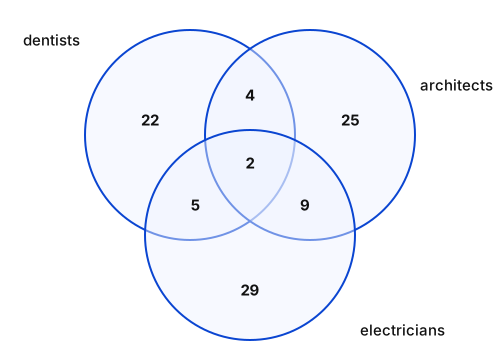
The numbers in different sections indicate the number of persons. How many electricians are there who are also architects but not dentists?
दिए गए वेन आरेख का ध्यानपूर्वक अध्ययन कीजिए और प्रश्नों के उत्तर दीजिए।
विभिन्न खंडों में दी गई संख्याएँ व्यक्तियों की संख्या दर्शाती हैं। ऐसे कितने इलेक्ट्रीशियन हैं जो आर्किटेक्ट भी हैं लेकिन डेंटिस्ट नहीं हैं?
- A5
- B2
- C9
- D4
Show answer
Concept: 'Electricians who are architects but not dentists' = region in E and A only, outside D.
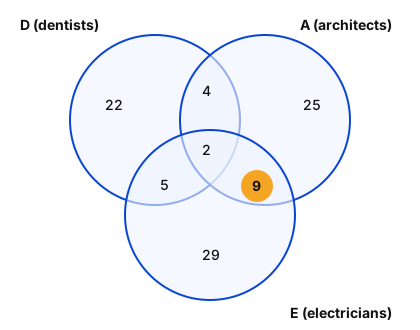
- E ∩ A (both) contains persons.
- The in the centre are also dentists, so exclude them.
- Required .
Trick: 'Both but not the third' → the two-circle overlap region only, never the centre.
Answer: (C)
अवधारणा: 'वे इलेक्ट्रीशियन जो आर्किटेक्ट भी हैं पर डेंटिस्ट नहीं' = केवल E और A का साझा क्षेत्र, D से बाहर।
- E ∩ A में व्यक्ति हैं।
- बीच के डेंटिस्ट भी हैं, अतः उन्हें हटाएँ।
- अभीष्ट ।
ट्रिक: 'दोनों पर तीसरा नहीं' → केवल दो वृत्तों का साझा भाग, केंद्र नहीं।
उत्तर: (C)
RRB NTPC Graduate CBT 1General Intelligence and ReasoningVenn diagram – reading regionsRRB NTPC Graduate CBT 1 2024 · 5 Jun Shift 3
Q1349.In a certain code language,
A + B means ‘A is the mother of B’,
A − B means ‘A is the brother of B’,
A × B means ‘A is the wife of B’ and
A ÷ B means ‘A is the father of B’.
How is M related to Q if ‘M + N × O − P ÷ Q’?
एक निश्चित कूट भाषा में,
A + B का अर्थ है ‘A, B की माँ है’,
A − B का अर्थ है ‘A, B का भाई है’,
A × B का अर्थ है ‘A, B की पत्नी है’ और
A ÷ B का अर्थ है ‘A, B का पिता है’।
यदि ‘M + N × O − P ÷ Q’ है, तो M, Q से किस प्रकार संबंधित है?
- AMother's brother's wife's sisterमाँ के भाई की पत्नी की बहन
- BFather's brother's wife's sisterपिता के भाई की पत्नी की बहन
- CFather's brother's wife's motherपिता के भाई की पत्नी की माँ
- DMother's brother's wife's motherमाँ के भाई की पत्नी की माँ
Show answer
Concept: Decode each symbol and build the family tree.
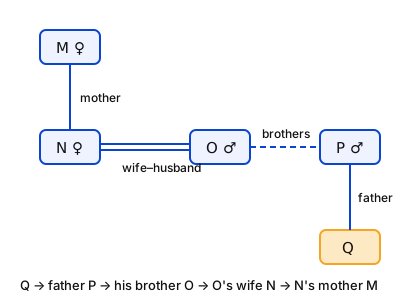
- M + N: M is the mother of N. N × O: N is the wife of O.
- O − P: O is the brother of P. P ÷ Q: P is the father of Q.
- From Q: father = P → father's brother = O → his wife = N → her mother = M.
- M is Q's father's brother's wife's mother.
Trick: Start from the person asked about (Q) and walk back along the chain.
Answer: (C) Father's brother's wife's mother
अवधारणा: प्रत्येक चिह्न को खोलकर वंश-वृक्ष बनाएँ।
- M + N: M, N की माँ है। N × O: N, O की पत्नी है।
- O − P: O, P का भाई है। P ÷ Q: P, Q का पिता है।
- Q से: पिता = P → पिता का भाई = O → उसकी पत्नी = N → उसकी माँ = M।
- M, Q के पिता के भाई की पत्नी की माँ है।
ट्रिक: जिसके बारे में पूछा है (Q) वहीं से शुरू कर श्रृंखला में पीछे चलें।
उत्तर: (C) Father's brother's wife's mother (पिता के भाई की पत्नी की माँ)
RRB NTPC Graduate CBT 1General Intelligence and ReasoningBlood relations – codedRRB NTPC Graduate CBT 1 2024 · 5 Jun Shift 3
Q1350.Rajendra starts from point A and drives 9 km towards the north. He then takes a left turn, drives 7 km, turns left and drives 11 km. He then takes a left turn and drives 10 km. He takes a final left turn, drives 2 km and stops at point P. How far (shortest distance) and towards which direction should he drive in order to reach point A again? (All turns are 90 degree turns only unless specified.)
राजेंद्र बिंदु A से शुरू करता है और उत्तर की ओर 9 km ड्राइव करता है। फिर वह बाएँ मुड़ता है, 7 km ड्राइव करता है, बाएँ मुड़ता है और 11 km ड्राइव करता है। फिर वह बाएँ मुड़ता है और 10 km ड्राइव करता है। वह अंतिम बार बाएँ मुड़ता है, 2 km ड्राइव करता है और बिंदु P पर रुक जाता है। बिंदु A पर पुनः पहुँचने के लिए उसे कितनी दूर (न्यूनतम दूरी) और किस दिशा में ड्राइव करना चाहिए? (जब तक निर्दिष्ट न किया जाए, सभी मोड़ केवल 90 डिग्री के मोड़ हैं।)
- A3 km to the westपश्चिम की ओर 3 km
- B1 km to the westपश्चिम की ओर 1 km
- C2 km to the westपश्चिम की ओर 2 km
- D3 km to the eastपूर्व की ओर 3 km
Show answer
Concept: Track net north–south and east–west displacement (every left turn here is a 90° turn).
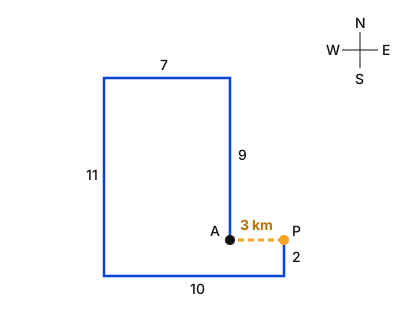
- North 9 → left (west) 7 → left (south) 11 → left (east) 10 → left (north) 2.
- North–south: .
- East–west: east of A.
- So P is 3 km east of A; to return he drives 3 km to the west.
Trick: Four left turns bring you back to the start direction — only the leftover east–west gap matters.
Answer: (A) 3 km to the west
अवधारणा: उत्तर–दक्षिण व पूर्व–पश्चिम कुल विस्थापन ज्ञात करें (हर बायाँ मोड़ 90°)।
- उत्तर 9 → बाएँ (पश्चिम) 7 → बाएँ (दक्षिण) 11 → बाएँ (पूर्व) 10 → बाएँ (उत्तर) 2।
- उत्तर–दक्षिण: ।
- पूर्व–पश्चिम: A के पूर्व।
- अतः P, A से 3 km पूर्व; लौटने के लिए 3 km पश्चिम जाना होगा।
ट्रिक: चार बाएँ मोड़ों के बाद दिशा वही — केवल बचा पूर्व–पश्चिम अंतर देखें।
उत्तर: (A) 3 km पश्चिम
RRB NTPC Graduate CBT 1General Intelligence and ReasoningDirection and distanceRRB NTPC Graduate CBT 1 2024 · 5 Jun Shift 3
Q1351.Select the number from among the given options that can replace the question mark (?) in the following series.
37 55 66 84 95 113 ?
दिए गए विकल्पों में से उस संख्या का चयन कीजिए जो निम्नलिखित श्रृंखला में प्रश्न चिह्न (?) के स्थान पर आ सकती है।
37 55 66 84 95 113 ?
- A166
- B145
- C131
- D124
Show answer
Concept: Look at the differences between consecutive terms.
- Differences: +18, +11, +18, +11, +18, …
- Next difference = +11: .
Trick: Alternating add pattern (+18, +11) – check differences first.
Answer: (D) 124
अवधारणा: क्रमागत पदों का अंतर देखें।
- अंतर: +18, +11, +18, +11, +18, …
- अगला अंतर +11: .
ट्रिक: वैकल्पिक जोड़ (+18, +11) – पहले अंतर जाँचें।
उत्तर: (D) 124
RRB NTPC Graduate CBT 1General Intelligence and ReasoningNumber SeriesRRB NTPC Graduate CBT 1 2024 · 5 Jun Shift 2
Q1352.In a certain code language, ‘GIVE’ is coded as ‘4628’ and ‘VOLT’ is coded as ‘3567’. What is the code for ‘V’ in the given code language?
एक निश्चित कूट भाषा में, ‘GIVE’ को ‘4628’ और ‘VOLT’ को ‘3567’ के रूप में कूटबद्ध किया जाता है। दी गई कूट भाषा में ‘V’ का कूट क्या है?
- A2
- B5
- C6
- D3
Show answer
Concept: A letter common to two words gets the digit common to their codes.
- GIVE = {G,I,V,E} → {4,6,2,8}; VOLT = {V,O,L,T} → {3,5,6,7}.
- Common letter: V; common digit: 6.
- So V = 6.
Trick: Common letter ↔ common digit.
Answer: (C) 6
अवधारणा: दो शब्दों में उभयनिष्ठ अक्षर का कोड उनके कोड में उभयनिष्ठ अंक होता है।
- GIVE = {G,I,V,E} → {4,6,2,8}; VOLT = {V,O,L,T} → {3,5,6,7}.
- उभयनिष्ठ अक्षर: V; उभयनिष्ठ अंक: 6.
- अतः V = 6.
ट्रिक: उभयनिष्ठ अक्षर ↔ उभयनिष्ठ अंक।
उत्तर: (C) 6
RRB NTPC Graduate CBT 1General Intelligence and ReasoningCoding-DecodingRRB NTPC Graduate CBT 1 2024 · 5 Jun Shift 2
Q1353.Which of the following letter-clusters should replace # and % so that the pattern and relationship followed between the letter-cluster pair on the left side of :: is the same as that on the right side of ::?
# : FLN :: TXB : %
निम्नलिखित में से कौन-से अक्षर-समूह # और % को प्रतिस्थापित करने चाहिए, ताकि :: के बाईं ओर के अक्षर-समूह युग्म के बीच का पैटर्न और संबंध वही हो जो :: के दाईं ओर है?
# : FLN :: TXB : %
- A# = BPJ, % = XTF
- B# = LFT, % = BPJ
- C# = XTF, % = PBX
- D# = PBX, % = XTF
Show answer
Concept: Find the letter shifts from first cluster to second on one side and apply them on the other side.
- Try (A): BPJ → FLN: B+4=F, P−4=L, J+4=N → pattern (+4, −4, +4).
- TXB → T+4=X, X−4=T, B+4=F = XTF ✓.
Trick: Test each option on the left pair first; reuse the same shifts on the right.
Answer: (A) # = BPJ, % = XTF
अवधारणा: बाएँ जोड़े में अक्षरों का खिसकाव (shift) निकालें और दाएँ जोड़े पर लगाएँ।
- विकल्प (A): BPJ → FLN: B+4=F, P−4=L, J+4=N → पैटर्न (+4, −4, +4)।
- TXB → T+4=X, X−4=T, B+4=F = XTF ✓.
ट्रिक: पहले बाएँ जोड़े पर विकल्प जाँचें, वही shift दाईं ओर लगाएँ।
उत्तर: (A) # = BPJ, % = XTF
RRB NTPC Graduate CBT 1General Intelligence and ReasoningLetter AnalogyRRB NTPC Graduate CBT 1 2024 · 5 Jun Shift 2
Q1354.Based on the English alphabetical order, three of the following four letter-cluster pairs are alike in a certain way and thus form a group. Which letter-cluster pair DOES NOT belong to that group? (Note: The odd one out is not based on the number of
consonants/vowels or their position in the letter cluster)
अंग्रेज़ी वर्णमाला क्रम के आधार पर, निम्नलिखित चार अक्षर-समूह युग्मों में से तीन किसी निश्चित प्रकार से एकसमान हैं और इस प्रकार एक समूह बनाते हैं। कौन-सा अक्षर-समूह युग्म उस समूह से संबंधित नहीं है? (ध्यान दें: असंगत अक्षर-समूह, उस अक्षर-समूह में
व्यंजनों/स्वरों की संख्या या उनके स्थान पर आधारित नहीं है।)
- AHK - LP
- BKL - FG
- CXY - ST
- DOP - JK
Show answer
Concept: Compare letters at the same position in the two clusters.
- KL − FG: K−5=F, L−5=G; XY − ST: −5, −5; OP − JK: −5, −5.
- HK − LP: H+4=L, K+5=P – different rule (also H, K are not consecutive).
Trick: Three pairs = "consecutive letters, each moved back 5".
Answer: (A) HK - LP
अवधारणा: दोनों समूहों में समान स्थान के अक्षरों की तुलना करें।
- KL − FG: K−5=F, L−5=G; XY − ST: −5, −5; OP − JK: −5, −5.
- HK − LP: H+4=L, K+5=P – अलग नियम (H, K क्रमागत भी नहीं)।
ट्रिक: तीन जोड़े = "क्रमागत अक्षर, प्रत्येक 5 पीछे"।
उत्तर: (A) HK - LP
RRB NTPC Graduate CBT 1General Intelligence and ReasoningOdd One Out – Letter PairsRRB NTPC Graduate CBT 1 2024 · 5 Jun Shift 2
Q1355.If ‘S’ stands for ‘−’, ‘Q’ stands for ‘×’, ‘R’ stands for ‘÷’, and ‘P’ stands for ‘+’, what will come in place of the question mark (?) in the following equation?
1 P 4 5 R 2 Q 2 S 4 = ?
यदि ‘S’ का अर्थ ‘−’, ‘Q’ का अर्थ ‘×’, ‘R’ का अर्थ ‘÷’ और ‘P’ का अर्थ ‘+’ है, तो निम्नलिखित समीकरण में प्रश्न चिह्न (?) के स्थान पर क्या आएगा?
1 P 4 5 R 2 Q 2 S 4 = ?
- A40
- B42
- C46
- D36
Show answer
Concept: Replace letters by signs, then apply BODMAS.
Trick: ÷ and × are done left to right before + and −.
Answer: (B) 42
अवधारणा: अक्षरों को चिह्नों से बदलें, फिर BODMAS लगाएँ।
ट्रिक: ÷ और × बाएँ से दाएँ, फिर + और −।
उत्तर: (B) 42
RRB NTPC Graduate CBT 1General Intelligence and ReasoningMathematical OperationsRRB NTPC Graduate CBT 1 2024 · 5 Jun Shift 2
Q1356.P, Q, R, S, T, U and V are sitting around a circular table facing the centre. Only one person sits between R and T when counted from the left of T. Q sits third to the right of P. U sits third to the left of V. Q sits to the immediate right of U. S is not an immediate neighbour of U. How many people sit between S and T when counted from the right of S?
P, Q, R, S, T, U और V एक वृत्ताकार मेज़ के चारों ओर केंद्र की ओर मुख करके बैठे हैं। T के बाएँ से गिनने पर R और T के बीच केवल एक व्यक्ति बैठा है। Q, P के दाएँ से तीसरे स्थान पर बैठा है। U, V के बाएँ से तीसरे स्थान पर बैठा है। Q, U के ठीक दाएँ बैठा है। S, U का निकटतम पड़ोसी नहीं है। S के दाएँ से गिनने पर S और T के बीच कितने व्यक्ति बैठे हैं?
- A4
- B2
- C3
- D1
Show answer
Concept: Facing the centre: right = anticlockwise, left = clockwise.
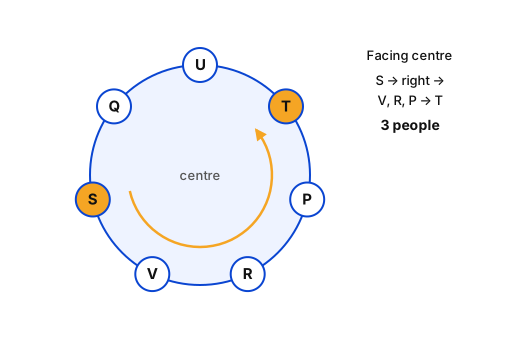
- U fixed; Q is immediate right of U; P is 3rd to the left of Q (Q 3rd right of P); V is 3rd to the right of U.
- Remaining 3 seats for R, S, T. R is 2nd to the left of T; S not next to U → T next to U, then R, then S.
- Order (clockwise): U, T, P, R, V, S, Q.
- From S going right: V, R, P, then T → 3 people.
Trick: Fix the person with most links (U) first.
Answer: (C) 3
अवधारणा: केंद्र की ओर मुख: दायाँ = वामावर्त (anticlockwise), बायाँ = दक्षिणावर्त (clockwise)।
- U निश्चित; Q, U के तुरंत दाएँ; P, Q के बाएँ तीसरा; V, U के दाएँ तीसरा।
- बची 3 सीटें R, S, T की। R, T के बाएँ दूसरा; S, U का पड़ोसी नहीं → T, U के पास, फिर R, फिर S।
- क्रम (clockwise): U, T, P, R, V, S, Q.
- S के दाएँ से: V, R, P, फिर T → 3 व्यक्ति।
ट्रिक: सबसे अधिक संबंध वाले व्यक्ति (U) को पहले रखें।
उत्तर: (C) 3
RRB NTPC Graduate CBT 1General Intelligence and ReasoningCircular Seating ArrangementRRB NTPC Graduate CBT 1 2024 · 5 Jun Shift 2
Q1357.If 2 is added to each even digit and 1 is subtracted from each odd digit in the number 6154932, how many digits will appear more than once in the new number thus formed?
यदि संख्या 6154932 में प्रत्येक सम अंक में 2 जोड़ा जाए और प्रत्येक विषम अंक में से 1 घटाया जाए, तो इस प्रकार बनी नई संख्या में कितने अंक एक से अधिक बार आएँगे?
- AThreeतीन
- BFourचार
- CTwoदो
- DOneएक
Show answer
Concept: Change each digit separately: even + 2, odd − 1.
- 6→8, 1→0, 5→4, 4→6, 9→8, 3→2, 2→4
- New number: 8046824
- 8 appears twice, 4 appears twice; 0, 6, 2 once → two digits.
Trick: Write the new number fully, then tally.
Answer: (C) Two
अवधारणा: हर अंक अलग से बदलें: सम + 2, विषम − 1।
- 6→8, 1→0, 5→4, 4→6, 9→8, 3→2, 2→4
- नई संख्या: 8046824
- 8 दो बार, 4 दो बार; 0, 6, 2 एक बार → दो अंक।
ट्रिक: नई संख्या पूरी लिखें, फिर गिनें।
उत्तर: (C) Two
RRB NTPC Graduate CBT 1General Intelligence and ReasoningDigit OperationsRRB NTPC Graduate CBT 1 2024 · 5 Jun Shift 2
Q1358.Which of the following letter-clusters should replace # and % so that the pattern and relationship followed between the letter-cluster pair on the left side of :: is the same as that on the right side of :: ?
# : LPR :: PSV : %
निम्नलिखित में से कौन-से अक्षर-समूह # और % को प्रतिस्थापित करने चाहिए, ताकि :: के बाईं ओर के अक्षर-समूह युग्म के बीच का पैटर्न और संबंध वही हो जो :: के दाईं ओर है?
# : LPR :: PSV : %
- A# = HNT, % = TUT
- B# = HMR, % = TVW
- C# = FNR, % = RVM
- D# = FMP, % = RUY
Show answer
Concept: Find the shift from # to LPR and apply the same shift to PSV.
- (A) HNT → LPR: H+4=L, N+2=P, T−2=R → (+4, +2, −2).
- PSV → P+4=T, S+2=U, V−2=T = TUT ✓.
Trick: Check the left pair for each option; keep the one whose shifts also give a listed %.
Answer: (A) # = HNT, % = TUT
अवधारणा: # से LPR तक का खिसकाव निकालकर PSV पर लगाएँ।
- (A) HNT → LPR: H+4=L, N+2=P, T−2=R → (+4, +2, −2)।
- PSV → P+4=T, S+2=U, V−2=T = TUT ✓.
ट्रिक: हर विकल्प का बायाँ जोड़ा जाँचें; जिसका % भी मिले वही सही।
उत्तर: (A) # = HNT, % = TUT
RRB NTPC Graduate CBT 1General Intelligence and ReasoningLetter AnalogyRRB NTPC Graduate CBT 1 2024 · 5 Jun Shift 2
Q1359.Which of the following letter-clusters should replace # and % so that the pattern and relationship followed between the letter-cluster pair on the left side of :: is the same as that on the right side of ::?
# : AND :: RWX : %
निम्नलिखित में से कौन-से अक्षर-समूह # और % को प्रतिस्थापित करने चाहिए, ताकि :: के बाईं ओर के अक्षर-समूह युग्म के बीच का पैटर्न और संबंध वही हो जो :: के दाईं ओर है?
# : AND :: RWX : %
- A# = UTZ, % = OZV
- B# = OZV, % = LCT
- C# = XQB, % = UTZ
- D# = LCT, % = XQB
Show answer
Concept: Find the shift from # to AND and apply it to RWX.
- (C) XQB → AND: X+3=A (wrap-around), Q−3=N, B+2=D → (+3, −3, +2).
- RWX → R+3=U, W−3=T, X+2=Z = UTZ ✓.
Trick: Remember wrap-around: X → Y → Z → A.
Answer: (C) # = XQB, % = UTZ
अवधारणा: # से AND तक का खिसकाव निकालकर RWX पर लगाएँ।
- (C) XQB → AND: X+3=A (Z के बाद फिर A), Q−3=N, B+2=D → (+3, −3, +2)।
- RWX → R+3=U, W−3=T, X+2=Z = UTZ ✓.
ट्रिक: चक्रीय क्रम याद रखें: X → Y → Z → A।
उत्तर: (C) # = XQB, % = UTZ
RRB NTPC Graduate CBT 1General Intelligence and ReasoningLetter AnalogyRRB NTPC Graduate CBT 1 2024 · 5 Jun Shift 2
Q1360.Select the triad that follows the same pattern as that followed by the two triads given below. Both triads follow the same pattern.
EL-GN-IK
GN-IP-KM
उस त्रयी का चयन कीजिए जो नीचे दी गई दो त्रयियों के समान पैटर्न का अनुसरण करती है। दोनों त्रयी एक ही पैटर्न का अनुसरण करती हैं।
EL-GN-IK
GN-IP-KM
- AJP-KR-MQ
- BIP-KR-MQ
- CIP-KR-MO
- DJP-KS-MQ
Show answer
Concept: Check each letter position separately.
- EL-GN-IK: E→G→I (+2, +2); L→N (+2), N→K (−3).
- GN-IP-KM: same rule.
- IP-KR-MO: I→K→M; P→R (+2), R→O (−3) ✓.
Trick: Option (B) gives MQ – the second letter must be R−3 = O, not Q.
Answer: (C) IP-KR-MO
अवधारणा: हर स्थान के अक्षर अलग जाँचें।
- EL-GN-IK: E→G→I (+2, +2); L→N (+2), N→K (−3)।
- GN-IP-KM: वही नियम।
- IP-KR-MO: I→K→M; P→R (+2), R→O (−3) ✓.
ट्रिक: (B) में MQ है – दूसरा अक्षर R−3 = O होना चाहिए, Q नहीं।
उत्तर: (C) IP-KR-MO
RRB NTPC Graduate CBT 1General Intelligence and ReasoningLetter TriadsRRB NTPC Graduate CBT 1 2024 · 5 Jun Shift 2

