Q5581.If ‘A’ stands for ‘÷’, ‘B’ stands for ‘×’, ‘C’ stands for ‘+’ and ‘D’ stands for ‘−’, what will come in place of the question mark (?) in the following equation?
46 A 2 C 21 D 8 B 3 = ?
यदि ‘A’ का अर्थ ‘÷’, ‘B’ का अर्थ ‘×’, ‘C’ का अर्थ ‘+’ और ‘D’ का अर्थ ‘−’ है, तो निम्नलिखित समीकरण में प्रश्न चिह्न (?) के स्थान पर क्या आएगा?
46 A 2 C 21 D 8 B 3 = ?
- A33
- B20
- C26
- D41
Show answer
Concept: Replace letters by signs, then follow BODMAS.
- .
- .
- .
Trick: Do and first: 23 and 24, then .
Answer: (B) 20
अवधारणा: अक्षरों को चिह्नों से बदलें, फिर BODMAS लगाएँ।
- ।
- ।
- ।
ट्रिक: पहले और : 23 और 24, फिर ।
उत्तर: (B) 20
RRB NTPC Undergraduate CBT 1General Intelligence and ReasoningMathematical OperationsRRB NTPC Undergraduate CBT 1 2024 · 7 Aug Shift 1
Q5582.This question is based on the five, three-digit numbers given below.
(Left) 324 523 643 136 441 (Right)
(Example- 697 – First digit = 6, second digit = 9 and third digit = 7)
(NOTE: All operations to be done from left to right.)
If 3 is added to the first digit of every number, in how many numbers will the first digit be exactly divisible by the second digit?
यह प्रश्न नीचे दी गई पाँच, तीन अंकों वाली संख्याओं पर आधारित है।
(बाएँ) 324 523 643 136 441 (दाएँ)
(उदाहरण- 697 – पहला अंक = 6, दूसरा अंक = 9 और तीसरा अंक = 7)
(ध्यान दें: सभी संक्रियाएँ बाएँ से दाएँ की जानी हैं।)
यदि प्रत्येक संख्या के पहले अंक में 3 जोड़ दिया जाए, तो कितनी संख्याओं में पहला अंक, दूसरे अंक से पूर्णतः विभाज्य होगा?
- A1
- B4
- C3
- D2
Show answer
Concept: Change only the first digit, then test divisibility by the second digit.
- 324 → first 6, second 2: ✓.
- 523 → 8, 2: ✓.
- 643 → 9, 4 ✗; 136 → 4, 3 ✗; 441 → 7, 4 ✗.
- Count .
Trick: Second digit 2 always divides an even first digit — only 324 and 523 have it.
Answer: (D) 2
अवधारणा: केवल पहला अंक बदलें, फिर दूसरे अंक से विभाज्यता जाँचें।
- 324 → पहला 6, दूसरा 2: ✓।
- 523 → 8, 2: ✓।
- 643 → 9, 4 ✗; 136 → 4, 3 ✗; 441 → 7, 4 ✗।
- संख्या ।
ट्रिक: दूसरा अंक 2 हो तो सम पहला अंक विभाज्य — केवल 324 और 523 में।
उत्तर: (D) 2
RRB NTPC Undergraduate CBT 1General Intelligence and ReasoningNumber Puzzle – DigitsRRB NTPC Undergraduate CBT 1 2024 · 7 Aug Shift 1
Q5583.Seven boxes, A, B, C, D, M, N and O, are kept one over the other but not necessarily in the same order.
No box is kept above B. Only three boxes are kept between B and N. Only one box is kept between D and A. Only C is kept below O. A is kept immediately above N. Only four boxes are kept between D and C. How many boxes are kept below M?
सात बक्से, A, B, C, D, M, N और O, एक के ऊपर एक रखे गए हैं, लेकिन ज़रूरी नहीं कि इसी क्रम में हों।
B के ऊपर कोई बक्सा नहीं रखा गया है। B और N के बीच केवल तीन बक्से रखे गए हैं। D और A के बीच केवल एक बक्सा रखा गया है। O के नीचे केवल C रखा गया है। A, N के ठीक ऊपर रखा गया है। D और C के बीच केवल चार बक्से रखे गए हैं। M के नीचे कितने बक्से रखे गए हैं?
- AFiveपाँच
- BFourचार
- CTwoदो
- DThreeतीन
Show answer
Concept: Number positions 1 (bottom) to 7 (top) and place the fixed clues first.
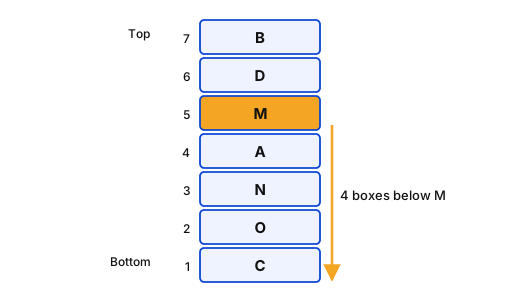
- No box above B → B = 7. Three between B and N → N = 3; A just above N → A = 4.
- Only C below O → C = 1, O = 2.
- One between D and A → D = 2 or 6; 2 is taken → D = 6 (four between D and C ✓).
- M = 5 → boxes below M: A, N, O, C = 4.
Trick: 'Only C is below O' fixes the bottom two boxes at once.
Answer: (B) Four
अवधारणा: स्थान 1 (नीचे) से 7 (ऊपर) तक मानें और पहले निश्चित संकेत रखें।
- B के ऊपर कोई नहीं → B = 7। B और N के बीच तीन → N = 3; A, N के ठीक ऊपर → A = 4।
- O के नीचे केवल C → C = 1, O = 2।
- D और A के बीच एक → D = 2 या 6; 2 भरा → D = 6 (D और C के बीच चार ✓)।
- M = 5 → M के नीचे: A, N, O, C = 4।
ट्रिक: 'O के नीचे केवल C' से नीचे के दो बॉक्स तुरंत तय।
उत्तर: (B) चार
RRB NTPC Undergraduate CBT 1General Intelligence and ReasoningBox ArrangementRRB NTPC Undergraduate CBT 1 2024 · 7 Aug Shift 1
Q5584.In a certain code language, ‘GALE’ is coded as ‘7513’ and ‘FLEA’ is coded as ‘5197’. What is the code for ‘F’ in that language?
एक निश्चित कूट भाषा में, ‘GALE’ को ‘7513’ के रूप में कूटबद्ध किया जाता है और ‘FLEA’ को ‘5197’ के रूप में कूटबद्ध किया जाता है। उस भाषा में ‘F’ का कूट क्या है?
- A1
- B9
- C5
- D7
Show answer
Concept: Codes are jumbled; compare common letters with common digits.
- GALE → {7, 5, 1, 3}; FLEA → {5, 1, 9, 7}.
- Common letters A, L, E ↔ common digits 7, 5, 1.
- Leftover: G → 3 and F → 9.
Trick: The only letter unique to FLEA gets the only digit unique to its code: 9.
Answer: (B) 9
अवधारणा: कोड क्रम में नहीं हैं; उभयनिष्ठ अक्षरों की तुलना उभयनिष्ठ अंकों से करें।
- GALE → {7, 5, 1, 3}; FLEA → {5, 1, 9, 7}।
- उभयनिष्ठ अक्षर A, L, E ↔ उभयनिष्ठ अंक 7, 5, 1।
- बचे: G → 3 और F → 9।
ट्रिक: FLEA का अकेला अलग अक्षर F, उसके कोड का अकेला अलग अंक 9 पाता है।
उत्तर: (B) 9
RRB NTPC Undergraduate CBT 1General Intelligence and ReasoningCoding-Decoding – Letter CodesRRB NTPC Undergraduate CBT 1 2024 · 7 Aug Shift 1
Q5585.Seven people, A, B, C, T, U, V and W are sitting in a row, facing north. Only two people sit to the right of C. Only two people sit between C and U. Only two people sit between A and V. V sits to the immediate left of C. T sits to the immediate right of W. Who sits at third position from the left end of the line?
सात व्यक्ति, A, B, C, T, U, V और W उत्तर की ओर मुख करके एक पंक्ति में बैठे हैं। C के दाईं ओर केवल दो व्यक्ति बैठे हैं। C और U के बीच केवल दो व्यक्ति बैठे हैं। A और V के बीच केवल दो व्यक्ति बैठे हैं। V, C के ठीक बाईं ओर बैठा है। T, W के ठीक दाईं ओर बैठा है। पंक्ति के बाएँ छोर से तीसरे स्थान पर कौन बैठा है?
- AT
- BU
- CA
- DB
Show answer
Concept: Number seats 1–7 from the left (all face north) and place definite clues first.
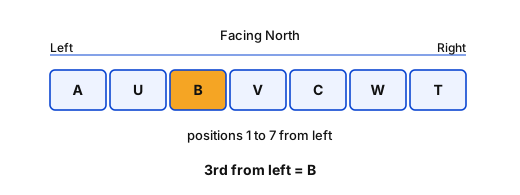
- Two to the right of C → C = 5. V immediately left of C → V = 4.
- Two between C and U → U = 2. Two between A and V → A = 1 or 7.
- W, T must be adjacent (T right of W): if A = 7, free seats 1, 3, 6 have no adjacent pair ✗. So A = 1, W = 6, T = 7, B = 3.
Trick: Use the W–T pair to decide where A goes.
Answer: (D) B
अवधारणा: बाएँ से सीट 1–7 मानें (सभी उत्तर की ओर) और पहले निश्चित संकेत रखें।
- C के दाएँ केवल दो → C = 5। V, C के ठीक बाएँ → V = 4।
- C और U के बीच दो → U = 2। A और V के बीच दो → A = 1 या 7।
- W, T पास-पास (T, W के दाएँ): A = 7 हो तो खाली सीटें 1, 3, 6 में कोई जोड़ी नहीं ✗। अतः A = 1, W = 6, T = 7, B = 3।
ट्रिक: W–T जोड़ी से तय करें कि A कहाँ बैठेगा।
उत्तर: (D) B
RRB NTPC Undergraduate CBT 1General Intelligence and ReasoningLinear Seating ArrangementRRB NTPC Undergraduate CBT 1 2024 · 7 Aug Shift 1
Q5586.Read the given statement(s) and conclusions carefully. Assuming that the information given in the statements is true, even if it appears to be at variance with commonly known facts, decide which of the given conclusion(s) logically follow(s) from the statement(s).
Statements:
All Cabbages are Peas.
No Peas are Broccolis.
Conclusions:
I: No Broccolis are Cabbages.
II: Some Broccolis are Cabbages.
दिए गए कथन/कथनों और निष्कर्षों को ध्यानपूर्वक पढ़िए। यह मानते हुए कि कथनों में दी गई जानकारी सत्य है, भले ही वह सामान्यतः ज्ञात तथ्यों से भिन्न प्रतीत होती हो, निर्णय कीजिए कि दिए गए निष्कर्षों में से कौन-सा/कौन-से निष्कर्ष तार्किक रूप से कथन/कथनों का अनुसरण करता है/करते हैं।
कथन:
सभी पत्तागोभी, मटर हैं।
कोई मटर, ब्रोकली नहीं है।
निष्कर्ष:
I: कोई ब्रोकली, पत्तागोभी नहीं है।
II: कुछ ब्रोकली, पत्तागोभी हैं।
- AOnly conclusion (I) follows.केवल निष्कर्ष (I) अनुसरण करता है।
- BNeither conclusion (I) nor (II) follows.न तो निष्कर्ष (I) और न ही (II) अनुसरण करता है।
- COnly conclusion (II) follows.केवल निष्कर्ष (II) अनुसरण करता है।
- DBoth conclusions (I) and (II) follow.निष्कर्ष (I) और (II) दोनों अनुसरण करते हैं।
Show answer
Concept: If A is inside B and B has nothing in common with C, then A has nothing in common with C.
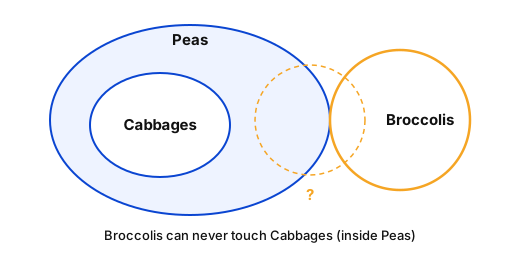
- Cabbages lie completely inside Peas.
- Broccolis are completely outside Peas, so they can never touch Cabbages.
- I: 'No broccolis are cabbages' — definitely true ✓. II: 'Some broccolis are cabbages' — impossible ✗.
Yaad rakhein: All + No → No (All A are B, No B is C ⇒ No A is C).
Answer: (A) Only conclusion (I) follows.
अवधारणा: यदि A, B के अंदर है और B का C से कुछ भी उभयनिष्ठ नहीं, तो A का भी C से कुछ उभयनिष्ठ नहीं।
- Cabbages पूरी तरह Peas के अंदर।
- Broccolis पूरी तरह Peas के बाहर, अतः Cabbages को कभी नहीं छू सकते।
- I: 'कोई broccoli, cabbage नहीं' — निश्चित सत्य ✓। II: 'कुछ broccolis, cabbages हैं' — असंभव ✗।
याद रखें: सभी + कोई नहीं → कोई नहीं (सभी A, B हैं; कोई B, C नहीं ⇒ कोई A, C नहीं)।
उत्तर: (A) केवल निष्कर्ष (I) अनुसरण करता है।
RRB NTPC Undergraduate CBT 1General Intelligence and ReasoningSyllogismRRB NTPC Undergraduate CBT 1 2024 · 7 Aug Shift 1
Q5587.What should come in place of the question mark (?) in the given series?
779 780 784 793 809 ?
दी गई शृंखला में प्रश्न चिह्न (?) के स्थान पर क्या आना चाहिए?
779 780 784 793 809 ?
- A831
- B837
- C834
- D841
Show answer
Concept: Look at the differences between consecutive terms.
- Differences: 1, 4, 9, 16 = .
- Next difference .
- .
Trick: Differences being perfect squares is a very common pattern.
Answer: (C) 834
अवधारणा: क्रमागत पदों के अंतर देखें।
- अंतर: 1, 4, 9, 16 = ।
- अगला अंतर ।
- ।
ट्रिक: अंतरों का पूर्ण वर्ग होना बहुत आम पैटर्न है।
उत्तर: (C) 834
RRB NTPC Undergraduate CBT 1General Intelligence and ReasoningNumber SeriesRRB NTPC Undergraduate CBT 1 2024 · 7 Aug Shift 1
Q5588.Select the triad that follows the same pattern as that followed by the two triads given below. Both triads follow the same pattern.
GN-JQ-MP
DK-GN-JM
उस त्रयी का चयन कीजिए जो उसी पैटर्न का अनुसरण करती है जिसका अनुसरण नीचे दी गई दो त्रयी करती हैं। दोनों त्रयी एक ही पैटर्न का अनुसरण करती हैं।
GN-JQ-MP
DK-GN-JM
- AJQ-MT-PR
- BJQ-MT-PS
- CIQ-NT-PR
- DIQ-MT-PR
Show answer
Concept: Compare each pair of letters with the next pair.
- GN → JQ: , . JQ → MP: , .
- DK → GN: , . GN → JM: , .
- JQ → MT (, ) → PS (, ) ✓.
Trick: (A) ends PR (), so check the last letter carefully: T → S.
Answer: (B) JQ-MT-PS
अवधारणा: हर अक्षर-जोड़ी की अगली जोड़ी से तुलना करें।
- GN → JQ: , । JQ → MP: , ।
- DK → GN: , । GN → JM: , ।
- JQ → MT (, ) → PS (, ) ✓।
ट्रिक: (A) में PR () है, अतः अंतिम अक्षर ध्यान से जाँचें: T → S।
उत्तर: (B) JQ-MT-PS
RRB NTPC Undergraduate CBT 1General Intelligence and ReasoningLetter TriadsRRB NTPC Undergraduate CBT 1 2024 · 7 Aug Shift 1
Q5589.Which of the following letter-number clusters will replace the question mark (?) in the given series to make it logically complete?
FJN 45, DHL 40, BFJ 35, ZDH 30, XBF 25, ?
निम्नलिखित में से कौन-सा अक्षर-संख्या समूह दी गई शृंखला में प्रश्न चिह्न (?) के स्थान पर आकर उसे तार्किक रूप से पूर्ण करेगा?
FJN 45, DHL 40, BFJ 35, ZDH 30, XBF 25, ?
- AVZD 20
- BVUD 20
- CVZE 20
- DUZD 20
Show answer
Concept: Each letter moves back by 2 (with wrap-around Z after A) and the number falls by 5.
- 1st letters: F, D, B, Z, X → V.
- 2nd letters: J, H, F, D, B → Z.
- 3rd letters: N, L, J, H, F → D.
- Numbers: 45, 40, 35, 30, 25 → 20.
Trick: B wraps around to Z.
Answer: (A) VZD 20
अवधारणा: हर अक्षर 2 पीछे जाता है (A के बाद Z पर लौटता है) और संख्या 5 घटती है।
- पहले अक्षर: F, D, B, Z, X → V।
- दूसरे अक्षर: J, H, F, D, B → Z।
- तीसरे अक्षर: N, L, J, H, F → D।
- संख्याएँ: 45, 40, 35, 30, 25 → 20।
ट्रिक: B घूमकर Z बनता है।
उत्तर: (A) VZD 20
RRB NTPC Undergraduate CBT 1General Intelligence and ReasoningLetter-Number SeriesRRB NTPC Undergraduate CBT 1 2024 · 7 Aug Shift 1
Q5590.If 2 is added to each odd digit and 3 is subtracted from each even digit in the number 7843651, how many digits will appear more than once in the new number thus formed?
यदि संख्या 7843651 के प्रत्येक विषम अंक में 2 जोड़ दिया जाए और प्रत्येक सम अंक में से 3 घटा दिया जाए, तो इस प्रकार बनी नई संख्या में कितने अंक एक से अधिक बार आएँगे?
- AThreeतीन
- BTwoदो
- COneएक
- DNoneकोई नहीं
Show answer
Concept: Apply the rule to every digit separately, then count digits that occur more than once.
- Odd digit , even digit .
- 7843651 → 9 5 1 5 3 7 3.
- 5 and 3 appear twice → two digits repeat.
Trick: Note that 3 → 5 and 8 → 5 both give 5; 6 → 3 and 1 → 3 both give 3.
Answer: (B) Two
अवधारणा: हर अंक पर अलग-अलग नियम लगाएँ, फिर एक से अधिक बार आने वाले अंक गिनें।
- विषम अंक , सम अंक ।
- 7843651 → 9 5 1 5 3 7 3।
- 5 और 3 दो-दो बार → दो अंक दोहराए गए।
ट्रिक: 3 → 5 और 8 → 5 दोनों 5 देते हैं; 6 → 3 और 1 → 3 दोनों 3 देते हैं।
उत्तर: (B) दो
RRB NTPC Undergraduate CBT 1General Intelligence and ReasoningNumber Operations – DigitsRRB NTPC Undergraduate CBT 1 2024 · 7 Aug Shift 1
Q5591.Based on the English alphabetical order, three of the following four letter-clusters are alike in a certain way and thus form a group. Which letter-cluster DOES NOT belong to that group?
(Note: The odd one out is not based on the number of consonants/vowels or their position in the letter-cluster.)
अंग्रेज़ी वर्णमाला क्रम के आधार पर, निम्नलिखित चार अक्षर-समूहों में से तीन किसी निश्चित प्रकार से एकसमान हैं और इस प्रकार एक समूह बनाते हैं। कौन-सा अक्षर-समूह उस समूह से संबंधित नहीं है?
(ध्यान दें: असंगत अक्षर-समूह, उस अक्षर-समूह में व्यंजनों/स्वरों की संख्या या उनके स्थान पर आधारित नहीं है।)
- AHDK
- BFBJ
- CMIP
- DJFM
Show answer
Concept: Use alphabet positions and compare the gaps.
- HDK: (, ). MIP: (, ).
- JFM: (, ).
- FBJ: (, ) ✗.
Trick: First to last letter is in HDK, MIP, JFM but in FBJ.
Answer: (B) FBJ
अवधारणा: अक्षरों के स्थानीय मान लेकर अंतर की तुलना करें।
- HDK: (, )। MIP: (, )।
- JFM: (, )।
- FBJ: (, ) ✗।
ट्रिक: पहले से अंतिम अक्षर HDK, MIP, JFM में पर FBJ में ।
उत्तर: (B) FBJ
RRB NTPC Undergraduate CBT 1General Intelligence and ReasoningOdd One Out – Letter ClustersRRB NTPC Undergraduate CBT 1 2024 · 7 Aug Shift 1
Q5592.In the following triads, each group of letters is related to the subsequent one following a certain logic. Select from the given options, the one which follows the same logic. RACK - AKCR - KCAR
LOAD - ODAL - DAOL
निम्नलिखित त्रयी में, अक्षरों का प्रत्येक समूह एक निश्चित तर्क का अनुसरण करते हुए अगले समूह से संबंधित है। दिए गए विकल्पों में से उस त्रयी का चयन कीजिए जो समान तर्क का अनुसरण करती है। RACK - AKCR - KCAR
LOAD - ODAL - DAOL
- AABLE - BALE - EBLA
- BNAPS - NPAS - SPAN
- CITEM - TMEI - METI
- DFLAT - LFAT - TLAF
Show answer
Concept: Find the position pattern: word 1 (1234) → word 2 → word 3.
- RACK → AKCR: letters 2, 4, 3, 1. LOAD → ODAL: same.
- Third word is the first word reversed: RACK → KCAR, LOAD → DAOL.
- ITEM → TMEI (2, 4, 3, 1) → METI (ITEM reversed) ✓.
Trick: Reversal test first: NAPS → SPAN and ITEM → METI pass; NAPS → NPAS fails the 2, 4, 3, 1 rule (should be APSN).
Answer: (C) ITEM - TMEI - METI
अवधारणा: स्थान-क्रम पहचानें: शब्द 1 (1234) → शब्द 2 → शब्द 3।
- RACK → AKCR: अक्षर 2, 4, 3, 1। LOAD → ODAL: वही।
- तीसरा शब्द पहले का उल्टा है: RACK → KCAR, LOAD → DAOL।
- ITEM → TMEI (2, 4, 3, 1) → METI (ITEM उल्टा) ✓।
ट्रिक: पहले उल्टा-जाँच: NAPS → SPAN और ITEM → METI पास; पर NAPS → NPAS, 2, 4, 3, 1 नियम पर असफल (APSN होना चाहिए)।
उत्तर: (C) ITEM - TMEI - METI
RRB NTPC Undergraduate CBT 1General Intelligence and ReasoningLetter Triads – RearrangementRRB NTPC Undergraduate CBT 1 2024 · 7 Aug Shift 1
Q5593.What should come in place of the question mark (?) in the given series?
456 457 455 456 454 455 453 ?
दी गई शृंखला में प्रश्न चिह्न (?) के स्थान पर क्या आना चाहिए?
456 457 455 456 454 455 453 ?
- A454
- B453
- C456
- D455
Show answer
Concept: Alternating differences.
- 456 → 457 () → 455 () → 456 () → 454 () → 455 () → 453 ().
- Next: .
Trick: Every second term (457, 456, 455, …) falls by 1, so after 453 comes .
Answer: (A) 454
अवधारणा: एकांतर अंतर।
- 456 → 457 () → 455 () → 456 () → 454 () → 455 () → 453 ()।
- अगला: ।
ट्रिक: सम स्थानों के पद (457, 456, 455, …) 1-1 घटते हैं, अतः 453 के बाद ।
उत्तर: (A) 454
RRB NTPC Undergraduate CBT 1General Intelligence and ReasoningNumber SeriesRRB NTPC Undergraduate CBT 1 2024 · 7 Aug Shift 1
Q5594.A, B, C, D, E, F and G are sitting around a circular table facing the centre. B sits second to the right of C. E sits third to the left of B. D is the immediate neighbour of G and A. F sits second to the left of G. How many people sit between A and B when counted from the left of A?
A, B, C, D, E, F और G एक वृत्ताकार मेज़ के चारों ओर केंद्र की ओर मुख करके बैठे हैं। B, C के दाईं ओर दूसरे स्थान पर बैठा है। E, B के बाईं ओर तीसरे स्थान पर बैठा है। D, G और A का निकटतम पड़ोसी है। F, G के बाईं ओर दूसरे स्थान पर बैठा है। A के बाईं ओर से गिनने पर A और B के बीच कितने व्यक्ति बैठे हैं?
- AFourचार
- BTwoदो
- CThreeतीन
- DOneएक
Show answer
Concept: Facing the centre, a person's right is anticlockwise and left is clockwise.
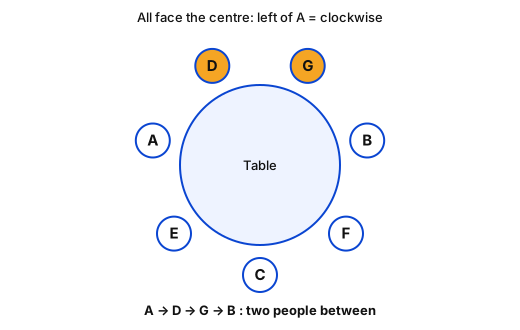
- Fix C; B is second to the right of C; E is third to the left of B.
- Three seats remain together for G, D, A with D in the middle; F second to the left of G works only when G is next to B.
- Order (anticlockwise from C): C, F, B, G, D, A, E.
- Going left (clockwise) from A: D, G, then B → two people.
Trick: D–G–A block must fit in the three empty consecutive seats.
Answer: (B) Two
अवधारणा: केंद्र की ओर मुख होने पर दायाँ = वामावर्त (anticlockwise), बायाँ = दक्षिणावर्त (clockwise)।
- C तय करें; B, C के दाएँ दूसरे स्थान पर; E, B के बाएँ तीसरे स्थान पर।
- G, D, A के लिए तीन लगातार सीटें बचती हैं, D बीच में; F, G के बाएँ दूसरा तभी होगा जब G, B के पास हो।
- क्रम (C से वामावर्त): C, F, B, G, D, A, E।
- A के बाएँ (दक्षिणावर्त) चलें: D, G, फिर B → दो व्यक्ति।
ट्रिक: D–G–A समूह तीन खाली लगातार सीटों में ही आएगा।
उत्तर: (B) दो
RRB NTPC Undergraduate CBT 1General Intelligence and ReasoningCircular Seating ArrangementRRB NTPC Undergraduate CBT 1 2024 · 7 Aug Shift 1
Q5595.What should come in place of the question mark (?) in the given series?
6 9 15 24 36 ?
दी गई शृंखला में प्रश्न चिह्न (?) के स्थान पर क्या आना चाहिए?
6 9 15 24 36 ?
- A51
- B41
- C75
- D52
Show answer
Concept: Differences form a table of 3.
- Differences: 3, 6, 9, 12.
- Next difference .
- .
Trick: Each term : .
Answer: (A) 51
अवधारणा: अंतर 3 का पहाड़ा बनाते हैं।
- अंतर: 3, 6, 9, 12।
- अगला अंतर ।
- ।
ट्रिक: हर पद : ।
उत्तर: (A) 51
RRB NTPC Undergraduate CBT 1General Intelligence and ReasoningNumber SeriesRRB NTPC Undergraduate CBT 1 2024 · 7 Aug Shift 1
Q5596.All 105 students in a class are standing in a row facing north. Ravi is 49th from the right end while Shruti is 38th from the left end. How many people stand between Ravi and Shruti?
एक कक्षा के सभी 105 विद्यार्थी उत्तर की ओर मुख करके एक पंक्ति में खड़े हैं। रवि दाएँ छोर से 49वें स्थान पर है जबकि श्रुति बाएँ छोर से 38वें स्थान पर है। रवि और श्रुति के बीच कितने व्यक्ति खड़े हैं?
- A19
- B17
- C16
- D18
Show answer
Concept: Convert both positions to the same end: from left .
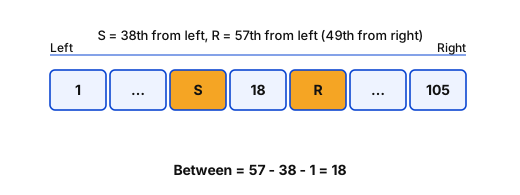
- Ravi from left .
- Shruti from left .
- Between them .
Trick: Since , they do not overlap: between .
Answer: (D) 18
अवधारणा: दोनों स्थान एक ही छोर से बदलें: बाएँ से ।
- रवि बाएँ से ।
- श्रुति बाएँ से ।
- बीच में ।
ट्रिक: , अतः ओवरलैप नहीं: बीच में ।
उत्तर: (D) 18
RRB NTPC Undergraduate CBT 1General Intelligence and ReasoningRanking and OrderRRB NTPC Undergraduate CBT 1 2024 · 7 Aug Shift 1
Q5597.Based on the English alphabetical order, three of the following four letter-cluster pairs are alike in a certain way and thus form a group. Which letter-cluster pair DOES NOT belong to that group?
(Note: The odd one out is not based on the number of consonants/vowels or their position in the letter-cluster.)
अंग्रेज़ी वर्णमाला क्रम के आधार पर, निम्नलिखित चार अक्षर-समूह युग्मों में से तीन किसी निश्चित प्रकार से एकसमान हैं और इस प्रकार एक समूह बनाते हैं। कौन-सा अक्षर-समूह युग्म उस समूह से संबंधित नहीं है?
(ध्यान दें: असंगत अक्षर-समूह युग्म, उस अक्षर-समूह में व्यंजनों/स्वरों की संख्या या उनके स्थान पर आधारित नहीं है।)
- APN−QO
- BQO−RP
- CLJ−MK
- DUS−UV
Show answer
Concept: Check the gap within each cluster and between the two clusters.
- PN−QO: P = N, Q = O, and P = Q.
- QO−RP and LJ−MK follow the same rule.
- US−UV: U = S but U → U and S → V break the rule ✗.
Trick: In the group, the second pair is the first pair shifted ; US−UV is not.
Answer: (D) US−UV
अवधारणा: हर समूह के अंदर और दोनों समूहों के बीच अंतर जाँचें।
- PN−QO: P = N, Q = O, और P = Q।
- QO−RP और LJ−MK भी यही नियम।
- US−UV: U = S पर U → U और S → V नियम तोड़ते हैं ✗।
ट्रिक: समूह में दूसरा युग्म पहले का खिसका रूप है; US−UV नहीं।
उत्तर: (D) US−UV
RRB NTPC Undergraduate CBT 1General Intelligence and ReasoningOdd One Out – Letter PairsRRB NTPC Undergraduate CBT 1 2024 · 7 Aug Shift 1
Q5598.In the following number-pairs, the second number is obtained by applying certain mathematical operations to the first number. Select the pair in which the numbers are related in the same way as are the numbers of the following pairs.
(Note: Operations should be performed on the whole numbers, without breaking down the numbers into its constituent digits. E.g., 13 – Operations on 13 such as
adding/subtracting/multiplying etc. to 13 can be performed. Breaking down 13 into 1 and 3 and then performing mathematical operations on 1 and 3 is not allowed.) 52, 81
72, 101
निम्नलिखित संख्या-युग्मों में, पहली संख्या पर कुछ निश्चित गणितीय संक्रियाएँ करके दूसरी संख्या प्राप्त की जाती है। उस युग्म का चयन कीजिए जिसमें संख्याएँ उसी प्रकार संबंधित हैं जिस प्रकार निम्नलिखित युग्मों की संख्याएँ संबंधित हैं।
(ध्यान दें: संख्याओं को उसके घटक अंकों में विभाजित किए बिना, संक्रियाएँ पूर्ण संख्याओं पर की जानी चाहिए। उदाहरण के लिए, 13 – 13 पर संक्रियाएँ, जैसे 13 में
जोड़ना/घटाना/गुणा करना आदि किया जा सकता है। 13 को 1 और 3 में विभाजित करना और फिर 1 और 3 पर गणितीय संक्रियाएँ करना वर्जित है।) 52, 81
72, 101
- A84, 107
- B75, 104
- C79, 102
- D53, 76
Show answer
Concept: Find the operation that turns the first number into the second.
- ; → rule: add 29.
- ✓.
- Others: , , ✗.
Trick: Last digits: and both drop by 1 (adding 29), unlike the rest.
Answer: (B) 75, 104
अवधारणा: वह संक्रिया खोजें जो पहली संख्या को दूसरी में बदलती है।
- ; → नियम: 29 जोड़ें।
- ✓।
- बाकी: , , ✗।
ट्रिक: इकाई अंक: और दोनों 1 घटते हैं (29 जोड़ने पर), बाकी में नहीं।
उत्तर: (B) 75, 104
RRB NTPC Undergraduate CBT 1General Intelligence and ReasoningNumber Pair AnalogyRRB NTPC Undergraduate CBT 1 2024 · 7 Aug Shift 1
Q5599.Mr. Oxi starts from Point A and drives 9 km towards the south. He then takes a right turn and drives 3 km, then turns right and drives 15 km. He then takes a right turn and drives 11 km. He takes a final right turn, drives 6 km and stops at Point P. How far (shortest distance) and in which direction should he drive in order to reach Point A again? (All turns are 90-degree turns only unless specified.)
श्री ऑक्सी बिंदु A से चलना शुरू करते हैं और दक्षिण की ओर 9 km गाड़ी चलाते हैं। फिर वे दाएँ मुड़ते हैं और 3 km गाड़ी चलाते हैं, फिर दाएँ मुड़ते हैं और 15 km गाड़ी चलाते हैं। फिर वे दाएँ मुड़ते हैं और 11 km गाड़ी चलाते हैं। वे अंतिम बार दाएँ मुड़ते हैं, 6 km गाड़ी चलाते हैं और बिंदु P पर रुक जाते हैं। बिंदु A पर फिर से पहुँचने के लिए उन्हें कितनी दूर (न्यूनतम दूरी) और किस दिशा में गाड़ी चलानी चाहिए? (जब तक निर्दिष्ट न किया जाए, सभी मोड़ केवल 90 डिग्री के मोड़ हैं।)
- A8 km to the westपश्चिम की ओर 8 km
- B7 km to the eastपूर्व की ओर 7 km
- C8 km to the southदक्षिण की ओर 8 km
- D8 km to the eastपूर्व की ओर 8 km
Show answer
Concept: Trace each turn (facing south, right = west) and find the net displacement.
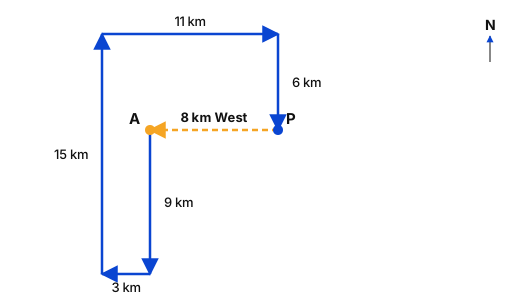
- South 9 → right (West) 3 → right (North) 15 → right (East) 11 → right (South) 6.
- North–South: → P is level with A.
- East–West: km East of A → Mr. Oxi must drive 8 km West.
Trick: Four right turns in a row make a spiral — just add signed distances.
Answer: (A) 8 km to the west
अवधारणा: हर मोड़ पहचानें (दक्षिण की ओर मुख हो तो दायाँ = पश्चिम) और शुद्ध विस्थापन निकालें।
- दक्षिण 9 → दाएँ (पश्चिम) 3 → दाएँ (उत्तर) 15 → दाएँ (पूर्व) 11 → दाएँ (दक्षिण) 6।
- उत्तर–दक्षिण: → P, A की सीध में।
- पूर्व–पश्चिम: km, A से पूर्व → 8 km पश्चिम जाना होगा।
ट्रिक: लगातार दाएँ मोड़ — बस चिह्न सहित दूरियाँ जोड़ें।
उत्तर: (A) 8 km पश्चिम की ओर
RRB NTPC Undergraduate CBT 1General Intelligence and ReasoningDirection and DistanceRRB NTPC Undergraduate CBT 1 2024 · 7 Aug Shift 1
Q5600.If 1 is added for each even digit and 1 is subtracted from each odd digit of the number 56218643, how many digits are repeated more than once in the new number thus formed?
यदि संख्या 56218643 के प्रत्येक सम अंक में 1 जोड़ दिया जाए और प्रत्येक विषम अंक में से 1 घटा दिया जाए, तो इस प्रकार बनी नई संख्या में कितने अंक एक से अधिक बार दोहराए गए हैं?
- ANoneकोई नहीं
- BThreeतीन
- COneएक
- DTwoदो
Show answer
Concept: Apply the rule to every digit separately, then count digits that occur more than once.
- Even digit , odd digit .
- 56218643 → 4 7 3 0 9 7 5 2.
- Only 7 appears twice (from both 6s) → one digit repeats.
Trick: Equal original digits always give equal new digits — spot the two 6s first.
Answer: (C) One
अवधारणा: हर अंक पर अलग-अलग नियम लगाएँ, फिर एक से अधिक बार आने वाले अंक गिनें।
- सम अंक , विषम अंक ।
- 56218643 → 4 7 3 0 9 7 5 2।
- केवल 7 दो बार (दोनों 6 से) → एक अंक दोहराया गया।
ट्रिक: समान मूल अंक हमेशा समान नए अंक देते हैं — पहले दोनों 6 पहचानें।
उत्तर: (C) एक
RRB NTPC Undergraduate CBT 1General Intelligence and ReasoningNumber Operations – DigitsRRB NTPC Undergraduate CBT 1 2024 · 7 Aug Shift 1

