Q881.What should come in place of the question mark (?) in the given series?
561 560 562 561 563 562 564 ?
दी गई श्रृंखला में प्रश्न चिह्न (?) के स्थान पर क्या आना चाहिए?
561 560 562 561 563 562 564 ?
- A562
- B564
- C563
- D565
Show answer
Concept: Alternating pattern −1, +2.
- 561 −1 = 560, +2 = 562, −1 = 561, +2 = 563, −1 = 562, +2 = 564.
- Next: 564 − 1 = 563.
Trick: Alternate terms 561, 562, 563, 564 … and 560, 561, 562, 563.
Answer: (C) 563
अवधारणा: एकांतर पैटर्न −1, +2।
- 561 −1 = 560, +2 = 562, −1 = 561, +2 = 563, −1 = 562, +2 = 564।
- अगला: 564 − 1 = 563।
ट्रिक: एकांतर पद 560, 561, 562, 563 … बढ़ते हैं।
उत्तर: (C) 563
RRB NTPC Undergraduate CBT 1General Intelligence and ReasoningNumber SeriesRRB NTPC Undergraduate CBT 1 2024 · 4 Sep Shift 1
Q882.Seven boxes F, G, H, M, N, O and P are kept one over the other but not necessarily in the same order. O is kept immediately above F. G is kept immediately above M. Only P is kept above N. Only two boxes are kept above O. G is not kept at third position from the bottom. How many boxes are kept between H and P?
सात बक्से F, G, H, M, N, O और P एक के ऊपर एक रखे गए हैं, परंतु आवश्यक नहीं कि इसी क्रम में हों। O को F के ठीक ऊपर रखा गया है। G को M के ठीक ऊपर रखा गया है। N के ऊपर केवल P रखा गया है। O के ऊपर केवल दो बक्से रखे गए हैं। G को नीचे से तीसरे स्थान पर नहीं रखा गया है। H और P के बीच कितने बक्से रखे गए हैं?
- AFourचार
- BThreeतीन
- CTwoदो
- DOneएक
Show answer
Concept: Number positions from the top and fix definite clues first.
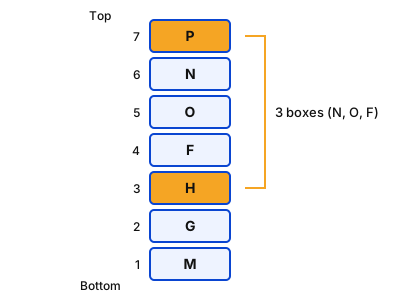
- Only P above N → P 1st, N 2nd. Two above O → O 3rd, F 4th.
- G just above M: 5–6 or 6–7; G cannot be 3rd from bottom (5th from top) → G 6th, M 7th.
- H takes 5th.
- Between H (5th) and P (1st): N, O, F = 3 boxes.
Trick: Boxes between positions and .
Answer: (B) Three
अवधारणा: ऊपर से स्थान गिनें और निश्चित संकेत पहले लगाएँ।
- केवल P, N के ऊपर → P 1, N 2। O के ऊपर दो → O 3, F 4।
- G ठीक M के ऊपर: 5–6 या 6–7; G नीचे से तीसरा (ऊपर से 5वाँ) नहीं → G 6, M 7।
- H को 5वाँ स्थान।
- H (5) और P (1) के बीच: N, O, F = 3 बॉक्स।
ट्रिक: स्थान और के बीच बॉक्स ।
उत्तर: (B) तीन
RRB NTPC Undergraduate CBT 1General Intelligence and ReasoningBox ArrangementRRB NTPC Undergraduate CBT 1 2024 · 4 Sep Shift 1
Q883.If ‘A’ stands for ‘÷’, ‘B’ stands for ‘×’, ‘C’ stands for ‘+’ and ‘D’ stands for ‘−’, then what will come in place of the question mark (?) in the following equation?
32 B 5 C 63 B 5 D 89 C 9 A 9 D 7 = ?
यदि ‘A’ का अर्थ ‘÷’, ‘B’ का अर्थ ‘×’, ‘C’ का अर्थ ‘+’ और ‘D’ का अर्थ ‘−’ है, तो निम्नलिखित समीकरण में प्रश्न चिह्न (?) के स्थान पर क्या आएगा?
32 B 5 C 63 B 5 D 89 C 9 A 9 D 7 = ?
- A293
- B380
- C349
- D308
Show answer
Concept: Replace letters by signs, then apply BODMAS.
- .
- .
- .
Trick: Do ÷ and × first: 160, 315, 1 – then add/subtract.
Answer: (B) 380
अवधारणा: अक्षरों के स्थान पर चिह्न रखें, फिर BODMAS लगाएँ।
- ।
- ।
- ।
ट्रिक: पहले ÷ और ×: 160, 315, 1 – फिर जोड़/घटाव।
उत्तर: (B) 380
RRB NTPC Undergraduate CBT 1General Intelligence and ReasoningMathematical OperationsRRB NTPC Undergraduate CBT 1 2024 · 4 Sep Shift 1
Q884.In a certain code language, ‘LOAD’ is coded as ‘5364’ and ‘GOLD’ is coded as ‘4136’. What is the code for ‘G’ in the given code language?
एक निश्चित कूट भाषा में, ‘LOAD’ को ‘5364’ लिखा जाता है और ‘GOLD’ को ‘4136’ लिखा जाता है। दी गई कूट भाषा में ‘G’ का कूट क्या है?
- A6
- B4
- C1
- D3
Show answer
Concept: Letters common to both words share the common digits.
- LOAD = 5364, GOLD = 4136.
- Common letters L, O, D ↔ common digits 3, 4, 6.
- Remaining: A ↔ 5 and G ↔ 1.
Trick: Cancel the common part; what is left pairs up.
Answer: (C) 1
अवधारणा: दोनों शब्दों के समान अक्षरों के कोड भी समान अंक होते हैं।
- LOAD = 5364, GOLD = 4136।
- समान अक्षर L, O, D ↔ समान अंक 3, 4, 6।
- बचे हुए: A ↔ 5 और G ↔ 1।
ट्रिक: समान भाग काट दें; बचा हुआ जोड़ा कोड देता है।
उत्तर: (C) 1
RRB NTPC Undergraduate CBT 1General Intelligence and ReasoningCoding-DecodingRRB NTPC Undergraduate CBT 1 2024 · 4 Sep Shift 1
Q885.In a certain code language,
'A ¥ B' means ‘A is the father of B’,
'A # B' means ‘ A is the brother of B’,
'A % B' means ‘A is the son of B’ and
'A = B' means ‘A is the wife of B’.
How is A related to D if 'A = S # G % E ¥ D'?
एक निश्चित कूट भाषा में,
'A ¥ B' का अर्थ है ‘A, B का पिता है’,
'A # B' का अर्थ है ‘A, B का भाई है’,
'A % B' का अर्थ है ‘A, B का पुत्र है’ और
'A = B' का अर्थ है ‘A, B की पत्नी है’।
यदि 'A = S # G % E ¥ D' है, तो A, D से किस प्रकार संबंधित है?
- ABrother's wifeभाई की पत्नी
- BSister's brotherबहन का भाई
- CSister's sonबहन का पुत्र
- DBrother's sonभाई का पुत्र
Show answer
Concept: Decode each symbol and build the family tree.
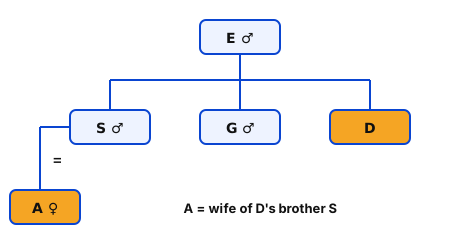
- A = S: A is the wife of S. S # G: S is the brother of G.
- G % E: G is the son of E. E ¥ D: E is the father of D.
- S, G and D are children of E; S is D's brother.
- A is the wife of D's brother.
Trick: Read the chain left to right and mark gender as you go (S male, A female).
Answer: (A) Brother's wife
अवधारणा: हर चिह्न का अर्थ लगाकर वंश-वृक्ष बनाएँ।
- A = S: A, S की पत्नी है। S # G: S, G का भाई है।
- G % E: G, E का पुत्र है। E ¥ D: E, D का पिता है।
- S, G और D, E की संतान हैं; S, D का भाई है।
- A, D के भाई की पत्नी (भाभी) है।
ट्रिक: शृंखला बाएँ से दाएँ पढ़ें और साथ-साथ लिंग अंकित करें (S पुरुष, A महिला)।
उत्तर: (A) भाई की पत्नी
RRB NTPC Undergraduate CBT 1General Intelligence and ReasoningBlood Relation (Coded)RRB NTPC Undergraduate CBT 1 2024 · 4 Sep Shift 1
Q886.Karan, Shiv, Ritu, Himani, Gunjan and Pari are sitting in a straight line, facing north. Karan sits third to the left of Himani. Himani sits second from the right end. Pari sits to the immediate left of Gunjan. Shiv does not sit next to Karan. Who sits second to the right of Gunjan?
करण, शिव, रितु, हिमानी, गुंजन और परी उत्तर की ओर मुख करके एक सीधी पंक्ति में बैठे हैं। करण, हिमानी के बाईं ओर तीसरे स्थान पर बैठा है। हिमानी दाएँ छोर से दूसरे स्थान पर बैठी है। परी, गुंजन के ठीक बाईं ओर बैठी है। शिव, करण के बगल में नहीं बैठा है। गुंजन के दाईं ओर दूसरे स्थान पर कौन बैठा है?
- AKaranकरण
- BShivशिव
- CRituरितु
- DHimaniहिमानी
Show answer
Concept: Six seats, all facing north; fix the end-based clue first.
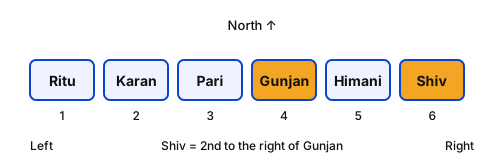
- Himani 2nd from right → 5th; Karan 3rd to her left → 2nd.
- Pari–Gunjan adjacent pair fits only 3–4.
- Shiv not next to Karan → 6th; Ritu 1st.
- Ritu Karan Pari Gunjan Himani Shiv → 2nd right of Gunjan = Shiv.
Trick: Facing north: right of a person = higher seat number.
Answer: (B) Shiv
अवधारणा: छह सीटें, सभी उत्तर की ओर; पहले छोर वाला संकेत लगाएँ।
- हिमानी दाएँ छोर से दूसरी → 5वीं; करण उसके तीसरे बाएँ → 2रा।
- पारी–गुंजन की जोड़ी केवल 3–4 पर।
- शिव करण के पास नहीं → 6ठा; रितु 1ली।
- रितु करण पारी गुंजन हिमानी शिव → गुंजन के दूसरे दाएँ = शिव।
ट्रिक: उत्तर की ओर मुख: दायाँ = बड़ी सीट संख्या।
उत्तर: (B) शिव
RRB NTPC Undergraduate CBT 1General Intelligence and ReasoningLinear Seating ArrangementRRB NTPC Undergraduate CBT 1 2024 · 4 Sep Shift 1
Q887.Read the given statements and conclusions carefully. Assuming that the information given in the statements is true, even if it appears to be at variance with commonly known facts, decide which of the given conclusion(s) logically follow(s) from the statements.
Statements: All forks are spoons. Some forks are caps.
Conclusions (I): Some spoons are caps.
Conclusions (II): All caps are forks.
दिए गए कथनों और निष्कर्षों को ध्यानपूर्वक पढ़िए। कथनों में दी गई जानकारी को सत्य मानते हुए, भले ही वह सामान्यतः ज्ञात तथ्यों से भिन्न प्रतीत होती हो, निर्णय कीजिए कि दिए गए निष्कर्षों में से कौन-सा/से निष्कर्ष कथनों का तार्किक रूप से अनुसरण करता है/करते हैं।
कथन: सभी कांटे, चम्मच हैं। कुछ कांटे, टोपियाँ हैं।
निष्कर्ष (I): कुछ चम्मच, टोपियाँ हैं।
निष्कर्ष (II): सभी टोपियाँ, कांटे हैं।
- ABoth conclusions (I) and (II) follow.निष्कर्ष (I) और (II) दोनों अनुसरण करते हैं।
- BNeither conclusion (I) nor (II) follows.न तो निष्कर्ष (I) और न ही (II) अनुसरण करता है।
- COnly conclusion (I) follows.केवल निष्कर्ष (I) अनुसरण करता है।
- DOnly conclusion (II) follows.केवल निष्कर्ष (II) अनुसरण करता है।
Show answer
Concept: Draw the least-overlap Venn diagram for the statements.
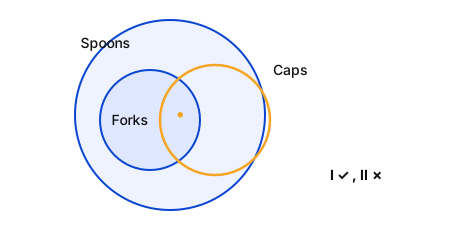
- All forks are spoons; some forks are caps.
- Those caps that are forks are also spoons → some spoons are caps: I follows.
- Caps may lie outside forks, so 'all caps are forks' is not certain: II fails.
Trick: 'Some' never proves 'All'.
Answer: (C) Only conclusion (I) follows.
अवधारणा: कथनों का न्यूनतम-अतिव्याप्ति वेन आरेख बनाएँ।
- सभी fork, spoon हैं; कुछ fork, cap हैं।
- जो cap, fork हैं वे spoon भी हैं → कुछ spoon, cap हैं: I अनुसरण करता है।
- cap, fork के बाहर भी हो सकते हैं, अतः 'सभी cap, fork हैं' निश्चित नहीं: II नहीं।
ट्रिक: 'कुछ' से कभी 'सभी' सिद्ध नहीं होता।
उत्तर: (C) केवल निष्कर्ष (I) अनुसरण करता है।
RRB NTPC Undergraduate CBT 1General Intelligence and ReasoningSyllogismRRB NTPC Undergraduate CBT 1 2024 · 4 Sep Shift 1
Q888.RBNH is related to LVHB in a certain way based on the English alphabetical order. In the same way, TDPJ is related to NXJD. To which of the given options is BLXR related, following the same logic?
अंग्रेज़ी वर्णमाला क्रम के आधार पर RBNH एक निश्चित प्रकार से LVHB से संबंधित है। उसी प्रकार, TDPJ, NXJD से संबंधित है। समान तर्क का अनुसरण करते हुए, BLXR दिए गए विकल्पों में से किससे संबंधित है?
- AVFLR
- BVRFL
- CVFRL
- DVLRF
Show answer
Concept: Each letter moves 6 places back.
- R→L, B→V, N→H, H→B (each −6).
- Check: T→N, D→X, P→J, J→D ✓.
- B−6 = V, L−6 = F, X−6 = R, R−6 = L → VFRL.
Trick: Going back from A wraps to Z: B−6 = V.
Answer: (C) VFRL
अवधारणा: हर अक्षर 6 स्थान पीछे जाता है।
- R→L, B→V, N→H, H→B (प्रत्येक −6)।
- जाँच: T→N, D→X, P→J, J→D ✓।
- B−6 = V, L−6 = F, X−6 = R, R−6 = L → VFRL।
ट्रिक: A से पीछे जाने पर Z से गिनें: B−6 = V।
उत्तर: (C) VFRL
RRB NTPC Undergraduate CBT 1General Intelligence and ReasoningLetter AnalogyRRB NTPC Undergraduate CBT 1 2024 · 4 Sep Shift 1
Q889.Select the set in which the numbers are related in the same way as are the numbers of the following sets.
(Note: Operations should be performed on the whole numbers, without breaking down the numbers into their constituent digits. E.g., 13 – Operations on 13 such as
adding/subtracting/multiplying to 13 can be performed. Breaking down 13 into 1 and 3 and then performing mathematical operations on 1 and 3 is not allowed.)
(48, 26, 15)
(88, 46, 25)
उस समुच्चय का चयन कीजिए जिसमें संख्याएँ उसी प्रकार संबंधित हैं जिस प्रकार निम्नलिखित समुच्चयों की संख्याएँ संबंधित हैं।
(नोट: संक्रियाएँ संख्याओं को उनके घटक अंकों में विभाजित किए बिना, पूर्ण संख्याओं पर की जानी चाहिए। उदाहरण के लिए, 13 – 13 पर संक्रियाएँ जैसे
13 में जोड़ना/घटाना/गुणा करना आदि किया जा सकता है। 13 को 1 और 3 में विभाजित करना और फिर 1 और 3 पर गणितीय संक्रियाएँ करना वर्जित है।)
(48, 26, 15)
(88, 46, 25)
- A(12, 6, 7)
- B(58, 34, 19)
- C(36, 20, 8)
- D(24, 14, 9)
Show answer
Concept: Rule: next number .
- , ✓; , ✓.
- (24, 14, 9): , ✓.
- (58, 34, 19): ✗; others also fail.
Trick: Test the rule on the first two numbers of each option only.
Answer: (D) (24, 14, 9)
अवधारणा: नियम: अगली संख्या ।
- , ✓; , ✓।
- (24, 14, 9): , ✓।
- (58, 34, 19): ✗; अन्य भी असफल।
ट्रिक: हर विकल्प की पहली दो संख्याओं पर नियम जाँचें।
उत्तर: (D) (24, 14, 9)
RRB NTPC Undergraduate CBT 1General Intelligence and ReasoningNumber Set AnalogyRRB NTPC Undergraduate CBT 1 2024 · 4 Sep Shift 1
Q890.Each of the digits in the number 67849315 is arranged in ascending order from left to right. What will be the sum of the digits which are second from the left and third from the right in the new number thus formed?
संख्या 67849315 के प्रत्येक अंक को बाएँ से दाएँ आरोही क्रम में व्यवस्थित किया जाता है। इस प्रकार बनी नई संख्या में बाएँ से दूसरे और दाएँ से तीसरे अंकों का योग क्या होगा?
- A9
- B10
- C7
- D11
Show answer
Concept: Arrange the digits in ascending order and count positions.
- 67849315 → 13456789.
- 2nd from left = 3; 3rd from right = 7.
- Sum .
Trick: Distinct digits 1–9 without 2 – the order is easy to write.
Answer: (B) 10
अवधारणा: अंकों को आरोही क्रम में रखें और स्थान गिनें।
- 67849315 → 13456789।
- बाएँ से दूसरा = 3; दाएँ से तीसरा = 7।
- योग ।
ट्रिक: 1 से 9 तक के अंक (2 को छोड़कर) – क्रम लिखना आसान है।
उत्तर: (B) 10
RRB NTPC Undergraduate CBT 1General Intelligence and ReasoningDigit ArrangementRRB NTPC Undergraduate CBT 1 2024 · 4 Sep Shift 1
Q891.Refer to the following number, symbol series and answer the question that follow. Counting to be done from left to right only.
(Left) 6 \ & > 3 @ 8 * & @ 7 1 ^ @ 4 ? \ ? 4 5 < (Right)
How many such numbers are there each of which is immediately preceded by a symbol and also immediately followed by a symbol?
निम्नलिखित संख्या, प्रतीक श्रृंखला को देखिए और उसके बाद दिए गए प्रश्न का उत्तर दीजिए। गिनती केवल बाएँ से दाएँ की जानी है।
(बाएँ) 6 \ & > 3 @ 8 * & @ 7 1 ^ @ 4 ? \ ? 4 5 < (दाएँ)
ऐसी कितनी संख्याएँ हैं जिनमें से प्रत्येक के ठीक पहले एक प्रतीक है और ठीक बाद भी एक प्रतीक है?
- ATwoदो
- BFourचार
- CThreeतीन
- DOneएक
Show answer
Concept: Check each number's left and right neighbours: both must be symbols.
- > 3 @ ✓; @ 8 * ✓.
- @ 7 1 ✗ and 7 1 (symbol) ✗ (number beside).
- @ 4 ? ✓; ? 4 5 ✗; 4 5 < ✗; first 6 has nothing before it.
- Total = 3 (the numbers 3, 8, 4).
Trick: Skip numbers that sit next to another number – they can never qualify.
Answer: (C) Three
अवधारणा: हर संख्या के बाएँ और दाएँ पड़ोसी देखें: दोनों प्रतीक होने चाहिए।
- > 3 @ ✓; @ 8 * ✓।
- @ 7 1 ✗ और 1 के बाएँ 7 (संख्या) ✗।
- @ 4 ? ✓; ? 4 5 ✗; 4 5 < ✗; पहले 6 के पहले कुछ नहीं।
- कुल = 3 (संख्याएँ 3, 8, 4)।
ट्रिक: जो संख्या दूसरी संख्या के पास है वह कभी गिनी नहीं जाएगी।
उत्तर: (C) तीन
RRB NTPC Undergraduate CBT 1General Intelligence and ReasoningNumber-Symbol SeriesRRB NTPC Undergraduate CBT 1 2024 · 4 Sep Shift 1
Q892.Read the given statements and conclusions carefully. Assuming that the information given in the statements is true, even if it appears to be at variance with commonly known facts, decide which of the given conclusions logically follow(s) from the statements.
Statements:
All gardens are forests.
All forests are meadows.
Conclusions:
(I) All gardens are meadows.
(II) All meadows are forests.
दिए गए कथनों और निष्कर्षों को ध्यानपूर्वक पढ़िए। कथनों में दी गई जानकारी को सत्य मानते हुए, भले ही वह सामान्यतः ज्ञात तथ्यों से भिन्न प्रतीत होती हो, निर्णय कीजिए कि दिए गए निष्कर्षों में से कौन-सा/से निष्कर्ष कथनों का तार्किक रूप से अनुसरण करता है/करते हैं।
कथन:
सभी बगीचे, वन हैं।
सभी वन, घास के मैदान हैं।
निष्कर्ष:
(I) सभी बगीचे, घास के मैदान हैं।
(II) सभी घास के मैदान, वन हैं।
- AOnly conclusion (I) follows.केवल निष्कर्ष (I) अनुसरण करता है।
- BBoth conclusions (I) and (II) follow.निष्कर्ष (I) और (II) दोनों अनुसरण करते हैं।
- COnly conclusion (II) follows.केवल निष्कर्ष (II) अनुसरण करता है।
- DNeither conclusion (I) nor (II) follows.न तो निष्कर्ष (I) और न ही (II) अनुसरण करता है।
Show answer
Concept: Chain of 'All' statements gives a nested Venn diagram.
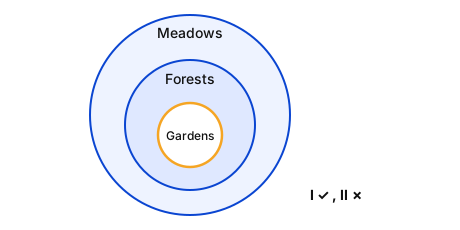
- Gardens ⊂ Forests ⊂ Meadows.
- So all gardens are meadows: I follows.
- Meadows can exist outside forests: II ('All meadows are forests') fails.
Trick: All A are B + All B are C ⇒ All A are C; the reverse 'All C are B' never follows.
Answer: (A) Only conclusion (I) follows.
अवधारणा: 'सभी' वाले कथनों की शृंखला से नेस्टेड वेन आरेख बनता है।
- Gardens ⊂ Forests ⊂ Meadows।
- अतः सभी gardens, meadows हैं: I अनुसरण करता है।
- meadows, forests के बाहर भी हो सकते हैं: II नहीं।
ट्रिक: सभी A, B + सभी B, C ⇒ सभी A, C; उल्टा 'सभी C, B' कभी नहीं।
उत्तर: (A) केवल निष्कर्ष (I) अनुसरण करता है।
RRB NTPC Undergraduate CBT 1General Intelligence and ReasoningSyllogismRRB NTPC Undergraduate CBT 1 2024 · 4 Sep Shift 1
Q893.Mr. Toni ranked 94th from the bottom and 65th from the top in his class. How many students are there in his class?
श्री टोनी का अपनी कक्षा में नीचे से 94वाँ और ऊपर से 65वाँ स्थान था। उसकी कक्षा में कितने विद्यार्थी हैं?
- A159
- B156
- C157
- D158
Show answer
Concept: Total = rank from top + rank from bottom − 1.
- .
Trick: Subtract 1 because the person is counted twice.
Answer: (D) 158
अवधारणा: कुल = ऊपर से रैंक + नीचे से रैंक − 1।
- ।
ट्रिक: व्यक्ति दो बार गिना जाता है, इसलिए 1 घटाएँ।
उत्तर: (D) 158
RRB NTPC Undergraduate CBT 1General Intelligence and ReasoningRankingRRB NTPC Undergraduate CBT 1 2024 · 4 Sep Shift 1
Q894.What should come in place of the question mark (?) in the given series?
19 42 78 122 179 ?
दी गई श्रृंखला में प्रश्न चिह्न (?) के स्थान पर क्या आना चाहिए?
19 42 78 122 179 ?
- A234
- B244
- C243
- D204
Show answer
Concept: Look at the differences, then at the differences of those.
- Differences: 23, 36, 44, 57.
- Second differences: 13, 8, 13 → next 8.
- Next difference ; next term .
Trick: If first differences look random, check their differences – here an alternating +13, +8.
Answer: (B) 244
अवधारणा: अंतर निकालें, फिर उन अंतरों का अंतर देखें।
- अंतर: 23, 36, 44, 57।
- द्वितीय अंतर: 13, 8, 13 → अगला 8।
- अगला अंतर ; अगला पद ।
ट्रिक: प्रथम अंतर अनियमित लगें तो उनके अंतर देखें – यहाँ बारी-बारी +13, +8।
उत्तर: (B) 244
RRB NTPC Undergraduate CBT 1General Intelligence and ReasoningNumber SeriesRRB NTPC Undergraduate CBT 1 2024 · 4 Sep Shift 1
Q895.Based on the English alphabetical order, three of the following four letter-clusters are alike in a certain way and thus form a group. Which letter-cluster DOES NOT belong to that group? (Note: The odd one out is not based on the number of consonants/vowels or their position in the letter-cluster.)
अंग्रेज़ी वर्णमाला क्रम के आधार पर, निम्नलिखित चार अक्षर-समूहों में से तीन किसी निश्चित प्रकार से एकसमान हैं और इस प्रकार एक समूह बनाते हैं। कौन-सा अक्षर-समूह उस समूह से संबंधित नहीं है? (नोट: असंगत, व्यंजनों/स्वरों की संख्या या अक्षर-समूह में उनके स्थान पर आधारित नहीं है।)
- ANIO
- BKFM
- CTOV
- DQLS
Show answer
Concept: Find the gaps between letter positions.
- KFM: K(11)−5 = F(6), F+7 = M(13).
- TOV: −5, +7; QLS: −5, +7.
- NIO: N(14)−5 = I(9), but I+6 = O(15) → odd one.
Trick: Remember positions with EJOTY = 5, 10, 15, 20, 25.
Answer: (A) NIO
अवधारणा: अक्षरों के स्थानों का अंतर निकालें।
- KFM: K(11)−5 = F(6), F+7 = M(13)।
- TOV: −5, +7; QLS: −5, +7।
- NIO: N(14)−5 = I(9), पर I+6 = O(15) → विषम।
ट्रिक: EJOTY = 5, 10, 15, 20, 25 से स्थान जल्दी याद आते हैं।
उत्तर: (A) NIO
RRB NTPC Undergraduate CBT 1General Intelligence and ReasoningLetter Cluster Odd One OutRRB NTPC Undergraduate CBT 1 2024 · 4 Sep Shift 1
Q896.What should come in place of the question mark (?) in the given series?
154 181 208 ? 262 289
दी गई श्रृंखला में प्रश्न चिह्न (?) के स्थान पर क्या आना चाहिए?
154 181 208 ? 262 289
- A242
- B235
- C228
- D260
Show answer
Concept: Constant difference of 27.
- 181 − 154 = 27, 208 − 181 = 27.
- ; check ✓.
Trick: Verify with the term after the blank.
Answer: (B) 235
अवधारणा: स्थिर अंतर 27।
- 181 − 154 = 27, 208 − 181 = 27।
- ; जाँच ✓।
ट्रिक: खाली स्थान के बाद वाले पद से जाँच करें।
उत्तर: (B) 235
RRB NTPC Undergraduate CBT 1General Intelligence and ReasoningNumber SeriesRRB NTPC Undergraduate CBT 1 2024 · 4 Sep Shift 1
Q897.Which of the following letter-number clusters will replace the question mark (?) in the given series to make it logically complete?
LSP 15 OOO 12 RKN 9 UGM 6 ?
निम्नलिखित में से कौन-सा अक्षर-संख्या समूह दी गई श्रृंखला को तार्किक रूप से पूर्ण करने के लिए प्रश्न चिह्न (?) का स्थान लेगा?
LSP 15 OOO 12 RKN 9 UGM 6 ?
- ADLV 4
- BXCL 3
- CDSR 9
- DXLC 7
Show answer
Concept: Split into four series: 1st letter, 2nd letter, 3rd letter, number.
- 1st: L, O, R, U → +3 → X.
- 2nd: S, O, K, G → −4 → C.
- 3rd: P, O, N, M → −1 → L.
- Number: 15, 12, 9, 6 → −3 → 3. Answer XCL 3.
Trick: The number part alone (−3 each time) already leaves only XCL 3.
Answer: (B) XCL 3
अवधारणा: चार अलग श्रृंखलाएँ बनाएँ: पहला, दूसरा, तीसरा अक्षर और संख्या।
- पहला: L, O, R, U → +3 → X।
- दूसरा: S, O, K, G → −4 → C।
- तीसरा: P, O, N, M → −1 → L।
- संख्या: 15, 12, 9, 6 → −3 → 3। उत्तर XCL 3।
ट्रिक: केवल संख्या वाला भाग (हर बार −3) देखकर ही XCL 3 बचता है।
उत्तर: (B) XCL 3
RRB NTPC Undergraduate CBT 1General Intelligence and ReasoningLetter-Number SeriesRRB NTPC Undergraduate CBT 1 2024 · 4 Sep Shift 1
Q898.Based on the English alphabetical order, three of the following four letter-cluster pairs are alike in a certain way and thus form a group. Which letter-cluster pair DOES NOT belong to that group?
(Note: The odd one out is not based on the number of consonants/vowels or their position in the letter-cluster pair.)
अंग्रेज़ी वर्णमाला क्रम के आधार पर, निम्नलिखित चार अक्षर-समूह युग्मों में से तीन किसी निश्चित प्रकार से एकसमान हैं और इस प्रकार एक समूह बनाते हैं। कौन-सा अक्षर-समूह युग्म उस समूह से संबंधित नहीं है?
(नोट: असंगत, व्यंजनों/स्वरों की संख्या या अक्षर-समूह युग्म में उनके स्थान पर आधारित नहीं है।)
- AKO-RW
- BIM-PT
- CMQ-TX
- DFJ-MQ
Show answer
Concept: In each pair XY-ZW: Y = X+4, Z = X+7, W = Y+7.
- IM-PT: I+4 = M, I+7 = P, M+7 = T ✓.
- MQ-TX ✓ and FJ-MQ ✓ similarly.
- KO-RW: K+4 = O, K+7 = R, but O+8 = W ✗ → odd one.
Trick: Equivalently Z−X and W−Y must both be 7.
Answer: (A) KO-RW
अवधारणा: हर युग्म XY-ZW में: Y = X+4, Z = X+7, W = Y+7।
- IM-PT: I+4 = M, I+7 = P, M+7 = T ✓।
- MQ-TX ✓ और FJ-MQ ✓ इसी तरह।
- KO-RW: K+4 = O, K+7 = R, पर O+8 = W ✗ → विषम।
ट्रिक: अर्थात Z−X और W−Y दोनों 7 होने चाहिए।
उत्तर: (A) KO-RW
RRB NTPC Undergraduate CBT 1General Intelligence and ReasoningLetter Pair Odd One OutRRB NTPC Undergraduate CBT 1 2024 · 4 Sep Shift 1
Q899.What will come in place of the question mark (?) in the following equation, if ‘+’ and ‘−’ are interchanged and ‘×’ and ‘÷’ are interchanged?
14 ÷ 4 + 78 × 13 − 13 = ?
यदि ‘+’ और ‘−’ को आपस में बदल दिया जाए तथा ‘×’ और ‘÷’ को आपस में बदल दिया जाए, तो निम्नलिखित समीकरण में प्रश्न चिह्न (?) के स्थान पर क्या आएगा?
14 ÷ 4 + 78 × 13 − 13 = ?
- A65
- B55
- C63
- D58
Show answer
Concept: Interchange the signs first, then apply BODMAS.
- becomes .
- .
- .
Trick: Rewrite the whole expression with new signs before calculating.
Answer: (C) 63
अवधारणा: पहले चिह्न आपस में बदलें, फिर BODMAS लगाएँ।
- बनता है ।
- ।
- ।
ट्रिक: गणना से पहले पूरा व्यंजक नए चिह्नों के साथ लिख लें।
उत्तर: (C) 63
RRB NTPC Undergraduate CBT 1General Intelligence and ReasoningMathematical OperationsRRB NTPC Undergraduate CBT 1 2024 · 4 Sep Shift 1
Q900.Raj ranked 35th from the top and 27th from the bottom in his class. How many students are there in his class?
राज का अपनी कक्षा में ऊपर से 35वाँ और नीचे से 27वाँ स्थान था। उसकी कक्षा में कितने विद्यार्थी हैं?
- A60
- B62
- C63
- D61
Show answer
Concept: Total = rank from top + rank from bottom − 1.
- .
Trick: Subtract 1 because the person is counted twice.
Answer: (D) 61
अवधारणा: कुल = ऊपर से रैंक + नीचे से रैंक − 1।
- ।
ट्रिक: व्यक्ति दो बार गिना जाता है, इसलिए 1 घटाएँ।
उत्तर: (D) 61
RRB NTPC Undergraduate CBT 1General Intelligence and ReasoningRankingRRB NTPC Undergraduate CBT 1 2024 · 4 Sep Shift 1

