Q1161.The product of two positive numbers is 2645. If the first number is five times the second number, then the sum of the two numbers is:
दो धनात्मक संख्याओं का गुणनफल 2645 है। यदि पहली संख्या दूसरी संख्या की पाँच गुनी है, तो दोनों संख्याओं का योग है:
- A138
- B149
- C146
- D155
Show answer
Concept: Express both numbers in one variable and use the product.
- Second , first .
- .
- Sum .
Trick: ; sum .
Answer: (A) 138
अवधारणा: दोनों संख्याओं को एक चर में लिखें और गुणनफल का प्रयोग करें।
- दूसरी , पहली ।
- ।
- योग ।
ट्रिक: ; योग ।
उत्तर: (A) 138
RRB NTPC Undergraduate CBT 1MathematicsNumbersRRB NTPC Undergraduate CBT 1 2024 · 3 Sep Shift 1
Q1162.The average runs scored by a batsman in 23 matches is 43. In the next 10 matches, the batsman scored an average of 15 runs. Find his average runs scored (rounded off to two decimal places) in all the 33 matches.
एक बल्लेबाज़ द्वारा 23 मैचों में बनाए गए रनों का औसत 43 है। अगले 10 मैचों में, बल्लेबाज़ ने औसतन 15 रन बनाए। सभी 33 मैचों में उसके द्वारा बनाए गए रनों का औसत (दो दशमलव स्थानों तक पूर्णांकित) ज्ञात कीजिए।
- A33.52
- B35.52
- C34.52
- D36.52
Show answer
Concept: Overall average = total runs ÷ total matches.
- Runs in 23 matches .
- Runs in next 10 .
- Average .
Trick: Deviation method: .
Answer: (C) 34.52
अवधारणा: कुल औसत = कुल रन ÷ कुल मैच।
- 23 मैचों के रन ।
- अगले 10 मैच ।
- औसत ।
ट्रिक: विचलन विधि: ।
उत्तर: (C) 34.52
RRB NTPC Undergraduate CBT 1MathematicsAverageRRB NTPC Undergraduate CBT 1 2024 · 3 Sep Shift 1
Q1163.The number 938315 is divisible by which of the following?
संख्या 938315 निम्नलिखित में से किससे विभाज्य है?
- A12
- B13
- C5
- D9
Show answer
Concept: A number is divisible by 5 if its last digit is 0 or 5.
- 938315 ends in 5 → divisible by 5.
- Not by 12 or 9: it is odd and digit sum (not a multiple of 3 or 9).
- → not by 13.
Trick: Look at the last digit first – it settles 2, 4, 5, 10 instantly.
Answer: (C) 5
अवधारणा: जिस संख्या का अंतिम अंक 0 या 5 हो वह 5 से विभाज्य होती है।
- 938315 का अंतिम अंक 5 → 5 से विभाज्य।
- 12 या 9 से नहीं: संख्या विषम है और अंकों का योग (3 या 9 का गुणज नहीं)।
- → 13 से नहीं।
ट्रिक: पहले अंतिम अंक देखें – 2, 4, 5, 10 तुरंत तय हो जाते हैं।
उत्तर: (C) 5
RRB NTPC Undergraduate CBT 1MathematicsDivisibilityRRB NTPC Undergraduate CBT 1 2024 · 3 Sep Shift 1
Q1164.An amount of ₹785 is divided among three persons in the ratio of 19 : 3 : 18. The difference between the largest and the smallest shares (in ₹) in the distribution is:
₹785 की एक राशि को तीन व्यक्तियों के बीच 19 : 3 : 18 के अनुपात में बाँटा जाता है। इस वितरण में सबसे बड़े और सबसे छोटे हिस्सों के बीच का अंतर (₹ में) है:
- A387
- B315
- C314
- D369
Show answer
Concept: Value of 1 part .
- Sum of ratio ; 1 part .
- Largest − smallest parts.
- (₹).
Trick: Difference .
Answer: (C) 314
अवधारणा: 1 भाग ।
- अनुपात योग ; 1 भाग ।
- सबसे बड़ा − सबसे छोटा भाग।
- (₹)।
ट्रिक: अंतर ।
उत्तर: (C) 314
RRB NTPC Undergraduate CBT 1MathematicsRatio & proportionRRB NTPC Undergraduate CBT 1 2024 · 3 Sep Shift 1
Q1165.Aarohi has to reach Lucknow which is 907 km away in 14 hours. His starting speed for 5 hours was 32 km/hr. For the next 81 km his speed was 27 km/hr. By what speed he must travel now so as to reach Lucknow in the decided time of 14 hours?
आरोही को 907 km दूर स्थित लखनऊ 14 घंटे में पहुँचना है। पहले 5 घंटे तक उसकी प्रारंभिक चाल 32 km/hr थी। अगले 81 km तक उसकी चाल 27 km/hr थी। निर्धारित 14 घंटे के समय में लखनऊ पहुँचने के लिए उसे अब किस चाल से यात्रा करनी होगी?
- A108 km/hr
- B117 km/hr
- C107 km/hr
- D111 km/hr
Show answer
Concept: Required speed = remaining distance ÷ remaining time.
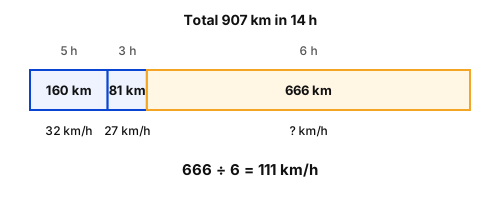
- First 5 h: .
- Next at takes h.
- Remaining distance ; remaining time h.
- Speed .
Trick: Keep a running total of distance and time; the last leg gives the answer directly.
Answer: (D) 111 km/hr
अवधारणा: आवश्यक चाल = शेष दूरी ÷ शेष समय।
- पहले 5 घंटे: ।
- अगले , पर घंटे।
- शेष दूरी ; शेष समय घंटे।
- चाल ।
ट्रिक: दूरी और समय का चालू योग रखें; अंतिम हिस्सा सीधे उत्तर देता है।
उत्तर: (D) 111 km/hr
RRB NTPC Undergraduate CBT 1MathematicsSpeed, distance & timeRRB NTPC Undergraduate CBT 1 2024 · 3 Sep Shift 1
Q1166.A can do a work in 11 days and B can do the same work in 24 days. If they work on it together for 2 days, then what fraction of the work is left?
A किसी कार्य को 11 दिनों में कर सकता है और B उसी कार्य को 24 दिनों में कर सकता है। यदि वे 2 दिनों तक एक साथ मिलकर उस पर कार्य करते हैं, तो कार्य का कितना भाग शेष रह जाता है?
- A
- B
- C
- D
Show answer
Concept: One day's work = ; work left = work done.
- in 1 day .
- In 2 days .
- Left .
Trick: All options have denominator 132, so work done and left parts.
Answer: (C)
अवधारणा: 1 दिन का काम = ; शेष काम = किया गया काम।
- का 1 दिन का काम ।
- 2 दिन में ।
- शेष ।
ट्रिक: सभी विकल्पों का हर 132 है, अतः किया गया भाग, शेष भाग।
उत्तर: (C)
RRB NTPC Undergraduate CBT 1MathematicsTime & workRRB NTPC Undergraduate CBT 1 2024 · 3 Sep Shift 1
Q1167.Find the circumference (in m) of the largest circle that can be drawn completely inside a rectangle with sides 196 m and 271 m. (Take .)
196 m और 271 m भुजाओं वाले एक आयत के अंदर पूर्णतः खींचे जा सकने वाले सबसे बड़े वृत्त की परिधि (m में) ज्ञात कीजिए। ( लीजिए।)
- A613
- B616
- C608
- D614
Show answer
Concept: The largest circle inside a rectangle has diameter equal to the shorter side.
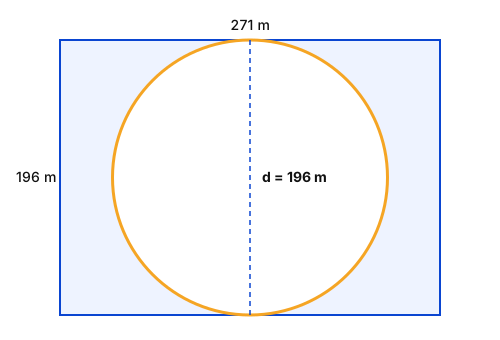
- Diameter (shorter side).
- Circumference .
- .
Trick: 196 is a multiple of 7 → directly.
Answer: (B) 616
अवधारणा: आयत के अंदर सबसे बड़े वृत्त का व्यास छोटी भुजा के बराबर होता है।
- व्यास (छोटी भुजा)।
- परिधि ।
- ।
ट्रिक: 196, 7 का गुणज है → ।
उत्तर: (B) 616
RRB NTPC Undergraduate CBT 1MathematicsMensuration – circleRRB NTPC Undergraduate CBT 1 2024 · 3 Sep Shift 1
Q1168.The value of is ______.
का मान ______ है।
- A17.31
- B4.24
- C2.92
- D15.32
Show answer
Concept: Find square roots of decimals by pairing decimal places.
- .
- (since ).
- (since ).
- .
Trick: Decimal places in the root = half of those in the number: (4) → (2).
Answer: (A) 17.31
अवधारणा: दशमलव संख्याओं का वर्गमूल दशमलव स्थानों को जोड़ी में लेकर निकालें।
- ।
- (क्योंकि )।
- (क्योंकि )।
- ।
ट्रिक: वर्गमूल में दशमलव स्थान = संख्या के आधे: (4) → (2)।
उत्तर: (A) 17.31
RRB NTPC Undergraduate CBT 1MathematicsSquare rootsRRB NTPC Undergraduate CBT 1 2024 · 3 Sep Shift 1
Q1169.Anjani can do a certain piece of work in 12 days. Anjani and Khushbu can together do the same work in 9 days, and Anjani, Khushbu and Sushmita can do the same work together in 8 days. In how many days can Anjani and Sushmita do the same work together?
अंजनी किसी कार्य को 12 दिनों में कर सकती है। अंजनी और खुशबू मिलकर उसी कार्य को 9 दिनों में कर सकती हैं, और अंजनी, खुशबू और सुष्मिता मिलकर उसी कार्य को 8 दिनों में कर सकती हैं। अंजनी और सुष्मिता मिलकर उसी कार्य को कितने दिनों में कर सकती हैं?
- A
- B
- C
- D
Show answer
Concept: Use LCM of days as total work and find each person's efficiency.
- Total work units.
- Anjani , Anjani+Khushbu , all three units/day.
- Sushmita unit/day.
- Anjani+Sushmita units/day → days.
Trick: Efficiencies by subtraction: for Sushmita; then .
Answer: (A)
अवधारणा: दिनों का LCM कुल काम मानें और हर व्यक्ति की क्षमता निकालें।
- कुल काम इकाई।
- अंजनी , अंजनी+खुशबू , तीनों इकाई/दिन।
- सुष्मिता इकाई/दिन।
- अंजनी+सुष्मिता इकाई/दिन → दिन।
ट्रिक: घटाकर क्षमता: सुष्मिता ; फिर ।
उत्तर: (A)
RRB NTPC Undergraduate CBT 1MathematicsTime & workRRB NTPC Undergraduate CBT 1 2024 · 3 Sep Shift 1
Q1170.If and , then find the value of .
यदि और है, तो का मान ज्ञात कीजिए।
- A
- B
- C
- D
Show answer
Concept: .
- .
- .
- .
Trick: Whenever cosec and cot (or sec and tan) are given, square and subtract.
Answer: (C)
अवधारणा: ।
- ।
- ।
- ।
ट्रिक: cosec और cot (या sec और tan) दिए हों तो वर्ग करके घटाएँ।
उत्तर: (C)
RRB NTPC Undergraduate CBT 1MathematicsTrigonometric identitiesRRB NTPC Undergraduate CBT 1 2024 · 3 Sep Shift 1
Q1171.In a certain code language, ‘RACK’ is coded as ‘3192’ and ‘JACK’ is coded as ‘1326’. What is the code for ‘J’ in the given code language?
एक निश्चित कूट भाषा में, ‘RACK’ को ‘3192’ के रूप में कूटबद्ध किया जाता है और ‘JACK’ को ‘1326’ के रूप में कूटबद्ध किया जाता है। दी गई कूट भाषा में ‘J’ का कूट क्या है?
- A6
- B1
- C3
- D2
Show answer
Concept: Common letters share common digits; the uncommon letter takes the uncommon digit.
- RACK → 3, 1, 9, 2 and JACK → 1, 3, 2, 6.
- A, C, K are common → digits 1, 2, 3 are common.
- R → 9 and J → 6.
Trick: Strike out the common digits; what is left in JACK's code is J.
Answer: (A) 6
अवधारणा: समान अक्षरों के समान अंक होते हैं; असमान अक्षर को बचा अंक मिलता है।
- RACK → 3, 1, 9, 2 और JACK → 1, 3, 2, 6।
- A, C, K समान → अंक 1, 2, 3 समान।
- R → 9 और J → 6।
ट्रिक: समान अंक काट दें; JACK के कोड में बचा अंक J है।
उत्तर: (A) 6
RRB NTPC Undergraduate CBT 1General Intelligence and ReasoningCoding-decodingRRB NTPC Undergraduate CBT 1 2024 · 3 Sep Shift 1
Q1172.Read the given statements and conclusions carefully. Assuming that the information given in the statements is true, even if it appears to be at variance with commonly known facts, decide which of the given conclusion(s) logically follow(s) from the statements.
Statements:
No watch is a bow.
No bow is a tie.
Conclusions:
(I) No watch is a tie.
(II) No bow is a watch.
दिए गए कथनों और निष्कर्षों को ध्यानपूर्वक पढ़िए। यह मानते हुए कि कथनों में दी गई जानकारी सत्य है, भले ही वह सामान्य रूप से ज्ञात तथ्यों से भिन्न प्रतीत होती हो, निर्णय लीजिए कि दिए गए निष्कर्षों में से कौन-सा/कौन-से निष्कर्ष तार्किक रूप से कथनों का अनुसरण करता है/करते हैं।
कथन:
कोई भी घड़ी, धनुष नहीं है।
कोई भी धनुष, टाई नहीं है।
निष्कर्ष:
(I) कोई भी घड़ी, टाई नहीं है।
(II) कोई भी धनुष, घड़ी नहीं है।
- ABoth conclusions (I) and (II) follow.निष्कर्ष (I) और (II) दोनों अनुसरण करते हैं।
- BOnly conclusion (I) follows.केवल निष्कर्ष (I) अनुसरण करता है।
- CNeither conclusion (I) nor (II) follows.न तो निष्कर्ष (I) और न ही (II) अनुसरण करता है।
- DOnly conclusion (II) follows.केवल निष्कर्ष (II) अनुसरण करता है।
Show answer
Concept: A 'No' statement can be reversed; two 'No' statements give no definite conclusion between the end terms.
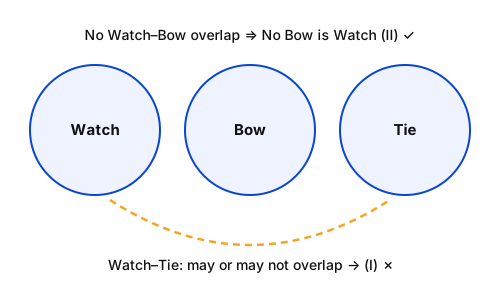
- 'No watch is a bow' ⇔ 'No bow is a watch' → (II) follows.
- Watch and Tie are both separate from Bow, but they may or may not overlap → (I) does not follow.
Trick: No + No = no conclusion; but a conversion of the given 'No' statement always follows.
Answer: (D) Only conclusion (II) follows.
अवधारणा: 'कोई नहीं' कथन उलटा जा सकता है; दो 'कोई नहीं' कथनों से अंतिम पदों के बीच निश्चित निष्कर्ष नहीं निकलता।
- 'कोई घड़ी धनुष नहीं' ⇔ 'कोई धनुष घड़ी नहीं' → (II) अनुसरण करता है।
- घड़ी और टाई दोनों धनुष से अलग हैं, पर आपस में मिल भी सकते हैं, नहीं भी → (I) अनुसरण नहीं करता।
ट्रिक: No + No = कोई निष्कर्ष नहीं; पर दिए गए 'No' कथन का उलटा हमेशा सही।
उत्तर: (D) केवल निष्कर्ष (II) अनुसरण करता है।
RRB NTPC Undergraduate CBT 1General Intelligence and ReasoningSyllogismRRB NTPC Undergraduate CBT 1 2024 · 3 Sep Shift 1
Q1173.What will come in the place of the question mark (?) in the following equation, if ‘+’ and ‘−’ are interchanged and ‘×’ and ‘÷’ are interchanged?
17 ÷ 3 + 49 × 7 − 13 = ?
यदि ‘+’ और ‘−’ को आपस में बदल दिया जाए तथा ‘×’ और ‘÷’ को आपस में बदल दिया जाए, तो निम्नलिखित समीकरण में प्रश्न चिह्न (?) के स्थान पर क्या आएगा?
17 ÷ 3 + 49 × 7 − 13 = ?
- A41
- B57
- C45
- D43
Show answer
Concept: Interchange the signs first, then apply BODMAS.
- After swapping: .
- .
- .
Trick: Rewrite the whole expression with new signs before calculating – avoids mixing old and new signs.
Answer: (B) 57
अवधारणा: पहले चिह्न बदलें, फिर BODMAS लगाएँ।
- बदलने के बाद: ।
- ।
- ।
ट्रिक: गणना से पहले पूरा व्यंजक नए चिह्नों से दोबारा लिखें।
उत्तर: (B) 57
RRB NTPC Undergraduate CBT 1General Intelligence and ReasoningMathematical operationsRRB NTPC Undergraduate CBT 1 2024 · 3 Sep Shift 1
Q1174.What should come in place of the question mark (?) in the given series?
691 692 690 691 689 690 688 ?
दी गई श्रृंखला में प्रश्न चिह्न (?) के स्थान पर क्या आना चाहिए?
691 692 690 691 689 690 688 ?
- A688
- B689
- C687
- D690
Show answer
Concept: Alternating pattern of differences.
- Differences: .
- Next: .
Trick: Alternate terms also form a series: 691, 690, 689, 688 and 692, 691, 690, 689.
Answer: (B) 689
अवधारणा: अंतरों का एकांतर पैटर्न।
- अंतर: ।
- अगला: ।
ट्रिक: एकांतर पद भी श्रृंखला हैं: 691, 690, 689, 688 और 692, 691, 690, 689।
उत्तर: (B) 689
RRB NTPC Undergraduate CBT 1General Intelligence and ReasoningNumber seriesRRB NTPC Undergraduate CBT 1 2024 · 3 Sep Shift 1
Q1175.In the following number-pairs, the second number is obtained by applying certain mathematical operations to the first number. Select the pair in which the numbers are related in the same way as are the numbers of the following pairs.
(Note: Operations should be performed on the whole numbers, without breaking down the numbers into its constituent digits. E.g., 13 – Operations on 13 such as
adding/subtracting/multiplying etc. to 13 can be performed. Breaking down 13 into 1 and 3 and then performing mathematical operations on 1 and 3 is not allowed.) 25, 100
21, 84
निम्नलिखित संख्या-युग्मों में, पहली संख्या पर कुछ गणितीय संक्रियाएँ करके दूसरी संख्या प्राप्त की जाती है। उस युग्म का चयन कीजिए जिसमें संख्याएँ उसी प्रकार संबंधित हैं जिस प्रकार निम्नलिखित युग्मों की संख्याएँ संबंधित हैं।
(ध्यान दें: संक्रियाएँ संख्याओं को उनके घटक अंकों में विभाजित किए बिना, पूर्ण संख्याओं पर की जानी चाहिए। उदाहरण के लिए, 13 – 13 पर संक्रियाएँ जैसे
13 में जोड़ना/घटाना/गुणा करना आदि किया जा सकता है। 13 को 1 और 3 में विभाजित करना और फिर 1 और 3 पर गणितीय संक्रियाएँ करना वर्जित है।) 25, 100
21, 84
- A28, 102
- B40, 180
- C32, 128
- D35, 120
Show answer
Concept: Find the single operation that links each given pair.
- and → rule: second first.
- Check: ✓; ; ; .
Trick: Divide second by first in each option; only .
Answer: (C) 32, 128
अवधारणा: हर दिए गए जोड़े को जोड़ने वाली एक संक्रिया खोजें।
- और → नियम: दूसरी पहली।
- जाँच: ✓; ; ; ।
ट्रिक: हर विकल्प में दूसरी ÷ पहली करें; केवल ।
उत्तर: (C) 32, 128
RRB NTPC Undergraduate CBT 1General Intelligence and ReasoningNumber analogyRRB NTPC Undergraduate CBT 1 2024 · 3 Sep Shift 1
Q1176.In a certain code language,
A $ B means ‘A is the daughter of B’
A + B means ‘A is the brother of B’
A @ B means ‘A is the wife of B’
A ÷ B means ‘A is the father of B’
Based on the above, how is E related to N if ‘E $ F @ G ÷ M + N’?
एक निश्चित कूट भाषा में,
A $ B का अर्थ है ‘A, B की पुत्री है’
A + B का अर्थ है ‘A, B का भाई है’
A @ B का अर्थ है ‘A, B की पत्नी है’
A ÷ B का अर्थ है ‘A, B का पिता है’
उपर्युक्त के आधार पर, यदि ‘E $ F @ G ÷ M + N’ है, तो E का N से क्या संबंध है?
- AMotherमाता
- BDaughterपुत्री
- CWifeपत्नी
- DSisterबहन
Show answer
Concept: Decode each symbol and build the family tree.
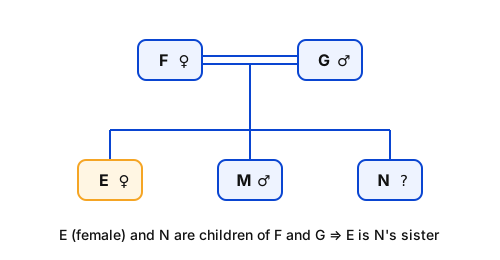
- E $ F: E is the daughter of F (E is female).
- F @ G: F is the wife of G.
- G ÷ M: G is the father of M; M + N: M is the brother of N.
- So E, M and N are children of F and G → E is the sister of N.
Trick: Gender of the person asked about comes from the first relation ('daughter') – female sibling = sister.
Answer: (D) Sister
अवधारणा: हर चिह्न को डिकोड करके वंश-वृक्ष बनाएँ।
- E $ F: E, F की बेटी है (E स्त्री)।
- F @ G: F, G की पत्नी है।
- G ÷ M: G, M का पिता है; M + N: M, N का भाई है।
- अतः E, M और N, F व G की संतानें हैं → E, N की बहन है।
ट्रिक: पूछे गए व्यक्ति का लिंग पहले संबंध ('बेटी') से मिलता है – स्त्री सहोदर = बहन।
उत्तर: (D) बहन
RRB NTPC Undergraduate CBT 1General Intelligence and ReasoningBlood relations (coded)RRB NTPC Undergraduate CBT 1 2024 · 3 Sep Shift 1
Q1177.Based on the English alphabetical order, three of the following four letter-clusters are alike in a certain way and thus form a group. Which letter-cluster DOES NOT belong to that group?
(Note: The odd one out is not based on the number of consonants/vowels or their position in the letter-cluster.)
अंग्रेज़ी वर्णमाला क्रम के आधार पर, निम्नलिखित चार अक्षर-समूहों में से तीन किसी निश्चित प्रकार से एकसमान हैं और इस प्रकार एक समूह बनाते हैं। कौन-सा अक्षर-समूह उस समूह से संबंधित नहीं है?
(ध्यान दें: असंगत अक्षर-समूह, उस अक्षर-समूह में व्यंजनों/स्वरों की संख्या या उनके स्थान पर आधारित नहीं है।)
- ANQL
- BEHC
- CUXS
- DLKO
Show answer
Concept: Check the alphabetical gaps between consecutive letters.
- NQL: N(14)→Q(17) , Q→L(12) .
- EHC: ; UXS: .
- LKO: L(12)→K(11) , K→O(15) → different.
Trick: Write place values once (E=5, J=10, O=15, T=20, Y=25) to read gaps fast.
Answer: (D) LKO
अवधारणा: क्रमागत अक्षरों के बीच अंतर जाँचें।
- NQL: N(14)→Q(17) , Q→L(12) ।
- EHC: ; UXS: ।
- LKO: L(12)→K(11) , K→O(15) → अलग।
ट्रिक: स्थान मान याद रखें (E=5, J=10, O=15, T=20, Y=25)।
उत्तर: (D) LKO
RRB NTPC Undergraduate CBT 1General Intelligence and ReasoningOdd one out (letters)RRB NTPC Undergraduate CBT 1 2024 · 3 Sep Shift 1
Q1178.Manoj starts from Point A and drives 9 km towards north. He then takes a right turn, drives 6 km, turns right and drives 3 km. He then takes a left turn and drives 5 km. He takes a final right turn, drives 6 km and stops at Point P. How far (shortest distance) and towards which direction should he drive in order to reach Point A again? (All turns are 90° turns only unless specified.)
मनोज बिंदु A से चलना शुरू करता है और उत्तर की ओर 9 km गाड़ी चलाता है। फिर वह दाएँ मुड़ता है, 6 km गाड़ी चलाता है, दाएँ मुड़ता है और 3 km गाड़ी चलाता है। फिर वह बाएँ मुड़ता है और 5 km गाड़ी चलाता है। वह अंतिम बार दाएँ मुड़ता है, 6 km गाड़ी चलाता है और बिंदु P पर रुक जाता है। बिंदु A पर पुनः पहुँचने के लिए उसे कितनी दूरी (न्यूनतम दूरी) तक और किस दिशा में गाड़ी चलानी चाहिए? (जब तक निर्दिष्ट न किया जाए, सभी मोड़ केवल 90° के मोड़ हैं।)
- A9 km towards southदक्षिण की ओर 9 km
- B9 km towards westपश्चिम की ओर 9 km
- C11 km towards eastपूर्व की ओर 11 km
- D11 km towards westपश्चिम की ओर 11 km
Show answer
Concept: Track net north–south and east–west displacement.
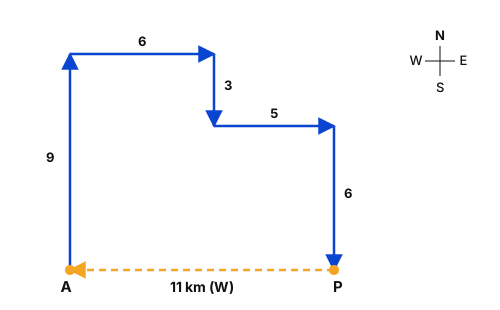
- North 9, then south → net north–south .
- East .
- So P is 11 km east of A → he must drive 11 km towards west.
Trick: If the N–S totals cancel, the answer is just the E–W total in the opposite direction.
Answer: (D) 11 km towards west
अवधारणा: कुल उत्तर–दक्षिण और पूर्व–पश्चिम विस्थापन देखें।
- उत्तर 9, फिर दक्षिण → उत्तर–दक्षिण शुद्ध ।
- पूर्व ।
- P, A से 11 km पूर्व में है → 11 km पश्चिम की ओर जाना होगा।
ट्रिक: उत्तर–दक्षिण बराबर हो जाएँ तो केवल पूर्व–पश्चिम योग विपरीत दिशा में उत्तर है।
उत्तर: (D) 11 km पश्चिम की ओर
RRB NTPC Undergraduate CBT 1General Intelligence and ReasoningDirection & distanceRRB NTPC Undergraduate CBT 1 2024 · 3 Sep Shift 1
Q1179.In a certain code language, 'mud depth urn' is coded as 'qz bd aa' and 'rain dog mud' is coded as 'bd gl kn'. How is 'mud' coded in the given code language?
एक निश्चित कूट भाषा में, 'mud depth urn' को 'qz bd aa' के रूप में कूटबद्ध किया जाता है और 'rain dog mud' को 'bd gl kn' के रूप में कूटबद्ध किया जाता है। दी गई कूट भाषा में 'mud' को किस प्रकार कूटबद्ध किया जाता है?
- Aqz
- Baa
- Cgl
- Dbd
Show answer
Concept: A word common to two sentences takes the code common to both.
- 'mud' appears in both phrases.
- Common code in 'qz bd aa' and 'bd gl kn' is 'bd'.
- So mud = bd.
Trick: Common word ↔ common code – no need to decode the others.
Answer: (D) bd
अवधारणा: दोनों वाक्यों में समान शब्द का कोड भी समान होता है।
- 'mud' दोनों वाक्यांशों में है।
- 'qz bd aa' और 'bd gl kn' में समान कोड 'bd' है।
- अतः mud = bd।
ट्रिक: समान शब्द ↔ समान कोड।
उत्तर: (D) bd
RRB NTPC Undergraduate CBT 1General Intelligence and ReasoningCoding-decoding (words)RRB NTPC Undergraduate CBT 1 2024 · 3 Sep Shift 1
Q1180.Read the given statements and conclusions carefully. Assuming that the information given in the statements is true, even if it appears to be at variance with commonly known facts, decide which of the given conclusions logically follow(s) from the statements.
Statements:
All stars are rectangles.
All cones are rectangles.
Conclusions:
(I): Some stars are cones.
(II): Some rectangles are cones.
दिए गए कथनों और निष्कर्षों को ध्यानपूर्वक पढ़िए। यह मानते हुए कि कथनों में दी गई जानकारी सत्य है, भले ही वह सामान्य रूप से ज्ञात तथ्यों से भिन्न प्रतीत होती हो, निर्णय लीजिए कि दिए गए निष्कर्षों में से कौन-सा/कौन-से निष्कर्ष तार्किक रूप से कथनों का अनुसरण करता है/करते हैं।
कथन:
सभी तारे, आयत हैं।
सभी शंकु, आयत हैं।
निष्कर्ष:
(I): कुछ तारे, शंकु हैं।
(II): कुछ आयत, शंकु हैं।
- ABoth conclusions (I) and (II) follow.निष्कर्ष (I) और (II) दोनों अनुसरण करते हैं।
- BOnly conclusion (II) follows.केवल निष्कर्ष (II) अनुसरण करता है।
- CNeither conclusion (I) nor (II) follows.न तो निष्कर्ष (I) और न ही (II) अनुसरण करता है।
- DOnly conclusion (I) follows.केवल निष्कर्ष (I) अनुसरण करता है।
Show answer
Concept: Two 'All' statements with a common predicate give no relation between their subjects.
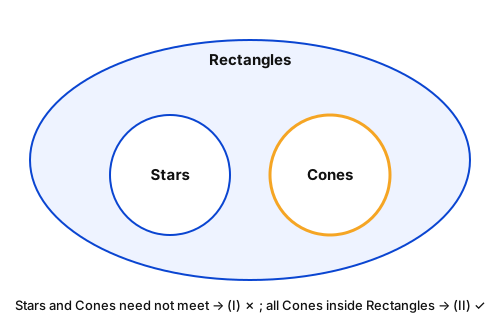
- Stars and cones are both inside rectangles but need not meet → (I) does not follow.
- All cones are rectangles ⇒ some rectangles are cones (conversion) → (II) follows.
Trick: 'All A are B' always gives 'Some B are A'.
Answer: (B) Only conclusion (II) follows.
अवधारणा: उभयनिष्ठ विधेय वाले दो 'सभी' कथनों से उनके उद्देश्यों में संबंध नहीं निकलता।
- स्टार और कोन दोनों आयतों के अंदर हैं पर आवश्यक नहीं कि मिलें → (I) अनुसरण नहीं करता।
- सभी कोन आयत हैं ⇒ कुछ आयत कोन हैं → (II) अनुसरण करता है।
ट्रिक: 'सभी A, B हैं' से सदैव 'कुछ B, A हैं' निकलता है।
उत्तर: (B) केवल निष्कर्ष (II) अनुसरण करता है।
RRB NTPC Undergraduate CBT 1General Intelligence and ReasoningSyllogismRRB NTPC Undergraduate CBT 1 2024 · 3 Sep Shift 1

