Q1261.Pipe P can fill part of a tank in 28 hours, and pipe Q can fill part of the same tank in 12 hours. Both P and Q were kept open for 6 hours, then both were closed. Pipe R alone was then opened and it emptied the water in the tank in 8 hours. Pipes P, Q and R together can fill the empty tank in:
पाइप P किसी टंकी का भाग 28 घंटे में भर सकता है, और पाइप Q उसी टंकी का भाग 12 घंटे में भर सकता है। P और Q दोनों को 6 घंटे तक खुला रखा गया, फिर दोनों को बंद कर दिया गया। इसके बाद केवल पाइप R को खोला गया और उसने टंकी का पानी 8 घंटे में खाली कर दिया। पाइप P, Q और R एक साथ खाली टंकी को कितने समय में भर सकते हैं?
- A117 hours117 घंटे
- B137 hours137 घंटे
- C126 hours126 घंटे
- D145 hours145 घंटे
Show answer
Concept: Find each pipe’s full-tank time; filling rates add, emptying rate subtracts.
- P fills in h ⇒ full in h; Q: h
- In h: filled
- R empties in h ⇒ full tank in h
- Together: ⇒ h
Trick: R empties exactly as fast as Q fills ( h each), so they cancel and only P works.
Answer: (C) hours
अवधारणा: हर पाइप का पूरा भरने का समय निकालें; भरने की दरें जुड़ती हैं, खाली करने की दर घटती है।
- P, भाग घंटे में ⇒ पूरा घंटे; Q: घंटे
- घंटे में: भरा
- R, को घंटे में खाली करता है ⇒ पूरा घंटे
- तीनों साथ: ⇒ घंटे
ट्रिक: R उतनी ही तेज़ी से खाली करता है जितनी तेज़ी से Q भरता है ( घंटे), इसलिए केवल P का काम बचता है।
उत्तर: (C) घंटे
RRB NTPC Undergraduate CBT 1MathematicsPipes and cisternsRRB NTPC Undergraduate CBT 1 2024 · 2 Sep Shift 3
Q1262.The ratio of an interior angle to its corresponding exterior angle in a regular polygon is 3 : 2. Determine the number of sides of the polygon.
एक सम बहुभुज में एक अंतः कोण और उसके संगत बाह्य कोण का अनुपात 3 : 2 है। बहुभुज की भुजाओं की संख्या ज्ञात कीजिए।
- A8
- B7
- C5
- D6
Show answer
Concept: Interior exterior , and exterior angle of a regular -gon .
- Exterior
Trick: Interior : exterior ⇒ (formula: ).
Answer: (C)
अवधारणा: आंतरिक बाह्य कोण , और सम -भुज का बाह्य कोण ।
- बाह्य कोण
ट्रिक: आंतरिक : बाह्य हो तो ।
उत्तर: (C)
RRB NTPC Undergraduate CBT 1MathematicsPolygons – anglesRRB NTPC Undergraduate CBT 1 2024 · 2 Sep Shift 3
Q1263.The HCF and the LCM of two numbers are 29 and 174, respectively. If one of the numbers is 58, find the other one.
दो संख्याओं का HCF और LCM क्रमशः 29 और 174 है। यदि उनमें से एक संख्या 58 है, तो दूसरी संख्या ज्ञात कीजिए।
- A116
- B174
- C145
- D87
Show answer
Concept: For two numbers: .
- Other number
Trick: Check: , ⇒ HCF , LCM ✓
Answer: (D)
अवधारणा: दो संख्याओं के लिए: ।
- दूसरी संख्या
ट्रिक: जाँच: , ⇒ HCF , LCM ✓
उत्तर: (D)
RRB NTPC Undergraduate CBT 1MathematicsHCF and LCMRRB NTPC Undergraduate CBT 1 2024 · 2 Sep Shift 3
Q1264.₹32,100 were divided among A, B and C, such that 2 times of A = 7 times of B = 4 times of C. Find the share of A.
₹32,100 को A, B और C में इस प्रकार बाँटा गया कि A का 2 गुना = B का 7 गुना = C का 4 गुना। A का हिस्सा ज्ञात कीजिए।
- A₹17,976
- B₹17,815
- C₹18,091
- D₹17,847
Show answer
Concept: If , then .
- Multiply by LCM : , total parts
- part
Trick: Ratio is the reciprocal of the multipliers: .
Answer: (A) ₹
अवधारणा: यदि , तो ।
- LCM से गुणा: , कुल भाग
- भाग
ट्रिक: अनुपात गुणकों का व्युत्क्रम होता है: ।
उत्तर: (A) ₹
RRB NTPC Undergraduate CBT 1MathematicsRatio – division of moneyRRB NTPC Undergraduate CBT 1 2024 · 2 Sep Shift 3
Q1265.The average of first 151 odd natural numbers, is:
प्रथम 151 विषम प्राकृत संख्याओं का औसत है:
- A151
- B151.5
- C152
- D150.5
Show answer
Concept: Sum of first odd natural numbers , so their average .
- Sum
- Average
Yaad rakhein: Average of first odd numbers ; of first even numbers .
Answer: (A)
अवधारणा: प्रथम विषम प्राकृत संख्याओं का योग , अतः औसत ।
- योग
- औसत
याद रखें: प्रथम विषम संख्याओं का औसत ; प्रथम सम संख्याओं का औसत ।
उत्तर: (A)
RRB NTPC Undergraduate CBT 1MathematicsAverage of odd numbersRRB NTPC Undergraduate CBT 1 2024 · 2 Sep Shift 3
Q1266.Sapna invested ₹22,800 on simple interest, partly at 6% per annum and partly at 4% per annum. If she earns equal interests from the two investments after 8 years, then find the sum invested at 6% per annum (in ₹).
सपना ने ₹22,800 साधारण ब्याज पर निवेश किए, जिसका कुछ भाग 6% वार्षिक दर पर और कुछ भाग 4% वार्षिक दर पर था। यदि 8 वर्ष बाद उसे दोनों निवेशों से समान ब्याज प्राप्त होता है, तो 6% वार्षिक दर पर निवेश की गई राशि (₹ में) ज्ञात कीजिए।
- A9,123
- B9,120
- C9,117
- D9,122
Show answer
Concept: With the same time, equal SI means , so sums are in inverse ratio of rates.
- (at : at )
- Sum at
Trick: Time ( years) cancels out – it is not needed.
Answer: (B) ₹
अवधारणा: समय समान हो तो बराबर साधारण ब्याज के लिए , अर्थात् मूलधन दरों के व्युत्क्रम अनुपात में।
- ( : )
- पर राशि
ट्रिक: समय ( वर्ष) कट जाता है – उसकी ज़रूरत नहीं।
उत्तर: (B) ₹
RRB NTPC Undergraduate CBT 1MathematicsSimple interest – equal interestRRB NTPC Undergraduate CBT 1 2024 · 2 Sep Shift 3
Q1267.P, Q and R invest sum in the ratio of 2 : 22 : 70, respectively. If they earned a total profit of ₹4,700 at the end of the year, then what is the difference between share of Q and R?
P, Q और R क्रमशः 2 : 22 : 70 के अनुपात में राशि निवेश करते हैं। यदि वर्ष के अंत में उन्होंने कुल ₹4,700 का लाभ अर्जित किया, तो Q और R के हिस्सों का अंतर क्या है?
- A₹2,447
- B₹2,430
- C₹2,306
- D₹2,400
Show answer
Concept: For the same period, profit is shared in the ratio of investments.
- Total parts ; part
- Difference R − Q parts
Trick: Find value of one part first, then multiply by the difference of parts.
Answer: (D) ₹
अवधारणा: समान अवधि में लाभ निवेश के अनुपात में बँटता है।
- कुल भाग ; भाग
- अंतर R − Q भाग
ट्रिक: पहले एक भाग का मान निकालें, फिर भागों के अंतर से गुणा करें।
उत्तर: (D) ₹
RRB NTPC Undergraduate CBT 1MathematicsPartnershipRRB NTPC Undergraduate CBT 1 2024 · 2 Sep Shift 3
Q1268.Which of the following ratios is the greatest?
निम्नलिखित में से कौन-सा अनुपात सबसे बड़ा है?
- A30 : 53
- B48 : 55
- C22 : 51
- D40 : 90
Show answer
Concept: Convert each ratio to a decimal (or compare with ) to find the greatest.
- ,
- ,
- Greatest:
Trick: Only has the antecedent very close to the consequent.
Answer: (B)
अवधारणा: हर अनुपात को दशमलव में बदलें (या से तुलना करें)।
- ,
- ,
- सबसे बड़ा:
ट्रिक: केवल में पूर्ववर्ती पद, उत्तरवर्ती के बहुत पास है।
उत्तर: (B)
RRB NTPC Undergraduate CBT 1MathematicsComparison of ratiosRRB NTPC Undergraduate CBT 1 2024 · 2 Sep Shift 3
Q1269.Find the surface area of the cuboid with dimensions 3 cm, 5 cm and 8 cm.
3 cm, 5 cm और 8 cm विमाओं वाले घनाभ का पृष्ठीय क्षेत्रफल ज्ञात कीजिए।
- A79 square cm.79 वर्ग cm
- B158 square cm.158 वर्ग cm
- C60 square cm.60 वर्ग cm
- D120 square cm.120 वर्ग cm
Show answer
Concept: Total surface area of a cuboid .
- TSA
Trick: (option A) is only half – don’t forget the factor .
Answer: (B) square cm
अवधारणा: घनाभ का कुल पृष्ठीय क्षेत्रफल ।
- TSA
ट्रिक: (विकल्प A) केवल आधा है – से गुणा करना न भूलें।
उत्तर: (B) वर्ग cm
RRB NTPC Undergraduate CBT 1MathematicsCuboid surface areaRRB NTPC Undergraduate CBT 1 2024 · 2 Sep Shift 3
Q1270.The product of two consecutive natural numbers is 90. The greater of the two numbers is:
दो क्रमागत प्राकृत संख्याओं का गुणनफल 90 है। दोनों में से बड़ी संख्या है:
- A6
- B10
- C11
- D21
Show answer
Concept: Take numbers and : .
- ; numbers and ; greater
Trick: – the two numbers lie on either side: .
Answer: (B)
अवधारणा: संख्याएँ और लें: ।
- ; संख्याएँ और ; बड़ी
ट्रिक: – दोनों संख्याएँ इसके दोनों ओर: ।
उत्तर: (B)
RRB NTPC Undergraduate CBT 1MathematicsConsecutive numbersRRB NTPC Undergraduate CBT 1 2024 · 2 Sep Shift 3
Q1271.In the following number-pairs, the second number is obtained by applying certain mathematical operation(s) to the first number. Select the number-pair in which the numbers are related in the same way as are the numbers of the following pairs. (NOTE: Operations should be performed on the whole numbers, without breaking down the numbers into their constituent digits. E.g. 13 – Operations on 13 such as adding to/subtracting from/multiplying with 13 can be performed. Breaking down 13 into 1 and 3 and then performing mathematical operations on 1 and 3 is not allowed.)
45, 165
24, 144
निम्नलिखित संख्या-युग्मों में, पहली संख्या पर कुछ गणितीय संक्रिया/संक्रियाएँ करके दूसरी संख्या प्राप्त की जाती है। उस संख्या-युग्म का चयन कीजिए जिसमें संख्याएँ उसी प्रकार संबंधित हैं जिस प्रकार निम्नलिखित युग्मों की संख्याएँ संबंधित हैं। (नोट: संख्याओं को उनके घटक अंकों में विभाजित किए बिना, पूर्ण संख्याओं पर संक्रियाएँ की जानी चाहिए। उदाहरण 13 – 13 पर संक्रियाएँ जैसे 13 में जोड़ना/घटाना/गुणा करना आदि की जा सकती हैं। 13 को 1 और 3 में विभाजित करके फिर 1 और 3 पर गणितीय संक्रियाएँ करने की अनुमति नहीं है।)
45, 165
24, 144
- A42, 172
- B18, 142
- C38, 158
- D21, 131
Show answer
Concept: Find the common operation between the two given pairs.
- , ⇒ rule: add
- A: ✗, B: ✗, C: ✓, D: ✗
Trick: Just subtract: second − first in each valid pair.
Answer: (C)
अवधारणा: दिए गए दोनों युग्मों में सामान्य संक्रिया खोजें।
- , ⇒ नियम: जोड़ें
- A: ✗, B: ✗, C: ✓, D: ✗
ट्रिक: बस घटाएँ: दूसरी − पहली ।
उत्तर: (C)
RRB NTPC Undergraduate CBT 1General Intelligence and ReasoningNumber pair analogyRRB NTPC Undergraduate CBT 1 2024 · 2 Sep Shift 3
Q1272.SPLT is related to QNJR in a certain way based on the English alphabetical order. In the same way, OLHP is related to MJFN. To which of the given options is KHDL related, following the same logic?
अंग्रेज़ी वर्णमाला क्रम के आधार पर SPLT एक निश्चित प्रकार से QNJR से संबंधित है। उसी प्रकार, OLHP, MJFN से संबंधित है। समान तर्क का अनुसरण करते हुए, KHDL दिए गए विकल्पों में से किससे संबंधित है?
- AIFBJ
- BIFJB
- CFIJB
- DFIBJ
Show answer
Concept: Compare each letter with its counterpart using alphabet positions.
- SPLT → QNJR:
- OLHP → MJFN: each ✓
- KHDL: ⇒ IFBJ
Trick: Every letter moves steps back, order unchanged.
Answer: (A) IFBJ
अवधारणा: अक्षरों की वर्णमाला स्थिति से तुलना करें।
- SPLT → QNJR:
- OLHP → MJFN: हर अक्षर ✓
- KHDL: ⇒ IFBJ
ट्रिक: हर अक्षर कदम पीछे, क्रम वही।
उत्तर: (A) IFBJ
RRB NTPC Undergraduate CBT 1General Intelligence and ReasoningLetter analogyRRB NTPC Undergraduate CBT 1 2024 · 2 Sep Shift 3
Q1273.What will come in the place of the question mark (?) in the following equation, if ‘+’ and ‘÷’ are interchanged, and ‘−’ and ‘×’ are interchanged?
6 − 4 × 85 + 5 ÷ 22 = ?
यदि ‘+’ और ‘÷’ को आपस में बदल दिया जाए, तथा ‘−’ और ‘×’ को आपस में बदल दिया जाए, तो निम्नलिखित समीकरण में प्रश्नवाचक चिह्न (?) के स्थान पर क्या आएगा?
6 − 4 × 85 + 5 ÷ 22 = ?
- A29
- B22
- C42
- D36
Show answer
Concept: Swap the signs first, then apply BODMAS.
- Swap and :
Trick: Rewrite the whole expression first; don’t swap and solve at the same time.
Answer: (A)
अवधारणा: पहले चिह्न बदलें, फिर BODMAS लगाएँ।
- और :
ट्रिक: पहले पूरा व्यंजक दोबारा लिखें, फिर हल करें।
उत्तर: (A)
RRB NTPC Undergraduate CBT 1General Intelligence and ReasoningSymbol interchangeRRB NTPC Undergraduate CBT 1 2024 · 2 Sep Shift 3
Q1274.Which of the following letter-number clusters will replace the question mark (?) in the given series to make it logically complete?
LIG 1, NKI 4, ?, ROM 16, TQO 25
निम्नलिखित में से कौन-सा अक्षर-संख्या समूह दी गई श्रृंखला में प्रश्नवाचक चिह्न (?) का स्थान लेकर उसे तार्किक रूप से पूर्ण करेगा?
LIG 1, NKI 4, ?, ROM 16, TQO 25
- APMK 9
- BQNL 9
- CPNL 9
- DQNK 12
Show answer
Concept: Track letters and numbers separately.
- 1st letters: L, N, P, R, T (); 2nd: I, K, M, O, Q (); 3rd: G, I, K, M, O ()
- Numbers: ⇒
- Missing term: PMK 9
Trick: Numbers are squares .
Answer: (A) PMK 9
अवधारणा: अक्षरों और संख्याओं को अलग-अलग देखें।
- पहले अक्षर: L, N, P, R, T (); दूसरे: I, K, M, O, Q (); तीसरे: G, I, K, M, O ()
- संख्याएँ: ⇒
- लुप्त पद: PMK 9
ट्रिक: संख्याएँ वर्ग हैं ।
उत्तर: (A) PMK 9
RRB NTPC Undergraduate CBT 1General Intelligence and ReasoningLetter-number seriesRRB NTPC Undergraduate CBT 1 2024 · 2 Sep Shift 3
Q1275.What should come in place of the question mark (?) in the given series based on the English alphabetical order?
ZMB JXN TIZ DTL ?
अंग्रेज़ी वर्णमाला क्रम के आधार पर दी गई श्रृंखला में प्रश्नवाचक चिह्न (?) के स्थान पर क्या आना चाहिए?
ZMB JXN TIZ DTL ?
- ANEY
- BNXE
- CNEX
- DNYE
Show answer
Concept: Each letter position moves (wrapping after Z).
- 1st: Z, J, T, D, N ()
- 2nd: M, X, I, T, E ()
- 3rd: B, N, Z, L, X ()
- Next term: NEX
Trick: with wrap = : e.g. .
Answer: (C) NEX
अवधारणा: हर स्थान का अक्षर बढ़ता है (Z के बाद फिर A से)।
- पहला: Z, J, T, D, N ()
- दूसरा: M, X, I, T, E ()
- तीसरा: B, N, Z, L, X ()
- अगला पद: NEX
ट्रिक: (चक्रीय) : जैसे ।
उत्तर: (C) NEX
RRB NTPC Undergraduate CBT 1General Intelligence and ReasoningLetter seriesRRB NTPC Undergraduate CBT 1 2024 · 2 Sep Shift 3
Q1276.S is the father of Y. Y is the brother of R. R is the wife of U. U is the son of P. How is S related to P?
S, Y का पिता है। Y, R का भाई है। R, U की पत्नी है। U, P का पुत्र है। S का P से क्या संबंध है?
- ASon's wife's fatherपुत्र की पत्नी का पिता
- BSon's wife's sisterपुत्र की पत्नी की बहन
- CSon's wife's brotherपुत्र की पत्नी का भाई
- DSon's wife's motherपुत्र की पत्नी की माता
Show answer
Concept: Build a family tree from the statements.
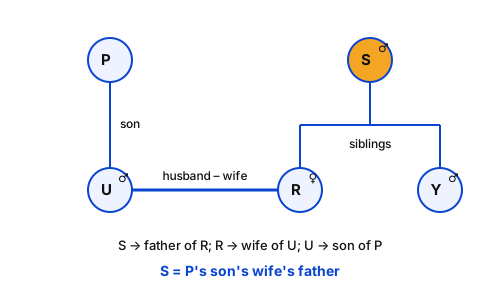
- S is father of Y; Y is brother of R ⇒ S is father of R
- R is wife of U; U is son of P ⇒ R is P’s son’s wife
- So S is father of P’s son’s wife
Trick: Y is only a link – the brother tells us R is S’s child.
Answer: (A) Son’s wife’s father
अवधारणा: कथनों से परिवार वृक्ष बनाएँ।
- S, Y का पिता; Y, R का भाई ⇒ S, R का पिता
- R, U की पत्नी; U, P का पुत्र ⇒ R, P के पुत्र की पत्नी
- अतः S, P के पुत्र की पत्नी के पिता हैं
ट्रिक: Y केवल कड़ी है – भाई होने से पता चलता है कि R, S की संतान है।
उत्तर: (A) पुत्र की पत्नी के पिता
RRB NTPC Undergraduate CBT 1General Intelligence and ReasoningBlood relationRRB NTPC Undergraduate CBT 1 2024 · 2 Sep Shift 3
Q1277.What should come in place of the question mark (?) in the given series?
9 15 47 91 275 ?
दी गई श्रृंखला में प्रश्नवाचक चिह्न (?) के स्थान पर क्या आना चाहिए?
9 15 47 91 275 ?
- A547
- B574
- C505
- D550
Show answer
Concept: Alternating operations: and .
- ,
- ,
Trick: Big jumps that alternate small/large suggest alternating multipliers.
Answer: (A)
अवधारणा: बारी-बारी से संक्रियाएँ: और ।
- ,
- ,
ट्रिक: छोटी-बड़ी बारी-बारी छलाँगें बदलते गुणक का संकेत हैं।
उत्तर: (A)
RRB NTPC Undergraduate CBT 1General Intelligence and ReasoningNumber seriesRRB NTPC Undergraduate CBT 1 2024 · 2 Sep Shift 3
Q1278.Based on the English alphabetical order, three of the following four letter cluster pairs are alike in a certain way and thus form a group. Which pair DOES NOT belong to that group? (NOTE: The odd one out is not based on the number of consonants/vowels or their position in the letter cluster.)
अंग्रेज़ी वर्णमाला क्रम के आधार पर, निम्नलिखित चार अक्षर-समूह युग्मों में से तीन किसी निश्चित प्रकार से एकसमान हैं और इस प्रकार एक समूह बनाते हैं। कौन-सा युग्म उस समूह से संबंधित नहीं है? (नोट: असंगत युग्म, व्यंजनों/स्वरों की संख्या या अक्षर-समूह में उनके स्थान पर आधारित नहीं है।)
- ARM-VP
- BAV-DY
- CGB-JE
- DOJ-RM
Show answer
Concept: Compare each letter of the first cluster with the second using positions.
- AV-DY: ; GB-JE: ; OJ-RM:
- RM-VP: , ✗
Trick: Check the first letter shift quickly – only RM-VP uses .
Answer: (A) RM-VP
अवधारणा: पहले समूह के हर अक्षर की दूसरे से स्थिति द्वारा तुलना करें।
- AV-DY: ; GB-JE: ; OJ-RM:
- RM-VP: , ✗
ट्रिक: पहले अक्षर का अंतर देखें – केवल RM-VP में है।
उत्तर: (A) RM-VP
RRB NTPC Undergraduate CBT 1General Intelligence and ReasoningOdd one out – letter pairsRRB NTPC Undergraduate CBT 1 2024 · 2 Sep Shift 3
Q1279.Based on the English alphabetical order, three of the following four letter-clusters are alike in a certain way and thus form a group. Which letter-cluster DOES NOT belong to that group? (Note: The odd one out is not based on the number of consonants/vowels or their position in the letter-cluster.)
अंग्रेज़ी वर्णमाला क्रम के आधार पर, निम्नलिखित चार अक्षर-समूहों में से तीन किसी निश्चित प्रकार से एकसमान हैं और इस प्रकार एक समूह बनाते हैं। कौन-सा अक्षर-समूह उस समूह से संबंधित नहीं है? (नोट: असंगत अक्षर-समूह, व्यंजनों/स्वरों की संख्या या अक्षर-समूह में उनके स्थान पर आधारित नहीं है।)
- ASOJD
- BGCXR
- CAWRL
- DQNHB
Show answer
Concept: Find the gap pattern between consecutive letters (backward, with wrap).
- SOJD: :
- GCXR: : ; AWRL: :
- QNHB: : ✗
Trick: Backward from A wraps to Z: , .
Answer: (D) QNHB
अवधारणा: क्रमागत अक्षरों के बीच अंतर का पैटर्न देखें (पीछे की ओर, चक्रीय)।
- SOJD: :
- GCXR: : ; AWRL: :
- QNHB: : ✗
ट्रिक: A से पीछे जाने पर Z आता है: , ।
उत्तर: (D) QNHB
RRB NTPC Undergraduate CBT 1General Intelligence and ReasoningOdd one out – letter clustersRRB NTPC Undergraduate CBT 1 2024 · 2 Sep Shift 3
Q1280.Refer to the following number, symbol series and answer the question. Counting to be done from left to right only.
(Left) 7 # * © & 8 4 & 6 1 5 9 € 8 $ * 6 6 8 5 7 7 (Right)
How many such numbers are there each of which is immediately preceded by a symbol and also immediately followed by a symbol?
निम्नलिखित संख्या, प्रतीक श्रृंखला का संदर्भ लेकर प्रश्न का उत्तर दीजिए। गणना केवल बाएँ से दाएँ की जानी है।
(बाएँ) 7 # * © & 8 4 & 6 1 5 9 € 8 $ * 6 6 8 5 7 7 (दाएँ)
ऐसी कितनी संख्याएँ हैं जिनमें से प्रत्येक के ठीक पहले एक प्रतीक है और ठीक बाद भी एक प्रतीक है?
- AZeroशून्य
- BOneएक
- CTwoदो
- DThreeतीन
Show answer
Concept: Check every number: the element just before it and just after it must both be symbols.
- Numbers next to symbols: 8 (after &, before 4) ✗; 6 (after &, before 1) ✗
- 8 (after €, before $) ✓; 6 (after *, before 6) ✗; first 7 has nothing before ✗
- In the series as printed, exactly one number (8 in “€ 8 $”) qualifies
Trick: Scan only numbers that touch a symbol on the left, then check the right side.
Answer: (B) One
अवधारणा: हर संख्या जाँचें: उसके ठीक पहले और ठीक बाद दोनों प्रतीक होने चाहिए।
- प्रतीक से सटी संख्याएँ: 8 (& के बाद, 4 से पहले) ✗; 6 (& के बाद, 1 से पहले) ✗
- 8 (€ के बाद, $ से पहले) ✓; 6 (* के बाद, 6 से पहले) ✗; पहले 7 से पहले कुछ नहीं ✗
- छपी हुई श्रृंखला में केवल एक संख्या (“€ 8 $” वाली 8) शर्त पूरी करती है
ट्रिक: केवल वे संख्याएँ देखें जिनके बाईं ओर प्रतीक है, फिर दाईं ओर जाँचें।
उत्तर: (B) एक
RRB NTPC Undergraduate CBT 1General Intelligence and ReasoningNumber-symbol seriesRRB NTPC Undergraduate CBT 1 2024 · 2 Sep Shift 3

