Q2341.Simplify:
सरल कीजिए:
- A
- B
- C
- D
Show answer
Concept: Apply BODMAS – brackets first, then "of", then , , , .
- , so first part
- , so
- Total
Trick: "of" is done before . Cancel common factors early – both parts come out as , so the answer is simply double.
Answer: (B)
अवधारणा: BODMAS लगाएँ – पहले कोष्ठक, फिर "of", फिर , , , ।
- , अतः पहला भाग
- , अतः
- योग
ट्रिक: "of" को से पहले हल करें। शुरू में ही common factor काटें – दोनों भाग आते हैं, उत्तर बस दोगुना।
उत्तर: (B)
RRB NTPC Undergraduate CBT 1MathematicsSimplification (BODMAS)RRB NTPC Undergraduate CBT 1 2025 · 8 May Shift 3
Q2342.Which of the following ratios is equal to 3:2?
निम्नलिखित में से कौन-सा अनुपात 3:2 के बराबर है?
- A35:25
- B45:20
- C60:45
- D120:80
Show answer
Concept: Two ratios are equal if they reduce to the same simplest form.
- , ,
- – divide both by 40: ✓
Trick: Check quickly: , others give .
Answer: (D) 120:80
अवधारणा: दो अनुपात बराबर होते हैं यदि सरलतम रूप समान हो।
- , ,
- – दोनों को 40 से भाग दें: ✓
ट्रिक: जाँचें: , बाकी देते हैं।
उत्तर: (D) 120:80
RRB NTPC Undergraduate CBT 1MathematicsRatioRRB NTPC Undergraduate CBT 1 2025 · 8 May Shift 3
Q2343.If the interest on a sum of ₹y at 4% per annum compounded annually for 2 years is ₹765, then the total amount payable at the end of the two-year period will be _________.
यदि ₹y की राशि पर 4% वार्षिक दर से वार्षिक रूप से संयोजित 2 वर्षों का ब्याज ₹765 है, तो दो वर्ष की अवधि के अंत में देय कुल मिश्रधन _________ होगा।
- A₹10,115
- B₹10,210
- C₹10,140
- D₹10,351
Show answer
Concept: Effective CI rate for 2 years at .
- At : of the sum ₹765
- Sum ₹9,375
- Amount ₹10,140
Trick: Amount = Principal + CI, so just add 765 to the principal – no need to recompute .
Answer: (C) ₹10,140
अवधारणा: 2 वर्ष, पर प्रभावी CI दर ।
- पर: of मूलधन ₹765
- मूलधन ₹9,375
- मिश्रधन ₹10,140
ट्रिक: मिश्रधन = मूलधन + CI, इसलिए मूलधन में 765 जोड़ दें – दोबारा निकालने की ज़रूरत नहीं।
उत्तर: (C) ₹10,140
RRB NTPC Undergraduate CBT 1MathematicsCompound InterestRRB NTPC Undergraduate CBT 1 2025 · 8 May Shift 3
Q2344.A pair of shoes is marked at ₹2800 and is subject to a trade discount of 18%. Under a special offer, a customer buys 5 pairs at the discounted price and gets an additional 2 pairs at 50% off the discounted price. Find the total cost to the customer for 7 pairs of shoes.
जूतों की एक जोड़ी का अंकित मूल्य ₹2800 है और उस पर 18% की व्यापारिक छूट दी जाती है। एक विशेष ऑफ़र के अंतर्गत, एक ग्राहक छूट वाले मूल्य पर 5 जोड़ी खरीदता है और छूट वाले मूल्य पर 50% की अतिरिक्त छूट के साथ 2 जोड़ी और प्राप्त करता है। ग्राहक के लिए 7 जोड़ी जूतों की कुल लागत ज्ञात कीजिए।
- A₹ 13,776
- B₹ 13,876
- C₹ 13,676
- D₹ 13,667
Show answer
Concept: Discounted price ; apply the extra offer on this price.
- Price after discount ₹2,296
- 5 pairs: ₹11,480
- 2 pairs at half: ₹2,296
- Total ₹13,776
Trick: 2 pairs at off = 1 pair at full discounted price, so total .
Answer: (A) ₹13,776
अवधारणा: छूट के बाद मूल्य ; अतिरिक्त ऑफर इसी मूल्य पर लगेगा।
- छूट के बाद ₹2,296
- 5 जोड़ी: ₹11,480
- 2 जोड़ी आधे दाम पर: ₹2,296
- कुल ₹13,776
ट्रिक: छूट पर 2 जोड़ी = पूरे छूट-मूल्य पर 1 जोड़ी, अतः कुल ।
उत्तर: (A) ₹13,776
RRB NTPC Undergraduate CBT 1MathematicsDiscountRRB NTPC Undergraduate CBT 1 2025 · 8 May Shift 3
Q2345.Three numbers are in the ratio 3 : 7 : 2, and their LCM is 8820. Their HCF is:
तीन संख्याएँ 3 : 7 : 2 के अनुपात में हैं और उनका LCM 8820 है। उनका HCF है:
- A240
- B208
- C210
- D235
Show answer
Concept: If numbers are (co-prime ratio terms), HCF and LCM .
- HCF
Trick: For co-prime ratio terms, .
Answer: (C) 210
अवधारणा: संख्याएँ (अनुपात के पद सह-अभाज्य) हों तो HCF और LCM ।
- HCF
ट्रिक: सह-अभाज्य अनुपात पदों के लिए ।
उत्तर: (C) 210
RRB NTPC Undergraduate CBT 1MathematicsHCF and LCMRRB NTPC Undergraduate CBT 1 2025 · 8 May Shift 3
Q2346.Pipes A and B together can fill a cistern in 10 hours. Pipes B and C together can fill the same cistern in 20 hours, and pipes C and A together can fill it in 12 hours. Find the time taken by pipe B alone to fill the cistern.
पाइप A और B मिलकर एक टंकी को 10 घंटे में भर सकते हैं। पाइप B और C मिलकर उसी टंकी को 20 घंटे में भर सकते हैं, और पाइप C और A मिलकर उसे 12 घंटे में भर सकते हैं। अकेले पाइप B द्वारा टंकी को भरने में लगने वाला समय ज्ञात कीजिए।
- A32 hours32 घंटे
- B25 hours25 घंटे
- C28 hours28 घंटे
- D30 hours30 घंटे
Show answer
Concept: Take total work = LCM of times and work in units/hour.
- LCM(10,20,12) units. A+B , B+C , C+A units/h
- Adding:
- B units/h
- Time for B hours
Trick: Single pipe = (sum of all three pairs) − (pair without it).
Answer: (D) 30 hours
अवधारणा: कुल काम = समयों का LCM लें और इकाई/घंटा में काम करें।
- LCM(10,20,12) इकाई। A+B , B+C , C+A इकाई/घंटा
- जोड़ने पर:
- B इकाई/घंटा
- B का समय घंटे
ट्रिक: अकेला पाइप = (तीनों जोड़ों का योग) − (उसके बिना वाला जोड़ा)।
उत्तर: (D) 30 घंटे
RRB NTPC Undergraduate CBT 1MathematicsPipes and CisternsRRB NTPC Undergraduate CBT 1 2025 · 8 May Shift 3
Q2347.A spherical water tank has an internal diameter of 10 meters. If the tank is coated with a material that costs ₹5 per square meter, what is the total cost to coat the entire internal surface? (Use π = 3.14)
एक गोलाकार पानी की टंकी का आंतरिक व्यास 10 मीटर है। यदि टंकी पर ₹5 प्रति वर्ग मीटर की लागत वाली सामग्री का लेप किया जाता है, तो संपूर्ण आंतरिक सतह पर लेप करने की कुल लागत कितनी होगी? (π = 3.14 का प्रयोग कीजिए)
- A₹785
- B₹314
- C₹1570
- D₹1257
Show answer
Concept: Surface area of a sphere .
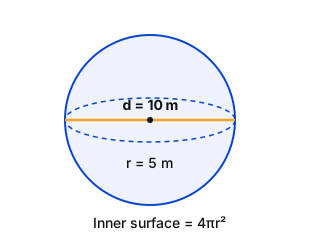
- m
- Area
- Cost ₹1,570
Trick: ; with , area directly.
Answer: (C) ₹1570
अवधारणा: गोले का पृष्ठीय क्षेत्रफल ।
- m
- क्षेत्रफल
- लागत ₹1,570
ट्रिक: ; पर क्षेत्रफल सीधे।
उत्तर: (C) ₹1570
RRB NTPC Undergraduate CBT 1MathematicsMensuration – SphereRRB NTPC Undergraduate CBT 1 2025 · 8 May Shift 3
Q2348.The average monthly income of six employees in an office is ₹24,000. When a new employee joins the office, the average income of all seven employees becomes ₹25,500. What is the monthly income of the new employee?
एक कार्यालय के छह कर्मचारियों की औसत मासिक आय ₹24,000 है। जब एक नया कर्मचारी कार्यालय में शामिल होता है, तो सभी सात कर्मचारियों की औसत आय ₹25,500 हो जाती है। नए कर्मचारी की मासिक आय कितनी है?
- A₹34,000
- B₹33,000
- C₹33,500
- D₹34,500
Show answer
Concept: New member = new total − old total.
- Old total
- New total
- New employee ₹34,500
Trick: New income = new average + (rise in average × old count) .
Answer: (D) ₹34,500
अवधारणा: नया सदस्य = नया योग − पुराना योग।
- पुराना योग
- नया योग
- नया कर्मचारी ₹34,500
ट्रिक: नई आय = नया औसत + (औसत में वृद्धि × पुरानी संख्या) ।
उत्तर: (D) ₹34,500
RRB NTPC Undergraduate CBT 1MathematicsAverageRRB NTPC Undergraduate CBT 1 2025 · 8 May Shift 3
Q2349.In a college, the ratio of science to arts students is different for each of its three batches. In Batch A, the ratio is 5:8, in Batch B it is 7:11, and in Batch C it is 3:5. Which batch has the highest proportion of science students?
एक कॉलेज में, विज्ञान और कला के विद्यार्थियों का अनुपात उसके तीनों बैचों में अलग-अलग है। बैच A में यह अनुपात 5:8, बैच B में 7:11 और बैच C में 3:5 है। किस बैच में विज्ञान के विद्यार्थियों का अनुपात सबसे अधिक है?
- ABatch Bबैच B
- BBatch Cबैच C
- CAll have the same proportionसभी में समान अनुपात है
- DBatch Aबैच A
Show answer
Concept: Proportion of science students ; compare the fractions.
- A:
- B:
- C:
- Highest is Batch B.
Trick: Compare and by cross-multiplying: , so is bigger.
Answer: (A) Batch B
अवधारणा: विज्ञान छात्रों का अनुपात ; भिन्नों की तुलना करें।
- A:
- B:
- C:
- सबसे अधिक Batch B।
ट्रिक: और की तुलना वज्र-गुणन से: , अतः बड़ा।
उत्तर: (A) Batch B
RRB NTPC Undergraduate CBT 1MathematicsRatio – ComparisonRRB NTPC Undergraduate CBT 1 2025 · 8 May Shift 3
Q2350.If the third proportional to 4 and 20 is m and the third proportional to m and 50 is n, what is the value of n?
यदि 4 और 20 का तृतीयानुपाती m है और m और 50 का तृतीयानुपाती n है, तो n का मान क्या है?
- A24
- B20
- C28
- D25
Show answer
Concept: Third proportional to and is .
Trick: – the middle term is squared.
Answer: (D) 25
अवधारणा: और का तृतीयानुपाती ।
ट्रिक: – बीच वाला पद वर्ग होता है।
उत्तर: (D) 25
RRB NTPC Undergraduate CBT 1MathematicsProportionRRB NTPC Undergraduate CBT 1 2025 · 8 May Shift 3
Q2351.In , and , what is the measure of ?
में, और है, तो का माप क्या है?
- A
- B
- C
- D
Show answer
Concept: Angles opposite equal sides are equal; angle sum of a triangle .
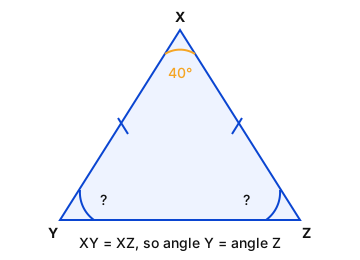
Trick: Base angle of an isosceles triangle .
Answer: (B)
अवधारणा: बराबर भुजाओं के सामने के कोण बराबर होते हैं; त्रिभुज के कोणों का योग ।
ट्रिक: समद्विबाहु त्रिभुज का आधार कोण ।
उत्तर: (B)
RRB NTPC Undergraduate CBT 1MathematicsGeometry – Isosceles TriangleRRB NTPC Undergraduate CBT 1 2025 · 8 May Shift 3
Q2352.The mean of the following data is 12.5. Find the missing frequency p.
Data Values (x): 10, 15
Frequency (f): 5, p
निम्नलिखित आँकड़ों का माध्य 12.5 है। लुप्त बारंबारता p ज्ञात कीजिए।
आँकड़ों के मान (x): 10, 15
बारंबारता (f): 5, p
- A6
- B5
- C4
- D3
Show answer
Concept: Mean .
Trick: Mean 12.5 is exactly midway between 10 and 15, so the frequencies must be equal: .
Answer: (B) 5
अवधारणा: माध्य ।
ट्रिक: माध्य 12.5, 10 और 15 के ठीक बीच में है, अतः दोनों बारंबारताएँ बराबर होंगी: ।
उत्तर: (B) 5
RRB NTPC Undergraduate CBT 1MathematicsStatistics – MeanRRB NTPC Undergraduate CBT 1 2025 · 8 May Shift 3
Q2353.A delivery van covers the first 100 km at 50 km/h, the next 150 km at 60 km/h, and the last 50 km at 40 km/h. What is the average speed for the entire journey (correct to two places of decimal)?
एक डिलीवरी वैन पहले 100 km की दूरी 50 km/h की चाल से, अगले 150 km की दूरी 60 km/h की चाल से और अंतिम 50 km की दूरी 40 km/h की चाल से तय करती है। पूरी यात्रा के लिए औसत चाल क्या है (दशमलव के दो स्थानों तक सही)?
- A50.05 km/h
- B52.17 km/h
- C48.29 km/h
- D54.54 km/h
Show answer
Concept: Average speed (never the average of speeds).
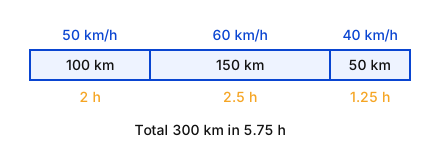
- Times: h, h, h
- Total: 300 km in h
- Average speed
Trick: – only option B lies between 50 and 60 close to this value.
Answer: (B) 52.17 km/h
अवधारणा: औसत चाल (चालों का औसत नहीं)।
- समय: h, h, h
- कुल: 300 km, h में
- औसत चाल
ट्रिक: – यही मान विकल्प B से मेल खाता है।
उत्तर: (B) 52.17 km/h
RRB NTPC Undergraduate CBT 1MathematicsAverage SpeedRRB NTPC Undergraduate CBT 1 2025 · 8 May Shift 3
Q2354.The population of a town increases by 10% in the year 2015 and decreases by 15% in the year 2016. If the population of the town at the end of the year 2016 is 1,87,000, find the population of the town in the beginning of the year 2015.
एक कस्बे की जनसंख्या वर्ष 2015 में 10% बढ़ती है और वर्ष 2016 में 15% घटती है। यदि वर्ष 2016 के अंत में कस्बे की जनसंख्या 1,87,000 है, तो वर्ष 2015 के प्रारंभ में कस्बे की जनसंख्या ज्ञात कीजिए।
- A2,00,000
- B2,10,000
- C2,15,000
- D1,95,000
Show answer
Concept: Successive changes multiply: .
Trick: Net change , so of .
Answer: (A) 2,00,000
अवधारणा: क्रमिक परिवर्तन गुणा होते हैं: ।
ट्रिक: शुद्ध परिवर्तन , अतः का ।
उत्तर: (A) 2,00,000
RRB NTPC Undergraduate CBT 1MathematicsPercentage – PopulationRRB NTPC Undergraduate CBT 1 2025 · 8 May Shift 3
Q2355.Which of the following numbers is divisible by 11?
निम्नलिखित में से कौन-सी संख्या 11 से विभाज्य है?
- A3,762
- B6,184
- C4,915
- D7,393
Show answer
Concept: A number is divisible by 11 if (sum of digits at odd places) − (sum at even places) is 0 or a multiple of 11.
- 3762: ✓ divisible
- 6184: ✗; 4915: ✗; 7393: ✗
Trick: – alternate-digit difference zero means divisible.
Answer: (A) 3,762
अवधारणा: संख्या 11 से विभाज्य है यदि (विषम स्थानों के अंकों का योग) − (सम स्थानों का योग) 0 या 11 का गुणज हो।
- 3762: ✓ विभाज्य
- 6184: ✗; 4915: ✗; 7393: ✗
ट्रिक: – एकांतर अंकों का अंतर शून्य = विभाज्य।
उत्तर: (A) 3,762
RRB NTPC Undergraduate CBT 1MathematicsDivisibility Rule of 11RRB NTPC Undergraduate CBT 1 2025 · 8 May Shift 3
Q2356.In a division sum, the divisor is 14 times the quotient and 5 times the remainder. If the remainder is 56, what is the dividend?
एक भाग के प्रश्न में, भाजक भागफल का 14 गुना और शेषफल का 5 गुना है। यदि शेषफल 56 है, तो भाज्य क्या है?
- A5655
- B5656
- C5651
- D5653
Show answer
Concept: Dividend .
- Divisor
- Quotient
- Dividend
Trick: Find the divisor from the remainder first – it links both given relations.
Answer: (B) 5656
अवधारणा: भाज्य ।
- भाजक
- भागफल
- भाज्य
ट्रिक: पहले शेषफल से भाजक निकालें – यही दोनों संबंधों को जोड़ता है।
उत्तर: (B) 5656
RRB NTPC Undergraduate CBT 1MathematicsDivision AlgorithmRRB NTPC Undergraduate CBT 1 2025 · 8 May Shift 3
Q2357.Sangeeta’s salary is revised twice in two consecutive years. In the first year, the salary is increased by 12%. In the second year, it is decreased by 10%. Despite this, her salary after the second revision is ₹1,584 more than the original salary. What is Sangeeta’s original monthly salary (in ₹)?
संगीता के वेतन में लगातार दो वर्षों में दो बार संशोधन किया जाता है। पहले वर्ष में वेतन में 12% की वृद्धि की जाती है। दूसरे वर्ष में इसमें 10% की कमी की जाती है। इसके बावजूद, दूसरे संशोधन के बाद उसका वेतन मूल वेतन से ₹1,584 अधिक है। संगीता का मूल मासिक वेतन (₹ में) कितना है?
- A1,75,000
- B1,89,000
- C2,00,000
- D1,98,000
Show answer
Concept: Net change for then .
- Net
- of salary salary ₹1,98,000
Trick: ; the extra part equals ₹1,584, so salary .
Answer: (D) 1,98,000
अवधारणा: फिर का शुद्ध परिवर्तन ।
- शुद्ध
- वेतन का वेतन ₹1,98,000
ट्रिक: ; अतिरिक्त भाग = ₹1,584, अतः वेतन ।
उत्तर: (D) 1,98,000
RRB NTPC Undergraduate CBT 1MathematicsSuccessive Percentage ChangeRRB NTPC Undergraduate CBT 1 2025 · 8 May Shift 3
Q2358.A train covers a distance of 300 kilometers in 5 hours. If the same train takes 6 hours to cover the same distance, what is the change in its speed?
एक रेलगाड़ी 300 किलोमीटर की दूरी 5 घंटे में तय करती है। यदि वही रेलगाड़ी उतनी ही दूरी तय करने में 6 घंटे लेती है, तो उसकी चाल में क्या परिवर्तन होगा?
- A15 km/h decrease15 km/h की कमी
- B10 km/h increase10 km/h की वृद्धि
- C15 km/h increase15 km/h की वृद्धि
- D10 km/h decrease10 km/h की कमी
Show answer
Concept: Speed .
- Original speed
- New speed
- Change decrease
Trick: More time for the same distance always means lower speed – so only "decrease" options qualify.
Answer: (D) 10 km/h decrease
अवधारणा: चाल ।
- मूल चाल
- नई चाल
- परिवर्तन की कमी
ट्रिक: समान दूरी में अधिक समय = कम चाल, अतः केवल "कमी" वाले विकल्प संभव हैं।
उत्तर: (D) 10 km/h की कमी
RRB NTPC Undergraduate CBT 1MathematicsSpeed, Time and DistanceRRB NTPC Undergraduate CBT 1 2025 · 8 May Shift 3
Q2359.Simplify: (0.25 × 1.6) ÷ (0.04 × 0.5)
सरल कीजिए: (0.25 × 1.6) ÷ (0.04 × 0.5)
- A20
- B2
- C10
- D8
Show answer
Concept: Multiply inside each bracket, then divide.
Trick: Remove decimals: … or simply note and , product 20.
Answer: (A) 20
अवधारणा: पहले हर कोष्ठक में गुणा करें, फिर भाग दें।
ट्रिक: जोड़ी बनाकर देखें: और , गुणनफल 20।
उत्तर: (A) 20
RRB NTPC Undergraduate CBT 1MathematicsDecimal SimplificationRRB NTPC Undergraduate CBT 1 2025 · 8 May Shift 3
Q2360.A and B can do a piece of work in 12 days and 39 days, respectively. Both work for 4 days and then A leaves. How long (in days) will B take to complete the remaining work?
A और B एक कार्य को क्रमशः 12 दिनों और 39 दिनों में कर सकते हैं। दोनों 4 दिन कार्य करते हैं और फिर A कार्य छोड़ देता है। शेष कार्य पूरा करने में B को कितने दिन लगेंगे?
- A24
- B21
- C23
- D22
Show answer
Concept: Total work = LCM of days; efficiency = work per day.
- LCM(12,39) units; A , B units/day
- 4 days together: units; remaining
- B alone: days
Trick: In 4 days A does of the work; B must do the rest alone, so B's remaining time .
Answer: (D) 22
अवधारणा: कुल कार्य = दिनों का LCM; दक्षता = प्रतिदिन कार्य।
- LCM(12,39) इकाई; A , B इकाई/दिन
- 4 दिन साथ: इकाई; शेष
- B अकेला: दिन
ट्रिक: 4 दिनों में A काम करता है; B का शेष समय ।
उत्तर: (D) 22
RRB NTPC Undergraduate CBT 1MathematicsTime and WorkRRB NTPC Undergraduate CBT 1 2025 · 8 May Shift 3

