Q2361.The amount under simple interest on a sum of ₹8,000 for 3 years at an interest rate of 7.5% per annum is
₹8,000 की राशि पर 7.5% वार्षिक ब्याज दर से 3 वर्षों के लिए साधारण ब्याज पर मिश्रधन है
- A₹9800
- B₹10000
- C₹9600
- D₹9400
Show answer
Concept: ; Amount .
- Amount ₹9,800
Trick: of 8000 in one step.
Answer: (A) ₹9800
अवधारणा: ; मिश्रधन ।
- मिश्रधन ₹9,800
ट्रिक: of 8000 एक ही चरण में।
उत्तर: (A) ₹9800
RRB NTPC Undergraduate CBT 1MathematicsSimple InterestRRB NTPC Undergraduate CBT 1 2025 · 8 May Shift 3
Q2362.If a man bought an article at 20% less than its marked price and sold it for ₹10 more than its marked price, his profit was 40%. What was the marked price (in ₹) of the article (correct to two decimal places)?
यदि एक व्यक्ति ने एक वस्तु को उसके अंकित मूल्य से 20% कम पर खरीदा और उसे अंकित मूल्य से ₹10 अधिक पर बेच दिया, तो उसका लाभ 40% था। वस्तु का अंकित मूल्य (₹ में) क्या था (दशमलव के दो स्थानों तक सही)?
- A₹83.33
- B₹76.66
- C₹86.66
- D₹73.33
Show answer
Concept: . Let marked price .
- ,
Trick: , so the ₹10 above MP is exactly of MP.
Answer: (A) ₹83.33
अवधारणा: । अंकित मूल्य मानें।
- ,
ट्रिक: , अतः MP से ऊपर के ₹10 ठीक MP का हैं।
उत्तर: (A) ₹83.33
RRB NTPC Undergraduate CBT 1MathematicsProfit and LossRRB NTPC Undergraduate CBT 1 2025 · 8 May Shift 3
Q2363.Evaluate 233 + (-14)3 + (-9)3
233 + (-14)3 + (-9)3 का मान ज्ञात कीजिए
- A8502
- B8694
- C8498
- D8581
Show answer
Concept: If , then .
- Sum
Trick: Whenever three cubes are added and the bases sum to zero, skip cubing – just use .
Answer: (B) 8694
अवधारणा: यदि तो ।
- योग
ट्रिक: तीन घनों का योग हो और आधार का योग शून्य हो तो घन न निकालें – सीधे ।
उत्तर: (B) 8694
RRB NTPC Undergraduate CBT 1MathematicsAlgebraic IdentityRRB NTPC Undergraduate CBT 1 2025 · 8 May Shift 3
Q2364.The present age of Person A is 5 years more than twice the age of Person B. If Person B is 15 years old, what is the present age (in years) of Person A?
व्यक्ति A की वर्तमान आयु व्यक्ति B की आयु के दोगुने से 5 वर्ष अधिक है। यदि व्यक्ति B की आयु 15 वर्ष है, तो व्यक्ति A की वर्तमान आयु (वर्षों में) क्या है?
- A35
- B33
- C34
- D32
Show answer
Concept: Translate words into an equation: .
- years
Trick: "5 more than twice" = double first, then add 5.
Answer: (A) 35
अवधारणा: शब्दों को समीकरण में बदलें: ।
- वर्ष
ट्रिक: "दोगुने से 5 अधिक" = पहले दोगुना, फिर 5 जोड़ें।
उत्तर: (A) 35
RRB NTPC Undergraduate CBT 1MathematicsAgesRRB NTPC Undergraduate CBT 1 2025 · 8 May Shift 3
Q2365.A trader buys a consignment of goods for ₹2400. He sells one-third of the goods at a 20% profit, and one-fourth of the goods at a 10% loss, and the remaining goods at cost price. What is the overall profit or loss percentage?
एक व्यापारी ₹2400 में माल की एक खेप खरीदता है। वह एक-तिहाई माल 20% लाभ पर, एक-चौथाई माल 10% हानि पर और शेष माल क्रय मूल्य पर बेचता है। कुल लाभ या हानि प्रतिशत क्या है?
- A profit लाभ
- B loss हानि
- C profit लाभ
- D loss हानि
Show answer
Concept: Overall .
- One-third: CP ₹800, profit
- One-fourth: CP ₹600, loss
- Rest at cost: . Net gain
- profit
Trick: Weighted profit – no need to use ₹2400 at all.
Answer: (A) profit
अवधारणा: कुल ।
- एक-तिहाई: CP ₹800, लाभ
- एक-चौथाई: CP ₹600, हानि
- शेष क्रय मूल्य पर: । शुद्ध लाभ
- लाभ
ट्रिक: भारित लाभ – ₹2400 की ज़रूरत ही नहीं।
उत्तर: (A) लाभ
RRB NTPC Undergraduate CBT 1MathematicsProfit and Loss – Mixed SaleRRB NTPC Undergraduate CBT 1 2025 · 8 May Shift 3
Q2366.A shopkeeper offers the following schemes on toys of the same marked price. (A) Successive discounts of 21% and 8% on any number of toys bought.
(B) Successive discounts of 38%, 42% and 30% on any number of toys bought. (C) 17% discount on the first 8 toys and 20% discount on each toy thereon.
(D) 7 toys free of cost on buying 10 toys.
A customer wants to buy 10 toys. Which of the above schemes is the least beneficial to her?
एक दुकानदार समान अंकित मूल्य वाले खिलौनों पर निम्नलिखित योजनाएँ प्रस्तुत करता है। (A) खरीदे गए किसी भी संख्या के खिलौनों पर 21% और 8% की क्रमिक छूट।
(B) खरीदे गए किसी भी संख्या के खिलौनों पर 38%, 42% और 30% की क्रमिक छूट। (C) पहले 8 खिलौनों पर 17% छूट और उसके बाद प्रत्येक खिलौने पर 20% छूट।
(D) 10 खिलौने खरीदने पर 7 खिलौने निःशुल्क।
एक ग्राहक 10 खिलौने खरीदना चाहती है। उपरोक्त में से कौन-सी योजना उसके लिए सबसे कम लाभदायक है?
- AA
- BD
- CC
- DB
Show answer
Concept: Compare the effective price paid per toy (take MP = ₹100 each).
- (A) ₹72.68 per toy
- (B) ₹25.17 per toy
- (C) for 10, i.e. ₹82.40 per toy
- (D) Pay for 10, get 17: ₹58.82 per toy
- Highest effective price = scheme C → least beneficial.
Trick: Successive discounts always beat the plain sum; a scheme with only – off can never compete with or three big discounts.
Answer: (C) C
अवधारणा: प्रति खिलौना प्रभावी मूल्य की तुलना करें (MP = ₹100 मानें)।
- (A) ₹72.68 प्रति खिलौना
- (B) ₹25.17 प्रति खिलौना
- (C) (10 के लिए), यानी ₹82.40 प्रति खिलौना
- (D) 10 का भुगतान, 17 मिले: ₹58.82 प्रति खिलौना
- सबसे अधिक प्रभावी मूल्य = योजना C → सबसे कम लाभकारी।
ट्रिक: केवल – छूट वाली योजना या तीन बड़ी छूटों का मुकाबला नहीं कर सकती।
उत्तर: (C) C
RRB NTPC Undergraduate CBT 1MathematicsSuccessive Discounts – ComparisonRRB NTPC Undergraduate CBT 1 2025 · 8 May Shift 3
Q2367.Eight mangoes and five oranges cost ₹164, while five mangoes and eight oranges cost ₹148. Determine the cost of three mangoes and three oranges.
आठ आमों और पाँच संतरों की कीमत ₹164 है, जबकि पाँच आमों और आठ संतरों की कीमत ₹148 है। तीन आमों और तीन संतरों की कीमत ज्ञात कीजिए।
- A₹74
- B₹76
- C₹72
- D₹70
Show answer
Concept: Symmetric equations – add them to get directly.
- ,
- Adding:
Trick: When coefficients are swapped, adding gives the sum and subtracting gives the difference – no need to solve for each item.
Answer: (C) ₹72
अवधारणा: सममित समीकरण – जोड़कर सीधे निकालें।
- ,
- जोड़ने पर:
ट्रिक: गुणांक आपस में बदले हों तो जोड़ने से योग और घटाने से अंतर मिलता है – अलग-अलग हल करने की ज़रूरत नहीं।
उत्तर: (C) ₹72
RRB NTPC Undergraduate CBT 1MathematicsLinear EquationsRRB NTPC Undergraduate CBT 1 2025 · 8 May Shift 3
Q2368.A ladder leans against a wall, making an angle of 60° with the ground. If the foot of the ladder is 15 metres from the wall, what is the length of the ladder?
एक सीढ़ी एक दीवार के सहारे टिकी है और ज़मीन के साथ 60° का कोण बनाती है। यदि सीढ़ी का पाद दीवार से 15 मीटर दूर है, तो सीढ़ी की लंबाई कितनी है?
- A32 m
- B30 m
- C42 m
- D36 m
Show answer
Concept: In the right triangle, .
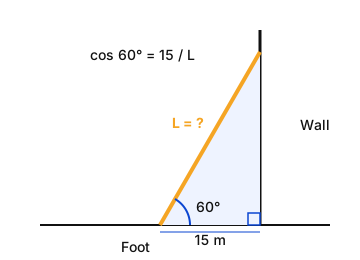
- m
Trick: In a -- triangle the hypotenuse is twice the side opposite (the base here).
Answer: (B) 30 m
अवधारणा: समकोण त्रिभुज में ।
- m
ट्रिक: -- त्रिभुज में कर्ण, के सामने वाली भुजा (यहाँ आधार) का दोगुना होता है।
उत्तर: (B) 30 m
RRB NTPC Undergraduate CBT 1MathematicsHeights and DistancesRRB NTPC Undergraduate CBT 1 2025 · 8 May Shift 3
Q2369.Simplify:
सरल कीजिए:
- A
- B
- C
- D
Show answer
Concept: , , .
- Numerator:
- Divide:
Trick: Put : expression ; only gives .
Answer: (A)
अवधारणा: , , ।
- अंश:
- भाग:
ट्रिक: रखें: व्यंजक ; केवल से मिलता है।
उत्तर: (A)
RRB NTPC Undergraduate CBT 1MathematicsLaws of ExponentsRRB NTPC Undergraduate CBT 1 2025 · 8 May Shift 3
Q2370.Sphere A has a radius of 6 cm and Sphere B has a radius of 3 cm. What is the ratio of the surface area of A to that of B?
गोले A की त्रिज्या 6 cm और गोले B की त्रिज्या 3 cm है। A के पृष्ठीय क्षेत्रफल का B के पृष्ठीय क्षेत्रफल से अनुपात क्या है?
- A4:1
- B3:1
- C2:1
- D6:1
Show answer
Concept: Surface area , so the ratio of areas .
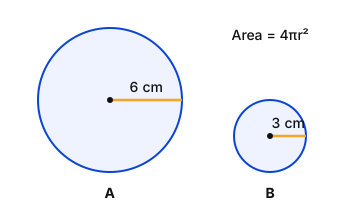
- Area ratio
Trick: Double the radius → area , volume .
Answer: (A) 4:1
अवधारणा: पृष्ठीय क्षेत्रफल , अतः क्षेत्रफलों का अनुपात ।
- क्षेत्रफल अनुपात
ट्रिक: त्रिज्या दोगुनी → क्षेत्रफल , आयतन ।
उत्तर: (A) 4:1
RRB NTPC Undergraduate CBT 1MathematicsMensuration – SphereRRB NTPC Undergraduate CBT 1 2025 · 8 May Shift 3
Q2371.Read the given statements and conclusions carefully. Assuming that the information given in the statements is true, even if it appears to be at variance with commonly known facts, decide which of the given conclusions logically follow(s) from the statements.
Statement: All Chickens are Quails. All Quails are Pigeons.
Conclusion (I): No Pigeons are Chickens.
Conclusion (II): Some Pigeons are Chickens.
दिए गए कथनों और निष्कर्षों को ध्यानपूर्वक पढ़िए। यह मानते हुए कि कथनों में दी गई जानकारी सत्य है, भले ही वह सामान्यतः ज्ञात तथ्यों से भिन्न प्रतीत होती हो, निर्णय कीजिए कि दिए गए निष्कर्षों में से कौन-सा/कौन-से निष्कर्ष कथनों का तार्किक रूप से अनुसरण करता है/करते हैं।
कथन: सभी मुर्गियाँ बटेर हैं। सभी बटेर कबूतर हैं।
निष्कर्ष (I): कोई कबूतर मुर्गी नहीं है।
निष्कर्ष (II): कुछ कबूतर मुर्गियाँ हैं।
- ABoth conclusions (I) and (II) followनिष्कर्ष (I) और (II) दोनों अनुसरण करते हैं
- BOnly conclusion (I) followsकेवल निष्कर्ष (I) अनुसरण करता है
- COnly conclusion (II) followsकेवल निष्कर्ष (II) अनुसरण करता है
- DNeither conclusion (I) nor (II) followsन तो निष्कर्ष (I) और न ही (II) अनुसरण करता है
Show answer
Concept: Draw the Venn diagram for two "All" statements – the sets nest inside each other.
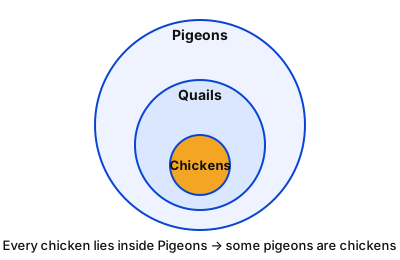
- All Chickens are Quails and all Quails are Pigeons → Chickens ⊂ Quails ⊂ Pigeons, so all Chickens are Pigeons.
- Conclusion (I) "No Pigeons are Chickens" is the opposite of this – false.
- Conclusion (II) "Some Pigeons are Chickens" is the converse of "All Chickens are Pigeons" – it follows.
Trick: All A are B ⇒ Some B are A (always true); "No" can never follow from two "All" statements.
Answer: (C) Only conclusion (II) follows
अवधारणा: दो "All" कथनों का Venn चित्र बनाएँ – समूह एक-दूसरे के अंदर समा जाते हैं।
- सभी Chickens, Quails हैं और सभी Quails, Pigeons हैं → Chickens ⊂ Quails ⊂ Pigeons, अतः सभी Chickens, Pigeons हैं।
- निष्कर्ष (I) "कोई Pigeon, Chicken नहीं" इसके विपरीत है – गलत।
- निष्कर्ष (II) "कुछ Pigeons, Chickens हैं" – "सभी Chickens, Pigeons हैं" का converse है – सही।
ट्रिक: All A are B ⇒ Some B are A (हमेशा सही); दो "All" कथनों से "No" कभी नहीं निकलता।
उत्तर: (C) Only conclusion (II) follows
RRB NTPC Undergraduate CBT 1General Intelligence and ReasoningSyllogismRRB NTPC Undergraduate CBT 1 2025 · 8 May Shift 3
Q2372.Which of the following letter-number clusters will replace the question mark (?) in the given series to make it logically complete?
EIJ 33 GKL 27 IMN 21 KOP 15 ?
निम्नलिखित में से कौन-सा अक्षर-संख्या समूह दी गई शृंखला में प्रश्नचिह्न (?) के स्थान पर आकर उसे तार्किक रूप से पूर्ण करेगा?
EIJ 33 GKL 27 IMN 21 KOP 15 ?
- AMQV 8
- BMRQ 9
- CMPQ 8
- DMQR 9
Show answer
Concept: Treat the letter part and the number part as two separate series.
- Letters: E→G→I→K (+2 each), I→K→M→O (+2), J→L→N→P (+2). Next: K+2 = M, O+2 = Q, P+2 = R → MQR.
- Numbers: , each → .
- Required cluster: MQR 9.
Trick: Check the first letter and the number first – M and 9 together already point to option (D).
Answer: (D) MQR 9
अवधारणा: अक्षर भाग और संख्या भाग को दो अलग श्रृंखलाओं की तरह देखें।
- अक्षर: E→G→I→K (+2), I→K→M→O (+2), J→L→N→P (+2)। अगला: K+2 = M, O+2 = Q, P+2 = R → MQR।
- संख्याएँ: , हर बार → ।
- अभीष्ट पद: MQR 9।
ट्रिक: पहले अक्षर और संख्या को पहले जाँचें – M और 9 मिलकर सीधे विकल्प (D) बताते हैं।
उत्तर: (D) MQR 9
RRB NTPC Undergraduate CBT 1General Intelligence and ReasoningLetter-number seriesRRB NTPC Undergraduate CBT 1 2025 · 8 May Shift 3
Q2373.In a certain code language, ‘jaw bush oven’ is coded as 'ht vq xe' and ‘zebra egg jaw’ is coded as ‘vq db ia’. How is ‘jaw’ coded in the given language?
एक निश्चित कूट भाषा में, ‘jaw bush oven’ को 'ht vq xe' के रूप में कूटबद्ध किया जाता है और ‘zebra egg jaw’ को ‘vq db ia’ के रूप में कूटबद्ध किया जाता है। दी गई भाषा में ‘jaw’ को किस प्रकार कूटबद्ध किया जाएगा?
- Avq
- Bht
- Cxe
- Ddb
Show answer
Concept: In sentence coding, a word common to two sentences has the code common to both.
- 'jaw bush oven' → ht vq xe; 'zebra egg jaw' → vq db ia.
- Common word: jaw; common code: vq.
- So jaw = vq. (ht/xe stand for bush/oven; db/ia for zebra/egg.)
Trick: Match the repeated word with the repeated code – no need to decode the rest.
Answer: (A) vq
अवधारणा: वाक्य कोडिंग में दो वाक्यों का साझा शब्द, साझा कोड का होता है।
- 'jaw bush oven' → ht vq xe; 'zebra egg jaw' → vq db ia।
- साझा शब्द: jaw; साझा कोड: vq।
- अतः jaw = vq। (ht/xe = bush/oven; db/ia = zebra/egg।)
ट्रिक: दोहराए गए शब्द को दोहराए गए कोड से मिलाएँ – बाकी decode करने की ज़रूरत नहीं।
उत्तर: (A) vq
RRB NTPC Undergraduate CBT 1General Intelligence and ReasoningCoding-decoding (sentence)RRB NTPC Undergraduate CBT 1 2025 · 8 May Shift 3
Q2374.Seven people, J, K, C, D, E, Q and H, are sitting in a row, facing north.
Only four people sit to the right of Q. Only two people sit to the right of E. K is the immediate neighbour of J and E. H sits third to the right of D.
How many people sit between C and K?
सात व्यक्ति J, K, C, D, E, Q और H एक पंक्ति में उत्तर की ओर मुख करके बैठे हैं।
Q के दाईं ओर केवल चार व्यक्ति बैठे हैं। E के दाईं ओर केवल दो व्यक्ति बैठे हैं। K, J और E का निकटतम पड़ोसी है। H, D के दाईं ओर तीसरे स्थान पर बैठा है।
C और K के बीच कितने व्यक्ति बैठे हैं?
- AFiveपाँच
- BThreeतीन
- CTwoदो
- DFourचार
Show answer
Concept: Number the seats 1–7 from the left (all face north, so right = higher number).
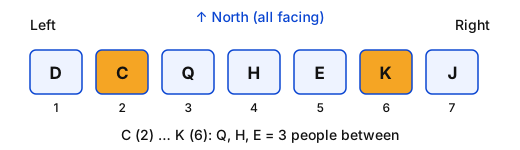
- Only four people to the right of Q → Q at seat 3. Only two to the right of E → E at seat 5.
- K is a neighbour of both J and E. If K = 4, its neighbours are Q and E – no room for J. So K = 6, J = 7.
- H is third to the right of D: remaining seats 1, 2, 4 → D = 1, H = 4, and C = 2.
- Order: D C Q H E K J. Between C (2) and K (6) sit Q, H, E = three.
Trick: "Only n people to the right" fixes a seat instantly: seat = 7 − n.
Answer: (B) Three
अवधारणा: बाएँ से सीटें 1–7 मानें (सब उत्तर की ओर, इसलिए दाएँ = बड़ी संख्या)।
- Q के दाएँ केवल चार लोग → Q सीट 3 पर। E के दाएँ केवल दो → E सीट 5 पर।
- K, J और E दोनों का पड़ोसी है। K = 4 हो तो पड़ोसी Q और E हैं – J के लिए जगह नहीं। अतः K = 6, J = 7।
- H, D के दाएँ तीसरा: बची सीटें 1, 2, 4 → D = 1, H = 4, और C = 2।
- क्रम: D C Q H E K J। C (2) और K (6) के बीच Q, H, E = तीन।
ट्रिक: "दाएँ केवल n लोग" तुरंत सीट तय करता है: सीट = 7 − n।
उत्तर: (B) Three
RRB NTPC Undergraduate CBT 1General Intelligence and ReasoningLinear seating arrangementRRB NTPC Undergraduate CBT 1 2025 · 8 May Shift 3
Q2375.Select the pair which follows the same pattern as that followed by the two sets of pairs given below. Both pairs follow the same pattern.
GFK : JAE
LGP : OBJ
उस युग्म का चयन कीजिए जो नीचे दिए गए दो युग्मों के समान पैटर्न का अनुसरण करता है। दोनों युग्म एक ही पैटर्न का अनुसरण करते हैं।
GFK : JAE
LGP : OBJ
- AFNP : IIK
- BGIM : JDH
- CJKH : MGB
- DCLW : FGQ
Show answer
Concept: Find the position shift of each letter separately.
- GFK : JAE → G(7)+3 = J(10), F(6)−5 = A(1), K(11)−6 = E(5). Pattern: .
- LGP : OBJ → L+3 = O, G−5 = B, P−6 = J. Same pattern confirmed.
- CLW → C+3 = F, L(12)−5 = G(7), W(23)−6 = Q(17) → FGQ.
- Check (B): G+3 = J, I−5 = D, M−6 = G ≠ H – fails.
Trick: Write the shift triplet once, then test each option quickly on the middle letter.
Answer: (D) CLW : FGQ
अवधारणा: हर अक्षर का स्थान-परिवर्तन अलग-अलग निकालें।
- GFK : JAE → G(7)+3 = J(10), F(6)−5 = A(1), K(11)−6 = E(5)। पैटर्न: ।
- LGP : OBJ → L+3 = O, G−5 = B, P−6 = J। वही पैटर्न।
- CLW → C+3 = F, L(12)−5 = G(7), W(23)−6 = Q(17) → FGQ।
- जाँच (B): G+3 = J, I−5 = D, M−6 = G ≠ H – गलत।
ट्रिक: शिफ्ट एक बार लिखें, फिर हर विकल्प को बीच वाले अक्षर पर जल्दी जाँचें।
उत्तर: (D) CLW : FGQ
RRB NTPC Undergraduate CBT 1General Intelligence and ReasoningLetter analogyRRB NTPC Undergraduate CBT 1 2025 · 8 May Shift 3
Q2376.FR 6 is related to JL 17 in a certain way. In the same way, EU 12 is related to IO 23. To which of the following is SL 3 related, following the same logic?
FR 6, JL 17 से एक निश्चित प्रकार से संबंधित है। उसी प्रकार, EU 12, IO 23 से संबंधित है। उसी तर्क का अनुसरण करते हुए, SL 3 निम्नलिखित में से किससे संबंधित है?
- AYT 9
- BWF 14
- CAK 11
- DOK 17
Show answer
Concept: Compare letters by position and numbers by difference.
- FR 6 → JL 17: F(6)+4 = J(10), R(18)−6 = L(12), .
- EU 12 → IO 23: E+4 = I, U(21)−6 = O(15), . Rule: .
- SL 3 → S(19)+4 = W(23), L(12)−6 = F(6), → WF 14.
Trick: The number rule () alone eliminates (A), (C), (D).
Answer: (B) WF 14
अवधारणा: अक्षरों की स्थिति और संख्याओं के अंतर की तुलना करें।
- FR 6 → JL 17: F(6)+4 = J(10), R(18)−6 = L(12), ।
- EU 12 → IO 23: E+4 = I, U(21)−6 = O(15), । नियम: ।
- SL 3 → S(19)+4 = W(23), L(12)−6 = F(6), → WF 14।
ट्रिक: केवल संख्या नियम () से ही (A), (C), (D) कट जाते हैं।
उत्तर: (B) WF 14
RRB NTPC Undergraduate CBT 1General Intelligence and ReasoningLetter-number analogyRRB NTPC Undergraduate CBT 1 2025 · 8 May Shift 3
Q2377.Refer to the given series and answer the question that follows. All numbers are single- digit numbers only. Counting to be done from left to right only.
(Left) 2 8 7 5 6 9 7 6 8 4 8 2 1 8 2 8 6 8 1 3 1 1 3 (Right)
How many such odd digits are there, each of which is immediately preceded by an odd digit and also immediately followed by an even digit?
दी गई शृंखला को देखिए और उसके बाद दिए गए प्रश्न का उत्तर दीजिए। सभी संख्याएँ केवल एक-अंकीय संख्याएँ हैं। गिनती केवल बाएँ से दाएँ की जानी है।
(बाएँ) 2 8 7 5 6 9 7 6 8 4 8 2 1 8 2 8 6 8 1 3 1 1 3 (दाएँ)
ऐसे कितने विषम अंक हैं, जिनमें से प्रत्येक के ठीक पहले एक विषम अंक और ठीक बाद एक सम अंक है?
- AOneएक
- BFourचार
- CThreeतीन
- DTwoदो
Show answer
Concept: We need the pattern odd – odd – even, and count the middle digit.
- Series: 2 8 7 5 6 9 7 6 8 4 8 2 1 8 2 8 6 8 1 3 1 1 3.
- Scan each odd digit: 7 (before it 8, even – no); 5 (7 before, 6 after – yes); 7 (9 before, 6 after – yes); 1 (2 before – no); 3, 1, 1 at the end are followed by odd digits – no; the last 3 has nothing after it.
- Count = 2.
Trick: Underline all odd digits first; then only check those whose left neighbour is also underlined.
Answer: (D) Two
अवधारणा: हमें विषम – विषम – सम का पैटर्न चाहिए और बीच वाला अंक गिनना है।
- श्रृंखला: 2 8 7 5 6 9 7 6 8 4 8 2 1 8 2 8 6 8 1 3 1 1 3।
- हर विषम अंक जाँचें: 7 (पहले 8, सम – नहीं); 5 (पहले 7, बाद 6 – हाँ); 7 (पहले 9, बाद 6 – हाँ); 1 (पहले 2 – नहीं); अंत के 3, 1, 1 के बाद विषम अंक हैं – नहीं; अंतिम 3 के बाद कुछ नहीं।
- गिनती = 2।
ट्रिक: पहले सभी विषम अंकों को रेखांकित करें; फिर केवल उन्हें देखें जिनका बायाँ पड़ोसी भी रेखांकित है।
उत्तर: (D) Two
RRB NTPC Undergraduate CBT 1General Intelligence and ReasoningNumber series countingRRB NTPC Undergraduate CBT 1 2025 · 8 May Shift 3
Q2378.Moksh starts from Point A and drives 21 km towards the south. He then takes a left turn, drives 14 km, turns left and drives 29 km. He then takes a left turn and drives 21 km. He takes a final left turn, drives 8 km and stops at Point P. How far (shortest distance) and towards which direction should he drive in order to reach Point A again? (All turns are 90-degree turns only unless specified.)
मोक्ष बिंदु A से चलना शुरू करता है और दक्षिण की ओर 21 km गाड़ी चलाता है। फिर वह बाएँ मुड़ता है, 14 km गाड़ी चलाता है, बाएँ मुड़ता है और 29 km गाड़ी चलाता है। फिर वह बाएँ मुड़ता है और 21 km गाड़ी चलाता है। वह अंतिम बार बाएँ मुड़ता है, 8 km गाड़ी चलाता है और बिंदु P पर रुक जाता है। बिंदु A पर पुनः पहुँचने के लिए उसे कितनी दूर (न्यूनतम दूरी) और किस दिशा में गाड़ी चलानी चाहिए? (जब तक अन्यथा निर्दिष्ट न हो, सभी मोड़ केवल 90 डिग्री के मोड़ हैं।)
- A8 km to the westपश्चिम की ओर 8 km
- B7 km to the westपश्चिम की ओर 7 km
- C7 km to the eastपूर्व की ओर 7 km
- D8 km to the eastपूर्व की ओर 8 km
Show answer
Concept: Plot the path with coordinates; take A as origin, east = +x, north = +y. Every left turn rotates anticlockwise: S → E → N → W → S.
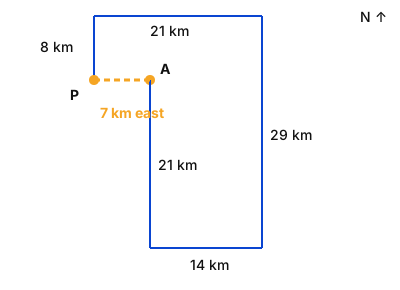
- 21 km south → ; left (east) 14 km → .
- Left (north) 29 km → ; left (west) 21 km → .
- Left (south) 8 km → P .
- P is 7 km due west of A, so he must drive 7 km east to reach A.
Trick: Net north–south: ; net east–west: → 7 km west of start.
Answer: (C) 7 km to the east
अवधारणा: निर्देशांक से पथ बनाएँ; A मूल बिंदु, पूर्व = +x, उत्तर = +y। हर बायाँ मोड़ वामावर्त घुमाता है: S → E → N → W → S।
- 21 km दक्षिण → ; बाएँ (पूर्व) 14 km → ।
- बाएँ (उत्तर) 29 km → ; बाएँ (पश्चिम) 21 km → ।
- बाएँ (दक्षिण) 8 km → P ।
- P, A से ठीक 7 km पश्चिम में है, अतः A पहुँचने के लिए 7 km पूर्व चलना होगा।
ट्रिक: कुल उत्तर–दक्षिण: ; कुल पूर्व–पश्चिम: → प्रारंभ से 7 km पश्चिम।
उत्तर: (C) 7 km to the east
RRB NTPC Undergraduate CBT 1General Intelligence and ReasoningDirection & distanceRRB NTPC Undergraduate CBT 1 2025 · 8 May Shift 3
Q2379.If 1 is added to each odd digit and 2 is subtracted from each even digit in the number 5431786, what will be difference between the highest and lowest digits in the number thus formed?
यदि संख्या 5431786 के प्रत्येक विषम अंक में 1 जोड़ा जाए और प्रत्येक सम अंक में से 2 घटाया जाए, तो इस प्रकार बनी संख्या के सबसे बड़े और सबसे छोटे अंकों के बीच का अंतर क्या होगा?
- A6
- B8
- C2
- D5
Show answer
Concept: Apply the rule digit by digit: odd → , even → .
- 5431786 → 5+1 = 6, 4−2 = 2, 3+1 = 4, 1+1 = 2, 7+1 = 8, 8−2 = 6, 6−2 = 4.
- New number: 6242864.
- Highest digit 8, lowest digit 2 → difference .
Trick: Only the maximum and minimum are needed – the largest odd digit (7) becomes 8 and the smallest digits (1, 4) both become 2.
Answer: (A) 6
अवधारणा: नियम हर अंक पर लगाएँ: विषम → , सम → ।
- 5431786 → 5+1 = 6, 4−2 = 2, 3+1 = 4, 1+1 = 2, 7+1 = 8, 8−2 = 6, 6−2 = 4।
- नई संख्या: 6242864।
- सबसे बड़ा अंक 8, सबसे छोटा 2 → अंतर ।
ट्रिक: केवल अधिकतम और न्यूनतम चाहिए – सबसे बड़ा विषम अंक (7) 8 बनता है और सबसे छोटे अंक (1, 4) दोनों 2 बनते हैं।
उत्तर: (A) 6
RRB NTPC Undergraduate CBT 1General Intelligence and ReasoningDigit operationsRRB NTPC Undergraduate CBT 1 2025 · 8 May Shift 3
Q2380.Each letter in the word MONKEYS is arranged in the English alphabetical order. How many letters are there in the English alphabetical order between the letter which is second from the left and the one which is fourth from the right in the new letter cluster thus formed?
शब्द MONKEYS के प्रत्येक अक्षर को अंग्रेज़ी वर्णमाला क्रम में व्यवस्थित किया जाता है। इस प्रकार बने नए अक्षर-समूह में बाएँ से दूसरे अक्षर और दाएँ से चौथे अक्षर के बीच अंग्रेज़ी वर्णमाला क्रम में कितने अक्षर हैं?
- A2
- B4
- C1
- D5
Show answer
Concept: Arrange the letters alphabetically, locate the two required letters, then count letters between them in the alphabet.
- MONKEYS → E K M N O S Y.
- Second from left = K; fourth from right = N (Y S O N).
- Between K(11) and N(14) in the alphabet: L, M → .
Trick: Letters between two letters = difference of positions − 1.
Answer: (A) 2
अवधारणा: अक्षरों को वर्णमाला क्रम में लगाएँ, दोनों अभीष्ट अक्षर पहचानें, फिर वर्णमाला में उनके बीच के अक्षर गिनें।
- MONKEYS → E K M N O S Y।
- बाएँ से दूसरा = K; दाएँ से चौथा = N (Y S O N)।
- वर्णमाला में K(11) और N(14) के बीच: L, M → ।
ट्रिक: दो अक्षरों के बीच के अक्षर = स्थानों का अंतर − 1।
उत्तर: (A) 2
RRB NTPC Undergraduate CBT 1General Intelligence and ReasoningAlphabetical arrangementRRB NTPC Undergraduate CBT 1 2025 · 8 May Shift 3

