Q681.Read the given statement(s) and conclusions carefully. Assuming that the information given in the statements is true, even if it appears to be at variance with commonly known facts, decide which of the given conclusions logically follow(s) from the statement(s).
Statements: All ribbons are goats. Some crows are ribbons.
Conclusion (I): Some crows are goats.
Conclusion (II): All goats are crows.
दिए गए कथन(नों) और निष्कर्षों को ध्यानपूर्वक पढ़िए। यह मानते हुए कि कथनों में दी गई जानकारी सत्य है, भले ही वह सामान्य रूप से ज्ञात तथ्यों से भिन्न प्रतीत होती हो, निर्णय कीजिए कि दिए गए निष्कर्षों में से कौन-सा/से निष्कर्ष कथन(नों) का तार्किक रूप से अनुसरण करता है/करते हैं।
कथन: सभी रिबन, बकरियाँ हैं। कुछ कौवे, रिबन हैं।
निष्कर्ष (I): कुछ कौवे, बकरियाँ हैं।
निष्कर्ष (II): सभी बकरियाँ, कौवे हैं।
- AOnly conclusion (II) followsकेवल निष्कर्ष (II) अनुसरण करता है
- BOnly conclusion (I) followsकेवल निष्कर्ष (I) अनुसरण करता है
- CNeither conclusion (I) nor (II) followsन तो निष्कर्ष (I) और न ही (II) अनुसरण करता है
- DBoth conclusions (I) and (II) followनिष्कर्ष (I) और (II) दोनों अनुसरण करते हैं
Show answer
Concept: Draw the least-overlap Venn diagram satisfying the statements.
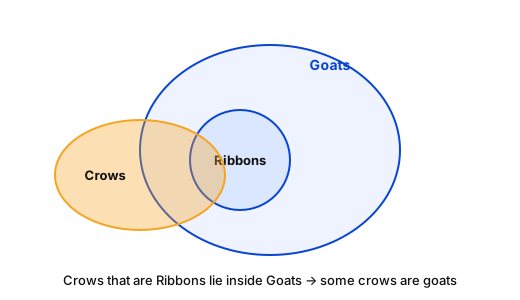
- All ribbons are goats → Ribbons circle inside Goats.
- Some crows are ribbons → those crows are inside Goats too → Some crows are goats: (I) follows.
- Goats may have members that are not crows → (II) ‘All goats are crows’ does not follow.
Trick: “Some A are B” + “All B are C” ⇒ “Some A are C” always.
Answer: (B) Only conclusion (I) follows
अवधारणा: कथनों को संतुष्ट करने वाला न्यूनतम-ओवरलैप वेन आरेख बनाइए।
- सभी ribbons goats हैं → Ribbons वृत्त Goats के अंदर।
- कुछ crows ribbons हैं → वे crows भी Goats के अंदर → कुछ crows goats हैं: (I) अनुसरण करता है।
- Goats में ऐसे सदस्य हो सकते हैं जो crows नहीं → (II) ‘सभी goats crows हैं’ अनुसरण नहीं करता।
ट्रिक: “कुछ A, B हैं” + “सभी B, C हैं” ⇒ “कुछ A, C हैं” हमेशा।
उत्तर: (B) केवल निष्कर्ष (I) अनुसरण करता है
RRB NTPC Undergraduate CBT 1General Intelligence and ReasoningSyllogismRRB NTPC Undergraduate CBT 1 2025 · 18 Jun Shift 3
Q682.Refer to the given series and answer the question that follows. All numbers are single- digit numbers only.
(Left) 8 5 2 8 8 2 3 1 8 8 9 6 6 4 8 6 2 9 9 2 4 6 9 (Right)
How many such odd digits are there, each of which is immediately preceded by an odd digit and also immediately followed by an odd digit?
दी गई शृंखला को देखिए और उसके बाद आने वाले प्रश्न का उत्तर दीजिए। सभी संख्याएँ केवल एक-अंकीय संख्याएँ हैं।
(बाएँ) 8 5 2 8 8 2 3 1 8 8 9 6 6 4 8 6 2 9 9 2 4 6 9 (दाएँ)
ऐसे कितने विषम अंक हैं, जिनमें से प्रत्येक के ठीक पहले एक विषम अंक है और ठीक बाद भी एक विषम अंक है?
- ATwoदो
- BOneएक
- CNoneकोई नहीं
- DThreeतीन
Show answer
Concept: Find odd digits whose both neighbours are odd: pattern odd–odd–odd.
- Odd digits: 5, 3, 1, 9, 9, 9, 9 (positions 2, 7, 8, 11, 18, 19, 23).
- Only two places have adjacent odd digits: ‘3 1’ (preceded by 2, followed by 8) and ‘9 9’ (preceded by 2, followed by 2).
- No odd digit has odd digits on both sides → none.
Trick: You need three odd digits in a row; scan for that block – there is none.
Answer: (C) None
अवधारणा: ऐसे विषम अंक खोजें जिनके दोनों पड़ोसी विषम हों: क्रम विषम–विषम–विषम।
- विषम अंक: 5, 3, 1, 9, 9, 9, 9 (स्थान 2, 7, 8, 11, 18, 19, 23)।
- केवल दो जगह विषम अंक साथ हैं: ‘3 1’ (पहले 2, बाद में 8) और ‘9 9’ (पहले 2, बाद में 2)।
- किसी विषम अंक के दोनों ओर विषम नहीं → कोई नहीं।
ट्रिक: लगातार तीन विषम अंक चाहिए; ऐसा कोई समूह नहीं है।
उत्तर: (C) कोई नहीं (None)
RRB NTPC Undergraduate CBT 1General Intelligence and ReasoningNumber sequence – digit conditionsRRB NTPC Undergraduate CBT 1 2025 · 18 Jun Shift 3
Q683.Refer to the following letter series and answer the question.
(Left) T Y E V B I W F X A P D G H M K R Z O L M S (Right)
How many letters are there in the English alphabetical series between the letter which is sixth from the right end and fourth from the left end of the series?
निम्नलिखित अक्षर शृंखला को देखिए और प्रश्न का उत्तर दीजिए।
(बाएँ) T Y E V B I W F X A P D G H M K R Z O L M S (दाएँ)
शृंखला के दाएँ छोर से छठे अक्षर और बाएँ छोर से चौथे अक्षर के बीच अंग्रेज़ी वर्णमाला शृंखला में कितने अक्षर हैं?
- AThreeतीन
- BTwoदो
- CFiveपाँच
- DFourचार
Show answer
Concept: Find both letters by counting from the stated ends, then count the alphabet gap.
- 4th from left: T, Y, E, V.
- 6th from right: S, M, L, O, Z, R.
- Between R (18) and V (22) in the alphabet: S, T, U → .
Trick: Letters between positions and .
Answer: (A) Three
अवधारणा: बताए गए सिरों से गिनकर दोनों अक्षर निकालें, फिर वर्णमाला में अंतर गिनें।
- बाएँ से चौथा: T, Y, E, V।
- दाएँ से छठा: S, M, L, O, Z, R।
- वर्णमाला में R (18) और V (22) के बीच: S, T, U → ।
ट्रिक: स्थान और के बीच अक्षर ।
उत्तर: (A) तीन (Three)
RRB NTPC Undergraduate CBT 1General Intelligence and ReasoningLetter series – positionRRB NTPC Undergraduate CBT 1 2025 · 18 Jun Shift 3
Q684.If ‘A’ stands for ‘+’, ‘B’ stands for ‘–’, ‘C’ stands for ‘×’ and ‘D’ stands for ‘÷’, then what will come in place of the question mark (?) in the following equation?
126 B 13 A 42 D 7 C 15 = ?
यदि ‘A’ का अर्थ ‘+’, ‘B’ का अर्थ ‘–’, ‘C’ का अर्थ ‘×’ और ‘D’ का अर्थ ‘÷’ है, तो निम्नलिखित समीकरण में प्रश्न चिह्न (?) के स्थान पर क्या आएगा?
126 B 13 A 42 D 7 C 15 = ?
- A203
- B330
- C620
- D480
Show answer
Concept: Replace letters (A , B , C , D ) and use BODMAS.
- ,
Trick: Do and first, then and from left to right.
Answer: (A) 203
अवधारणा: अक्षर बदलें (A , B , C , D ) और BODMAS लगाएँ।
- ,
ट्रिक: पहले और , फिर बाएँ से दाएँ और ।
उत्तर: (A) 203
RRB NTPC Undergraduate CBT 1General Intelligence and ReasoningMathematical operationsRRB NTPC Undergraduate CBT 1 2025 · 18 Jun Shift 3
Q685.Select the pair that follows the same pattern as that followed by the two pairs given below. Both pairs follow the same pattern.
UQL : QMH
CAT : YWP
उस युग्म का चयन कीजिए जो उसी पैटर्न का अनुसरण करता है जिसका अनुसरण नीचे दिए गए दो युग्म करते हैं। दोनों युग्म समान पैटर्न का अनुसरण करते हैं।
UQL : QMH
CAT : YWP
- ANOP : OPQ
- BZBM : VXI
- CUTW : RQT
- DLJH : NLJ
Show answer
Concept: Find the shift of each letter from the first cluster to the second.
- UQL → QMH: each letter . CAT → YWP: each letter (C → Y wraps).
- ZBM → VXI: , , ✓
- NOP → OPQ is ; UTW → RQT is ; LJH → NLJ is ✗
Trick: Check only the first letter of each option: from Z gives V – unique.
Answer: (B) ZBM : VXI
अवधारणा: पहले क्लस्टर से दूसरे तक हर अक्षर का खिसकाव निकालें।
- UQL → QMH: हर अक्षर । CAT → YWP: हर अक्षर (C → Y घूमकर)।
- ZBM → VXI: , , ✓
- NOP → OPQ ; UTW → RQT ; LJH → NLJ ✗
ट्रिक: हर विकल्प का केवल पहला अक्षर देखें: Z से = V – केवल यही।
उत्तर: (B) ZBM : VXI
RRB NTPC Undergraduate CBT 1General Intelligence and ReasoningLetter analogy – pairsRRB NTPC Undergraduate CBT 1 2025 · 18 Jun Shift 3
Q686.What should come in place of ? in the given series based on the English alphabetical order?
NJI HDC BXW VRQ ?
अंग्रेज़ी वर्णमाला क्रम के आधार पर दी गई शृंखला में ? के स्थान पर क्या आना चाहिए?
NJI HDC BXW VRQ ?
- APLK
- BPMJ
- CPQS
- DPKJ
Show answer
Concept: Track each letter position through the terms.
- 1st: N, H, B, V, P ( each).
- 2nd: J, D, X, R, L ( each).
- 3rd: I, C, W, Q, K ( each).
- Also, in each term the 3rd letter is just before the 2nd (JI, DC, XW, RQ → LK).
Trick: Inside each term the last two letters are consecutive reversed; only PLK has L-K.
Answer: (A) PLK
अवधारणा: हर स्थान के अक्षर को पदों में आगे बढ़ाइए।
- पहला: N, H, B, V, P (हर बार )।
- दूसरा: J, D, X, R, L (हर बार )।
- तीसरा: I, C, W, Q, K (हर बार )।
- हर पद में तीसरा अक्षर दूसरे से ठीक पहले का है (JI, DC, XW, RQ → LK)।
ट्रिक: हर पद के अंतिम दो अक्षर उल्टे क्रमागत हैं; केवल PLK में L-K है।
उत्तर: (A) PLK
RRB NTPC Undergraduate CBT 1General Intelligence and ReasoningLetter seriesRRB NTPC Undergraduate CBT 1 2025 · 18 Jun Shift 3
Q687.What should come in place of '?' in the given series?
391 349 376 334 361 319 ?
दी गई शृंखला में '?' के स्थान पर क्या आना चाहिए?
391 349 376 334 361 319 ?
- A360
- B354
- C350
- D346
Show answer
Concept: Look at differences between consecutive terms.
- ,
- , ,
- Next:
Trick: Alternate , (net every two steps: ).
Answer: (D) 346
अवधारणा: क्रमागत पदों का अंतर देखें।
- ,
- , ,
- अगला:
ट्रिक: बारी-बारी , (हर दो कदम में : )।
उत्तर: (D) 346
RRB NTPC Undergraduate CBT 1General Intelligence and ReasoningNumber seriesRRB NTPC Undergraduate CBT 1 2025 · 18 Jun Shift 3
Q688.Select the pair which follows the same pattern as that followed by the two sets of pairs given below. Both pairs follow the same pattern.
UOM : YRK
VSL : ZVJ
उस युग्म का चयन कीजिए जो उसी पैटर्न का अनुसरण करता है जिसका अनुसरण नीचे दिए गए युग्मों के दो समुच्चय करते हैं। दोनों युग्म समान पैटर्न का अनुसरण करते हैं।
UOM : YRK
VSL : ZVJ
- AGVS : KYR
- BFEO : JHL
- CINK : MQI
- DKRX : OTV
Show answer
Concept: Find the letter-wise shift and apply it to each option.
- UOM → YRK: , , . VSL → ZVJ: , , ✓
- INK → MQI: , , ✓
- GVS → KYR: last ✗; FEO → JHL: last ✗; KRX → OTV: middle ✗
Trick: Check the unusual step ( on the 3rd letter) first to eliminate fast.
Answer: (C) INK : MQI
अवधारणा: अक्षर-वार खिसकाव निकालें और हर विकल्प पर लगाएँ।
- UOM → YRK: , , । VSL → ZVJ: , , ✓
- INK → MQI: , , ✓
- GVS → KYR: अंतिम ✗; FEO → JHL: अंतिम ✗; KRX → OTV: मध्य ✗
ट्रिक: पहले असामान्य कदम (तीसरे अक्षर पर ) जाँचें, जल्दी छँट जाएगा।
उत्तर: (C) INK : MQI
RRB NTPC Undergraduate CBT 1General Intelligence and ReasoningLetter analogy – pairsRRB NTPC Undergraduate CBT 1 2025 · 18 Jun Shift 3
Q689.If 1 is added to each odd digit and 2 is subtracted from each even digit in the number 4317856, how many digits will appear more than once in the new number thus formed?
यदि संख्या 4317856 में प्रत्येक विषम अंक में 1 जोड़ा जाए और प्रत्येक सम अंक में से 2 घटाया जाए, तो इस प्रकार बनी नई संख्या में कितने अंक एक से अधिक बार आएँगे?
- AThreeतीन
- BTwoदो
- COneएक
- DNoneकोई नहीं
Show answer
Concept: Apply the rule digit by digit: odd , even .
- 4317856: , , , , , , .
- New number: 2428664.
- Repeated digits: 2 (twice), 4 (twice), 6 (twice) → 3 digits.
Trick: Odd digits become even and even stay even – so all new digits are even, repeats are likely.
Answer: (A) Three
अवधारणा: नियम हर अंक पर लगाएँ: विषम , सम ।
- 4317856: , , , , , , ।
- नई संख्या: 2428664।
- दोहराए अंक: 2 (दो बार), 4 (दो बार), 6 (दो बार) → 3 अंक।
ट्रिक: विषम अंक सम बन जाते हैं और सम सम ही रहते हैं – सभी नए अंक सम, दोहराव तय।
उत्तर: (A) तीन (Three)
RRB NTPC Undergraduate CBT 1General Intelligence and ReasoningNumber operations – digitsRRB NTPC Undergraduate CBT 1 2025 · 18 Jun Shift 3
Q690.Each letter in the word INJURED is arranged in the English alphabetical order. How many letters are there in the English alphabetical order between the letter which is third from the left and the one which is second from the right in the new letter cluster thus formed?
शब्द INJURED के प्रत्येक अक्षर को अंग्रेज़ी वर्णमाला क्रम में व्यवस्थित किया जाता है। इस प्रकार बने नए अक्षर-समूह में बाएँ से तीसरे अक्षर और दाएँ से दूसरे अक्षर के बीच अंग्रेज़ी वर्णमाला क्रम में कितने अक्षर हैं?
- A7
- B9
- C8
- D11
Show answer
Concept: Arrange the letters of INJURED alphabetically, then count the gap.
- Arranged: D E I J N R U.
- 3rd from left = I (9); 2nd from right = R (18).
- Letters between I and R: J…Q → .
Trick: Use positions: I = 9, R = 18; gap difference .
Answer: (C) 8
अवधारणा: INJURED के अक्षरों को वर्णमाला क्रम में लगाएँ, फिर अंतर गिनें।
- क्रम: D E I J N R U।
- बाएँ से तीसरा = I (9); दाएँ से दूसरा = R (18)।
- I और R के बीच अक्षर: J…Q → ।
ट्रिक: स्थान लें: I = 9, R = 18; बीच के अक्षर अंतर ।
उत्तर: (C) 8
RRB NTPC Undergraduate CBT 1General Intelligence and ReasoningAlphabet arrangementRRB NTPC Undergraduate CBT 1 2025 · 18 Jun Shift 3
Q691.In a certain code language,
A @ B means ‘A is the mother of B’,
A × B means ‘A is the wife of B’,
A + B means ‘A is the brother of B’ and
A ÷ B means ‘A is the father of B’.
How is S related to H if ‘S ÷ D + R @ Y × H’?
एक निश्चित कूट भाषा में,
A @ B का अर्थ है ‘A, B की माता है’,
A × B का अर्थ है ‘A, B की पत्नी है’,
A + B का अर्थ है ‘A, B का भाई है’ और
A ÷ B का अर्थ है ‘A, B का पिता है’।
यदि ‘S ÷ D + R @ Y × H’ है, तो S का H से क्या संबंध है?
- AWife's mother's fatherपत्नी की माता का पिता
- BWife's fatherपत्नी का पिता
- CWife's brotherपत्नी का भाई
- DWife's mother's brotherपत्नी की माता का भाई
Show answer
Concept: Decode each symbol and draw the family tree.
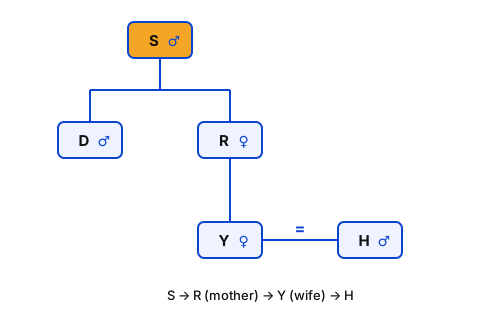
- S ÷ D: S is father of D. D + R: D is brother of R, so S is also father of R.
- R @ Y: R is mother of Y (R is female).
- Y × H: Y is wife of H.
- So for H: wife Y → her mother R → her father S. S is H's wife's mother's father.
Trick: Read the chain from H backwards: wife → mother → father.
Answer: (A) Wife's mother's father
अवधारणा: हर चिह्न को खोलें और वंश-वृक्ष बनाएँ।
- S ÷ D: S, D का पिता है। D + R: D, R का भाई है, अतः S, R का भी पिता है।
- R @ Y: R, Y की माता है (R महिला)।
- Y × H: Y, H की पत्नी है।
- H के लिए: पत्नी Y → उसकी माता R → उसके पिता S। S, H की पत्नी की माता के पिता हैं।
ट्रिक: H से उल्टा पढ़ें: पत्नी → माता → पिता।
उत्तर: (A) पत्नी की माता के पिता (Wife's mother's father)
RRB NTPC Undergraduate CBT 1General Intelligence and ReasoningCoded blood relationsRRB NTPC Undergraduate CBT 1 2025 · 18 Jun Shift 3
Q692.Shishir starts from Point Y and drives 75 km towards East. He then takes a left turn, drives 35 km, turns left and drives 38 km. He then takes a left turn and drives 41 km. He takes a right turn, drives 37 km. He then turns left, drives 26 km to stop at Point Z. How far (shortest distance) and towards which direction should he drive in order to reach Point Y again? (All turns are 90° turns only unless specified.)
शिशिर बिंदु Y से चलना शुरू करता है और पूर्व की ओर 75 km गाड़ी चलाता है। फिर वह बाएँ मुड़ता है, 35 km गाड़ी चलाता है, बाएँ मुड़ता है और 38 km गाड़ी चलाता है। फिर वह बाएँ मुड़ता है और 41 km गाड़ी चलाता है। वह दाएँ मुड़ता है, 37 km गाड़ी चलाता है। फिर वह बाएँ मुड़ता है, 26 km गाड़ी चलाकर बिंदु Z पर रुक जाता है। बिंदु Y पर पुनः पहुँचने के लिए उसे कितनी दूरी (न्यूनतम दूरी) तक और किस दिशा में गाड़ी चलानी चाहिए? (जब तक निर्दिष्ट न किया जाए, सभी मोड़ केवल 90° के मोड़ हैं।)
- A32 km towards northउत्तर की ओर 32 km
- B33 km towards westपश्चिम की ओर 33 km
- C35 km towards northउत्तर की ओर 35 km
- D29 km towards southदक्षिण की ओर 29 km
Show answer
Concept: Track the net East–West and North–South movement from Y.
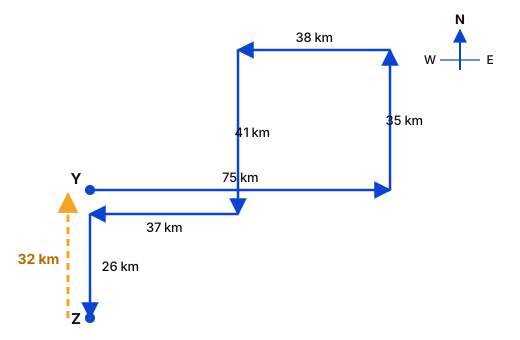
- East–West: → Z is directly in line with Y (north–south).
- North–South: → Z is 32 km south of Y.
- Turns: E → left N → left W → left S → right W → left S.
- To return to Y he must drive 32 km towards north.
Trick: Add E/W and N/S separately; a zero in one means a straight-line answer.
Answer: (A) 32 km towards north
अवधारणा: Y से कुल पूर्व–पश्चिम और उत्तर–दक्षिण गति निकालें।
- पूर्व–पश्चिम: → Z, Y की सीध में (उत्तर–दक्षिण रेखा पर)।
- उत्तर–दक्षिण: → Z, Y से 32 km दक्षिण में।
- मोड़: पूर्व → बाएँ उत्तर → बाएँ पश्चिम → बाएँ दक्षिण → दाएँ पश्चिम → बाएँ दक्षिण।
- Y पर लौटने के लिए 32 km उत्तर की ओर जाना होगा।
ट्रिक: E/W और N/S अलग जोड़ें; एक का योग शून्य हो तो सीधी रेखा वाला उत्तर।
उत्तर: (A) 32 km उत्तर की ओर
RRB NTPC Undergraduate CBT 1General Intelligence and ReasoningDirection and distanceRRB NTPC Undergraduate CBT 1 2025 · 18 Jun Shift 3
Q693.Based on the English alphabetical order, three of the following four letter-cluster pairs are alike in a certain way and thus form a group. Which is the one that does not belong to that group?
(Note: The odd one out is not based on the number of consonants/vowels or their position in the letter-cluster pairs.)
अंग्रेज़ी वर्णमाला क्रम के आधार पर, निम्नलिखित चार अक्षर-समूह युग्मों में से तीन किसी निश्चित प्रकार से एकसमान हैं और इस प्रकार एक समूह बनाते हैं। कौन-सा युग्म उस समूह से संबंधित नहीं है?
(ध्यान दें: असंगत युग्म, व्यंजनों/स्वरों की संख्या या अक्षर-समूह युग्मों में उनके स्थान पर आधारित नहीं है।)
- AVT – LE
- BXV-NH
- CBZ-RL
- DOM – EY
Show answer
Concept: Use letter positions: inside each cluster and from cluster to cluster.
- XV – NH: , , ✓
- BZ – RL: , , ✓; OM – EY: , , ✓
- VT – LE: and , but (not ) ✗
Trick: Check the second cluster's gap (): only LE gives .
Answer: (A) VT – LE
अवधारणा: अक्षर स्थान लें: हर क्लस्टर के अंदर और एक क्लस्टर से दूसरे तक।
- XV – NH: , , ✓
- BZ – RL: , , ✓; OM – EY: , , ✓
- VT – LE: और , पर ( नहीं) ✗
ट्रिक: दूसरे क्लस्टर का अंतर () जाँचें: केवल LE में ।
उत्तर: (A) VT – LE
RRB NTPC Undergraduate CBT 1General Intelligence and ReasoningOdd one out – letter pairsRRB NTPC Undergraduate CBT 1 2025 · 18 Jun Shift 3
Q694.Eight people, S, T, U, V, W, X, Y and Z, are sitting around a circular table, facing the centre. T sits third to the left of W. T sits third to the right of V. X is an immediate neighbour of U and V. Z sits second to the left of S. How many people sit between X and W, when counted from the left of X?
आठ व्यक्ति, S, T, U, V, W, X, Y और Z, एक वृत्ताकार मेज़ के चारों ओर केंद्र की ओर मुख करके बैठे हैं। T, W के बाईं ओर तीसरे स्थान पर बैठा है। T, V के दाईं ओर तीसरे स्थान पर बैठा है। X, U और V दोनों का निकटतम पड़ोसी है। Z, S के बाईं ओर दूसरे स्थान पर बैठा है। X के बाईं ओर से गिनने पर X और W के बीच कितने व्यक्ति बैठे हैं?
- AThreeतीन
- BOneएक
- CTwoदो
- DFourचार
Show answer
Concept: Facing the centre, left = clockwise and right = anticlockwise.
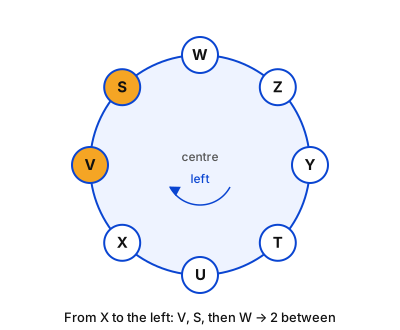
- Fix W. T is third to the left of W; V is third to the left of T (since T is third to the right of V).
- X is a neighbour of both U and V → X sits between U and V, on the side between T and V (the other side of V is next to W).
- Z is second to the left of S → S sits between V and W, Z next to W, Y next to T.
- From X going left: V, S, then W → 2 people.
Trick: “A is third to the right of B” = “B is third to the left of A”.
Answer: (C) Two
अवधारणा: केंद्र की ओर मुख: बायाँ = दक्षिणावर्त, दायाँ = वामावर्त।
- W को स्थिर करें। T, W के बाएँ तीसरा; V, T के बाएँ तीसरा (क्योंकि T, V के दाएँ तीसरा है)।
- X, U और V दोनों का पड़ोसी → X, U और V के बीच, T और V के बीच वाली तरफ़ (V की दूसरी तरफ़ W के पास जगह)।
- Z, S के बाएँ दूसरा → S, V और W के बीच; Z, W के पास; Y, T के पास।
- X से बाईं ओर: V, S, फिर W → 2 व्यक्ति।
ट्रिक: “A, B के दाएँ तीसरा” = “B, A के बाएँ तीसरा”।
उत्तर: (C) दो (Two)
RRB NTPC Undergraduate CBT 1General Intelligence and ReasoningCircular seating arrangementRRB NTPC Undergraduate CBT 1 2025 · 18 Jun Shift 3
Q695.What should come in place of the ‘?’ in the given series?
5 9 20 40 67 103 ?
दी गई शृंखला में ‘?’ के स्थान पर क्या आना चाहिए?
5 9 20 40 67 103 ?
- A146
- B148
- C184
- D164
Show answer
Concept: When first differences are irregular, check the second differences.
- First differences: .
- Second differences: → next , so next first difference .
- Next term: .
Trick: Alternating , in the gaps.
Answer: (A) 146
अवधारणा: जब प्रथम अंतर अनियमित हों, तो द्वितीय अंतर जाँचें।
- प्रथम अंतर: ।
- द्वितीय अंतर: → अगला , अतः अगला प्रथम अंतर ।
- अगला पद: ।
ट्रिक: अंतरों में बारी-बारी , ।
उत्तर: (A) 146
RRB NTPC Undergraduate CBT 1General Intelligence and ReasoningNumber series – second differencesRRB NTPC Undergraduate CBT 1 2025 · 18 Jun Shift 3
Q696.Based on the English alphabetical order, three of the following four letter-cluster pairs are alike in a certain way and thus form a group. Which is the one that does not belong to that group?
(Note: The odd man out is not based on the number of consonants/vowels or their position in the letter-cluster.)
अंग्रेज़ी वर्णमाला क्रम के आधार पर, निम्नलिखित चार अक्षर-समूह युग्मों में से तीन किसी निश्चित प्रकार से एकसमान हैं और इस प्रकार एक समूह बनाते हैं। कौन-सा युग्म उस समूह से संबंधित नहीं है?
(ध्यान दें: असंगत युग्म, व्यंजनों/स्वरों की संख्या या अक्षर-समूह में उनके स्थान पर आधारित नहीं है।)
- ALX – HT
- BQE – MA
- CBK – XF
- DNV – JR
Show answer
Concept: Compare each letter of the first cluster with the matching letter of the second.
- LX – HT: , ✓
- QE – MA: , ✓; NV – JR: , ✓
- BK – XF: but ✗
Trick: Every pair should be the first cluster moved back by 4; one letter breaks it.
Answer: (C) BK – XF
अवधारणा: पहले क्लस्टर के हर अक्षर की दूसरे क्लस्टर के संगत अक्षर से तुलना करें।
- LX – HT: , ✓
- QE – MA: , ✓; NV – JR: , ✓
- BK – XF: पर ✗
ट्रिक: हर युग्म = पहला क्लस्टर 4 पीछे; एक अक्षर नियम तोड़ता है।
उत्तर: (C) BK – XF
RRB NTPC Undergraduate CBT 1General Intelligence and ReasoningOdd one out – letter pairsRRB NTPC Undergraduate CBT 1 2025 · 18 Jun Shift 3
Q697.What should come in place of '?' in the given series based on the English alphabetical order?
KFP SNX AVF IDN ?
अंग्रेज़ी वर्णमाला क्रम के आधार पर दी गई शृंखला में '?' के स्थान पर क्या आना चाहिए?
KFP SNX AVF IDN ?
- AKDF
- BIAK
- CQLV
- DLFP
Show answer
Concept: Track each position; here every letter moves .
- 1st: K, S, A, I, Q (, wrapping S → A).
- 2nd: F, N, V, D, L.
- 3rd: P, X, F, N, V.
Trick: Inside each term letters are 5 apart (K→F is , F→P is ); QLV keeps that.
Answer: (C) QLV
अवधारणा: हर स्थान को ट्रैक करें; यहाँ हर अक्षर बढ़ता है।
- पहला: K, S, A, I, Q (, S के बाद A पर लौटकर)।
- दूसरा: F, N, V, D, L।
- तीसरा: P, X, F, N, V।
ट्रिक: हर पद के अंदर अंतर समान (K→F , F→P ); QLV में भी यही।
उत्तर: (C) QLV
RRB NTPC Undergraduate CBT 1General Intelligence and ReasoningLetter seriesRRB NTPC Undergraduate CBT 1 2025 · 18 Jun Shift 3
Q698.In a certain code language,
A ÷ B means ‘A is the mother of B’,
A x B means ‘A is the husband of B’,
A – B means ‘A is the sister of B’ and
A + B means ‘A is the father of B’.
Based on the above, how is M related to R if ‘M + N ÷ O – P x Q ÷ R’?
एक निश्चित कूट भाषा में,
A ÷ B का अर्थ है ‘A, B की माता है’,
A x B का अर्थ है ‘A, B का पति है’,
A – B का अर्थ है ‘A, B की बहन है’ और
A + B का अर्थ है ‘A, B का पिता है’।
उपर्युक्त के आधार पर, यदि ‘M + N ÷ O – P x Q ÷ R’ है, तो M का R से क्या संबंध है?
- AFather's father's fatherपिता के पिता के पिता
- BFather's father's brotherपिता के पिता का भाई
- CMother's brotherमाता का भाई
- DFather's mother's fatherपिता की माता के पिता
Show answer
Concept: Decode the chain and build the tree from M down to R.
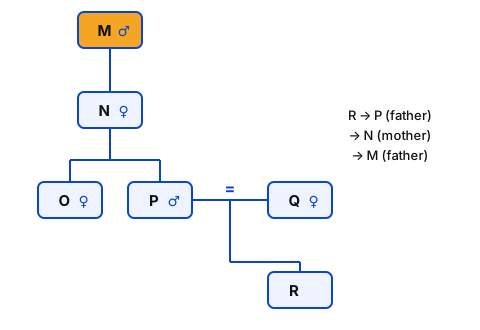
- M + N: M is father of N. N ÷ O: N is mother of O (N female).
- O – P: O is sister of P, so N is mother of P too.
- P × Q: P is husband of Q. Q ÷ R: Q is mother of R, so P is R's father.
- From R: father P → his mother N → her father M. M is R's father's mother's father.
Trick: Write the path from R upward: father → mother → father.
Answer: (D) Father's mother's father
अवधारणा: कूट खोलें और M से R तक वंश-वृक्ष बनाएँ।
- M + N: M, N का पिता। N ÷ O: N, O की माता (N महिला)।
- O – P: O, P की बहन, अतः N, P की भी माता।
- P × Q: P, Q का पति। Q ÷ R: Q, R की माता, अतः P, R का पिता।
- R से: पिता P → उसकी माता N → उसके पिता M। M, R के पिता की माता के पिता हैं।
ट्रिक: R से ऊपर का रास्ता लिखें: पिता → माता → पिता।
उत्तर: (D) पिता की माता के पिता (Father's mother's father)
RRB NTPC Undergraduate CBT 1General Intelligence and ReasoningCoded blood relationsRRB NTPC Undergraduate CBT 1 2025 · 18 Jun Shift 3
Q699.Read the given statement(s) and conclusions carefully. Assuming that the information given in the statements is true, even if it appears to be at variance with commonly known facts, decide which of the given conclusions logically follow(s) from the statement(s).
Statements:
All hats are carpets.
No carpet is a locket.
Conclusions:
(I) No hat is a locket.
(II) Some lockets are carpets.
दिए गए कथन(नों) और निष्कर्षों को ध्यानपूर्वक पढ़िए। यह मानते हुए कि कथनों में दी गई जानकारी सत्य है, भले ही वह सामान्य रूप से ज्ञात तथ्यों से भिन्न प्रतीत होती हो, निर्णय कीजिए कि दिए गए निष्कर्षों में से कौन-सा/से निष्कर्ष कथन(नों) का तार्किक रूप से अनुसरण करता है/करते हैं।
कथन:
सभी टोपियाँ, कालीन हैं।
कोई कालीन, लॉकेट नहीं है।
निष्कर्ष:
(I) कोई टोपी, लॉकेट नहीं है।
(II) कुछ लॉकेट, कालीन हैं।
- ANeither conclusion (I) nor (II) followsन तो निष्कर्ष (I) और न ही (II) अनुसरण करता है
- BOnly conclusion (I) followsकेवल निष्कर्ष (I) अनुसरण करता है
- COnly conclusion (II) followsकेवल निष्कर्ष (II) अनुसरण करता है
- DBoth conclusions (I) and (II) followनिष्कर्ष (I) और (II) दोनों अनुसरण करते हैं
Show answer
Concept: “All A are B” + “No B is C” ⇒ “No A is C”.
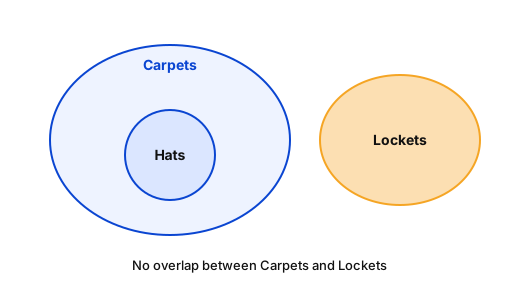
- All hats are carpets → Hats circle inside Carpets.
- No carpet is a locket → Lockets lie completely outside Carpets, hence outside Hats → (I) ‘No hat is a locket’ follows.
- (II) ‘Some lockets are carpets’ directly contradicts ‘No carpet is a locket’ → does not follow.
Trick: All + No ⇒ No (in the same order of terms).
Answer: (B) Only conclusion (I) follows
अवधारणा: “सभी A, B हैं” + “कोई B, C नहीं” ⇒ “कोई A, C नहीं”।
- सभी hats carpets हैं → Hats वृत्त Carpets के अंदर।
- कोई carpet locket नहीं → Lockets पूरी तरह Carpets के बाहर, अतः Hats के भी बाहर → (I) ‘कोई hat locket नहीं’ अनुसरण करता है।
- (II) ‘कुछ lockets carpets हैं’ सीधे ‘कोई carpet locket नहीं’ के विपरीत है → अनुसरण नहीं करता।
ट्रिक: All + No ⇒ No (पदों के उसी क्रम में)।
उत्तर: (B) केवल निष्कर्ष (I) अनुसरण करता है
RRB NTPC Undergraduate CBT 1General Intelligence and ReasoningSyllogismRRB NTPC Undergraduate CBT 1 2025 · 18 Jun Shift 3
Q700.Vimal ranked 28th from the top and 65th from the bottom in his class. How many students are there in his class?
विमल अपनी कक्षा में ऊपर से 28वें और नीचे से 65वें स्थान पर है। उसकी कक्षा में कितने छात्र हैं?
- A93
- B90
- C92
- D91
Show answer
Concept: Total rank from top rank from bottom (the person is counted twice).
- Rank from top , from bottom .
- Total
- students.
Trick: Never forget the ; is the trap option.
Answer: (C) 92
अवधारणा: कुल ऊपर से रैंक नीचे से रैंक (व्यक्ति दो बार गिना जाता है)।
- ऊपर से रैंक , नीचे से ।
- कुल
- छात्र।
ट्रिक: कभी न भूलें; जाल वाला विकल्प है।
उत्तर: (C) 92
RRB NTPC Undergraduate CBT 1General Intelligence and ReasoningRankingRRB NTPC Undergraduate CBT 1 2025 · 18 Jun Shift 3

