Q1081.Seven people P1, P2, P3, P4, P5, P6 and P7 are sitting around a circular table facing towards the centre of the table. P7 sits second to right of P1. There are exactly two people between P1 and P6 when checked from right of P1. P2 is sitting immediately between P5 and P6. P3 sits second to right of P4. Who is sitting immediately between P6 and P3?
सात व्यक्ति P1, P2, P3, P4, P5, P6 और P7 एक वृत्ताकार मेज़ के चारों ओर मेज़ के केंद्र की ओर मुख करके बैठे हैं। P7, P1 के दाएँ से दूसरे स्थान पर बैठा है। P1 के दाएँ से गिनने पर P1 और P6 के बीच ठीक दो व्यक्ति हैं। P2, P5 और P6 के ठीक बीच में बैठा है। P3, P4 के दाएँ से दूसरे स्थान पर बैठा है। P6 और P3 के ठीक बीच में कौन बैठा है?
- AP5
- BP1
- CP4
- DP7
Show answer
Concept: Facing the centre: right = anticlockwise, left = clockwise.
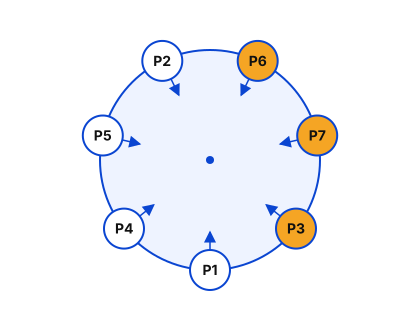
- Fix P1. P7 is second to the right of P1.
- Two people between P1 and P6 counting from P1’s right → P6 is third to the right of P1 (P7 is between them).
- P2 is between P5 and P6 → P2 next to P6 (on the far side), then P5.
- The two empty seats go to P4 and P3 with P3 second to the right of P4 → P4 next to P1 on its left, P3 immediately right of P1.
- Seat between P6 and P3 is P7.
Trick: Place the person with the most clues (P1) first and count seats on the drawing.
Answer: (D) P7
अवधारणा: केंद्र की ओर मुख: दायाँ = वामावर्त, बायाँ = दक्षिणावर्त।
- P1 को स्थिर करें। P7, P1 के दाएँ दूसरा है।
- P1 के दाएँ से गिनने पर P1 और P6 के बीच दो व्यक्ति → P6, P1 के दाएँ तीसरा है (बीच में P7 है)।
- P2, P5 और P6 के बीच है → P6 के आगे P2, फिर P5।
- बची दो सीटें P4 और P3 की हैं; P3, P4 के दाएँ दूसरा है → P4, P1 के बाएँ और P3, P1 के ठीक दाएँ।
- P6 और P3 के बीच P7 बैठा है।
ट्रिक: सबसे अधिक संकेत वाले व्यक्ति (P1) को पहले बैठाएँ और चित्र पर सीटें गिनें।
उत्तर: (D) P7
RRB NTPC Undergraduate CBT 1General Intelligence and ReasoningCircular Seating ArrangementRRB NTPC Undergraduate CBT 1 2025 · 17 Jun Shift 2
Q1082.Seven boxes B, C, D, E, Q, R and S are kept one over the other but not necessarily in the same order. No box is kept above E. Only B is kept between E and Q. Only R is kept below C. Only one box is kept between Q and D. How many boxes are kept between S and R?
सात डिब्बे B, C, D, E, Q, R और S एक के ऊपर एक रखे गए हैं, लेकिन आवश्यक नहीं कि इसी क्रम में हों। E के ऊपर कोई डिब्बा नहीं रखा है। E और Q के बीच केवल B रखा है। C के नीचे केवल R रखा है। Q और D के बीच केवल एक डिब्बा रखा है। S और R के बीच कितने डिब्बे रखे हैं?
- AThreeतीन
- BOneएक
- CTwoदो
- DFourचार
Show answer
Concept: Number the positions 1 (top) to 7 (bottom).
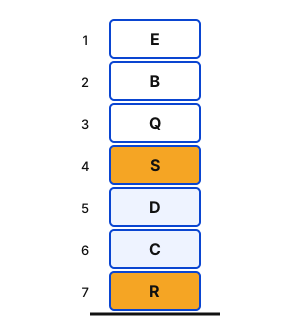
- No box above E → E at 1.
- Only B between E and Q → B at 2, Q at 3.
- Only R below C → R at 7, C at 6.
- One box between Q and D → D at 5 (position 1 is taken).
- The remaining box S is at 4. Between S (4) and R (7): D and C → two boxes.
Trick: “No box above E” = E on top; “only R below C” = C sixth, R last.
Answer: (C) Two
अवधारणा: स्थानों को 1 (ऊपर) से 7 (नीचे) तक क्रमांकित करें।
- E के ऊपर कोई बॉक्स नहीं → E स्थान 1।
- E और Q के बीच केवल B → B स्थान 2, Q स्थान 3।
- C के नीचे केवल R → R स्थान 7, C स्थान 6।
- Q और D के बीच एक बॉक्स → D स्थान 5 (स्थान 1 भरा है)।
- बचा S स्थान 4 पर। S (4) और R (7) के बीच D और C → दो बॉक्स।
ट्रिक: “E के ऊपर कोई नहीं” = E सबसे ऊपर; “C के नीचे केवल R” = C छठा, R अंतिम।
उत्तर: (C) दो
RRB NTPC Undergraduate CBT 1General Intelligence and ReasoningBox ArrangementRRB NTPC Undergraduate CBT 1 2025 · 17 Jun Shift 2
Q1083.In the following triads, each group of letters is related to the subsequent one following a certain logic. Select from the given options the triad which follows the same logic. DISK - DKSI - KSID
LEAF - LFAE - FAEL
निम्नलिखित त्रिकों में, अक्षरों का प्रत्येक समूह एक निश्चित तर्क के अनुसार अगले समूह से संबंधित है। दिए गए विकल्पों में से उस त्रिक का चयन कीजिए जो उसी तर्क का अनुसरण करता है। DISK - DKSI - KSID
LEAF - LFAE - FAEL
- APOEM - PMEO - MEOP
- BGOAT - GAOT - TAOG
- CPRAY - PRYA - RAYP
- DWEST - EWST - TESW
Show answer
Concept: Track positions of letters 1, 2, 3, 4 in each step.
- DISK → DKSI: letters taken in order 1, 4, 3, 2.
- DKSI → KSID: first letter moves to the end (order 2, 3, 4, 1).
- Check LEAF → LFAE → FAEL ✓.
- POEM → PMEO (1, 4, 3, 2) → MEOP (first letter to the end) ✓.
Trick: Step 1 swaps the 2nd and 4th letters; step 2 sends the first letter to the end.
Answer: (A) POEM - PMEO - MEOP
अवधारणा: हर चरण में अक्षरों के स्थान 1, 2, 3, 4 पर ध्यान दें।
- DISK → DKSI: अक्षर क्रम 1, 4, 3, 2।
- DKSI → KSID: पहला अक्षर अंत में (क्रम 2, 3, 4, 1)।
- जाँच LEAF → LFAE → FAEL ✓।
- POEM → PMEO (1, 4, 3, 2) → MEOP (पहला अक्षर अंत में) ✓।
ट्रिक: पहले चरण में दूसरा और चौथा अक्षर बदलते हैं; दूसरे चरण में पहला अक्षर अंत में जाता है।
उत्तर: (A) POEM - PMEO - MEOP
RRB NTPC Undergraduate CBT 1General Intelligence and ReasoningLetter Triads (Position Shuffle)RRB NTPC Undergraduate CBT 1 2025 · 17 Jun Shift 2
Q1084.Based on the English alphabetical order, three of the following four letter-cluster pairs are alike in a certain way and thus form a group. Which is the one that does not belong to that group? (Note: The odd one out is not based on the number of
consonants/vowels or their position in the letter cluster.)
अंग्रेज़ी वर्णमाला क्रम के आधार पर, निम्नलिखित चार अक्षर-समूह युग्मों में से तीन किसी निश्चित प्रकार से एक समान हैं और इस प्रकार एक समूह बनाते हैं। वह कौन-सा युग्म है जो उस समूह से संबंधित नहीं है? (नोट: असंगत युग्म, व्यंजनों/स्वरों की संख्या या अक्षर-समूह में उनके
स्थान पर आधारित नहीं है।)
- AUT−PR
- BZY−VU
- CJI−FE
- DML−IH
Show answer
Concept: Compare letter positions inside each cluster and between the two clusters.
- ZY−VU: , , and .
- JI−FE and ML−IH follow the same: each cluster is two consecutive letters in reverse (), and the second cluster starts 4 letters back.
- UT−PR: , not ; also . So UT−PR is odd.
Trick: Three pairs are “reverse-consecutive” twins; spot the cluster that breaks it.
Answer: (A) UT−PR
अवधारणा: हर समूह के भीतर और दोनों समूहों के बीच अक्षरों के स्थान की तुलना करें।
- ZY−VU: , और ।
- JI−FE और ML−IH भी ऐसे ही हैं: हर समूह में उल्टे क्रम के दो क्रमागत अक्षर (), और दूसरा समूह 4 अक्षर पीछे से शुरू।
- UT−PR: , नहीं; साथ ही । अतः UT−PR विषम है।
ट्रिक: तीन युग्म “उल्टे क्रमागत” जोड़े हैं; जो नियम तोड़े वही उत्तर।
उत्तर: (A) UT−PR
RRB NTPC Undergraduate CBT 1General Intelligence and ReasoningOdd One Out – Letter PairsRRB NTPC Undergraduate CBT 1 2025 · 17 Jun Shift 2
Q1085.What should come in place of ? in the given series based on the English alphabetical order?
POR VUX BAD HGJ ?
अंग्रेज़ी वर्णमाला क्रम के आधार पर दी गई शृंखला में ? के स्थान पर क्या आना चाहिए?
POR VUX BAD HGJ ?
- ANLO
- BNMP
- CNNO
- DNOQ
Show answer
Concept: Compare each letter of a cluster with the same position in the next cluster.
- POR: ; VUX: → each letter .
- VUX → BAD ( after Z) → HGJ, all .
- HGJ : → NMP.
Trick: Inside every cluster the pattern is (P→O→R); NMP also follows N→M→P.
Answer: (B) NMP
अवधारणा: हर समूह के प्रत्येक अक्षर की तुलना अगले समूह के उसी स्थान वाले अक्षर से करें।
- POR: ; VUX: → हर अक्षर ।
- VUX → BAD (Z के बाद ) → HGJ, सभी ।
- HGJ : → NMP।
ट्रिक: हर समूह के अंदर क्रम है (P→O→R); NMP में भी N→M→P।
उत्तर: (B) NMP
RRB NTPC Undergraduate CBT 1General Intelligence and ReasoningLetter SeriesRRB NTPC Undergraduate CBT 1 2025 · 17 Jun Shift 2
Q1086.Select the triad which follows the same pattern as that followed by the two triads given below. Both triads follow the same pattern.
TO-UP-VY
QL-RM-SV
उस त्रिक का चयन कीजिए जो उसी पैटर्न का अनुसरण करता है जिसका अनुसरण नीचे दिए गए दो त्रिक करते हैं। दोनों त्रिक एक ही पैटर्न का अनुसरण करते हैं।
TO-UP-VY
QL-RM-SV
- ANI-OJ-PR
- BMI-OK-PR
- CMI-OJ-PR
- DNI-OJ-PS
Show answer
Concept: Find the change from one pair to the next for both letters.
- TO → UP: ; UP → VY: , .
- QL → RM → SV: then ✓.
- NI → OJ () → PS: , ✓.
- Option (C) MI-OJ starts with , so it fails.
Trick: Check the last letter jump of — it decides the option quickly.
Answer: (D) NI-OJ-PS
अवधारणा: हर युग्म से अगले युग्म में दोनों अक्षरों का परिवर्तन देखें।
- TO → UP: ; UP → VY: , ।
- QL → RM → SV: फिर ✓।
- NI → OJ () → PS: , ✓।
- विकल्प (C) MI-OJ में पहला परिवर्तन है, अतः गलत।
ट्रिक: अंतिम अक्षर का का उछाल देखकर विकल्प जल्दी चुनें।
उत्तर: (D) NI-OJ-PS
RRB NTPC Undergraduate CBT 1General Intelligence and ReasoningLetter TriadsRRB NTPC Undergraduate CBT 1 2025 · 17 Jun Shift 2
Q1087.Read the given statement(s) and conclusions carefully. Assuming that the information given in the statements is true, even if it appears to be at variance with commonly known facts, decide which of the given conclusions logically follow(s) from the statement(s).
Statements:
All cars are bars.
No car is a sun.
Conclusions:
(I) Some suns are bars.
(II) All bars are suns.
दिए गए कथन(नों) और निष्कर्षों को ध्यानपूर्वक पढ़िए। यह मानते हुए कि कथनों में दी गई जानकारी सत्य है, भले ही वह सामान्य रूप से ज्ञात तथ्यों से भिन्न प्रतीत होती हो, निर्णय कीजिए कि दिए गए निष्कर्षों में से कौन-सा/से निष्कर्ष कथन(नों) का तार्किक रूप से अनुसरण करता है/करते हैं।
कथन:
सभी कार, बार हैं।
कोई कार, सूर्य नहीं है।
निष्कर्ष:
(I) कुछ सूर्य, बार हैं।
(II) सभी बार, सूर्य हैं।
- ABoth conclusions (I) and (II) followनिष्कर्ष (I) और (II) दोनों अनुसरण करते हैं
- BNeither conclusion (I) nor (II) followsन तो निष्कर्ष (I) और न ही (II) अनुसरण करता है
- COnly conclusion (II) followsकेवल निष्कर्ष (II) अनुसरण करता है
- DOnly conclusion (I) followsकेवल निष्कर्ष (I) अनुसरण करता है
Show answer
Concept: Draw the least-overlap Venn diagram; a conclusion follows only if it is true in every possible diagram.
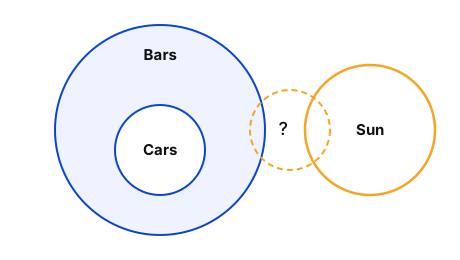
- All cars are bars → Cars circle inside Bars.
- No car is a sun → Sun is outside Cars, but it may or may not touch Bars.
- (I) Some suns are bars: only a possibility (dashed part) → does not follow.
- (II) All bars are suns: cars are bars but not suns, so this is definitely false → does not follow.
Trick: A “possibility” is never a definite conclusion.
Answer: (B) Neither conclusion (I) nor (II) follows
अवधारणा: न्यूनतम ओवरलैप वाला वेन आरेख बनाएँ; निष्कर्ष तभी सही है जब हर संभव आरेख में सत्य हो।
- सभी cars, bars हैं → Cars वृत्त Bars के अंदर।
- कोई car, sun नहीं → Sun, Cars के बाहर है, पर Bars को छू भी सकता है और नहीं भी।
- (I) कुछ suns, bars हैं: केवल संभावना (डैश वाला भाग) → अनुसरण नहीं करता।
- (II) सभी bars, suns हैं: cars, bars हैं पर suns नहीं, अतः यह निश्चित रूप से गलत → अनुसरण नहीं करता।
ट्रिक: “संभावना” कभी निश्चित निष्कर्ष नहीं होती।
उत्तर: (B) न तो निष्कर्ष (I) और न ही (II) अनुसरण करता है
RRB NTPC Undergraduate CBT 1General Intelligence and ReasoningSyllogismRRB NTPC Undergraduate CBT 1 2025 · 17 Jun Shift 2
Q1088.Based on the English alphabetical order, three of the following four letter-cluster pairs are alike in a certain way and thus form a group. Which letter-cluster pair DOES NOT belong to that group?
(Note: The odd one out is not based on the number of consonants/vowels or their position in the letter-cluster.)
अंग्रेज़ी वर्णमाला क्रम के आधार पर, निम्नलिखित चार अक्षर-समूह युग्मों में से तीन किसी निश्चित प्रकार से एक समान हैं और इस प्रकार एक समूह बनाते हैं। कौन-सा अक्षर-समूह युग्म उस समूह से संबंधित नहीं है?
(नोट: असंगत युग्म, व्यंजनों/स्वरों की संख्या या अक्षर-समूह में उनके स्थान पर आधारित नहीं है।)
- AWB - PY
- BIN - BK
- CTY - MV
- DEJ - RG
Show answer
Concept: Count the gap between the two letters of each cluster (wrap Z → A if needed).
- IN − BK: ; .
- TY − MV: ; .
- WB − PY: (after Z); .
- EJ − RG: but is not . So EJ − RG is odd.
Trick: Pattern “first cluster , second cluster ”; also the first letters drop by 7 (W→P, I→B, T→M) but E→R does not.
Answer: (D) EJ - RG
अवधारणा: हर समूह के दोनों अक्षरों के बीच का अंतर गिनें (आवश्यक हो तो Z के बाद A)।
- IN − BK: ; ।
- TY − MV: ; ।
- WB − PY: (Z के बाद); ।
- EJ − RG: पर में नहीं। अतः EJ − RG विषम है।
ट्रिक: नियम “पहला समूह , दूसरा ”; पहले अक्षर भी 7 घटते हैं (W→P, I→B, T→M), पर E→R नहीं।
उत्तर: (D) EJ - RG
RRB NTPC Undergraduate CBT 1General Intelligence and ReasoningOdd One Out – Letter PairsRRB NTPC Undergraduate CBT 1 2025 · 17 Jun Shift 2
Q1089.Each vowel in the word WRENCHINGLY is changed to the letter immediately following it in the English alphabetical order AND each consonant is changed to the second letter preceding it in the English alphabetical order. How many letters will appear exactly twice in the group of letters thus formed?
शब्द WRENCHINGLY में प्रत्येक स्वर को अंग्रेज़ी वर्णमाला क्रम में उसके ठीक बाद वाले अक्षर से बदल दिया जाता है और प्रत्येक व्यंजन को अंग्रेज़ी वर्णमाला क्रम में उससे दो स्थान पहले वाले अक्षर से बदल दिया जाता है। इस प्रकार बने अक्षर-समूह में कितने अक्षर ठीक दो बार आएँगे?
- ATwoदो
- BThreeतीन
- CFourचार
- DOneएक
Show answer
Concept: Vowels: ; consonants: .
- WRENCHINGLY → W→U, R→P, E→F, N→L, C→A, H→F, I→J, N→L, G→E, L→J, Y→W.
- New group: U P F L A F J L E J W.
- F, L and J each appear exactly twice; others appear once.
Trick: Write the new letters in one line and tick repeats — avoid doing it mentally.
Answer: (B) Three
अवधारणा: स्वर: ; व्यंजन: ।
- WRENCHINGLY → W→U, R→P, E→F, N→L, C→A, H→F, I→J, N→L, G→E, L→J, Y→W।
- नया समूह: U P F L A F J L E J W।
- F, L और J प्रत्येक ठीक दो बार आते हैं; बाकी एक बार।
ट्रिक: नए अक्षर एक पंक्ति में लिखें और दोहराव पर निशान लगाएँ।
उत्तर: (B) तीन
RRB NTPC Undergraduate CBT 1General Intelligence and ReasoningLetter Coding – CountingRRB NTPC Undergraduate CBT 1 2025 · 17 Jun Shift 2
Q1090.Select the option that represents the correct order of the given words as they would appear in an English dictionary.
1. Roast
2. Router
3. Road
4. Robust
5. Rope
उस विकल्प का चयन कीजिए जो दिए गए शब्दों के उस सही क्रम को दर्शाता है जिसमें वे अंग्रेज़ी शब्दकोश में आएँगे।
1. Roast
2. Router
3. Road
4. Robust
5. Rope
- A1, 4, 3, 2, 5
- B1, 4, 3, 5, 2
- C3, 1, 5, 4, 2
- D3, 1, 4, 5, 2
Show answer
Concept: All words start with “Ro”, so compare from the third letter.
- Third letters: Road, Roast, Robust, Rope, Router.
- Road vs Roast: fourth letter d before s → Road first.
- Order: Road, Roast, Robust, Rope, Router = 3, 1, 4, 5, 2.
Trick: When prefixes match, move one letter to the right and compare again.
Answer: (D) 3, 1, 4, 5, 2
अवधारणा: सभी शब्द “Ro” से शुरू होते हैं, अतः तीसरे अक्षर से तुलना करें।
- तीसरे अक्षर: Road, Roast, Robust, Rope, Router।
- Road और Roast: चौथा अक्षर d, s से पहले → Road पहले।
- क्रम: Road, Roast, Robust, Rope, Router = 3, 1, 4, 5, 2।
ट्रिक: जब शुरुआती अक्षर समान हों तो अगले अक्षर से तुलना करें।
उत्तर: (D) 3, 1, 4, 5, 2
RRB NTPC Undergraduate CBT 1General Intelligence and ReasoningDictionary OrderRRB NTPC Undergraduate CBT 1 2025 · 17 Jun Shift 2
Q1091.Rakesh ranked 39th from the top and 46th from the bottom in his class. How many students are there in his class?
राकेश अपनी कक्षा में ऊपर से 39वें और नीचे से 46वें स्थान पर है। उसकी कक्षा में कितने छात्र हैं?
- A86
- B84
- C83
- D85
Show answer
Concept: .
- Rakesh is counted in both ranks, so subtract 1 once.
- .
Trick: Add both ranks and subtract 1.
Answer: (B)
अवधारणा: ।
- राकेश दोनों रैंकों में गिना गया है, इसलिए एक बार 1 घटाएँ।
- ।
ट्रिक: दोनों रैंक जोड़ें और 1 घटाएँ।
उत्तर: (B)
RRB NTPC Undergraduate CBT 1General Intelligence and ReasoningRankingRRB NTPC Undergraduate CBT 1 2025 · 17 Jun Shift 2
Q1092.X is the mother of F. F is the sister of T. U is the father of K. K is the husband of T. How is K related to X?
X, F की माँ है। F, T की बहन है। U, K का पिता है। K, T का पति है। K का X से क्या संबंध है?
- AFatherपिता
- BDaughter's husbandपुत्री का पति
- CBrotherभाई
- DDaughter's sonपुत्री का पुत्र
Show answer
Concept: Draw the family tree with genders.
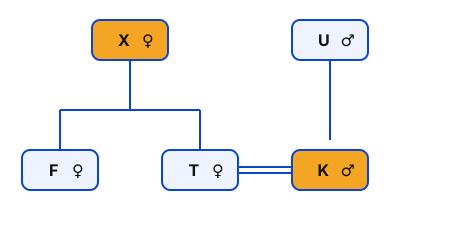
- X is the mother of F, and F is the sister of T → X is also the mother of T.
- K is the husband of T → T is female, a daughter of X.
- U is the father of K (only K’s side).
- So K is the husband of X’s daughter.
Trick: Husband of one’s daughter = son-in-law = daughter’s husband.
Answer: (B) Daughter's husband
अवधारणा: लिंग के साथ परिवार वृक्ष बनाएँ।
- X, F की माँ है और F, T की बहन है → X, T की भी माँ है।
- K, T का पति है → T महिला है, X की बेटी।
- U, K का पिता है (केवल K की ओर)।
- अतः K, X की बेटी का पति है।
ट्रिक: बेटी का पति = दामाद (son-in-law)।
उत्तर: (B) बेटी का पति (दामाद)
RRB NTPC Undergraduate CBT 1General Intelligence and ReasoningBlood RelationsRRB NTPC Undergraduate CBT 1 2025 · 17 Jun Shift 2
Q1093.Each of the digits in the number 4738165 is arranged in ascending order from left to right. The position(s) of how many digits will remain unchanged as compared to that in the original number?
संख्या 4738165 के प्रत्येक अंक को बाएँ से दाएँ आरोही क्रम में व्यवस्थित किया जाता है। मूल संख्या की तुलना में कितने अंकों का/के स्थान अपरिवर्तित रहेगा/रहेंगे?
- ATwoदो
- BThreeतीन
- COneएक
- DNoneकोई नहीं
Show answer
Concept: Write the original number and the sorted number one under the other and compare place by place.
- Original: 4 7 3 8 1 6 5.
- Ascending: 1 3 4 5 6 7 8.
- Place by place: 4–1, 7–3, 3–4, 8–5, 1–6, 6–7, 5–8 — no digit matches.
Trick: Compare position by position, not digit by digit.
Answer: (D) None
अवधारणा: मूल संख्या और क्रमबद्ध संख्या को एक के नीचे एक लिखकर हर स्थान की तुलना करें।
- मूल: 4 7 3 8 1 6 5।
- आरोही क्रम: 1 3 4 5 6 7 8।
- स्थानवार: 4–1, 7–3, 3–4, 8–5, 1–6, 6–7, 5–8 — कोई अंक मेल नहीं खाता।
ट्रिक: अंक नहीं, स्थान के अनुसार तुलना करें।
उत्तर: (D) कोई नहीं
RRB NTPC Undergraduate CBT 1General Intelligence and ReasoningDigit ArrangementRRB NTPC Undergraduate CBT 1 2025 · 17 Jun Shift 2
Q1094.In a certain code language, ‘zebra peak blue’ is coded as 'sr dt tx' and ‘bee zebra chest’ is coded as ‘dt bm qb’. How is ‘zebra’ coded in the given language?
एक निश्चित कूट भाषा में, ‘zebra peak blue’ को 'sr dt tx' के रूप में और ‘bee zebra chest’ को ‘dt bm qb’ के रूप में कूटबद्ध किया जाता है। उसी भाषा में ‘zebra’ को किस प्रकार कूटबद्ध किया जाता है?
- Asr
- Bbm
- Ctx
- Ddt
Show answer
Concept: A word common to two sentences gets the code common to both.
- “zebra peak blue” → sr dt tx.
- “bee zebra chest” → dt bm qb.
- Common word: zebra; common code: dt.
Trick: Common word ↔ common code.
Answer: (D) dt
अवधारणा: दो वाक्यों में समान शब्द का कोड दोनों कोडों में समान होता है।
- “zebra peak blue” → sr dt tx।
- “bee zebra chest” → dt bm qb।
- समान शब्द: zebra; समान कोड: dt।
ट्रिक: समान शब्द ↔ समान कोड।
उत्तर: (D) dt
RRB NTPC Undergraduate CBT 1General Intelligence and ReasoningCoding–Decoding (Words)RRB NTPC Undergraduate CBT 1 2025 · 17 Jun Shift 2
Q1095.Based on the English alphabetical order, three of the following four letter-cluster pairs are alike in a certain way and thus form a group. Which is the one that does not belong to that group?
(Note: The odd man out is not based on the number of consonants/vowels or their position in the letter cluster.)
अंग्रेज़ी वर्णमाला क्रम के आधार पर, निम्नलिखित चार अक्षर-समूह युग्मों में से तीन किसी निश्चित प्रकार से एक समान हैं और इस प्रकार एक समूह बनाते हैं। वह कौन-सा युग्म है जो उस समूह से संबंधित नहीं है?
(नोट: असंगत युग्म, व्यंजनों/स्वरों की संख्या या अक्षर-समूह में उनके स्थान पर आधारित नहीं है।)
- AUC – QY
- BTR – PN
- CBP – XL
- DKF – GA
Show answer
Concept: Compare each letter of the first cluster with the corresponding letter of the second.
- UC – QY: , (going back past A).
- TR – PN: . BP – XL: , .
- KF – GA: but . So KF – GA is odd.
Trick: All pairs shift both letters by ; one breaks it.
Answer: (D) KF – GA
अवधारणा: पहले समूह के हर अक्षर की तुलना दूसरे समूह के संगत अक्षर से करें।
- UC – QY: , (A के पीछे जाकर)।
- TR – PN: । BP – XL: , ।
- KF – GA: पर । अतः KF – GA विषम है।
ट्रिक: सभी युग्मों में दोनों अक्षर खिसकते हैं; एक नियम तोड़ता है।
उत्तर: (D) KF – GA
RRB NTPC Undergraduate CBT 1General Intelligence and ReasoningOdd One Out – Letter PairsRRB NTPC Undergraduate CBT 1 2025 · 17 Jun Shift 2
Q1096.Read the given statement(s) and conclusions carefully. Assuming that the information given in the statements is true, even if it appears to be at variance with commonly known facts, decide which of the given conclusions logically follow(s) from the statement(s).
Statements:
All bats are chicks.
All bats are mats.
Conclusions:
(I) Some chicks are mats.
(II) All mats are bats.
दिए गए कथन(नों) और निष्कर्षों को ध्यानपूर्वक पढ़िए। यह मानते हुए कि कथनों में दी गई जानकारी सत्य है, भले ही वह सामान्य रूप से ज्ञात तथ्यों से भिन्न प्रतीत होती हो, निर्णय कीजिए कि दिए गए निष्कर्षों में से कौन-सा/से निष्कर्ष कथन(नों) का तार्किक रूप से अनुसरण करता है/करते हैं।
कथन:
सभी चमगादड़, चूज़े हैं।
सभी चमगादड़, चटाइयाँ हैं।
निष्कर्ष:
(I) कुछ चूज़े, चटाइयाँ हैं।
(II) सभी चटाइयाँ, चमगादड़ हैं।
- AOnly conclusion (II) followsकेवल निष्कर्ष (II) अनुसरण करता है
- BOnly conclusion (I) followsकेवल निष्कर्ष (I) अनुसरण करता है
- CNeither conclusion (I) nor (II) followsन तो निष्कर्ष (I) और न ही (II) अनुसरण करता है
- DBoth conclusions (I) and (II) followनिष्कर्ष (I) और (II) दोनों अनुसरण करते हैं
Show answer
Concept: Draw the Venn diagram; check each conclusion for definiteness.
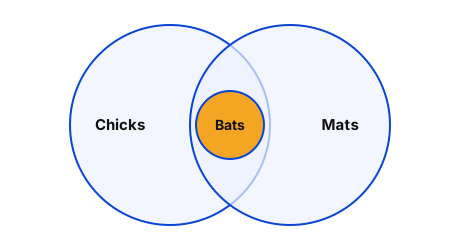
- All bats are chicks and all bats are mats → Bats lies in the common part of Chicks and Mats.
- So the bats region is both chicks and mats → “Some chicks are mats” is definitely true. (I) follows.
- Mats may contain things that are not bats → “All mats are bats” does not follow.
Trick: Two “All” statements with the same subject always give “Some” between the two predicates.
Answer: (B) Only conclusion (I) follows
अवधारणा: वेन आरेख बनाएँ और हर निष्कर्ष की निश्चितता जाँचें।
- सभी bats, chicks हैं और सभी bats, mats हैं → Bats, Chicks और Mats के उभयनिष्ठ भाग में है।
- अतः bats वाला भाग chicks भी है और mats भी → “कुछ chicks, mats हैं” निश्चित सत्य। (I) अनुसरण करता है।
- Mats में bats के अलावा भी कुछ हो सकता है → “सभी mats, bats हैं” अनुसरण नहीं करता।
ट्रिक: एक ही विषय वाले दो “सभी” कथन, दोनों विधेयों के बीच “कुछ” देते हैं।
उत्तर: (B) केवल निष्कर्ष (I) अनुसरण करता है
RRB NTPC Undergraduate CBT 1General Intelligence and ReasoningSyllogismRRB NTPC Undergraduate CBT 1 2025 · 17 Jun Shift 2
Q1097.The position(s) of how many letters will remain unchanged if each of the letters in the word ORANGEY is arranged in the English alphabetical order?
यदि शब्द ORANGEY के प्रत्येक अक्षर को अंग्रेज़ी वर्णमाला क्रम में व्यवस्थित किया जाए, तो कितने अक्षरों का/के स्थान अपरिवर्तित रहेगा/रहेंगे?
- AFourचार
- BOneएक
- CTwoदो
- DThreeतीन
Show answer
Concept: Write the word and its alphabetical arrangement one under the other.
- ORANGEY: O R A N G E Y.
- Alphabetical: A E G N O R Y.
- Place by place: O/A, R/E, A/G, N/N, G/O, E/R, Y/Y → N and Y stay.
Trick: Y is the last letter of the word and also the alphabetically last — it never moves.
Answer: (C) Two
अवधारणा: शब्द और उसकी वर्णानुक्रम व्यवस्था एक के नीचे एक लिखें।
- ORANGEY: O R A N G E Y।
- वर्णानुक्रम: A E G N O R Y।
- स्थानवार: O/A, R/E, A/G, N/N, G/O, E/R, Y/Y → N और Y अपरिवर्तित।
ट्रिक: Y शब्द का अंतिम अक्षर है और वर्णानुक्रम में भी अंतिम — वह हिलता नहीं।
उत्तर: (C) दो
RRB NTPC Undergraduate CBT 1General Intelligence and ReasoningLetter ArrangementRRB NTPC Undergraduate CBT 1 2025 · 17 Jun Shift 2
Q1098.Yaman starts from Point A and drives 18 km towards the west. He then takes a right turn, drives 19 km, turns right and drives 21 km. He then takes a right turn and drives 23 km. He takes a final right turn, drives 3 km and stops at Point P. How far (shortest distance) and towards which direction should he drive in order to reach Point A again? (All turns are 90-degree turns only unless specified.)
यमन बिंदु A से चलना शुरू करता है और पश्चिम की ओर 18 km गाड़ी चलाता है। फिर वह दाएँ मुड़ता है, 19 km गाड़ी चलाता है, दाएँ मुड़ता है और 21 km गाड़ी चलाता है। फिर वह दाएँ मुड़ता है और 23 km गाड़ी चलाता है। वह अंतिम बार दाएँ मुड़ता है, 3 km गाड़ी चलाता है और बिंदु P पर रुक जाता है। बिंदु A पर पुनः पहुँचने के लिए उसे कितनी दूरी (न्यूनतम दूरी) और किस दिशा में गाड़ी चलानी चाहिए? (जब तक निर्दिष्ट न हो, सभी मोड़ केवल 90 डिग्री के हैं।)
- A3 km to the southदक्षिण की ओर 3 km
- B2 km to the southदक्षिण की ओर 2 km
- C4 km to the northउत्तर की ओर 4 km
- D5 km to the northउत्तर की ओर 5 km
Show answer
Concept: Take A as origin, east and north positive; a right turn changes W→N→E→S→W.
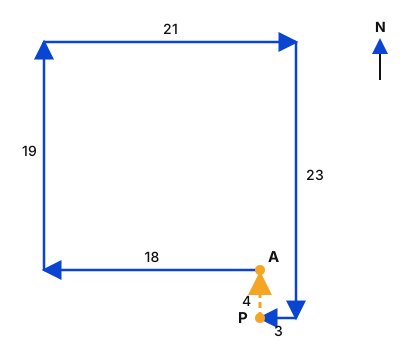
- 18 km west → . Right (north) 19 km → .
- Right (east) 21 km → . Right (south) 23 km → .
- Right (west) 3 km → P .
- P is 4 km directly south of A, so he must drive 4 km north.
Trick: Net east–west ; net north–south .
Answer: (C) 4 km to the north
अवधारणा: A को मूल बिंदु मानें, पूर्व और उत्तर धनात्मक; दाएँ मुड़ने पर पश्चिम→उत्तर→पूर्व→दक्षिण→पश्चिम।
- 18 km पश्चिम → । दाएँ (उत्तर) 19 km → ।
- दाएँ (पूर्व) 21 km → । दाएँ (दक्षिण) 23 km → ।
- दाएँ (पश्चिम) 3 km → P ।
- P, A से ठीक 4 km दक्षिण में है, अतः उसे 4 km उत्तर जाना होगा।
ट्रिक: कुल पूर्व–पश्चिम ; कुल उत्तर–दक्षिण ।
उत्तर: (C) 4 km उत्तर की ओर
RRB NTPC Undergraduate CBT 1General Intelligence and ReasoningDirection and DistanceRRB NTPC Undergraduate CBT 1 2025 · 17 Jun Shift 2
Q1099.If ‘D’ stands for ‘÷’, ‘B’ stands for ‘×’, ‘A’ stands for ‘+’ and ‘C’ stands for ‘−’, then what will come in place of the question mark (?) in the following equation?
16 C 92 D 4 A 12 B 7 C 15 = ?
यदि ‘D’ का अर्थ ‘÷’, ‘B’ का अर्थ ‘×’, ‘A’ का अर्थ ‘+’ और ‘C’ का अर्थ ‘−’ है, तो निम्नलिखित समीकरण में प्रश्न चिह्न (?) के स्थान पर क्या आएगा?
16 C 92 D 4 A 12 B 7 C 15 = ?
- A87
- B32
- C91
- D62
Show answer
Concept: Replace the letters by signs and solve using BODMAS.
- .
- , .
- .
Trick: Do , first, then add all positives () and subtract negatives (): .
Answer: (D)
अवधारणा: अक्षरों के स्थान पर चिह्न रखें और BODMAS से हल करें।
- ।
- , ।
- ।
ट्रिक: पहले , ; फिर धनात्मक जोड़ें () और ऋणात्मक घटाएँ (): ।
उत्तर: (D)
RRB NTPC Undergraduate CBT 1General Intelligence and ReasoningSymbol SubstitutionRRB NTPC Undergraduate CBT 1 2025 · 17 Jun Shift 2
Q1100.What should come in place of '?' in the given series based on the English alphabetical order?
CBY WVS QPM KJG ?
अंग्रेज़ी वर्णमाला क्रम के आधार पर दी गई शृंखला में '?' के स्थान पर क्या आना चाहिए?
CBY WVS QPM KJG ?
- AEDA
- BGCA
- CHDP
- DFCB
Show answer
Concept: Compare each letter with the same position in the next cluster.
- CBY → WVS: (backwards past A), , .
- WVS → QPM → KJG: every letter .
- KJG : , , → EDA.
Trick: Inside each cluster the pattern is (K→J→G, E→D→A).
Answer: (A) EDA
अवधारणा: हर अक्षर की तुलना अगले समूह के उसी स्थान वाले अक्षर से करें।
- CBY → WVS: (A के पीछे जाकर), , ।
- WVS → QPM → KJG: हर अक्षर ।
- KJG : , , → EDA।
ट्रिक: हर समूह के अंदर क्रम है (K→J→G, E→D→A)।
उत्तर: (A) EDA
RRB NTPC Undergraduate CBT 1General Intelligence and ReasoningLetter SeriesRRB NTPC Undergraduate CBT 1 2025 · 17 Jun Shift 2

