Q221.A concave mirror produces a virtual, erect and magnified image when the object is positioned _________.
एक अवतल दर्पण आभासी, सीधा और आवर्धित प्रतिबिंब तब बनाता है जब वस्तु _________ रखी जाती है।
- ABetween the centre of curvature and the focusवक्रता केंद्र और फोकस के बीच
- BBeyond the centre of curvatureवक्रता केंद्र से परे
- CBetween the focus and the poleफोकस और ध्रुव के बीच
- DAt the principal focusमुख्य फोकस पर
Show answer
Concept: A concave mirror gives a virtual, erect image only for an object between P and F.
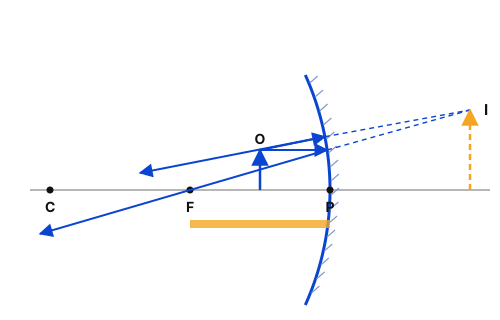
- Object between F and P → image behind the mirror, virtual, erect, enlarged.
- At F → image at infinity; between C and F → real, inverted, enlarged.
Yaad rakhein: This is why concave mirrors are used as shaving/makeup mirrors.
Answer: (C) Between the focus and the pole
अवधारणा: अवतल दर्पण केवल P और F के बीच वस्तु पर आभासी, सीधा प्रतिबिंब देता है।
हल:
- F और P के बीच → दर्पण के पीछे, आभासी, सीधा, बड़ा।
- F पर → अनंत पर; C और F के बीच → वास्तविक, उल्टा, बड़ा।
याद रखें: इसीलिए दाढ़ी बनाने/मेकअप दर्पण में अवतल दर्पण।
उत्तर: (C) फोकस और ध्रुव के बीच
RRB Technician Grade IIIGeneral ScienceConcave mirror – image formationRRB Technician Grade III 2025 · 9 Mar Shift 1
Q222.Which of the following can happen when non-biodegradable waste is dumped into water bodies?
जब अजैव निम्नीकरणीय (non-biodegradable) अपशिष्ट को जलाशयों में फेंका जाता है, तो निम्नलिखित में से क्या हो सकता है?
- AIt pollutes the water and harms aquatic life.यह जल को प्रदूषित करता है और जलीय जीवों को हानि पहुँचाता है।
- BIt helps aquatic plants grow.यह जलीय पौधों की वृद्धि में सहायता करता है।
- CIt cleans the water.यह जल को स्वच्छ करता है।
- DIt quickly dissolves in water.यह जल में शीघ्रता से घुल जाता है।
Show answer
Concept: Non-biodegradable waste is not broken down by microbes.
- Plastics etc. persist for years, pollute water and harm aquatic animals (choking, toxins).
- They do not dissolve, clean water or help plants grow.
Yaad rakhein: Such substances can also enter food chains and accumulate (biomagnification).
Answer: (A) It pollutes the water and harms aquatic life.
अवधारणा: अजैव निम्नीकरणीय अपशिष्ट सूक्ष्मजीवों से नहीं टूटता।
हल:
- प्लास्टिक आदि वर्षों तक रहते हैं, जल प्रदूषित कर जलीय जीवों को हानि पहुँचाते हैं।
- ये न घुलते हैं, न जल साफ करते हैं, न पौधों की वृद्धि करते हैं।
याद रखें: ऐसे पदार्थ खाद्य श्रृंखला में जमा होते हैं (जैव आवर्धन)।
उत्तर: (A) यह जल को प्रदूषित करता है और जलीय जीवों को हानि पहुँचाता है।
RRB Technician Grade IIIGeneral ScienceEnvironment – non-biodegradable wasteRRB Technician Grade III 2025 · 9 Mar Shift 1
Q223.Sexual maturation in humans results in:
मनुष्यों में लैंगिक परिपक्वता का परिणाम होता है:
- ALoss of reproductive capacity and growthजनन क्षमता और वृद्धि की हानि
- BDevelopment of reproductive organs and secondary sexual characteristicsजनन अंगों और द्वितीयक लैंगिक लक्षणों का विकास
- CDecrease in hormone levels and loss of reproductive organsहार्मोन स्तरों में कमी और जनन अंगों की हानि
- DOnly physical growthकेवल शारीरिक वृद्धि
Show answer
Concept: At puberty the body becomes sexually mature.
- Reproductive organs mature and start producing gametes and hormones.
- Secondary sexual characters appear (e.g. facial hair, voice change in boys; breast development in girls).
Yaad rakhein: Hormones: testosterone in males, oestrogen in females.
Answer: (B) Development of reproductive organs and secondary sexual characteristics
अवधारणा: यौवनारंभ में शरीर लैंगिक रूप से परिपक्व होता है।
हल:
- जनन अंग परिपक्व होकर युग्मक व हार्मोन बनाने लगते हैं।
- द्वितीयक लैंगिक लक्षण (लड़कों में दाढ़ी, आवाज़ भारी; लड़कियों में स्तन विकास)।
याद रखें: हार्मोन: पुरुष – टेस्टोस्टेरोन, महिला – एस्ट्रोजन।
उत्तर: (B) जनन अंगों और द्वितीयक लैंगिक लक्षणों का विकास
RRB Technician Grade IIIGeneral ScienceHuman reproduction – pubertyRRB Technician Grade III 2025 · 9 Mar Shift 1
Q224.Plastids, which are found only in plant cells, help in:
लवक (plastids), जो केवल पादप कोशिकाओं में पाए जाते हैं, किसमें सहायता करते हैं?
- Aphotosynthesis and storageप्रकाश संश्लेषण और भंडारण
- Bexcretionउत्सर्जन
- Ctransportपरिवहन
- Drespirationश्वसन
Show answer
Concept: Plastids are of two main types.
- Chloroplasts (with chlorophyll) carry out photosynthesis.
- Leucoplasts (colourless) store starch, oil and protein.
Yaad rakhein: Plastids, like mitochondria, have their own DNA and ribosomes.
Answer: (A) photosynthesis and storage
अवधारणा: लवक मुख्यतः दो प्रकार के।
हल:
- हरितलवक (क्लोरोफिल युक्त) – प्रकाश संश्लेषण।
- अवर्णीलवक (रंगहीन) – स्टार्च, तेल, प्रोटीन का संचय।
याद रखें: लवक और माइटोकॉन्ड्रिया दोनों में अपना DNA व राइबोसोम होते हैं।
उत्तर: (A) प्रकाश संश्लेषण और भंडारण
RRB Technician Grade IIIGeneral ScienceCell organelles – plastidsRRB Technician Grade III 2025 · 9 Mar Shift 1
Q225.What is the audible frequency range for human beings?
मनुष्यों के लिए श्रव्य आवृत्ति परिसर क्या है?
- A200 Hz to 200,000 Hz200 Hz से 200,000 Hz
- B20 kHz to 200 kHz20 kHz से 200 kHz
- C2 Hz to 200 Hz2 Hz से 200 Hz
- D20 Hz to 20,000 Hz20 Hz से 20,000 Hz
Show answer
Concept: Human ear hears 20 Hz to 20 kHz.
- Below 20 Hz = infrasound (e.g. earthquakes, whales).
- Above 20,000 Hz = ultrasound (dogs, bats; used in sonar, scans).
Yaad rakhein: 20 Hz to 20 kHz = 20 Hz to 20,000 Hz.
Answer: (D) 20 Hz to 20,000 Hz
अवधारणा: मानव कान 20 Hz से 20 kHz तक सुनता है।
हल:
- 20 Hz से कम = अवश्रव्य (भूकंप, व्हेल)।
- 20,000 Hz से अधिक = पराश्रव्य (कुत्ते, चमगादड़; सोनार, स्कैन)।
याद रखें: 20 Hz से 20 kHz = 20 Hz से 20,000 Hz
उत्तर: (D) 20 Hz से 20,000 Hz
RRB Technician Grade IIIGeneral ScienceSound – audible rangeRRB Technician Grade III 2025 · 9 Mar Shift 1
Q226.A device has a resistance of 75 Ω and carries a current of 4 A. The power dissipated is _______.
एक युक्ति का प्रतिरोध (resistance) 75 Ω है और उसमें 4 A की धारा प्रवाहित होती है। क्षयित शक्ति _______ है।
- A1400 W
- B1200 W
- C300 W
- D18.75 W
Show answer
Concept: .
- W
Trick: Also V, W. Option 300 is V, not P.
Answer: (B) 1200 W
अवधारणा:
हल:
- W
ट्रिक: V; W – 300 विकल्प वोल्टेज है, शक्ति नहीं।
उत्तर: (B) 1200 W
RRB Technician Grade IIIGeneral ScienceElectric powerRRB Technician Grade III 2025 · 9 Mar Shift 1
Q227.Which of the following are produced when a metal oxide reacts with an acid?
जब कोई धातु ऑक्साइड किसी अम्ल के साथ अभिक्रिया करता है, तो निम्नलिखित में से क्या उत्पन्न होते हैं?
- ASalt and carbon dioxideलवण और कार्बन डाइऑक्साइड
- BSalt and hydrogen gasलवण और हाइड्रोजन गैस
- CSalt and waterलवण और जल
- DSalt and oxygen gasलवण और ऑक्सीजन गैस
Show answer
Concept: Metal oxides are basic, so they neutralise acids.
- Metal oxide + acid → salt + water.
- CuO + 2HCl → CuCl₂ + H₂O.
Yaad rakhein: Metal + acid → salt + H₂; carbonate + acid → salt + H₂O + CO₂; oxide + acid → salt + H₂O.
Answer: (C) Salt and water
अवधारणा: धातु ऑक्साइड क्षारकीय हैं, अतः अम्ल को उदासीन करते हैं।
हल:
- धातु ऑक्साइड + अम्ल → लवण + जल
- CuO + 2HCl → CuCl₂ + H₂O
याद रखें: धातु + अम्ल → लवण + H₂; कार्बोनेट + अम्ल → लवण + जल + CO₂; ऑक्साइड + अम्ल → लवण + जल।
उत्तर: (C) लवण और जल
RRB Technician Grade IIIGeneral ScienceAcids – reaction with metal oxidesRRB Technician Grade III 2025 · 9 Mar Shift 1
Q228.The gravitational force between two masses increases when ________.
दो द्रव्यमानों के बीच गुरुत्वाकर्षण बल तब बढ़ता है जब ________।
- AThe product of their masses increasesउनके द्रव्यमानों का गुणनफल बढ़ता है
- BThey are kept in waterउन्हें जल में रखा जाता है
- CTheir masses decreaseउनके द्रव्यमान घटते हैं
- DThe distance between them increasesउनके बीच की दूरी बढ़ती है
Show answer
Concept: .
- → larger product of masses gives larger force.
- → increasing distance decreases force.
- The medium (water) has no effect on gravitation.
Yaad rakhein: Doubling distance makes force .
Answer: (A) The product of their masses increases
अवधारणा:
हल:
- → द्रव्यमानों का गुणनफल बढ़े तो बल बढ़े।
- → दूरी बढ़े तो बल घटे।
- माध्यम (जल) का गुरुत्व पर प्रभाव नहीं।
याद रखें: दूरी दोगुनी करने पर बल हो जाता है।
उत्तर: (A) उनके द्रव्यमानों का गुणनफल बढ़ता है
RRB Technician Grade IIIGeneral ScienceUniversal law of gravitationRRB Technician Grade III 2025 · 9 Mar Shift 1
Q229.A student notices that Hydra creates new organisms by developing small protrusions on its body, which eventually detach. What kind of reproduction is this?
एक छात्र देखता है कि हाइड्रा अपने शरीर पर छोटे उभार विकसित करके नए जीवों का निर्माण करता है, जो अंततः अलग हो जाते हैं। यह किस प्रकार का जनन है?
- AParthenogenesisअनिषेकजनन (Parthenogenesis)
- BRegenerationपुनर्जनन (Regeneration)
- CBuddingमुकुलन (Budding)
- DSexual reproductionलैंगिक जनन
Show answer
Concept: Budding: a bud grows on the parent and detaches as a new individual.
- Hydra forms buds by repeated cell division at one spot.
- The bud becomes a tiny Hydra and separates. Yeast also buds.
Yaad rakhein: Hydra shows both budding and regeneration; the outgrowth clue means budding.
Answer: (C) Budding
अवधारणा: मुकुलन: जनक पर कलिका बनकर अलग होकर नया जीव बनती है।
हल:
- हाइड्रा में एक स्थान पर बार-बार कोशिका विभाजन से कलिका बनती है।
- कलिका छोटा हाइड्रा बनकर अलग हो जाती है। यीस्ट में भी मुकुलन।
याद रखें: हाइड्रा में मुकुलन व पुनरुद्भवन दोनों; 'उभार' का संकेत = मुकुलन।
उत्तर: (C) मुकुलन (Budding)
RRB Technician Grade IIIGeneral ScienceAsexual reproduction – buddingRRB Technician Grade III 2025 · 9 Mar Shift 1
Q230.Which of the following distinguishes the Rough Endoplasmic Reticulum from the Smooth Endoplasmic Reticulum?
निम्नलिखित में से कौन-सा खुरदरी अंतर्द्रव्यी जालिका (Rough Endoplasmic Reticulum) को चिकनी अंतर्द्रव्यी जालिका (Smooth Endoplasmic Reticulum) से अलग करता है?
- ARER stores lipids.RER लिपिडों का भंडारण करती है।
- BRER has ribosomes.RER में राइबोसोम होते हैं।
- CSER synthesizes proteins only.SER केवल प्रोटीनों का संश्लेषण करती है।
- DSER is rich in ribosomes.SER राइबोसोम से समृद्ध होती है।
Show answer
Concept: RER vs SER differ by ribosomes.
- RER has ribosomes on its surface → protein synthesis.
- SER has no ribosomes → makes lipids (fats) and detoxifies.
Trick: Rough = ribosomes; Smooth = no ribosomes, lipids.
Answer: (B) RER has ribosomes.
अवधारणा: RER और SER में अंतर राइबोसोम का है।
हल:
- RER की सतह पर राइबोसोम → प्रोटीन संश्लेषण।
- SER में राइबोसोम नहीं → लिपिड बनाता है, विषहरण।
ट्रिक: Rough = राइबोसोम; Smooth = राइबोसोम नहीं, लिपिड।
उत्तर: (B) RER में राइबोसोम होते हैं।
RRB Technician Grade IIIGeneral ScienceCell organelles – endoplasmic reticulumRRB Technician Grade III 2025 · 9 Mar Shift 1
Q231.Which of the following statements correctlydescribes the transportation of blood from the heart to the lungs?
निम्नलिखित में से कौन-सा कथन हृदय से फेफड़ों तक रक्त के परिवहन का सही वर्णन करता है?
- ADeoxygenated blood is pumped from the left ventricle to the lungs.विऑक्सीजनित रक्त बाएँ निलय से फेफड़ों में पंप किया जाता है।
- BOxygenated blood is carried from the lungs to the right atrium.ऑक्सीजनित रक्त फेफड़ों से दाएँ अलिंद में ले जाया जाता है।
- COxygenated blood flows from the left ventricle to the lungs for purification.ऑक्सीजनित रक्त शुद्धिकरण के लिए बाएँ निलय से फेफड़ों में प्रवाहित होता है।
- DDeoxygenated blood is pumped from the right ventricle to the lungs.विऑक्सीजनित रक्त दाएँ निलय से फेफड़ों में पंप किया जाता है।
Show answer
Concept: Right side of heart handles deoxygenated blood.
- Right ventricle pumps deoxygenated blood via pulmonary artery to lungs.
- Oxygenated blood returns via pulmonary veins to the LEFT atrium; left ventricle pumps it to the body.
Trick: Right = 'Return to lungs' (deoxygenated); Left = 'Leaves for body' (oxygenated).
Answer: (D) Deoxygenated blood is pumped from the right ventricle to the lungs.
अवधारणा: हृदय का दायाँ भाग विऑक्सीजनित रक्त संभालता है।
हल:
- दायाँ निलय फुफ्फुस धमनी से विऑक्सीजनित रक्त फेफड़ों को भेजता है।
- ऑक्सीजनित रक्त फुफ्फुस शिराओं से बाएँ आलिंद में; बायाँ निलय शरीर को भेजता है।
ट्रिक: दायाँ = फेफड़ों की ओर (अशुद्ध); बायाँ = शरीर की ओर (शुद्ध)।
उत्तर: (D) विऑक्सीजनित रक्त दाएँ निलय से फेफड़ों में पंप किया जाता है।
RRB Technician Grade IIIGeneral ScienceHuman circulation – pulmonaryRRB Technician Grade III 2025 · 9 Mar Shift 1
Q232.Which of the following best defines reduction in a redox reaction?
निम्नलिखित में से कौन-सा, रेडॉक्स अभिक्रिया में अपचयन (reduction) को सबसे अच्छी तरह परिभाषित करता है?
- ALoss of electrons onlyकेवल इलेक्ट्रॉनों की हानि
- BGain of oxygen or loss of hydrogenऑक्सीजन की प्राप्ति या हाइड्रोजन की हानि
- CGain of hydrogen or loss of oxygenहाइड्रोजन की प्राप्ति या ऑक्सीजन की हानि
- DGain of both oxygen and electronsऑक्सीजन और इलेक्ट्रॉन दोनों की प्राप्ति
Show answer
Concept: Reduction = gain of hydrogen or loss of oxygen (also gain of electrons).
- CuO + H₂ → Cu + H₂O: CuO loses oxygen → reduced.
- Gain of oxygen / loss of hydrogen = oxidation.
Trick: OIL RIG: Oxidation Is Loss, Reduction Is Gain (of electrons).
Answer: (C) Gain of hydrogen or loss of oxygen
अवधारणा: अपचयन = हाइड्रोजन की प्राप्ति या ऑक्सीजन की हानि (इलेक्ट्रॉन की प्राप्ति भी)।
हल:
- CuO + H₂ → Cu + H₂O: CuO ने ऑक्सीजन खोई → अपचयित।
- ऑक्सीजन लेना / हाइड्रोजन खोना = ऑक्सीकरण।
ट्रिक: OIL RIG: Oxidation Is Loss, Reduction Is Gain (इलेक्ट्रॉन)।
उत्तर: (C) हाइड्रोजन की प्राप्ति या ऑक्सीजन की हानि
RRB Technician Grade IIIGeneral ScienceRedox – reductionRRB Technician Grade III 2025 · 9 Mar Shift 1
Q233.What factor primarily influences the quality and quantity of honey produced in bee farming?
मधुमक्खी पालन में उत्पादित शहद की गुणवत्ता और मात्रा को मुख्य रूप से कौन-सा कारक प्रभावित करता है?
- AThe size of the beehive used onlyकेवल प्रयुक्त मधुमक्खी के छत्ते का आकार
- BFlower types and their abundance for nectar gatheringमकरंद एकत्र करने के लिए फूलों के प्रकार और उनकी प्रचुरता
- CThe colour of the beesमधुमक्खियों का रंग
- DThe temperature inside the beehive aloneकेवल मधुमक्खी के छत्ते के अंदर का तापमान
Show answer
Concept: Honey yield and quality depend on pasturage.
- Bees make honey from nectar; more and better flowers → more and better honey.
- Hive size, bee colour or temperature alone do not decide it.
Yaad rakhein: High-yield bee: Apis mellifera (Italian bee) is widely used commercially.
Answer: (B) Flower types and their abundance for nectar gathering
अवधारणा: शहद की मात्रा व गुणवत्ता चरागाह (फूलों) पर निर्भर।
हल:
- मधुमक्खियाँ मकरंद से शहद बनाती हैं; अधिक व अच्छे फूल → अधिक व अच्छा शहद।
- केवल छत्ते का आकार, रंग या तापमान निर्णायक नहीं।
याद रखें: व्यावसायिक रूप से इटैलियन मधुमक्खी (Apis mellifera) प्रचलित है।
उत्तर: (B) मकरंद एकत्र करने के लिए फूलों के प्रकार और उनकी प्रचुरता
RRB Technician Grade IIIGeneral ScienceApiculture – pasturageRRB Technician Grade III 2025 · 9 Mar Shift 1
Q234.The magnitude of force on a conductor in a magnetic field increases when _______.
चुंबकीय क्षेत्र में स्थित किसी चालक पर लगने वाले बल का परिमाण तब बढ़ता है जब _______।
- AMagnetic field decreasesचुंबकीय क्षेत्र घटता है
- BCurrent increasesधारा बढ़ती है
- CLength decreasesलंबाई घटती है
- DCurrent decreasesधारा घटती है
Show answer
Concept: F = B I L (conductor ⊥ field).
- Force ∝ current, ∝ field, ∝ length.
- So force increases when current increases.
Yaad rakhein: Direction by Fleming's left-hand rule.
Answer: (B) Current increases
अवधारणा: F = B I L (चालक क्षेत्र के लंबवत)
हल:
- बल ∝ धारा, ∝ क्षेत्र, ∝ लंबाई
- अतः धारा बढ़ने पर बल बढ़ता है।
याद रखें: दिशा: फ्लेमिंग का वाम-हस्त नियम।
उत्तर: (B) धारा बढ़ती है
RRB Technician Grade IIIGeneral ScienceForce on current-carrying conductorRRB Technician Grade III 2025 · 9 Mar Shift 1
Q235.The motion of the moon around the earth requires a centripetal force, which is provided by _____________.
पृथ्वी के चारों ओर चंद्रमा की गति के लिए अभिकेंद्र बल (centripetal force) की आवश्यकता होती है, जो _____________ द्वारा प्रदान किया जाता है।
- AThe thrust of the sunसूर्य के प्रणोद
- BThe inertia of the moonचंद्रमा के जड़त्व
- CThe force of attraction of the earthपृथ्वी के आकर्षण बल
- DThe internal forces of the moonचंद्रमा के आंतरिक बलों
Show answer
Concept: Circular motion needs a centripetal force towards the centre.
- For the moon, this force is Earth's gravitational pull.
- Inertia alone would make the moon move in a straight line.
Yaad rakhein: Similarly the Sun's gravity keeps planets in orbit.
Answer: (C) The force of attraction of the earth
अवधारणा: वृत्तीय गति के लिए केंद्र की ओर अभिकेंद्र बल चाहिए।
हल:
- चंद्रमा के लिए यह बल पृथ्वी का गुरुत्वाकर्षण है।
- केवल जड़त्व से चंद्रमा सीधी रेखा में चला जाता।
याद रखें: इसी प्रकार सूर्य का गुरुत्व ग्रहों को कक्षा में रखता है।
उत्तर: (C) पृथ्वी के आकर्षण बल
RRB Technician Grade IIIGeneral ScienceGravitation – centripetal forceRRB Technician Grade III 2025 · 9 Mar Shift 1
Q236.Which of the following metals forms an amphoteric oxide when reacting with air?
निम्नलिखित में से कौन-सी धातु वायु के साथ अभिक्रिया करके उभयधर्मी ऑक्साइड (amphoteric oxide) बनाती है?
- ACalciumकैल्शियम
- BSodiumसोडियम
- CAluminiumऐलुमिनियम
- DPotassiumपोटैशियम
Show answer
Concept: Amphoteric oxides react with both acids and bases.
- Aluminium forms Al₂O₃, which reacts with HCl and with NaOH.
- Na, K, Ca form basic oxides.
Trick: Amphoteric pair to remember: Al₂O₃ and ZnO.
Answer: (C) Aluminium
अवधारणा: उभयधर्मी ऑक्साइड अम्ल व क्षार दोनों से अभिक्रिया करते हैं।
हल:
- एल्युमिनियम Al₂O₃ बनाता है, जो HCl व NaOH दोनों से अभिक्रिया करता है।
- Na, K, Ca क्षारकीय ऑक्साइड बनाते हैं।
ट्रिक: याद रखें: Al₂O₃ और ZnO उभयधर्मी।
उत्तर: (C) ऐलुमिनियम
RRB Technician Grade IIIGeneral ScienceAmphoteric oxidesRRB Technician Grade III 2025 · 9 Mar Shift 1
Q237.In the chemical equation xPb(NO₃)₂(s) → yPbO(s) + zNO₂(g) + wO₂(g), what are the values of x, y, z and w?
रासायनिक समीकरण xPb(NO₃)₂(s) → yPbO(s) + zNO₂(g) + wO₂(g) में, x, y, z और w के मान क्या हैं?
- Ax = 2 ; y = 4 ; z = 2 ; w = 1
- Bx = 1 ; y = 2 ; z = 3 ; w = 2
- Cx = 2 ; y = 1 ; z = 4 ; w = 2
- Dx = 2 ; y = 2 ; z = 4 ; w = 1
Show answer
Concept: Equal atoms of each element on both sides.
- 2Pb(NO₃)₂ → 2PbO + 4NO₂ + O₂
- Pb: 2 = 2; N: 4 = 4; O: 12 = 2 + 8 + 2 = 12 ✓.
- x = 2, y = 2, z = 4, w = 1.
Trick: Pb balance needs x = y → only option D has x = y.
Answer: (D) x = 2 ; y = 2 ; z = 4 ; w = 1
अवधारणा: दोनों ओर हर तत्व के परमाणु बराबर।
हल:
- 2Pb(NO₃)₂ → 2PbO + 4NO₂ + O₂
- Pb: 2 = 2; N: 4 = 4; O: 12 = 2 + 8 + 2 ✓
- x = 2, y = 2, z = 4, w = 1
ट्रिक: Pb संतुलन के लिए x = y – केवल विकल्प D में।
उत्तर: (D) x = 2 ; y = 2 ; z = 4 ; w = 1
RRB Technician Grade IIIGeneral ScienceBalancing chemical equationsRRB Technician Grade III 2025 · 9 Mar Shift 1
Q238.Which of the following pairs of element names and symbols is correctly matched?
निम्नलिखित में से तत्वों के नाम और प्रतीकों का कौन-सा युग्म सही सुमेलित है?
- AMercury – Meपारा (Mercury) – Me
- BLead – Ldसीसा (Lead) – Ld
- CSilver – Sचाँदी (Silver) – S
- DTin – Snटिन (Tin) – Sn
Show answer
Concept: Many symbols come from Latin names.
- Tin = Sn (Stannum) ✓.
- Mercury = Hg (Hydrargyrum), Lead = Pb (Plumbum), Silver = Ag (Argentum); S is sulphur.
Yaad rakhein: Latin set: Na (Natrium), K (Kalium), Fe (Ferrum), Cu (Cuprum), Ag, Au, Pb, Sn, Hg.
Answer: (D) Tin – Sn
अवधारणा: कई प्रतीक लैटिन नामों से आते हैं।
हल:
- टिन = Sn (Stannum) ✓
- पारा = Hg, सीसा = Pb, चाँदी = Ag; S = सल्फर
याद रखें: लैटिन: Na, K, Fe, Cu, Ag, Au, Pb, Sn, Hg
उत्तर: (D) टिन (Tin) – Sn
RRB Technician Grade IIIGeneral ScienceChemical symbolsRRB Technician Grade III 2025 · 9 Mar Shift 1
Q239.A body moves 6 km towards the east in 1 hour and then 8 km towards the west in the next 1 hour. The average velocity of the body for the whole journey is ___________ .
एक वस्तु 1 घंटे में पूर्व की ओर 6 km चलती है और फिर अगले 1 घंटे में पश्चिम की ओर 8 km चलती है। पूरी यात्रा के लिए वस्तु का औसत वेग ___________ है।
- A0
- B7 km/h east7 km/h पूर्व
- C1 km/h east1 km/h पूर्व
- D1 km/h west1 km/h पश्चिम
Show answer
Concept: Average velocity = total displacement ÷ total time.
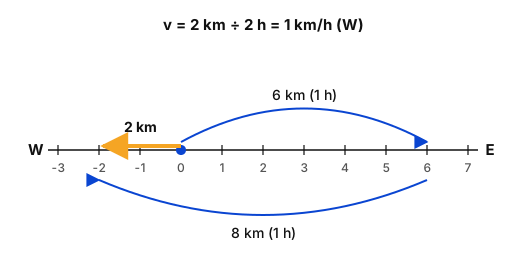
- Take east as +: displacement = km (2 km west).
- Time = 2 h → velocity = km/h towards west.
Trick: Average speed here would be km/h – the trap option.
Answer: (D) 1 km/h west
अवधारणा: औसत वेग = कुल विस्थापन ÷ कुल समय
हल:
- पूर्व = +: विस्थापन = km (2 km पश्चिम)
- समय = 2 h → वेग = 1 km/h पश्चिम
ट्रिक: औसत चाल = km/h – यही जाल वाला विकल्प है।
उत्तर: (D) 1 km/h पश्चिम
RRB Technician Grade IIIGeneral ScienceAverage velocity – displacementRRB Technician Grade III 2025 · 9 Mar Shift 1
Q240.A body covers a straight-line distance of 10 m from point A to B in 5 s and then covers back the distance from point B to point A along the same straight path in 5 s. How much will be the average speed of the body?
एक वस्तु बिंदु A से B तक 10 m की सरल-रेखीय दूरी 5 s में तय करती है और फिर उसी सरल रेखीय पथ पर बिंदु B से बिंदु A तक की दूरी वापस 5 s में तय करती है। वस्तु की औसत चाल कितनी होगी?
- A2 m/s
- B0.5 m/s
- C5 m/s
- D200 m/s
Show answer
Concept: Average speed = total distance ÷ total time.
- Distance = m; time = s.
- Average speed = m/s.
Trick: Average velocity here is 0 (back to start), but speed uses distance.
Answer: (A) 2 m/s
अवधारणा: औसत चाल = कुल दूरी ÷ कुल समय
हल:
- दूरी = m; समय = 10 s
- औसत चाल = m/s
ट्रिक: यहाँ औसत वेग 0 है (प्रारंभ बिंदु पर वापस), पर चाल में दूरी लेते हैं।
उत्तर: (A) 2 m/s
RRB Technician Grade IIIGeneral ScienceAverage speedRRB Technician Grade III 2025 · 9 Mar Shift 1

