Q301.Seven boxes A, B, E, F, L, M and P are kept one over the other but not necessarily in the same order. Only A is kept above E. Only F is kept between E and B. Only P is kept below M. How many boxes are kept between L and P?
सात बक्से A, B, E, F, L, M और P एक के ऊपर एक रखे गए हैं, लेकिन जरूरी नहीं कि इसी क्रम में हों। केवल A, E के ऊपर रखा गया है। केवल F, E और B के बीच रखा गया है। केवल P, M के नीचे रखा गया है। L और P के बीच कितने बक्से रखे गए हैं?
- AOneएक
- BThreeतीन
- CFourचार
- DTwoदो
Show answer
Concept: Use the “only” clues to fix exact positions from top and bottom.
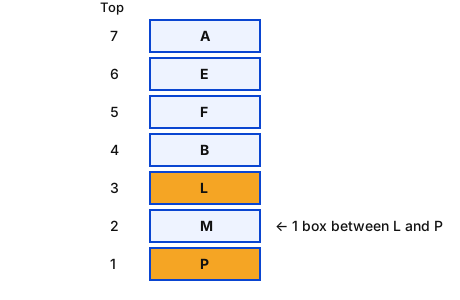
- Only A is above E ⇒ A at top, E second.
- Only F between E and B ⇒ F third, B fourth.
- Only P below M ⇒ P at bottom, M just above it.
- L takes the remaining place (5th from top). Between L and P: only M.
Trick: “Only X is above Y” fixes X at top and Y at 2nd immediately.
Answer: (A) One
अवधारणा: “केवल” वाले संकेतों से ऊपर और नीचे से सटीक स्थान तय करें।
- केवल A, E के ऊपर ⇒ A सबसे ऊपर, E दूसरे।
- E और B के बीच केवल F ⇒ F तीसरे, B चौथे।
- M के नीचे केवल P ⇒ P सबसे नीचे, M उसके ठीक ऊपर।
- बचा स्थान (ऊपर से 5वाँ) L का। L और P के बीच केवल M।
ट्रिक: “केवल X, Y के ऊपर” से X सबसे ऊपर और Y दूसरे स्थान पर तुरंत तय।
उत्तर: (A) एक
RRB Technician Grade IIIGeneral Intelligence and ReasoningBox arrangement (stacking)RRB Technician Grade III 2024 · 29 Dec Shift 3
Q302.Which of the following options should come in place of the question mark (?) in the given series to make it logically complete?
36, 72, 45, 90, 63, 126,?
दी गई श्रृंखला को तार्किक रूप से पूर्ण करने के लिए प्रश्न चिह्न (?) के स्थान पर निम्नलिखित में से कौन-सा विकल्प आना चाहिए?
36, 72, 45, 90, 63, 126,?
- A95
- B99
- C106
- D83
Show answer
Concept: Look at consecutive differences/ratios; here two operations alternate.
- ,
- ,
- ,
Trick: When numbers go up and down alternately, test “ then −” pattern.
Answer: (B) 99
अवधारणा: क्रमागत अंतर/अनुपात देखें; यहाँ दो संक्रियाएँ बारी-बारी से हैं।
- ,
- ,
- ,
ट्रिक: जब संख्याएँ बारी-बारी से बढ़ें-घटें, तो “ फिर −” पैटर्न जाँचें।
उत्तर: (B) 99
RRB Technician Grade IIIGeneral Intelligence and ReasoningNumber series – alternate operationsRRB Technician Grade III 2024 · 29 Dec Shift 3
Q303.Refer to the given number and symbol series and answer the question that follows. Counting to be done from left to right only.
(Left) 9 @ 8 $ 7 & 3 Ω 9 # 1 * £ 5 & % 4 6 (Right)
How many such symbols are there, each of which is immediately preceded by an odd number and also immediately followed by a symbol?
दी गई संख्या और प्रतीक श्रृंखला को देखें और नीचे दिए गए प्रश्न का उत्तर दें। गिनती केवल बाएँ से दाएँ की जानी है।
(बाएँ) 9 @ 8 $ 7 & 3 Ω 9 # 1 * £ 5 & % 4 6 (दाएँ)
ऐसे कितने प्रतीक हैं, जिनमें से प्रत्येक के ठीक पहले एक विषम संख्या है और ठीक बाद एक प्रतीक है?
- AMore than twoदो से अधिक
- BTwoदो
- COneएक
- DNoneकोई नहीं
Show answer
Concept: For each symbol check: left neighbour odd number AND right neighbour a symbol.
- Symbols followed by a symbol: * (before £) and & (before %).
- * is preceded by 1 (odd) ✓
- & is preceded by 5 (odd) ✓
- Others fail (e.g. @ → followed by 8). Total = 2.
Trick: First find “symbol-symbol” pairs, then check only their left neighbour.
Answer: (B) Two
अवधारणा: हर प्रतीक के लिए जाँचें: बाएँ विषम संख्या और दाएँ कोई प्रतीक।
- जिन प्रतीकों के बाद प्रतीक है: * (£ से पहले) और & (% से पहले)।
- * से पहले 1 (विषम) ✓
- & से पहले 5 (विषम) ✓
- बाकी विफल (जैसे @ के बाद 8)। कुल = 2।
ट्रिक: पहले “प्रतीक-प्रतीक” जोड़े खोजें, फिर केवल उनका बायाँ पड़ोसी देखें।
उत्तर: (B) दो
RRB Technician Grade IIIGeneral Intelligence and ReasoningSymbol-number seriesRRB Technician Grade III 2024 · 29 Dec Shift 3
Q304.Devansh starts from point A and drives 10 km towards the North. He takes two simultaneous right turns and drives 3 km and 6 km, respectively. He takes a final right turn and drives 3 km to reach point B. How far (shortest distance) and towards which direction should he drive to reach Point A again? (All turns are 90 degrees turns only unless specified.)
देवांश बिंदु A से शुरू करता है और उत्तर की ओर 10 km गाड़ी चलाता है। वह लगातार दो बार दाएँ मुड़ता है और क्रमशः 3 km और 6 km गाड़ी चलाता है। वह अंतिम बार दाएँ मुड़ता है और बिंदु B तक पहुँचने के लिए 3 km गाड़ी चलाता है। बिंदु A पर फिर से पहुँचने के लिए उसे कितनी दूर (न्यूनतम दूरी) और किस दिशा में गाड़ी चलानी चाहिए? (जब तक निर्दिष्ट न हो, सभी मोड़ केवल 90 डिग्री के हैं।)
- A3 km East3 km पूर्व
- B4 km North4 km उत्तर
- C6 km South6 km दक्षिण
- D4 km South4 km दक्षिण
Show answer
Concept: Trace the path with right turns: North → East → South → West.
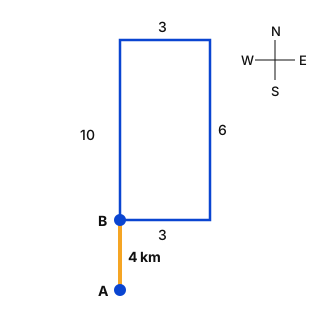
- A to 10 km North.
- Right: 3 km East; Right: 6 km South (now 4 km north of A’s level).
- Right: 3 km West ⇒ back on A’s north line, 4 km north of A (this is B).
- To return to A: 4 km South.
Trick: East 3 and West 3 cancel; net north km.
Answer: (D) 4 km South
अवधारणा: दाएँ मोड़ों से मार्ग बनाएँ: उत्तर → पूर्व → दक्षिण → पश्चिम।
- A से 10 km उत्तर।
- दाएँ: 3 km पूर्व; दाएँ: 6 km दक्षिण।
- दाएँ: 3 km पश्चिम ⇒ B, A से ठीक 4 km उत्तर में।
- A पर लौटने के लिए: 4 km दक्षिण।
ट्रिक: पूर्व 3 और पश्चिम 3 कट जाते हैं; शुद्ध उत्तर km।
उत्तर: (D) 4 km दक्षिण
RRB Technician Grade IIIGeneral Intelligence and ReasoningDirection sense – distanceRRB Technician Grade III 2024 · 29 Dec Shift 3
Q305.Select the set in which the numbers are related in the same way as are the numbers of the following sets.
(NOTE: Operations should be performed on the whole numbers, without breaking down the numbers into its constituent digits. E.g. 13 – Operations on 13 such as adding/subtracting/multiplying etc. to 13 can be performed. Breaking down 13 into 1 and 3 and then performing mathematical operations on 1 and 3 is not allowed.)
(3, 12, 36)
(8, 32, 96)
उस समुच्चय का चयन कीजिए जिसमें संख्याएँ उसी प्रकार संबंधित हैं जिस प्रकार निम्नलिखित समुच्चयों की संख्याएँ संबंधित हैं।
(ध्यान दें: संख्याओं को उनके घटक अंकों में विभाजित किए बिना, पूर्ण संख्याओं पर संक्रियाएँ की जानी चाहिए। उदाहरण के लिए 13 – 13 पर संक्रियाएँ जैसे 13 में जोड़ना/घटाना/गुणा करना आदि किया जा सकता है। 13 को 1 और 3 में विभाजित करना और फिर 1 और 3 पर गणितीय संक्रियाएँ करना वर्जित है।)
(3, 12, 36)
(8, 32, 96)
- A(12, 42, 144)
- B(14, 48, 144)
- C(12, 48, 124)
- D(12, 48, 144)
Show answer
Concept: Find the operation linking 1st → 2nd → 3rd number in both given sets.
- ,
- ,
- Option: , ✓
Trick: Third number first: .
Answer: (D) (12, 48, 144)
अवधारणा: दोनों समुच्चयों में पहली → दूसरी → तीसरी संख्या का संबंध खोजें।
- ,
- ,
- विकल्प: , ✓
ट्रिक: तीसरी संख्या पहली: ।
उत्तर: (D) (12, 48, 144)
RRB Technician Grade IIIGeneral Intelligence and ReasoningNumber set analogyRRB Technician Grade III 2024 · 29 Dec Shift 3
Q306.Based on the English alphabetical order, three of the following four letter-cluster pairs are alike in a certain way and thus form a group. Which pair does not belong to that group?
(Note: The odd one out is not based on the number of consonants/vowels or their position in the letter-cluster.)
अंग्रेजी वर्णमाला क्रम के आधार पर, निम्नलिखित चार अक्षर-समूह युग्मों में से तीन किसी निश्चित प्रकार से एकसमान हैं और इस प्रकार एक समूह बनाते हैं। कौन-सा युग्म उस समूह से संबंधित नहीं है?
(ध्यान दें: असंगत युग्म, व्यंजनों/स्वरों की संख्या या अक्षर-समूह में उनके स्थान पर आधारित नहीं है।)
- ALH-KN
- BNJ-MP
- CJF-IL
- DQM-PR
Show answer
Concept: Write letter positions and compare the moves within each pair.
- LH-KN: L(12)−4=H(8); L−1=K(11); K+3=N(14).
- NJ-MP and JF-IL follow the same: −4, −1, +3.
- QM-PR: Q(17)−4=M(13); Q−1=P(16); P+3=S(19), but given R(18) ✗
Trick: Check only one relation (e.g. 2nd letter of first cluster +6 = last letter): H+6=N, J+6=P, F+6=L, M+6=S≠R.
Answer: (D) QM-PR
अवधारणा: अक्षरों के स्थानांक लिखकर हर जोड़ी के बदलाव की तुलना करें।
- LH-KN: L(12)−4=H(8); L−1=K(11); K+3=N(14)।
- NJ-MP और JF-IL भी: −4, −1, +3।
- QM-PR: Q(17)−4=M(13); Q−1=P(16); P+3=S(19), पर दिया R(18) ✗
ट्रिक: केवल एक संबंध जाँचें: पहले समूह का दूसरा अक्षर +6 = अंतिम अक्षर: H+6=N, J+6=P, F+6=L, M+6=S≠R।
उत्तर: (D) QM-PR
RRB Technician Grade IIIGeneral Intelligence and ReasoningLetter-cluster odd one outRRB Technician Grade III 2024 · 29 Dec Shift 3
Q307.Seven people, A, B, E, F, P, Q and R, are sitting in a row, facing north. Only two people sit between A and E. Only P sits to the right of Q. Only one person sits between E and Q. R sits at some place to the right of B but at some place to the left of F. Who sits third from the right end of the row?
सात व्यक्ति A, B, E, F, P, Q और R एक पंक्ति में उत्तर की ओर मुख करके बैठे हैं। A और E के बीच केवल दो व्यक्ति बैठे हैं। केवल P, Q के दाईं ओर बैठा है। E और Q के बीच केवल एक व्यक्ति बैठा है। R, B के दाईं ओर किसी स्थान पर लेकिन F के बाईं ओर किसी स्थान पर बैठा है। पंक्ति के दाएँ छोर से तीसरे स्थान पर कौन बैठा है?
- AE
- BF
- CB
- DR
Show answer
Concept: Start with the most definite clue (“only P to the right of Q”) and fill the row facing north.
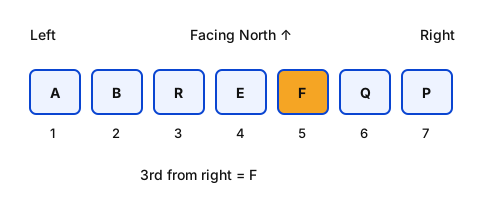
- Only P is right of Q ⇒ Q at 6th, P at 7th (from left).
- One person between E and Q ⇒ E at 4th.
- Two between A and E ⇒ A at 1st.
- B, R, F in 2nd, 3rd, 5th with B left of R left of F ⇒ A B R E F Q P. 3rd from right = F.
Trick: Facing north: your right = the right end of the row.
Answer: (B) F
अवधारणा: सबसे निश्चित संकेत (“Q के दाएँ केवल P”) से शुरू करें; सभी उत्तर की ओर मुख।
- Q के दाएँ केवल P ⇒ Q 6वें, P 7वें (बाएँ से)।
- E और Q के बीच एक ⇒ E 4थे।
- A और E के बीच दो ⇒ A 1ले।
- B, R, F क्रम से 2, 3, 5 पर ⇒ A B R E F Q P। दाएँ से तीसरा = F।
ट्रिक: उत्तर की ओर मुख हो तो आपका दायाँ = पंक्ति का दायाँ सिरा।
उत्तर: (B) F
RRB Technician Grade IIIGeneral Intelligence and ReasoningLinear seating arrangementRRB Technician Grade III 2024 · 29 Dec Shift 3
Q308.Select the triad which follows the same pattern as that followed by the two triads given below. Both triads follow the same pattern.
PL-QN-ST
JF-KH-MN
उस त्रिक का चयन कीजिए जो नीचे दिए गए दो त्रिकों द्वारा अनुसरण किए गए पैटर्न का ही अनुसरण करता है। दोनों त्रिक एक ही पैटर्न का अनुसरण करते हैं।
PL-QN-ST
JF-KH-MN
- AMI-NK-PQ
- BTP-UR-WY
- CSO-TQ-VX
- DQM-RO-TV
Show answer
Concept: Compare positions: in each triad the first letters go +1, +2 and the second letters go +2, +6.
- PL-QN-ST: P→Q (+1)→S (+2); L→N (+2)→T (+6).
- JF-KH-MN: J→K→M; F→H (+2)→N (+6) ✓
- MI-NK-PQ: M→N→P; I→K (+2)→Q (+6) ✓
- Other options give +7 in the last step (e.g. O→V).
Trick: Also in each first pair, 2nd letter = 1st letter −4 (P−4=L, M−4=I).
Answer: (A) MI-NK-PQ
अवधारणा: स्थानांकों की तुलना करें: पहले अक्षर +1, +2 तथा दूसरे अक्षर +2, +6 बढ़ते हैं।
- PL-QN-ST: P→Q (+1)→S (+2); L→N (+2)→T (+6)।
- JF-KH-MN: J→K→M; F→H (+2)→N (+6) ✓
- MI-NK-PQ: M→N→P; I→K (+2)→Q (+6) ✓
- अन्य विकल्पों में अंतिम चरण +7 है (जैसे O→V)।
ट्रिक: हर पहली जोड़ी में दूसरा अक्षर = पहला अक्षर −4 (P−4=L, M−4=I)।
उत्तर: (A) MI-NK-PQ
RRB Technician Grade IIIGeneral Intelligence and ReasoningLetter triad patternRRB Technician Grade III 2024 · 29 Dec Shift 3
Q309.Refer to the given number and symbol series and answer the question that follows. Counting to be done from left to right only.
(Left) 3 Ω 9 # 1 7 3 @ 1 ^ 9 # * £ 5 8 $ 7 & * £ 5 (Right)
How many such symbols are there, each of which is immediately preceded by an even number and also immediately followed by a symbol?
दी गई संख्या और प्रतीक श्रृंखला को देखें और नीचे दिए गए प्रश्न का उत्तर दें। गिनती केवल बाएँ से दाएँ की जानी है।
(बाएँ) 3 Ω 9 # 1 7 3 @ 1 ^ 9 # * £ 5 8 $ 7 & * £ 5 (दाएँ)
ऐसे कितने प्रतीक हैं, जिनमें से प्रत्येक के ठीक पहले एक सम संख्या है और ठीक बाद एक प्रतीक है?
- ANoneकोई नहीं
- BOneएक
- CMore than twoदो से अधिक
- DTwoदो
Show answer
Concept: Condition: symbol with an even number just before it AND a symbol just after it.
- Even numbers in the series: only 8 (in “5 8 $ 7”).
- The symbol after 8 is $, which is followed by 7 (a number) ✗
- No other symbol has an even number before it. Count = 0.
Trick: Start from the rarer condition — here even numbers are very few.
Answer: (A) None
अवधारणा: शर्त: प्रतीक से ठीक पहले सम संख्या और ठीक बाद कोई प्रतीक।
- श्रृंखला में सम संख्या: केवल 8 (“5 8 $ 7” में)।
- 8 के बाद $ है, जिसके बाद 7 (संख्या) है ✗
- किसी अन्य प्रतीक से पहले सम संख्या नहीं। कुल = 0।
ट्रिक: दुर्लभ शर्त से शुरू करें — यहाँ सम संख्याएँ बहुत कम हैं।
उत्तर: (A) कोई नहीं
RRB Technician Grade IIIGeneral Intelligence and ReasoningSymbol-number seriesRRB Technician Grade III 2024 · 29 Dec Shift 3
Q310.Refer to the given series and answer the question that follows (all numbers are single-digit numbers only, and all counting is to be done from left to right).
(Left) 9 7 4 5 1 8 2 7 5 1 3 4 2 3 7 4 9 5 2 7 5 6 9 2 8 5 4 1 9 3 (Right)
How many such odd digits are there, each of which is immediately preceded by an odd digit and also immediately followed by an odd digit?
दी गई श्रृंखला को देखिए और नीचे दिए गए प्रश्न का उत्तर दीजिए (सभी संख्याएँ केवल एक-अंकीय संख्याएँ हैं, और सभी गणना बाएँ से दाएँ की जानी है)।
(बाएँ) 9 7 4 5 1 8 2 7 5 1 3 4 2 3 7 4 9 5 2 7 5 6 9 2 8 5 4 1 9 3 (दाएँ)
ऐसे कितने विषम अंक हैं, जिनमें से प्रत्येक के ठीक पहले एक विषम अंक है और ठीक बाद भी एक विषम अंक है?
- A4
- B2
- C3
- D1
Show answer
Concept: Find odd digits whose both neighbours are also odd (odd–odd–odd triplets).
- “2 7 5 1 3 4”: 5 (7 before, 1 after) ✓; 1 (5 before, 3 after) ✓
- “4 1 9 3”: 9 (1 before, 3 after) ✓
- Other odd runs like “3 7 4” or “9 5 2” break the rule.
- Count = 3.
Trick: Look for runs of three or more odd digits; each inner digit counts.
Answer: (C) 3
अवधारणा: वे विषम अंक खोजें जिनके दोनों पड़ोसी भी विषम हों (विषम–विषम–विषम)।
- “2 7 5 1 3 4”: 5 (पहले 7, बाद 1) ✓; 1 (पहले 5, बाद 3) ✓
- “4 1 9 3”: 9 (पहले 1, बाद 3) ✓
- “3 7 4” या “9 5 2” जैसे क्रम शर्त तोड़ते हैं।
- कुल = 3।
ट्रिक: तीन या अधिक विषम अंकों का क्रम खोजें; हर भीतरी अंक गिना जाता है।
उत्तर: (C) 3
RRB Technician Grade IIIGeneral Intelligence and ReasoningDigit series – conditionsRRB Technician Grade III 2024 · 29 Dec Shift 3
Q311.In the following number-pairs, the second number is obtained by applying certain mathematical operations to the first number. Which numbers should replace X and Y so that the pattern followed by the two numbers on the left side of :: is same as that on the right side of ::?
(NOTE: Operations should be performed on the whole numbers, without breaking down the numbers into its constituent digits. E.g. 13 – Operations on 13 such as adding/subtracting/multiplying etc. to 13 can be performed. Breaking down 13 into 1 and 3 and then performing mathematical operations on 1 and 3 is not allowed.)
X : 19 :: 92 : Y
निम्नलिखित संख्या-युग्मों में, पहली संख्या पर कुछ गणितीय संक्रियाएँ करके दूसरी संख्या प्राप्त की जाती है। X और Y के स्थान पर कौन-सी संख्याएँ आनी चाहिए ताकि :: के बाईं ओर की दोनों संख्याओं द्वारा अनुसरित पैटर्न वही हो जो :: के दाईं ओर है?
(नोट: संक्रियाएँ संख्याओं को उनके घटक अंकों में तोड़े बिना, पूर्ण संख्याओं पर की जानी चाहिए। उदाहरण के लिए 13 – 13 पर संक्रियाएँ जैसे 13 में जोड़ना/घटाना/गुणा करना आदि किया जा सकता है। 13 को 1 और 3 में तोड़ना और फिर 1 और 3 पर गणितीय संक्रियाएँ करना वर्जित है।)
X : 19 :: 92 : Y
- AX = 98, Y = 24
- BX = 84, Y = 26
- CX = 76, Y = 23
- DX = 88, Y = 21
Show answer
Concept: Find the operation from the complete pair in an option and apply it to both sides.
- Rule: second number
- ✓ and ✓
- Other options fail, e.g. is not 19.
Trick: Since and use the same rule, test .
Answer: (C) X = 76, Y = 23
अवधारणा: विकल्प से संक्रिया पहचानें और दोनों ओर लगाएँ।
- नियम: दूसरी संख्या
- ✓ और ✓
- अन्य विकल्प विफल, जैसे , 19 नहीं।
ट्रिक: और में एक ही नियम, तो जाँचें।
उत्तर: (C) X = 76, Y = 23
RRB Technician Grade IIIGeneral Intelligence and ReasoningNumber analogyRRB Technician Grade III 2024 · 29 Dec Shift 3
Q312.In a certain code language, ‘REVS’ is coded as ‘6942’ and ‘ORES’ is coded as ‘6421’. What is the code for ‘V’ in the given code language?
एक निश्चित कूट भाषा में, ‘REVS’ को ‘6942’ के रूप में कूटबद्ध किया जाता है और ‘ORES’ को ‘6421’ के रूप में कूटबद्ध किया जाता है। उसी कूट भाषा में ‘V’ के लिए कूट क्या है?
- A2
- B9
- C4
- D6
Show answer
Concept: Letters common to both words share the digits common to both codes.
- REVS → 6942; ORES → 6421
- Common letters R, E, S ↔ common digits 6, 4, 2
- Left over: V ↔ 9 (and O ↔ 1)
Trick: Remove the common part; the leftover letter takes the leftover digit.
Answer: (B) 9
अवधारणा: दोनों शब्दों के उभयनिष्ठ अक्षरों के कोड भी दोनों कोड में उभयनिष्ठ होते हैं।
- REVS → 6942; ORES → 6421
- उभयनिष्ठ अक्षर R, E, S ↔ उभयनिष्ठ अंक 6, 4, 2
- शेष: V ↔ 9 (और O ↔ 1)
ट्रिक: उभयनिष्ठ भाग हटाएँ; बचा अक्षर बचे अंक से जुड़ता है।
उत्तर: (B) 9
RRB Technician Grade IIIGeneral Intelligence and ReasoningCoding-decoding (common letters)RRB Technician Grade III 2024 · 29 Dec Shift 3
Q313.What will come in the place of ‘?’ in the following equation, if ‘+’ and ‘−’ are interchanged and ‘×’ and ‘÷’ are interchanged?
यदि ‘+’ और ‘−’ को आपस में बदल दिया जाए तथा ‘×’ और ‘÷’ को आपस में बदल दिया जाए, तो निम्नलिखित समीकरण में ‘?’ के स्थान पर क्या आएगा?
- A7
- B6
- C4
- D9
Show answer
Concept: Swap the signs first, then apply BODMAS.
- After swapping:
Trick: Rewrite the whole expression with new signs before calculating.
Answer: (B) 6
अवधारणा: पहले चिह्न बदलें, फिर BODMAS लगाएँ।
- बदलने पर:
ट्रिक: गणना से पहले पूरा व्यंजक नए चिह्नों के साथ दोबारा लिखें।
उत्तर: (B) 6
RRB Technician Grade IIIGeneral Intelligence and ReasoningMathematical operations – interchangeRRB Technician Grade III 2024 · 29 Dec Shift 3
Q314.If ‘A’ stands for ‘÷’, ‘B’ stands for ‘×’, ‘C’ stands for ‘+’, and ‘D’ stands for ‘−’, what will come in place of the question mark ‘?’ in the following equation?
16 C 24 A 3 B 8 D 5 = ?
यदि ‘A’ का अर्थ ‘÷’, ‘B’ का अर्थ ‘×’, ‘C’ का अर्थ ‘+’ और ‘D’ का अर्थ ‘−’ है, तो निम्नलिखित समीकरण में प्रश्न चिह्न ‘?’ के स्थान पर क्या आएगा?
16 C 24 A 3 B 8 D 5 = ?
- A75
- B65
- C70
- D80
Show answer
Concept: Replace letters by operators, then use BODMAS.
- ,
Trick: Division and multiplication are done left to right before + and −.
Answer: (A) 75
अवधारणा: अक्षरों को संक्रियाओं से बदलें, फिर BODMAS लगाएँ।
- ,
ट्रिक: + और − से पहले भाग व गुणा बाएँ से दाएँ।
उत्तर: (A) 75
RRB Technician Grade IIIGeneral Intelligence and ReasoningMathematical operations – symbol substitutionRRB Technician Grade III 2024 · 29 Dec Shift 3
Q315.Seven people, A, B, C, D, E, F and G, are sitting in a row, facing north. B sits third from the right end. Only one person sits to the left of D. F sits to the right of B but left of G. E is an immediate neighbour of C and D. How many people sit between A and G?
सात व्यक्ति, A, B, C, D, E, F और G, उत्तर की ओर मुख करके एक पंक्ति में बैठे हैं। B दाएँ छोर से तीसरे स्थान पर बैठा है। D के बाईं ओर केवल एक व्यक्ति बैठा है। F, B के दाईं ओर परंतु G के बाईं ओर बैठा है। E, C और D दोनों का निकटतम पड़ोसी है। A और G के बीच कितने व्यक्ति बैठे हैं?
- AThreeतीन
- BFiveपाँच
- CTwoदो
- DFourचार
Show answer
Concept: All face north; fix definite positions first, then neighbours.
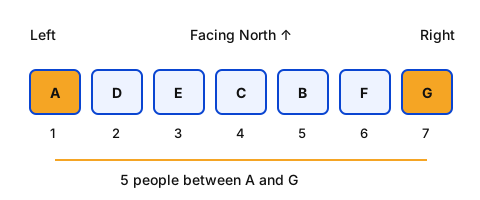
- B third from right ⇒ B at 5th (from left).
- Only one person left of D ⇒ D at 2nd.
- F right of B, left of G ⇒ F 6th, G 7th.
- E is neighbour of both C and D ⇒ E 3rd, C 4th, A 1st. Row: A D E C B F G ⇒ 5 people between A and G.
Trick: “E is neighbour of C and D” means E sits between them.
Answer: (B) Five
अवधारणा: सभी उत्तर की ओर; पहले निश्चित स्थान, फिर पड़ोसी तय करें।
- B दाएँ से तीसरा ⇒ B बाएँ से 5वें।
- D के बाएँ केवल एक ⇒ D 2रे।
- F, B के दाएँ और G के बाएँ ⇒ F 6ठे, G 7वें।
- E, C और D दोनों का पड़ोसी ⇒ E 3रे, C 4थे, A 1ले। पंक्ति: A D E C B F G ⇒ A और G के बीच 5।
ट्रिक: “E, C और D दोनों का पड़ोसी” = E उन दोनों के बीच।
उत्तर: (B) पाँच
RRB Technician Grade IIIGeneral Intelligence and ReasoningLinear seating arrangementRRB Technician Grade III 2024 · 29 Dec Shift 3
Q316.In a certain code language,
‘P + Q’ means ‘P is the sister of Q’,
‘P – Q’ means ‘P is the son of Q’,
‘P x Q’ means ‘P is the husband of Q’ and
‘P ÷ Q’ means ‘P is the daughter of Q’.
How is A related to E if ‘A + B – C x D ÷ E’?
एक निश्चित कूट भाषा में,
‘P + Q’ का अर्थ है ‘P, Q की बहन है’,
‘P – Q’ का अर्थ है ‘P, Q का पुत्र है’,
‘P x Q’ का अर्थ है ‘P, Q का पति है’ और
‘P ÷ Q’ का अर्थ है ‘P, Q की पुत्री है’।
यदि ‘A + B – C x D ÷ E’ है, तो A का E से क्या संबंध है?
- ASon’s daughterपुत्र की पुत्री
- BDaughterपुत्री
- CDaughter’s daughterपुत्री की पुत्री
- DSisterबहन
Show answer
Concept: Decode each symbol from left to right and draw the family tree.
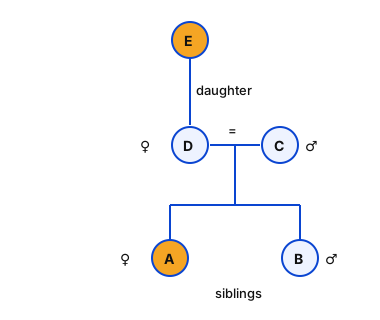
- A + B: A is sister of B (A is female).
- B − C: B is son of C.
- C × D: C is husband of D ⇒ D is mother of A and B.
- D ÷ E: D is daughter of E ⇒ A is daughter of E’s daughter.
Trick: Mark gender with each code (sister/daughter = female) to fix the final relation.
Answer: (C) Daughter’s daughter
अवधारणा: हर चिह्न को बाएँ से दाएँ खोलें और वंश-वृक्ष बनाएँ।
- A + B: A, B की बहन है (A स्त्री)।
- B − C: B, C का पुत्र है।
- C × D: C, D का पति है ⇒ D, A और B की माँ।
- D ÷ E: D, E की पुत्री ⇒ A, E की पुत्री की पुत्री (नातिन)।
ट्रिक: हर कोड के साथ लिंग लिखें (बहन/पुत्री = स्त्री), अंतिम संबंध तुरंत मिलेगा।
उत्तर: (C) पुत्री की पुत्री
RRB Technician Grade IIIGeneral Intelligence and ReasoningCoded blood relationsRRB Technician Grade III 2024 · 29 Dec Shift 3
Q317.In a certain code language, ‘REPS’ is coded as ‘9631’ and ‘EARS’ is coded as ‘6914’. What is the code for ‘A’ in the given code language?
एक निश्चित कूट भाषा में, ‘REPS’ को ‘9631’ के रूप में कूटबद्ध किया जाता है और ‘EARS’ को ‘6914’ के रूप में कूटबद्ध किया जाता है। उसी कूट भाषा में ‘A’ के लिए कूट क्या है?
- A6
- B9
- C1
- D4
Show answer
Concept: Letters common to both words share the digits common to both codes.
- REPS → 9631; EARS → 6914
- Common letters R, E, S ↔ common digits 9, 6, 1
- Left over: A ↔ 4 (and P ↔ 3)
Trick: Remove the common part; the leftover letter takes the leftover digit.
Answer: (D) 4
अवधारणा: दोनों शब्दों के उभयनिष्ठ अक्षरों के कोड भी दोनों कोड में उभयनिष्ठ होते हैं।
- REPS → 9631; EARS → 6914
- उभयनिष्ठ अक्षर R, E, S ↔ उभयनिष्ठ अंक 9, 6, 1
- शेष: A ↔ 4 (और P ↔ 3)
ट्रिक: उभयनिष्ठ भाग हटाएँ; बचा अक्षर बचे अंक से जुड़ता है।
उत्तर: (D) 4
RRB Technician Grade IIIGeneral Intelligence and ReasoningCoding-decoding (common letters)RRB Technician Grade III 2024 · 29 Dec Shift 3
Q318.Read the given statements and conclusions carefully. You have to take the given statements to be true even if they seem to be at variance from commonly known facts and decide which conclusion(s) logically follow(s) from the given statements.
Statements:
No door is a lock.
No lock is a key
Conclusions:
I. No door is a key.
II. No lock is a door.
दिए गए कथनों और निष्कर्षों को ध्यानपूर्वक पढ़िए। आपको दिए गए कथनों को सत्य मानना है, भले ही वे सामान्य रूप से ज्ञात तथ्यों से भिन्न प्रतीत होते हों, और निर्णय लीजिए कि कौन-सा/से निष्कर्ष तार्किक रूप से दिए गए कथनों का अनुसरण करता है/करते हैं।
कथन:
कोई भी दरवाज़ा, ताला नहीं है।
कोई भी ताला, चाबी नहीं है।
निष्कर्ष:
I. कोई भी दरवाज़ा, चाबी नहीं है।
II. कोई भी ताला, दरवाज़ा नहीं है।
- ABoth conclusions I and II followनिष्कर्ष I और II दोनों अनुसरण करते हैं
- BOnly conclusion II followsकेवल निष्कर्ष II अनुसरण करता है
- COnly conclusion I followsकेवल निष्कर्ष I अनुसरण करता है
- DNeither conclusion I nor II followsन तो निष्कर्ष I और न ही II अनुसरण करता है
Show answer
Concept: Draw the Venn diagram; a conclusion follows only if it is true in every possible diagram.
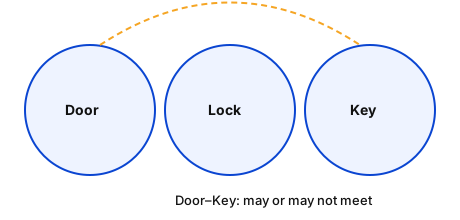
- Door and Lock are separate; Lock and Key are separate.
- Door and Key may or may not overlap ⇒ I (No door is a key) is not certain.
- “No door is a lock” is the same as “No lock is a door” ⇒ II follows.
Yaad rakhein: “No A is B” can always be reversed to “No B is A”. Two negative statements give no definite link between the end terms.
Answer: (B) Only conclusion II follows
अवधारणा: वेन आरेख बनाएँ; निष्कर्ष तभी अनुसरण करता है जब हर संभव आरेख में सत्य हो।
- दरवाज़ा और ताला अलग; ताला और चाबी अलग।
- दरवाज़ा और चाबी मिल भी सकते हैं, नहीं भी ⇒ I (कोई दरवाज़ा चाबी नहीं) निश्चित नहीं।
- “कोई दरवाज़ा ताला नहीं” = “कोई ताला दरवाज़ा नहीं” ⇒ II अनुसरण करता है।
याद रखें: “कोई A, B नहीं” को उलटकर “कोई B, A नहीं” लिख सकते हैं। दो नकारात्मक कथनों से अंतिम पदों में कोई निश्चित संबंध नहीं बनता।
उत्तर: (B) केवल निष्कर्ष II अनुसरण करता है
RRB Technician Grade IIIGeneral Intelligence and ReasoningSyllogismRRB Technician Grade III 2024 · 29 Dec Shift 3
Q319.Given below is a statement followed by two courses of actions, numbered I and II. You must assume everything in the statement to be true, and on the basis of the information given in the statement, decide which of the courses of action logically follow(s) for pursuing.
Statement:
School X has received a notice from the Commissioner of Police on the many complaints that have been received regarding the traffic jam caused outside the school gates every morning between 8 a.m. and 9 a.m. due to illegal parking of cars.
Courses of Action:
(I) School X should deploy security personnel to monitor the illegal car parking outside school gates and clear any jams being caused.
(II) School X should ban parents from dropping their children by car to the school.
नीचे एक कथन और उसके बाद I और II क्रमांकित दो कार्यवाहियाँ दी गई हैं। आपको कथन में दी गई प्रत्येक बात को सत्य मानना है, और कथन में दी गई जानकारी के आधार पर निर्णय लेना है कि कौन-सी कार्यवाही/कार्यवाहियाँ अपनाने के लिए तार्किक रूप से अनुसरण करती है/करती हैं।
कथन:
स्कूल X को पुलिस आयुक्त से एक नोटिस प्राप्त हुआ है, जो कारों की अवैध पार्किंग के कारण प्रतिदिन सुबह 8 बजे से 9 बजे के बीच स्कूल के गेटों के बाहर लगने वाले ट्रैफ़िक जाम के संबंध में प्राप्त अनेक शिकायतों के बारे में है।
कार्यवाहियाँ:
(I) स्कूल X को स्कूल के गेटों के बाहर अवैध कार पार्किंग की निगरानी करने और लगने वाले किसी भी जाम को हटाने के लिए सुरक्षा कर्मियों को तैनात करना चाहिए।
(II) स्कूल X को अभिभावकों द्वारा अपने बच्चों को कार से स्कूल छोड़ने पर प्रतिबंध लगा देना चाहिए।
- ABoth I and II followI और II दोनों अनुसरण करती हैं
- BOnly I followsकेवल I अनुसरण करती है
- CNeither I nor II followsन तो I और न ही II अनुसरण करती है
- DOnly II followsकेवल II अनुसरण करती है
Show answer
Concept: A valid course of action should solve the stated problem practically, without being extreme.
- Problem: traffic jam due to illegal parking at drop-off time.
- I: Deploying security to monitor parking and clear jams directly tackles it ⇒ follows.
- II: Banning all car drops is extreme and impractical; parents can drop children legally ⇒ does not follow.
Trick: Reject actions with “ban/stop all” type extreme words unless the situation demands it.
Answer: (B) Only I follows
अवधारणा: सही कार्यवाही वह है जो समस्या को व्यावहारिक रूप से हल करे और अतिवादी न हो।
- समस्या: छोड़ने के समय अवैध पार्किंग से जाम।
- I: पार्किंग पर नज़र रखने और जाम हटाने हेतु सुरक्षाकर्मी लगाना सीधे समस्या हल करता है ⇒ अनुसरण करता है।
- II: कार से छोड़ने पर पूर्ण प्रतिबंध अतिवादी व अव्यावहारिक ⇒ अनुसरण नहीं करता।
ट्रिक: “पूर्ण प्रतिबंध/सब बंद” जैसे अतिवादी कदम सामान्यतः अस्वीकार करें।
उत्तर: (B) केवल I अनुसरण करती है
RRB Technician Grade IIIGeneral Intelligence and ReasoningCourse of actionRRB Technician Grade III 2024 · 29 Dec Shift 3
Q320.Which of the following options should come in place of the question mark (?) in the given series based on the English alphabetical order?
ORN, QTP, SVR, UXT, ?
अंग्रेज़ी वर्णमाला क्रम के आधार पर दी गई श्रृंखला में प्रश्न चिह्न (?) के स्थान पर निम्नलिखित में से कौन-सा विकल्प आना चाहिए?
ORN, QTP, SVR, UXT, ?
- AWVZ
- BWZV
- CVZW
- DVWZ
Show answer
Concept: Check each letter position of the clusters separately.
- 1st letters: O, Q, S, U → +2 → W
- 2nd letters: R, T, V, X → +2 → Z
- 3rd letters: N, P, R, T → +2 → V
Trick: Every letter moves +2, so just add 2 to each letter of UXT.
Answer: (B) WZV
अवधारणा: समूहों के हर स्थान के अक्षर अलग-अलग देखें।
- पहले अक्षर: O, Q, S, U → +2 → W
- दूसरे अक्षर: R, T, V, X → +2 → Z
- तीसरे अक्षर: N, P, R, T → +2 → V
ट्रिक: हर अक्षर +2 बढ़ रहा है, अतः UXT के हर अक्षर में 2 जोड़ें।
उत्तर: (B) WZV
RRB Technician Grade IIIGeneral Intelligence and ReasoningLetter seriesRRB Technician Grade III 2024 · 29 Dec Shift 3

