Q301.Which of the following non-metals is a good conductor of electricity in the solid state due to the presence of delocalized electrons within its crystal lattice?
निम्नलिखित में से कौन-सी अधातु अपने क्रिस्टल जालक में विस्थानीकृत इलेक्ट्रॉनों की उपस्थिति के कारण ठोस अवस्था में विद्युत की सुचालक है?
- APhosphorusफ़ॉस्फ़ोरस
- BIodineआयोडीन
- CGraphiteग्रेफ़ाइट
- DSulphurसल्फ़र
Show answer
Concept: Graphite has free (delocalised) electrons in its layers.
- Each carbon bonds to 3 others; the 4th electron is free to move
- So graphite conducts electricity; P, I, S are insulators
Yaad rakhein: Graphite is the only non-metal commonly used as an electrode.
Answer: (C) Graphite
अवधारणा: ग्रेफाइट की परतों में मुक्त (विस्थानीकृत) इलेक्ट्रॉन होते हैं।
हल:
- हर कार्बन 3 से जुड़ा; चौथा इलेक्ट्रॉन मुक्त
- इसलिए ग्रेफाइट विद्युत चालक; P, I, S कुचालक
याद रखें: ग्रेफाइट — इलेक्ट्रोड के रूप में प्रयुक्त अधातु।
उत्तर: (C) ग्रेफ़ाइट
RRB Technician Grade IIIGeneral ScienceGraphite – conductor non-metalRRB Technician Grade III 2025 · 6 Mar Shift 2
Q302.A cyclist riding at constant speed on a circular track is an example of which type of motion?
वृत्ताकार पथ पर स्थिर चाल से साइकिल चलाता हुआ एक साइकिल सवार किस प्रकार की गति का उदाहरण है?
- ANon-uniform motionअसमान गति
- BLinear motionरैखिक गति
- CUniform circular motionएकसमान वृत्तीय गति
- DOscillatory motionदोलनी गति
Show answer
Concept: Constant speed along a circular path = uniform circular motion.
- Speed is constant, but direction changes continuously
- So velocity changes ⇒ it is accelerated motion
Yaad rakhein: Uniform circular motion: constant speed, changing velocity.
Answer: (C) Uniform circular motion
अवधारणा: वृत्ताकार पथ पर नियत चाल = एकसमान वृत्तीय गति।
हल:
- चाल स्थिर, पर दिशा लगातार बदलती है
- अतः वेग बदलता है ⇒ त्वरित गति
याद रखें: एकसमान वृत्तीय गति: चाल स्थिर, वेग परिवर्ती।
उत्तर: (C) एकसमान वृत्तीय गति
RRB Technician Grade IIIGeneral ScienceUniform circular motionRRB Technician Grade III 2025 · 6 Mar Shift 2
Q303.Which of the following is NOT an application of the Archimede's Principle?
निम्नलिखित में से कौन-सा आर्किमिडीज़ के सिद्धांत का अनुप्रयोग नहीं है?
- ASpeedometersस्पीडोमीटर
- BHydrometersहाइड्रोमीटर
- CLactometersलैक्टोमीटर
- DDesigning of submarinesपनडुब्बियों का डिज़ाइन
Show answer
Concept: Archimedes' principle deals with buoyant force on immersed bodies.
- Hydrometer (density of liquids), lactometer (purity of milk), submarines/ships — all use buoyancy
- Speedometer measures vehicle speed — not based on buoyancy
Trick: '-meter for liquids' (hydro/lacto) ⇒ Archimedes.
Answer: (A) Speedometers
अवधारणा: आर्किमिडीज़ सिद्धांत डूबी वस्तु पर उत्प्लावन बल से संबंधित है।
हल:
- हाइड्रोमीटर, लैक्टोमीटर, पनडुब्बी — सभी उत्प्लावन पर आधारित
- स्पीडोमीटर वाहन की चाल मापता है — उत्प्लावन से संबंध नहीं
ट्रिक: द्रवों के मीटर (हाइड्रो/लैक्टो) ⇒ आर्किमिडीज़।
उत्तर: (A) स्पीडोमीटर
RRB Technician Grade IIIGeneral ScienceArchimedes' principle – applicationsRRB Technician Grade III 2025 · 6 Mar Shift 2
Q304.Choose a term to complete analogy.
Axon : Single long process :: Dendrite : _______________
सादृश्यता को पूरा करने के लिए एक पद का चयन कीजिए।
तंत्रिकाक्ष (axon) : एकल लंबा प्रवर्ध :: द्रुमिका (dendrite) : _______________
- AMany short, branched partsअनेक छोटे, शाखित भाग
- BProtective connective tissueसुरक्षात्मक संयोजी ऊतक
- CCell body with nucleusकेंद्रक युक्त कोशिका काय
- DRapid stimulus transmissionतीव्र उद्दीपन संचरण
Show answer
Concept: A neuron has one long axon and many short branched dendrites.
- Axon: single long process carrying impulse away from cell body
- Dendrites: many short, branched processes receiving impulses
Trick: Dendrite = 'tree-like' (Greek dendron = tree) ⇒ branched.
Answer: (A) Many short, branched parts
अवधारणा: न्यूरॉन में एक लंबा एक्सॉन और कई छोटे शाखित डेन्ड्राइट होते हैं।
हल:
- एक्सॉन: एक लंबा प्रवर्ध, आवेग को कोशिका काय से दूर ले जाता है
- डेन्ड्राइट: कई छोटे, शाखित भाग, आवेग ग्रहण करते हैं
ट्रिक: Dendron = पेड़ ⇒ शाखित।
उत्तर: (A) अनेक छोटे, शाखित भाग
RRB Technician Grade IIIGeneral ScienceNeuron – axon and dendritesRRB Technician Grade III 2025 · 6 Mar Shift 2
Q305.Which statement is true about mass number?
द्रव्यमान संख्या के बारे में कौन-सा कथन सत्य है?
- AIt is always twice the atomic numberयह सदैव परमाणु संख्या की दोगुनी होती है
- BIt is the sum of protons and neutrons in an atomयह किसी परमाणु में प्रोटॉनों और न्यूट्रॉनों का योग है
- CIt is equal to the number of electrons in an atomयह किसी परमाणु में इलेक्ट्रॉनों की संख्या के बराबर होती है
- DIt is the total number of protons and electrons in an atomयह किसी परमाणु में प्रोटॉनों और इलेक्ट्रॉनों की कुल संख्या है
Show answer
Concept: Mass number (A) = protons + neutrons.
- Protons and neutrons (nucleons) carry almost all the mass
- Not always 2 × Z: e.g. Na has Z = 11, A = 23
Trick: A = Z + N; neutrons = A − Z.
Answer: (B) It is the sum of protons and neutrons in an atom
अवधारणा: द्रव्यमान संख्या (A) = प्रोटॉन + न्यूट्रॉन।
हल:
- नाभिकीय कण (प्रोटॉन, न्यूट्रॉन) ही लगभग पूरा द्रव्यमान रखते हैं
- हमेशा 2 × Z नहीं: Na में Z = 11, A = 23
ट्रिक: A = Z + N; न्यूट्रॉन = A − Z.
उत्तर: (B) यह किसी परमाणु में प्रोटॉनों और न्यूट्रॉनों का योग है
RRB Technician Grade IIIGeneral ScienceMass numberRRB Technician Grade III 2025 · 6 Mar Shift 2
Q306.Which of the following is true about Fleming’s left-hand rule?
फ्लेमिंग के वामहस्त नियम के बारे में निम्नलिखित में से कौन-सा सत्य है?
- AIf the thumb points in the direction of current and the middle finger in the direction of magnetic field, the forefinger shows the direction of force.यदि अँगूठा धारा की दिशा में और मध्यमा चुंबकीय क्षेत्र की दिशा में संकेत करे, तो तर्जनी बल की दिशा दर्शाती है।
- BIt is used only in electric circuits and not in devices like motors or loudspeakers.इसका उपयोग केवल विद्युत परिपथों में किया जाता है, मोटर या लाउडस्पीकर जैसे उपकरणों में नहीं।
- CIf the thumb points in the direction of force and the forefinger in the direction of current, the middle finger shows the direction of magnetic field.यदि अँगूठा बल की दिशा में और तर्जनी धारा की दिशा में संकेत करे, तो मध्यमा चुंबकीय क्षेत्र की दिशा दर्शाती है।
- DIf the forefinger points in the direction of magnetic field and the middle finger in the direction of current, the thumb shows the direction of motion or force on the conductor.यदि तर्जनी चुंबकीय क्षेत्र की दिशा में और मध्यमा धारा की दिशा में संकेत करे, तो अँगूठा चालक पर गति या बल की दिशा दर्शाता है।
Show answer
Concept: Gives the direction of force on a current-carrying conductor in a magnetic field.
- Forefinger → magnetic Field; middle finger → Current; thumb → Motion/force
- Used in electric motors and loudspeakers
Trick: FBI: thumb F (force), forefinger B (field), middle I (current).
Answer: (D) If the forefinger points in the direction of magnetic field and the middle finger in the direction of current, the thumb shows the direction of motion or force on the conductor.
अवधारणा: चुंबकीय क्षेत्र में धारावाही चालक पर बल की दिशा बताता है।
हल:
- तर्जनी → चुंबकीय क्षेत्र; मध्यमा → धारा; अंगूठा → बल/गति
- मोटर और लाउडस्पीकर में उपयोग
ट्रिक: FBI: अंगूठा F (बल), तर्जनी B (क्षेत्र), मध्यमा I (धारा)।
उत्तर: (D) यदि तर्जनी चुंबकीय क्षेत्र की दिशा में और मध्यमा धारा की दिशा में संकेत करे, तो अँगूठा चालक पर गति या बल की दिशा दर्शाता है।
RRB Technician Grade IIIGeneral ScienceFleming's left-hand ruleRRB Technician Grade III 2025 · 6 Mar Shift 2
Q307.Which of the following is NOT a reason for carbon’s versatility?
निम्नलिखित में से कौन-सा कार्बन की सर्वतोमुखी प्रकृति का कारण नहीं है?
- ACatenationशृंखलन (catenation)
- BAbility to form single, double and triple bondsएकल, द्वि और त्रि आबंध बनाने की क्षमता
- CTetravalencyचतुःसंयोजकता
- DFormation of ionic bondsआयनिक आबंधों का निर्माण
Show answer
Concept: Carbon forms covalent bonds by sharing electrons.
- Catenation, tetravalency and multiple bonds explain the huge number of carbon compounds
- Carbon does not form ionic bonds (C⁴⁺ / C⁴⁻ need too much energy)
Trick: Carbon = covalent king; 'ionic' is the odd one.
Answer: (D) Formation of ionic bonds
अवधारणा: कार्बन इलेक्ट्रॉन साझा करके सहसंयोजी बंध बनाता है।
हल:
- शृंखलन, चतुःसंयोजकता और बहु-बंध — असंख्य यौगिकों का कारण
- कार्बन आयनिक बंध नहीं बनाता (C⁴⁺ / C⁴⁻ बनाने में बहुत ऊर्जा)
ट्रिक: कार्बन = सहसंयोजी; 'आयनिक' विषम।
उत्तर: (D) आयनिक आबंधों का निर्माण
RRB Technician Grade IIIGeneral ScienceVersatile nature of carbonRRB Technician Grade III 2025 · 6 Mar Shift 2
Q308.Which description correctly characterises parenchyma cells in the pith of a mature stem?
कौन-सा विवरण परिपक्व तने के मज्जा (pith) में स्थित मृदूतक (parenchyma) कोशिकाओं का सही अभिलक्षण बताता है?
- ALarge, loosely arranged living cells for storage.संचय के लिए बड़ी, ढीली व्यवस्थित सजीव कोशिकाएँ।
- BTightly packed dead cells that aid in support and conduction.सघन रूप से व्यवस्थित मृत कोशिकाएँ जो सहारा और संवहन में सहायता करती हैं।
- CThick-walled lignified cells for mechanical strength.यांत्रिक दृढ़ता के लिए मोटी भित्ति वाली लिग्निनयुक्त कोशिकाएँ।
- DSclerenchyma fibers forming a protective cylinder.सुरक्षात्मक बेलन बनाने वाले दृढ़ोतक (sclerenchyma) तंतु।
Show answer
Concept: Parenchyma = simple permanent tissue of living, thin-walled cells.
- Cells are large, loosely packed with intercellular spaces
- Main role in pith: storage of food
- Dead, lignified cells = sclerenchyma
Trick: Parenchyma: living + loose + storage; Sclerenchyma: dead + lignified + strength.
Answer: (A) Large, loosely arranged living cells for storage.
अवधारणा: पैरेन्काइमा = जीवित, पतली भित्ति वाली कोशिकाओं का सरल स्थायी ऊतक।
हल:
- कोशिकाएँ बड़ी, ढीली व्यवस्थित, अंतरकोशिकीय स्थान सहित
- पिथ में मुख्य कार्य: भोजन संग्रह
- मृत, लिग्निनयुक्त कोशिकाएँ = स्क्लेरेन्काइमा
ट्रिक: पैरेन्काइमा: जीवित + ढीली + संग्रह।
उत्तर: (A) संचय के लिए बड़ी, ढीली व्यवस्थित सजीव कोशिकाएँ।
RRB Technician Grade IIIGeneral ScienceParenchyma tissueRRB Technician Grade III 2025 · 6 Mar Shift 2
Q309.Where in the body would you expect to find a single layer of extremely thin, flat epithelial cells designed for the transport of substances (gases) across a delicate lining?
शरीर में आप कहाँ अत्यंत पतली, चपटी उपकला कोशिकाओं की एक एकल परत पाए जाने की अपेक्षा करेंगे, जो एक कोमल आस्तर के आर-पार पदार्थों (गैसों) के परिवहन के लिए बनी होती है?
- ALining of kidney tubules, for mechanical supportवृक्क नलिकाओं का आस्तर, यांत्रिक सहारे के लिए
- BInner lining of the intestine, for absorptionआंत्र का आंतरिक आस्तर, अवशोषण के लिए
- CLining of lung alveoli, for gas exchangeफुफ्फुस कूपिकाओं का आस्तर, गैसीय विनिमय के लिए
- DSkin, to prevent wear and tearत्वचा, टूट-फूट से बचाने के लिए
Show answer
Concept: Simple squamous epithelium = single layer of thin, flat cells.
- Found in lung alveoli and blood vessel lining
- Allows easy diffusion of gases
- Intestine: columnar; kidney tubules: cuboidal; skin: stratified squamous
Trick: Thin + flat = fast diffusion ⇒ alveoli.
Answer: (C) Lining of lung alveoli, for gas exchange
अवधारणा: सरल शल्की उपकला = पतली, चपटी कोशिकाओं की एक परत।
हल:
- फेफड़ों की कूपिकाओं और रक्त वाहिकाओं में
- गैसों का आसान विसरण
- आंत: स्तंभाकार; वृक्क नलिका: घनाकार; त्वचा: स्तरित शल्की
ट्रिक: पतली + चपटी = तेज़ विसरण ⇒ कूपिकाएँ।
उत्तर: (C) फुफ्फुस कूपिकाओं का आस्तर, गैसीय विनिमय के लिए
RRB Technician Grade IIIGeneral ScienceSquamous epitheliumRRB Technician Grade III 2025 · 6 Mar Shift 2
Q310.The primary purpose of check-dams in irrigation is to ______________.
सिंचाई में रोक बाँधों (check-dams) का प्राथमिक उद्देश्य ______________ है।
- ATo increase groundwater by storing rainwaterवर्षा जल का संचय करके भौम जल में वृद्धि करना
- BTo lower the quality of the soilमृदा की गुणवत्ता को कम करना
- CTo worsen erosion of top soilऊपरी मृदा के अपरदन को बढ़ाना
- DTo channel river water for factory operationsकारखानों के संचालन के लिए नदी के जल को प्रवाहित करना
Show answer
Concept: Check-dams slow down runoff and store rainwater.
- Stored water percolates and recharges groundwater
- They also reduce soil erosion
Trick: Check-dam = rainwater harvesting + groundwater recharge.
Answer: (A) To increase groundwater by storing rainwater
अवधारणा: चेक-डैम बहते पानी को रोककर वर्षा जल संग्रहित करते हैं।
हल:
- संग्रहित जल रिसकर भूजल बढ़ाता है
- मृदा अपरदन भी घटता है
ट्रिक: चेक-डैम = वर्षा जल संग्रहण + भूजल पुनर्भरण।
उत्तर: (A) वर्षा जल का संचय करके भौम जल में वृद्धि करना
RRB Technician Grade IIIGeneral ScienceCheck-dams – water harvestingRRB Technician Grade III 2025 · 6 Mar Shift 2
Q311.If mass is doubled and g remains constant, weight becomes ________.
यदि द्रव्यमान दोगुना कर दिया जाए और g स्थिर रहे, तो भार ________ हो जाता है।
- AHalfआधा
- BFour timesचार गुना
- CDoubleदोगुना
- DSameसमान
Show answer
Concept: Weight is directly proportional to mass when g is constant.
- W = m × g
- m → 2m ⇒ W → 2W (double)
Yaad rakhein: Mass is constant everywhere; weight changes with g.
Answer: (C) Double
अवधारणा: g स्थिर हो तो भार द्रव्यमान के समानुपाती।
हल:
- W = m × g
- m → 2m ⇒ W → 2W (दोगुना)
याद रखें: द्रव्यमान हर जगह समान; भार g के साथ बदलता है।
उत्तर: (C) दोगुना
RRB Technician Grade IIIGeneral ScienceWeight – W = mgRRB Technician Grade III 2025 · 6 Mar Shift 2
Q312.Consider the following statements regarding the size of an atom.
Statement 1: The size of an atom is approximately in the range of 0.1 nm to 0.5 nm. Statement 2: Atomic size increases as we move from left to right in a period of the periodic table.
Statement 3: The radius of a hydrogen atom is about 10⁻¹⁰ meters.
Which of the above statements is/are correct?
परमाणु के आकार के संबंध में निम्नलिखित कथनों पर विचार कीजिए।
कथन 1: किसी परमाणु का आकार लगभग 0.1 nm से 0.5 nm की सीमा में होता है। कथन 2: आवर्त सारणी के किसी आवर्त में बाएँ से दाएँ जाने पर परमाणु आकार बढ़ता है।
कथन 3: हाइड्रोजन परमाणु की त्रिज्या लगभग 10⁻¹⁰ मीटर होती है।
उपर्युक्त में से कौन-सा/से कथन सही है/हैं?
- AOnly 2 and 3केवल 2 और 3
- BOnly 1 and 2केवल 1 और 2
- COnly 1, 2 and 3केवल 1, 2 और 3
- DOnly 1 and 3केवल 1 और 3
Show answer
Concept: Atomic radii are of the order of 10⁻¹⁰ m (0.1 nm).
- Statement 1: atoms are about 0.1–0.5 nm — correct
- Statement 2: atomic size DECREASES left to right in a period (nuclear charge rises) — wrong
- Statement 3: NCERT gives hydrogen atom radius ≈ 10⁻¹⁰ m — correct
Trick: Across a period size ↓, down a group size ↑.
Answer: (D) Only 1 and 3
अवधारणा: परमाणु त्रिज्या लगभग 10⁻¹⁰ m (0.1 nm) कोटि की होती है।
हल:
- कथन 1: 0.1–0.5 nm — सही
- कथन 2: आवर्त में बाएँ से दाएँ आकार घटता है — गलत
- कथन 3: NCERT के अनुसार हाइड्रोजन परमाणु त्रिज्या ≈ 10⁻¹⁰ m — सही
ट्रिक: आवर्त में आकार ↓, समूह में नीचे आकार ↑।
उत्तर: (D) केवल 1 और 3
RRB Technician Grade IIIGeneral ScienceSize of atomsRRB Technician Grade III 2025 · 6 Mar Shift 2
Q313.Newton’s first law of motion explains the concept of _________.
न्यूटन का गति का प्रथम नियम _________ की अवधारणा की व्याख्या करता है।
- AContinuous accelerationनिरंतर त्वरण
- BBalanced forcesसंतुलित बल
- CChange in momentumसंवेग में परिवर्तन
- DNet force being non-zeroनेट बल का शून्येतर होना
Show answer
Concept: A body stays at rest or in uniform motion unless an unbalanced force acts.
- When forces are balanced (net force zero), state of motion does not change
- Acceleration / change in momentum relate to the second law
Trick: 1st law: net force = 0; 2nd law: .
Answer: (B) Balanced forces
अवधारणा: असंतुलित बल न लगे तो वस्तु विराम या एकसमान गति में रहती है।
हल:
- संतुलित बल (शुद्ध बल शून्य) पर गति की अवस्था नहीं बदलती
- त्वरण/संवेग परिवर्तन दूसरे नियम से संबंधित
ट्रिक: पहला नियम: शुद्ध बल = 0; दूसरा: .
उत्तर: (B) संतुलित बल
RRB Technician Grade IIIGeneral ScienceNewton's first law – inertiaRRB Technician Grade III 2025 · 6 Mar Shift 2
Q314.SONAR technology uses ultrasound to ________.
सोनार (SONAR) प्रौद्योगिकी ________ के लिए पराध्वनि (ultrasound) का उपयोग करती है।
- AMeasure electric currentविद्युत धारा मापने
- BProduce high temperaturesउच्च तापमान उत्पन्न करने
- CLocate underwater objectsजल के नीचे की वस्तुओं का पता लगाने
- DMeasure atmospheric pressureवायुमंडलीय दाब मापने
Show answer
Concept: SONAR = Sound Navigation And Ranging.
- Ultrasound pulses are sent into water; echoes return from objects
- Distance = — locates submarines, shoals, sea-bed depth
Yaad rakhein: Echo time ÷ 2 because sound goes and comes back.
Answer: (C) Locate underwater objects
अवधारणा: SONAR = Sound Navigation And Ranging।
हल:
- पानी में पराध्वनि भेजी जाती है, वस्तुओं से प्रतिध्वनि लौटती है
- दूरी = चाल × समय / 2 — पनडुब्बी, समुद्र की गहराई ज्ञात करना
याद रखें: प्रतिध्वनि में ध्वनि जाती और आती है, इसलिए ÷ 2.
उत्तर: (C) जल के नीचे की वस्तुओं का पता लगाने
RRB Technician Grade IIIGeneral ScienceSONAR – use of ultrasoundRRB Technician Grade III 2025 · 6 Mar Shift 2
Q315.If the molecular mass of an alkane is 44, then its molecular formula is:
यदि किसी ऐल्केन का आण्विक द्रव्यमान 44 है, तो उसका आण्विक सूत्र है:
- AC₂H₆
- BC₄H₁₀
- CC₃H₈
- DCH₄
Show answer
Concept: Alkane formula CₙH₂ₙ₊₂; molar mass = 12n + 2n + 2 = 14n + 2.
- 14n + 2 = 44 ⇒ n = 3
- Formula = C₃H₈ (propane): 36 + 8 = 44
Trick: Memorise: CH₄ 16, C₂H₆ 30, C₃H₈ 44, C₄H₁₀ 58 (each +14).
Answer: (C) C₃H₈
अवधारणा: एल्केन सूत्र CₙH₂ₙ₊₂; द्रव्यमान = 14n + 2।
हल:
- 14n + 2 = 44 ⇒ n = 3
- सूत्र = C₃H₈ (प्रोपेन): 36 + 8 = 44
ट्रिक: CH₄ 16, C₂H₆ 30, C₃H₈ 44, C₄H₁₀ 58 (हर बार +14)।
उत्तर: (C) C₃H₈
RRB Technician Grade IIIGeneral ScienceAlkanes – molecular formulaRRB Technician Grade III 2025 · 6 Mar Shift 2
Q316.A block of mass 20 kg is dropped from the top of a building of height 200 m. What will be the velocity with which the block will hit the ground? (Take the value of g = 10 m/s2)
20 kg द्रव्यमान का एक गुटका 200 m ऊँचे भवन के शीर्ष से गिराया जाता है। गुटका किस वेग से भूमि से टकराएगा? (g का मान 10 m/s2 लीजिए)
- A20√5 m/s
- B40 m/s
- C20√10 m/s
- D20 m/s
Show answer
Concept: with u = 0; mass does not matter.
- m/s
Trick: Mass (20 kg) is extra data — free-fall speed is independent of mass.
Answer: (C) 20√10 m/s
अवधारणा: , u = 0; द्रव्यमान का प्रभाव नहीं।
हल:
- m/s
ट्रिक: 20 kg अतिरिक्त आँकड़ा है — मुक्त पतन में वेग द्रव्यमान पर निर्भर नहीं।
उत्तर: (C) 20√10 m/s
RRB Technician Grade IIIGeneral ScienceFree fall – final velocityRRB Technician Grade III 2025 · 6 Mar Shift 2
Q317.Which of the following is NOT known to reproduce through fission?
निम्नलिखित में से कौन विखंडन द्वारा जनन करने के लिए ज्ञात नहीं है?
- AHydraहाइड्रा
- BParameciumपैरामीशियम
- CLeishmaniaलीशमानिया
- DAmoebaअमीबा
Show answer
Concept: Fission is seen in unicellular organisms.
- Amoeba, Paramecium: binary fission; Leishmania: binary fission (definite plane); Plasmodium: multiple fission
- Hydra reproduces by budding (and regeneration), not fission
Trick: Hydra and yeast = budding.
Answer: (A) Hydra
अवधारणा: विखंडन एककोशिकीय जीवों में होता है।
हल:
- अमीबा, पैरामीशियम, लीशमैनिया: द्विविभाजन
- हाइड्रा मुकुलन (और पुनरुद्भवन) से जनन करता है
ट्रिक: हाइड्रा और यीस्ट = मुकुलन।
उत्तर: (A) हाइड्रा
RRB Technician Grade IIIGeneral ScienceAsexual reproduction – fission vs buddingRRB Technician Grade III 2025 · 6 Mar Shift 2
Q318.Which of the following is represented by a circle with the letter 'V' in a circuit diagram?
परिपथ आरेख में अक्षर 'V' वाले वृत्त द्वारा निम्नलिखित में से किसे निरूपित किया जाता है?
- AVoltage regulatorवोल्टता नियामक
- BVariable resistanceपरिवर्ती प्रतिरोध
- CVacuum diodeनिर्वात डायोड
- DVoltmeterवोल्टमीटर
Show answer
Concept: Measuring instruments are drawn as a circle with a letter.
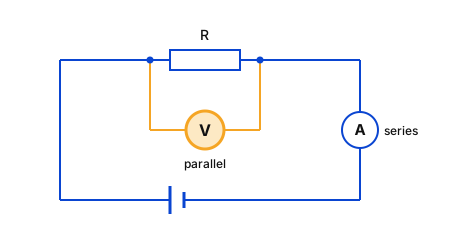
- Circle with V = voltmeter (connected in parallel)
- Circle with A = ammeter (connected in series)
Yaad rakhein: Voltmeter parallel, ammeter series.
Answer: (D) Voltmeter
अवधारणा: मापक यंत्र वृत्त के अंदर अक्षर से दर्शाए जाते हैं।
हल:
- वृत्त में V = वोल्टमीटर (समानांतर में)
- वृत्त में A = अमीटर (श्रेणी में)
याद रखें: वोल्टमीटर समानांतर, अमीटर श्रेणी में।
उत्तर: (D) वोल्टमीटर
RRB Technician Grade IIIGeneral ScienceCircuit symbolsRRB Technician Grade III 2025 · 6 Mar Shift 2
Q319.A student mixes sand, salt and water in a beaker and stirs well. After some time, what will be observed?
एक विद्यार्थी एक बीकर में रेत, नमक और जल को मिलाता है और अच्छी तरह हिलाता है। कुछ समय बाद क्या देखा जाएगा?
- ASand and salt both remain undissolved, forming two distinct layers.रेत और नमक दोनों अघुलित रहते हैं और दो अलग-अलग परतें बनाते हैं।
- BAll components dissolve completely, forming a clear solution.सभी घटक पूर्णतः घुल जाते हैं और एक स्वच्छ विलयन बनाते हैं।
- CSand settles at the bottom, while salt dissolves in water.रेत तली में बैठ जाती है, जबकि नमक जल में घुल जाता है।
- DSand remains permanently suspended in water, making the mixture cloudy.रेत स्थायी रूप से जल में निलंबित रहती है, जिससे मिश्रण धुँधला हो जाता है।
Show answer
Concept: Salt is soluble in water; sand is insoluble and heavier.
- Salt dissolves to form a solution
- Sand does not dissolve and settles at the bottom
Trick: Separate by filtration (sand), then evaporation (salt).
Answer: (C) Sand settles at the bottom, while salt dissolves in water.
अवधारणा: नमक पानी में घुलता है; रेत अघुलनशील और भारी है।
हल:
- नमक घुलकर विलयन बनाता है
- रेत नहीं घुलती और तली में बैठ जाती है
ट्रिक: पहले छानकर रेत, फिर वाष्पन से नमक अलग करें।
उत्तर: (C) रेत तली में बैठ जाती है, जबकि नमक जल में घुल जाता है।
RRB Technician Grade IIIGeneral ScienceMixtures – soluble and insoluble componentsRRB Technician Grade III 2025 · 6 Mar Shift 2
Q320.In chemical industries, bleaching powder acts mainly as:
रासायनिक उद्योगों में, विरंजक चूर्ण (bleaching powder) मुख्य रूप से किस रूप में कार्य करता है?
- AA reducing agentएक अपचायक
- BA neutralising agentएक उदासीनकारक
- CAn oxidising agentएक ऑक्सीकारक
- DA catalystएक उत्प्रेरक
Show answer
Concept: Bleaching powder (CaOCl₂) releases chlorine, a strong oxidising agent.
- Used for bleaching cotton/linen in textile industry and wood pulp in paper factories
- Also used as an oxidising agent in chemical industries and to disinfect water
Trick: Chlorine bleaches by oxidation (permanent bleaching).
Answer: (C) An oxidising agent
अवधारणा: ब्लीचिंग पाउडर (CaOCl₂) क्लोरीन देता है जो प्रबल ऑक्सीकारक है।
हल:
- वस्त्र और कागज़ उद्योग में विरंजन हेतु
- रासायनिक उद्योगों में ऑक्सीकारक और पानी के कीटाणुशोधन में
ट्रिक: क्लोरीन ऑक्सीकरण द्वारा विरंजन करती है।
उत्तर: (C) एक ऑक्सीकारक
RRB Technician Grade IIIGeneral ScienceBleaching powder – usesRRB Technician Grade III 2025 · 6 Mar Shift 2

