Q21.If two isotopes of an element ‘X’ are X-35 and X-37, the average atomic mass of chlorine (if X-35 = 25% and X-37 = 75%) will be:
यदि किसी तत्व ‘X’ के दो समस्थानिक X-35 और X-37 हैं, तो क्लोरीन का औसत परमाणु द्रव्यमान (यदि X-35 = 25% और X-37 = 75% है) होगा:
- A35.5 u
- B36.0 u
- C34.5 u
- D36.5 u
Show answer
Concept: Average atomic mass = Σ (isotope mass × fractional abundance).
- Average = u
Trick: Answer lies closer to the more abundant isotope (37): .
Answer: (D) 36.5 u
अवधारणा: औसत परमाणु द्रव्यमान = Σ (समस्थानिक द्रव्यमान × प्रतिशत भाग)।
- औसत = u
ट्रिक: उत्तर अधिक मात्रा वाले समस्थानिक (37) के निकट: ।
उत्तर: (D) 36.5 u
RRB Technician Grade IIIGeneral ScienceAverage atomic mass of isotopesRRB Technician Grade III 2025 · 10 Mar Shift 3
Q22.In the electrolytic refining of copper, which of the following acts as the anode?
कॉपर के विद्युत अपघटनी परिष्करण में, निम्नलिखित में से कौन ऐनोड के रूप में कार्य करता है?
- APure copper plateशुद्ध कॉपर की प्लेट
- BCopper sulphate solutionकॉपर सल्फेट विलयन
- CCarbon electrodeकार्बन इलेक्ट्रोड
- DImpure copper blockअशुद्ध कॉपर का ब्लॉक
Show answer
Concept: Impure metal is the anode, pure metal strip is the cathode, salt solution of the metal is the electrolyte.
- Anode: impure copper — dissolves into solution
- Cathode: thin pure copper strip — pure Cu deposits
- Electrolyte: acidified copper sulphate; impurities settle as anode mud
Trick: Mnemonic 'AI–CP': Anode = Impure, Cathode = Pure.
Answer: (D) Impure copper block
अवधारणा: अशुद्ध धातु एनोड, शुद्ध धातु की पट्टी कैथोड, और उसी धातु का लवण विलयन विद्युत अपघट्य।
- एनोड: अशुद्ध कॉपर — घुलता है
- कैथोड: शुद्ध कॉपर की पतली पट्टी — शुद्ध Cu जमा होता है
- विद्युत अपघट्य: अम्लीय कॉपर सल्फेट; अशुद्धियाँ एनोड पंक बनती हैं
ट्रिक: अशुद्ध = एनोड, शुद्ध = कैथोड।
उत्तर: (D) अशुद्ध कॉपर का ब्लॉक
RRB Technician Grade IIIGeneral ScienceElectrolytic refining of copperRRB Technician Grade III 2025 · 10 Mar Shift 3
Q23.In a chemical reaction, 5.6 g of sodium reacts with 8.0 g of chlorine to form sodium chloride. What is the mass of sodium chloride formed according to the Law of Conservation of Mass?
एक रासायनिक अभिक्रिया में, 5.6 g सोडियम, 8.0 g क्लोरीन के साथ अभिक्रिया करके सोडियम क्लोराइड बनाता है। द्रव्यमान संरक्षण के नियम के अनुसार बनने वाले सोडियम क्लोराइड का द्रव्यमान क्या है?
- A8.0 g
- B12.4 g
- C13.6 g
- D14.4 g
Show answer
Concept: Mass can neither be created nor destroyed in a chemical reaction: mass of reactants = mass of products.
- Reactants: 5.6 g Na + 8.0 g Cl₂
- Product NaCl = 5.6 + 8.0 = 13.6 g
Yaad rakhein: Law given by Lavoisier; just add masses of reactants.
Answer: (C) 13.6 g
अवधारणा: रासायनिक अभिक्रिया में द्रव्यमान न बनता है न नष्ट होता है: अभिकारकों का द्रव्यमान = उत्पादों का द्रव्यमान।
- अभिकारक: 5.6 g Na + 8.0 g Cl₂
- उत्पाद NaCl = 5.6 + 8.0 = 13.6 g
याद रखें: यह नियम लेवोज़िए ने दिया; अभिकारकों के द्रव्यमान जोड़ दें।
उत्तर: (C) 13.6 g
RRB Technician Grade IIIGeneral ScienceLaw of conservation of massRRB Technician Grade III 2025 · 10 Mar Shift 3
Q24.If an element forms an ion with a charge of −2, what does this indicate about its valency?
यदि कोई तत्व −2 आवेश वाला आयन बनाता है, तो यह उसकी संयोजकता के बारे में क्या दर्शाता है?
- AThe element has lost 2 electrons.तत्व ने 2 इलेक्ट्रॉन त्यागे हैं।
- BThe element has gained 2 electrons.तत्व ने 2 इलेक्ट्रॉन ग्रहण किए हैं।
- CThe element has 2 electrons in the nucleus.तत्व के नाभिक में 2 इलेक्ट्रॉन हैं।
- DThe element has gained 2 protons.तत्व ने 2 प्रोटॉन ग्रहण किए हैं।
Show answer
Concept: A negative ion (anion) forms by gaining electrons; charge −2 means 2 electrons gained, valency 2.
- Electrons are negative, so gaining 2 e⁻ gives charge −2
- Example: (valency 2)
- Protons never change in ions; electrons are not in the nucleus
Yaad rakhein: Gain of e⁻ → negative ion (non-metals); loss of e⁻ → positive ion (metals).
Answer: (B) The element has gained 2 electrons.
अवधारणा: ऋणायन इलेक्ट्रॉन ग्रहण करके बनता है; −2 आवेश यानी 2 इलेक्ट्रॉन ग्रहण, संयोजकता 2।
- इलेक्ट्रॉन ऋणात्मक हैं, 2 e⁻ लेने पर आवेश −2
- उदाहरण: (संयोजकता 2)
- आयन बनने में प्रोटॉन नहीं बदलते; इलेक्ट्रॉन नाभिक में नहीं होते
याद रखें: e⁻ ग्रहण → ऋणायन (अधातु); e⁻ त्याग → धनायन (धातु)।
उत्तर: (B) तत्व ने 2 इलेक्ट्रॉन ग्रहण किए हैं।
RRB Technician Grade IIIGeneral ScienceIon charge and valencyRRB Technician Grade III 2025 · 10 Mar Shift 3
Q25.What happens to a ray of light that either passes through the principal focus (for a convex lens) or appears to meet at the principal focus (for a concave lens) before striking the lens?
प्रकाश की उस किरण का क्या होता है जो लेंस पर पड़ने से पहले या तो मुख्य फोकस से होकर गुजरती है (उत्तल लेंस के लिए) या मुख्य फोकस पर मिलती हुई प्रतीत होती है (अवतल लेंस के लिए)?
- AIt always converges at the optical centre.यह सदैव प्रकाशिक केंद्र पर अभिसरित होती है।
- BIt forms an image at the focal plane of the lens.यह लेंस के फोकस तल पर प्रतिबिंब बनाती है।
- CIt emerges parallel to the principal axis after refraction.अपवर्तन के पश्चात यह मुख्य अक्ष के समांतर निर्गत होती है।
- DIt bends randomly after refraction.अपवर्तन के पश्चात यह यादृच्छिक रूप से मुड़ जाती है।
Show answer
Concept: A ray through (or directed towards) the principal focus emerges parallel to the principal axis after refraction.
- Convex lens: ray through F → parallel to axis
- Concave lens: ray heading towards F on the other side → parallel to axis
- Reverse of: parallel ray → passes through / appears from F
Yaad rakhein: Ray through optical centre goes undeviated; parallel ray ↔ focus ray are reverses of each other.
Answer: (C) It emerges parallel to the principal axis after refraction.
अवधारणा: मुख्य फोकस से होकर (या उसकी ओर) जाने वाली किरण अपवर्तन के बाद मुख्य अक्ष के समांतर निकलती है।
- उत्तल लेंस: F से होकर जाती किरण → अक्ष के समांतर
- अवतल लेंस: दूसरी ओर के F की ओर जाती किरण → अक्ष के समांतर
- यह 'समांतर किरण → F से गुजरती' नियम का उल्टा है
याद रखें: प्रकाशिक केंद्र से जाने वाली किरण बिना मुड़े निकलती है।
उत्तर: (C) अपवर्तन के पश्चात यह मुख्य अक्ष के समांतर निर्गत होती है।
RRB Technician Grade IIIGeneral ScienceLens ray diagram rulesRRB Technician Grade III 2025 · 10 Mar Shift 3
Q26.______________ is a process in which persistent, non-degradable chemicals become progressively more concentrated at each higher trophic level in a food chain.
______________ एक प्रक्रिया है जिसमें स्थायी, अजैव निम्नीकरणीय रसायन किसी खाद्य शृंखला में प्रत्येक उच्चतर पोषी स्तर पर उत्तरोत्तर अधिक सांद्रित होते जाते हैं।
- ABiological magnificationजैव आवर्धन (Biological magnification)
- BEcological successionपारिस्थितिक अनुक्रमण
- CBioremediationजैव उपचारण (Bioremediation)
- DBiodegradationजैव निम्नीकरण
Show answer
Concept: Non-biodegradable chemicals (e.g. DDT) accumulate more at each higher trophic level.
- They cannot be broken down or excreted, so they pass up the food chain
- Top consumers (e.g. humans, eagles) get the highest concentration
- Biodegradation = breakdown by microbes (opposite idea)
Yaad rakhein: Maximum concentration of such chemicals is found in top carnivores.
Answer: (A) Biological magnification
अवधारणा: अजैव-निम्नीकरणीय रसायन (जैसे DDT) हर उच्च पोषी स्तर पर अधिक सांद्र होते जाते हैं।
- ये न टूटते हैं न बाहर निकलते हैं, इसलिए खाद्य श्रृंखला में ऊपर जाते हैं
- शीर्ष उपभोक्ता (मनुष्य, बाज़) में सबसे अधिक सांद्रता
- जैव-निम्नीकरण = सूक्ष्मजीवों द्वारा अपघटन (विपरीत अवधारणा)
याद रखें: ऐसे रसायनों की अधिकतम सांद्रता शीर्ष मांसाहारियों में होती है।
उत्तर: (A) जैव आवर्धन (Biological magnification)
RRB Technician Grade IIIGeneral ScienceBiological magnificationRRB Technician Grade III 2025 · 10 Mar Shift 3
Q27.Choose a term to complete the analogy.
Prokaryotic cell : Small and simple :: Eukaryotic cell : _______
सादृश्य को पूरा करने के लिए एक पद का चयन कीजिए।
प्रोकैरियोटी कोशिका : छोटी और सरल :: यूकैरियोटी कोशिका : _______
- ASame size and complexityसमान आकार और जटिलता
- BIrregular and simpleअनियमित और सरल
- CSmaller and simpleअपेक्षाकृत छोटी और सरल
- DLarger and complexअपेक्षाकृत बड़ी और जटिल
Show answer
Concept: Prokaryotic cells are small and simple; eukaryotic cells are larger and complex.
- Prokaryotes: no nuclear membrane, no membrane-bound organelles (e.g. bacteria)
- Eukaryotes: true nucleus and membrane-bound organelles (e.g. plant, animal cells), generally larger
Yaad rakhein: Pro = 'before' nucleus (no true nucleus); Eu = 'true' nucleus.
Answer: (D) Larger and complex
अवधारणा: प्रोकैरियोटिक कोशिका छोटी और सरल; यूकैरियोटिक बड़ी और जटिल।
- प्रोकैरियोट: केंद्रक झिल्ली और झिल्ली-युक्त कोशिकांग नहीं (जैसे जीवाणु)
- यूकैरियोट: वास्तविक केंद्रक और झिल्ली-युक्त कोशिकांग (पादप, जंतु कोशिका), आमतौर पर बड़ी
याद रखें: Pro = 'पहले' (असली केंद्रक नहीं); Eu = 'सच्चा' केंद्रक।
उत्तर: (D) अपेक्षाकृत बड़ी और जटिल
RRB Technician Grade IIIGeneral ScienceProkaryotic vs eukaryotic cellsRRB Technician Grade III 2025 · 10 Mar Shift 3
Q28.Which of the following is correct regarding the male and female gamete?
नर और मादा युग्मक के संबंध में निम्नलिखित में से कौन-सा सही है?
- AMale gamete is small and motile; and female gamete is larger and non-motile.नर युग्मक छोटा और चलनशील होता है; तथा मादा युग्मक अपेक्षाकृत बड़ा और अचल होता है।
- BMale gamete is large and motile; and female gamete is smaller and non-motile.नर युग्मक बड़ा और चलनशील होता है; तथा मादा युग्मक अपेक्षाकृत छोटा और अचल होता है।
- CMale gamete is large and non-motile; and female gamete is smaller and motile.नर युग्मक बड़ा और अचल होता है; तथा मादा युग्मक अपेक्षाकृत छोटा और चलनशील होता है।
- DMale gamete is small and non-motile; and female gamete is larger and motile.नर युग्मक छोटा और अचल होता है; तथा मादा युग्मक अपेक्षाकृत बड़ा और चलनशील होता है।
Show answer
Concept: Male gamete is small and motile; female gamete is large, non-motile and stores food.
- Sperm: tiny, has a tail → moves to reach the egg
- Egg (ovum): larger, stores food for the zygote, does not move
Yaad rakhein: In humans the ovum is the largest cell and the sperm one of the smallest.
Answer: (A) Male gamete is small and motile; and female gamete is larger and non-motile.
अवधारणा: नर युग्मक छोटा और गतिशील; मादा युग्मक बड़ा, अगतिशील और भोजन संग्रही।
- शुक्राणु: बहुत छोटा, पूँछ वाला → अंडे तक तैरकर जाता है
- अंडाणु: बड़ा, युग्मनज के लिए भोजन संग्रह, गति नहीं करता
याद रखें: मनुष्य में अंडाणु सबसे बड़ी कोशिका और शुक्राणु सबसे छोटी कोशिकाओं में से एक है।
उत्तर: (A) नर युग्मक छोटा और चलनशील होता है; तथा मादा युग्मक अपेक्षाकृत बड़ा और अचल होता है।
RRB Technician Grade IIIGeneral ScienceMale and female gametesRRB Technician Grade III 2025 · 10 Mar Shift 3
Q29.Which of the following relations is incorrect for electric power (P)?
विद्युत शक्ति (P) के लिए निम्नलिखित में से कौन-सा संबंध गलत है?
- AP=I2R
- BP=R/V2
- CP=V2/R
- DP=VI
Show answer
Concept: ; with , .
- ✓
- ✓ (put )
- ✓ (put )
- is the reciprocal of → incorrect
Trick: Check units: is not watt — it is 1/W.
Answer: (B) P=R/V2
अवधारणा: ; रखने पर ।
- ✓
- ✓ ( रखें)
- ✓ ( रखें)
- , का उल्टा है → गलत
ट्रिक: मात्रक जाँचें: का मात्रक वाट नहीं, 1/W है।
उत्तर: (B) P=R/V2
RRB Technician Grade IIIGeneral ScienceElectric power formulasRRB Technician Grade III 2025 · 10 Mar Shift 3
Q30.A convex mirror produces a magnification of 1/3 when an object is placed at a distance of 30 cm from it. How much will be the image distance?
एक उत्तल दर्पण से 30 cm की दूरी पर वस्तु रखने पर वह 1/3 का आवर्धन उत्पन्न करता है। प्रतिबिंब दूरी कितनी होगी?
- A- 90 cm
- B+ 10 cm
- C+ 90 cm
- D- 10 cm
Show answer
Concept: For mirrors, .
- , cm
- cm
Trick: Convex mirror image is always behind the mirror → v positive; only +10 or +90, and in size → 10.
Answer: (B) + 10 cm
अवधारणा: दर्पण के लिए ।
- , cm
- cm
ट्रिक: उत्तल दर्पण का प्रतिबिंब सदा पीछे → v धनात्मक; +10 या +90 में से ।
उत्तर: (B) + 10 cm
RRB Technician Grade IIIGeneral ScienceMagnification – convex mirrorRRB Technician Grade III 2025 · 10 Mar Shift 3
Q31.Which of the following is the method used for refining metals such as copper, zinc and silver?
कॉपर, जिंक और सिल्वर जैसी धातुओं के परिष्करण के लिए निम्नलिखित में से कौन-सी विधि उपयोग की जाती है?
- ADistillationआसवन
- BExtractionनिष्कर्षण
- CElectrolytic refiningविद्युत अपघटनी परिष्करण
- DSmeltingप्रगलन
Show answer
Concept: Electrolytic refining is the most common method to purify metals like Cu, Zn, Ag, Sn, Ni, Au.
- Impure metal = anode, pure metal strip = cathode
- Pure metal deposits on cathode; impurities form anode mud
- Distillation suits low-boiling metals (Zn, Hg); smelting is extraction, not refining
Yaad rakhein: Anode mud from copper refining contains precious metals like gold and silver.
Answer: (C) Electrolytic refining
अवधारणा: Cu, Zn, Ag, Ni, Au जैसी धातुओं के शोधन की सबसे प्रचलित विधि विद्युत अपघटनी परिष्करण है।
- अशुद्ध धातु = एनोड, शुद्ध धातु की पट्टी = कैथोड
- शुद्ध धातु कैथोड पर जमती है; अशुद्धियाँ एनोड पंक
- आसवन कम क्वथनांक धातुओं (Zn, Hg) के लिए; प्रगलन निष्कर्षण है, परिष्करण नहीं
याद रखें: कॉपर परिष्करण के एनोड पंक में सोना, चाँदी जैसी कीमती धातुएँ होती हैं।
उत्तर: (C) विद्युत अपघटनी परिष्करण
RRB Technician Grade IIIGeneral ScienceRefining of metalsRRB Technician Grade III 2025 · 10 Mar Shift 3
Q32.According to Bohr’s model, where are electrons found in an atom?
बोर के मॉडल के अनुसार, किसी परमाणु में इलेक्ट्रॉन कहाँ पाए जाते हैं?
- AMoving in fixed circular orbits around the nucleusनाभिक के चारों ओर निश्चित वृत्ताकार कक्षाओं में घूमते हुए
- BFixed positions inside the nucleusनाभिक के अंदर निश्चित स्थितियों पर
- CRandomly scattered inside the atomपरमाणु के अंदर यादृच्छिक रूप से बिखरे हुए
- DResting outside the atom in free spaceपरमाणु के बाहर मुक्त आकाश में स्थिर अवस्था में
Show answer
Concept: Electrons revolve in fixed circular orbits (energy levels/shells) around the nucleus.
- Orbits K, L, M, N have fixed energy
- While in an orbit, an electron does not radiate energy
- The nucleus contains protons and neutrons, not electrons
Yaad rakhein: Maximum electrons in a shell = (K = 2, L = 8, M = 18).
Answer: (A) Moving in fixed circular orbits around the nucleus
अवधारणा: इलेक्ट्रॉन नाभिक के चारों ओर निश्चित वृत्ताकार कक्षाओं (ऊर्जा स्तर/कोश) में घूमते हैं।
- कक्षाएँ K, L, M, N — प्रत्येक की निश्चित ऊर्जा
- कक्षा में घूमते समय इलेक्ट्रॉन ऊर्जा नहीं छोड़ता
- नाभिक में प्रोटॉन व न्यूट्रॉन होते हैं, इलेक्ट्रॉन नहीं
याद रखें: किसी कोश में अधिकतम इलेक्ट्रॉन = (K = 2, L = 8, M = 18)।
उत्तर: (A) नाभिक के चारों ओर निश्चित वृत्ताकार कक्षाओं में घूमते हुए
RRB Technician Grade IIIGeneral ScienceBohr's atomic modelRRB Technician Grade III 2025 · 10 Mar Shift 3
Q33.The solubility of gases in liquids generally:
द्रवों में गैसों की विलेयता सामान्यतः:
- AIs unaffected by temperatureताप से अप्रभावित रहती है
- BIncreases with increase in temperatureताप में वृद्धि के साथ बढ़ती है
- CDecreases with increase in temperatureताप में वृद्धि के साथ घटती है
- DFirst increases then decreases with increase in temperatureताप में वृद्धि के साथ पहले बढ़ती है फिर घटती है
Show answer
Concept: Gas solubility in liquids decreases as temperature increases.
- Heating gives gas molecules energy to escape from the liquid
- Example: warm soda loses fizz faster; warm water holds less O₂ (fish suffer)
- Gas solubility increases with pressure (Henry's law)
Yaad rakhein: Gases: more soluble at low temperature and high pressure.
Answer: (C) Decreases with increase in temperature
अवधारणा: तापमान बढ़ने पर द्रव में गैसों की विलेयता घटती है।
- गर्म करने से गैस अणुओं को बाहर निकलने की ऊर्जा मिलती है
- उदाहरण: गर्म सोडा जल्दी फीका; गर्म पानी में कम O₂ (मछलियों को कठिनाई)
- दाब बढ़ने पर विलेयता बढ़ती है (हेनरी का नियम)
याद रखें: गैसें: कम ताप और उच्च दाब पर अधिक विलेय।
उत्तर: (C) ताप में वृद्धि के साथ घटती है
RRB Technician Grade IIIGeneral ScienceSolubility of gasesRRB Technician Grade III 2025 · 10 Mar Shift 3
Q34.A distance–time graph for uniform motion must pass through ________.
एकसमान गति के लिए दूरी-समय ग्राफ को अनिवार्य रूप से ________ से होकर गुजरना चाहिए।
- A(0, 1)
- B(1, 1) onlyकेवल (1, 1)
- CAny pointकोई भी बिंदु
- DThe originमूल बिंदु
Show answer
Concept: For uniform motion starting at t = 0, distance ∝ time → straight line through the origin.
- At t = 0, distance covered = 0 → point (0, 0)
- Equal distances in equal time → straight line of constant slope
- Points like (0, 1) or (1, 1) are not compulsory
Yaad rakhein: s = vt has no constant term, so the graph starts at the origin.
Answer: (D) The origin
अवधारणा: t = 0 से शुरू एकसमान गति में दूरी ∝ समय → मूल बिंदु से होकर सीधी रेखा।
- t = 0 पर तय दूरी = 0 → बिंदु (0, 0)
- बराबर समय में बराबर दूरी → स्थिर ढाल की सीधी रेखा
- (0, 1) या (1, 1) अनिवार्य नहीं
याद रखें: s = vt में कोई स्थिर पद नहीं, अतः ग्राफ मूल बिंदु से शुरू।
उत्तर: (D) मूल बिंदु
RRB Technician Grade IIIGeneral ScienceDistance–time graph for uniform motionRRB Technician Grade III 2025 · 10 Mar Shift 3
Q35.What is formed when the male germ-cell from the pollen grain fuses with the female gamete in flowering plants?
पुष्पी पादपों में जब परागकण से आने वाली नर जनन-कोशिका, मादा युग्मक से संलयित होती है, तो क्या बनता है?
- APollen grainपरागकण
- BZygoteयुग्मनज
- CStigmaवर्तिकाग्र
- DOvuleबीजांड
Show answer
Concept: Fusion of male and female gametes is fertilisation; its product is the zygote.
- Male germ cell (from pollen tube) fuses with egg in the ovule
- Zygote → develops into embryo; ovule → seed; ovary → fruit
- Stigma, pollen grain and ovule are structures, not products of fusion
Yaad rakhein: Zygote → embryo, ovule → seed, ovary → fruit.
Answer: (B) Zygote
अवधारणा: नर और मादा युग्मक का संलयन निषेचन है; इसका उत्पाद युग्मनज (zygote) है।
- पराग नलिका से आया नर युग्मक बीजांड में अंड से जुड़ता है
- युग्मनज → भ्रूण; बीजांड → बीज; अंडाशय → फल
- वर्तिकाग्र, परागकण और बीजांड संरचनाएँ हैं, संलयन के उत्पाद नहीं
याद रखें: युग्मनज → भ्रूण, बीजांड → बीज, अंडाशय → फल।
उत्तर: (B) युग्मनज
RRB Technician Grade IIIGeneral ScienceFertilisation in flowering plantsRRB Technician Grade III 2025 · 10 Mar Shift 3
Q36.The centre of curvature (C) of a concave mirror is located ____________.
अवतल दर्पण का वक्रता केंद्र (C) ____________ स्थित होता है।
- ABehind the mirrorदर्पण के पीछे
- BAt the pole (P)ध्रुव (P) पर
- CIn front of the mirrorदर्पण के सामने
- DAt infinityअनंत पर
Show answer
Concept: For a concave mirror, the reflecting surface faces the object, so C and F lie in front of the mirror.
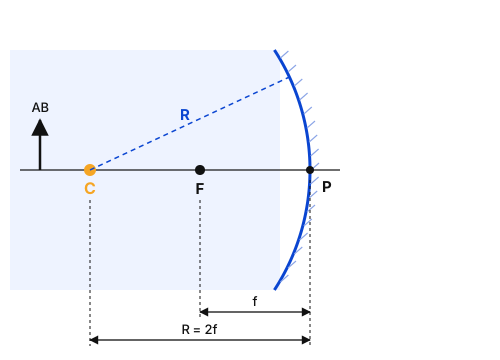
- C is the centre of the sphere of which the mirror is a part
- Concave: C in front (R = 2f, negative)
- Convex: C and F lie behind the mirror
Yaad rakhein: R = 2f — C is twice as far from the pole as F.
Answer: (C) In front of the mirror
अवधारणा: अवतल दर्पण की परावर्तक सतह वस्तु की ओर होती है, अतः C और F दर्पण के सामने होते हैं।
- C उस गोले का केंद्र है जिसका भाग दर्पण है
- अवतल: C सामने (R = 2f, ऋणात्मक)
- उत्तल: C और F दर्पण के पीछे
याद रखें: R = 2f — C, ध्रुव से F की दोगुनी दूरी पर।
उत्तर: (C) दर्पण के सामने
RRB Technician Grade IIIGeneral ScienceCentre of curvature – concave mirrorRRB Technician Grade III 2025 · 10 Mar Shift 3
Q37.What specialisation is commonly found in the epidermal cells of plant roots to aid in their primary function?
पादप जड़ों की बाह्यत्वचीय कोशिकाओं में उनके प्राथमिक कार्य में सहायता के लिए सामान्यतः कौन-सा विशिष्टीकरण पाया जाता है?
- AIrregularly thickened cornersअनियमित रूप से मोटे कोने
- BLarge air cavities (aerenchyma)बड़ी वायु गुहिकाएँ (वायूतक)
- CA thick, waxy coating of cutinक्यूटिन की एक मोटी, मोमी परत
- DLong, hair-like extensionsलंबे, बाल जैसे प्रवर्ध
Show answer
Concept: Epidermal cells of roots form long hair-like root hairs to absorb water and minerals.
- Root hairs greatly increase surface area for absorption
- Waxy cutin is on aerial parts (prevents water loss)
- Aerenchyma is in aquatic plants; thickened corners = collenchyma
Yaad rakhein: Cutin on leaves/stems reduces water loss; desert plants have a thick cuticle.
Answer: (D) Long, hair-like extensions
अवधारणा: जड़ की बाह्यत्वचा कोशिकाएँ लंबे बाल जैसे मूल रोम बनाती हैं जो जल व खनिज सोखते हैं।
- मूल रोम अवशोषण का सतही क्षेत्रफल बहुत बढ़ाते हैं
- मोमी क्यूटिन वायवीय भागों पर होता है (जल हानि रोकने हेतु)
- वायूतक (aerenchyma) जलीय पौधों में; कोनों पर मोटाई = स्थूलकोण ऊतक
याद रखें: पत्तियों/तनों पर क्यूटिन जल हानि घटाता है; मरुस्थलीय पौधों में मोटी क्यूटिकल।
उत्तर: (D) लंबे, बाल जैसे प्रवर्ध
RRB Technician Grade IIIGeneral ScienceRoot epidermis – root hairsRRB Technician Grade III 2025 · 10 Mar Shift 3
Q38.Even though action and reaction forces are equal in size, they may not cause equal accelerations. Why?
यद्यपि क्रिया और प्रतिक्रिया बल परिमाण में बराबर होते हैं, फिर भी वे समान त्वरण उत्पन्न नहीं कर सकते हैं। क्यों?
- ABecause the forces act on the same objectक्योंकि बल एक ही वस्तु पर कार्य करते हैं
- BBecause reaction forces are always weaker in effectक्योंकि प्रतिक्रिया बल सदैव प्रभाव में दुर्बल होते हैं
- CBecause each force acts on a different object, and the objects may have different massesक्योंकि प्रत्येक बल भिन्न वस्तु पर कार्य करता है, और वस्तुओं के द्रव्यमान भिन्न हो सकते हैं
- DBecause only the larger force causes accelerationक्योंकि केवल बड़ा बल ही त्वरण उत्पन्न करता है
Show answer
Concept: : equal forces on different masses give different accelerations.
- Action and reaction act on two different bodies
- Same F, bigger mass → smaller a (gun recoils slowly, bullet moves fast)
- Forces on the same body would cancel — not the case here
Yaad rakhein: Gun–bullet: equal and opposite forces, but the light bullet gets a huge acceleration.
Answer: (C) Because each force acts on a different object, and the objects may have different masses
अवधारणा: : बराबर बल अलग-अलग द्रव्यमानों पर अलग त्वरण देता है।
- क्रिया और प्रतिक्रिया दो अलग पिंडों पर लगते हैं
- समान F, अधिक द्रव्यमान → कम त्वरण (बंदूक धीरे पीछे हटती है, गोली तेज़)
- एक ही पिंड पर होते तो निरस्त हो जाते — ऐसा नहीं है
याद रखें: बंदूक–गोली: बल बराबर व विपरीत, पर हल्की गोली का त्वरण बहुत अधिक।
उत्तर: (C) क्योंकि प्रत्येक बल भिन्न वस्तु पर कार्य करता है, और वस्तुओं के द्रव्यमान भिन्न हो सकते हैं
RRB Technician Grade IIIGeneral ScienceThird law – unequal accelerationsRRB Technician Grade III 2025 · 10 Mar Shift 3
Q39.Addition reactions are characteristic of which type of hydrocarbons?
योगात्मक अभिक्रियाएँ (addition reactions) किस प्रकार के हाइड्रोकार्बनों की विशेषता हैं?
- ABoth alkynes and alkenesऐल्काइन और ऐल्कीन दोनों
- BOnly alkynesकेवल ऐल्काइन
- COnly alkenesकेवल ऐल्कीन
- DOnly alkanesकेवल ऐल्केन
Show answer
Concept: Addition reactions occur at double or triple bonds, i.e. in unsaturated hydrocarbons.
- Alkenes (C=C) and alkynes (C≡C) both undergo addition, e.g. hydrogenation
- Alkanes (only single bonds) give substitution reactions
Yaad rakhein: Hydrogenation of vegetable oils (Ni catalyst) is an addition reaction → vanaspati ghee.
Answer: (A) Both alkynes and alkenes
अवधारणा: योगात्मक अभिक्रिया द्वि- या त्रि-आबंध पर होती है, अर्थात असंतृप्त हाइड्रोकार्बन में।
- एल्कीन (C=C) और एल्काइन (C≡C) दोनों में योग, जैसे हाइड्रोजनीकरण
- एल्केन (केवल एकल आबंध) में प्रतिस्थापन अभिक्रिया
याद रखें: वनस्पति तेल का हाइड्रोजनीकरण (Ni उत्प्रेरक) योगात्मक अभिक्रिया है → वनस्पति घी।
उत्तर: (A) ऐल्काइन और ऐल्कीन दोनों
RRB Technician Grade IIIGeneral ScienceAddition reactions – unsaturated hydrocarbonsRRB Technician Grade III 2025 · 10 Mar Shift 3
Q40.Which of the following correctly explains why veins have valves but arteries do not?
निम्नलिखित में से कौन-सा सही रूप से स्पष्ट करता है कि शिराओं में वाल्व क्यों होते हैं परंतु धमनियों में नहीं?
- AVeins carry blood at low pressure and need valves to prevent backflowशिराएँ निम्न दाब पर रुधिर ले जाती हैं और रुधिर के पश्च प्रवाह को रोकने के लिए उन्हें वाल्व की आवश्यकता होती है
- BVeins carry blood under high pressure, so valves prevent it from burstingशिराएँ उच्च दाब पर रुधिर ले जाती हैं, इसलिए वाल्व उन्हें फटने से रोकते हैं
- CArteries carry oxygenated blood and do not need valvesधमनियाँ ऑक्सीजनित रुधिर ले जाती हैं और उन्हें वाल्व की आवश्यकता नहीं होती
- DArteries are located deep inside the body and are supported by musclesधमनियाँ शरीर के अंदर गहराई में स्थित होती हैं और पेशियों द्वारा सहारा पाती हैं
Show answer
Concept: Veins carry blood at low pressure back to the heart, so valves stop backflow.
- Arteries: thick elastic walls, blood at high pressure from heart → no valves needed
- Veins: thin walls, low pressure, blood often flows against gravity → valves keep it one-way
Yaad rakhein: Pulmonary vein carries oxygenated blood; pulmonary artery carries deoxygenated blood.
Answer: (A) Veins carry blood at low pressure and need valves to prevent backflow
अवधारणा: शिराएँ कम दाब पर रक्त हृदय तक लौटाती हैं, इसलिए वाल्व उल्टा प्रवाह रोकते हैं।
- धमनियाँ: मोटी लचीली भित्ति, हृदय से उच्च दाब पर रक्त → वाल्व की ज़रूरत नहीं
- शिराएँ: पतली भित्ति, कम दाब, रक्त अक्सर गुरुत्व के विरुद्ध → वाल्व एकदिशीय प्रवाह रखते हैं
याद रखें: फुफ्फुसीय शिरा ऑक्सीजनित रक्त और फुफ्फुसीय धमनी विऑक्सीजनित रक्त ले जाती है।
उत्तर: (A) शिराएँ निम्न दाब पर रुधिर ले जाती हैं और रुधिर के पश्च प्रवाह को रोकने के लिए उन्हें वाल्व की आवश्यकता होती है
RRB Technician Grade IIIGeneral ScienceVeins and valvesRRB Technician Grade III 2025 · 10 Mar Shift 3

