Q421.Which of the following pairs is correct in terms of pH values?
(a) Tooth decay in humans: pH of mouth 5.5
(b) pH range of human body: 7.0 to 7.8
(c) Acid rain: pH of rain water 8
pH मानों के संदर्भ में निम्नलिखित में से कौन-सा युग्म सही है?
(a) मनुष्यों में दंत क्षय: मुँह का pH 5.5
(b) मानव शरीर की pH परास: 7.0 से 7.8
(c) अम्लीय वर्षा: वर्षा जल का pH 8
- AOnly (b) is correct.केवल (b) सही है।
- B(a), (b) and (c) are correct.(a), (b) और (c) सही हैं।
- COnly (c) is correct.केवल (c) सही है।
- DOnly (a) is correct.केवल (a) सही है।
Show answer
Concept: NCERT facts: tooth decay starts when mouth pH falls below 5.5; the body works in pH 7.0–7.8; acid rain has pH below 5.6.
- (a) says pH causes decay – wrong (decay below 5.5).
- (b) 7.0 to 7.8 – correct.
- (c) says acid rain pH – wrong (it is acidic, ).
Yaad rakhein: Acid rain is acidic → pH ; any statement giving it pH is wrong at once.
Answer: (A) Only (b) is correct.
अवधारणा: NCERT तथ्य: मुँह का pH 5.5 से कम होने पर दंत-क्षय शुरू होता है; शरीर pH 7.0–7.8 में कार्य करता है; अम्लीय वर्षा का pH 5.6 से कम।
- (a) pH पर क्षय – गलत (क्षय 5.5 से नीचे)।
- (b) 7.0 से 7.8 – सही।
- (c) अम्लीय वर्षा pH – गलत (यह अम्लीय है, )।
याद रखें: अम्लीय वर्षा अम्लीय है → pH ; इसे pH बताने वाला कथन तुरंत गलत।
उत्तर: (A) केवल (b) सही है।
RRB Technician Grade IIIGeneral SciencepH in daily lifeRRB Technician Grade III 2024 · 30 Dec Shift 2
Q422.Which of the following diseases is/are a viral infection(s) transmitted through sexual contact?
a. HIV
b. Warts
c. Gonorrhoea
d. Syphilis
निम्नलिखित में से कौन-सा/कौन-से रोग लैंगिक संपर्क के माध्यम से संचरित होने वाला/वाले विषाणुजनित संक्रमण है/हैं?
a. HIV
b. मस्से (Warts)
c. सुजाक (Gonorrhoea)
d. सिफलिस (Syphilis)
- AOnly aकेवल a
- BOnly c and dकेवल c और d
- COnly a and bकेवल a और b
- DOnly cकेवल c
Show answer
Concept: STDs may be bacterial or viral. NCERT: gonorrhoea and syphilis are bacterial; warts and HIV-AIDS are viral.
- HIV – virus → viral STD.
- Warts – human papilloma virus → viral.
- Gonorrhoea, syphilis – bacteria.
Yaad rakhein: Bacterial STDs: Gonorrhoea, Syphilis (G-S); Viral: HIV, Warts (H-W).
Answer: (C) Only a and b
अवधारणा: यौन संचारित रोग जीवाणु या विषाणु जनित होते हैं। NCERT: गोनोरिया और सिफलिस जीवाणु जनित; मस्से (वार्ट्स) और HIV-AIDS विषाणु जनित।
- HIV – विषाणु → विषाणु जनित।
- मस्से – ह्यूमन पैपिलोमा वायरस → विषाणु जनित।
- गोनोरिया, सिफलिस – जीवाणु।
याद रखें: जीवाणु: गोनोरिया, सिफलिस; विषाणु: HIV, मस्से।
उत्तर: (C) केवल a और b
RRB Technician Grade IIIGeneral ScienceSexually transmitted diseasesRRB Technician Grade III 2024 · 30 Dec Shift 2
Q423.Which of the following statements is/are correct regarding the liquid state of matter?
Statement I: Liquids have fixed volume but no fixed shape.
Statement II: The rate of diffusion of liquids is higher than that of solids.
द्रव्य की द्रव अवस्था के संबंध में निम्नलिखित में से कौन-सा/कौन-से कथन सही है/हैं?
कथन I: द्रवों का आयतन निश्चित होता है परंतु आकार निश्चित नहीं होता।
कथन II: द्रवों की विसरण दर ठोसों की तुलना में अधिक होती है।
- ANeither statement I nor II is correct.न तो कथन I और न ही II सही है।
- BOnly statement II is correct.केवल कथन II सही है।
- CBoth statements I and II are correct.कथन I और II दोनों सही हैं।
- DOnly statement I is correct.केवल कथन I सही है।
Show answer
Concept: Particles of a liquid are close but can slide past each other — more freedom than solids, less than gases.
- Statement I: fixed volume, no fixed shape (takes shape of container) – correct.
- Statement II: particles move more freely than in solids, so diffusion in liquids is faster – correct.
Yaad rakhein: Diffusion rate: gas liquid solid.
Answer: (C) Both statements I and II are correct.
अवधारणा: द्रव के कण पास-पास होते हैं पर एक-दूसरे पर फिसल सकते हैं — ठोस से अधिक, गैस से कम स्वतंत्रता।
- कथन I: निश्चित आयतन, निश्चित आकार नहीं (पात्र का आकार ले लेता है) – सही।
- कथन II: कण ठोस से अधिक स्वतंत्र, अतः द्रव में विसरण तेज़ – सही।
याद रखें: विसरण दर: गैस द्रव ठोस।
उत्तर: (C) कथन I और II दोनों सही हैं।
RRB Technician Grade IIIGeneral ScienceStates of matterRRB Technician Grade III 2024 · 30 Dec Shift 2
Q424.In some multicellular organisms, the body breaks up into smaller pieces upon maturation and each piece grows into a new organism. What is this known as?
कुछ बहुकोशिकीय जीवों में, परिपक्व होने पर शरीर छोटे-छोटे टुकड़ों में टूट जाता है और प्रत्येक टुकड़ा एक नए जीव के रूप में विकसित हो जाता है। इसे क्या कहा जाता है?
- ASexual reproductionलैंगिक जनन (Sexual reproduction)
- BGamete formationयुग्मक निर्माण (Gamete formation)
- CFragmentationखंडन (Fragmentation)
- DBuddingमुकुलन (Budding)
Show answer
Concept: Fragmentation is asexual reproduction in which a mature body breaks into pieces and each piece grows into a new individual (e.g. Spirogyra).
- No gametes involved, so not sexual reproduction or gamete formation.
- Budding (Hydra, yeast) forms an outgrowth, not breaking of the body.
- Body breaking into pieces → fragmentation.
Yaad rakhein: Spirogyra → fragmentation; Planaria → regeneration; Hydra → budding.
Answer: (C) Fragmentation
अवधारणा: खंडन अलैंगिक जनन है जिसमें परिपक्व शरीर टुकड़ों में टूटता है और हर टुकड़ा नया जीव बनता है (जैसे स्पाइरोगायरा)।
- युग्मक नहीं बनते, अतः लैंगिक जनन या युग्मक निर्माण नहीं।
- मुकुलन (हाइड्रा, यीस्ट) में उभार बनता है, शरीर टूटता नहीं।
- शरीर का टुकड़ों में टूटना → खंडन।
याद रखें: स्पाइरोगायरा → खंडन; प्लेनेरिया → पुनर्जनन; हाइड्रा → मुकुलन।
उत्तर: (C) खंडन (Fragmentation)
RRB Technician Grade IIIGeneral ScienceAsexual reproductionRRB Technician Grade III 2024 · 30 Dec Shift 2
Q425.How does a plant move its leaves in response to touch?
पौधा स्पर्श की प्रतिक्रिया में अपनी पत्तियों को कैसे गति देता है?
- ABy changing the amount of nucleic acid in themउनमें न्यूक्लिक अम्ल की मात्रा बदलकर
- BBy changing the amount of protein in themउनमें प्रोटीन की मात्रा बदलकर
- CBy changing the amount of lipid in themउनमें लिपिड की मात्रा बदलकर
- DBy changing the amount of water in themउनमें जल की मात्रा बदलकर
Show answer
Concept: Leaves of the touch-me-not (Mimosa) fold because cells change shape by changing the amount of water in them.
- Touch stimulus is passed from cell to cell electro-chemically.
- Cells lose water (swell or shrink) and change shape.
- The leaflets fold — no growth is involved.
Yaad rakhein: Mimosa (chhui-mui) = water movement, not growth.
Answer: (D) By changing the amount of water in them
अवधारणा: छुई-मुई (माइमोसा) की पत्तियाँ इसलिए मुड़ती हैं क्योंकि कोशिकाएँ अपने अंदर जल की मात्रा बदलकर आकार बदलती हैं।
- स्पर्श का संदेश कोशिका से कोशिका विद्युत-रासायनिक रूप से जाता है।
- कोशिकाएँ जल खोकर/लेकर सिकुड़ती या फूलती हैं।
- पत्रक मुड़ जाते हैं — इसमें वृद्धि शामिल नहीं।
याद रखें: छुई-मुई = जल की गति, वृद्धि नहीं।
उत्तर: (D) उनमें जल की मात्रा बदलकर
RRB Technician Grade IIIGeneral SciencePlant movementsRRB Technician Grade III 2024 · 30 Dec Shift 2
Q426.The action of chlorine on dry produces which of the following?
शुष्क पर क्लोरीन की क्रिया से निम्नलिखित में से क्या उत्पन्न होता है?
- AHydrochloric acidहाइड्रोक्लोरिक अम्ल
- BCalcium chlorideकैल्शियम क्लोराइड
- CBleaching powderविरंजक चूर्ण (Bleaching powder)
- DCalcium oxideकैल्शियम ऑक्साइड
Show answer
Concept: Bleaching powder is made by passing chlorine over dry slaked lime.
- is bleaching powder (calcium oxychloride).
Yaad rakhein: Chlor-alkali products: NaOH, , ; + dry slaked lime → bleaching powder.
Answer: (C) Bleaching powder
अवधारणा: शुष्क बुझे चूने पर क्लोरीन प्रवाहित करके विरंजक चूर्ण बनाया जाता है।
- विरंजक चूर्ण (कैल्शियम ऑक्सीक्लोराइड) है।
याद रखें: क्लोर-क्षार उत्पाद: NaOH, , ; + शुष्क बुझा चूना → विरंजक चूर्ण।
उत्तर: (C) विरंजक चूर्ण (Bleaching powder)
RRB Technician Grade IIIGeneral ScienceBleaching powderRRB Technician Grade III 2024 · 30 Dec Shift 2
Q427.Which of the following methods is NOT used for preventing iron from rusting?
लोहे को जंग लगने से बचाने के लिए निम्नलिखित में से किस विधि का उपयोग नहीं किया जाता है?
- AChrome platingक्रोम लेपन (Chrome plating)
- BPaintingपेंट करना
- CGalvanisingयशदलेपन (Galvanising)
- DHeatingगर्म करना
Show answer
Concept: Rusting needs both air (oxygen) and moisture; prevention methods put a barrier on iron.
- Painting, oiling, greasing – coat the surface.
- Galvanising – coating of zinc.
- Chrome plating / alloying – protective layer.
- Heating does not form a barrier; heat actually speeds up oxidation.
Yaad rakhein: Rust prevention = Cover the iron (paint, oil, zinc, chrome, alloy).
Answer: (D) Heating
अवधारणा: जंग लगने के लिए वायु (ऑक्सीजन) और नमी दोनों चाहिए; बचाव के तरीके लोहे पर अवरोधी परत बनाते हैं।
- पेंट, तेल, ग्रीस – सतह को ढकते हैं।
- यशदलेपन (गैल्वनीकरण) – ज़िंक की परत।
- क्रोम लेपन / मिश्रातु – सुरक्षात्मक परत।
- गर्म करने से कोई परत नहीं बनती; ताप तो ऑक्सीकरण तेज़ करता है।
याद रखें: जंग से बचाव = लोहे को ढकना (पेंट, तेल, ज़िंक, क्रोम, मिश्रातु)।
उत्तर: (D) गर्म करना
RRB Technician Grade IIIGeneral SciencePrevention of rustingRRB Technician Grade III 2024 · 30 Dec Shift 2
Q428.The force experienced by a current carrying conductor in a magnetic field is maximum when the angle between the direction of current and the direction of magnetic field is
चुंबकीय क्षेत्र में स्थित धारावाही चालक द्वारा अनुभव किया गया बल अधिकतम होता है, जब धारा की दिशा और चुंबकीय क्षेत्र की दिशा के बीच का कोण होता है
- A
- B
- C
- D
Show answer
Concept: Force on a current-carrying conductor: , where is the angle between current and field.
- is maximum () at .
- At , → no force.
Yaad rakhein: Perpendicular = maximum force; parallel = zero force (Fleming’s left-hand rule).
Answer: (B)
अवधारणा: धारावाही चालक पर बल: , जहाँ धारा और क्षेत्र के बीच का कोण है।
- पर अधिकतम ()।
- पर → बल शून्य।
याद रखें: लंबवत = अधिकतम बल; समांतर = शून्य बल (फ्लेमिंग का वाम-हस्त नियम)।
उत्तर: (B)
RRB Technician Grade IIIGeneral ScienceForce on a current-carrying conductorRRB Technician Grade III 2024 · 30 Dec Shift 2
Q429.Identify the substance that gets reduced in the given equation:
दिए गए समीकरण में अपचयित होने वाले पदार्थ की पहचान कीजिए:
- ACO
- BZn
- CZnO
- DC
Show answer
Concept: Reduction = loss of oxygen (or gain of hydrogen); oxidation = gain of oxygen.
- ZnO loses oxygen to become Zn → ZnO is reduced.
- C gains oxygen to become CO → C is oxidised (reducing agent).
Trick: Look at the reactant that loses O — that reactant is reduced; Zn and CO are products, not the substance reduced.
Answer: (C) ZnO
अवधारणा: अपचयन = ऑक्सीजन का ह्रास (या हाइड्रोजन का योग); ऑक्सीकरण = ऑक्सीजन का योग।
- ZnO ऑक्सीजन खोकर Zn बनता है → ZnO का अपचयन।
- C ऑक्सीजन लेकर CO बनता है → C का ऑक्सीकरण (अपचायक)।
ट्रिक: जो अभिकारक O खोता है वही अपचयित होता है; Zn और CO उत्पाद हैं।
उत्तर: (C) ZnO
RRB Technician Grade IIIGeneral ScienceOxidation and reductionRRB Technician Grade III 2024 · 30 Dec Shift 2
Q430.Which of the following is least reactive?
निम्नलिखित में से कौन-सा सबसे कम अभिक्रियाशील है?
- ANa
- BK
- CCa
- DMg
Show answer
Concept: Reactivity series (top part): K Na Ca Mg Al Zn Fe …
- K and Na react violently with cold water.
- Ca reacts less violently with cold water.
- Mg reacts only with hot water → least reactive of the four.
Trick: ‘King Napoleon Called Me At Zoo’ – K, Na, Ca, Mg, Al, Zn.
Answer: (D) Mg
अवधारणा: सक्रियता श्रेणी (ऊपरी भाग): K Na Ca Mg Al Zn Fe …
- K और Na ठंडे जल से तीव्र अभिक्रिया करते हैं।
- Ca ठंडे जल से कम तीव्रता से।
- Mg केवल गर्म जल से → चारों में सबसे कम सक्रिय।
ट्रिक: क्रम याद करें: K, Na, Ca, Mg, Al, Zn — ‘King Napoleon Called Me At Zoo’।
उत्तर: (D) Mg
RRB Technician Grade IIIGeneral ScienceReactivity seriesRRB Technician Grade III 2024 · 30 Dec Shift 2
Q431.Select the INCORRECT pair related to digestive glands and their enzymes.
पाचक ग्रंथियों और उनके एंजाइमों से संबंधित गलत युग्म का चयन कीजिए।
- ASalivary gland – trypsinलार ग्रंथि – ट्रिप्सिन
- BLiver – bile juiceयकृत – पित्त रस
- CGastric gland – pepsinजठर ग्रंथि – पेप्सिन
- DPancreas – pancreatic juiceअग्न्याशय – अग्न्याशयी रस
Show answer
Concept: Each digestive gland releases a specific juice/enzyme.
- Salivary gland – salivary amylase, not trypsin.
- Liver – bile juice; gastric gland – pepsin, HCl, mucus.
- Pancreas – pancreatic juice containing trypsin and lipase.
Yaad rakhein: Trypsin belongs to the pancreas; saliva has amylase (starch → sugar).
Answer: (A) Salivary gland – trypsin
अवधारणा: हर पाचक ग्रंथि एक विशिष्ट रस/एंजाइम स्रावित करती है।
- लार ग्रंथि – लार एमाइलेज़, ट्रिप्सिन नहीं।
- यकृत – पित्त रस; जठर ग्रंथि – पेप्सिन, HCl, श्लेष्मा।
- अग्न्याशय – अग्न्याशयी रस जिसमें ट्रिप्सिन और लाइपेज़।
याद रखें: ट्रिप्सिन अग्न्याशय का है; लार में एमाइलेज़ (स्टार्च → शर्करा)।
उत्तर: (A) लार ग्रंथि – ट्रिप्सिन
RRB Technician Grade IIIGeneral ScienceDigestive glands and enzymesRRB Technician Grade III 2024 · 30 Dec Shift 2
Q432.Which mirror has negative focal length?
किस दर्पण की फोकस दूरी ऋणात्मक होती है?
- APlane mirrorसमतल दर्पण
- BBoth convex and concaveउत्तल और अवतल दोनों
- CConcaveअवतल
- DConvexउत्तल
Show answer
Concept: New Cartesian sign convention: distances measured against the incident light (in front of the mirror) are negative.
- Focus of a concave mirror is in front → negative.
- Focus of a convex mirror is behind → positive.
- Plane mirror – focal length infinite.
Yaad rakhein: Mirrors: concave , convex . Lenses are opposite: convex lens , concave lens .
Answer: (C) Concave
अवधारणा: नई कार्तीय चिह्न परिपाटी: आपतित प्रकाश के विपरीत (दर्पण के सामने) मापी गई दूरियाँ ऋणात्मक होती हैं।
- अवतल दर्पण का फोकस सामने → ऋणात्मक।
- उत्तल दर्पण का फोकस पीछे → धनात्मक।
- समतल दर्पण – फोकस दूरी अनंत।
याद रखें: अवतल दर्पण: ; उत्तल दर्पण: (लेंस में उलटा: अवतल लेंस , उत्तल लेंस )।
उत्तर: (C) अवतल
RRB Technician Grade IIIGeneral ScienceSign convention for mirrorsRRB Technician Grade III 2024 · 30 Dec Shift 2
Q433.What is the simple form of protein?
प्रोटीन का सरल रूप क्या है?
- AGlucoseग्लूकोज
- BGlycerolग्लिसरॉल
- CAmino acidअमीनो अम्ल
- DFatty acidवसा अम्ल
Show answer
Concept: Large food molecules are broken into simple units: proteins → amino acids, carbohydrates → glucose, fats → fatty acids + glycerol.
- Glucose – simple form of carbohydrates.
- Glycerol and fatty acids – simple forms of fats.
- Amino acids – building blocks of proteins.
Yaad rakhein: P→A (Protein → Amino acid), C→G (Carbohydrate → Glucose), F→FG (Fat → Fatty acid + Glycerol).
Answer: (C) Amino acid
अवधारणा: बड़े भोजन अणु सरल इकाइयों में टूटते हैं: प्रोटीन → अमीनो अम्ल, कार्बोहाइड्रेट → ग्लूकोज़, वसा → वसीय अम्ल + ग्लिसरॉल।
- ग्लूकोज़ – कार्बोहाइड्रेट का सरल रूप।
- ग्लिसरॉल और वसीय अम्ल – वसा के सरल रूप।
- अमीनो अम्ल – प्रोटीन की इकाई।
याद रखें: प्रोटीन → अमीनो अम्ल, कार्बोहाइड्रेट → ग्लूकोज़, वसा → वसीय अम्ल + ग्लिसरॉल।
उत्तर: (C) अमीनो अम्ल
RRB Technician Grade IIIGeneral ScienceDigestion of proteinsRRB Technician Grade III 2024 · 30 Dec Shift 2
Q434.The sperms produced in the testes are transported via the ________.
वृषण में उत्पन्न शुक्राणुओं का परिवहन ________ के माध्यम से होता है।
- Avas deferensशुक्रवाहिका (vas deferens)
- BUrethraमूत्रमार्ग (Urethra)
- Cseminal vesicleशुक्राशय (seminal vesicle)
- Durinary bladderमूत्राशय (urinary bladder)
Show answer
Concept: Sperms formed in the testes are carried by the vas deferens, which joins a tube coming from the bladder (urethra).
- Testes → vas deferens → urethra → outside.
- Seminal vesicle and prostate add fluid; they do not carry sperms from testes.
- Urinary bladder stores urine.
Yaad rakhein: Path: Testis → Vas deferens → Urethra (T-V-U).
Answer: (A) vas deferens
अवधारणा: वृषण में बने शुक्राणु शुक्रवाहिका (वास डिफेरेंस) द्वारा ले जाए जाते हैं, जो मूत्राशय से आने वाली नली (मूत्रमार्ग) से मिलती है।
- वृषण → शुक्रवाहिका → मूत्रमार्ग → बाहर।
- शुक्राशय और प्रोस्टेट द्रव मिलाते हैं; वे वृषण से शुक्राणु नहीं ले जाते।
- मूत्राशय मूत्र संग्रह करता है।
याद रखें: मार्ग: वृषण → शुक्रवाहिका → मूत्रमार्ग।
उत्तर: (A) शुक्रवाहिका (vas deferens)
RRB Technician Grade IIIGeneral ScienceMale reproductive systemRRB Technician Grade III 2024 · 30 Dec Shift 2
Q435.What is the reason for the formation of a bud in Hydra?
हाइड्रा में मुकुल (bud) बनने का कारण क्या है?
- ARepeated cell division at one specific siteएक विशिष्ट स्थान पर बार-बार कोशिका विभाजन
- BOvergrowth of the whole bodyपूरे शरीर की अतिवृद्धि
- CCell cycleकोशिका चक्र
- DMutationउत्परिवर्तन
Show answer
Concept: In Hydra, regenerative cells divide repeatedly at one specific site, producing an outgrowth called a bud.
- Repeated mitosis at one spot → bud.
- The bud grows into a tiny Hydra.
- On maturity it detaches and lives independently.
Yaad rakhein: Bud = local repeated cell division; whole-body growth or mutation is not the cause.
Answer: (A) Repeated cell division at one specific site
अवधारणा: हाइड्रा में पुनर्जनन कोशिकाएँ एक विशिष्ट स्थान पर बार-बार विभाजित होकर उभार बनाती हैं, जिसे मुकुल कहते हैं।
- एक स्थान पर बार-बार समसूत्री विभाजन → मुकुल।
- मुकुल नन्हे हाइड्रा में विकसित होता है।
- परिपक्व होकर अलग हो जाता है और स्वतंत्र रहता है।
याद रखें: मुकुल = एक स्थान पर बार-बार कोशिका विभाजन; पूरे शरीर की वृद्धि या उत्परिवर्तन कारण नहीं।
उत्तर: (A) एक विशिष्ट स्थान पर बार-बार कोशिका विभाजन
RRB Technician Grade IIIGeneral ScienceBudding in HydraRRB Technician Grade III 2024 · 30 Dec Shift 2
Q436.Which of the following substances is NOT selectively reabsorbed as the urine flows along the tubules?
मूत्र के नलिकाओं से होकर प्रवाहित होने के दौरान निम्नलिखित में से किस पदार्थ का चयनात्मक पुनरावशोषण नहीं होता है?
- AGlucoseग्लूकोज
- BAmino acidsअमीनो अम्ल
- CUreaयूरिया
- DSaltsलवण
Show answer
Concept: In the nephron, useful substances in the filtrate are selectively reabsorbed; the waste remains to form urine.
- Glucose, amino acids, salts and much water – reabsorbed (useful).
- Urea – nitrogenous waste, not reabsorbed; it is excreted in urine.
Yaad rakhein: Useful returns to blood; waste (urea) goes out in urine.
Answer: (C) Urea
अवधारणा: वृक्काणु में निस्यंद के उपयोगी पदार्थ चयनात्मक रूप से पुनः अवशोषित होते हैं; अपशिष्ट मूत्र बनाता है।
- ग्लूकोज़, अमीनो अम्ल, लवण और अधिकांश जल – पुनः अवशोषित (उपयोगी)।
- यूरिया – नाइट्रोजनी अपशिष्ट, पुनः अवशोषित नहीं; मूत्र में बाहर।
याद रखें: उपयोगी वापस रक्त में; अपशिष्ट (यूरिया) मूत्र में बाहर।
उत्तर: (C) यूरिया
RRB Technician Grade IIIGeneral ScienceExcretion – nephronRRB Technician Grade III 2024 · 30 Dec Shift 2
Q437.Two resistors of each are connected in series to a battery of 4V. The current in Ampere flowing through the resistors will be:
के दो प्रतिरोधक 4V की बैटरी से श्रेणीक्रम में जुड़े हैं। प्रतिरोधकों से प्रवाहित होने वाली धारा (एम्पियर में) होगी:
- A1/2
- B1
- C4
- D2
Show answer
Concept: In series, resistances add: . Then Ohm's law gives .
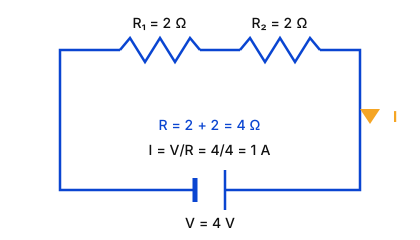
- .
- .
- Same current flows through both resistors in series.
Yaad rakhein: Equal resistors in series: .
Answer: (B) 1
अवधारणा: श्रेणीक्रम में प्रतिरोध जुड़ते हैं: . फिर ओम का नियम .
- .
- .
- श्रेणीक्रम में दोनों प्रतिरोधों से समान धारा बहती है।
याद रखें: समान प्रतिरोध श्रेणीक्रम में: .
उत्तर: (B) 1
RRB Technician Grade IIIGeneral ScienceOhm's law – series resistorsRRB Technician Grade III 2024 · 30 Dec Shift 2
Q438.______ results in the formation of different types of permanent tissues.
______ के परिणामस्वरूप विभिन्न प्रकार के स्थायी ऊतक बनते हैं।
- AElongationदीर्घीकरण (Elongation)
- BDifferentiationविभेदन (Differentiation)
- CVegetative Propagationकायिक प्रवर्धन (Vegetative Propagation)
- DGerminationअंकुरण (Germination)
Show answer
Concept: Cells formed by meristematic tissue take up a permanent shape, size and function; this process is called differentiation.
- Meristem cells divide.
- They then lose the ability to divide and specialise → differentiation.
- Result: permanent tissues (parenchyma, collenchyma, xylem, phloem…).
Yaad rakhein: Meristematic → (differentiation) → permanent tissue.
Answer: (B) Differentiation
अवधारणा: विभज्योतक ऊतक से बनी कोशिकाएँ स्थायी आकार, माप और कार्य ग्रहण करती हैं; इस प्रक्रिया को विभेदन कहते हैं।
- विभज्योतक कोशिकाएँ विभाजित होती हैं।
- फिर विभाजन क्षमता खोकर विशिष्ट बनती हैं → विभेदन।
- परिणाम: स्थायी ऊतक (पैरेन्काइमा, कॉलेन्काइमा, जाइलम, फ्लोएम…)।
याद रखें: विभज्योतक → (विभेदन) → स्थायी ऊतक।
उत्तर: (B) विभेदन (Differentiation)
RRB Technician Grade IIIGeneral SciencePlant tissuesRRB Technician Grade III 2024 · 30 Dec Shift 2
Q439.Calculate the molecular mass of ammonia, , using the provided atomic masses (Atomic mass of N = 14 u and H = 1 u).
दिए गए परमाणु द्रव्यमानों का उपयोग करके अमोनिया, , के आणविक द्रव्यमान की गणना कीजिए (N का परमाणु द्रव्यमान = 14 u और H = 1 u)।
- A21 u
- B10 u
- C42 u
- D17 u
Show answer
Concept: Molecular mass = sum of atomic masses of all atoms in the molecule.
- has 1 N and 3 H.
- .
Trick: Multiply each atomic mass by its subscript, then add.
Answer: (D) 17 u
अवधारणा: आणविक द्रव्यमान = अणु के सभी परमाणुओं के परमाणु द्रव्यमानों का योग।
- में 1 N और 3 H.
- .
ट्रिक: हर परमाणु द्रव्यमान को उसकी पादांक संख्या से गुणा कर जोड़ें।
उत्तर: (D) 17 u
RRB Technician Grade IIIGeneral ScienceMolecular massRRB Technician Grade III 2024 · 30 Dec Shift 2
Q440.The centre of curvature of a concave mirror lies _____ the mirror, whereas it lies _______ the mirror for a convex mirror.
अवतल दर्पण का वक्रता केंद्र दर्पण के _____ स्थित होता है, जबकि उत्तल दर्पण के लिए यह दर्पण के _______ स्थित होता है।
- Ain front of; in front ofसामने; सामने
- Bbehind; behindपीछे; पीछे
- Cbehind; in front ofपीछे; सामने
- Din front of; behindसामने; पीछे
Show answer
Concept: The centre of curvature (C) is the centre of the sphere of which the mirror is a part. Light falls from the front.
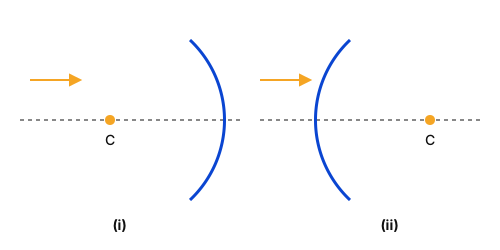
- Concave (figure i): the reflecting surface curves around C → C lies in front of the mirror.
- Convex (figure ii): the reflecting surface bulges outward → C lies behind the mirror.
- Same is true for the focus F.
Yaad rakhein: Concave → C and F real, in front; convex → C and F virtual, behind.
Answer: (D) in front of; behind
अवधारणा: वक्रता केंद्र (C) उस गोले का केंद्र है जिसका भाग दर्पण है। प्रकाश सामने से आता है।
- अवतल (चित्र i): परावर्तक सतह C के चारों ओर मुड़ी है → C दर्पण के सामने।
- उत्तल (चित्र ii): परावर्तक सतह बाहर उभरी है → C दर्पण के पीछे।
- फोकस F के लिए भी यही सत्य है।
याद रखें: अवतल → C और F वास्तविक, सामने; उत्तल → C और F आभासी, पीछे।
उत्तर: (D) सामने; पीछे
RRB Technician Grade IIIGeneral ScienceSpherical mirrorsRRB Technician Grade III 2024 · 30 Dec Shift 2

