Q441.An imaginary straight line passing through the pole and the centre of curvature of a spherical mirror is called as ________.
गोलीय दर्पण के ध्रुव और वक्रता केंद्र से होकर गुजरने वाली एक काल्पनिक सीधी रेखा ________ कहलाती है।
- Aemergent rayनिर्गत किरण (emergent ray)
- Breflected rayपरावर्तित किरण (reflected ray)
- Cprincipal axisमुख्य अक्ष (principal axis)
- Dincident rayआपतित किरण (incident ray)
Show answer
Concept: For a spherical mirror, the pole (P) is the centre of its reflecting surface and the centre of curvature (C) is the centre of the sphere of which the mirror is a part.
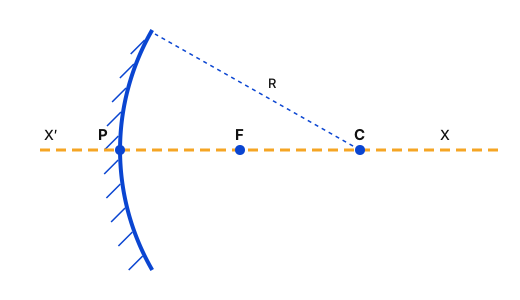
- Join P and C by a straight line and extend it both ways (XX′ in the figure).
- This imaginary line is the principal axis; the focus F also lies on it, midway between P and C.
- Incident, reflected and emergent rays are actual light rays, not this reference line.
Yaad rakhein: Principal axis = line through P, F and C; it is normal to the mirror at the pole.
Answer: (C) principal axis
अवधारणा: गोलीय दर्पण में ध्रुव (P) परावर्तक सतह का मध्य बिंदु है और वक्रता केंद्र (C) उस गोले का केंद्र है जिसका दर्पण एक भाग है।
- P और C को सीधी रेखा से मिलाकर दोनों ओर बढ़ाइए (चित्र में XX′)।
- यही काल्पनिक रेखा मुख्य अक्ष कहलाती है; फोकस F भी इसी पर P और C के बीच में होता है।
- आपतित, परावर्तित और निर्गत किरणें वास्तविक प्रकाश किरणें हैं, यह संदर्भ रेखा नहीं।
याद रखें: मुख्य अक्ष = P, F और C से गुजरने वाली रेखा; यह ध्रुव पर दर्पण के अभिलंबवत होती है।
उत्तर: (C) मुख्य अक्ष (principal axis)
RRB Technician Grade IIIGeneral ScienceSpherical mirror termsRRB Technician Grade III 2024 · 30 Dec Shift 1
Q442.Identify the balanced chemical equation for the following reaction.
निम्नलिखित अभिक्रिया के लिए संतुलित रासायनिक समीकरण की पहचान कीजिए।
- A
- B
- C
- D
Show answer
Concept: A balanced equation has equal numbers of each type of atom on both sides (law of conservation of mass).
- Mg: 1 on left, 1 in on right – balanced.
- O: 1 atom in , so we need on the left.
- Check others: (A) has 3 O vs 1; (B) and (C) do not match Mg/O counts.
Trick: Multiply by 2 → the familiar .
Answer: (D)
अवधारणा: संतुलित समीकरण में दोनों ओर प्रत्येक प्रकार के परमाणुओं की संख्या बराबर होती है (द्रव्यमान संरक्षण का नियम)।
- Mg: बाएँ 1, दाएँ में 1 – संतुलित।
- O: में 1 परमाणु, अतः बाएँ चाहिए।
- बाकी जाँचें: (A) में 3 O बनाम 1; (B) व (C) में Mg/O की गिनती मेल नहीं खाती।
ट्रिक: को 2 से गुणा करें → परिचित ।
उत्तर: (D)
RRB Technician Grade IIIGeneral ScienceBalancing chemical equationsRRB Technician Grade III 2024 · 30 Dec Shift 1
Q443.Which of the following elements is monoatomic?
निम्नलिखित में से कौन-सा तत्व एकपरमाणुक (monoatomic) है?
- AHeliumहीलियम
- BNitrogenनाइट्रोजन
- COxygenऑक्सीजन
- DHydrogenहाइड्रोजन
Show answer
Concept: Atomicity is the number of atoms in one molecule of an element. Noble gases have a stable complete outer shell, so they exist as single atoms.
- Helium (noble gas) – monoatomic: .
- Nitrogen, oxygen and hydrogen exist as diatomic molecules: , , .
- Hence only helium is monoatomic.
Yaad rakhein: All noble gases (He, Ne, Ar, Kr, Xe, Rn) are monoatomic; is triatomic, tetra-atomic, poly-atomic.
Answer: (A) Helium
अवधारणा: परमाणुकता किसी तत्व के एक अणु में परमाणुओं की संख्या है। उत्कृष्ट गैसों का बाहरी कोश पूर्ण व स्थिर होता है, इसलिए वे एकल परमाणु के रूप में रहती हैं।
- हीलियम (उत्कृष्ट गैस) – एकपरमाणुक: ।
- नाइट्रोजन, ऑक्सीजन और हाइड्रोजन द्विपरमाणुक अणु बनाते हैं: , , ।
- अतः केवल हीलियम एकपरमाणुक है।
याद रखें: सभी उत्कृष्ट गैसें (He, Ne, Ar, Kr, Xe, Rn) एकपरमाणुक हैं; त्रिपरमाणुक, चतुष्परमाणुक, बहुपरमाणुक।
उत्तर: (A) हीलियम
RRB Technician Grade IIIGeneral ScienceAtomicity of elementsRRB Technician Grade III 2024 · 30 Dec Shift 1
Q444.Which of the following functions is NOT regulated by the medulla in the hind brain?
निम्नलिखित में से कौन-सा कार्य पश्चमस्तिष्क (hind brain) में स्थित मेडुला द्वारा नियंत्रित नहीं होता है?
- ASalivary regulationलार का नियमन
- BBlood pressure regulationरक्तचाप का नियमन
- CRegulation of hearingश्रवण का नियमन
- DVomiting controlउल्टी (वमन) का नियंत्रण
Show answer
Concept: The medulla oblongata of the hind brain controls involuntary actions of the body.
- Medulla controls blood pressure, salivation, vomiting, swallowing, coughing and sneezing.
- Hearing, smell and sight are sensory functions handled by specific regions of the fore brain (cerebrum).
- So regulation of hearing is NOT a medulla function.
Yaad rakhein: Medulla = involuntary 'SBV' – Salivation, Blood pressure, Vomiting; Cerebellum = balance and posture.
Answer: (C) Regulation of hearing
अवधारणा: पश्च मस्तिष्क का मेडुला ऑब्लांगेटा शरीर की अनैच्छिक क्रियाओं को नियंत्रित करता है।
- मेडुला रक्तचाप, लार स्राव, वमन (उल्टी), निगलना, खाँसना व छींकना नियंत्रित करता है।
- सुनना, सूँघना और देखना अग्र मस्तिष्क (प्रमस्तिष्क) के विशेष क्षेत्रों का कार्य है।
- अतः श्रवण का नियमन मेडुला का कार्य नहीं है।
याद रखें: मेडुला = अनैच्छिक कार्य – लार, रक्तचाप, वमन; अनुमस्तिष्क = संतुलन व मुद्रा।
उत्तर: (C) श्रवण का नियमन
RRB Technician Grade IIIGeneral ScienceHind brain – medullaRRB Technician Grade III 2024 · 30 Dec Shift 1
Q445.The electric power consumed by a resistor of resistance R, carrying current I, is ________.
धारा I प्रवाहित करने वाले R प्रतिरोध के प्रतिरोधक द्वारा उपभुक्त विद्युत शक्ति ________ होती है।
- A
- B
- C
- D
Show answer
Concept: Electric power is the rate of doing electrical work: .
- By Ohm's law, .
- Substitute: .
- Other forms: .
Yaad rakhein: – unit watt ().
Answer: (D)
अवधारणा: विद्युत शक्ति विद्युत कार्य करने की दर है: ।
- ओम के नियम से ।
- रखने पर: ।
- अन्य रूप: ।
याद रखें: – मात्रक वाट ()।
उत्तर: (D)
RRB Technician Grade IIIGeneral ScienceElectric powerRRB Technician Grade III 2024 · 30 Dec Shift 1
Q446.In phloem, which of the following cells are dead cells?
फ्लोएम में, निम्नलिखित में से कौन-सी कोशिकाएँ मृत कोशिकाएँ होती हैं?
- ACompanion cellsसहचर कोशिकाएँ (Companion cells)
- BSieve cellsचालनी कोशिकाएँ (Sieve cells)
- CPhloem fibresफ्लोएम रेशे (Phloem fibres)
- DPhloem parenchymaफ्लोएम मृदूतक (Phloem parenchyma)
Show answer
Concept: Phloem has four elements: sieve tubes (sieve cells), companion cells, phloem parenchyma and phloem fibres.
- Sieve tubes, companion cells and phloem parenchyma are living cells.
- Phloem fibres are sclerenchymatous, thick-walled and dead.
- Hence phloem fibres are the only dead cells of phloem.
Yaad rakhein: Phloem – only fibres are dead; Xylem – only xylem parenchyma is living (tracheids, vessels, fibres are dead).
Answer: (C) Phloem fibres
अवधारणा: फ्लोएम के चार अवयव हैं: चालनी नलिकाएँ (चालनी कोशिकाएँ), सहचर कोशिकाएँ, फ्लोएम मृदूतक और फ्लोएम रेशे।
- चालनी नलिकाएँ, सहचर कोशिकाएँ और फ्लोएम मृदूतक जीवित कोशिकाएँ हैं।
- फ्लोएम रेशे दृढ़ोतक (स्क्लेरेनकाइमा) के, मोटी भित्ति वाले और मृत होते हैं।
- अतः फ्लोएम में केवल फ्लोएम रेशे मृत कोशिकाएँ हैं।
याद रखें: फ्लोएम – केवल रेशे मृत; जाइलम – केवल जाइलम मृदूतक जीवित (वाहिनिकाएँ, वाहिकाएँ, रेशे मृत)।
उत्तर: (C) फ्लोएम रेशे (Phloem fibres)
RRB Technician Grade IIIGeneral SciencePhloem – complex tissueRRB Technician Grade III 2024 · 30 Dec Shift 1
Q447.Which of the following factors does NOT affect the rate of evaporation?
निम्नलिखित में से कौन-सा कारक वाष्पन की दर को प्रभावित नहीं करता है?
- AHumidity of the surrounding airआसपास की वायु की आर्द्रता
- BSurface area of the liquidद्रव का पृष्ठीय क्षेत्रफल
- CTemperature of the liquidद्रव का तापमान
- DColour of the liquidद्रव का रंग
Show answer
Concept: Evaporation is a surface phenomenon in which liquid particles escape into vapour below the boiling point.
- Larger surface area → faster evaporation.
- Higher temperature → more particles have enough kinetic energy → faster.
- Higher humidity → slower; wind speed increases it.
- Colour of the liquid has no effect on the rate.
Yaad rakhein: Evaporation factors: surface area ↑, temperature ↑, wind speed ↑ → rate ↑; humidity ↑ → rate ↓.
Answer: (D) Colour of the liquid
अवधारणा: वाष्पीकरण एक सतही प्रक्रिया है जिसमें द्रव के कण क्वथनांक से नीचे ही वाष्प में बदलते हैं।
- अधिक पृष्ठ क्षेत्रफल → तेज वाष्पीकरण।
- अधिक ताप → अधिक कणों को पर्याप्त गतिज ऊर्जा → तेज।
- अधिक आर्द्रता → धीमा; वायु की गति इसे बढ़ाती है।
- द्रव के रंग का दर पर कोई प्रभाव नहीं।
याद रखें: पृष्ठ क्षेत्रफल ↑, ताप ↑, वायु गति ↑ → दर ↑; आर्द्रता ↑ → दर ↓।
उत्तर: (D) द्रव का रंग
RRB Technician Grade IIIGeneral ScienceFactors affecting evaporationRRB Technician Grade III 2024 · 30 Dec Shift 1
Q448.When iron filings are sprinkled around a magnet, they form a pattern. What does this pattern represent?
जब किसी चुंबक के चारों ओर लौह-चूर्ण छिड़का जाता है, तो वे एक प्रतिरूप (पैटर्न) बनाते हैं। यह प्रतिरूप किसे दर्शाता है?
- ANeither electric nor magnetic field linesन तो विद्युत और न ही चुंबकीय क्षेत्र रेखाएँ
- BBoth electric and magnetic field linesविद्युत और चुंबकीय दोनों क्षेत्र रेखाएँ
- CElectric field linesविद्युत क्षेत्र रेखाएँ
- DMagnetic field linesचुंबकीय क्षेत्र रेखाएँ
Show answer
Concept: A magnet produces a magnetic field around it; small iron filings act like tiny magnets and align along this field.
- Iron filings sprinkled near a bar magnet arrange themselves in curved lines from N to S.
- These curves trace the magnetic field lines.
- A stationary magnet produces no electric field, so the pattern is only magnetic.
Yaad rakhein: Field lines go N → S outside the magnet, S → N inside; they never intersect and are crowded near the poles (strong field).
Answer: (D) Magnetic field lines
अवधारणा: चुंबक अपने चारों ओर चुंबकीय क्षेत्र बनाता है; लोहे का बुरादा छोटे-छोटे चुंबकों की तरह इस क्षेत्र के अनुदिश व्यवस्थित हो जाता है।
- दंड चुंबक के पास छिड़का बुरादा N से S तक वक्र रेखाओं में सज जाता है।
- ये वक्र चुंबकीय क्षेत्र रेखाएँ दर्शाते हैं।
- स्थिर चुंबक विद्युत क्षेत्र नहीं बनाता, अतः यह पैटर्न केवल चुंबकीय है।
याद रखें: बाहर क्षेत्र रेखाएँ N → S, अंदर S → N; ये कभी नहीं काटतीं और ध्रुवों के पास घनी (प्रबल क्षेत्र) होती हैं।
उत्तर: (D) चुंबकीय क्षेत्र रेखाएँ
RRB Technician Grade IIIGeneral ScienceMagnetic field linesRRB Technician Grade III 2024 · 30 Dec Shift 1
Q449.Mendel used a number of contrasting visible characters of garden peas. Match the last of the following with Which one of the following options appropriately fills the below blank space?
A. Round / Wrinkled seeds
B. Tall / Short plants
C. White / ______ flowers
मेंडल ने उद्यान मटर के अनेक विपरीत दृश्य लक्षणों का उपयोग किया। निम्नलिखित में से कौन-सा विकल्प नीचे दिए गए रिक्त स्थान को उपयुक्त रूप से भरता है?
A. गोल / झुर्रीदार बीज
B. लंबे / बौने पौधे
C. सफ़ेद / ______ फूल
- AYellowपीला
- BGreenहरा
- CVioletबैंगनी
- DPinkगुलाबी
Show answer
Concept: Mendel studied seven pairs of contrasting characters in garden pea (Pisum sativum).
- Seed shape: round / wrinkled; plant height: tall / short (dwarf).
- Flower colour: violet (purple) / white.
- So the blank is filled by violet.
Yaad rakhein: Seven pea traits: seed shape, seed colour (yellow/green), flower colour (violet/white), pod shape, pod colour, flower position, stem height.
Answer: (C) Violet
अवधारणा: मेंडल ने उद्यान मटर (पाइसम सैटाइवम) के सात विपर्यासी लक्षण-युग्मों का अध्ययन किया।
- बीज का आकार: गोल / झुर्रीदार; पौधे की लंबाई: लंबा / बौना।
- पुष्प का रंग: बैंगनी / सफेद।
- अतः रिक्त स्थान में बैंगनी आएगा।
याद रखें: सात लक्षण: बीज आकार, बीज रंग (पीला/हरा), पुष्प रंग (बैंगनी/सफेद), फली आकार, फली रंग, पुष्प स्थिति, तने की लंबाई।
उत्तर: (C) बैंगनी
RRB Technician Grade IIIGeneral ScienceMendel's contrasting traitsRRB Technician Grade III 2024 · 30 Dec Shift 1
Q450.1 kilowatt is equal to ________.
1 किलोवाट ________ के बराबर होता है।
- A
- B
- C
- D
Show answer
Concept: Power is energy used or work done per unit time: , so .
- .
- .
- alone is energy and is not power.
Yaad rakhein: is energy (1 unit), while is power.
Answer: (A)
अवधारणा: शक्ति प्रति इकाई समय में किया गया कार्य या खर्च ऊर्जा है: , अतः ।
- ।
- ।
- केवल ऊर्जा का मात्रक है और शक्ति नहीं है।
याद रखें: ऊर्जा (1 यूनिट) है, जबकि शक्ति है।
उत्तर: (A)
RRB Technician Grade IIIGeneral ScienceUnit of powerRRB Technician Grade III 2024 · 30 Dec Shift 1
Q451.The process of fermentation involves the conversion of sugars into which of the following compounds?
किण्वन की प्रक्रिया में शर्करा का निम्नलिखित में से किस यौगिक में रूपांतरण होता है?
- AEtheneएथीन
- BEthanoic acidएथेनॉइक अम्ल
- CMethaneमेथेन
- DEthanolएथेनॉल
Show answer
Concept: Fermentation is anaerobic respiration by yeast, which breaks down sugars in the absence of oxygen.
- Glucose → ethanol + carbon dioxide + energy.
- .
- This is how alcohol is made and why dough rises ().
Yaad rakhein: Yeast → ethanol + ; muscles (lack of ) → lactic acid.
Answer: (D) Ethanol
अवधारणा: किण्वन यीस्ट द्वारा अवायवीय श्वसन है जिसमें ऑक्सीजन की अनुपस्थिति में शर्करा टूटती है।
- ग्लूकोज → एथेनॉल + कार्बन डाइऑक्साइड + ऊर्जा।
- ।
- इसी से एल्कोहॉल बनता है और आटा फूलता है ()।
याद रखें: यीस्ट → एथेनॉल + ; मांसपेशियाँ ( की कमी) → लैक्टिक अम्ल।
उत्तर: (D) एथेनॉल
RRB Technician Grade IIIGeneral ScienceFermentationRRB Technician Grade III 2024 · 30 Dec Shift 1
Q452.Why does the following action take place in plants?
Plant cells change shape by changing the amount of water in them, resulting in swelling or shrinking, and therefore in changing shape.
पौधों में निम्नलिखित क्रिया क्यों होती है?
पादप कोशिकाएँ अपने अंदर जल की मात्रा में परिवर्तन करके आकार बदलती हैं, जिसके परिणामस्वरूप वे फूलती या सिकुड़ती हैं, और इस प्रकार उनका आकार बदल जाता है।
- AIn immediate response to some stimulusकिसी उद्दीपन के प्रति तात्कालिक अनुक्रिया में
- BTo maintain balanceसंतुलन बनाए रखने के लिए
- CTo conserve energyऊर्जा संरक्षित करने के लिए
- DIn fearडर से
Show answer
Concept: Some plants move quickly in response to touch (e.g. 'touch-me-not', Mimosa) without any growth.
- Touch acts as a stimulus; electrical-chemical signals pass from cell to cell.
- Cells lose or gain water, so they shrink or swell and change shape.
- The leaves fold immediately – it is a response to a stimulus, not a growth movement.
Yaad rakhein: Mimosa leaf folding = immediate, non-growth movement by change in water content (turgor).
Answer: (A) In immediate response to some stimulus
अवधारणा: कुछ पौधे स्पर्श के प्रति बिना वृद्धि के तुरंत गति करते हैं (जैसे छुईमुई, माइमोसा)।
- स्पर्श उद्दीपन है; विद्युत-रासायनिक संकेत एक कोशिका से दूसरी में जाते हैं।
- कोशिकाएँ जल खोकर या लेकर सिकुड़ती या फूलती हैं और आकार बदलती हैं।
- पत्तियाँ तुरंत मुड़ जाती हैं – यह उद्दीपन के प्रति अनुक्रिया है, वृद्धि गति नहीं।
याद रखें: छुईमुई का पत्ती मोड़ना = जल की मात्रा (स्फीति) बदलने से तुरंत, बिना वृद्धि वाली गति।
उत्तर: (A) किसी उद्दीपन के प्रति तात्कालिक अनुक्रिया में
RRB Technician Grade IIIGeneral SciencePlant movementsRRB Technician Grade III 2024 · 30 Dec Shift 1
Q453.Which of the options represents the correct and balanced chemical equation for the reaction between a metallic oxide and an acid?
______ + ______
कौन-सा विकल्प एक धात्विक ऑक्साइड और एक अम्ल के बीच अभिक्रिया के सही और संतुलित रासायनिक समीकरण को दर्शाता है?
______ + ______
- A
- B
- C
- D
Show answer
Concept: Metallic oxides are basic; they react with acids to give salt and water (neutralisation).
- .
- Cl: 2 needed on right, so take ; then H = 2 and O = 1 on both sides.
- (blue-green solution).
Yaad rakhein: Metal oxide + acid → salt + water; no or is released.
Answer: (C)
अवधारणा: धात्विक ऑक्साइड क्षारकीय होते हैं; ये अम्ल से अभिक्रिया कर लवण और जल बनाते हैं (उदासीनीकरण)।
- ।
- दाएँ 2 Cl हैं, अतः लें; तब दोनों ओर H = 2 और O = 1।
- (नीला-हरा विलयन)।
याद रखें: धातु ऑक्साइड + अम्ल → लवण + जल; या नहीं निकलती।
उत्तर: (C)
RRB Technician Grade IIIGeneral ScienceMetal oxide + acidRRB Technician Grade III 2024 · 30 Dec Shift 1
Q454.Heating of ethanol at 443 K with excess concentrated sulphuric acid yields which of the following?
एथेनॉल को अधिक मात्रा में सांद्र सल्फ्यूरिक अम्ल के साथ 443 K पर गर्म करने से निम्नलिखित में से क्या प्राप्त होता है?
- AEthaneएथेन
- BAcetic acidएसिटिक अम्ल
- CEtherईथर
- DEtheneएथीन
Show answer
Concept: Hot concentrated sulphuric acid is a dehydrating agent; it removes water from ethanol.
- At with excess conc. , one is removed from each ethanol molecule.
- .
- The product is ethene (an alkene).
Yaad rakhein: + excess acid → ethene; lower temperature (about ) with excess ethanol → ether.
Answer: (D) Ethene
अवधारणा: गर्म सांद्र सल्फ्यूरिक अम्ल निर्जलीकारक है; यह एथेनॉल से जल हटा देता है।
- पर अधिक सांद्र के साथ प्रत्येक एथेनॉल अणु से एक निकलता है।
- ।
- उत्पाद एथीन (एक एल्कीन) है।
याद रखें: + अधिक अम्ल → एथीन; कम ताप (लगभग ) व अधिक एथेनॉल → ईथर।
उत्तर: (D) एथीन
RRB Technician Grade IIIGeneral ScienceDehydration of ethanolRRB Technician Grade III 2024 · 30 Dec Shift 1
Q455.What is the name of the connective tissue that connects two bones to each other?
दो अस्थियों को आपस में जोड़ने वाले संयोजी ऊतक का क्या नाम है?
- AAdipose tissueवसा ऊतक (Adipose tissue)
- BTendonकंडरा (Tendon)
- CCartilageउपास्थि (Cartilage)
- DLigamentस्नायु (Ligament)
Show answer
Concept: Ligaments and tendons are both connective tissues found at joints, but they join different structures.
- Ligament: joins bone to bone; it is very elastic and strong.
- Tendon: joins muscle to bone; strong but with limited flexibility.
- Cartilage smoothens bone surfaces at joints; adipose tissue stores fat.
Trick: Ligament = Links bone–bone; Tendon = Ties muscle to bone.
Answer: (D) Ligament
अवधारणा: स्नायु (लिगामेंट) और कंडरा (टेंडन) दोनों जोड़ों पर पाए जाने वाले संयोजी ऊतक हैं, पर ये अलग संरचनाएँ जोड़ते हैं।
- स्नायु: अस्थि को अस्थि से जोड़ता है; बहुत लचीला व मजबूत।
- कंडरा: पेशी को अस्थि से जोड़ता है; मजबूत पर सीमित लचीलापन।
- उपास्थि जोड़ों पर अस्थियों की सतह चिकनी करती है; वसा ऊतक वसा संचित करता है।
ट्रिक: Ligament = अस्थि–अस्थि; Tendon = पेशी–अस्थि।
उत्तर: (D) स्नायु (Ligament)
RRB Technician Grade IIIGeneral ScienceConnective tissueRRB Technician Grade III 2024 · 30 Dec Shift 1
Q456.Zinc metal reacts with sodium hydroxide to produce ________.
जिंक धातु सोडियम हाइड्रॉक्साइड के साथ अभिक्रिया करके ________ बनाती है।
- Azinc hydroxideजिंक हाइड्रॉक्साइड
- Bzinc oxideजिंक ऑक्साइड
- Csodium hydrideसोडियम हाइड्राइड
- Dsodium zincateसोडियम ज़िंकेट
Show answer
Concept: Some metals like zinc and aluminium react with strong bases (NaOH) to form a salt and hydrogen gas.
- .
- is sodium zincate.
- Hydrogen gas is also released (burns with a pop sound).
Yaad rakhein: Zn + NaOH → sodium zincate + ; Al + NaOH → sodium aluminate + .
Answer: (D) sodium zincate
अवधारणा: जिंक और ऐलुमिनियम जैसी कुछ धातुएँ प्रबल क्षारक (NaOH) से अभिक्रिया कर लवण और हाइड्रोजन गैस बनाती हैं।
- ।
- सोडियम जिंकेट है।
- साथ में हाइड्रोजन गैस निकलती है (पॉप ध्वनि के साथ जलती है)।
याद रखें: Zn + NaOH → सोडियम जिंकेट + ; Al + NaOH → सोडियम ऐलुमिनेट + ।
उत्तर: (D) सोडियम ज़िंकेट
RRB Technician Grade IIIGeneral ScienceMetals with basesRRB Technician Grade III 2024 · 30 Dec Shift 1
Q457.Which of the following is the best example of a heterogeneous mixture?
निम्नलिखित में से कौन-सा विषमांगी मिश्रण का सबसे अच्छा उदाहरण है?
- ASugar in waterजल में चीनी
- BMixture of iron chloride and iron fillingsआयरन क्लोराइड और लौह-चूर्ण का मिश्रण
- CSalt in waterजल में नमक
- DCopper sulphate solutionकॉपर सल्फेट विलयन
Show answer
Concept: A homogeneous mixture has uniform composition throughout (solutions); a heterogeneous mixture has visibly different parts.
- Sugar in water, salt in water and copper sulphate solution are true solutions – homogeneous.
- Iron filings stay as separate solid particles that can be seen and separated (e.g. by a magnet).
- So the iron chloride + iron filings mixture is heterogeneous.
Yaad rakhein: Every true solution is homogeneous; mixtures with visible separate particles (sand + water, iron filings + salt) are heterogeneous.
Answer: (B) Mixture of iron chloride and iron fillings
अवधारणा: समांगी मिश्रण का संघटन सर्वत्र एक समान होता है (विलयन); विषमांगी मिश्रण के भाग अलग-अलग दिखाई देते हैं।
- पानी में चीनी, पानी में नमक और कॉपर सल्फेट विलयन वास्तविक विलयन हैं – समांगी।
- लोहे का बुरादा अलग ठोस कणों के रूप में दिखता है और (चुंबक से) अलग किया जा सकता है।
- अतः आयरन क्लोराइड + लोहे के बुरादे का मिश्रण विषमांगी है।
याद रखें: हर वास्तविक विलयन समांगी है; दिखने वाले अलग कणों वाले मिश्रण (रेत + जल, बुरादा + नमक) विषमांगी हैं।
उत्तर: (B) आयरन क्लोराइड और लौह-चूर्ण का मिश्रण
RRB Technician Grade IIIGeneral ScienceHomogeneous vs heterogeneous mixturesRRB Technician Grade III 2024 · 30 Dec Shift 1
Q458.What is the momentum p, of an object of mass m, moving with a velocity v?
वेग v से गतिमान, द्रव्यमान m वाली किसी वस्तु का संवेग (momentum) p क्या होगा?
- A
- B
- C
- D
Show answer
Concept: Momentum is the quantity of motion of a body, defined as the product of its mass and velocity.
- .
- It is a vector, in the direction of velocity.
- SI unit: .
Yaad rakhein: Force = rate of change of momentum: .
Answer: (C)
अवधारणा: संवेग किसी वस्तु की गति की मात्रा है, जो उसके द्रव्यमान और वेग के गुणनफल के बराबर है।
- ।
- यह सदिश राशि है, वेग की दिशा में।
- SI मात्रक: ।
याद रखें: बल = संवेग परिवर्तन की दर: ।
उत्तर: (C)
RRB Technician Grade IIIGeneral ScienceMomentumRRB Technician Grade III 2024 · 30 Dec Shift 1
Q459.How many water molecules are present in plaster of Paris?
प्लास्टर ऑफ पेरिस में जल के कितने अणु उपस्थित होते हैं?
- AHalf molecules of waterजल के आधे अणु
- BZero molecules of waterजल के शून्य अणु
- COne molecule of waterजल का एक अणु
- DThree molecules of waterजल के तीन अणु
Show answer
Concept: Plaster of Paris is calcium sulphate hemihydrate, made by heating gypsum at .
- Gypsum: .
- On heating: .
- So one formula unit of POP has half a molecule of water (two units share one water molecule).
Yaad rakhein: Gypsum – 2 water; POP – ½ water ('hemi' = half); adding water to POP gives gypsum again (sets hard).
Answer: (A) Half molecules of water
अवधारणा: प्लास्टर ऑफ पेरिस कैल्शियम सल्फेट हेमीहाइड्रेट है, जो जिप्सम को पर गर्म करके बनता है।
- जिप्सम: ।
- गर्म करने पर: ।
- अतः POP की एक सूत्र इकाई में आधा जल अणु होता है (दो इकाइयाँ एक जल अणु साझा करती हैं)।
याद रखें: जिप्सम – 2 जल अणु; POP – आधा जल अणु ('हेमी' = आधा); POP में पानी मिलाने पर फिर जिप्सम बनकर कठोर हो जाता है।
उत्तर: (A) जल के आधे अणु
RRB Technician Grade IIIGeneral SciencePlaster of ParisRRB Technician Grade III 2024 · 30 Dec Shift 1
Q460.The tube which grows out of pollen grain to reach the ovary, travels through the:
परागकण से निकलकर अंडाशय तक पहुँचने वाली नलिका किससे होकर गुजरती है?
- Astyleवर्तिका (style)
- Bfilamentतंतु (filament)
- Cpetalपंखुड़ी (petal)
- Dantherपरागकोश (anther)
Show answer
Concept: After pollination, the pollen grain on the stigma grows a pollen tube to carry male germ cells to the ovule in the ovary.
- Pistil = stigma (top) + style (long middle part) + ovary (base).
- The pollen tube grows from the stigma down through the style.
- It reaches the ovary and the ovule, where fertilisation occurs.
Yaad rakhein: Path of pollen tube: stigma → style → ovary → ovule. Filament and anther belong to the stamen (male part).
Answer: (A) style
अवधारणा: परागण के बाद वर्तिकाग्र पर पड़ा परागकण पराग नलिका बनाता है जो नर युग्मक को अंडाशय के बीजांड तक ले जाती है।
- स्त्रीकेसर = वर्तिकाग्र (ऊपर) + वर्तिका (लंबा मध्य भाग) + अंडाशय (आधार)।
- पराग नलिका वर्तिकाग्र से वर्तिका के भीतर नीचे बढ़ती है।
- यह अंडाशय व बीजांड तक पहुँचती है, जहाँ निषेचन होता है।
याद रखें: पराग नलिका का मार्ग: वर्तिकाग्र → वर्तिका → अंडाशय → बीजांड। तंतु व परागकोश पुंकेसर (नर भाग) के हैं।
उत्तर: (A) वर्तिका (style)
RRB Technician Grade IIIGeneral ScienceFertilisation in flowersRRB Technician Grade III 2024 · 30 Dec Shift 1

