Q481.An object is placed in front of a concave mirror of focal length f, and it is found that an image of the same size as that of the object is formed. The object distance u is:
एक वस्तु को फोकस दूरी f वाले अवतल दर्पण (concave mirror) के सामने रखा जाता है, और यह पाया जाता है कि वस्तु के समान आकार का प्रतिबिंब बनता है। वस्तु की दूरी u है:
- Aless than ff से कम
- Bequal to 2f2f के बराबर
- Cgreater than 2f2f से अधिक
- Dequal to ff के बराबर
Show answer
Concept: For a concave mirror, the centre of curvature C lies at from the pole. An object placed at C gives an image at C itself.
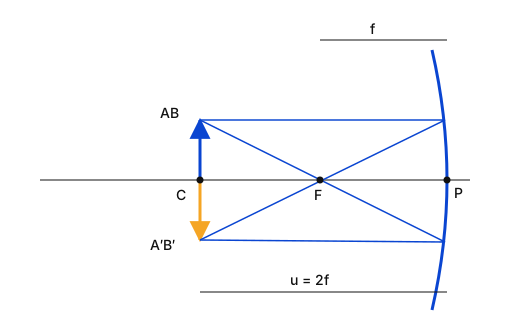
- Same-size image means magnification , so .
- Mirror formula: .
- So (object at C); image is real, inverted and of the same size.
Trick: Object at C → image at C (same size); beyond C → diminished; between F and C → enlarged.
Answer: (B) equal to 2f
अवधारणा: अवतल दर्पण में वक्रता केंद्र C ध्रुव से दूरी पर होता है। वस्तु को C पर रखने से प्रतिबिंब भी C पर ही बनता है।
- समान आकार का प्रतिबिंब अर्थात आवर्धन , इसलिए ।
- दर्पण सूत्र: ।
- अतः (वस्तु C पर); प्रतिबिंब वास्तविक, उल्टा और समान आकार का।
ट्रिक: वस्तु C पर → प्रतिबिंब C पर (समान आकार); C से परे → छोटा; F और C के बीच → बड़ा।
उत्तर: (B) 2f के बराबर
RRB Technician Grade IIIGeneral ScienceConcave mirror – image formationRRB Technician Grade III 2024 · 29 Dec Shift 3
Q482.Identify the INCORRECT statement related to neurons.
न्यूरॉन (तंत्रिका कोशिका) से संबंधित गलत कथन की पहचान कीजिए।
- ANeurons typically have one long section called the axon.न्यूरॉन में सामान्यतः एक लंबा भाग होता है जिसे एक्सॉन (axon) कहते हैं।
- BEach neuron has multiple short, branching sections called dendrites.प्रत्येक न्यूरॉन में कई छोटे, शाखित भाग होते हैं जिन्हें डेंड्राइट (dendrites) कहते हैं।
- CNervous tissue consists of cells known as neurons.तंत्रिका ऊतक न्यूरॉन नामक कोशिकाओं से बना होता है।
- DThe cell body of a neuron has many nuclei.न्यूरॉन के कोशिका काय में कई केंद्रक होते हैं।
Show answer
Concept: A neuron (nerve cell) is the structural and functional unit of nervous tissue. It has a cell body (cyton), dendrites and an axon.
- Each neuron has one long axon that carries impulses away from the cell body.
- It has many short branched dendrites that receive impulses.
- The cell body contains a single nucleus, not many nuclei – so statement (D) is incorrect.
Yaad rakhein: Neuron = one nucleus, one axon, many dendrites. (Many nuclei is a feature of skeletal muscle fibres.)
Answer: (D) The cell body of a neuron has many nuclei.
अवधारणा: न्यूरॉन (तंत्रिका कोशिका) तंत्रिका ऊतक की संरचनात्मक व क्रियात्मक इकाई है। इसमें कोशिका काय (साइटॉन), द्रुमिका (डेंड्राइट) और तंत्रिकाक्ष (एक्सॉन) होते हैं।
- प्रत्येक न्यूरॉन में एक लंबा एक्सॉन होता है जो आवेग को कोशिका काय से दूर ले जाता है।
- इसमें कई छोटी शाखित द्रुमिकाएँ होती हैं जो आवेग ग्रहण करती हैं।
- कोशिका काय में केवल एक केंद्रक होता है, अनेक नहीं – अतः कथन (D) गलत है।
याद रखें: न्यूरॉन = एक केंद्रक, एक एक्सॉन, अनेक डेंड्राइट। (बहुकेंद्रकी होना कंकाल पेशी तंतु का लक्षण है।)
उत्तर: (D) न्यूरॉन के कोशिका काय में कई केंद्रक होते हैं।
RRB Technician Grade IIIGeneral ScienceStructure of neuronRRB Technician Grade III 2024 · 29 Dec Shift 3
Q483.The energy transfer within the food web has a ________ pattern.
खाद्य जाल (food web) में ऊर्जा स्थानांतरण का ________ प्रतिरूप होता है।
- AUnidirectionalएकदिशीय
- BCircularवृत्ताकार
- CMultidimensionalबहुआयामी
- DBidirectionalद्विदिशीय
Show answer
Concept: In a food chain or food web, energy flows from the sun → producers → herbivores → carnivores, and never returns to the previous level.
- Energy captured by autotrophs does not go back to the sun.
- Energy passed to herbivores does not come back to autotrophs.
- At each level some energy is lost as heat, so the flow is one-way (unidirectional).
Yaad rakhein: Energy flows (one-way); nutrients cycle (circular).
Answer: (A) Unidirectional
अवधारणा: खाद्य श्रृंखला या खाद्य जाल में ऊर्जा सूर्य → उत्पादक → शाकाहारी → मांसाहारी की ओर बहती है और पिछले स्तर पर कभी वापस नहीं लौटती।
- स्वपोषियों द्वारा ग्रहण की गई ऊर्जा सूर्य को वापस नहीं जाती।
- शाकाहारियों को मिली ऊर्जा स्वपोषियों को वापस नहीं लौटती।
- हर स्तर पर कुछ ऊर्जा ऊष्मा के रूप में नष्ट होती है, अतः प्रवाह एकदिशीय होता है।
याद रखें: ऊर्जा का प्रवाह एकदिशीय; पोषक तत्वों का चक्रण (चक्रीय)।
उत्तर: (A) एकदिशीय
RRB Technician Grade IIIGeneral ScienceEnergy flow in ecosystemRRB Technician Grade III 2024 · 29 Dec Shift 3
Q484.What will happen if you pour some acetone on your palm?
यदि आप अपनी हथेली पर कुछ एसीटोन डालें तो क्या होगा?
- AIt will cause no effect on the palm.हथेली पर इसका कोई प्रभाव नहीं होगा।
- BIt will cause the palm to feel cool.हथेली ठंडी महसूस होगी।
- CIt will cause the palm to feel hot.हथेली गर्म महसूस होगी।
- DIt will cause the palm to feel itchy.हथेली में खुजली महसूस होगी।
Show answer
Concept: Evaporation causes cooling. A volatile liquid takes the latent heat of vaporisation from the surface it is on.
- Acetone is highly volatile and evaporates quickly at room temperature.
- The energy needed for evaporation is absorbed from the palm.
- The palm loses heat, so it feels cool.
Yaad rakhein: Acetone, petrol, perfume, spirit on skin → quick evaporation → cooling.
Answer: (B) It will cause the palm to feel cool.
अवधारणा: वाष्पन से शीतलता उत्पन्न होती है। वाष्पशील द्रव जिस सतह पर होता है, उससे वाष्पन की गुप्त ऊष्मा ले लेता है।
- एसीटोन अत्यधिक वाष्पशील है और कमरे के ताप पर तेजी से वाष्पित होता है।
- वाष्पन के लिए आवश्यक ऊर्जा हथेली से अवशोषित होती है।
- हथेली की ऊष्मा घटती है, इसलिए वह ठंडी महसूस होती है।
याद रखें: एसीटोन, पेट्रोल, इत्र, स्पिरिट त्वचा पर → तेज वाष्पन → ठंडक।
उत्तर: (B) हथेली ठंडी महसूस होगी।
RRB Technician Grade IIIGeneral ScienceEvaporation causes coolingRRB Technician Grade III 2024 · 29 Dec Shift 3
Q485.Select the INCORRECT pair.
गलत युग्म का चयन कीजिए।
- ALactic acid – 4 carbon moleculesलैक्टिक अम्ल – 4 कार्बन अणु
- BPyruvate – 3 carbon moleculesपाइरुवेट – 3 कार्बन अणु
- CGlucose – 6 carbon moleculesग्लूकोज – 6 कार्बन अणु
- DEthanol – 2 carbon moleculesएथेनॉल – 2 कार्बन अणु
Show answer
Concept: In respiration, glucose (6-carbon) is broken in the cytoplasm into two molecules of pyruvate (3-carbon). Pyruvate then forms different products.
- Glucose – 6 carbons ✔
- Pyruvate – 3 carbons ✔
- Anaerobic (yeast): ethanol (2 C) + ✔
- Lack of oxygen in muscles: lactic acid – 3 carbons, not 4 ✘
Yaad rakhein: Glucose 6 → pyruvate 3 → lactic acid 3 / ethanol 2 + .
Answer: (A) Lactic acid – 4 carbon molecules
अवधारणा: श्वसन में ग्लूकोज (6-कार्बन) कोशिकाद्रव्य में टूटकर पाइरुवेट (3-कार्बन) के दो अणु बनाता है। पाइरुवेट फिर अलग-अलग उत्पाद बनाता है।
- ग्लूकोज – 6 कार्बन ✔
- पाइरुवेट – 3 कार्बन ✔
- अवायवीय (यीस्ट): एथेनॉल (2 C) + ✔
- पेशियों में ऑक्सीजन की कमी: लैक्टिक अम्ल – 3 कार्बन, 4 नहीं ✘
याद रखें: ग्लूकोज 6 → पाइरुवेट 3 → लैक्टिक अम्ल 3 / एथेनॉल 2 + ।
उत्तर: (A) लैक्टिक अम्ल – 4 कार्बन अणु
RRB Technician Grade IIIGeneral ScienceRespiration – carbon count of moleculesRRB Technician Grade III 2024 · 29 Dec Shift 3
Q486.Which of the following is produced when copper is heated in the presence of air?
जब कॉपर (ताँबे) को वायु की उपस्थिति में गर्म किया जाता है, तो निम्नलिखित में से क्या बनता है?
- ABlack-coloured copper (II) oxideकाले रंग का कॉपर (II) ऑक्साइड
- BBrown-coloured copper(II) oxideभूरे रंग का कॉपर(II) ऑक्साइड
- CBlack-coloured copper (I) oxideकाले रंग का कॉपर (I) ऑक्साइड
- DBlue-coloured copper(II) oxideनीले रंग का कॉपर(II) ऑक्साइड
Show answer
Concept: When copper powder is heated in air, it combines with oxygen to form copper(II) oxide, which is black.
- Reaction: .
- Copper is brown/reddish; the surface turns black due to .
- Copper(I) oxide is red, not black.
Yaad rakhein: Heated copper turns black (); passing over hot turns it brown again (reduction).
Answer: (A) Black-coloured copper (II) oxide
अवधारणा: कॉपर चूर्ण को वायु में गर्म करने पर वह ऑक्सीजन से मिलकर कॉपर(II) ऑक्साइड बनाता है, जो काले रंग का होता है।
- अभिक्रिया: ।
- कॉपर भूरा/लालिमा लिए होता है; सतह बनने से काली हो जाती है।
- कॉपर(I) ऑक्साइड लाल होता है, काला नहीं।
याद रखें: गर्म कॉपर काला (); गर्म पर प्रवाहित करने से फिर भूरा (अपचयन)।
उत्तर: (A) काले रंग का कॉपर (II) ऑक्साइड
RRB Technician Grade IIIGeneral ScienceOxidation of copperRRB Technician Grade III 2024 · 29 Dec Shift 3
Q487.A current of 1 A is drawn by a filament of an electric bulb for 5 minutes. Then the amount of electric charge that flows through the circuit will be ____________.
एक विद्युत बल्ब का तंतु (filament) 5 मिनट तक 1 A की धारा लेता है। तब परिपथ से प्रवाहित होने वाले विद्युत आवेश की मात्रा ____________ होगी।
- A150 C
- B10 C
- C300 C
- D5 C
Show answer
Concept: Electric current is the rate of flow of charge: , so (time in seconds).
- , .
- .
- .
Trick: Always convert minutes to seconds before using .
Answer: (C) 300 C
अवधारणा: विद्युत धारा आवेश प्रवाह की दर है: , अतः (समय सेकंड में)।
- , ।
- ।
- ।
ट्रिक: लगाने से पहले मिनट को सेकंड में बदलें।
उत्तर: (C) 300 C
RRB Technician Grade IIIGeneral ScienceElectric charge and currentRRB Technician Grade III 2024 · 29 Dec Shift 3
Q488.The kinetic energy E possessed by an object of mass m and moving with a uniform velocity v is ______.
द्रव्यमान m वाली तथा एकसमान वेग v से गतिमान किसी वस्तु की गतिज ऊर्जा E ______ होती है।
- A
- B
- C
- D
Show answer
Concept: Kinetic energy is the energy possessed by a body due to its motion. It equals the work done to bring the body from rest to velocity .
- Using with : .
- Work .
- So .
Yaad rakhein: Double the speed → KE becomes 4 times (since ).
Answer: (B)
अवधारणा: गतिज ऊर्जा वह ऊर्जा है जो किसी वस्तु में उसकी गति के कारण होती है। यह वस्तु को विराम से वेग तक लाने में किए गए कार्य के बराबर है।
- में रखने पर: ।
- कार्य ।
- अतः ।
याद रखें: वेग दोगुना → गतिज ऊर्जा 4 गुनी (क्योंकि )।
उत्तर: (B)
RRB Technician Grade IIIGeneral ScienceKinetic energyRRB Technician Grade III 2024 · 29 Dec Shift 3
Q489.The sodium or potassium salts of which acid are defined as soaps?
किस अम्ल के सोडियम या पोटैशियम लवणों को साबुन के रूप में परिभाषित किया जाता है?
- ASulphuric acidसल्फ्यूरिक अम्ल
- BHydrochloric acidहाइड्रोक्लोरिक अम्ल
- CCarboxylic acidकार्बोक्सिलिक अम्ल
- DNitric acidनाइट्रिक अम्ल
Show answer
Concept: Soaps are sodium or potassium salts of long-chain carboxylic acids (fatty acids), e.g. sodium stearate .
- Soaps are made by saponification: oil/fat + → soap + glycerol.
- The ionic end () is water-loving; the long hydrocarbon tail is oil-loving.
- Detergents, in contrast, are sodium salts of sulphonic acids.
Yaad rakhein: Soap → carboxylic acid salt; Detergent → sulphonic acid salt.
Answer: (C) Carboxylic acid
अवधारणा: साबुन लंबी श्रृंखला वाले कार्बोक्सिलिक अम्लों (वसा अम्लों) के सोडियम या पोटैशियम लवण हैं, जैसे सोडियम स्टीयरेट ।
- साबुन साबुनीकरण से बनते हैं: तेल/वसा + → साबुन + ग्लिसरॉल।
- आयनिक सिरा () जलरागी और लंबी हाइड्रोकार्बन पूँछ तेलरागी होती है।
- इसके विपरीत, अपमार्जक सल्फोनिक अम्लों के सोडियम लवण होते हैं।
याद रखें: साबुन → कार्बोक्सिलिक अम्ल का लवण; अपमार्जक → सल्फोनिक अम्ल का लवण।
उत्तर: (C) कार्बोक्सिलिक अम्ल
RRB Technician Grade IIIGeneral ScienceSoapsRRB Technician Grade III 2024 · 29 Dec Shift 3
Q490.Which of the following statements is correct when an acid is dissolved in water ?
a) The separation of ions from HCl molecules cannot occur in the absence of water.
b) Hydrogen ions must always be shown as (aq) or hydronium ion ().
जब किसी अम्ल को जल में घोला जाता है, तो निम्नलिखित में से कौन-सा कथन सही है?
a) जल की अनुपस्थिति में HCl अणुओं से आयनों का पृथक्करण नहीं हो सकता।
b) हाइड्रोजन आयनों को सदैव (aq) या हाइड्रोनियम आयन () के रूप में दर्शाया जाना चाहिए।
- AOnly aकेवल a
- BNeither a nor bन तो a और न ही b
- CBoth a and ba और b दोनों
- DOnly bकेवल b
Show answer
Concept: Acids show acidic behaviour only in water, because water helps them release ions.
- – without water, does not separate from HCl. Statement a is correct.
- cannot exist alone; it combines with water: .
- So hydrogen ions are always written as or . Statement b is correct.
Yaad rakhein: Dry HCl gas does not change the colour of dry blue litmus – no water, no .
Answer: (C) Both a and b
अवधारणा: अम्ल केवल जल में ही अम्लीय व्यवहार दिखाते हैं, क्योंकि जल उन्हें आयन मुक्त करने में मदद करता है।
- – जल के बिना HCl से अलग नहीं होता। कथन a सही है।
- अकेले नहीं रह सकता; यह जल से जुड़ता है: ।
- इसलिए हाइड्रोजन आयन को सदैव या लिखा जाता है। कथन b सही है।
याद रखें: शुष्क HCl गैस शुष्क नीले लिटमस का रंग नहीं बदलती – जल नहीं तो नहीं।
उत्तर: (C) a और b दोनों
RRB Technician Grade IIIGeneral ScienceAcids in water – H⁺ / hydronium ionsRRB Technician Grade III 2024 · 29 Dec Shift 3
Q491.Which of the following was discovered by Rutherford’s gold foil experiment?
रदरफोर्ड के स्वर्ण पन्नी (gold foil) प्रयोग द्वारा निम्नलिखित में से किसकी खोज की गई थी?
- AElectronइलेक्ट्रॉन
- BProtonप्रोटॉन
- CNucleusनाभिक
- DNeutronन्यूट्रॉन
Show answer
Concept: Rutherford bombarded a thin gold foil with fast α-particles and studied how they scattered. This led to the discovery of the nucleus (1911).
- Most α-particles passed straight → most of the atom is empty space.
- A few were deflected → positive charge occupies a very small volume.
- Very few (about 1 in 20,000) bounced back → a tiny, dense, positively charged nucleus at the centre.
Yaad rakhein: Electron – J.J. Thomson; Proton – Goldstein; Nucleus – Rutherford; Neutron – Chadwick.
Answer: (C) Nucleus
अवधारणा: रदरफोर्ड ने पतली सोने की पन्नी पर तीव्र α-कणों की बौछार की और उनके प्रकीर्णन का अध्ययन किया। इससे नाभिक की खोज हुई (1911)।
- अधिकांश α-कण सीधे निकल गए → परमाणु का अधिकांश भाग खाली है।
- कुछ कण विचलित हुए → धनावेश बहुत छोटे आयतन में है।
- बहुत कम (लगभग 20,000 में 1) वापस लौटे → केंद्र में अत्यंत छोटा, सघन, धनावेशित नाभिक।
याद रखें: इलेक्ट्रॉन – जे.जे. थॉमसन; प्रोटॉन – गोल्डस्टीन; नाभिक – रदरफोर्ड; न्यूट्रॉन – चैडविक।
उत्तर: (C) नाभिक
RRB Technician Grade IIIGeneral ScienceRutherford's α-scattering experimentRRB Technician Grade III 2024 · 29 Dec Shift 3
Q492.If the earth had no atmosphere, then the colour of the sky would be _________.
यदि पृथ्वी पर कोई वायुमंडल न होता, तो आकाश का रंग _________ होता।
- Ablackकाला
- Bblueनीला
- Cyellowपीला
- Dredलाल
Show answer
Concept: The sky looks blue because tiny air molecules scatter blue light (shorter wavelength) much more than red light.
- Scattering needs particles of the atmosphere.
- With no atmosphere, there would be no scattering of sunlight.
- No scattered light reaches the eye from the sky, so it appears dark (black).
Yaad rakhein: Astronauts and the Moon's sky see a black sky – no atmosphere, no scattering.
Answer: (A) black
अवधारणा: आकाश नीला दिखता है क्योंकि वायु के सूक्ष्म अणु नीले प्रकाश (कम तरंगदैर्ध्य) को लाल की तुलना में अधिक प्रकीर्णित करते हैं।
- प्रकीर्णन के लिए वायुमंडल के कण आवश्यक हैं।
- वायुमंडल न होने पर सूर्य के प्रकाश का प्रकीर्णन नहीं होगा।
- आकाश से कोई प्रकीर्णित प्रकाश आँख तक नहीं पहुँचेगा, इसलिए वह काला दिखेगा।
याद रखें: अंतरिक्ष यात्रियों को और चंद्रमा पर आकाश काला दिखता है – वायुमंडल नहीं, प्रकीर्णन नहीं।
उत्तर: (A) काला
RRB Technician Grade IIIGeneral ScienceScattering of light – colour of skyRRB Technician Grade III 2024 · 29 Dec Shift 3
Q493.The speed of light is ____________.
प्रकाश की चाल ____________ है।
- Agreater in glass than in waterजल की तुलना में काँच में अधिक
- Bsame in air, glass and waterवायु, काँच और जल में समान
- Cgreater in water than in airवायु की तुलना में जल में अधिक
- Dgreater in water than in glassकाँच की तुलना में जल में अधिक
Show answer
Concept: Speed of light in a medium ; a greater refractive index means a smaller speed.
- Refractive indices: air , water , glass .
- So speed: air water glass.
- Hence light is faster in water than in glass.
Trick: Optically denser medium → light slows down (higher , lower ).
Answer: (D) greater in water than in glass
अवधारणा: किसी माध्यम में प्रकाश की चाल ; अपवर्तनांक जितना अधिक, चाल उतनी कम।
- अपवर्तनांक: वायु , जल , काँच ।
- अतः चाल: वायु जल काँच।
- इसलिए प्रकाश जल में काँच की तुलना में तेज चलता है।
ट्रिक: प्रकाशतः सघन माध्यम → प्रकाश की चाल कम (अधिक , कम )।
उत्तर: (D) काँच की तुलना में जल में अधिक
RRB Technician Grade IIIGeneral ScienceSpeed of light in mediaRRB Technician Grade III 2024 · 29 Dec Shift 3
Q494.Which of the following is the general formula of alkane?
निम्नलिखित में से कौन-सा एल्केन (alkane) का सामान्य सूत्र है?
- A
- B
- C
- D
Show answer
Concept: Alkanes are saturated hydrocarbons with only single C–C bonds. Their general formula is .
- Methane (): ; ethane (): .
- Alkenes (one double bond): .
- Alkynes (one triple bond): .
Trick: Alkane +2, alkene 0, alkyne −2 (H count relative to ).
Answer: (D)
अवधारणा: एल्केन संतृप्त हाइड्रोकार्बन हैं जिनमें केवल एकल C–C आबंध होते हैं। इनका सामान्य सूत्र है।
- मेथेन (): ; एथेन (): ।
- एल्कीन (एक द्विआबंध): ।
- एल्काइन (एक त्रिआबंध): ।
ट्रिक: एल्केन +2, एल्कीन 0, एल्काइन −2 ( के सापेक्ष H की संख्या)।
उत्तर: (D)
RRB Technician Grade IIIGeneral ScienceAlkanes – general formulaRRB Technician Grade III 2024 · 29 Dec Shift 3
Q495.Which of the following is NOT a suitable method to deal with non-biodegradable substances?
निम्नलिखित में से कौन-सी विधि अजैव निम्नीकरणीय (non-biodegradable) पदार्थों से निपटने के लिए उपयुक्त नहीं है?
- AReuse themउनका पुन: उपयोग करना
- BReduce their productionउनका उत्पादन कम करना
- CThrow them openlyउन्हें खुले में फेंकना
- DRecycle themउनका पुनर्चक्रण करना
Show answer
Concept: Non-biodegradable substances (plastics, glass, metals) are not broken down by microbes and stay in the environment for a long time.
- Reduce – use less of such materials.
- Reuse – use items again; Recycle – convert them into new products.
- Throwing them openly pollutes soil and water, blocks drains and harms animals – not a suitable method.
Yaad rakhein: 3 R's – Reduce, Reuse, Recycle. Open dumping is never a solution.
Answer: (C) Throw them openly
अवधारणा: अजैव-निम्नीकरणीय पदार्थ (प्लास्टिक, काँच, धातु) सूक्ष्मजीवों द्वारा अपघटित नहीं होते और लंबे समय तक पर्यावरण में बने रहते हैं।
- कम उपयोग (Reduce) – ऐसे पदार्थों का उपयोग घटाएँ।
- पुनः उपयोग (Reuse) – वस्तुओं को दोबारा उपयोग करें; पुनःचक्रण (Recycle) – नए उत्पाद बनाएँ।
- इन्हें खुले में फेंकने से मिट्टी व जल प्रदूषित होते हैं, नालियाँ बंद होती हैं, जीवों को हानि होती है – यह उचित तरीका नहीं है।
याद रखें: 3 R – Reduce, Reuse, Recycle। खुले में फेंकना कभी समाधान नहीं।
उत्तर: (C) उन्हें खुले में फेंकना
RRB Technician Grade IIIGeneral ScienceManaging non-biodegradable wasteRRB Technician Grade III 2024 · 29 Dec Shift 3
Q496.If a constant force of 2 Newton is applied on a body such that displacement of the body in the direction of the applied force is zero, then the work done by the force is _____.
यदि किसी पिंड पर 2 न्यूटन का एक नियत बल इस प्रकार लगाया जाता है कि लगाए गए बल की दिशा में पिंड का विस्थापन शून्य है, तो बल द्वारा किया गया कार्य _____ है।
- A1 joules1 जूल
- B20 joules20 जूल
- C2 joules2 जूल
- D0
Show answer
Concept: Work done by a constant force: , where is the displacement in the direction of the force.
- , .
- .
- No displacement along the force → no work, however large the force.
Yaad rakhein: Pushing a wall or holding a load still → work done .
Answer: (D) 0
अवधारणा: स्थिर बल द्वारा किया गया कार्य: , जहाँ बल की दिशा में विस्थापन है।
- , ।
- ।
- बल की दिशा में विस्थापन नहीं → कार्य नहीं, बल चाहे कितना भी हो।
याद रखें: दीवार को धकेलना या भार को स्थिर पकड़े रखना → कार्य ।
उत्तर: (D) 0
RRB Technician Grade IIIGeneral ScienceWork done – zero displacementRRB Technician Grade III 2024 · 29 Dec Shift 3
Q497.An electric geyser of resistance 4 Ω produces 100 J of heat per sec. The current flowing through it will be:
4 Ω प्रतिरोध वाला एक विद्युत गीज़र प्रति सेकंड 100 J ऊष्मा उत्पन्न करता है। इसमें प्रवाहित होने वाली धारा होगी:
- A5 A
- B50 A
- C25 A
- D2.5 A
Show answer
Concept: Heat produced per second (power) in a resistor: .
- , .
- .
- .
Yaad rakhein: Heat per second ; total heat .
Answer: (A) 5 A
अवधारणा: प्रतिरोधक में प्रति सेकंड उत्पन्न ऊष्मा (शक्ति): ।
- , ।
- ।
- ।
याद रखें: प्रति सेकंड ऊष्मा ; कुल ऊष्मा ।
उत्तर: (A) 5 A
RRB Technician Grade IIIGeneral ScienceJoule's law of heatingRRB Technician Grade III 2024 · 29 Dec Shift 3
Q498.Which of the following best describes the mixture of air?
निम्नलिखित में से कौन-सा वायु के मिश्रण का सबसे अच्छा वर्णन करता है?
- AColloidsकोलॉइड
- BSuspensionनिलंबन (suspension)
- CHeterogeneous mixtureविषमांगी मिश्रण
- DHomogeneous mixtureसमांगी मिश्रण
Show answer
Concept: A homogeneous mixture has a uniform composition throughout and no visible boundaries between its components.
- Air is a mixture of gases – mainly (~78%) and (~21%), plus Ar, , water vapour.
- The gases mix uniformly, so any sample has the same composition.
- Hence air is a homogeneous mixture (a gaseous solution).
Yaad rakhein: Air, sugar solution, brass – homogeneous; muddy water, oil + water – heterogeneous.
Answer: (D) Homogeneous mixture
अवधारणा: समांगी मिश्रण का संघटन पूरे में एक समान होता है और घटकों के बीच कोई दृश्य सीमा नहीं होती।
- वायु गैसों का मिश्रण है – मुख्यतः (~78%) और (~21%), साथ में Ar, , जलवाष्प।
- गैसें समान रूप से मिल जाती हैं, इसलिए किसी भी नमूने का संघटन समान होता है।
- अतः वायु समांगी मिश्रण (गैसीय विलयन) है।
याद रखें: वायु, चीनी का घोल, पीतल – समांगी; गंदला पानी, तेल + पानी – विषमांगी।
उत्तर: (D) समांगी मिश्रण
RRB Technician Grade IIIGeneral ScienceAir – homogeneous mixtureRRB Technician Grade III 2024 · 29 Dec Shift 3
Q499.Which of the following statements is/are correct related to eco-system?
(i) UV radiation is not damaging to organisms.
(ii) Ozone at the higher levels of the atmosphere is a product of UV radiation acting on oxygen molecule.
(iii) The amount of ozone in the atmosphere began to drop sharply in 1980.
पारितंत्र (eco-system) से संबंधित निम्नलिखित में से कौन-सा/से कथन सही है/हैं?
(i) UV विकिरण जीवों के लिए हानिकारक नहीं है।
(ii) वायुमंडल के उच्च स्तरों पर ओज़ोन, ऑक्सीजन अणु पर UV विकिरण की क्रिया का उत्पाद है।
(iii) वायुमंडल में ओज़ोन की मात्रा 1980 में तेज़ी से घटने लगी।
- A(i), (ii) and (iii)(i), (ii) और (iii)
- BOnly (ii) and (iii)केवल (ii) और (iii)
- COnly (i)केवल (i)
- DOnly (i) and (ii)केवल (i) और (ii)
Show answer
Concept: Ozone () in the upper atmosphere shields the earth from harmful ultraviolet (UV) radiation of the sun.
- (i) UV radiation is highly damaging (e.g. skin cancer) – incorrect.
- (ii) UV splits into O atoms, which combine with to form – correct.
- (iii) Ozone levels began to drop sharply in the 1980s, linked to CFCs – correct.
Yaad rakhein: , ; CFCs deplete ozone (Montreal Protocol, 1987).
Answer: (B) Only (ii) and (iii)
अवधारणा: ऊपरी वायुमंडल में ओज़ोन () पृथ्वी को सूर्य के हानिकारक पराबैंगनी (UV) विकिरण से बचाती है।
- (i) UV विकिरण अत्यधिक हानिकारक है (जैसे त्वचा कैंसर) – गलत।
- (ii) UV को O परमाणुओं में तोड़ता है, जो से मिलकर बनाते हैं – सही।
- (iii) 1980 के दशक में ओज़ोन की मात्रा तेजी से घटने लगी, CFC इसका कारण – सही।
याद रखें: , ; CFC ओज़ोन घटाते हैं (मॉन्ट्रियल प्रोटोकॉल, 1987)।
उत्तर: (B) केवल (ii) और (iii)
RRB Technician Grade IIIGeneral ScienceOzone layerRRB Technician Grade III 2024 · 29 Dec Shift 3
Q500.Match the following.
(i) Ovary | (a) fertilisation
(ii) Oviduct | (b) implantation
(iii) Uterus | (c) nourishes the growing embryo
(iv) Placenta | (d) makes the female gametes
निम्नलिखित का मिलान कीजिए।
(i) अंडाशय (Ovary) | (a) निषेचन
(ii) अंडवाहिनी (Oviduct) | (b) रोपण (implantation)
(iii) गर्भाशय (Uterus) | (c) विकसित हो रहे भ्रूण को पोषण देता है
(iv) अपरा (Placenta) | (d) मादा युग्मक बनाता है
- A(i)-(d), (ii)-(b), (iii)-(a), (iv)-(c)
- B(i)-(d), (ii)-(c), (iii)-(b), (iv)-(a)
- C(i)-(d), (ii)-(a), (iii)-(b), (iv)-(c)
- D(i)-(b), (ii)-(a), (iii)-(d), (iv)-(c)
Show answer
Concept: Each part of the female reproductive system has a specific role from making eggs to nourishing the embryo.
- Ovary → makes female gametes (eggs): (i)-(d).
- Oviduct (fallopian tube) → site of fertilisation: (ii)-(a).
- Uterus → implantation of the embryo: (iii)-(b).
- Placenta → nourishes the growing embryo: (iv)-(c).
Trick: Egg made in ovary → meets sperm in oviduct → sticks in uterus → fed by placenta.
Answer: (C) (i)-(d), (ii)-(a), (iii)-(b), (iv)-(c)
अवधारणा: मादा जनन तंत्र के प्रत्येक भाग की विशिष्ट भूमिका है – अंडाणु बनाने से लेकर भ्रूण के पोषण तक।
- अंडाशय → मादा युग्मक (अंडाणु) बनाता है: (i)-(d)।
- अंडवाहिनी (फैलोपियन ट्यूब) → निषेचन का स्थान: (ii)-(a)।
- गर्भाशय → भ्रूण का रोपण: (iii)-(b)।
- अपरा (प्लेसेंटा) → विकसित होते भ्रूण को पोषण: (iv)-(c)।
ट्रिक: अंडाशय में अंडाणु → अंडवाहिनी में शुक्राणु से मिलन → गर्भाशय में रोपण → अपरा से पोषण।
उत्तर: (C) (i)-(d), (ii)-(a), (iii)-(b), (iv)-(c)
RRB Technician Grade IIIGeneral ScienceHuman female reproductive systemRRB Technician Grade III 2024 · 29 Dec Shift 3

