Q501.What will come in the place of ‘?’ in the following equation, if ‘+’ and ‘÷’ are interchanged and ‘×’ and ‘−’ are interchanged?
?
यदि ‘+’ और ‘÷’ को आपस में बदल दिया जाए तथा ‘×’ और ‘−’ को आपस में बदल दिया जाए, तो निम्नलिखित समीकरण में ‘?’ के स्थान पर क्या आएगा?
?
- A24
- B19
- C14
- D27
Show answer
Concept: Swap and , then apply BODMAS.
- becomes
Trick: Rewrite the full expression first, then solve – don't swap mentally.
Answer: (A) 24
अवधारणा: और बदलें, फिर BODMAS लगाएँ।
- बनता है
ट्रिक: पहले पूरा व्यंजक दोबारा लिखें, फिर हल करें – मन में बदलाव न करें।
उत्तर: (A) 24
RRB Technician Grade IIIGeneral Intelligence and ReasoningInterchanging signsRRB Technician Grade III 2024 · 27 Dec Shift 1
Q502.In a certain code language, ‘email needs internet’ is coded as ‘ma bi cy’ and ‘radio needs waves’ is coded as ‘cy nu ph’. What is the code for ‘needs’ in the given code language?
एक निश्चित कूट भाषा में, ‘email needs internet’ को ‘ma bi cy’ के रूप में कूटबद्ध किया जाता है और ‘radio needs waves’ को ‘cy nu ph’ के रूप में कूटबद्ध किया जाता है। दी गई कूट भाषा में ‘needs’ के लिए कूट क्या है?
- Aph
- Bbi
- Cnu
- Dcy
Show answer
Concept: A word common to two sentences has the code common to both.
- "needs" appears in both sentences
- Codes common to "ma bi cy" and "cy nu ph" = cy
- So needs = cy
Trick: Match common words with common codes.
Answer: (D) cy
अवधारणा: दो वाक्यों में उभयनिष्ठ शब्द का कोड भी दोनों कोडों में उभयनिष्ठ होता है।
- "needs" दोनों वाक्यों में है
- "ma bi cy" और "cy nu ph" में उभयनिष्ठ कोड = cy
- अतः needs = cy
ट्रिक: उभयनिष्ठ शब्द ↔ उभयनिष्ठ कोड मिलाएँ।
उत्तर: (D) cy
RRB Technician Grade IIIGeneral Intelligence and ReasoningCoding-decoding – common wordsRRB Technician Grade III 2024 · 27 Dec Shift 1
Q503.Select the triad which follows the same pattern as that followed by the two triads given below. Both triads follow the same pattern.
JH-KI-LN
LJ-MK-NP
उस त्रिक का चयन करें जो उसी पैटर्न का अनुसरण करता है जिसका अनुसरण नीचे दिए गए दो त्रिक करते हैं। दोनों त्रिक एक ही पैटर्न का अनुसरण करते हैं।
JH-KI-LN
LJ-MK-NP
- ARP-SQ-TU
- BQO-RP-ST
- COM-PN-QS
- DSQ-TR-UV
Show answer
Concept: Within each pair: 2nd letter 1st for the first two pairs and 1st for the third; first letters run consecutively.
- JH, KI: , ; LN:
- LJ, MK: ; NP:
- (C) OM, PN: , ; QS: ✓
Trick: Check the last pair first: only QS has a gap; others are .
Answer: (C) OM-PN-QS
अवधारणा: प्रत्येक जोड़े में: पहले दो जोड़ों में दूसरा अक्षर पहला , तीसरे में पहला ; पहले अक्षर क्रमागत हैं।
- JH, KI: , ; LN:
- LJ, MK: ; NP:
- (C) OM, PN: , ; QS: ✓
ट्रिक: अंतिम जोड़ा पहले जाँचें: केवल QS में का अंतर है; बाकी में ।
उत्तर: (C) OM-PN-QS
RRB Technician Grade IIIGeneral Intelligence and ReasoningLetter triadsRRB Technician Grade III 2024 · 27 Dec Shift 1
Q504.Based on the English alphabetical order, three of the following four letter-clusters are alike in a certain way and thus form a group. Which letter-cluster does not belong to that group?
(Note: The odd one out is not based on the number of consonants/vowels or their position in the letter-cluster.)
अंग्रेजी वर्णमाला क्रम के आधार पर, निम्नलिखित चार अक्षर-समूहों में से तीन किसी निश्चित प्रकार से एकसमान हैं और इस प्रकार एक समूह बनाते हैं। कौन-सा अक्षर-समूह उस समूह से संबंधित नहीं है?
(ध्यान दें: असंगत अक्षर-समूह, उस अक्षर-समूह में व्यंजनों/स्वरों की संख्या या उनके स्थान पर आधारित नहीं है।)
- AJFB
- BTPL
- CFOZ
- DCYU
Show answer
Concept: Use letter positions and find the common gap.
- JFB: →
- TPL: →
- CYU: (, wrapping), →
- FOZ: → ✗
Trick: Backward wrap: C goes C→B→A→Z→Y.
Answer: (C) FOZ
अवधारणा: अक्षरों के स्थानीय मान लें और समान अंतर खोजें।
- JFB: →
- TPL: →
- CYU: (, चक्रीय), →
- FOZ: → ✗
ट्रिक: पीछे की ओर चक्र: C = C→B→A→Z→Y।
उत्तर: (C) FOZ
RRB Technician Grade IIIGeneral Intelligence and ReasoningOdd one out – letter clustersRRB Technician Grade III 2024 · 27 Dec Shift 1
Q505.Amit starts from Point A and drives 35 km towards East. He then takes a right turn, drives 17 km, turns right and drives 15 km. He then takes a left turn and drives 13 km. He takes a final right turn, drives 20 km and stops at Point P. How far (shortest distance) and towards which direction should he drive in order to reach Point A again?
(All turns are 90 degree turns only unless otherwise specified.)
अमित बिंदु A से चलना शुरू करता है और पूर्व की ओर 35 km गाड़ी चलाता है। फिर वह दाएँ मुड़ता है, 17 km गाड़ी चलाता है, दाएँ मुड़ता है और 15 km गाड़ी चलाता है। फिर वह बाएँ मुड़ता है और 13 km गाड़ी चलाता है। वह अंतिम बार दाएँ मुड़ता है, 20 km गाड़ी चलाता है और बिंदु P पर रुक जाता है। बिंदु A पर फिर से पहुँचने के लिए उसे कितनी दूर (न्यूनतम दूरी) और किस दिशा में गाड़ी चलानी चाहिए?
(जब तक अन्यथा निर्दिष्ट न हो, सभी मोड़ केवल 90 डिग्री के मोड़ हैं।)
- A28 km towards Southदक्षिण की ओर 28 km
- B30 km towards Eastपूर्व की ओर 30 km
- C30 km towards Northउत्तर की ओर 30 km
- D28 km towards Northउत्तर की ओर 28 km
Show answer
Concept: Trace the path on axes (East , North ) and compare final point with start.
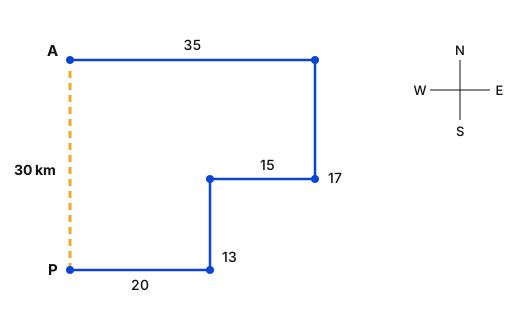
- East 35 → ; right = South 17 →
- Right = West 15 → ; left = South 13 →
- Right = West 20 →
- P is km directly South of A ⇒ drive km North
Trick: East–West: ; South: .
Answer: (C) 30 km towards North
अवधारणा: पथ को अक्षों पर बनाएँ (पूर्व , उत्तर ) और अंतिम बिंदु की आरंभ से तुलना करें।
- पूर्व 35 → ; दाएँ = दक्षिण 17 →
- दाएँ = पश्चिम 15 → ; बाएँ = दक्षिण 13 →
- दाएँ = पश्चिम 20 →
- P, A से ठीक km दक्षिण में है ⇒ km उत्तर जाना होगा
ट्रिक: पूर्व–पश्चिम: ; दक्षिण: ।
उत्तर: (C) उत्तर की ओर 30 km
RRB Technician Grade IIIGeneral Intelligence and ReasoningDirection senseRRB Technician Grade III 2024 · 27 Dec Shift 1
Q506.Refer to the given series and answer the question that follows (all numbers are single-digit numbers only, and all counting is to be done from left to right).
(Left) 4 1 6 1 9 8 8 1 3 8 4 8 6 8 1 9 2 3 3 4 6 2 8 4 5 1 (Right)
How many such odd digits are there, each of which is immediately preceded by an even digit and also immediately followed by an even digit?
दी गई श्रृंखला का संदर्भ लें और उसके बाद पूछे गए प्रश्न का उत्तर दें (सभी संख्याएँ केवल एक अंक वाली संख्याएँ हैं, और सभी गिनती बाएँ से दाएँ की जानी है)।
(बाएँ) 4 1 6 1 9 8 8 1 3 8 4 8 6 8 1 9 2 3 3 4 6 2 8 4 5 1 (दाएँ)
ऐसे कितने विषम अंक हैं, जिनमें से प्रत्येक के ठीक पहले एक सम अंक है और ठीक बाद में भी एक सम अंक है?
- A4
- B2
- C0
- D1
Show answer
Concept: Check every odd digit: its left and right neighbours must both be even.
- 4 1 6 → both even ✓
- 1 (after 6) → next 9 ✗; 9, 3, 1, 9, 3, 3 → a neighbour is odd ✗
- 5 (in 4 5 1) → next 1 ✗
- Count
Trick: Scan only odd digits and stop at the first odd neighbour.
Answer: (D) 1
अवधारणा: प्रत्येक विषम अंक जाँचें: उसके बाएँ और दाएँ दोनों अंक सम होने चाहिए।
- 4 1 6 → दोनों सम ✓
- 1 (6 के बाद) → अगला 9 ✗; 9, 3, 1, 9, 3, 3 → कोई पड़ोसी विषम ✗
- 5 (4 5 1 में) → अगला 1 ✗
- गिनती
ट्रिक: केवल विषम अंक देखें और पहला विषम पड़ोसी मिलते ही छोड़ दें।
उत्तर: (D) 1
RRB Technician Grade IIIGeneral Intelligence and ReasoningDigit series – odd/even neighboursRRB Technician Grade III 2024 · 27 Dec Shift 1
Q507.In a certain code language, ‘TEACH’ is coded as ‘18239’, ‘MAKE’ is coded as ‘4168’ and 'CHECK' is coded as '83943'. What is the code for ‘T’ in the given code language?
एक निश्चित कूट भाषा में, ‘TEACH’ को ‘18239’ के रूप में, ‘MAKE’ को ‘4168’ के रूप में और 'CHECK' को '83943' के रूप में कूटबद्ध किया जाता है। दी गई कूट भाषा में ‘T’ के लिए कूट क्या है?
- A2
- B1
- C9
- D8
Show answer
Concept: Codes are jumbled; compare common letters with common digits.
- CHECK has C twice and 3 twice ⇒ C
- TEACH ∩ CHECK = C, H, E ↔ 3, 8, 9 ⇒ H, E ↔ 8, 9
- TEACH ∩ MAKE = A, E ↔ 1, 8 ⇒ E , A , H
- TEACH = 1 8 2 3 9 ⇒ leftover T
Trick: A repeated letter matches the repeated digit.
Answer: (A) 2
अवधारणा: कोड क्रम में नहीं हैं; उभयनिष्ठ अक्षरों की उभयनिष्ठ अंकों से तुलना करें।
- CHECK में C दो बार और 3 दो बार ⇒ C
- TEACH ∩ CHECK = C, H, E ↔ 3, 8, 9 ⇒ H, E ↔ 8, 9
- TEACH ∩ MAKE = A, E ↔ 1, 8 ⇒ E , A , H
- TEACH = 1 8 2 3 9 ⇒ बचा T
ट्रिक: दोहराया गया अक्षर दोहराए गए अंक से मेल खाता है।
उत्तर: (A) 2
RRB Technician Grade IIIGeneral Intelligence and ReasoningCoding-decoding – letter to digitRRB Technician Grade III 2024 · 27 Dec Shift 1
Q508.In a certain code language,
'A + B' means ‘A is the sister of B’,
'A – B' means ‘A is the husband of B’,
'A x B' means ‘A is the mother of B’
and 'A ÷ B' means ‘A is the son of B’.
How is S related to W if ‘R – S x T + U – V x W'?
एक निश्चित कूट भाषा में,
'A + B' का अर्थ है ‘A, B की बहन है’,
'A – B' का अर्थ है ‘A, B का पति है’,
'A x B' का अर्थ है ‘A, B की माता है’
और 'A ÷ B' का अर्थ है ‘A, B का पुत्र है’।
यदि ‘R – S x T + U – V x W' है, तो S, W से किस प्रकार संबंधित है?
- AMotherमाता
- BSisterबहन
- CMother's motherमाता की माता
- DFather's motherपिता की माता
Show answer
Concept: Decode each symbol and build the family tree.
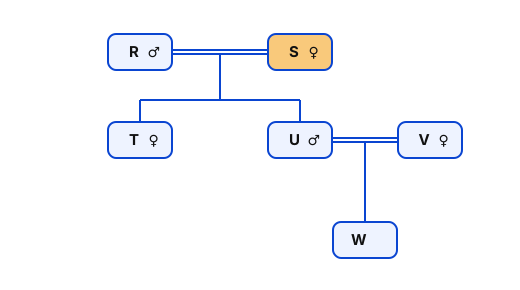
- R – S: R is husband of S; S × T: S is mother of T
- T + U: T is sister of U ⇒ S is mother of U
- U – V: U is husband of V; V × W: V is mother of W ⇒ U is father of W
- S is mother of W's father
Trick: Draw couples with double lines and generations level by level.
Answer: (D) Father's mother
अवधारणा: प्रत्येक चिह्न को डिकोड करें और वंश-वृक्ष बनाएँ।
- R – S: R, S का पति है; S × T: S, T की माँ है
- T + U: T, U की बहन है ⇒ S, U की माँ है
- U – V: U, V का पति है; V × W: V, W की माँ है ⇒ U, W का पिता है
- S, W के पिता की माँ है (दादी)
ट्रिक: दंपति को दोहरी रेखा से और पीढ़ियों को स्तर-दर-स्तर बनाएँ।
उत्तर: (D) पिता की माता
RRB Technician Grade IIIGeneral Intelligence and ReasoningBlood relations – codedRRB Technician Grade III 2024 · 27 Dec Shift 1
Q509.John, Kelly, Lisa, Mike, Nancy, and Owen—are sitting in a straight line, facing north. Only one person sits to the left of Kelly. Exactly two people sit between Kelly and Lisa. Mike sits second to the right of Owen. Mike is not an immediate neighbor of Lisa. John sits to the immediate right of Lisa.
Who sits at the extreme left end of the line ?
John, Kelly, Lisa, Mike, Nancy और Owen एक सीधी पंक्ति में उत्तर की ओर मुख करके बैठे हैं। Kelly के बाईं ओर केवल एक व्यक्ति बैठा है। Kelly और Lisa के बीच ठीक दो व्यक्ति बैठे हैं। Mike, Owen के दाईं ओर दूसरे स्थान पर बैठा है। Mike, Lisa का निकटतम पड़ोसी नहीं है। John, Lisa के ठीक दाईं ओर बैठा है।
पंक्ति के बाएँ छोर पर कौन बैठा है?
- ANancy
- BOwen
- CMike
- DJohn
Show answer
Concept: Facing North, left of the line = left end; number seats 1 to 6 from the left.
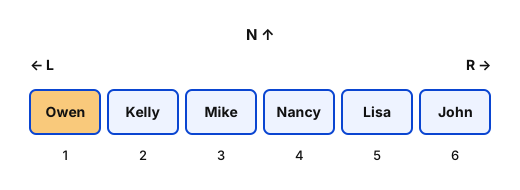
- Only one person left of Kelly ⇒ Kelly at 2
- Two between Kelly and Lisa ⇒ Lisa at 5; John right of Lisa ⇒ John at 6
- Mike 2nd right of Owen: only Owen 1, Mike 3 fits (Mike not next to Lisa ✓)
- Nancy at 4 ⇒ Owen at extreme left
Trick: Fix the most definite clue ("only one to the left") first.
Answer: (B) Owen
अवधारणा: उत्तर की ओर मुख होने पर पंक्ति का बायाँ छोर = बायाँ; बाएँ से स्थान 1 से 6 मानें।
- केली के बाएँ केवल एक व्यक्ति ⇒ केली स्थान 2 पर
- केली और लीसा के बीच दो ⇒ लीसा 5 पर; जॉन लीसा के ठीक दाएँ ⇒ 6 पर
- माइक, ओवेन के दाएँ दूसरा: केवल ओवेन 1, माइक 3 संभव (माइक लीसा का पड़ोसी नहीं ✓)
- नैन्सी 4 पर ⇒ बाएँ छोर पर ओवेन
ट्रिक: सबसे निश्चित सूचना ("बाएँ केवल एक") से शुरू करें।
उत्तर: (B) Owen
RRB Technician Grade IIIGeneral Intelligence and ReasoningLinear seating arrangementRRB Technician Grade III 2024 · 27 Dec Shift 1
Q510.Select the triad which follows the same pattern as that followed by the two triads given below. Both triads follow the same pattern.
JF-BE-HG
MI-EH-KJ
उस त्रिक का चयन कीजिए जो उसी पैटर्न का अनुसरण करता है जिसका अनुसरण नीचे दिए गए दो त्रिक करते हैं। दोनों त्रिक एक ही पैटर्न का अनुसरण करते हैं।
JF-BE-HG
MI-EH-KJ
- AQM-IL-ON
- BPM-IL-OJ
- CQM-IK-ON
- DPM-IL-OK
Show answer
Concept: Find gaps inside each pair and between pairs.
- JF: ; BE: ; HG: (also J→B , B→H )
- MI: ; EH: ; KJ: (M→E , E→K )
- (A) QM: ; IL: ; ON: ; Q→I , I→O ✓
Trick: Eliminate fast: PM is (B, D out); IK is (C out).
Answer: (A) QM-IL-ON
अवधारणा: प्रत्येक जोड़े के भीतर और जोड़ों के बीच का अंतर देखें।
- JF: ; BE: ; HG: (साथ ही J→B , B→H )
- MI: ; EH: ; KJ: (M→E , E→K )
- (A) QM: ; IL: ; ON: ; Q→I , I→O ✓
ट्रिक: जल्दी हटाएँ: PM में (B, D बाहर); IK में (C बाहर)।
उत्तर: (A) QM-IL-ON
RRB Technician Grade IIIGeneral Intelligence and ReasoningLetter triadsRRB Technician Grade III 2024 · 27 Dec Shift 1
Q511.Based on the English alphabetical order, three of the following four letter-clusters are alike in a certain way and thus form a group. Which letter-cluster does not belong to that group?
(Note: The odd one out is not based on the number of consonants/vowels or their position in the letter-cluster.)
अंग्रेजी वर्णमाला क्रम के आधार पर, निम्नलिखित चार अक्षर-समूहों में से तीन किसी निश्चित प्रकार से समान हैं और इस प्रकार एक समूह बनाते हैं। कौन-सा अक्षर-समूह उस समूह से संबंधित नहीं है?
(ध्यान दें: असंगत अक्षर-समूह, अक्षर-समूह में व्यंजनों/स्वरों की संख्या या उनके स्थान पर आधारित नहीं है।)
- AVAF
- BAFK
- CTYD
- DPVZ
Show answer
Concept: Use letter positions (wrap Z→A) and find the common gap.
- VAF: →
- AFK: →
- TYD: →
- PVZ: → ✗
Trick: After Z continue counting: A , D , F .
Answer: (D) PVZ
अवधारणा: अक्षरों के स्थानीय मान लें (Z के बाद A) और समान अंतर खोजें।
- VAF: →
- AFK: →
- TYD: →
- PVZ: → ✗
ट्रिक: Z के बाद गिनती जारी रखें: A , D , F ।
उत्तर: (D) PVZ
RRB Technician Grade IIIGeneral Intelligence and ReasoningOdd one out – letter clustersRRB Technician Grade III 2024 · 27 Dec Shift 1
Q512.What will come in the place of ‘?’ in the following equation, if ‘+’ and ‘÷‘ are interchanged and ‘×’ and ‘–’ are interchanged?
24 + 4 − 15 ÷ 2 × 12 = ?
यदि ‘+’ और ‘÷‘ को आपस में बदल दिया जाए तथा ‘×’ और ‘–’ को आपस में बदल दिया जाए, तो निम्नलिखित समीकरण में ‘?’ के स्थान पर क्या आएगा?
24 + 4 − 15 ÷ 2 × 12 = ?
- A70
- B90
- C100
- D80
Show answer
Concept: Swap and , then apply BODMAS.
- becomes
Trick: Do division and multiplication left to right before addition/subtraction.
Answer: (D) 80
अवधारणा: और बदलें, फिर BODMAS लगाएँ।
- बनता है
ट्रिक: जोड़-घटाव से पहले भाग और गुणा बाएँ से दाएँ करें।
उत्तर: (D) 80
RRB Technician Grade IIIGeneral Intelligence and ReasoningInterchanging signsRRB Technician Grade III 2024 · 27 Dec Shift 1
Q513.Which of the following options should come in place of the question mark (?) in the given series based on the English alphabetical order?
QSU, PRT, OQS, NPR, ?
अंग्रेजी वर्णमाला क्रम के आधार पर दी गई श्रृंखला में प्रश्न चिह्न (?) के स्थान पर निम्नलिखित में से कौन-सा विकल्प आना चाहिए?
QSU, PRT, OQS, NPR, ?
- AMQO
- BMOQ
- COMQ
- DOQM
Show answer
Concept: Each letter of the cluster moves back by one.
- 1st: Q, P, O, N → M
- 2nd: S, R, Q, P → O
- 3rd: U, T, S, R → Q
Trick: Inside each term the letters go (Q S U), so the answer must be M O Q.
Answer: (B) MOQ
अवधारणा: समूह का प्रत्येक अक्षर एक-एक पीछे जाता है।
- पहला: Q, P, O, N → M
- दूसरा: S, R, Q, P → O
- तीसरा: U, T, S, R → Q
ट्रिक: हर पद में अक्षर के अंतर पर हैं (Q S U), अतः उत्तर M O Q।
उत्तर: (B) MOQ
RRB Technician Grade IIIGeneral Intelligence and ReasoningAlphabet seriesRRB Technician Grade III 2024 · 27 Dec Shift 1
Q514.Read the given statements and conclusions carefully. You have to take the given statements to be true even if they seem to be at variance from commonly known facts and decide which conclusion(s) logically follow(s) from the given statements.
Statements:
All wigs are plastics.
All stones are plastics.
Conclusion:
(I) All plastics are wigs.
(II) Some wigs are stones.
दिए गए कथनों और निष्कर्षों को ध्यानपूर्वक पढ़िए। आपको दिए गए कथनों को सत्य मानना है, भले ही वे सामान्यतः ज्ञात तथ्यों से भिन्न प्रतीत होते हों, और निर्णय लेना है कि कौन-सा/से निष्कर्ष दिए गए कथनों का तार्किक रूप से अनुसरण करता है/करते हैं।
कथन:
सभी विग, प्लास्टिक हैं।
सभी पत्थर, प्लास्टिक हैं।
निष्कर्ष:
(I) सभी प्लास्टिक, विग हैं।
(II) कुछ विग, पत्थर हैं।
- AOnly conclusion (II) follows.केवल निष्कर्ष (II) अनुसरण करता है।
- BOnly conclusion (I) follows.केवल निष्कर्ष (I) अनुसरण करता है।
- CBoth conclusions (I) and (II) follow.दोनों निष्कर्ष (I) और (II) अनुसरण करते हैं।
- DNeither conclusion (I) nor (II) follows.न तो निष्कर्ष (I) और न ही (II) अनुसरण करता है।
Show answer
Concept: Draw the possible-case Venn diagram: wigs and stones both inside plastics, possibly separate.
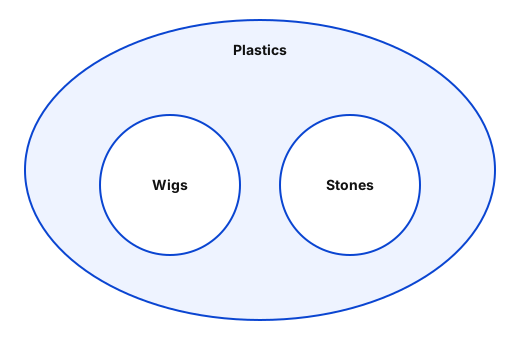
- "All wigs are plastics" does not reverse to "all plastics are wigs": (I) ✗
- Wigs and stones can be disjoint circles inside plastics, so "some wigs are stones" is not certain: (II) ✗
Yaad rakhein: Two "All" statements sharing the same predicate give no link between the subjects.
Answer: (D) Neither conclusion (I) nor (II) follows.
अवधारणा: संभव-स्थिति वेन आरेख बनाएँ: wigs और stones दोनों plastics के अंदर, अलग-अलग भी हो सकते हैं।
- "सभी wigs, plastics हैं" को उलटकर "सभी plastics, wigs हैं" नहीं कह सकते: (I) ✗
- wigs और stones, plastics के भीतर अलग-अलग वृत्त हो सकते हैं, अतः "कुछ wigs, stones हैं" निश्चित नहीं: (II) ✗
याद रखें: दो "सभी" कथनों का विधेय समान हो तो दोनों उद्देश्यों में कोई निश्चित संबंध नहीं बनता।
उत्तर: (D) न तो निष्कर्ष (I) और न ही (II) अनुसरण करता है।
RRB Technician Grade IIIGeneral Intelligence and ReasoningSyllogismRRB Technician Grade III 2024 · 27 Dec Shift 1
Q515.All 37 people are standing in a row facing North. Arav is 14th from the right end while Varun is 21st from the left end. How many people are there between Arav and Varun?
सभी 37 व्यक्ति उत्तर की ओर मुख करके एक पंक्ति में खड़े हैं। आरव दाएँ छोर से 14वें स्थान पर है जबकि वरुण बाएँ छोर से 21वें स्थान पर है। आरव और वरुण के बीच कितने व्यक्ति हैं?
- A2
- B11
- C6
- D4
Show answer
Concept: Convert both positions to the same end: position from left .
- Arav from left
- Varun from left
- Between them
Trick: Between two positions from the same end difference .
Answer: (A) 2
अवधारणा: दोनों स्थान एक ही छोर से लें: बाएँ से स्थान ।
- अरव बाएँ से वाँ
- वरुण बाएँ से वाँ
- दोनों के बीच
ट्रिक: एक ही छोर से दो स्थानों के बीच व्यक्ति अंतर ।
उत्तर: (A) 2
RRB Technician Grade IIIGeneral Intelligence and ReasoningRanking in a rowRRB Technician Grade III 2024 · 27 Dec Shift 1
Q516.B, C, D, E, F, K and L are sitting around a circular table, facing the centre. L sits third to the left of K. Only two people sit between E and F when counted from the left of F. C sits to the immediate right of K. C sits second to the left of E. B is not an immediate neighbour of L. Who sits third to the right of B?
B, C, D, E, F, K और L एक वृत्ताकार मेज के चारों ओर केंद्र की ओर मुख करके बैठे हैं। L, K के बाईं ओर तीसरे स्थान पर बैठा है। F के बाईं ओर से गिनने पर E और F के बीच केवल दो व्यक्ति बैठे हैं। C, K के ठीक दाईं ओर बैठा है। C, E के बाईं ओर दूसरे स्थान पर बैठा है। B, L का निकटतम पड़ोसी नहीं है। B के दाईं ओर तीसरे स्थान पर कौन बैठा है?
- AL
- BF
- CD
- DK
Show answer
Concept: Facing the centre, "left" means clockwise and "right" anticlockwise.
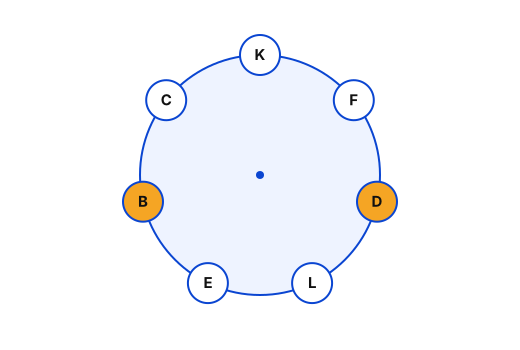
- Fix K; C immediately right of K; L third to the left of K
- C second to the left of E ⇒ E is second to the right of C, i.e. next to L
- E is third to the left of F ⇒ F immediately left of K
- B not next to L ⇒ B between E and C; D between F and L
- Third to the right of B: E, L, D
Trick: Place the person with the most fixed clues (K) first.
Answer: (C) D
अवधारणा: केंद्र की ओर मुख होने पर "बाएँ" = दक्षिणावर्त और "दाएँ" = वामावर्त।
- K को स्थिर करें; C, K के ठीक दाएँ; L, K के बाएँ तीसरे स्थान पर
- C, E के बाएँ दूसरा ⇒ E, C के दाएँ दूसरा अर्थात् L के पास
- E, F के बाएँ तीसरा ⇒ F, K के ठीक बाएँ
- B, L का पड़ोसी नहीं ⇒ B, E और C के बीच; D, F और L के बीच
- B के दाएँ तीसरा: E, L, D
ट्रिक: सबसे अधिक सूचनाओं वाले व्यक्ति (K) को पहले बैठाएँ।
उत्तर: (C) D
RRB Technician Grade IIIGeneral Intelligence and ReasoningCircular seating arrangementRRB Technician Grade III 2024 · 27 Dec Shift 1
Q517.Based on the English alphabetical order, three of the following four letter-clusters are alike in a certain way and thus form a group. Which letter-cluster does not belong to that group?
(Note: The odd one out is not based on the number of consonants/vowels or their position in the letter-cluster.)
अंग्रेजी वर्णमाला क्रम के आधार पर, निम्नलिखित चार अक्षर-समूहों में से तीन किसी निश्चित प्रकार से एकसमान हैं और इस प्रकार एक समूह बनाते हैं। कौन-सा अक्षर-समूह उस समूह से संबंधित नहीं है?
(ध्यान दें: असंगत अक्षर-समूह, व्यंजनों/स्वरों की संख्या या अक्षर-समूह में उनके स्थान पर आधारित नहीं है।)
- AQOL
- BVTR
- CMKH
- DYWT
Show answer
Concept: Check the gaps between consecutive letters using alphabet positions.
- QOL: → ; MKH: → ; YWT: → .
- VTR: → (different).
Trick: Write each letter’s position number once; the odd gap pattern stands out immediately.
Answer: (B) VTR
अवधारणा: अक्षरों की वर्णमाला स्थिति लेकर क्रमागत अक्षरों का अंतर देखें।
- QOL: → ; MKH: → ; YWT: → ।
- VTR: → (भिन्न)।
ट्रिक: हर अक्षर की स्थिति संख्या लिखें; अलग पैटर्न तुरंत दिख जाता है।
उत्तर: (B) VTR
RRB Technician Grade IIIGeneral Intelligence and ReasoningOdd One Out – Letter ClustersRRB Technician Grade III 2024 · 26 Dec Shift 3
Q518.Based on the English alphabetical order, three of the following four letter-clusters are alike in a certain way and thus form a group. Which letter-cluster does not belong to that group?
(Note: The odd one out is not based on the number of consonants/vowels or their position in the letter-cluster.)
अंग्रेजी वर्णमाला क्रम के आधार पर, निम्नलिखित चार अक्षर-समूहों में से तीन किसी निश्चित प्रकार से एकसमान हैं और इस प्रकार एक समूह बनाते हैं। कौन-सा अक्षर-समूह उस समूह से संबंधित नहीं है?
(ध्यान दें: असंगत अक्षर-समूह, व्यंजनों/स्वरों की संख्या या अक्षर-समूह में उनके स्थान पर आधारित नहीं है।)
- ANPK
- BJLG
- CHJF
- DFHC
Show answer
Concept: Compare the position gaps between letters in each cluster.
- NPK: → ; JLG: → ; FHC: → .
- HJF: → (different).
Trick: Here the first and third letters differ by in the group (N–K, J–G, F–C), but H–F differ by .
Answer: (C) HJF
अवधारणा: हर समूह में अक्षरों की स्थितियों का अंतर तुलना करें।
- NPK: → ; JLG: → ; FHC: → ।
- HJF: → (भिन्न)।
ट्रिक: समूह में पहले व तीसरे अक्षर का अंतर है (N–K, J–G, F–C), पर H–F में ।
उत्तर: (C) HJF
RRB Technician Grade IIIGeneral Intelligence and ReasoningOdd One Out – Letter ClustersRRB Technician Grade III 2024 · 26 Dec Shift 3
Q519.If each vowel in the word FLOWING is changed to the letter immediately following it in the English alphabetical order and each consonant is changed to the letter immediately preceding it in the English alphabetical order, then how many vowels are there in the group of letters thus formed?
यदि शब्द FLOWING में प्रत्येक स्वर को अंग्रेजी वर्णमाला क्रम में उसके ठीक बाद वाले अक्षर से और प्रत्येक व्यंजन को अंग्रेजी वर्णमाला क्रम में उसके ठीक पहले वाले अक्षर से बदल दिया जाए, तो इस प्रकार बने अक्षरों के समूह में कितने स्वर होंगे?
- A2
- B0
- C3
- D1
Show answer
Concept: Vowels move one step forward (+1); consonants move one step back (−1).
- F→E, L→K, O→P, W→V, I→J, N→M, G→F.
- New group: EKPVJMF. Vowels: only E → .
Trick: Vowels +1 never give a vowel (A→B, E→F, I→J, O→P, U→V); only a consonant that turns into a vowel (here F→E) adds one.
Answer: (D) 1
अवधारणा: स्वर एक अक्षर आगे (+1) और व्यंजन एक अक्षर पीछे (−1) जाते हैं।
- F→E, L→K, O→P, W→V, I→J, N→M, G→F।
- नया समूह: EKPVJMF। स्वर: केवल E → ।
ट्रिक: स्वर +1 करने पर कभी स्वर नहीं बनता (A→B, E→F, I→J, O→P, U→V); केवल वह व्यंजन जो स्वर बन जाए (यहाँ F→E) गिना जाएगा।
उत्तर: (D) 1
RRB Technician Grade IIIGeneral Intelligence and ReasoningLetter CodingRRB Technician Grade III 2024 · 26 Dec Shift 3
Q520.Refer to the given number and symbol series and answer the question that follows. Counting to be done from left to right only.
(Left) & 3 Ω 2 & % 4 6 @ 8 $ 7 ℧ 9 # 1 * £ 1 + & @ 5 (Right)
How many such symbols are there, each of which is immediately followed by a symbol and also immediately preceded by a symbol?
दी गई संख्या और प्रतीक श्रृंखला को देखें और उसके बाद आने वाले प्रश्न का उत्तर दें। गिनती केवल बाएँ से दाएँ की जानी है।
(बाएँ) & 3 Ω 2 & % 4 6 @ 8 $ 7 ℧ 9 # 1 * £ 1 + & @ 5 (दाएँ)
ऐसे कितने प्रतीक हैं, जिनमें से प्रत्येक के ठीक बाद एक प्रतीक है और ठीक पहले भी एक प्रतीक है?
- AOneएक
- BMore than twoदो से अधिक
- CNoneकोई नहीं
- DTwoदो
Show answer
Concept: Look for three symbols in a row: symbol – symbol – symbol; the middle one is counted.
- Scan the series for runs of consecutive symbols: (& %), (* £), (+ & @).
- Only “+ & @” has three symbols together, so only & qualifies.
- (& %) and (* £) have just two symbols – no middle symbol.
Trick: Mark every symbol, then circle only runs of length 3 or more; count the inner ones.
Answer: (A) One
अवधारणा: लगातार तीन प्रतीक खोजें: प्रतीक – प्रतीक – प्रतीक; बीच वाला गिना जाएगा।
- श्रृंखला में लगातार प्रतीकों के समूह: (& %), (* £), (+ & @)।
- केवल “+ & @” में तीन प्रतीक साथ हैं, अतः केवल & मान्य है।
- (& %) और (* £) में दो ही प्रतीक हैं – बीच का प्रतीक नहीं।
ट्रिक: सभी प्रतीकों पर निशान लगाएँ, फिर केवल 3 या अधिक लंबे समूहों के भीतरी प्रतीक गिनें।
उत्तर: (A) एक
RRB Technician Grade IIIGeneral Intelligence and ReasoningNumber–Symbol SeriesRRB Technician Grade III 2024 · 26 Dec Shift 3

