Q501.In a displacement reaction, what is the key factor that determines whether a more reactive metal will displace a less reactive metal from its compound?
विस्थापन अभिक्रिया में, वह मुख्य कारक क्या है जो यह निर्धारित करता है कि एक अधिक अभिक्रियाशील धातु किसी कम अभिक्रियाशील धातु को उसके यौगिक से विस्थापित करेगी या नहीं?
- AConcentration of the compoundयौगिक की सांद्रता
- BTemperature of the reactionअभिक्रिया का तापमान
- CSize of the metal atomsधातु परमाणुओं का आकार
- DPosition of the metals in the reactivity seriesसक्रियता श्रेणी (reactivity series) में धातुओं की स्थिति
Show answer
Concept: In a displacement reaction, a more reactive metal pushes out a less reactive metal from its salt solution.
- Example: – iron is above copper in the series.
- → no reaction, as copper is below iron.
- So the deciding factor is the relative position of the metals in the reactivity series.
Yaad rakhein: Higher in the reactivity series displaces lower – never the reverse.
Answer: (D) Position of the metals in the reactivity series
अवधारणा: विस्थापन अभिक्रिया में अधिक क्रियाशील धातु कम क्रियाशील धातु को उसके लवण विलयन से विस्थापित कर देती है।
- उदाहरण: – सक्रियता श्रेणी में आयरन, कॉपर से ऊपर है।
- → कोई अभिक्रिया नहीं, क्योंकि कॉपर आयरन से नीचे है।
- अतः निर्णायक कारक सक्रियता श्रेणी में धातुओं की सापेक्ष स्थिति है।
याद रखें: सक्रियता श्रेणी में ऊपर वाली धातु नीचे वाली को विस्थापित करती है – उलटा कभी नहीं।
उत्तर: (D) सक्रियता श्रेणी (reactivity series) में धातुओं की स्थिति
RRB Technician Grade IIIGeneral ScienceDisplacement reactionsRRB Technician Grade III 2024 · 29 Dec Shift 3
Q502.Which of the following is a covalent compound?
निम्नलिखित में से कौन-सा एक सहसंयोजक यौगिक है?
- A
- BNaCl
- CMgO
- D
Show answer
Concept: Covalent compounds form by sharing of electrons, usually between non-metals. Ionic compounds form by transfer of electrons from a metal to a non-metal.
- , NaCl, MgO – metal + non-metal → ionic.
- – carbon shares its 4 valence electrons with 4 H atoms.
- So is covalent (4 single C–H bonds).
Trick: Metal + non-metal → ionic; non-metal + non-metal → covalent.
Answer: (D)
अवधारणा: सहसंयोजक यौगिक इलेक्ट्रॉनों की साझेदारी से बनते हैं, प्रायः अधातुओं के बीच। आयनिक यौगिक धातु से अधातु में इलेक्ट्रॉन स्थानांतरण से बनते हैं।
- , NaCl, MgO – धातु + अधातु → आयनिक।
- – कार्बन अपने 4 संयोजी इलेक्ट्रॉन 4 H परमाणुओं से साझा करता है।
- अतः सहसंयोजक है (4 एकल C–H आबंध)।
ट्रिक: धातु + अधातु → आयनिक; अधातु + अधातु → सहसंयोजक।
उत्तर: (D)
RRB Technician Grade IIIGeneral ScienceCovalent vs ionic compoundsRRB Technician Grade III 2024 · 29 Dec Shift 3
Q503.Which one of the following organisms shows multiple fission?
निम्नलिखित में से कौन-सा जीव बहुखंडन (multiple fission) दर्शाता है?
- APlasmodiumप्लाज्मोडियम
- BYeastयीस्ट
- CHydraहाइड्रा
- DLeishmaniaलीशमैनिया
Show answer
Concept: In multiple fission, the nucleus of a single-celled organism divides many times and the cell splits into many daughter cells at once.
- Plasmodium (malaria parasite) reproduces by multiple fission.
- Leishmania – binary fission (in a definite plane).
- Yeast and Hydra – budding.
Yaad rakhein: Plasmodium → multiple; Amoeba, Leishmania → binary; Yeast, Hydra → budding.
Answer: (A) Plasmodium
अवधारणा: बहुखंडन में एककोशिकीय जीव का केंद्रक कई बार विभाजित होता है और कोशिका एक साथ अनेक संतति कोशिकाओं में बँट जाती है।
- प्लाज्मोडियम (मलेरिया परजीवी) बहुखंडन से जनन करता है।
- लीशमैनिया – द्विखंडन (निश्चित तल में)।
- यीस्ट और हाइड्रा – मुकुलन।
याद रखें: प्लाज्मोडियम → बहुखंडन; अमीबा, लीशमैनिया → द्विखंडन; यीस्ट, हाइड्रा → मुकुलन।
उत्तर: (A) प्लाज्मोडियम
RRB Technician Grade IIIGeneral ScienceMultiple fissionRRB Technician Grade III 2024 · 29 Dec Shift 3
Q504.Which of the following statements about solutions is correct?
विलयनों के बारे में निम्नलिखित में से कौन-सा कथन सही है?
- AA solution is a heterogeneous mixture.विलयन एक विषमांगी मिश्रण (heterogeneous mixture) है।
- BThe concentration of a solution can only be expressed in terms of mass per cent.विलयन की सांद्रता को केवल द्रव्यमान प्रतिशत (mass per cent) के रूप में व्यक्त किया जा सकता है।
- CThe solute is present in a smaller amount than the solvent.विलेय (solute), विलायक (solvent) की तुलना में कम मात्रा में उपस्थित होता है।
- DSolutions can be separated using simple filtration.विलयनों को साधारण निस्पंदन (filtration) द्वारा पृथक किया जा सकता है।
Show answer
Concept: A solution is a homogeneous mixture of two or more substances. The component present in larger amount is the solvent; the one in smaller amount is the solute.
- (A) Wrong – a solution is homogeneous.
- (B) Wrong – concentration can also be mass by volume, volume by volume, etc.
- (D) Wrong – solute particles are too small to be separated by filtration.
- (C) Correct – solute is present in a smaller amount than the solvent.
Yaad rakhein: Solution particles – they pass through filter paper and do not settle.
Answer: (C) The solute is present in a smaller amount than the solvent.
अवधारणा: विलयन दो या अधिक पदार्थों का समांगी मिश्रण है। अधिक मात्रा वाला घटक विलायक और कम मात्रा वाला घटक विलेय कहलाता है।
- (A) गलत – विलयन समांगी होता है।
- (B) गलत – सांद्रता द्रव्यमान/आयतन, आयतन/आयतन आदि में भी व्यक्त होती है।
- (D) गलत – विलेय कण इतने छोटे होते हैं कि छानने से अलग नहीं होते।
- (C) सही – विलेय की मात्रा विलायक से कम होती है।
याद रखें: विलयन के कण – ये फिल्टर पेपर से निकल जाते हैं और नीचे नहीं बैठते।
उत्तर: (C) विलेय (solute), विलायक (solvent) की तुलना में कम मात्रा में उपस्थित होता है।
RRB Technician Grade IIIGeneral ScienceSolutions – solute and solventRRB Technician Grade III 2024 · 29 Dec Shift 3
Q505.Which of the following is NOT a reproductive part of Rhizopus?
निम्नलिखित में से कौन-सा राइज़ोपस (Rhizopus) का जनन भाग नहीं है?
- ASporangiophoresबीजाणुधानीधर (Sporangiophores)
- BSporangiumबीजाणुधानी (Sporangium)
- CSporesबीजाणु (Spores)
- DHyphaeकवकतंतु (Hyphae)
Show answer
Concept: Rhizopus (bread mould) reproduces by spore formation. The thread-like hyphae form the vegetative body, not the reproductive part.
- Sporangiophores – vertical hyphae carrying the sporangia (reproductive).
- Sporangium – knob-like sac containing spores (reproductive).
- Spores – develop into new Rhizopus (reproductive).
- Hyphae – fine threads that spread over bread for nutrition, i.e. vegetative.
Yaad rakhein: Rhizopus: hyphae = body; blob on top (sporangium) = spore bag.
Answer: (D) Hyphae
अवधारणा: राइज़ोपस (ब्रेड मोल्ड) बीजाणु निर्माण द्वारा जनन करता है। धागे जैसी कवकतंतु (हाइफी) कायिक शरीर बनाती हैं, जनन भाग नहीं।
- स्पोरेंजियोफोर – बीजाणुधानी को धारण करने वाली सीधी कवकतंतु (जनन भाग)।
- बीजाणुधानी (स्पोरेंजियम) – बीजाणुओं से भरी गोल थैली (जनन भाग)।
- बीजाणु – नए राइज़ोपस में विकसित होते हैं (जनन भाग)।
- हाइफी – पोषण हेतु ब्रेड पर फैले महीन धागे, अर्थात कायिक भाग।
याद रखें: राइज़ोपस: हाइफी = शरीर; ऊपर की गोल घुंडी (बीजाणुधानी) = बीजाणुओं की थैली।
उत्तर: (D) कवकतंतु (Hyphae)
RRB Technician Grade IIIGeneral ScienceRhizopus – spore formationRRB Technician Grade III 2024 · 29 Dec Shift 3
Q506.What term is used for the reaction between acids and bases that results in the formation of salt and water?
अम्लों और क्षारकों के बीच होने वाली उस अभिक्रिया के लिए किस शब्द का प्रयोग किया जाता है जिसके परिणामस्वरूप लवण और जल का निर्माण होता है?
- ANeutralisation reactionउदासीनीकरण अभिक्रिया (Neutralisation reaction)
- BHydrolysis reactionजल-अपघटन अभिक्रिया (Hydrolysis reaction)
- CPolymerisation reactionबहुलकीकरण अभिक्रिया (Polymerisation reaction)
- DPhotosynthesis reactionप्रकाश-संश्लेषण अभिक्रिया (Photosynthesis reaction)
Show answer
Concept: The reaction between an acid and a base to give salt and water is called a neutralisation reaction.
- General form: acid + base → salt + water.
- Example: .
- The of the acid and of the base combine to form .
Yaad rakhein: Antacid for acidity, baking soda for ant/bee sting, lime for acidic soil – all neutralisation.
Answer: (A) Neutralisation reaction
अवधारणा: अम्ल और क्षारक के बीच होने वाली वह अभिक्रिया जिसमें लवण और जल बनते हैं, उदासीनीकरण अभिक्रिया कहलाती है।
- सामान्य रूप: अम्ल + क्षारक → लवण + जल।
- उदाहरण: ।
- अम्ल का और क्षारक का मिलकर बनाते हैं।
याद रखें: अम्लता में एंटासिड, चींटी/मधुमक्खी के डंक पर बेकिंग सोडा, अम्लीय मृदा में चूना – सभी उदासीनीकरण।
उत्तर: (A) उदासीनीकरण अभिक्रिया (Neutralisation reaction)
RRB Technician Grade IIIGeneral ScienceNeutralisation reactionRRB Technician Grade III 2024 · 29 Dec Shift 3
Q507.A book is pushed with a constant force of 1 N. It displaces 1 m in the direction of the force. The work done by the force is:
एक पुस्तक को 1 N के नियत बल से धकेला जाता है। यह बल की दिशा में 1 m विस्थापित होती है। बल द्वारा किया गया कार्य है:
- A0
- B J
- C J
- D2 J
Show answer
Concept: Work done . When force and displacement are in the same direction, the work is positive.
- , along the force.
- .
- Same direction → positive, so .
Yaad rakhein: 1 joule = work done when a force of 1 N moves an object by 1 m along the force.
Answer: (C) J
अवधारणा: किया गया कार्य । जब बल और विस्थापन एक ही दिशा में हों, तो कार्य धनात्मक होता है।
- , बल की दिशा में ।
- ।
- एक ही दिशा → धनात्मक, अतः ।
याद रखें: 1 जूल = 1 N बल द्वारा वस्तु को बल की दिशा में 1 m विस्थापित करने में किया गया कार्य।
उत्तर: (C) J
RRB Technician Grade IIIGeneral ScienceWork done – positive workRRB Technician Grade III 2024 · 29 Dec Shift 3
Q508.Which of the following natural phenomena is due to the force of gravitation between the moon and the earth?
निम्नलिखित में से कौन-सी प्राकृतिक घटना चंद्रमा और पृथ्वी के बीच गुरुत्वाकर्षण बल के कारण होती है?
- ABlue color of the skyआकाश का नीला रंग
- BThunderstormsतड़ित झंझा (Thunderstorms)
- CTidesज्वार-भाटा (Tides)
- DRainbowइंद्रधनुष
Show answer
Concept: Tides (periodic rise and fall of sea water) are caused mainly by the gravitational pull of the moon on the earth's oceans.
- The moon pulls the ocean water facing it more strongly, causing a bulge (high tide).
- As the earth rotates, places pass through bulges, giving high and low tides.
- Blue sky and rainbow are due to scattering/dispersion of light; thunderstorms are weather phenomena.
Yaad rakhein: Gravitation explains: tides, the moon orbiting the earth, planets orbiting the sun.
Answer: (C) Tides
अवधारणा: ज्वार-भाटा (समुद्री जल का आवर्ती चढ़ाव-उतार) मुख्यतः चंद्रमा के पृथ्वी के महासागरों पर गुरुत्वाकर्षण खिंचाव के कारण होता है।
- चंद्रमा अपनी ओर वाले समुद्री जल को अधिक खींचता है, जिससे उभार (ज्वार) बनता है।
- पृथ्वी के घूर्णन से स्थान इन उभारों से गुजरते हैं, जिससे ज्वार और भाटा आते हैं।
- नीला आकाश और इंद्रधनुष प्रकाश के प्रकीर्णन/विक्षेपण से; आँधी-तूफान मौसमी घटनाएँ हैं।
याद रखें: गुरुत्वाकर्षण से: ज्वार-भाटा, चंद्रमा का पृथ्वी की परिक्रमा, ग्रहों का सूर्य की परिक्रमा।
उत्तर: (C) ज्वार-भाटा (Tides)
RRB Technician Grade IIIGeneral ScienceGravitation – tidesRRB Technician Grade III 2024 · 29 Dec Shift 3
Q509.The distance from the focus point of a mirror to the pole is known as:
दर्पण के फोकस बिंदु से ध्रुव तक की दूरी को क्या कहा जाता है?
- Aradius of curvatureवक्रता त्रिज्या (radius of curvature)
- Bfocal lengthफोकस दूरी (focal length)
- Capertureद्वारक (aperture)
- Dcentre of curvatureवक्रता केंद्र (centre of curvature)
Show answer
Concept: For a spherical mirror, the distance between the pole (P) and the principal focus (F) is called the focal length .
- Radius of curvature = distance from pole to centre of curvature C.
- Aperture = diameter of the reflecting surface.
- Relation: , i.e. .
Trick: PF = , PC = = .
Answer: (B) focal length
अवधारणा: गोलीय दर्पण में ध्रुव (P) और मुख्य फोकस (F) के बीच की दूरी को फोकस दूरी कहते हैं।
- वक्रता त्रिज्या = ध्रुव से वक्रता केंद्र C तक की दूरी।
- द्वारक = परावर्तक सतह का व्यास।
- संबंध: , अर्थात ।
ट्रिक: PF = , PC = = ।
उत्तर: (B) फोकस दूरी (focal length)
RRB Technician Grade IIIGeneral ScienceSpherical mirror termsRRB Technician Grade III 2024 · 29 Dec Shift 3
Q510.An object is placed between F and 2F of a concave lens. Which of the following options represents the characteristics of the image formed?
एक वस्तु को अवतल लेंस (concave lens) के F और 2F के बीच रखा गया है। निम्नलिखित में से कौन-सा विकल्प बनने वाले प्रतिबिंब की विशेषताओं को दर्शाता है?
- AVirtual and enlargedआभासी और आवर्धित
- BVirtual and diminishedआभासी और छोटा (diminished)
- CReal and diminishedवास्तविक और छोटा (diminished)
- DReal and enlargedवास्तविक और आवर्धित
Show answer
Concept: A concave (diverging) lens always forms a virtual, erect and diminished image between F and the optical centre, on the same side as the object – wherever the object is placed.
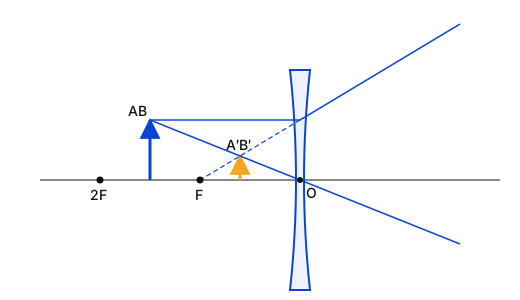
- Ray parallel to the axis diverges as if coming from F.
- Ray through the optical centre O goes straight.
- Their backward extensions meet between F and O → virtual, erect, smaller image.
Trick: Concave lens and convex mirror: image always virtual, erect, diminished.
Answer: (B) Virtual and diminished
अवधारणा: अवतल (अपसारी) लेंस हमेशा F और प्रकाशिक केंद्र के बीच, वस्तु की ओर ही आभासी, सीधा और छोटा प्रतिबिंब बनाता है – वस्तु कहीं भी रखी हो।
- अक्ष के समांतर किरण अपवर्तन के बाद F से आती हुई प्रतीत होती है।
- प्रकाशिक केंद्र O से जाने वाली किरण सीधी निकल जाती है।
- इनके पीछे की ओर बढ़ाए गए भाग F और O के बीच मिलते हैं → आभासी, सीधा, छोटा प्रतिबिंब।
ट्रिक: अवतल लेंस और उत्तल दर्पण: प्रतिबिंब सदैव आभासी, सीधा, छोटा।
उत्तर: (B) आभासी और छोटा (diminished)
RRB Technician Grade IIIGeneral ScienceConcave lens – image formationRRB Technician Grade III 2024 · 29 Dec Shift 3
Q511.What is the function of the growth hormone secreted by the pituitary gland?
पीयूष ग्रंथि (pituitary gland) द्वारा स्रावित वृद्धि हॉर्मोन का कार्य क्या है?
- AIt regulates the blood sugar level.यह रक्त में शर्करा के स्तर का नियमन करता है।
- BIt regulates the menstrual cycle.यह मासिक धर्म चक्र (menstrual cycle) का नियमन करता है।
- CIt stimulates growth in all organs.यह सभी अंगों में वृद्धि को प्रेरित करता है।
- DIt regulates metabolism for body growth.यह शरीर की वृद्धि के लिए उपापचय (metabolism) का नियमन करता है।
Show answer
Concept: Growth hormone is secreted by the pituitary gland and regulates growth and development of the body (all organs, bones, muscles).
- Blood sugar is regulated by insulin (pancreas).
- Menstrual cycle – by oestrogen/progesterone and pituitary sex-related hormones.
- Metabolism – by thyroxin (thyroid).
- Deficiency of growth hormone in childhood → dwarfism; excess → gigantism.
Yaad rakhein: Growth hormone – growth; thyroxin – metabolism; insulin – sugar.
Answer: (C) It stimulates growth in all organs.
अवधारणा: वृद्धि हॉर्मोन पीयूष ग्रंथि से स्रावित होता है और शरीर (सभी अंगों, हड्डियों, पेशियों) की वृद्धि व विकास का नियमन करता है।
- रक्त शर्करा का नियमन इंसुलिन (अग्न्याशय) करता है।
- मासिक चक्र – एस्ट्रोजन/प्रोजेस्टेरोन और पीयूष के लिंग-संबंधी हॉर्मोन।
- उपापचय – थायरॉक्सिन (थायरॉइड)।
- बचपन में वृद्धि हॉर्मोन की कमी → बौनापन; अधिकता → भीमकायता।
याद रखें: वृद्धि हॉर्मोन – वृद्धि; थायरॉक्सिन – उपापचय; इंसुलिन – शर्करा।
उत्तर: (C) यह सभी अंगों में वृद्धि को प्रेरित करता है।
RRB Technician Grade IIIGeneral SciencePituitary – growth hormoneRRB Technician Grade III 2024 · 29 Dec Shift 3
Q512.An organism simply splits into two equal halves during cell division. What is it known as?
कोशिका विभाजन के दौरान एक जीव साधारण रूप से दो बराबर भागों में विभाजित हो जाता है। इसे क्या कहा जाता है?
- ABinary fissionद्विखंडन (Binary fission)
- BSpore formationबीजाणु निर्माण (Spore formation)
- CRegenerationपुनरुद्भवन (Regeneration)
- DBuddingमुकुलन (Budding)
Show answer
Concept: In binary fission, a single-celled organism divides into two equal halves, each becoming a new individual.
- Seen in Amoeba, Paramecium, bacteria, Leishmania.
- Spore formation – Rhizopus; budding – Yeast, Hydra.
- Regeneration – Planaria, Hydra (body pieces grow into new organisms).
Trick: "Bi" = two → binary fission gives two equal daughter cells.
Answer: (A) Binary fission
अवधारणा: द्विखंडन में एककोशिकीय जीव दो बराबर भागों में बँट जाता है और प्रत्येक भाग नया जीव बन जाता है।
- अमीबा, पैरामीशियम, जीवाणु, लीशमैनिया में पाया जाता है।
- बीजाणु निर्माण – राइज़ोपस; मुकुलन – यीस्ट, हाइड्रा।
- पुनर्जनन – प्लेनेरिया, हाइड्रा (शरीर के टुकड़ों से नए जीव)।
ट्रिक: "द्वि" = दो → द्विखंडन से दो समान संतति कोशिकाएँ।
उत्तर: (A) द्विखंडन (Binary fission)
RRB Technician Grade IIIGeneral ScienceBinary fissionRRB Technician Grade III 2024 · 29 Dec Shift 3
Q513.Which of the following statements is INCORRECT?
निम्नलिखित में से कौन-सा कथन गलत है?
- AAll metals are equally reactive.सभी धातुएँ समान रूप से अभिक्रियाशील होती हैं।
- BSilver is less reactive than sodium.चाँदी, सोडियम की तुलना में कम अभिक्रियाशील है।
- CAll metals are not equally reactive.सभी धातुएँ समान रूप से अभिक्रियाशील नहीं होती हैं।
- DPotassium is more reactive than gold.पोटैशियम, सोने की तुलना में अधिक अभिक्रियाशील है।
Show answer
Concept: Metals differ in reactivity; arranging them in decreasing order gives the reactivity series: K > Na > Ca > Mg > Al > Zn > Fe > Pb > H > Cu > Hg > Ag > Au.
- Silver is far less reactive than sodium – true.
- Potassium (top) is more reactive than gold (bottom) – true.
- Metals are not equally reactive – true; so "all metals are equally reactive" is incorrect.
Trick: Please Send Charlie's Monkeys And Zebras In Lead Hidden Cages Made of Silver and Gold (K, Na, Ca, Mg, Al, Zn, Fe, Pb, H, Cu, Hg, Ag, Au).
Answer: (A) All metals are equally reactive.
अवधारणा: धातुओं की सक्रियता अलग-अलग होती है; घटते क्रम में व्यवस्थित करने पर सक्रियता श्रेणी बनती है: K > Na > Ca > Mg > Al > Zn > Fe > Pb > H > Cu > Hg > Ag > Au।
- सिल्वर, सोडियम से बहुत कम क्रियाशील है – सत्य।
- पोटैशियम (शीर्ष) सोने (सबसे नीचे) से अधिक क्रियाशील है – सत्य।
- सभी धातुएँ समान रूप से क्रियाशील नहीं हैं – सत्य; अतः "सभी धातुएँ समान क्रियाशील हैं" गलत है।
ट्रिक: क्रम याद रखें: K, Na, Ca, Mg, Al, Zn, Fe, Pb, H, Cu, Hg, Ag, Au – ऊपर सबसे क्रियाशील, सोना सबसे कम।
उत्तर: (A) सभी धातुएँ समान रूप से अभिक्रियाशील होती हैं।
RRB Technician Grade IIIGeneral ScienceReactivity series of metalsRRB Technician Grade III 2024 · 29 Dec Shift 3
Q514.Organisms having only one cell are called ______.
केवल एक कोशिका वाले जीवों को ______ कहा जाता है।
- Asingularएकल (singular)
- Bunicellularएककोशिकीय (unicellular)
- Cmulticellularबहुकोशिकीय (multicellular)
- Dunisexualएकलिंगी (unisexual)
Show answer
Concept: Organisms made of only one cell are called unicellular; that single cell performs all life functions.
- Examples: Amoeba, Paramecium, Chlamydomonas, bacteria.
- Organisms with many cells (humans, plants) are multicellular.
- Unisexual refers to separate sexes, not cell number.
Yaad rakhein: Uni = one, multi = many.
Answer: (B) unicellular
अवधारणा: केवल एक कोशिका से बने जीव एककोशिकीय कहलाते हैं; वही एक कोशिका सभी जैविक कार्य करती है।
- उदाहरण: अमीबा, पैरामीशियम, क्लैमाइडोमोनास, जीवाणु।
- अनेक कोशिकाओं वाले जीव (मनुष्य, पौधे) बहुकोशिकीय हैं।
- एकलिंगी का अर्थ अलग-अलग लिंग होना है, कोशिका संख्या नहीं।
याद रखें: एक = एककोशिकीय, अनेक = बहुकोशिकीय।
उत्तर: (B) एककोशिकीय (unicellular)
RRB Technician Grade IIIGeneral ScienceUnicellular organismsRRB Technician Grade III 2024 · 29 Dec Shift 3
Q515.Identify the correct match.
सही सुमेलन की पहचान कीजिए।
- ABacterial infections : Warts and HIV-AIDS
Viral infections : Gonorrhoea and syphilisजीवाणु संक्रमण (Bacterial infections) : मस्से (Warts) और HIV-AIDS
विषाणु संक्रमण (Viral infections) : सुज़ाक (Gonorrhoea) और सिफ़लिस (syphilis) - BBacterial infections : Warts and gonorrhoea
Viral infections : Syphilis and HIV-AIDSजीवाणु संक्रमण : मस्से (Warts) और सुज़ाक (gonorrhoea)
विषाणु संक्रमण : सिफ़लिस (Syphilis) और HIV-AIDS - CBacterial infections : Gonorrhoea and syphilis
Viral infections : Warts and HIV-AIDSजीवाणु संक्रमण : सुज़ाक (Gonorrhoea) और सिफ़लिस (syphilis)
विषाणु संक्रमण : मस्से (Warts) और HIV-AIDS - DBacterial infections : Warts and syphilis
Viral infections : Gonorrhoea and HIV-AIDSजीवाणु संक्रमण : मस्से (Warts) और सिफ़लिस (syphilis)
विषाणु संक्रमण : सुज़ाक (Gonorrhoea) और HIV-AIDS
Show answer
Concept: Sexually transmitted diseases (STDs) are caused by bacteria or viruses and spread through sexual contact.
- Bacterial: gonorrhoea and syphilis (treatable with antibiotics).
- Viral: warts (HPV) and HIV-AIDS.
- Only option (C) groups them correctly.
Trick: G-S = bacteria (Gonorrhoea, Syphilis); W-H = virus (Warts, HIV).
Answer: (C) Bacterial infections : Gonorrhoea and syphilis Viral infections : Warts and HIV-AIDS
अवधारणा: यौन संचारित रोग (STD) जीवाणु या विषाणु से होते हैं और यौन संपर्क से फैलते हैं।
- जीवाणुजनित: गोनोरिया और सिफलिस (प्रतिजैविकों से उपचार योग्य)।
- विषाणुजनित: मस्से (HPV) और HIV-AIDS।
- केवल विकल्प (C) इन्हें सही समूह में रखता है।
ट्रिक: G-S = जीवाणु (गोनोरिया, सिफलिस); W-H = विषाणु (वार्ट्स, HIV)।
उत्तर: (C) जीवाणु संक्रमण : सुज़ाक (Gonorrhoea) और सिफ़लिस (syphilis) विषाणु संक्रमण : मस्से (Warts) और HIV-AIDS
RRB Technician Grade IIIGeneral ScienceSexually transmitted diseasesRRB Technician Grade III 2024 · 29 Dec Shift 3
Q516.Which of the following does NOT have neurons?
निम्नलिखित में से किसमें न्यूरॉन (तंत्रिका कोशिकाएँ) नहीं होते हैं?
- AAdipocyteवसा कोशिका (Adipocyte)
- BNervesतंत्रिकाएँ (Nerves)
- CSpinal cordमेरुरज्जु (Spinal cord)
- DBrainमस्तिष्क (Brain)
Show answer
Concept: Neurons are found in the nervous system – brain, spinal cord and nerves.
- Brain and spinal cord form the central nervous system – made of neurons.
- Nerves are bundles of axons of neurons.
- An adipocyte is a fat-storing cell of adipose (connective) tissue – it has no neurons.
Yaad rakhein: Adipo = fat; adipocyte = fat cell, stores fat below skin and around organs.
Answer: (A) Adipocyte
अवधारणा: न्यूरॉन तंत्रिका तंत्र – मस्तिष्क, मेरुरज्जु और तंत्रिकाओं में पाए जाते हैं।
- मस्तिष्क और मेरुरज्जु केंद्रीय तंत्रिका तंत्र बनाते हैं – ये न्यूरॉन से बने हैं।
- तंत्रिकाएँ न्यूरॉनों के एक्सॉन के बंडल हैं।
- एडिपोसाइट वसा ऊतक (संयोजी ऊतक) की वसा संचय करने वाली कोशिका है – इसमें न्यूरॉन नहीं होते।
याद रखें: एडिपो = वसा; एडिपोसाइट = वसा कोशिका, त्वचा के नीचे व अंगों के चारों ओर वसा संचित करती है।
उत्तर: (A) वसा कोशिका (Adipocyte)
RRB Technician Grade IIIGeneral ScienceNervous tissue vs adipose tissueRRB Technician Grade III 2024 · 29 Dec Shift 3
Q517.The shortest distance measured from the initial to the final position of an object is known as ______.
किसी वस्तु की प्रारंभिक स्थिति से अंतिम स्थिति तक मापी गई न्यूनतम दूरी ______ कहलाती है।
- Aaccelerationत्वरण (acceleration)
- Bvelocityवेग (velocity)
- Cdisplacementविस्थापन (displacement)
- Dspeedचाल (speed)
Show answer
Concept: Displacement is the shortest (straight-line) distance from the initial to the final position of an object, along with direction.
- Distance = total path length (scalar).
- Displacement = shortest distance between start and end (vector); it can be zero.
- Speed and velocity are rates, and acceleration is rate of change of velocity.
Trick: Go around a circular track once – distance , displacement .
Answer: (C) displacement
अवधारणा: विस्थापन किसी वस्तु की प्रारंभिक से अंतिम स्थिति तक की न्यूनतम (सीधी रेखा) दूरी है, दिशा सहित।
- दूरी = तय किए गए पथ की कुल लंबाई (अदिश)।
- विस्थापन = आरंभ और अंत के बीच न्यूनतम दूरी (सदिश); यह शून्य भी हो सकता है।
- चाल और वेग दरें हैं, तथा त्वरण वेग परिवर्तन की दर है।
ट्रिक: वृत्ताकार पथ का एक चक्कर – दूरी , विस्थापन ।
उत्तर: (C) विस्थापन (displacement)
RRB Technician Grade IIIGeneral ScienceDistance and displacementRRB Technician Grade III 2024 · 29 Dec Shift 3
Q518.Which of the following edible acids is added to baking soda for making baking powder?
बेकिंग पाउडर बनाने के लिए बेकिंग सोडा में निम्नलिखित में से कौन-सा खाद्य अम्ल मिलाया जाता है?
- ASodium chlorideसोडियम क्लोराइड
- BTartaric acidटार्टरिक अम्ल (Tartaric acid)
- CLactic acidलैक्टिक अम्ल (Lactic acid)
- DVinegarसिरका (Vinegar)
Show answer
Concept: Baking powder is a mixture of baking soda () and a mild edible acid, tartaric acid.
- On heating or mixing with water, + (from tartaric acid) → sodium salt + + .
- makes bread and cakes soft and spongy.
- Tartaric acid neutralises the bitter taste of sodium carbonate.
Yaad rakhein: Baking powder = baking soda + tartaric acid.
Answer: (B) Tartaric acid
अवधारणा: बेकिंग पाउडर बेकिंग सोडा () और एक दुर्बल खाद्य अम्ल – टार्टरिक अम्ल – का मिश्रण है।
- गर्म करने या जल मिलाने पर + (टार्टरिक अम्ल से) → सोडियम लवण + + ।
- ब्रेड और केक को मुलायम व स्पंजी बनाती है।
- टार्टरिक अम्ल सोडियम कार्बोनेट के कड़वे स्वाद को उदासीन करता है।
याद रखें: बेकिंग पाउडर = बेकिंग सोडा + टार्टरिक अम्ल।
उत्तर: (B) टार्टरिक अम्ल (Tartaric acid)
RRB Technician Grade IIIGeneral ScienceBaking powderRRB Technician Grade III 2024 · 29 Dec Shift 3
Q519.When an object moves in a circular path with uniform speed, its motion is called ______.
जब कोई वस्तु एकसमान चाल से वृत्ताकार पथ पर गति करती है, तो उसकी गति ______ कहलाती है।
- Alinear motionरैखिक गति (linear motion)
- Buniform circular motionएकसमान वृत्तीय गति (uniform circular motion)
- Cmotion along a straight lineसरल रेखा के अनुदिश गति
- Dmotion along a hemisphereअर्धगोले के अनुदिश गति
Show answer
Concept: When an object moves along a circular path with constant speed, its motion is called uniform circular motion.
- Speed stays constant.
- Direction of motion changes at every point (along the tangent).
- So velocity changes → it is an accelerated motion, even though speed is uniform.
Yaad rakhein: Examples: the moon around the earth, a stone whirled on a string, tip of a clock's hand.
Answer: (B) uniform circular motion
अवधारणा: जब कोई वस्तु नियत चाल से वृत्ताकार पथ पर गति करती है, तो उसकी गति एकसमान वृत्तीय गति कहलाती है।
- चाल नियत रहती है।
- गति की दिशा हर बिंदु पर बदलती है (स्पर्शरेखा के अनुदिश)।
- अतः वेग बदलता है → चाल समान होने पर भी यह त्वरित गति है।
याद रखें: उदाहरण: पृथ्वी के चारों ओर चंद्रमा, धागे से घुमाया गया पत्थर, घड़ी की सुई की नोक।
उत्तर: (B) एकसमान वृत्तीय गति (uniform circular motion)
RRB Technician Grade IIIGeneral ScienceUniform circular motionRRB Technician Grade III 2024 · 29 Dec Shift 3
Q520.Which of the following endocrine glands secretes growth hormones?
निम्नलिखित में से कौन-सी अंतःस्रावी ग्रंथि वृद्धि हॉर्मोन स्रावित करती है?
- APituitary glandपीयूष ग्रंथि (Pituitary gland)
- BTestesवृषण (Testes)
- CThyroid glandअवटु ग्रंथि (Thyroid gland)
- DAdrenal glandअधिवृक्क ग्रंथि (Adrenal gland)
Show answer
Concept: Growth hormone is secreted by the pituitary gland, located at the base of the brain.
- Pituitary – growth hormone; often called the master gland.
- Thyroid – thyroxin (metabolism); adrenal – adrenaline (emergency).
- Testes – testosterone (male characteristics).
Yaad rakhein: Too little growth hormone in childhood → dwarfism; too much → gigantism.
Answer: (A) Pituitary gland
अवधारणा: वृद्धि हॉर्मोन पीयूष ग्रंथि से स्रावित होता है, जो मस्तिष्क के आधार में स्थित है।
- पीयूष – वृद्धि हॉर्मोन; इसे मास्टर ग्रंथि भी कहते हैं।
- थायरॉइड – थायरॉक्सिन (उपापचय); अधिवृक्क – एड्रिनलिन (आपात स्थिति)।
- वृषण – टेस्टोस्टेरोन (नर लक्षण)।
याद रखें: बचपन में वृद्धि हॉर्मोन की कमी → बौनापन; अधिकता → भीमकायता।
उत्तर: (A) पीयूष ग्रंथि (Pituitary gland)
RRB Technician Grade IIIGeneral ScienceEndocrine glands – growth hormoneRRB Technician Grade III 2024 · 29 Dec Shift 3

