Q521.An electric water heater converts electrical energy into _______.
विद्युत वॉटर हीटर विद्युत ऊर्जा को _______ में परिवर्तित करता है।
- Apotential energyस्थितिज ऊर्जा
- Bwind energyपवन ऊर्जा
- Clight energyप्रकाश ऊर्जा
- Dheat energyऊष्मा ऊर्जा
Show answer
Concept: An appliance is named by the useful energy it gives out. A heater's coil has high resistance, so current through it produces heat (Joule heating).
- Input to the heater: electrical energy.
- Current through the high-resistance element heats it: .
- This heat is passed to the water, so the useful output is heat energy.
Yaad rakhein: Heater, iron, toaster, geyser → electrical to heat; bulb → electrical to light; fan/motor → electrical to mechanical.
Answer: (D) heat energy
अवधारणा: उपकरण जिस उपयोगी ऊर्जा को देता है, उसी से उसका रूपांतरण पहचाना जाता है। हीटर की कुंडली का प्रतिरोध अधिक होता है, इसलिए धारा से ऊष्मा बनती है (जूल तापन)।
- हीटर में जाने वाली ऊर्जा: विद्युत ऊर्जा।
- उच्च प्रतिरोध वाले तत्व में धारा से ऊष्मा बनती है: ।
- यह ऊष्मा पानी को मिलती है, अतः उपयोगी निर्गत ऊर्जा = ऊष्मा ऊर्जा।
याद रखें: हीटर, इस्त्री, टोस्टर, गीज़र → विद्युत से ऊष्मा; बल्ब → विद्युत से प्रकाश; पंखा/मोटर → विद्युत से यांत्रिक।
उत्तर: (D) ऊष्मा ऊर्जा
RRB Technician Grade IIIGeneral ScienceEnergy conversionRRB Technician Grade III 2024 · 29 Dec Shift 2
Q522.Which of the following statements is/are correct related to transportation?
(i) Arteries are the vessels which carry blood away from the heart to various organs of the body.
(ii) The arteries have thin and elastic walls.
(iii) Veins have valves that ensure that blood flows only in one direction.
परिवहन से संबंधित निम्नलिखित में से कौन-सा/से कथन सही है/हैं?
(i) धमनियाँ वे वाहिकाएँ हैं जो रुधिर को हृदय से शरीर के विभिन्न अंगों तक ले जाती हैं।
(ii) धमनियों की भित्ति पतली और लचीली होती है।
(iii) शिराओं में वाल्व होते हैं जो सुनिश्चित करते हैं कि रुधिर केवल एक ही दिशा में प्रवाहित हो।
- AOnly (i)केवल (i)
- BOnly (i) and (ii)केवल (i) और (ii)
- COnly (i) and (iii)केवल (i) और (iii)
- D(i), (ii) and (iii)(i), (ii) और (iii)
Show answer
Concept: Arteries carry blood away from the heart under high pressure; veins bring blood back to the heart under low pressure.
- (i) Arteries carry blood from the heart to organs – correct.
- (ii) Arteries have thick, elastic walls to bear high pressure, not thin walls – wrong.
- (iii) Veins have valves that keep blood flowing one way, towards the heart – correct.
Yaad rakhein: Artery = Away from heart, thick walls; Vein = towards heart, thin walls + valves.
Answer: (C) Only (i) and (iii)
अवधारणा: धमनियाँ उच्च दाब पर रक्त को हृदय से दूर ले जाती हैं; शिराएँ कम दाब पर रक्त को हृदय तक वापस लाती हैं।
- (i) धमनियाँ हृदय से अंगों तक रक्त ले जाती हैं – सही।
- (ii) अधिक दाब सहने के लिए धमनियों की भित्ति मोटी और लचीली होती है, पतली नहीं – गलत।
- (iii) शिराओं में वाल्व होते हैं जो रक्त को एक ही दिशा (हृदय की ओर) में बहने देते हैं – सही।
याद रखें: धमनी = हृदय से दूर, मोटी भित्ति; शिरा = हृदय की ओर, पतली भित्ति + वाल्व।
उत्तर: (C) केवल (i) और (iii)
RRB Technician Grade IIIGeneral ScienceBlood vesselsRRB Technician Grade III 2024 · 29 Dec Shift 2
Q523.What product will be formed when ethanol at 443K with excess concentrated sulphuric acid is heated?
जब एथेनॉल को 443K पर अधिक मात्रा में सांद्र सल्फ्यूरिक अम्ल के साथ गर्म किया जाता है, तो कौन-सा उत्पाद बनेगा?
- AEthyne and hydrogenएथाइन (Ethyne) और हाइड्रोजन
- BEthane and waterएथेन (Ethane) और जल
- CEthene and waterएथीन (Ethene) और जल
- DOnly ethyneकेवल एथाइन (Ethyne)
Show answer
Concept: Hot concentrated sulphuric acid is a dehydrating agent; it removes a water molecule from ethanol and forms an alkene.
- Heat ethanol at 443 K with excess conc. .
- Products: ethene and water.
Yaad rakhein: Ethanol + conc. → ethene (dehydration); ethanol + alkaline → ethanoic acid (oxidation).
Answer: (C) Ethene and water
अवधारणा: गर्म सांद्र सल्फ्यूरिक अम्ल निर्जलीकारक है; यह एथेनॉल से जल का एक अणु हटाकर एल्कीन बनाता है।
- एथेनॉल को 443 K पर अधिक सांद्र के साथ गर्म करें।
- उत्पाद: एथीन और जल।
याद रखें: एथेनॉल + सांद्र → एथीन (निर्जलीकरण); एथेनॉल + क्षारीय → एथेनॉइक अम्ल (ऑक्सीकरण)।
उत्तर: (C) एथीन (Ethene) और जल
RRB Technician Grade IIIGeneral ScienceDehydration of ethanolRRB Technician Grade III 2024 · 29 Dec Shift 2
Q524.Which of the following compounds is/are saturated?
(i)
(ii)
(iii)
(iv)
निम्नलिखित में से कौन-सा/से यौगिक संतृप्त है/हैं?
(i)
(ii)
(iii)
(iv)
- Ai, ii and ivi, ii और iv
- Bi, ii and iiii, ii और iii
- Ci and ivi और iv
- Di and iii और ii
Show answer
Concept: Saturated hydrocarbons (alkanes) have only single C–C bonds and follow the formula .
- : , → alkane (ethane).
- : → alkane (propane).
- : fits → alkene (ethene), unsaturated.
- : → alkane (butane).
Trick: Check H count: → saturated; → alkene; → alkyne.
Answer: (A) i, ii and iv
अवधारणा: संतृप्त हाइड्रोकार्बन (एल्केन) में केवल एकल C–C बंध होते हैं और सूत्र होता है।
- : , → एल्केन (एथेन)।
- : → एल्केन (प्रोपेन)।
- : के अनुरूप → एल्कीन (एथीन), असंतृप्त।
- : → एल्केन (ब्यूटेन)।
ट्रिक: H की संख्या देखें: → संतृप्त; → एल्कीन; → एल्काइन।
उत्तर: (A) i, ii और iv
RRB Technician Grade IIIGeneral ScienceSaturated hydrocarbonsRRB Technician Grade III 2024 · 29 Dec Shift 2
Q525.What product is formed in the chlor-alkali process?
क्लोर-क्षार प्रक्रिया (chlor-alkali process) में कौन-सा उत्पाद बनता है?
- AWashing Sodaधावन सोडा (Washing Soda)
- BSodium Chlorideसोडियम क्लोराइड
- CSodium Hydroxideसोडियम हाइड्रॉक्साइड
- DBaking Sodaबेकिंग सोडा
Show answer
Concept: Electrolysis of brine (aqueous sodium chloride) is called the chlor-alkali process, named after its products chlorine and the alkali NaOH.
- Chlorine forms at the anode, hydrogen at the cathode.
- Sodium hydroxide solution forms near the cathode.
Yaad rakhein: chlor = , alkali = ; sodium chloride is the raw material, not the product.
Answer: (C) Sodium Hydroxide
अवधारणा: ब्राइन (सोडियम क्लोराइड का जलीय विलयन) के विद्युत अपघटन को क्लोर-क्षार प्रक्रिया कहते हैं, क्योंकि इसके उत्पाद क्लोरीन और क्षार NaOH हैं।
- ऐनोड पर क्लोरीन, कैथोड पर हाइड्रोजन बनती है।
- कैथोड के पास सोडियम हाइड्रॉक्साइड विलयन बनता है।
याद रखें: क्लोर = , क्षार = ; सोडियम क्लोराइड कच्चा माल है, उत्पाद नहीं।
उत्तर: (C) सोडियम हाइड्रॉक्साइड
RRB Technician Grade IIIGeneral ScienceChlor-alkali processRRB Technician Grade III 2024 · 29 Dec Shift 2
Q526.A ray of light passing or appear to pass through the principal focus of a concave/convex mirror after reflection _______.
अवतल/उत्तल दर्पण के मुख्य फोकस से होकर गुजरने वाली या गुजरती हुई प्रतीत होने वाली प्रकाश किरण परावर्तन के बाद _______।
- Awill emerge parallel to the principal axisमुख्य अक्ष के समांतर निकलेगी
- Bwill emerge perpendicular to the principal axis, only in the case of concave mirrorमुख्य अक्ष के लंबवत निकलेगी, केवल अवतल दर्पण की स्थिति में
- Cwill emerge perpendicular to the principal axisमुख्य अक्ष के लंबवत निकलेगी
- Dwill emerge perpendicular to the principal axis, only in the case of convex mirrorमुख्य अक्ष के लंबवत निकलेगी, केवल उत्तल दर्पण की स्थिति में
Show answer
Concept: For spherical mirrors, a ray parallel to the principal axis passes (or appears to pass) through F after reflection. By reversibility of light, the reverse is also true.
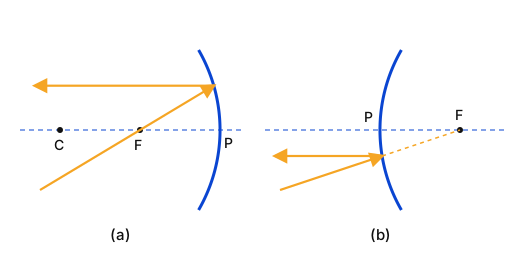
- (a) Concave: ray passing through F hits the mirror and returns parallel to the axis.
- (b) Convex: ray directed towards F (behind the mirror) reflects parallel to the axis.
- So in both mirrors the reflected ray is parallel to the principal axis.
Yaad rakhein: Parallel ⇄ through F; through C → retraces its path; at pole P → reflects symmetrically.
Answer: (A) will emerge parallel to the principal axis
अवधारणा: गोलीय दर्पण में मुख्य अक्ष के समांतर किरण परावर्तन के बाद F से होकर जाती है (या आती प्रतीत होती है)। प्रकाश की उत्क्रमणीयता से उल्टा भी सत्य है।
- (a) अवतल: F से होकर जाने वाली किरण दर्पण से टकराकर अक्ष के समांतर लौटती है।
- (b) उत्तल: F (दर्पण के पीछे) की ओर जाती किरण परावर्तन के बाद अक्ष के समांतर हो जाती है।
- अतः दोनों दर्पणों में परावर्तित किरण मुख्य अक्ष के समांतर होती है।
याद रखें: समांतर ⇄ F से होकर; C से होकर → उसी पथ पर लौटती है; ध्रुव P पर → सममित परावर्तन।
उत्तर: (A) मुख्य अक्ष के समांतर निकलेगी
RRB Technician Grade IIIGeneral ScienceRay diagrams – spherical mirrorsRRB Technician Grade III 2024 · 29 Dec Shift 2
Q527.Complex substances are broken down into simpler ones with the use of bio-catalysts called:
जटिल पदार्थों को सरल पदार्थों में तोड़ने के लिए जिन जैव-उत्प्रेरकों का उपयोग होता है, उन्हें क्या कहते हैं?
- Afatवसा
- Boilतेल
- Ccarbohydratesकार्बोहाइड्रेट
- Denzymesएंजाइम
Show answer
Concept: Enzymes are proteins that act as biological catalysts: they speed up reactions in living cells, such as breaking complex food into simpler substances, without being used up.
- Amylase breaks starch into sugars.
- Pepsin/trypsin break proteins; lipase breaks fats.
- Fat, oil and carbohydrates are food substances, not catalysts.
Yaad rakhein: Bio-catalyst = enzyme; most enzyme names end in '-ase' (amylase, lipase, maltase).
Answer: (D) enzymes
अवधारणा: एंजाइम प्रोटीन होते हैं जो जैव-उत्प्रेरक का कार्य करते हैं: ये जीवित कोशिकाओं में अभिक्रियाओं को तेज करते हैं, जैसे जटिल भोजन को सरल पदार्थों में तोड़ना, और स्वयं खर्च नहीं होते।
- एमाइलेज स्टार्च को शर्करा में तोड़ता है।
- पेप्सिन/ट्रिप्सिन प्रोटीन को और लाइपेज वसा को तोड़ता है।
- वसा, तेल और कार्बोहाइड्रेट भोज्य पदार्थ हैं, उत्प्रेरक नहीं।
याद रखें: जैव-उत्प्रेरक = एंजाइम; अधिकांश एंजाइमों के नाम '-ase' पर समाप्त होते हैं (एमाइलेज, लाइपेज, माल्टेज)।
उत्तर: (D) एंजाइम
RRB Technician Grade IIIGeneral ScienceEnzymesRRB Technician Grade III 2024 · 29 Dec Shift 2
Q528.Flexibility in plants is due to:
पौधों में लचीलापन किसके कारण होता है?
- Asclerenchymaदृढ़ोतक (sclerenchyma)
- Bcollenchymaस्थूलकोणोतक (collenchyma)
- Ccambiumएधा (cambium)
- Dparenchymaमृदूतक (parenchyma)
Show answer
Concept: Collenchyma is a simple permanent tissue with cells irregularly thickened at the corners; it gives mechanical support along with flexibility.
- Collenchyma lies below the epidermis in leaf stalks and young stems.
- It lets these parts bend without breaking (flexibility).
- Sclerenchyma gives rigidity, parenchyma stores food, cambium is a meristem for growth.
Yaad rakhein: Collenchyma → flexibility; Sclerenchyma → hardness/stiffness (husk of coconut); Parenchyma → storage.
Answer: (B) collenchyma
अवधारणा: स्थूलकोण ऊतक (कॉलेनकाइमा) एक सरल स्थायी ऊतक है जिसकी कोशिकाएँ कोनों पर अनियमित रूप से मोटी होती हैं; यह यांत्रिक सहारे के साथ लचीलापन देता है।
- कॉलेनकाइमा पत्तियों के डंठल और नए तनों में बाह्यत्वचा के नीचे होता है।
- इससे ये भाग बिना टूटे मुड़ सकते हैं (लचीलापन)।
- दृढ़ ऊतक (स्क्लेरेनकाइमा) कठोरता देता है, मृदूतक भोजन संचय करता है, कैम्बियम वृद्धि करने वाला विभज्योतक है।
याद रखें: कॉलेनकाइमा → लचीलापन; स्क्लेरेनकाइमा → कठोरता (नारियल का रेशा); पैरेनकाइमा → संचय।
उत्तर: (B) स्थूलकोणोतक (collenchyma)
RRB Technician Grade IIIGeneral SciencePlant tissuesRRB Technician Grade III 2024 · 29 Dec Shift 2
Q529.In a triangular glass prism, there is/are _______.
एक त्रिभुजाकार काँच के प्रिज़्म में _______ होता/होते है/हैं।
- Aone triangular base and three rectangular lateral surfacesएक त्रिभुजाकार आधार और तीन आयताकार पार्श्व पृष्ठ
- Bthree triangular bases and one rectangular lateral surfaceतीन त्रिभुजाकार आधार और एक आयताकार पार्श्व पृष्ठ
- Ctwo triangular bases and three rectangular lateral surfacesदो त्रिभुजाकार आधार और तीन आयताकार पार्श्व पृष्ठ
- Dthree triangular bases and three rectangular lateral surfacesतीन त्रिभुजाकार आधार और तीन आयताकार पार्श्व पृष्ठ
Show answer
Concept: A triangular prism is a solid with two identical triangular faces (bases) joined by rectangular side faces – one for each side of the triangle.
- Triangle has 3 sides → 3 rectangular lateral surfaces.
- Top and bottom faces are triangles → 2 triangular bases.
- Total faces ; the two refracting surfaces in experiments are two of the rectangles.
Yaad rakhein: Triangular prism: 5 faces, 9 edges, 6 vertices.
Answer: (C) two triangular bases and three rectangular lateral surfaces
अवधारणा: त्रिभुजाकार प्रिज़्म एक ठोस है जिसके दो समान त्रिभुजाकार फलक (आधार) होते हैं, जो आयताकार पार्श्व फलकों से जुड़े होते हैं – त्रिभुज की प्रत्येक भुजा के लिए एक।
- त्रिभुज की 3 भुजाएँ → 3 आयताकार पार्श्व पृष्ठ।
- ऊपर और नीचे के फलक त्रिभुज → 2 त्रिभुजाकार आधार।
- कुल फलक ; प्रयोग में अपवर्तक पृष्ठ इन्हीं आयतों में से दो होते हैं।
याद रखें: त्रिभुजाकार प्रिज़्म: 5 फलक, 9 किनारे, 6 शीर्ष।
उत्तर: (C) दो त्रिभुजाकार आधार और तीन आयताकार पार्श्व पृष्ठ
RRB Technician Grade IIIGeneral ScienceGlass prismRRB Technician Grade III 2024 · 29 Dec Shift 2
Q530.Identify the gas that is evolved when magnesium and manganese react with nitric acid.
उस गैस की पहचान कीजिए जो मैग्नीशियम और मैंगनीज़ के नाइट्रिक अम्ल से अभिक्रिया करने पर निकलती है।
- ANitrogen gasनाइट्रोजन गैस
- BHydrogen gasहाइड्रोजन गैस
- COxygen gasऑक्सीजन गैस
- DHelium gasहीलियम गैस
Show answer
Concept: Nitric acid is a strong oxidising agent, so it usually oxidises the formed to water. Magnesium and manganese are exceptions with very dilute .
- So the gas evolved is hydrogen.
Yaad rakhein: Only Mg and Mn give with very dilute nitric acid; other metals give oxides of nitrogen.
Answer: (B) Hydrogen gas
अवधारणा: नाइट्रिक अम्ल प्रबल ऑक्सीकारक है, इसलिए बनी को प्रायः जल में ऑक्सीकृत कर देता है। अति तनु के साथ मैग्नीशियम और मैंगनीज़ इसके अपवाद हैं।
- अतः निकलने वाली गैस हाइड्रोजन है।
याद रखें: केवल Mg और Mn अति तनु नाइट्रिक अम्ल से देते हैं; अन्य धातुएँ नाइट्रोजन के ऑक्साइड देती हैं।
उत्तर: (B) हाइड्रोजन गैस
RRB Technician Grade IIIGeneral ScienceMetals and nitric acidRRB Technician Grade III 2024 · 29 Dec Shift 2
Q531.The value of Universal Gravitational constant is G on a certain planet of mass M, on another planet of mass 4M, the value of the Universal Gravitational constant will be:
द्रव्यमान M वाले किसी ग्रह पर सार्वत्रिक गुरुत्वाकर्षण स्थिरांक का मान G है, तो द्रव्यमान 4M वाले किसी अन्य ग्रह पर सार्वत्रिक गुरुत्वाकर्षण स्थिरांक का मान क्या होगा?
- A4G
- BG/2
- CG
- DZeroशून्य
Show answer
Concept: in is a universal constant: its value is the same everywhere, independent of masses, distance or medium.
- everywhere in the universe.
- Changing the planet mass to changes , not .
- So on the second planet the constant is still .
Yaad rakhein: never changes; changes with planet mass and radius.
Answer: (C) G
अवधारणा: में सार्वत्रिक नियतांक है: इसका मान हर जगह समान है, द्रव्यमान, दूरी या माध्यम पर निर्भर नहीं।
- पूरे ब्रह्मांड में।
- ग्रह का द्रव्यमान करने से बदलता है, नहीं।
- अतः दूसरे ग्रह पर भी नियतांक ही रहेगा।
याद रखें: कभी नहीं बदलता; ग्रह के द्रव्यमान और त्रिज्या के साथ बदलता है।
उत्तर: (C) G
RRB Technician Grade IIIGeneral ScienceUniversal gravitational constantRRB Technician Grade III 2024 · 29 Dec Shift 2
Q532.The laws of reflection are applicable to _______.
परावर्तन के नियम _______ पर लागू होते हैं।
- Aboth plane and spherical surfacesसमतल और गोलीय दोनों पृष्ठों
- Bneither plane surfaces nor spherical surfacesन तो समतल पृष्ठों और न ही गोलीय पृष्ठों
- Conly to spherical surface and not to plane surfacesकेवल गोलीय पृष्ठ पर, समतल पृष्ठों पर नहीं
- Donly to plane surfaces and not to spherical surfacesकेवल समतल पृष्ठों पर, गोलीय पृष्ठों पर नहीं
Show answer
Concept: Laws of reflection: (1) angle of incidence = angle of reflection; (2) incident ray, normal and reflected ray lie in one plane.
- For a plane mirror, the normal is perpendicular to the surface.
- For a spherical mirror, the normal at any point is the radius through that point.
- With this normal, both laws hold at every point – so they apply to all reflecting surfaces.
Yaad rakhein: Laws of reflection work for every surface – plane, concave, convex – even rough ones, point by point.
Answer: (A) both plane and spherical surfaces
अवधारणा: परावर्तन के नियम: (1) आपतन कोण = परावर्तन कोण; (2) आपतित किरण, अभिलंब और परावर्तित किरण एक ही तल में होते हैं।
- समतल दर्पण में अभिलंब पृष्ठ के लंबवत होता है।
- गोलीय दर्पण में किसी बिंदु पर अभिलंब उस बिंदु से जाने वाली त्रिज्या होती है।
- इस अभिलंब से दोनों नियम हर बिंदु पर लागू होते हैं – अतः सभी परावर्तक पृष्ठों पर।
याद रखें: परावर्तन के नियम हर पृष्ठ पर लागू होते हैं – समतल, अवतल, उत्तल – खुरदुरे पृष्ठ पर भी, बिंदु-दर-बिंदु।
उत्तर: (A) समतल और गोलीय दोनों पृष्ठों
RRB Technician Grade IIIGeneral ScienceLaws of reflectionRRB Technician Grade III 2024 · 29 Dec Shift 2
Q533.Select the correct statement.
सही कथन का चयन कीजिए।
- AOne oviduct forms the uterus.एक अंडवाहिनी (oviduct) से गर्भाशय बनता है।
- BMany eggs are produced every month by the ovary.अंडाशय द्वारा प्रति माह कई अंडे उत्पन्न होते हैं।
- CThe fallopian tube is also known as womb.फैलोपियन नलिका को गर्भ (womb) भी कहा जाता है।
- DWhen a girl is born, the ovaries already contain thousands of immature eggs.जब किसी लड़की का जन्म होता है, तो उसके अंडाशय में पहले से ही हजारों अपरिपक्व अंडे होते हैं।
Show answer
Concept: A girl is born with ovaries already containing thousands of immature eggs; at puberty some start maturing.
- Two oviducts unite to form the uterus, not one – (A) wrong.
- Usually only one egg is released each month by one ovary – (B) wrong.
- The womb is the uterus, not the fallopian tube – (C) wrong.
- (D) is the correct statement.
Yaad rakhein: Ovary → egg; oviduct/fallopian tube → fertilisation site; uterus (womb) → embryo grows.
Answer: (D) When a girl is born, the ovaries already contain thousands of immature eggs.
अवधारणा: लड़की के जन्म के समय ही अंडाशयों में हज़ारों अपरिपक्व अंड होते हैं; यौवनारंभ पर इनमें से कुछ परिपक्व होने लगते हैं।
- दो अंडवाहिनियाँ मिलकर गर्भाशय बनाती हैं, एक नहीं – (A) गलत।
- प्रायः हर माह एक अंडाशय से केवल एक अंड निकलता है – (B) गलत।
- गर्भ (womb) गर्भाशय है, फैलोपियन नलिका नहीं – (C) गलत।
- (D) सही कथन है।
याद रखें: अंडाशय → अंड; अंडवाहिनी/फैलोपियन नलिका → निषेचन स्थल; गर्भाशय → भ्रूण का विकास।
उत्तर: (D) जब किसी लड़की का जन्म होता है, तो उसके अंडाशय में पहले से ही हजारों अपरिपक्व अंडे होते हैं।
RRB Technician Grade IIIGeneral ScienceFemale reproductive systemRRB Technician Grade III 2024 · 29 Dec Shift 2
Q534.What is used in the preparation of calcium sulphate hemihydrate?
कैल्शियम सल्फेट हेमीहाइड्रेट को बनाने में किसका उपयोग किया जाता है?
- ACopper Sulphateकॉपर सल्फेट
- BGypsumजिप्सम
- CSodium Hydrogen Carbonateसोडियम हाइड्रोजन कार्बोनेट
- DSodium Carbonateसोडियम कार्बोनेट
Show answer
Concept: Calcium sulphate hemihydrate is Plaster of Paris. It is made by heating gypsum at 373 K, which removes part of its water of crystallisation.
- Gypsum:
- Hemi = half molecule of water per formula unit.
Yaad rakhein: PoP + water → sets back into gypsum; used for plasters on fractured bones and toys.
Answer: (B) Gypsum
अवधारणा: कैल्शियम सल्फेट हेमीहाइड्रेट ही प्लास्टर ऑफ पेरिस है। यह जिप्सम को 373 K पर गर्म करके बनता है, जिससे उसका कुछ क्रिस्टलन जल निकल जाता है।
- जिप्सम:
- हेमी = प्रति सूत्र इकाई जल का आधा अणु।
याद रखें: PoP + जल → फिर जिप्सम बनकर कठोर हो जाता है; टूटी हड्डियों के प्लास्टर व खिलौनों में उपयोग।
उत्तर: (B) जिप्सम
RRB Technician Grade IIIGeneral SciencePlaster of ParisRRB Technician Grade III 2024 · 29 Dec Shift 2
Q535.The chemical formula of ammonium sulphate is _______.
अमोनियम सल्फेट का रासायनिक सूत्र _______ है।
- A
- B
- C
- D
Show answer
Concept: Write the formula by criss-crossing valencies: ammonium ion (valency 1) and sulphate ion (valency 2).
- Valencies: = 1, = 2.
- Cross over: gets subscript 2, gets 1.
- Formula: – charges .
Trick: Total positive charge must equal total negative charge; a polyatomic ion taken more than once goes in brackets.
Answer: (A)
अवधारणा: संयोजकता का क्रॉस-गुणन करें: अमोनियम आयन (संयोजकता 1) और सल्फेट आयन (संयोजकता 2)।
- संयोजकता: = 1, = 2।
- क्रॉस करें: को 2, को 1 मिलता है।
- सूत्र: – आवेश ।
ट्रिक: कुल धन आवेश = कुल ऋण आवेश; बहुपरमाणुक आयन एक से अधिक बार हो तो कोष्ठक में लिखें।
उत्तर: (A)
RRB Technician Grade IIIGeneral ScienceChemical formulaRRB Technician Grade III 2024 · 29 Dec Shift 2
Q536.A resistor has a resistivity . This resistor is now cut into three equal parts. The resistivity of each part will be:
एक प्रतिरोधक की प्रतिरोधकता है। अब इस प्रतिरोधक को तीन बराबर भागों में काटा जाता है। प्रत्येक भाग की प्रतिरोधकता कितनी होगी?
- A
- B
- C
- D
Show answer
Concept: Resistivity is a property of the material (and temperature) only. Resistance depends on size, but does not.
- Cutting into 3 equal parts: length becomes , so becomes .
- Material is unchanged, so resistivity stays the same.
- Each part has resistivity .
Yaad rakhein: Cutting, stretching or bending changes resistance ; it never changes resistivity of the same material.
Answer: (C)
अवधारणा: प्रतिरोधकता केवल पदार्थ (और ताप) का गुण है। प्रतिरोध आकार पर निर्भर करता है, पर नहीं।
- तीन बराबर भागों में काटने पर लंबाई , अतः हो जाता है ।
- पदार्थ वही है, इसलिए प्रतिरोधकता नहीं बदलती।
- प्रत्येक भाग की प्रतिरोधकता है।
याद रखें: काटने, खींचने या मोड़ने से प्रतिरोध बदलता है; उसी पदार्थ की प्रतिरोधकता कभी नहीं बदलती।
उत्तर: (C)
RRB Technician Grade IIIGeneral ScienceResistivityRRB Technician Grade III 2024 · 29 Dec Shift 2
Q537.Which of the following metals is least reactive with acids?
निम्नलिखित में से कौन-सी धातु अम्लों के साथ सबसे कम अभिक्रियाशील है?
- AZincजिंक
- BIronआयरन
- CAluminiumऐलुमिनियम
- DCopperकॉपर
Show answer
Concept: Metals above hydrogen in the reactivity series displace hydrogen from dilute acids; metals below hydrogen do not react.
- Order: Al > Zn > Fe > (H) > Cu.
- Al, Zn and Fe react with dilute HCl giving .
- Copper is below hydrogen, so it does not react with dilute acids – least reactive.
Yaad rakhein: Below H: Cu, Hg, Ag, Au – no with dilute acids.
Answer: (D) Copper
अवधारणा: सक्रियता श्रेणी में हाइड्रोजन से ऊपर की धातुएँ तनु अम्लों से हाइड्रोजन विस्थापित करती हैं; हाइड्रोजन से नीचे की धातुएँ अभिक्रिया नहीं करतीं।
- क्रम: Al > Zn > Fe > (H) > Cu।
- Al, Zn और Fe तनु HCl से अभिक्रिया कर देते हैं।
- ताँबा हाइड्रोजन से नीचे है, इसलिए तनु अम्लों से अभिक्रिया नहीं करता – सबसे कम सक्रिय।
याद रखें: H से नीचे: Cu, Hg, Ag, Au – तनु अम्लों से नहीं।
उत्तर: (D) कॉपर
RRB Technician Grade IIIGeneral ScienceReactivity seriesRRB Technician Grade III 2024 · 29 Dec Shift 2
Q538.A constant force F is applied on an object. The work done by the force is positive if the object:
किसी वस्तु पर एक नियत बल F लगाया जाता है। बल द्वारा किया गया कार्य धनात्मक होगा, यदि वस्तु:
- AIs displaced opposite to the direction of the forceबल की दिशा के विपरीत विस्थापित होती है
- Bis displaced in the direction of the forceबल की दिशा में विस्थापित होती है
- Cis displaced perpendicular to the forceबल के लंबवत विस्थापित होती है
- Dis not displacedविस्थापित नहीं होती है
Show answer
Concept: Work , where is the angle between force and displacement.
- Same direction: , → , positive.
- Opposite: → , negative.
- Perpendicular: → ; no displacement → .
Trick: Displacement along force → +ve, against force → −ve, at right angle or zero → no work.
Answer: (B) is displaced in the direction of the force
अवधारणा: कार्य , जहाँ बल और विस्थापन के बीच का कोण है।
- एक ही दिशा: , → , धनात्मक।
- विपरीत: → , ऋणात्मक।
- लंबवत: → ; विस्थापन न हो → ।
ट्रिक: बल की दिशा में विस्थापन → धनात्मक, विरुद्ध → ऋणात्मक, लंबवत या शून्य → कोई कार्य नहीं।
उत्तर: (B) बल की दिशा में विस्थापित होती है
RRB Technician Grade IIIGeneral ScienceWork doneRRB Technician Grade III 2024 · 29 Dec Shift 2
Q539.Which of the following is a function of epithelial tissues?
निम्नलिखित में से कौन-सा उपकला ऊतकों (epithelial tissues) का एक कार्य है?
- AResponsible for involuntary movementsअनैच्छिक गतियों के लिए उत्तरदायी
- BProvides response to stimulusउद्दीपन के प्रति अनुक्रिया प्रदान करता है
- CProtectionसुरक्षा
- DStorage of fatsवसा का संग्रहण
Show answer
Concept: Epithelial tissue forms the covering or lining of the body and organs (skin, mouth lining, blood vessels), so its main function is protection.
- Cells are tightly packed with almost no intercellular space – a continuous sheet.
- It protects underlying cells from drying, injury and germs, and controls exchange of materials.
- Involuntary movement → smooth muscle; response to stimulus → nervous tissue; fat storage → adipose tissue.
Yaad rakhein: Epithelium = body's protective cover; muscle = movement; nerve = response; connective = support/storage.
Answer: (C) Protection
अवधारणा: उपकला ऊतक शरीर और अंगों का आवरण या अस्तर बनाता है (त्वचा, मुख का अस्तर, रक्त वाहिकाएँ), इसलिए इसका मुख्य कार्य सुरक्षा है।
- कोशिकाएँ सटी हुई होती हैं, लगभग कोई अंतरकोशिकीय स्थान नहीं – एक सतत परत।
- यह नीचे की कोशिकाओं को सूखने, चोट और रोगाणुओं से बचाता है तथा पदार्थों के आदान-प्रदान को नियंत्रित करता है।
- अनैच्छिक गति → चिकनी पेशी; उद्दीपन पर अनुक्रिया → तंत्रिका ऊतक; वसा संचय → वसा ऊतक।
याद रखें: उपकला = शरीर का सुरक्षा आवरण; पेशी = गति; तंत्रिका = अनुक्रिया; संयोजी = सहारा/संचय।
उत्तर: (C) सुरक्षा
RRB Technician Grade IIIGeneral ScienceAnimal tissuesRRB Technician Grade III 2024 · 29 Dec Shift 2
Q540.Which of the following statements is/are true for the gravitational force between two bodies:
(i) It is repulsive in nature.
(ii) It's magnitude is same throughout the universe.
(iii) It is directly proportional to the product of the masses of the bodies.
(iv) Due to this force the earth goes around the sun.
दो पिंडों के बीच गुरुत्वाकर्षण बल के लिए निम्नलिखित में से कौन-सा/से कथन सत्य है/हैं:
(i) यह प्रकृति में प्रतिकर्षी है।
(ii) इसका परिमाण पूरे ब्रह्मांड में समान है।
(iii) यह पिंडों के द्रव्यमानों के गुणनफल के अनुक्रमानुपाती है।
(iv) इसी बल के कारण पृथ्वी सूर्य के चारों ओर चक्कर लगाती है।
- ABoth (i) and (ii)(i) और (ii) दोनों
- BOnly (iii)केवल (iii)
- CBoth (ii) and (iii)(ii) और (iii) दोनों
- DBoth (iii) and (iv)(iii) और (iv) दोनों
Show answer
Concept: Newton's law: – every two bodies attract each other with a force proportional to the product of their masses.
- (i) Gravity is always attractive, never repulsive – false.
- (ii) Its magnitude depends on masses and distance, so it is not the same everywhere (only is) – false.
- (iii) – true.
- (iv) The Sun's gravity keeps the Earth in orbit – true.
Yaad rakhein: Gravitational force: always attractive, , ; constant is universal, the force is not.
Answer: (D) Both (iii) and (iv)
अवधारणा: न्यूटन का नियम: – कोई भी दो पिंड एक-दूसरे को द्रव्यमानों के गुणनफल के समानुपाती बल से आकर्षित करते हैं।
- (i) गुरुत्व सदैव आकर्षी है, प्रतिकर्षी नहीं – असत्य।
- (ii) इसका परिमाण द्रव्यमान और दूरी पर निर्भर है, इसलिए हर जगह समान नहीं (केवल समान है) – असत्य।
- (iii) – सत्य।
- (iv) सूर्य का गुरुत्व पृथ्वी को कक्षा में रखता है – सत्य।
याद रखें: गुरुत्वाकर्षण बल: सदैव आकर्षी, , ; नियतांक सार्वत्रिक है, बल नहीं।
उत्तर: (D) (iii) और (iv) दोनों
RRB Technician Grade IIIGeneral ScienceGravitational forceRRB Technician Grade III 2024 · 29 Dec Shift 2

