Q561.Select the set in which the numbers are related in the same way as are the numbers of the following sets.
(NOTE: Operations should be performed on the whole numbers, without breaking down the numbers into its constituent digits. E.g. 13 – Operations on 13 such as adding/subtracting/multiplying etc. to 13 can be performed. Breaking down 13 into 1 and 3 and then performing mathematical operations on 1 and 3 is not allowed.)
(8, 4, 12)
(18, 9, 27)
उस समुच्चय का चयन कीजिए जिसकी संख्याएँ आपस में उसी प्रकार संबंधित हैं जिस प्रकार निम्नलिखित समुच्चयों की संख्याएँ संबंधित हैं।
(ध्यान दें: संक्रियाएँ पूर्ण संख्याओं पर की जानी चाहिए, संख्याओं को उनके घटक अंकों में तोड़े बिना। उदाहरण के लिए 13 – 13 पर संक्रियाएँ जैसे 13 में जोड़ना/घटाना/गुणा करना आदि किया जा सकता है। 13 को 1 और 3 में तोड़कर फिर 1 और 3 पर गणितीय संक्रियाएँ करने की अनुमति नहीं है।)
(8, 4, 12)
(18, 9, 27)
- A(20, 12, 36)
- B(24, 12, 34)
- C(24, 12, 36)
- D(24, 14, 36)
Show answer
Concept: Find the rule: second , third first second.
- : , .
- : , .
- : , ✓.
Trick: Third first; only with middle fits.
Answer: (C) (24, 12, 36)
अवधारणा: नियम: दूसरी , तीसरी पहली दूसरी।
- : , ।
- : , ।
- : , ✓।
ट्रिक: तीसरी पहली; केवल और बीच में सही बैठता है।
उत्तर: (C) (24, 12, 36)
RRB Technician Grade IIIGeneral Intelligence and ReasoningNumber set analogyRRB Technician Grade III 2024 · 26 Dec Shift 2
Q562.In a certain code language, 'Come Back Home' is written as 'Tu Ru Qu' and 'She Went Back' is written as 'Du Su Ru' and 'He Went Home' is written as 'Pu Tu Du'. How is 'She' written in the given language?
एक निश्चित कूट भाषा में, 'Come Back Home' को 'Tu Ru Qu' लिखा जाता है, 'She Went Back' को 'Du Su Ru' लिखा जाता है और 'He Went Home' को 'Pu Tu Du' लिखा जाता है। दी गई भाषा में 'She' को कैसे लिखा जाता है?
- ATu
- BSu
- CDu
- DRu
Show answer
Concept: Words common to two sentences share the common code.
- Back (sentences 1, 2) = Ru; Home (1, 3) = Tu; Went (2, 3) = Du.
- Sentence 2: She Went Back = Du Su Ru.
- Remove Du (Went) and Ru (Back) ⇒ She = Su.
Trick: Find codes of the shared words first; the leftover code is the answer.
Answer: (B) Su
अवधारणा: दो वाक्यों में समान शब्दों का कूट भी समान होता है।
- Back (वाक्य 1, 2) = Ru; Home (1, 3) = Tu; Went (2, 3) = Du।
- वाक्य 2: She Went Back = Du Su Ru।
- Du (Went) और Ru (Back) हटाने पर ⇒ She = Su।
ट्रिक: पहले साझा शब्दों के कूट निकालें; बचा हुआ कूट ही उत्तर है।
उत्तर: (B) Su
RRB Technician Grade IIIGeneral Intelligence and ReasoningCoding-decodingRRB Technician Grade III 2024 · 26 Dec Shift 2
Q563.Which of the following options should come in place of the question mark (?) in the given series based on the English alphabetical order?
IUF, LVJ, OWN, RXR, ?
अंग्रेजी वर्णमाला क्रम के आधार पर दी गई श्रृंखला में प्रश्न चिह्न (?) के स्थान पर निम्नलिखित में से कौन-सा विकल्प आना चाहिए?
IUF, LVJ, OWN, RXR, ?
- AUSV
- BVYU
- CVYX
- DUYV
Show answer
Concept: Track each letter position separately.
- 1st: I, L, O, R → → U.
- 2nd: U, V, W, X → → Y.
- 3rd: F, J, N, R → → V. Answer: UYV.
Trick: Middle letters run U, V, W, X, Y — only options with Y in the middle remain; then check the first letter U.
Answer: (D) UYV
अवधारणा: हर स्थान के अक्षर को अलग-अलग देखें।
- पहला: I, L, O, R → → U।
- दूसरा: U, V, W, X → → Y।
- तीसरा: F, J, N, R → → V। उत्तर: UYV।
ट्रिक: बीच के अक्षर U, V, W, X, Y — केवल Y वाले विकल्प बचते हैं; फिर पहला अक्षर U जाँचें।
उत्तर: (D) UYV
RRB Technician Grade IIIGeneral Intelligence and ReasoningAlphabet seriesRRB Technician Grade III 2024 · 26 Dec Shift 2
Q564.In a certain code language, 'happy children play' is coded as 'ha ch pl', and 'children love toys' is coded as 'ch lo tk'. What is the code for 'children' in the given code language?
एक निश्चित कूट भाषा में, 'happy children play' को 'ha ch pl' के रूप में कूटबद्ध किया जाता है, और 'children love toys' को 'ch lo tk' के रूप में कूटबद्ध किया जाता है। दी गई कूट भाषा में 'children' के लिए कूट क्या है?
- ALo
- Bha
- Cpl
- Dch
Show answer
Concept: A word common to two sentences gets the code common to both coded forms.
- 'happy children play' → 'ha ch pl'
- 'children love toys' → 'ch lo tk'
- Common word: children; common code: ch
Trick: Here each code is also the first two letters of the word – children → ch.
Answer: (D) ch
अवधारणा: दोनों वाक्यों में समान शब्द का कूट, दोनों कूटों में समान कूट होता है।
- 'happy children play' → 'ha ch pl'
- 'children love toys' → 'ch lo tk'
- समान शब्द: children; समान कूट: ch
ट्रिक: यहाँ हर कूट शब्द के पहले दो अक्षर भी हैं – children → ch।
उत्तर: (D) ch
RRB Technician Grade IIIGeneral Intelligence and ReasoningCoding-decoding (word codes)RRB Technician Grade III 2024 · 26 Dec Shift 1
Q565.Read the given statements and conclusions carefully. You have to take the given statements to be true even if they seem to be at variance from commonly known facts and decide which conclusion(s) logically follow(s) from the given statements.
Statements:
All onions are tomatoes.
Some tomatoes are potatoes.
Conclusions:
I. At least some tomatoes are onions.
II. Some onions are potatoes.
दिए गए कथनों और निष्कर्षों को ध्यानपूर्वक पढ़िए। आपको दिए गए कथनों को सत्य मानना है, भले ही वे सामान्य रूप से ज्ञात तथ्यों से भिन्न प्रतीत होते हों, और निर्णय लेना है कि कौन-सा/से निष्कर्ष दिए गए कथनों का तार्किक रूप से अनुसरण करता है/करते हैं।
कथन:
सभी प्याज, टमाटर हैं।
कुछ टमाटर, आलू हैं।
निष्कर्ष:
I. कम से कम कुछ टमाटर, प्याज हैं।
II. कुछ प्याज, आलू हैं।
- ANeither conclusion I nor II followsन तो निष्कर्ष I और न ही II अनुसरण करता है
- BBoth conclusions I and II followनिष्कर्ष I और II दोनों अनुसरण करते हैं
- COnly conclusion I followsकेवल निष्कर्ष I अनुसरण करता है
- DOnly conclusion II followsकेवल निष्कर्ष II अनुसरण करता है
Show answer
Concept: 'All A are B' always gives 'Some B are A'. 'Some B are C' does not connect A with C definitely.
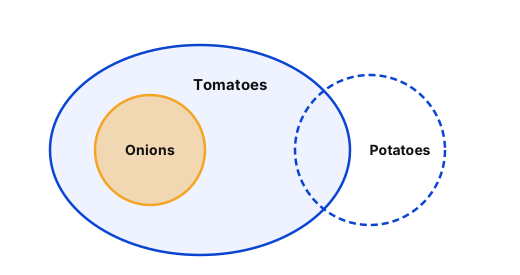
- All onions are tomatoes ⇒ some tomatoes are onions: I follows
- Potatoes overlap tomatoes, but may lie outside the onion circle
- So 'some onions are potatoes' is not certain: II does not follow
Yaad rakhein: 'All' converts to 'Some' (reverse); two 'Some'/'All–Some' links via the bigger set give no definite conclusion.
Answer: (C) Only conclusion I follows
अवधारणा: 'सभी A, B हैं' से हमेशा 'कुछ B, A हैं' निकलता है। 'कुछ B, C हैं' से A और C का निश्चित संबंध नहीं बनता।
- सभी प्याज टमाटर हैं ⇒ कुछ टमाटर प्याज हैं: I अनुसरण करता है
- आलू टमाटर से जुड़े हैं, पर प्याज के घेरे से बाहर भी हो सकते हैं
- अतः 'कुछ प्याज आलू हैं' निश्चित नहीं: II अनुसरण नहीं करता
याद रखें: 'सभी' उलटकर 'कुछ' बनता है; बड़े समूह के माध्यम से जुड़े कथनों से निश्चित निष्कर्ष नहीं मिलता।
उत्तर: (C) केवल निष्कर्ष I अनुसरण करता है
RRB Technician Grade IIIGeneral Intelligence and ReasoningSyllogismRRB Technician Grade III 2024 · 26 Dec Shift 1
Q566.Read the given statements and conclusions carefully. You have to take the given statements to be true even if they seem to be at variance from commonly known facts and decide which conclusion(s) logically follow(s) from the given statements.
Statements:
Some plates are glasses.
Some glasses are bowls.
Some bowls are cups.
Conclusions:
(I) Some cups are glasses.
(II) Some bowls are plates.
दिए गए कथनों और निष्कर्षों को ध्यानपूर्वक पढ़िए। आपको दिए गए कथनों को सत्य मानना है, भले ही वे सामान्य रूप से ज्ञात तथ्यों से भिन्न प्रतीत होते हों, और निर्णय लेना है कि कौन-सा/से निष्कर्ष दिए गए कथनों का तार्किक रूप से अनुसरण करता है/करते हैं।
कथन:
कुछ प्लेटें, गिलास हैं।
कुछ गिलास, कटोरे हैं।
कुछ कटोरे, कप हैं।
निष्कर्ष:
(I) कुछ कप, गिलास हैं।
(II) कुछ कटोरे, प्लेटें हैं।
- AOnly conclusion (I) follows.केवल निष्कर्ष (I) अनुसरण करता है।
- BBoth conclusions (I) and (II) follow.निष्कर्ष (I) और (II) दोनों अनुसरण करते हैं।
- COnly conclusion (II) follows.केवल निष्कर्ष (II) अनुसरण करता है।
- DNeither conclusion (I) nor (II) follows.न तो निष्कर्ष (I) और न ही (II) अनुसरण करता है।
Show answer
Concept: With only 'Some' statements, conclusions follow only between directly linked pairs.
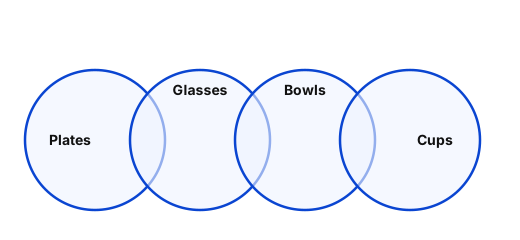
- Plates–Glasses, Glasses–Bowls, Bowls–Cups are the only definite links
- Cups and Glasses are not directly linked: I does not follow
- Bowls and Plates are not directly linked: II does not follow
Yaad rakhein: Some + Some = no conclusion.
Answer: (D) Neither conclusion (I) nor (II) follows.
अवधारणा: केवल 'कुछ' वाले कथनों में निष्कर्ष सिर्फ़ सीधे जुड़े युग्मों के बीच निकलता है।
- प्लेट–गिलास, गिलास–कटोरी, कटोरी–कप ही निश्चित संबंध हैं
- कप और गिलास सीधे नहीं जुड़े: I अनुसरण नहीं करता
- कटोरी और प्लेट सीधे नहीं जुड़े: II अनुसरण नहीं करता
याद रखें: कुछ + कुछ = कोई निष्कर्ष नहीं।
उत्तर: (D) न तो निष्कर्ष (I) और न ही (II) अनुसरण करता है।
RRB Technician Grade IIIGeneral Intelligence and ReasoningSyllogismRRB Technician Grade III 2024 · 26 Dec Shift 1
Q567.What will come in the place of ‘?’ in the following equation, if ‘÷’ and ‘−’ are interchanged and ‘×’ and ‘+’ are interchanged?
यदि ‘÷’ और ‘−’ को आपस में बदल दिया जाए तथा ‘×’ और ‘+’ को आपस में बदल दिया जाए, तो निम्नलिखित समीकरण में ‘?’ के स्थान पर क्या आएगा?
- A25
- B18
- C45
- D30
Show answer
Concept: Swap the signs first, then solve using BODMAS.
- and
Trick: Write the new expression fully before calculating – avoids sign slips.
Answer: (D) 30
अवधारणा: पहले चिह्न बदलें, फिर BODMAS से हल करें।
- तथा
ट्रिक: गणना से पहले नया व्यंजक पूरा लिख लें – चिह्न की गलती नहीं होगी।
उत्तर: (D) 30
RRB Technician Grade IIIGeneral Intelligence and ReasoningMathematical operations (interchange)RRB Technician Grade III 2024 · 26 Dec Shift 1
Q568.Refer to the given series and answer the question that follows (all numbers are single-digit numbers only).
(Left) 7 6 3 9 5 4 4 8 6 4 8 8 9 6 9 2 2 6 3 1 5 5 3 5 1 5 5 0 3 4 (Right)
What is the sum of the 15th digit from the left and the 11th digit from the right?
दी गई श्रृंखला का संदर्भ लें और आगे दिए गए प्रश्न का उत्तर दें (सभी संख्याएँ केवल एक अंक वाली संख्याएँ हैं)।
(बाएँ) 7 6 3 9 5 4 4 8 6 4 8 8 9 6 9 2 2 6 3 1 5 5 3 5 1 5 5 0 3 4 (दाएँ)
बाएँ से 15वें अंक और दाएँ से 11वें अंक का योग क्या है?
- A12
- B7
- C11
- D10
Show answer
Concept: In a series of digits, from right from left.
- Total digits
- from left
- from right from left
- Sum
Trick: Count in blocks of : 7 6 3 9 5 | 4 4 8 6 4 | 8 8 9 6 9 | 2 2 6 3 1.
Answer: (D) 10
अवधारणा: अंकों की श्रृंखला में दाएँ से वाँ बाएँ से वाँ।
- कुल अंक
- बाएँ से वाँ
- दाएँ से वाँ बाएँ से वाँ
- योग
ट्रिक: - के समूहों में गिनें: 7 6 3 9 5 | 4 4 8 6 4 | 8 8 9 6 9 | 2 2 6 3 1।
उत्तर: (D) 10
RRB Technician Grade IIIGeneral Intelligence and ReasoningNumber series – positionRRB Technician Grade III 2024 · 26 Dec Shift 1
Q569.In a certain code language, ‘ARID’ is coded as ‘9078’ and ‘DIRE’ is coded as ‘8095’. What is the code for ‘E’ in the given code language?
एक निश्चित कूट भाषा में, ‘ARID’ को ‘9078’ के रूप में और ‘DIRE’ को ‘8095’ के रूप में कूटबद्ध किया जाता है। दी गई कूट भाषा में ‘E’ के लिए कूट क्या है?
- A9
- B8
- C5
- D0
Show answer
Concept: Letters common to both words share the digits common to both codes; the leftover letter takes the leftover digit.
- ARID → 9, 0, 7, 8; DIRE → 8, 0, 9, 5
- Common letters D, I, R ↔ common digits 0, 8, 9
- So A ↔ 7 (left in ARID) and E ↔ 5 (left in DIRE)
Trick: Odd letter out ↔ odd digit out.
Answer: (C) 5
अवधारणा: दोनों शब्दों के समान अक्षरों के कूट, दोनों कूटों के समान अंक होते हैं; बचा अक्षर बचे अंक से जुड़ता है।
- ARID → 9, 0, 7, 8; DIRE → 8, 0, 9, 5
- समान अक्षर D, I, R ↔ समान अंक 0, 8, 9
- अतः A ↔ 7 (ARID में बचा) और E ↔ 5 (DIRE में बचा)
ट्रिक: बचा हुआ अक्षर ↔ बचा हुआ अंक।
उत्तर: (C) 5
RRB Technician Grade IIIGeneral Intelligence and ReasoningCoding-decoding (letter to digit)RRB Technician Grade III 2024 · 26 Dec Shift 1
Q570.In this question, a statement is followed by two courses of action, numbered I and II. You must assume everything in the statement to be true and on the basis of the information given in the statement, decide which of the courses of action logically follow(s) for pursuing.
Statement:
Air quality in City A has significantly deteriorated over the last decade due to increased industrial emissions.
Courses of Action:
I. Authorities of City A should implement strict emission control regulations for industries in the city.
II. The industries should distribute face masks to the residents of City A to protect them from the poor air quality.
इस प्रश्न में, एक कथन के बाद I और II क्रमांकित दो कार्यवाहियाँ दी गई हैं। आपको कथन में दी गई हर बात को सत्य मानना है और कथन में दी गई जानकारी के आधार पर निर्णय लेना है कि कौन-सी कार्यवाही/कार्यवाहियाँ अपनाने के लिए तार्किक रूप से अनुसरण करती है/करती हैं।
कथन:
बढ़ते औद्योगिक उत्सर्जन के कारण पिछले दशक में शहर A की वायु गुणवत्ता में काफी गिरावट आई है।
कार्यवाहियाँ:
I. शहर A के प्राधिकारियों को शहर के उद्योगों के लिए सख्त उत्सर्जन नियंत्रण नियम लागू करने चाहिए।
II. उद्योगों को शहर A के निवासियों को खराब वायु गुणवत्ता से बचाने के लिए फेस मास्क वितरित करने चाहिए।
- AOnly I followsकेवल I अनुसरण करती है
- BNeither I nor II followsन तो I और न ही II अनुसरण करती है
- COnly II followsकेवल II अनुसरण करती है
- DBoth I and II followI और II दोनों अनुसरण करती हैं
Show answer
Concept: A valid course of action tackles the root cause practically and is the duty of the right body.
- Cause: industrial emissions → strict emission norms by authorities removes the cause: I follows
- Distributing masks is not the industries' duty and does not solve the problem: II does not follow
Yaad rakhein: Prefer actions that remove the cause over temporary relief by the wrong agency.
Answer: (A) Only I follows
अवधारणा: सही कार्यवाही समस्या के मूल कारण को व्यावहारिक रूप से दूर करती है और उचित संस्था द्वारा की जाती है।
- कारण: औद्योगिक उत्सर्जन → प्राधिकरण द्वारा सख़्त उत्सर्जन नियम कारण दूर करते हैं: I अनुसरण करता है
- मास्क बाँटना उद्योगों का दायित्व नहीं और इससे समस्या हल नहीं होती: II अनुसरण नहीं करता
याद रखें: अस्थायी राहत की बजाय कारण दूर करने वाली कार्यवाही चुनें।
उत्तर: (A) केवल I अनुसरण करती है
RRB Technician Grade IIIGeneral Intelligence and ReasoningStatement and course of actionRRB Technician Grade III 2024 · 26 Dec Shift 1
Q571.Which of the following options should come in place of the question mark (?) in the given series to make it logically complete?
329, 472, 615, 758, 901, ?
दी गई श्रृंखला को तार्किक रूप से पूर्ण करने के लिए प्रश्न चिह्न (?) के स्थान पर निम्नलिखित में से कौन-सा विकल्प आना चाहिए?
329, 472, 615, 758, 901, ?
- A1068
- B1082
- C1044
- D1025
Show answer
Concept: Check differences between consecutive terms.
- , , ,
- Constant difference
- Next
Trick: Unit digits go (+3 each) ⇒ next ends in → only .
Answer: (C) 1044
अवधारणा: क्रमागत पदों का अंतर जाँचें।
- , , ,
- स्थिर अंतर
- अगला पद
ट्रिक: इकाई अंक (+3) ⇒ अगला पर खत्म → केवल ।
उत्तर: (C) 1044
RRB Technician Grade IIIGeneral Intelligence and ReasoningNumber seriesRRB Technician Grade III 2024 · 26 Dec Shift 1
Q572.Refer to the given series and answer the question that follows (all numbers are single-digit numbers only).
(Left) 5 1 9 4 7 7 1 4 4 1 2 8 5 4 2 6 0 3 2 2 9 3 5 4 4 6 4 5 4 7 (Right)
What is the sum of the 10th digit from the left and the 12th digit from the right?
दी गई श्रृंखला का संदर्भ लें और आगे दिए गए प्रश्न का उत्तर दें (सभी संख्याएँ केवल एक अंक वाली संख्याएँ हैं)।
(बाएँ) 5 1 9 4 7 7 1 4 4 1 2 8 5 4 2 6 0 3 2 2 9 3 5 4 4 6 4 5 4 7 (दाएँ)
बाएँ से 10वें अंक और दाएँ से 12वें अंक का योग क्या है?
- A4
- B3
- C2
- D1
Show answer
Concept: In a series of digits, from right from left.
- Total digits
- from left
- from right from left
- Sum
Trick: Blocks of : 5 1 9 4 7 | 7 1 4 4 1 | 2 8 5 4 2 | 6 0 3 2 2.
Answer: (B) 3
अवधारणा: अंकों की श्रृंखला में दाएँ से वाँ बाएँ से वाँ।
- कुल अंक
- बाएँ से वाँ
- दाएँ से वाँ बाएँ से वाँ
- योग
ट्रिक: - के समूह: 5 1 9 4 7 | 7 1 4 4 1 | 2 8 5 4 2 | 6 0 3 2 2।
उत्तर: (B) 3
RRB Technician Grade IIIGeneral Intelligence and ReasoningNumber series – positionRRB Technician Grade III 2024 · 26 Dec Shift 1
Q573.In a certain code language,
'A + B' means ‘A is the sister of B’,
'A – B' means ‘A is the husband of B’,
'A x B' means ‘A is the mother of B’
and 'A ÷ B' means ‘A is the son of B’.
How is Q related to S if ‘Q x R – S + T ÷ U'?
एक निश्चित कूट भाषा में,
'A + B' का अर्थ है ‘A, B की बहन है’,
'A – B' का अर्थ है ‘A, B का पति है’,
'A x B' का अर्थ है ‘A, B की माँ है’
और 'A ÷ B' का अर्थ है ‘A, B का पुत्र है’।
यदि ‘Q x R – S + T ÷ U' है, तो Q, S से किस प्रकार संबंधित है?
- ASisterबहन
- BMotherमाँ
- CHusband's motherपति की माँ
- DDaughterपुत्री
Show answer
Concept: Decode each symbol and build the family tree step by step.
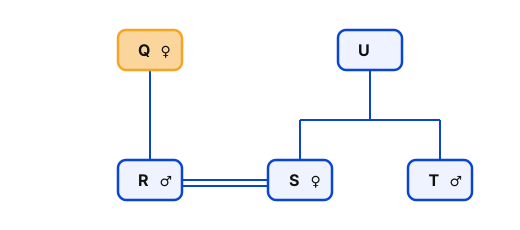
- Q × R: Q is mother of R
- R – S: R is husband of S
- S + T: S is sister of T; T ÷ U: T is son of U
- Q is the mother of S's husband ⇒ Q is S's husband's mother (mother-in-law)
Trick: Only the chain Q → R → S is needed; T and U do not affect the answer.
Answer: (C) Husband's mother
अवधारणा: प्रत्येक चिह्न का अर्थ लिखें और क्रम से वंश-वृक्ष बनाएँ।
- Q × R: Q, R की माता है
- R – S: R, S का पति है
- S + T: S, T की बहन है; T ÷ U: T, U का पुत्र है
- Q, S के पति की माता है ⇒ Q, S की सास है
ट्रिक: केवल Q → R → S की कड़ी चाहिए; T और U उत्तर को प्रभावित नहीं करते।
उत्तर: (C) पति की माँ
RRB Technician Grade IIIGeneral Intelligence and ReasoningBlood relations (coded)RRB Technician Grade III 2024 · 26 Dec Shift 1
Q574.Select the set in which the numbers are related in the same way as are the numbers of the following sets.
(NOTE: Operations should be performed on the whole numbers, without breaking down the numbers into its constituent digits. E.g. 13 – Operations on 13 such as adding/subtracting/multiplying etc. to 13 can be performed. Breaking down 13 into 1 and 3 and then performing mathematical operations on 1 and 3 is not allowed.)
(18, 6, 24)
(27, 9, 36)
उस समुच्चय का चयन कीजिए जिसमें संख्याएँ उसी प्रकार संबंधित हैं जिस प्रकार निम्नलिखित समुच्चयों की संख्याएँ संबंधित हैं।
(नोट: संख्याओं को उनके घटक अंकों में तोड़े बिना, पूर्ण संख्याओं पर संक्रियाएँ की जानी चाहिए। उदाहरण के लिए 13 – 13 पर संक्रियाएँ जैसे 13 में जोड़ना/घटाना/गुणा करना आदि किया जा सकता है। 13 को 1 और 3 में तोड़ना और फिर 1 और 3 पर गणितीय संक्रियाएँ करना वर्जित है।)
(18, 6, 24)
(27, 9, 36)
- A(33, 11, 44)
- B(33, 10, 44)
- C(33, 11, 42)
- D(31, 11, 44)
Show answer
Concept: Find the rule linking the three numbers in the given sets.
- : ,
- : ,
- : , ✓
Trick: Pattern is : gives .
Answer: (A) (33, 11, 44)
अवधारणा: दिए गए समूहों की तीनों संख्याओं को जोड़ने वाला नियम खोजें।
- : ,
- : ,
- : , ✓
ट्रिक: पैटर्न है: से ।
उत्तर: (A) (33, 11, 44)
RRB Technician Grade IIIGeneral Intelligence and ReasoningNumber analogy (sets)RRB Technician Grade III 2024 · 26 Dec Shift 1
Q575.Based on the English alphabetical order, three of the following four letter-cluster pairs are alike in a certain way and thus form a group. Which pair does not belong to that group?
(Note: The odd one out is not based on the number of consonants/vowels or their position in the letter cluster.)
अंग्रेजी वर्णमाला क्रम के आधार पर, निम्नलिखित चार अक्षर-समूह युग्मों में से तीन किसी निश्चित प्रकार से एकसमान हैं और इस प्रकार एक समूह बनाते हैं। कौन-सा युग्म उस समूह से संबंधित नहीं है?
(नोट: असंगत युग्म, व्यंजनों/स्वरों की संख्या या अक्षर-समूह में उनकी स्थिति पर आधारित नहीं है।)
- ANQ-LP
- BFI-DG
- CDG-BE
- DIL-GJ
Show answer
Concept: Compare the gap inside each cluster using letter positions.
- FI-DG: F(6)→I(9) , D(4)→G(7)
- DG-BE: , ; IL-GJ: ,
- NQ-LP: N(14)→Q(17) but L(12)→P(16) ✗
Trick: Both clusters should have the same gap; NQ-LP breaks it.
Answer: (A) NQ-LP
अवधारणा: अक्षरों की स्थिति लेकर प्रत्येक समूह के भीतर का अंतर देखें।
- FI-DG: F(6)→I(9) , D(4)→G(7)
- DG-BE: , ; IL-GJ: ,
- NQ-LP: N(14)→Q(17) पर L(12)→P(16) ✗
ट्रिक: दोनों समूहों में अंतर समान होना चाहिए; NQ-LP में नहीं है।
उत्तर: (A) NQ-LP
RRB Technician Grade IIIGeneral Intelligence and ReasoningOdd one out (letter pairs)RRB Technician Grade III 2024 · 26 Dec Shift 1
Q576.MILH is related to KGJF in a certain way based on the English alphabetical order. In the same way, QMPL is related to OKNJ. To which of the following options is TPSO related, following the same logic?
अंग्रेजी वर्णमाला क्रम के आधार पर MILH एक निश्चित प्रकार से KGJF से संबंधित है। उसी प्रकार, QMPL, OKNJ से संबंधित है। समान तर्क का अनुसरण करते हुए, TPSO निम्नलिखित में से किस विकल्प से संबंधित है?
- ARNMQ
- BRNQM
- CNRMQ
- DNRQM
Show answer
Concept: Find the letter-wise shift in the example pairs.
- MILH → KGJF: each letter
- QMPL → OKNJ: each letter ✓
- TPSO : T→R, P→N, S→Q, O→M = RNQM
Trick: Same shift for all four letters – apply it in the same order.
Answer: (B) RNQM
अवधारणा: उदाहरण युग्मों में प्रत्येक अक्षर का खिसकाव देखें।
- MILH → KGJF: प्रत्येक अक्षर
- QMPL → OKNJ: प्रत्येक अक्षर ✓
- TPSO : T→R, P→N, S→Q, O→M = RNQM
ट्रिक: चारों अक्षरों पर समान खिसकाव – उसी क्रम में लगाएँ।
उत्तर: (B) RNQM
RRB Technician Grade IIIGeneral Intelligence and ReasoningLetter analogyRRB Technician Grade III 2024 · 26 Dec Shift 1
Q577.Which of the following options should come in place of the question mark (?) in the given series based on the English alphabetical order?
CFI, KNQ, SVY, ADG, ?
अंग्रेजी वर्णमाला क्रम के आधार पर दी गई श्रृंखला में प्रश्न चिह्न (?) के स्थान पर निम्नलिखित में से कौन-सा विकल्प आना चाहिए?
CFI, KNQ, SVY, ADG, ?
- AIKM
- BILO
- CJLN
- DJMP
Show answer
Concept: Inside each term letters jump ; first letters of terms jump (cyclic).
- CFI, KNQ, SVY, ADG: each inside
- First letters: C→K→S→A, each (S wraps to A)
- Next first letter A I ⇒ I, L, O
Trick: Last letter gives the next first letter: I→K, Q→S, Y→A, so G→I.
Answer: (B) ILO
अवधारणा: प्रत्येक पद के भीतर अक्षर ; पदों के पहले अक्षर (चक्रीय)।
- CFI, KNQ, SVY, ADG: अंदर
- पहले अक्षर: C→K→S→A, प्रत्येक (S घूमकर A)
- अगला पहला अक्षर A I ⇒ I, L, O
ट्रिक: पिछले पद का अंतिम अक्षर = अगला पहला अक्षर: G I ✓।
उत्तर: (B) ILO
RRB Technician Grade IIIGeneral Intelligence and ReasoningLetter seriesRRB Technician Grade III 2024 · 26 Dec Shift 1
Q578.P, Q, R, S, T, U, and V are sitting around a circular table facing the centre. Only 1 person sits between V and T when counted from the right of V. Q and R are both immediate neighbours of U. S is not an immediate neighbour of T. Only 1 person sits between P and R when counted from the left of R. Who sits third to the left of U?
P, Q, R, S, T, U और V एक वृत्ताकार मेज के चारों ओर केंद्र की ओर मुख करके बैठे हैं। V के दाईं ओर से गिनने पर V और T के बीच केवल 1 व्यक्ति बैठा है। Q और R दोनों U के निकटतम पड़ोसी हैं। S, T का निकटतम पड़ोसी नहीं है। R के बाईं ओर से गिनने पर P और R के बीच केवल 1 व्यक्ति बैठा है। U के बाईं ओर तीसरे स्थान पर कौन बैठा है?
- AT
- BP
- CS
- DV
Show answer
Concept: Facing the centre, left = clockwise and right = anticlockwise.
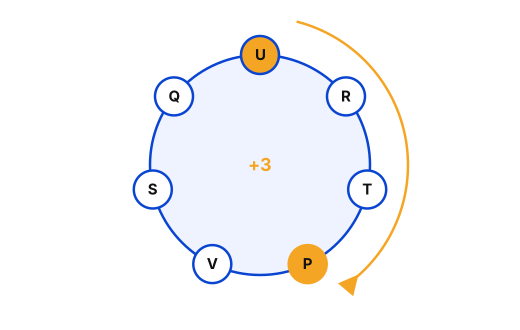
- U in middle of Q and R; try R to U's left. P is 2nd left of R
- V and T: T is 2nd to the right of V ⇒ order U, R, T, P, V, S, Q (clockwise)
- S's neighbours V and Q, not T ✓ (R on U's right fails – P's seat clashes with Q)
- Third to the left of U: R, T, P ⇒ P
Trick: Fix the 3-person block Q-U-R first, then place others.
Answer: (B) P
अवधारणा: केंद्र की ओर मुख होने पर बायाँ = दक्षिणावर्त और दायाँ = वामावर्त।
- U, Q और R के बीच; R को U के बाएँ रखें। P, R के बाएँ से दूसरा
- V और T: T, V के दाएँ से दूसरा ⇒ क्रम U, R, T, P, V, S, Q (दक्षिणावर्त)
- S के पड़ोसी V और Q, T नहीं ✓ (R को U के दाएँ रखने पर P की जगह Q से टकराती है)
- U के बाएँ से तीसरा: R, T, P ⇒ P
ट्रिक: पहले Q-U-R का 3-व्यक्ति खंड तय करें, फिर बाकी को रखें।
उत्तर: (B) P
RRB Technician Grade IIIGeneral Intelligence and ReasoningCircular seating arrangementRRB Technician Grade III 2024 · 26 Dec Shift 1
Q579.Based on the English alphabetical order, three of the following four letter-clusters are alike in a certain way and thus form a group. Which letter-cluster does not belong to that group?
(Note: The odd one out is not based on the number of consonants/vowels or their position in the letter-cluster.)
अंग्रेजी वर्णमाला क्रम के आधार पर, निम्नलिखित चार अक्षर-समूहों में से तीन किसी निश्चित प्रकार से एकसमान हैं और इस प्रकार एक समूह बनाते हैं। कौन-सा अक्षर-समूह उस समूह से संबंधित नहीं है?
(नोट: असंगत अक्षर-समूह, उस अक्षर-समूह में व्यंजनों/स्वरों की संख्या या उनके स्थान पर आधारित नहीं है।)
- AGDAX
- BKHEB
- CAXUR
- DOKJH
Show answer
Concept: Check the gap between successive letters (cyclic A–Z).
- GDAX: G→D→A→X, each
- KHEB: each ; AXUR: A→X→U→R, each
- OKJH: O→K , K→J , J→H ✗
Trick: Remember A wraps to X (26 → 24).
Answer: (D) OKJH
अवधारणा: क्रमागत अक्षरों का अंतर देखें (A–Z चक्रीय)।
- GDAX: G→D→A→X, प्रत्येक
- KHEB: प्रत्येक ; AXUR: A→X→U→R, प्रत्येक
- OKJH: O→K , K→J , J→H ✗
ट्रिक: ध्यान दें A घूमकर X बनता है।
उत्तर: (D) OKJH
RRB Technician Grade IIIGeneral Intelligence and ReasoningOdd one out (letter clusters)RRB Technician Grade III 2024 · 26 Dec Shift 1
Q580.Which of the following options should come in place of the question mark (?) in the given series based on the English alphabetical order?
HKN, ILO, JMP, KNQ, ?
अंग्रेजी वर्णमाला क्रम के आधार पर दी गई श्रृंखला में प्रश्न चिह्न (?) के स्थान पर निम्नलिखित में से कौन-सा विकल्प आना चाहिए?
HKN, ILO, JMP, KNQ, ?
- ALOR
- BLRO
- CORL
- DOLR
Show answer
Concept: Each letter position moves from one term to the next.
- HKN → ILO → JMP → KNQ (each letter )
- Next: K→L, N→O, Q→R
- Answer term LOR
Trick: Inside each term the gap is : L, O, R keeps it.
Answer: (A) LOR
अवधारणा: प्रत्येक स्थान का अक्षर अगले पद में बढ़ता है।
- HKN → ILO → JMP → KNQ (प्रत्येक अक्षर )
- अगला: K→L, N→O, Q→R
- उत्तर LOR
ट्रिक: हर पद के भीतर अंतर : L, O, R इसे बनाए रखता है।
उत्तर: (A) LOR
RRB Technician Grade IIIGeneral Intelligence and ReasoningLetter seriesRRB Technician Grade III 2024 · 26 Dec Shift 1

