Q581.Which of the following methods is used for refining impure metals?
अशुद्ध धातुओं के परिष्करण के लिए निम्नलिखित में से किस विधि का उपयोग किया जाता है?
- AElectrolytic refiningविद्युत-अपघटनी परिष्करण (Electrolytic refining)
- BOilingतेल लगाना (Oiling)
- CGalvanisationयशदलेपन (Galvanisation)
- DPaintingपेंट करना (Painting)
Show answer
Concept: Impure metals like copper, zinc, tin, nickel, silver and gold are purified by electrolytic refining.
- Impure metal is made the anode; a thin strip of pure metal is the cathode.
- A salt solution of the same metal is the electrolyte.
- On passing current, pure metal deposits on the cathode; impurities settle as anode mud.
- Oiling, painting and galvanisation only prevent rusting — they do not purify.
Yaad rakhein: Anode = impure, Cathode = pure. Galvanisation = zinc coating on iron.
Answer: (A) Electrolytic refining
अवधारणा: ताँबा, जिंक, टिन, निकेल, चाँदी, सोना जैसी अशुद्ध धातुओं का शोधन विद्युत-अपघटनी परिष्करण से होता है।
- अशुद्ध धातु को एनोड और शुद्ध धातु की पतली पट्टी को कैथोड बनाते हैं।
- उसी धातु के लवण का विलयन विद्युत-अपघट्य होता है।
- धारा प्रवाहित करने पर शुद्ध धातु कैथोड पर जमती है; अशुद्धियाँ एनोड पंक के रूप में नीचे बैठती हैं।
- तेल लगाना, पेंट करना, यशदलेपन केवल जंग रोकते हैं — शुद्ध नहीं करते।
याद रखें: एनोड = अशुद्ध, कैथोड = शुद्ध। यशदलेपन = लोहे पर जिंक की परत।
उत्तर: (A) विद्युत-अपघटनी परिष्करण (Electrolytic refining)
RRB Technician Grade IIIGeneral ScienceRefining of MetalsRRB Technician Grade III 2024 · 29 Dec Shift 1
Q582.24-carat gold is called ________.
24-कैरेट सोने को ________ कहा जाता है।
- Aspongy goldस्पंजी सोना
- Bimpure goldअशुद्ध सोना
- Cpure goldशुद्ध सोना
- Dwrought goldपिटवाँ सोना (wrought gold)
Show answer
Concept: Purity of gold is measured in carats; 24 carat is the maximum, i.e. pure gold.
- 24-carat gold is pure but very soft, so it is not used for jewellery.
- Jewellery gold is usually 22 carat: parts gold + parts copper or silver (an alloy).
- Purity of 22 carat .
Yaad rakhein: Carat value = fraction of gold.
Answer: (C) pure gold
अवधारणा: सोने की शुद्धता कैरेट में मापी जाती है; 24 कैरेट अधिकतम है, अर्थात शुद्ध सोना।
- 24 कैरेट सोना शुद्ध पर बहुत नरम होता है, इसलिए गहनों में नहीं लगता।
- गहनों में प्रायः 22 कैरेट: भाग सोना + भाग ताँबा या चाँदी (मिश्रातु)।
- 22 कैरेट की शुद्धता ।
याद रखें: कैरेट मान = सोने का अंश।
उत्तर: (C) शुद्ध सोना
RRB Technician Grade IIIGeneral ScienceAlloys – GoldRRB Technician Grade III 2024 · 29 Dec Shift 1
Q583.Which of the following products is NOT formed when electricity is passed through an aqueous solution of sodium chloride?
सोडियम क्लोराइड के जलीय विलयन में विद्युत प्रवाहित करने पर निम्नलिखित में से कौन-सा उत्पाद नहीं बनता है?
- ASodium hydroxideसोडियम हाइड्रॉक्साइड
- BChlorine gasक्लोरीन गैस
- CHydrogen gasहाइड्रोजन गैस
- DOxygen gasऑक्सीजन गैस
Show answer
Concept: Electrolysis of aqueous NaCl (brine) is the chlor-alkali process: .
- Chlorine gas is released at the anode.
- Hydrogen gas is released at the cathode.
- Sodium hydroxide solution forms near the cathode.
- Oxygen gas is not a product.
Yaad rakhein: Chlor () + alkali () + — name itself tells the products.
Answer: (D) Oxygen gas
अवधारणा: जलीय NaCl (लवण-जल) का विद्युत-अपघटन क्लोर-क्षार प्रक्रिया है: ।
- एनोड पर क्लोरीन गैस निकलती है।
- कैथोड पर हाइड्रोजन गैस निकलती है।
- कैथोड के पास सोडियम हाइड्रॉक्साइड बनता है।
- ऑक्सीजन गैस उत्पाद नहीं है।
याद रखें: क्लोर () + क्षार () + — नाम ही उत्पाद बताता है।
उत्तर: (D) ऑक्सीजन गैस
RRB Technician Grade IIIGeneral ScienceChlor-alkali ProcessRRB Technician Grade III 2024 · 29 Dec Shift 1
Q584.If an object is placed in front of a concave mirror at a distance of 20 cm and the image is formed on the same side at a distance of 40 cm, then the magnification of the mirror will be:
यदि किसी वस्तु को अवतल दर्पण (concave mirror) के सामने 20 cm की दूरी पर रखा जाता है और प्रतिबिंब उसी ओर 40 cm की दूरी पर बनता है, तो दर्पण का आवर्धन (magnification) क्या होगा?
- A+0.4
- B+2.0
- C−0.4
- D−2.0
Show answer
Concept: For a mirror, magnification . With the sign convention, distances in front of the mirror are negative.
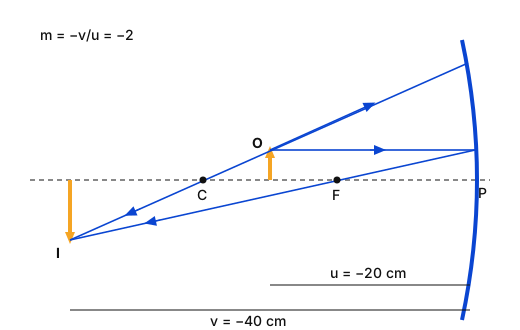
- Object in front: ; image on the same side (real): .
- Negative sign → real, inverted image, twice the size.
Trick: Real image of a mirror always has negative ; size ratio → .
Answer: (D) −2.0
अवधारणा: दर्पण का आवर्धन । चिह्न परिपाटी में दर्पण के सामने की दूरियाँ ऋणात्मक होती हैं।
- वस्तु सामने: ; प्रतिबिंब उसी ओर (वास्तविक): ।
- ऋणात्मक चिह्न → वास्तविक, उल्टा प्रतिबिंब, दोगुना बड़ा।
ट्रिक: दर्पण का वास्तविक प्रतिबिंब हमेशा ऋणात्मक देता है; आकार अनुपात → ।
उत्तर: (D) −2.0
RRB Technician Grade IIIGeneral ScienceMirror MagnificationRRB Technician Grade III 2024 · 29 Dec Shift 1
Q585.The kinetic energy of a moving body of mass ‘m’ and velocity ‘v’ is ________.
द्रव्यमान ‘m’ और वेग ‘v’ वाले किसी गतिमान पिंड की गतिज ऊर्जा ________ होती है।
- Ainversely proportional to its mass and square of its velocityउसके द्रव्यमान और उसके वेग के वर्ग के व्युत्क्रमानुपाती
- Bdirectly proportional to its mass but inversely proportional to its velocityउसके द्रव्यमान के अनुक्रमानुपाती परंतु उसके वेग के व्युत्क्रमानुपाती
- Cdirectly proportional to its velocity but inversely proportional to its massउसके वेग के अनुक्रमानुपाती परंतु उसके द्रव्यमान के व्युत्क्रमानुपाती
- Ddirectly proportional to its mass and square of its velocityउसके द्रव्यमान और उसके वेग के वर्ग के अनुक्रमानुपाती
Show answer
Concept: Kinetic energy .
- → directly proportional to mass.
- → directly proportional to the square of velocity.
- E.g., doubling makes four times.
Trick: Read the formula: and are both in the numerator → both 'directly proportional'.
Answer: (D) directly proportional to its mass and square of its velocity
अवधारणा: गतिज ऊर्जा ।
- → द्रव्यमान के अनुक्रमानुपाती।
- → वेग के वर्ग के अनुक्रमानुपाती।
- उदाहरण: दोगुना करने पर चार गुना।
ट्रिक: सूत्र देखें: और दोनों अंश में हैं → दोनों 'अनुक्रमानुपाती'।
उत्तर: (D) उसके द्रव्यमान और उसके वेग के वर्ग के अनुक्रमानुपाती
RRB Technician Grade IIIGeneral ScienceKinetic EnergyRRB Technician Grade III 2024 · 29 Dec Shift 1
Q586.Which of the following is NOT a sign of sexual maturity in girls?
निम्नलिखित में से कौन-सा लड़कियों में लैंगिक परिपक्वता का लक्षण नहीं है?
- ACracking of voiceआवाज का फटना (भारी होना)
- BIncrease in breast sizeस्तनों के आकार में वृद्धि
- CMenstruationरजोधर्म (मासिक धर्म)
- DOily skinतैलीय त्वचा
Show answer
Concept: At puberty, sex hormones bring changes; some are common to both sexes, some specific to girls or boys.
- Girls: increase in breast size, start of menstruation.
- Both sexes: oily skin, pimples, hair in armpits and genital area.
- Cracking of voice (and facial hair) is a sign in boys, due to testosterone and growth of the larynx.
Yaad rakhein: Cracking voice, beard, moustache → boys only.
Answer: (A) Cracking of voice
अवधारणा: यौवनारंभ में लिंग हॉर्मोन से परिवर्तन होते हैं; कुछ दोनों में सामान्य, कुछ केवल लड़कियों या लड़कों में।
- लड़कियाँ: स्तनों के आकार में वृद्धि, ऋतुस्राव (मासिक धर्म) का आरंभ।
- दोनों में: त्वचा तैलीय, मुहाँसे, बगल और जननांग क्षेत्र में बाल।
- आवाज़ का फटना (और चेहरे पर बाल) लड़कों का लक्षण है, टेस्टोस्टेरोन और स्वरयंत्र की वृद्धि के कारण।
याद रखें: आवाज़ फटना, दाढ़ी, मूँछ → केवल लड़कों में।
उत्तर: (A) आवाज का फटना (भारी होना)
RRB Technician Grade IIIGeneral SciencePuberty ChangesRRB Technician Grade III 2024 · 29 Dec Shift 1
Q587.What is the process by which autotrophs take in substance from outside and in the presence of sunlight, convert them into stored forms of energy?
वह कौन-सा प्रक्रम है जिसके द्वारा स्वपोषी (autotrophs) बाहर से पदार्थ ग्रहण करते हैं और सूर्य के प्रकाश की उपस्थिति में उन्हें ऊर्जा के संचित रूपों में परिवर्तित करते हैं?
- APhotosynthesisप्रकाश संश्लेषण
- BCirculationपरिसंचरण
- CMovementगति
- DDigestionपाचन
Show answer
Concept: Autotrophs (green plants) take in and water from outside and, using sunlight and chlorophyll, convert them into carbohydrates — stored energy. This is photosynthesis.
- Equation:
- Glucose formed is stored as starch.
- Digestion, circulation and movement do not convert light energy into chemical energy.
Yaad rakhein: Photo = light, synthesis = making — 'making food using light'.
Answer: (A) Photosynthesis
अवधारणा: स्वपोषी (हरे पौधे) बाहर से और जल लेकर सूर्य के प्रकाश और क्लोरोफिल की उपस्थिति में कार्बोहाइड्रेट (संचित ऊर्जा) बनाते हैं। यह प्रकाश-संश्लेषण है।
- समीकरण:
- बना हुआ ग्लूकोज़ मंड (स्टार्च) के रूप में संचित होता है।
- पाचन, परिसंचरण और गति प्रकाश ऊर्जा को रासायनिक ऊर्जा में नहीं बदलते।
याद रखें: फोटो = प्रकाश, संश्लेषण = बनाना — 'प्रकाश से भोजन बनाना'।
उत्तर: (A) प्रकाश संश्लेषण
RRB Technician Grade IIIGeneral ScienceNutrition in PlantsRRB Technician Grade III 2024 · 29 Dec Shift 1
Q588.A body of mass m and a body of mass 4m are dropped from the same height, the ratio of the time taken by the two bodies to reach the ground would be:
(Air resistance is neglected)
द्रव्यमान m वाले एक पिंड और द्रव्यमान 4m वाले एक पिंड को समान ऊँचाई से गिराया जाता है, दोनों पिंडों द्वारा जमीन तक पहुँचने में लिए गए समय का अनुपात क्या होगा?
(वायु प्रतिरोध की उपेक्षा की गई है)
- A4:1
- B1:4
- C1:1
- D1:2
Show answer
Concept: Without air resistance, all bodies fall with the same acceleration , whatever their mass. Time to fall height : .
- depends only on and — mass does not appear.
- Both bodies fall from the same height, so .
- Ratio .
Yaad rakhein: Galileo: a feather and a coin fall together in vacuum.
Answer: (C) 1:1
अवधारणा: वायु प्रतिरोध न हो तो सभी वस्तुएँ द्रव्यमान से स्वतंत्र, समान त्वरण से गिरती हैं। ऊँचाई से गिरने का समय: ।
- केवल और पर निर्भर है — द्रव्यमान सूत्र में नहीं।
- दोनों वस्तुएँ समान ऊँचाई से गिरती हैं, अतः ।
- अनुपात ।
याद रखें: गैलीलियो: निर्वात में पंख और सिक्का साथ-साथ गिरते हैं।
उत्तर: (C) 1:1
RRB Technician Grade IIIGeneral ScienceFree FallRRB Technician Grade III 2024 · 29 Dec Shift 1
Q589.The upward and downward growth of a plant is due to which of the following tropisms?
पौधे की ऊपर और नीचे की ओर वृद्धि निम्नलिखित में से किस अनुवर्तन (tropism) के कारण होती है?
- AGeotropismगुरुत्वानुवर्तन (Geotropism)
- BPhototropismप्रकाशानुवर्तन (Phototropism)
- CHydrotropismजलानुवर्तन (Hydrotropism)
- DChemotropismरसायनानुवर्तन (Chemotropism)
Show answer
Concept: Movement of plant parts in response to gravity is geotropism (gravitropism).
- Roots grow downward, towards gravity → positive geotropism.
- Shoots grow upward, away from gravity → negative geotropism.
- So both upward and downward growth are due to geotropism. (Phototropism = light, hydrotropism = water, chemotropism = chemicals, e.g. pollen tube.)
Yaad rakhein: Geo = earth: roots go to the earth, shoot goes away from it.
Answer: (A) Geotropism
अवधारणा: गुरुत्व के प्रति पौधे के भागों की गति गुरुत्वानुवर्तन (जियोट्रॉपिज़्म) कहलाती है।
- जड़ें नीचे, गुरुत्व की ओर बढ़ती हैं → धनात्मक गुरुत्वानुवर्तन।
- तना ऊपर, गुरुत्व से दूर बढ़ता है → ऋणात्मक गुरुत्वानुवर्तन।
- अतः ऊपर और नीचे दोनों वृद्धि गुरुत्वानुवर्तन से है। (प्रकाशानुवर्तन = प्रकाश, जलानुवर्तन = जल, रसायनानुवर्तन = रसायन, जैसे पराग नलिका।)
याद रखें: जियो = पृथ्वी: जड़ पृथ्वी की ओर, तना उससे दूर।
उत्तर: (A) गुरुत्वानुवर्तन (Geotropism)
RRB Technician Grade IIIGeneral SciencePlant TropismsRRB Technician Grade III 2024 · 29 Dec Shift 1
Q590.Express the speed of 25 m/s in km/h.
25 m/s की चाल को km/h में व्यक्त कीजिए।
- A50 km/h
- B90 km/h
- C15 km/h
- D99 km/h
Show answer
Concept: .
Trick: m/s → km/h: multiply by : .
Answer: (B) 90 km/h
अवधारणा: ।
ट्रिक: m/s → km/h: से गुणा करें: ।
उत्तर: (B) 90 km/h
RRB Technician Grade IIIGeneral ScienceUnit Conversion – SpeedRRB Technician Grade III 2024 · 29 Dec Shift 1
Q591.Which of the following metals reacts with cold water?
निम्नलिखित में से कौन-सी धातु ठंडे जल के साथ अभिक्रिया करती है?
- AZincजिंक
- BIronआयरन
- CAluminiumएल्युमिनियम
- DSodiumसोडियम
Show answer
Concept: Highly reactive metals like sodium and potassium react violently even with cold water.
- (heat released; hydrogen may catch fire).
- Aluminium, iron and zinc do not react with cold water; they react only with steam.
- Sodium is therefore stored in kerosene.
Yaad rakhein: Cold water: K, Na (violent), Ca (less violent). Hot water: Mg. Steam: Al, Zn, Fe.
Answer: (D) Sodium
अवधारणा: सोडियम और पोटैशियम जैसी अति अभिक्रियाशील धातुएँ ठंडे जल से भी तीव्रता से अभिक्रिया करती हैं।
- (ऊष्मा मुक्त; हाइड्रोजन आग पकड़ सकती है)।
- एल्युमिनियम, लोहा और जिंक ठंडे जल से अभिक्रिया नहीं करते; केवल भाप से करते हैं।
- इसीलिए सोडियम को केरोसिन में रखते हैं।
याद रखें: ठंडा जल: K, Na (तीव्र), Ca (कम तीव्र)। गरम जल: Mg। भाप: Al, Zn, Fe।
उत्तर: (D) सोडियम
RRB Technician Grade IIIGeneral ScienceReaction of Metals with WaterRRB Technician Grade III 2024 · 29 Dec Shift 1
Q592.Gastric glands present in the wall of the stomach do NOT release:
आमाशय की भित्ति में उपस्थित जठर ग्रंथियाँ (gastric glands) किसका स्रावण नहीं करती हैं?
- Ahydrochloric acidहाइड्रोक्लोरिक अम्ल
- Bmucusश्लेष्मा (mucus)
- Csalivaलार (saliva)
- Dpepsinपेप्सिन
Show answer
Concept: Gastric glands in the stomach wall secrete hydrochloric acid, pepsin and mucus.
- HCl — makes medium acidic, kills germs, activates pepsin.
- Pepsin — digests proteins.
- Mucus — protects the stomach lining from acid.
- Saliva is secreted by salivary glands in the mouth, not by gastric glands.
Yaad rakhein: Gastric juice = HCl + pepsin + mucus.
Answer: (C) saliva
अवधारणा: आमाशय की भित्ति की जठर ग्रंथियाँ हाइड्रोक्लोरिक अम्ल, पेप्सिन और श्लेष्मा स्रावित करती हैं।
- HCl — माध्यम अम्लीय करता है, रोगाणु मारता है, पेप्सिन सक्रिय करता है।
- पेप्सिन — प्रोटीन पचाता है।
- श्लेष्मा — अम्ल से आमाशय के आंतरिक स्तर की रक्षा करता है।
- लार मुख की लार ग्रंथियाँ बनाती हैं, जठर ग्रंथियाँ नहीं।
याद रखें: जठर रस = HCl + पेप्सिन + श्लेष्मा।
उत्तर: (C) लार (saliva)
RRB Technician Grade IIIGeneral ScienceDigestion in StomachRRB Technician Grade III 2024 · 29 Dec Shift 1
Q593.Which of the following is produced when acid reacts with metals?
जब अम्ल धातुओं के साथ अभिक्रिया करता है, तो निम्नलिखित में से क्या उत्पन्न होता है?
- AOnly Saltकेवल लवण
- BSalt and waterलवण और जल
- COnly Hydrogen gasकेवल हाइड्रोजन गैस
- DSalt and hydrogen gasलवण और हाइड्रोजन गैस
Show answer
Concept: Acids react with active metals to give a salt and hydrogen gas: Acid + Metal → Salt + .
- Example:
- Hydrogen is tested by a burning splinter — it burns with a 'pop' sound.
- Salt and water form when an acid reacts with a base (neutralisation), not with a metal.
Yaad rakhein: Acid + metal → salt + ; acid + base → salt + water; acid + carbonate → salt + water + .
Answer: (D) Salt and hydrogen gas
अवधारणा: अम्ल सक्रिय धातुओं से अभिक्रिया करके लवण और हाइड्रोजन गैस देते हैं: अम्ल + धातु → लवण + ।
- उदाहरण:
- हाइड्रोजन की पहचान: जलती तीली पास लाने पर 'पॉप' ध्वनि।
- लवण और जल तब बनते हैं जब अम्ल क्षारक से अभिक्रिया करे (उदासीनीकरण), धातु से नहीं।
याद रखें: अम्ल + धातु → लवण + ; अम्ल + क्षारक → लवण + जल; अम्ल + कार्बोनेट → लवण + जल + ।
उत्तर: (D) लवण और हाइड्रोजन गैस
RRB Technician Grade IIIGeneral ScienceAcids with MetalsRRB Technician Grade III 2024 · 29 Dec Shift 1
Q594.If the power of a lens is +1 Dioptre, then the focal length of the lens will be:
यदि किसी लेंस की क्षमता +1 डायोप्टर है, तो लेंस की फोकस दूरी कितनी होगी?
- A0.5 m
- B0.25 m
- C1 m
- D0.75 m
Show answer
Concept: Focal length , with in dioptre and in metres.
- (convex lens).
Yaad rakhein: = power of a lens of focal length — that is the definition of the dioptre.
Answer: (C) 1 m
अवधारणा: फोकस दूरी ; डायोप्टर में और मीटर में।
- (उत्तल लेंस)।
याद रखें: = फोकस दूरी वाले लेंस की क्षमता — यही डायोप्टर की परिभाषा है।
उत्तर: (C) 1 m
RRB Technician Grade IIIGeneral SciencePower of a LensRRB Technician Grade III 2024 · 29 Dec Shift 1
Q595.In a circuit, suppose the three resistors having the values 5 Ω, 10 Ω, 20 Ω are connected in parallel; then equivalent resistance of the circuit will be ________.
मान लीजिए किसी परिपथ में 5 Ω, 10 Ω, 20 Ω मान वाले तीन प्रतिरोधक पार्श्व (parallel) में जुड़े हैं; तब परिपथ का तुल्य प्रतिरोध ________ होगा।
- A
- B
- C35 Ω
- D20 Ω
Show answer
Concept: For resistors in parallel: .
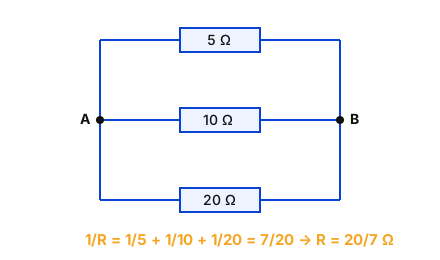
- LCM :
Trick: Parallel resistance is always less than the smallest resistor () — only fits.
Answer: (B)
अवधारणा: समांतर क्रम में प्रतिरोधों के लिए: ।
- LCM :
ट्रिक: समांतर तुल्य प्रतिरोध सबसे छोटे प्रतिरोध () से भी कम होता है — केवल उपयुक्त।
उत्तर: (B)
RRB Technician Grade IIIGeneral ScienceResistors in ParallelRRB Technician Grade III 2024 · 29 Dec Shift 1
Q596.All activities inside the cell and interactions of the cell with its environment are possible due to three important features observed in almost every cell. Which are the three features?
कोशिका के अंदर की सभी गतिविधियाँ और कोशिका की उसके पर्यावरण के साथ अन्योन्य क्रियाएँ लगभग प्रत्येक कोशिका में देखी जाने वाली तीन महत्वपूर्ण विशेषताओं के कारण संभव होती हैं। वे तीन विशेषताएँ कौन-सी हैं?
- AMitochondria, nucleus and cytoplasmमाइटोकॉन्ड्रिया, केंद्रक और कोशिकाद्रव्य
- BMitochondria, nucleus and Golgi apparatusमाइटोकॉन्ड्रिया, केंद्रक और गॉल्जी उपकरण
- CPlasma membrane, nucleus and cytoplasmप्लाज्मा झिल्ली, केंद्रक और कोशिकाद्रव्य
- DPlasma membrane, nucleus and Golgi apparatusप्लाज्मा झिल्ली, केंद्रक और गॉल्जी उपकरण
Show answer
Concept: Almost every cell has three basic features — plasma membrane, nucleus and cytoplasm — which make all its activities and interactions possible.
- Plasma membrane: controls entry and exit of substances.
- Nucleus: contains chromosomes (DNA) and controls cell activities.
- Cytoplasm: fluid in which organelles work and reactions occur.
- Mitochondria and Golgi apparatus are organelles, absent in prokaryotes, so they are not the 'three features'.
Yaad rakhein: Three basic parts of a cell: membrane, nucleus, cytoplasm.
Answer: (C) Plasma membrane, nucleus and cytoplasm
अवधारणा: लगभग हर कोशिका में तीन मूल लक्षण होते हैं — प्लाज़्मा झिल्ली, केंद्रक और कोशिकाद्रव्य — जिनसे उसकी सभी क्रियाएँ और पर्यावरण से अंतःक्रिया संभव होती है।
- प्लाज़्मा झिल्ली: पदार्थों के आने-जाने को नियंत्रित करती है।
- केंद्रक: गुणसूत्र (DNA) रखता है और कोशिका क्रियाएँ नियंत्रित करता है।
- कोशिकाद्रव्य: तरल जिसमें कोशिकांग काम करते हैं और अभिक्रियाएँ होती हैं।
- माइटोकॉन्ड्रिया और गॉल्जी उपकरण कोशिकांग हैं, प्रोकैरियोट में नहीं होते, अतः वे 'तीन लक्षण' नहीं।
याद रखें: कोशिका के तीन मूल भाग: झिल्ली, केंद्रक, कोशिकाद्रव्य।
उत्तर: (C) प्लाज्मा झिल्ली, केंद्रक और कोशिकाद्रव्य
RRB Technician Grade IIIGeneral ScienceCell StructureRRB Technician Grade III 2024 · 29 Dec Shift 1
Q597.Select the correct statement related to the characteristics of prokaryotic cell.
प्रोकैरियोटी कोशिका (prokaryotic cell) की विशेषताओं से संबंधित सही कथन का चयन कीजिए।
- AIt has a single chromosome.इसमें एकल गुणसूत्र होता है।
- BNuclear region is well defined and surrounded by nuclear membrane.केंद्रकीय क्षेत्र सुपरिभाषित होता है और केंद्रक झिल्ली से घिरा होता है।
- CMembrane bound cell organelles are present.झिल्ली युक्त कोशिकांग उपस्थित होते हैं।
- DIt has more than one chromosome.इसमें एक से अधिक गुणसूत्र होते हैं।
Show answer
Concept: Prokaryotic cells (e.g., bacteria) have no true nucleus; the genetic material lies in a poorly defined nucleoid region.
- They have a single chromosome (one circular DNA) — option 1 correct.
- No nuclear membrane — so option 2 is wrong.
- Membrane-bound organelles like mitochondria and plastids are absent — option 3 wrong.
- More than one chromosome is a feature of eukaryotes — option 4 wrong.
Yaad rakhein: Pro = primitive: no nuclear membrane, no membrane-bound organelles, single chromosome.
Answer: (A) It has a single chromosome.
अवधारणा: प्रोकैरियोटी कोशिकाओं (जैसे जीवाणु) में वास्तविक केंद्रक नहीं होता; आनुवंशिक पदार्थ अस्पष्ट केंद्रक-क्षेत्र (न्यूक्लिऑइड) में रहता है।
- इनमें एक ही गुणसूत्र (एक वृत्ताकार DNA) होता है — विकल्प 1 सही।
- केंद्रक झिल्ली नहीं होती — विकल्प 2 गलत।
- माइटोकॉन्ड्रिया, लवक जैसे झिल्ली-युक्त कोशिकांग नहीं होते — विकल्प 3 गलत।
- एक से अधिक गुणसूत्र यूकैरियोट का लक्षण है — विकल्प 4 गलत।
याद रखें: प्रो = आदिम: केंद्रक झिल्ली नहीं, झिल्ली-युक्त कोशिकांग नहीं, एक गुणसूत्र।
उत्तर: (A) इसमें एकल गुणसूत्र होता है।
RRB Technician Grade IIIGeneral ScienceProkaryotic CellRRB Technician Grade III 2024 · 29 Dec Shift 1
Q598.Besides products of photosynthesis, which of the following substances are transported by the phloem in plants?
प्रकाश संश्लेषण के उत्पादों के अतिरिक्त, पौधों में फ्लोएम द्वारा निम्नलिखित में से किन पदार्थों का परिवहन किया जाता है?
- AOnly Sucroseकेवल सुक्रोज
- BOnly Waterकेवल जल
- CBoth amino acids and sucroseअमीनो अम्ल और सुक्रोज दोनों
- DOnly Amino acidsकेवल अमीनो अम्ल
Show answer
Concept: Phloem carries products of photosynthesis (sucrose) and also other substances like amino acids from leaves to other parts — called translocation.
- Sucrose is moved through sieve tubes using ATP energy.
- Amino acids and other substances (hormones) are also carried by phloem.
- Water and minerals are carried by xylem, not phloem.
Yaad rakhein: Xylem → water and minerals (upward only); Phloem → food, amino acids (both directions).
Answer: (C) Both amino acids and sucrose
अवधारणा: फ्लोएम प्रकाश-संश्लेषण के उत्पाद (सुक्रोज़) के साथ-साथ अमीनो अम्ल जैसे अन्य पदार्थ भी पत्तियों से दूसरे भागों तक ले जाता है — इसे स्थानांतरण कहते हैं।
- सुक्रोज़ ATP ऊर्जा से चालनी नलिकाओं द्वारा ले जाया जाता है।
- अमीनो अम्ल और अन्य पदार्थ (हॉर्मोन) भी फ्लोएम से जाते हैं।
- जल और खनिज ज़ाइलम से जाते हैं, फ्लोएम से नहीं।
याद रखें: ज़ाइलम → जल और खनिज (केवल ऊपर); फ्लोएम → भोजन, अमीनो अम्ल (दोनों दिशाओं में)।
उत्तर: (C) अमीनो अम्ल और सुक्रोज दोनों
RRB Technician Grade IIIGeneral ScienceTransport in PlantsRRB Technician Grade III 2024 · 29 Dec Shift 1
Q599.The rigid outer covering present outside the plasma membrane in plants is called the:
पौधों में प्लाज्मा झिल्ली के बाहर उपस्थित दृढ़ बाहरी आवरण को क्या कहा जाता है?
- Anuclear membraneकेंद्रक झिल्ली
- Bcell wallकोशिका भित्ति
- Cselectively permeable membraneवरणात्मक पारगम्य झिल्ली
- Dcell envelopeकोशिका आवरण (cell envelope)
Show answer
Concept: Plant cells have a rigid outer covering outside the plasma membrane called the cell wall, made mainly of cellulose.
- It gives shape, strength and protection to the plant cell.
- It lets plant cells withstand very dilute surroundings without bursting.
- Animal cells have no cell wall; the plasma membrane is the selectively permeable layer inside it.
Yaad rakhein: Cell wall = cellulose (plants), chitin (fungi), peptidoglycan (bacteria).
Answer: (B) cell wall
अवधारणा: पादप कोशिकाओं में प्लाज़्मा झिल्ली के बाहर एक दृढ़ आवरण होता है जिसे कोशिका भित्ति कहते हैं; यह मुख्यतः सेलुलोज़ से बनी होती है।
- यह पादप कोशिका को आकार, मज़बूती और सुरक्षा देती है।
- इससे पादप कोशिका बहुत तनु माध्यम में भी फटती नहीं।
- जंतु कोशिका में कोशिका भित्ति नहीं होती; वरणात्मक पारगम्य परत प्लाज़्मा झिल्ली है जो भित्ति के अंदर होती है।
याद रखें: कोशिका भित्ति = सेलुलोज़ (पौधे), काइटिन (कवक), पेप्टिडोग्लाइकन (जीवाणु)।
उत्तर: (B) कोशिका भित्ति
RRB Technician Grade IIIGeneral SciencePlant CellRRB Technician Grade III 2024 · 29 Dec Shift 1
Q600.Match the class of organic compounds (Column I) with the suffix used (Column II).
Column I — Column II
(i) Ketone — (a) -al (-CHO)
(ii) Alkene — (b) -one (-C=O)
(iii) Aldehyde — (c) -ene (-C=C-)
(iv) Carboxylic acid — (d) -oic acid (-COOH)
कार्बनिक यौगिकों के वर्ग (स्तंभ I) का प्रयुक्त अनुलग्न (suffix) (स्तंभ II) से मिलान कीजिए।
स्तंभ I — स्तंभ II
(i) कीटोन — (a) -al (-CHO)
(ii) ऐल्कीन — (b) -one (-C=O)
(iii) ऐल्डिहाइड — (c) -ene (-C=C-)
(iv) कार्बोक्सिलिक अम्ल — (d) -oic acid (-COOH)
- A(i)-(b); (ii)-(c); (iii)-(a); (iv)-(d)
- B(i)-(b); (ii)-(c); (iii)-(d); (iv)-(a)
- C(i)-(c); (ii)-(d); (iii)-(b); (iv)-(a)
- D(i)-(c); (ii)-(b); (iii)-(a); (iv)-(d)
Show answer
Concept: In IUPAC names, the functional group decides the suffix of the compound.
- Ketone → '-one' (propanone) → (i)-(b)
- Alkene → '-ene' (ethene) → (ii)-(c)
- Aldehyde → '-al' (methanal) → (iii)-(a)
- Carboxylic acid → '-oic acid' (ethanoic acid) → (iv)-(d)
Trick: The suffix hides in the name: ket-one, alk-ene, al-dehyde; acid → '-oic acid'.
Answer: (A) (i)-(b); (ii)-(c); (iii)-(a); (iv)-(d)
अवधारणा: IUPAC नाम में क्रियात्मक समूह यौगिक का अनुलग्न (suffix) तय करता है।
- कीटोन → '-one' (प्रोपेनोन) → (i)-(b)
- एल्कीन → '-ene' (एथीन) → (ii)-(c)
- एल्डिहाइड → '-al' (मेथेनैल) → (iii)-(a)
- कार्बोक्सिलिक अम्ल → '-oic acid' (एथेनॉइक अम्ल) → (iv)-(d)
ट्रिक: कीट-one, एल्क-ene, al-dehyde — नाम में ही अनुलग्न छिपा है।
उत्तर: (A) (i)-(b); (ii)-(c); (iii)-(a); (iv)-(d)
RRB Technician Grade IIIGeneral ScienceNomenclature of Organic CompoundsRRB Technician Grade III 2024 · 29 Dec Shift 1

