Q601.Based on the English alphabetical order, three of the following four letter-clusters are alike in a certain way and thus form a group. Which letter-cluster does not belong to that group?
(Note: The odd one out is not based on the number of consonants/vowels or their position in the letter-cluster.)
अंग्रेज़ी वर्णमाला क्रम के आधार पर, निम्नलिखित चार अक्षर-समूहों में से तीन किसी निश्चित प्रकार से एकसमान हैं और इस प्रकार एक समूह बनाते हैं। कौन-सा अक्षर-समूह उस समूह से संबंधित नहीं है?
(ध्यान दें: असंगत अक्षर-समूह, उस अक्षर-समूह में व्यंजनों/स्वरों की संख्या या उनके स्थान पर आधारित नहीं है।)
- ASVAF
- BYCGK
- CMQUY
- DXBFJ
Show answer
Concept: Check the gaps between consecutive letters (A … Z , cyclic).
- YCGK: Y→C→G→K, each .
- MQUY and XBFJ: each step .
- SVAF: S→V , V→A , A→F ✗.
Trick: Count the first gap only — SVAF already differs ().
Answer: (A) SVAF
अवधारणा: क्रमागत अक्षरों का अंतर जाँचें (A … Z , चक्रीय)।
- YCGK: Y→C→G→K, प्रत्येक ।
- MQUY और XBFJ: प्रत्येक चरण ।
- SVAF: S→V , V→A , A→F ✗।
ट्रिक: केवल पहला अंतर देखें — SVAF में ही है।
उत्तर: (A) SVAF
RRB Technician Grade IIIGeneral Intelligence and ReasoningOdd One Out – LettersRRB Technician Grade III 2024 · 24 Dec Shift 3
Q602.In a certain code language, ‘education gives knowledge’ is coded as ‘ta bi nu’ and ‘knowledge upgrades skill' is coded as ‘hi nu ch’. What is the code for ‘knowledge’ in the given code language?
एक निश्चित कूट भाषा में, ‘education gives knowledge’ को ‘ta bi nu’ के रूप में कूटबद्ध किया जाता है और ‘knowledge upgrades skill’ को ‘hi nu ch’ के रूप में कूटबद्ध किया जाता है। दी गई कूट भाषा में ‘knowledge’ के लिए कूट क्या है?
- Ata
- Bnu
- Cbi
- Dhi
Show answer
Concept: The word common to both sentences has the code common to both codes.
- Common word: “knowledge”.
- Common code in “ta bi nu” and “hi nu ch”: nu.
Trick: Common word ↔ common code.
Answer: (B) nu
अवधारणा: दोनों वाक्यों में उभयनिष्ठ शब्द का कूट दोनों कूटों में उभयनिष्ठ होता है।
- उभयनिष्ठ शब्द: “knowledge”।
- “ta bi nu” और “hi nu ch” में उभयनिष्ठ कूट: nu।
ट्रिक: उभयनिष्ठ शब्द ↔ उभयनिष्ठ कूट।
उत्तर: (B) nu
RRB Technician Grade IIIGeneral Intelligence and ReasoningCoding-DecodingRRB Technician Grade III 2024 · 24 Dec Shift 3
Q603.Which of the following options should come in place of the question mark (?) in the given series based on the English alphabetical order?
EIM, HLP, KOS, NRV, ?
अंग्रेज़ी वर्णमाला क्रम के आधार पर दी गई शृंखला में प्रश्न चिह्न (?) के स्थान पर निम्नलिखित में से कौन-सा विकल्प आना चाहिए?
EIM, HLP, KOS, NRV, ?
- AUYQ
- BUQY
- CQUY
- DQYU
Show answer
Concept: Move each letter position forward by the same step.
- EIM → HLP → KOS → NRV: every letter .
- N Q, R U, V Y.
- Next term: QUY.
Trick: Inside each term the gap is also (Q→U→Y) — a quick check.
Answer: (C) QUY
अवधारणा: हर अक्षर को समान चरण से आगे बढ़ाएँ।
- EIM → HLP → KOS → NRV: हर अक्षर ।
- N Q, R U, V Y।
- अगला पद: QUY।
ट्रिक: हर पद के भीतर अंतर है (Q→U→Y) — त्वरित जाँच।
उत्तर: (C) QUY
RRB Technician Grade IIIGeneral Intelligence and ReasoningLetter SeriesRRB Technician Grade III 2024 · 24 Dec Shift 3
Q604.Namita starts from point A and drives 6 km towards the South. She takes two simultaneous left turns and drives 4 km and 3 km respectively. She takes a right turn and drives 2 km. She takes a final left turn and drives 3 km to reach point B. How far (shortest distance) and towards which direction should she drive to reach Point A again? (All turns are 90 degrees only unless specified.)
नमिता बिंदु A से चलना शुरू करती है और दक्षिण की ओर 6 km गाड़ी चलाती है। वह लगातार दो बार बाएँ मुड़ती है और क्रमशः 4 km और 3 km गाड़ी चलाती है। वह दाएँ मुड़ती है और 2 km गाड़ी चलाती है। वह अंतिम बार बाएँ मुड़ती है और बिंदु B पर पहुँचने के लिए 3 km गाड़ी चलाती है। बिंदु A पर फिर से पहुँचने के लिए उसे कितनी दूर (न्यूनतम दूरी) और किस दिशा में गाड़ी चलानी चाहिए? (जब तक निर्दिष्ट न हो, सभी मोड़ केवल 90 डिग्री के हैं।)
- A6 km West6 km पश्चिम
- B6 km South6 km दक्षिण
- C4 km West4 km पश्चिम
- D3 km South3 km दक्षिण
Show answer
Concept: Track the facing direction after every turn and plot the path.
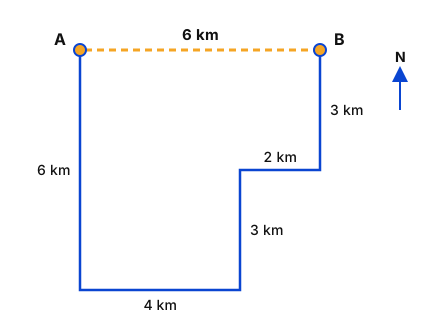
- 6 km South. Left → East 4 km. Left → North 3 km.
- Right → East 2 km. Left → North 3 km to B.
- North–South: ; East: km.
- B is 6 km East of A, so she must drive 6 km West.
Trick: Net out N–S and E–W separately; here N–S cancels fully.
Answer: (A) 6 km West
अवधारणा: हर मोड़ के बाद मुख की दिशा ध्यान रखें और पथ बनाएँ।
- 6 किमी दक्षिण। बाएँ → पूर्व 4 किमी। बाएँ → उत्तर 3 किमी।
- दाएँ → पूर्व 2 किमी। बाएँ → उत्तर 3 किमी, B पर।
- उत्तर–दक्षिण: ; पूर्व: किमी।
- B, A से 6 किमी पूर्व में है, अतः 6 किमी पश्चिम जाना होगा।
ट्रिक: उ–द और पू–प को अलग-अलग जोड़ें; यहाँ उ–द पूरी तरह कट जाता है।
उत्तर: (A) 6 km पश्चिम
RRB Technician Grade IIIGeneral Intelligence and ReasoningDirection and DistanceRRB Technician Grade III 2024 · 24 Dec Shift 3
Q605.Which of the following options should come in place of the question mark (?) in the given series to make it logically complete?
6, 18, 30, 66, 126, ?
दी गई शृंखला को तार्किक रूप से पूर्ण करने के लिए प्रश्न चिह्न (?) के स्थान पर निम्नलिखित में से कौन-सा विकल्प आना चाहिए?
6, 18, 30, 66, 126, ?
- A258
- B270
- C266
- D242
Show answer
Concept: Each term previous term, alternately and .
- , .
- , .
- Next: .
Trick: Terms nearly double each time → test .
Answer: (A) 258
अवधारणा: हर पद पिछला पद, बारी-बारी से और ।
- , ।
- , ।
- अगला: ।
ट्रिक: पद लगभग दोगुने हो रहे हों तो जाँचें।
उत्तर: (A) 258
RRB Technician Grade IIIGeneral Intelligence and ReasoningNumber SeriesRRB Technician Grade III 2024 · 24 Dec Shift 3
Q606.Which of the following options should come in place of the question mark (?) in the given series based on the English alphabetical order?
DIN, FKP, HMR, JOT, ?
अंग्रेज़ी वर्णमाला क्रम के आधार पर दी गई शृंखला में प्रश्न चिह्न (?) के स्थान पर निम्नलिखित में से कौन-सा विकल्प आना चाहिए?
DIN, FKP, HMR, JOT, ?
- ALQV
- BKOX
- CKOU
- DKOV
Show answer
Concept: Move each letter position forward by the same step.
- DIN → FKP → HMR → JOT: every letter .
- J L, O Q, T V.
- Next term: LQV.
Trick: Inside each term the gap is (L→Q→V) — a quick check.
Answer: (A) LQV
अवधारणा: हर अक्षर को समान चरण से आगे बढ़ाएँ।
- DIN → FKP → HMR → JOT: हर अक्षर ।
- J L, O Q, T V।
- अगला पद: LQV।
ट्रिक: हर पद के भीतर अंतर है (L→Q→V) — त्वरित जाँच।
उत्तर: (A) LQV
RRB Technician Grade IIIGeneral Intelligence and ReasoningLetter SeriesRRB Technician Grade III 2024 · 24 Dec Shift 3
Q607.In the following number-pairs, the second number is obtained by applying certain mathematical operations to the first number. Which numbers should replace X and Y so that the pattern followed by the two numbers on the left side of :: is the same as that on the right side of ::?
(NOTE: Operations should be performed on the whole numbers, without breaking down the numbers into its constituent digits. E.g. 13 - Operations on 13 such as adding/subtracting/multiplying etc. to 13 can be performed. Breaking down 13 into 1 and 3 and then performing mathematical operations on 1 and 3 is not allowed.)
X : 45 :: 16 : Y
निम्नलिखित संख्या-युग्मों में, पहली संख्या पर कुछ गणितीय संक्रियाएँ करके दूसरी संख्या प्राप्त की जाती है। X और Y के स्थान पर कौन-सी संख्याएँ आनी चाहिए ताकि :: के बाईं ओर की दोनों संख्याओं द्वारा अनुसरित पैटर्न वही हो जो :: के दाईं ओर है?
(ध्यान दें: संक्रियाएँ संख्याओं को उनके घटक अंकों में विभाजित किए बिना, पूर्ण संख्याओं पर की जानी चाहिए। उदाहरण के लिए 13 - 13 पर संक्रियाएँ जैसे 13 में जोड़ना/घटाना/गुणा करना आदि किया जा सकता है। 13 को 1 और 3 में विभाजित करना और फिर 1 और 3 पर गणितीय संक्रियाएँ करना वर्जित है।)
X : 45 :: 16 : Y
- AX = 14, Y = 85
- BX = 14, Y = 75
- CX = 10, Y = 65
- DX = 10, Y = 75
Show answer
Concept: Test each option to find one rule that fits both pairs.
- Try X , Y : rule “”.
- ✓.
- ✓.
Trick: With X and Y both unknown, plug options in — the right pair satisfies a single rule.
Answer: (D) X = 10, Y = 75
अवधारणा: हर विकल्प रखकर ऐसा एक नियम खोजें जो दोनों युग्मों पर लागू हो।
- X , Y रखें: नियम “”।
- ✓।
- ✓।
ट्रिक: X और Y दोनों अज्ञात हों तो विकल्प रखें — सही जोड़ी एक ही नियम मानती है।
उत्तर: (D) X = 10, Y = 75
RRB Technician Grade IIIGeneral Intelligence and ReasoningNumber AnalogyRRB Technician Grade III 2024 · 24 Dec Shift 3
Q608.Based on the English alphabetical order, three of the following four letter-clusters are alike in a certain way and thus form a group. Which letter-cluster does not belong to that group?
(Note: The odd one out is not based on the number of consonants/vowels or their position in the letter-cluster.)
अंग्रेज़ी वर्णमाला क्रम के आधार पर, निम्नलिखित चार अक्षर-समूहों में से तीन किसी निश्चित प्रकार से एकसमान हैं और इस प्रकार एक समूह बनाते हैं। कौन-सा अक्षर-समूह उस समूह से संबंधित नहीं है?
(ध्यान दें: असंगत अक्षर-समूह, उस अक्षर-समूह में व्यंजनों/स्वरों की संख्या या उनके स्थान पर आधारित नहीं है।)
- AWYU
- BSNI
- CLGB
- DXSN
Show answer
Concept: Check the gaps between consecutive letters (A … Z ).
- SNI: S→N→I, each .
- LGB and XSN: each step .
- WYU: W→Y , Y→U ✗.
Trick: Three clusters share a constant step; the odd one breaks it.
Answer: (A) WYU
अवधारणा: क्रमागत अक्षरों का अंतर जाँचें (A … Z )।
- SNI: S→N→I, प्रत्येक ।
- LGB और XSN: प्रत्येक चरण ।
- WYU: W→Y , Y→U ✗।
ट्रिक: तीन समूहों में स्थिर अंतर है; विषम समूह इसे तोड़ता है।
उत्तर: (A) WYU
RRB Technician Grade IIIGeneral Intelligence and ReasoningOdd One Out – LettersRRB Technician Grade III 2024 · 24 Dec Shift 3
Q609.In a certain code language,
A + B means ‘A is the sister of B’,
A − B means ‘A is the wife of B’,
A × B means ‘A is the father of B’,
and A ÷ B means ‘A is the brother of B’.
How is P related to T if ‘P + Q − R × S ÷ T’?
एक निश्चित कूट भाषा में,
A + B का अर्थ है ‘A, B की बहन है’,
A − B का अर्थ है ‘A, B की पत्नी है’,
A × B का अर्थ है ‘A, B का पिता है’,
और A ÷ B का अर्थ है ‘A, B का भाई है’।
यदि ‘P + Q − R × S ÷ T’ है, तो P का T से क्या संबंध है?
- AFather’s sisterपिता की बहन
- BMother’s motherमाता की माता
- CMother’s sisterमाता की बहन
- DFather’s motherपिता की माता
Show answer
Concept: Decode each symbol and draw the family tree.
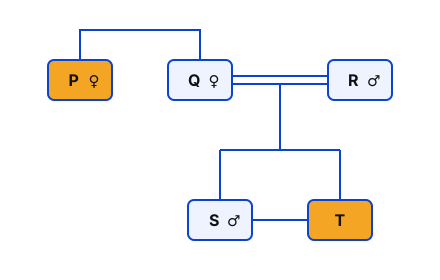
- P + Q: P is the sister of Q (P female).
- Q − R: Q is the wife of R.
- R × S: R is the father of S; S ÷ T: S is the brother of T.
- So T is a child of R and Q → Q is T’s mother; P (Q’s sister) is T’s mother’s sister.
Trick: Read the chain pair by pair, left to right.
Answer: (C) Mother’s sister
अवधारणा: हर चिह्न को डिकोड करें और वंश-वृक्ष बनाएँ।
- P + Q: P, Q की बहन है (P स्त्री)।
- Q − R: Q, R की पत्नी है।
- R × S: R, S का पिता है; S ÷ T: S, T का भाई है।
- अतः T, R और Q की संतान है → Q, T की माँ; P (Q की बहन) T की मौसी (माँ की बहन) है।
ट्रिक: शृंखला को बाएँ से दाएँ, युग्म-दर-युग्म पढ़ें।
उत्तर: (C) माता की बहन
RRB Technician Grade IIIGeneral Intelligence and ReasoningBlood Relations (Coded)RRB Technician Grade III 2024 · 24 Dec Shift 3
Q610.Read the given statements and conclusions carefully. You have to take the given statements to be true even if they seem to be at variance from commonly known facts and decide which conclusion(s) logically follow(s) from the given statements.
Statements:
All bats are balls.
All balls are wickets.
No wickets are gloves.
Conclusions:
(I) Some balls are bats.
(II) Some wickets are balls.
दिए गए कथनों और निष्कर्षों को ध्यानपूर्वक पढ़िए। आपको दिए गए कथनों को सत्य मानना है, भले ही वे सामान्यतः ज्ञात तथ्यों से भिन्न प्रतीत होते हों, और निर्णय लीजिए कि कौन-सा/से निष्कर्ष दिए गए कथनों का तार्किक रूप से अनुसरण करता है/करते हैं।
कथन:
सभी बैट, बॉल हैं।
सभी बॉल, विकेट हैं।
कोई विकेट, ग्लव्स नहीं है।
निष्कर्ष:
(I) कुछ बॉल, बैट हैं।
(II) कुछ विकेट, बॉल हैं।
- AOnly conclusion (II) follows.केवल निष्कर्ष (II) अनुसरण करता है।
- BNeither conclusion (I) nor (II) follows.न तो निष्कर्ष (I) और न ही (II) अनुसरण करता है।
- COnly conclusion (I) follows.केवल निष्कर्ष (I) अनुसरण करता है।
- DBoth conclusions (I) and (II) follow.दोनों निष्कर्ष (I) और (II) अनुसरण करते हैं।
Show answer
Concept: Draw the Venn diagram (Bt = bats, Bl = balls, W = wickets, G = gloves).
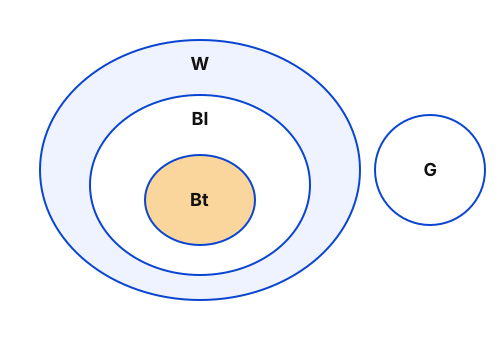
- Bt inside Bl, Bl inside W; G outside W.
- All bats are balls ⇒ some balls are bats → (I) ✓.
- All balls are wickets ⇒ some wickets are balls → (II) ✓.
Yaad rakhein: “All A are B” always gives “Some B are A”.
Answer: (D) Both conclusions (I) and (II) follow.
अवधारणा: वेन आरेख बनाएँ (Bt = बैट, Bl = गेंद, W = विकेट, G = दस्ताने)।
- Bt, Bl के अंदर; Bl, W के अंदर; G, W से बाहर।
- सभी बैट गेंद हैं ⇒ कुछ गेंदें बैट हैं → (I) ✓।
- सभी गेंदें विकेट हैं ⇒ कुछ विकेट गेंद हैं → (II) ✓।
याद रखें: “सभी A, B हैं” से हमेशा “कुछ B, A हैं” निकलता है।
उत्तर: (D) दोनों निष्कर्ष (I) और (II) अनुसरण करते हैं।
RRB Technician Grade IIIGeneral Intelligence and ReasoningSyllogismRRB Technician Grade III 2024 · 24 Dec Shift 3
Q611.NSQO is related to TYWU in a certain way based on the English alphabetical order. In the same way, JOMK is related to PUSQ. To which of the following options is LQOM related, following the same logic?
अंग्रेज़ी वर्णमाला क्रम के आधार पर NSQO एक निश्चित प्रकार से TYWU से संबंधित है। उसी प्रकार, JOMK, PUSQ से संबंधित है। समान तर्क का अनुसरण करते हुए, LQOM निम्नलिखित में से किस विकल्प से संबंधित है?
- AWRSU
- BWRUS
- CRWSU
- DRWUS
Show answer
Concept: Find the shift applied to each letter.
- NSQO → TYWU: N→T, S→Y, Q→W, O→U, each .
- JOMK → PUSQ: each ✓.
- LQOM: L→R, Q→W, O→U, M→S → RWUS.
Trick: One constant shift for all letters — just add to each.
Answer: (D) RWUS
अवधारणा: हर अक्षर पर लगा अंतर खोजें।
- NSQO → TYWU: N→T, S→Y, Q→W, O→U, प्रत्येक ।
- JOMK → PUSQ: प्रत्येक ✓।
- LQOM: L→R, Q→W, O→U, M→S → RWUS।
ट्रिक: सभी अक्षरों पर एक ही अंतर — प्रत्येक में जोड़ें।
उत्तर: (D) RWUS
RRB Technician Grade IIIGeneral Intelligence and ReasoningLetter AnalogyRRB Technician Grade III 2024 · 24 Dec Shift 3
Q612.Select the triad which follows the same pattern as that followed by the two triads given below. Both triads follow the same pattern.
TO-RM-PQ
WR-UP-ST
उस त्रिक का चयन कीजिए जो उसी पैटर्न का अनुसरण करता है जिसका अनुसरण नीचे दिए गए दो त्रिक करते हैं। दोनों त्रिक एक ही पैटर्न का अनुसरण करते हैं।
TO-RM-PQ
WR-UP-ST
- ASN-QL-OR
- BXS-VQ-TW
- CUP-SN-QR
- DVQ-TO-RU
Show answer
Concept: Use alphabet positions and find the rule between the pairs.
- TO-RM-PQ: T(20)→R(18)→P(16) is each; O(15)→M(13) is , M(13)→Q(17) is .
- WR-UP-ST: W→U→S is ; R→P is , P→T is .
- UP-SN-QR: U(21)→S(19)→Q(17) is ; P(16)→N(14) is , N(14)→R(18) is ✓.
Trick: First letters fall by 2; second letters go then .
Answer: (C) UP-SN-QR
अवधारणा: अक्षरों की स्थिति लेकर युग्मों के बीच नियम ज्ञात करें।
- TO-RM-PQ: T(20)→R(18)→P(16) हर बार ; O(15)→M(13) , M(13)→Q(17) ।
- WR-UP-ST: W→U→S ; R→P , P→T ।
- UP-SN-QR: U(21)→S(19)→Q(17) ; P(16)→N(14) , N(14)→R(18) ✓।
ट्रिक: पहले अक्षर 2-2 घटते हैं; दूसरे अक्षर फिर ।
उत्तर: (C) UP-SN-QR
RRB Technician Grade IIIGeneral Intelligence and ReasoningLetter TriadsRRB Technician Grade III 2024 · 24 Dec Shift 2
Q613.What will come in the place of ‘?’ in the following equation, if ‘×’ and ‘−’ are interchanged and ‘+’ and ‘÷’ are interchanged?
यदि ‘×’ और ‘−’ को आपस में बदल दिया जाए तथा ‘+’ और ‘÷’ को आपस में बदल दिया जाए, तो निम्नलिखित समीकरण में ‘?’ के स्थान पर क्या आएगा?
- A62
- B8
- C
- D25
Show answer
Concept: Swap the signs first, then solve using BODMAS.
- Swap × ↔ − and + ↔ ÷: .
- , then .
- .
Trick: Rewrite the whole expression after swapping before calculating anything.
Answer: (B) 8
अवधारणा: पहले चिह्न बदलें, फिर BODMAS से हल करें।
- × ↔ − और + ↔ ÷ बदलने पर: ।
- , फिर ।
- ।
ट्रिक: गणना से पहले चिह्न बदलकर पूरा व्यंजक दोबारा लिखें।
उत्तर: (B) 8
RRB Technician Grade IIIGeneral Intelligence and ReasoningMathematical Operations – InterchangeRRB Technician Grade III 2024 · 24 Dec Shift 2
Q614.B, C, D, E, F, G and K are sitting around a circular table, facing the centre. B sits third to the left of E. F sits second to the left of C. Only E sits between K and F. D is not an immediate neighbour of B.
How many people sit between G and F when counted from the right of G?
B, C, D, E, F, G और K एक वृत्ताकार मेज के चारों ओर केंद्र की ओर मुख करके बैठे हैं। B, E के बाएँ से तीसरे स्थान पर बैठा है। F, C के बाएँ से दूसरे स्थान पर बैठा है। K और F के बीच केवल E बैठा है। D, B का निकटतम पड़ोसी नहीं है।
G के दाएँ से गिनने पर G और F के बीच कितने व्यक्ति बैठे हैं?
- ATwoदो
- BThreeतीन
- COneएक
- DFourचार
Show answer
Concept: Facing the centre, “left” means moving clockwise and “right” means anticlockwise.
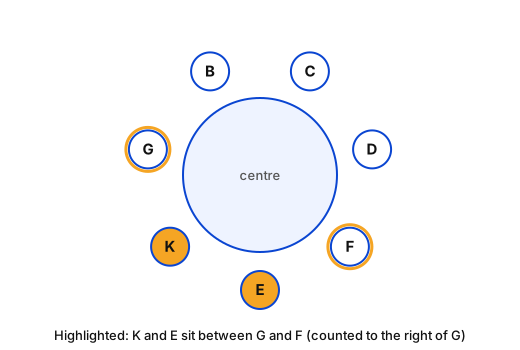
- Fix E; B is third to the left of E.
- Only E sits between K and F, so K and F are E’s neighbours. F second to the left of C works only when F is to E’s right and K to E’s left.
- D is not next to B, so D sits between C and F, and G between K and B.
- Order to the right of G: K, E, then F — two people between G and F.
Trick: Draw the circle and place the fixed person first; test both cases for “only E between K and F”.
Answer: (A) Two
अवधारणा: केंद्र की ओर मुख होने पर “बाएँ” = दक्षिणावर्त और “दाएँ” = वामावर्त।
- E को स्थिर करें; B, E के बाएँ तीसरे स्थान पर है।
- K और F के बीच केवल E है, अतः K और F, E के पड़ोसी हैं। F, C के बाएँ दूसरे स्थान पर तभी संभव है जब F, E के दाएँ और K, E के बाएँ हो।
- D, B का पड़ोसी नहीं है, अतः D, C और F के बीच, और G, K और B के बीच।
- G के दाएँ से क्रम: K, E, फिर F — G और F के बीच दो व्यक्ति।
ट्रिक: वृत्त बनाकर पहले स्थिर व्यक्ति रखें; “K और F के बीच केवल E” के दोनों विकल्प जाँचें।
उत्तर: (A) दो
RRB Technician Grade IIIGeneral Intelligence and ReasoningCircular Seating ArrangementRRB Technician Grade III 2024 · 24 Dec Shift 2
Q615.Based on the English alphabetical order, three of the following four letter-clusters are alike in a certain way and thus form a group. Which letter-cluster does not belong to that group?
(Note: The odd one out is not based on the number of consonants/vowels or their position in the letter-cluster.)
अंग्रेजी वर्णमाला क्रम के आधार पर, निम्नलिखित चार अक्षर-समूहों में से तीन किसी निश्चित प्रकार से एक समान हैं और इस प्रकार एक समूह बनाते हैं। कौन-सा अक्षर-समूह उस समूह से संबंधित नहीं है?
(ध्यान दें: असंगत अक्षर-समूह, उस अक्षर-समूह में व्यंजनों/स्वरों की संख्या या उनके स्थान पर आधारित नहीं है।)
- AYFM
- BGNU
- CBGT
- DKRY
Show answer
Concept: Check the gaps between alphabet positions (wrap around after Z).
- YFM: Y(25)→F(6)→M(13) is (wrapping after Z).
- GNU: 7→14→21 is ; KRY: 11→18→25 is .
- BGT: 2→7→20 is — different.
Trick: Gap of 7 each time: G-N-U, K-R-Y, Y-F-M.
Answer: (C) BGT
अवधारणा: अक्षरों की स्थितियों के अंतर देखें (Z के बाद फिर A से गिनें)।
- YFM: Y(25)→F(6)→M(13) में (Z के बाद घूमकर)।
- GNU: 7→14→21 में ; KRY: 11→18→25 में ।
- BGT: 2→7→20 में — भिन्न।
ट्रिक: हर बार 7 का अंतर: G-N-U, K-R-Y, Y-F-M।
उत्तर: (C) BGT
RRB Technician Grade IIIGeneral Intelligence and ReasoningOdd One Out – LettersRRB Technician Grade III 2024 · 24 Dec Shift 2
Q616.19 people are standing in a row facing North. Drisha is 17th from the right end while Vani is 9th from the left end. How many people are there between Drisha and Vani?
19 व्यक्ति उत्तर की ओर मुख करके एक पंक्ति में खड़े हैं। दृशा दाएँ छोर से 17वें स्थान पर है जबकि वाणी बाएँ छोर से 9वें स्थान पर है। दृशा और वाणी के बीच कितने व्यक्ति हैं?
- A8
- B2
- C3
- D5
Show answer
Concept: Position from left total position from right .
- Drisha from left rd.
- Vani is 9th from left.
- People between .
Trick: Convert both to the same end, then between difference .
Answer: (D) 5
अवधारणा: बाएँ से स्थान कुल दाएँ से स्थान ।
- दृशा बाएँ से रा।
- वाणी बाएँ से 9वीं है।
- बीच में व्यक्ति ।
ट्रिक: दोनों को एक ही छोर से बदलें, फिर बीच में अंतर ।
उत्तर: (D) 5
RRB Technician Grade IIIGeneral Intelligence and ReasoningRanking in a RowRRB Technician Grade III 2024 · 24 Dec Shift 2
Q617.If ‘A’ stands for ‘×’, ‘B’ stands for ‘÷’, ‘C’ stands for ‘+’ and ‘D’ stands for ‘−’, what will come in place of the question mark ‘?’ in the following equation?
12 D 15 B 3 C 6 A 5 = ?
यदि ‘A’ का अर्थ ‘×’, ‘B’ का अर्थ ‘÷’, ‘C’ का अर्थ ‘+’ और ‘D’ का अर्थ ‘−’ है, तो निम्नलिखित समीकरण में प्रश्न चिह्न ‘?’ के स्थान पर क्या आएगा?
12 D 15 B 3 C 6 A 5 = ?
- A34
- B36
- C37
- D31
Show answer
Concept: Replace letters with signs, then use BODMAS.
- A = ×, B = ÷, C = +, D = −.
- .
- .
Trick: Do ÷ and × first: , .
Answer: (C) 37
अवधारणा: अक्षरों के स्थान पर चिह्न रखें, फिर BODMAS लगाएँ।
- A = ×, B = ÷, C = +, D = −।
- ।
- ।
ट्रिक: पहले ÷ और ×: , ।
उत्तर: (C) 37
RRB Technician Grade IIIGeneral Intelligence and ReasoningCoded Mathematical OperationsRRB Technician Grade III 2024 · 24 Dec Shift 2
Q618.In the following number-pairs, the second number is obtained by applying certain mathematical operations to the first number. Which numbers should replace X and Y so that the pattern followed by the two numbers on the left side of :: is the same as that on the right side of ::?
(NOTE: Operations should be performed on the whole numbers, without breaking down the numbers into its constituent digits. E.g. 13 - Operations on 13 such as adding/subtracting/multiplying etc. to 13 can be performed. Breaking down 13 into 1 and 3 and then performing mathematical operations on 1 and 3 is not allowed.)
X : 108 :: 9 : Y
निम्नलिखित संख्या-युग्मों में, पहली संख्या पर कुछ गणितीय संक्रियाएँ करके दूसरी संख्या प्राप्त की जाती है। X और Y को किन संख्याओं से प्रतिस्थापित किया जाना चाहिए ताकि :: के बाईं ओर की दोनों संख्याओं द्वारा अनुसरित पैटर्न वही हो जो :: के दाईं ओर का है?
(ध्यान दें: संक्रियाएँ पूर्ण संख्याओं पर की जानी चाहिए, संख्याओं को उनके घटक अंकों में तोड़े बिना। उदाहरण 13 - 13 पर संक्रियाएँ जैसे 13 में जोड़ना/घटाना/गुणा करना आदि किया जा सकता है। 13 को 1 और 3 में तोड़ना और फिर 1 और 3 पर गणितीय संक्रियाएँ करना वर्जित है।)
X : 108 :: 9 : Y
- AX = 16, Y = 145
- BX = 14, Y = 81
- CX = 12, Y = 81
- DX = 12, Y = 126
Show answer
Concept: Test each option and find one rule that fits both pairs.
- Try , : and ✓.
- Rule: second number first .
- Other options fail, e.g. and .
Trick: Factor the given number: hints at “multiply by 9”.
Answer: (C) X = 12, Y = 81
अवधारणा: हर विकल्प जाँचें और ऐसा एक नियम खोजें जो दोनों युग्मों पर लागू हो।
- , : और ✓।
- नियम: दूसरी संख्या पहली ।
- अन्य विकल्प असफल, जैसे और ।
ट्रिक: से “9 से गुणा” का संकेत मिलता है।
उत्तर: (C) X = 12, Y = 81
RRB Technician Grade IIIGeneral Intelligence and ReasoningNumber Pair AnalogyRRB Technician Grade III 2024 · 24 Dec Shift 2
Q619.Which of the following options should come in place of the question mark (?) in the given series based on the English alphabetical order?
VYR, TWP, RUN, PSL, ?
अंग्रेजी वर्णमाला क्रम के आधार पर दी गई श्रृंखला में प्रश्न चिह्न (?) के स्थान पर निम्नलिखित में से कौन-सा विकल्प आना चाहिए?
VYR, TWP, RUN, PSL, ?
- ANJQ
- BNQJ
- CJNQ
- DJQN
Show answer
Concept: Track each letter position separately.
- 1st letters: V, T, R, P, N (each ).
- 2nd letters: Y, W, U, S, Q (each ).
- 3rd letters: R, P, N, L, J (each ).
Trick: Every letter moves back by 2, so PSL → NQJ.
Answer: (B) NQJ
अवधारणा: हर स्थान के अक्षर को अलग-अलग देखें।
- पहले अक्षर: V, T, R, P, N (हर बार )।
- दूसरे अक्षर: Y, W, U, S, Q (हर बार )।
- तीसरे अक्षर: R, P, N, L, J (हर बार )।
ट्रिक: हर अक्षर 2 पीछे जाता है, अतः PSL → NQJ।
उत्तर: (B) NQJ
RRB Technician Grade IIIGeneral Intelligence and ReasoningLetter SeriesRRB Technician Grade III 2024 · 24 Dec Shift 2
Q620.In a certain code language,
'A + B' means ‘A is the mother of B’,
'A − B' means ‘A is the son of B’,
'A x B' means ‘A is the husband of B’
and 'A ÷ B' means ‘A is the brother of B’.
How is A related to X if ‘X − Y x Z + A ÷ B'?
एक निश्चित कूट भाषा में,
'A + B' का अर्थ है ‘A, B की माता है’,
'A − B' का अर्थ है ‘A, B का पुत्र है’,
'A x B' का अर्थ है ‘A, B का पति है’
और 'A ÷ B' का अर्थ है ‘A, B का भाई है’।
यदि ‘X − Y x Z + A ÷ B' है, तो A का X से क्या संबंध है?
- AFather's fatherपिता के पिता
- BSonपुत्र
- CBrotherभाई
- DFatherपिता
Show answer
Concept: Decode each symbol step by step and draw a family tree.
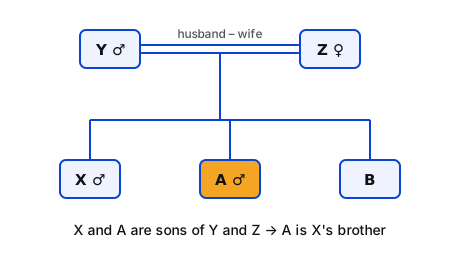
- X − Y: X is the son of Y.
- Y × Z: Y is the husband of Z.
- Z + A: Z is the mother of A, so A is also a child of Y and Z.
- A ÷ B: A is the brother of B, so A is male; X and A are both sons of Y and Z.
Trick: Gender comes from “brother”: A is male, so A is X’s brother.
Answer: (C) Brother
अवधारणा: हर चिह्न को क्रम से खोलें और वंश-वृक्ष बनाएँ।
- X − Y: X, Y का पुत्र है।
- Y × Z: Y, Z का पति है।
- Z + A: Z, A की माँ है, अतः A भी Y और Z की संतान है।
- A ÷ B: A, B का भाई है, अतः A पुरुष है; X और A दोनों Y और Z के पुत्र हैं।
ट्रिक: लिंग “भाई” से पता चलता है: A पुरुष है, अतः A, X का भाई है।
उत्तर: (C) भाई
RRB Technician Grade IIIGeneral Intelligence and ReasoningCoded Blood RelationsRRB Technician Grade III 2024 · 24 Dec Shift 2

