Q641.Select the triad which follows the same pattern as that followed by the two triads given below. Both triads follow the same pattern.
GL-IF-JM
JO-LI-MP
उस त्रिक का चयन कीजिए जो उसी पैटर्न का अनुसरण करता है जिसका अनुसरण नीचे दिए गए दो त्रिक करते हैं। दोनों त्रिक एक ही पैटर्न का अनुसरण करते हैं।
GL-IF-JM
JO-LI-MP
- AKP-MJ-NO
- BNS-PM-QR
- CLQ-NK-OP
- DMR-OL-PS
Show answer
Concept: Track first and second letters of each pair separately.
- GL-IF-JM: G I J; L F M
- JO-LI-MP: J L M; O I P
- MR-OL-PS: M O P; R L S ✓
Trick: Check the first letters () to cut options, then verify the second letters.
Answer: (D) MR-OL-PS
अवधारणा: हर युग्म के पहले और दूसरे अक्षर को अलग-अलग देखें।
- GL-IF-JM: G I J; L F M
- JO-LI-MP: J L M; O I P
- MR-OL-PS: M O P; R L S ✓
ट्रिक: पहले अक्षरों () से विकल्प घटाएँ, फिर दूसरे अक्षर जाँचें।
उत्तर: (D) MR-OL-PS
RRB Technician Grade IIIGeneral Intelligence and ReasoningLetter triads – patternRRB Technician Grade III 2024 · 24 Dec Shift 1
Q642.Seven boxes A, B, C, L, X, Y and Z are kept one over the other but not necessarily in the same order. Only four boxes are kept between A and Z. Only B is kept above A. Only two boxes are kept between L and Y. C is kept immediately above X. Y is not kept immediately above C.
Which box is kept fourth from the top?
सात बक्से A, B, C, L, X, Y और Z एक के ऊपर एक रखे गए हैं, लेकिन जरूरी नहीं कि इसी क्रम में हों। A और Z के बीच केवल चार बक्से रखे गए हैं। A के ऊपर केवल B रखा गया है। L और Y के बीच केवल दो बक्से रखे गए हैं। C को X के ठीक ऊपर रखा गया है। Y को C के ठीक ऊपर नहीं रखा गया है।
ऊपर से चौथे स्थान पर कौन-सा बक्सा रखा गया है?
- AC
- BL
- CA
- DX
Show answer
Concept: Fix definite positions first (1 = top, 7 = bottom).
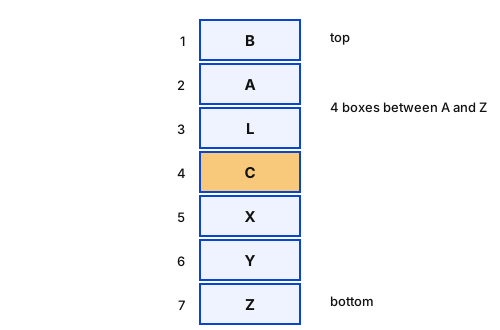
- Only B above A B , A
- 4 boxes between A and Z Z
- L, Y two apart in 3–6 positions 3 and 6; C, X take 4, 5
- Y not just above C Y , L : B, A, L, C, X, Y, Z
Trick: 'Only one box above' instantly fixes positions 1 and 2.
Answer: (A) C
अवधारणा: पहले निश्चित स्थान तय करें (1 = सबसे ऊपर, 7 = सबसे नीचे)।
- केवल B, A के ऊपर B , A
- A और Z के बीच 4 डिब्बे Z
- L, Y के बीच दो डिब्बे (3–6 में) स्थान 3 और 6; C, X को 4, 5
- Y, C के ठीक ऊपर नहीं Y , L : B, A, L, C, X, Y, Z
ट्रिक: 'केवल एक डिब्बा ऊपर' से स्थान 1 और 2 तुरंत तय होते हैं।
उत्तर: (A) C
RRB Technician Grade IIIGeneral Intelligence and ReasoningBox arrangementRRB Technician Grade III 2024 · 24 Dec Shift 1
Q643.Given below is a statement followed by two possible reasons numbered I and II. Read the statement carefully and decide which of the two explains the event/observation/information given in the statement.
Statement - Despite having a highly skilled workforce, Company A has not been profitable for the past three years.
I. The company is located in a region where the cost of functioning is extremely high.
II. The CEO of Company A is a well-known philanthropist.
नीचे एक कथन और उसके बाद I और II क्रमांकित दो संभावित कारण दिए गए हैं। कथन को ध्यानपूर्वक पढ़िए और निर्णय लीजिए कि दोनों में से कौन-सा कारण कथन में दी गई घटना/अवलोकन/सूचना की व्याख्या करता है।
कथन - अत्यधिक कुशल कार्यबल होने के बावजूद, कंपनी A पिछले तीन वर्षों से लाभ में नहीं रही है।
I. कंपनी ऐसे क्षेत्र में स्थित है जहाँ संचालन की लागत अत्यधिक ऊँची है।
II. कंपनी A का CEO एक प्रसिद्ध परोपकारी है।
- AOnly I is a possible reasonकेवल I एक संभावित कारण है
- BOnly II is a possible reasonकेवल II एक संभावित कारण है
- CNeither I nor II is a possible reasonन तो I और न ही II एक संभावित कारण है
- DBoth I and II are possible reasonsI और II दोनों संभावित कारण हैं
Show answer
Concept: A valid reason must directly explain why the company is not profitable.
- I: Very high operating cost reduces profit – directly explains losses
- II: The CEO's philanthropy is personal and does not affect company profit
Trick: Ask: 'Does this reason affect the company's income or expenses?' If not, reject it.
Answer: (A) Only I is a possible reason
अवधारणा: मान्य कारण को सीधे बताना चाहिए कि कंपनी लाभ में क्यों नहीं है।
- I: बहुत अधिक परिचालन लागत लाभ घटाती है – हानि को सीधे समझाता है
- II: CEO का परोपकार निजी है, कंपनी के लाभ पर असर नहीं
ट्रिक: पूछें: 'क्या यह कारण कंपनी की आय या खर्च पर असर डालता है?' नहीं तो अस्वीकार करें।
उत्तर: (A) केवल I एक संभावित कारण है
RRB Technician Grade IIIGeneral Intelligence and ReasoningStatement and reasonsRRB Technician Grade III 2024 · 24 Dec Shift 1
Q644.B, C, D, E, F, K and L are sitting around a circular table, facing the centre. F sits second to the left of C. Only E sits between K and F. B sits third to the left of E. D is not an immediate neighbour of B. Who sits fourth to the right of L?
B, C, D, E, F, K और L एक वृत्ताकार मेज के चारों ओर केंद्र की ओर मुख करके बैठे हैं। F, C के बाएँ से दूसरे स्थान पर बैठा है। K और F के बीच केवल E बैठा है। B, E के बाएँ से तीसरे स्थान पर बैठा है। D, B का निकटतम पड़ोसी नहीं है। L के दाएँ से चौथे स्थान पर कौन बैठा है?
- AD
- BC
- CE
- DF
Show answer
Concept: Facing the centre, 'left' means clockwise and 'right' means anticlockwise.
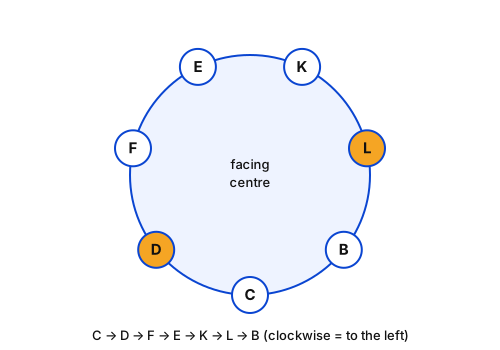
- Fix C; F is 2nd to the left of C
- Only E between K and F order C, _, F, E, K (clockwise)
- B 3rd to left of E; remaining seats for D, L – D not next to B D next to C
- Clockwise: C, D, F, E, K, L, B; 4th to right of L D
Trick: 7 people: 4th to the right 3rd to the left – count the shorter way to check.
Answer: (A) D
अवधारणा: केंद्र की ओर मुख होने पर 'बाएँ' = दक्षिणावर्त और 'दाएँ' = वामावर्त।
- C तय करें; F, C के बाएँ दूसरा
- K और F के बीच केवल E क्रम C, _, F, E, K (दक्षिणावर्त)
- B, E के बाएँ तीसरा; शेष स्थान D, L के लिए – D, B के पास नहीं D, C के पास
- दक्षिणावर्त: C, D, F, E, K, L, B; L के दाएँ चौथा D
ट्रिक: 7 लोग: दाएँ चौथा बाएँ तीसरा – छोटे रास्ते से गिनकर जाँचें।
उत्तर: (A) D
RRB Technician Grade IIIGeneral Intelligence and ReasoningCircular seating arrangementRRB Technician Grade III 2024 · 24 Dec Shift 1
Q645.Refer to the given series and answer the question that follows (all numbers are single-digit numbers only).
(Left) 6 3 0 4 7 5 5 6 8 3 6 6 9 6 1 1 0 8 7 8 5 0 4 0 3 2 1 3 0 6 (Right)
What is the sum of the digit from the left and the digit from the right?
दी गई श्रृंखला को देखिए और उसके बाद आने वाले प्रश्न का उत्तर दीजिए (सभी संख्याएँ केवल एक-अंकीय संख्याएँ हैं)।
(बाएँ) 6 3 0 4 7 5 5 6 8 3 6 6 9 6 1 1 0 8 7 8 5 0 4 0 3 2 1 3 0 6 (दाएँ)
बाएँ से अंक और दाएँ से अंक का योग क्या है?
- A7
- B5
- C6
- D4
Show answer
Concept: Count carefully from the given end.
- from left
- from right
- Sum
Trick: Count left digits in groups of five: (63047)(55683)(66…) – the is the second digit of the third group.
Answer: (C) 6
अवधारणा: दिए गए सिरे से ध्यानपूर्वक गिनें।
- बाएँ से
- दाएँ से
- योग
ट्रिक: पाँच-पाँच के समूह बनाएँ: (63047)(55683)(66…) – तीसरे समूह का दूसरा अंक है।
उत्तर: (C) 6
RRB Technician Grade IIIGeneral Intelligence and ReasoningNumber series – positionRRB Technician Grade III 2024 · 24 Dec Shift 1
Q646.In a certain code language,
'A + B' means ‘A is the sister of B’,
'A – B' means ‘A is the husband of B’,
'A x B' means ‘A is the mother of B’
and 'A ÷ B' means ‘A is the son of B’.
How is V related to T if ‘S + T – U x V – W + X’?
एक निश्चित कूट भाषा में,
'A + B' का अर्थ है ‘A, B की बहन है’,
'A – B' का अर्थ है ‘A, B का पति है’,
'A x B' का अर्थ है ‘A, B की माँ है’
और 'A ÷ B' का अर्थ है ‘A, B का पुत्र है’।
यदि ‘S + T – U x V – W + X’ है, तो V का T से क्या संबंध है?
- AFatherपिता
- BBrotherभाई
- CSonपुत्र
- DSon's sonपुत्र का पुत्र
Show answer
Concept: Decode each symbol step by step and draw the tree.
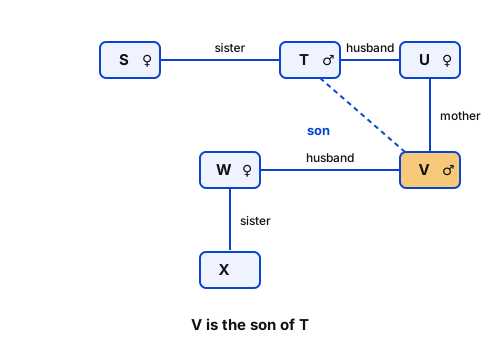
- S + T: S is sister of T
- T − U: T is husband of U (T male)
- U × V: U is mother of V
- V − W: V is husband of W V is male; so V is the son of T
Trick: Gender comes from the later link: '−' (husband) shows V is male.
Answer: (C) Son
अवधारणा: हर प्रतीक को क्रम से खोलें और वंशवृक्ष बनाएँ।
- S + T: S, T की बहन है
- T − U: T, U का पति है (T पुरुष)
- U × V: U, V की माँ है
- V − W: V, W का पति है V पुरुष; अतः V, T का पुत्र है
ट्रिक: लिंग बाद के संबंध से मिलता है: '−' (पति) से V पुरुष है।
उत्तर: (C) पुत्र
RRB Technician Grade IIIGeneral Intelligence and ReasoningCoded blood relationsRRB Technician Grade III 2024 · 24 Dec Shift 1
Q647.In a certain code language, ‘BEAR’ is coded as ‘7912’ and ‘EARN’ is coded as ‘1296’. What is the code for ‘N’ in the given code language?
एक निश्चित कूट भाषा में, ‘BEAR’ को ‘7912’ के रूप में कूटबद्ध किया जाता है और ‘EARN’ को ‘1296’ के रूप में कूटबद्ध किया जाता है। उस कूट भाषा में ‘N’ के लिए कूट क्या है?
- A1
- B6
- C9
- D2
Show answer
Concept: Letters common to both words share the common digits; the leftover letter gets the leftover digit.
- BEAR = 7912, EARN = 1296
- Common letters E, A, R ↔ common digits 1, 2, 9
- Left: B ↔ 7 and N ↔ 6
Trick: Strike out common letters and common digits – what remains pairs up directly.
Answer: (B) 6
अवधारणा: दोनों शब्दों में उभयनिष्ठ अक्षरों के कोड भी उभयनिष्ठ होते हैं; बचा अक्षर बचे अंक से जुड़ता है।
- BEAR = 7912, EARN = 1296
- उभयनिष्ठ अक्षर E, A, R ↔ उभयनिष्ठ अंक 1, 2, 9
- शेष: B ↔ 7 और N ↔ 6
ट्रिक: उभयनिष्ठ अक्षर और अंक काट दें – जो बचे वे सीधे जुड़ते हैं।
उत्तर: (B) 6
RRB Technician Grade IIIGeneral Intelligence and ReasoningCoding – common lettersRRB Technician Grade III 2024 · 24 Dec Shift 1
Q648.Seven people, A, B, C, L, X, Y and Z are sitting in a row, facing north. No one sits to the right of Y. Only three people sit between Y and C. Only two people sit between C and Z. B sits third to the left of X. L sits to the immediate right of X.
How many people sit between A and Z?
सात व्यक्ति, A, B, C, L, X, Y और Z एक पंक्ति में उत्तर की ओर मुख करके बैठे हैं। Y के दाईं ओर कोई नहीं बैठा है। Y और C के बीच में केवल तीन व्यक्ति बैठे हैं। C और Z के बीच में केवल दो व्यक्ति बैठे हैं। B, X के बाएँ से तीसरे स्थान पर बैठा है। L, X के ठीक दाएँ बैठा है।
A और Z के बीच में कितने व्यक्ति बैठे हैं?
- AOneएक
- BThreeतीन
- CTwoदो
- DFourचार
Show answer
Concept: Facing north, left and right are the solver's left and right. Number seats 1–7 from left.
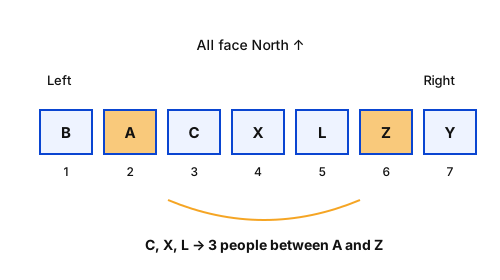
- No one right of Y Y ; C ; Z
- L just right of X and B 3rd left of X: only X fits L , B
- A : B, A, C, X, L, Z, Y
- Between A and Z: C, X, L
Trick: Fix the extreme end person first; 'third to the left' means 2 people in between.
Answer: (B) Three
अवधारणा: उत्तर की ओर मुख होने पर बाएँ-दाएँ हमारे बाएँ-दाएँ ही हैं। बाएँ से स्थान 1–7।
- Y के दाएँ कोई नहीं Y ; C ; Z
- L, X के ठीक दाएँ और B, X के बाएँ तीसरा: केवल X संभव L , B
- A : B, A, C, X, L, Z, Y
- A और Z के बीच: C, X, L
ट्रिक: पहले छोर वाला व्यक्ति तय करें; 'बाएँ तीसरा' मतलब बीच में 2 लोग।
उत्तर: (B) तीन
RRB Technician Grade IIIGeneral Intelligence and ReasoningLinear seating arrangementRRB Technician Grade III 2024 · 24 Dec Shift 1
Q649.What will come in the place of ‘?’ in the following equation, if ‘×’ and ‘÷’ are interchanged and ‘−’ and ‘+’ are interchanged?
यदि ‘×’ और ‘÷’ को आपस में बदल दिया जाए तथा ‘−’ और ‘+’ को आपस में बदल दिया जाए, तो निम्नलिखित समीकरण में ‘?’ के स्थान पर क्या आएगा?
- A69
- B99
- C9
- D39
Show answer
Concept: Swap the signs first, then solve using BODMAS.
- After swapping:
Trick: Rewrite the whole expression with new signs before calculating.
Answer: (C) 9
अवधारणा: पहले चिह्न बदलें, फिर BODMAS से हल करें।
- बदलने के बाद:
ट्रिक: गणना से पहले पूरा व्यंजक नए चिह्नों के साथ लिखें।
उत्तर: (C) 9
RRB Technician Grade IIIGeneral Intelligence and ReasoningInterchanging signsRRB Technician Grade III 2024 · 24 Dec Shift 1
Q650.Benji starts from Point A and drives 70 km towards South. He then takes a right turn, drives 20 km, turns right and drives 35 km. He then takes a left turn and drives 15 km. He takes a final right turn, drives 35 km and stops at Point P. How far (shortest distance) and towards which direction should he drive in order to reach Point A again?
(All turns are 90 degree turns only unless otherwise specified.)
बेंजी बिंदु A से चलना शुरू करता है और दक्षिण की ओर 70 km गाड़ी चलाता है। फिर वह दाएँ मुड़ता है, 20 km गाड़ी चलाता है, दाएँ मुड़ता है और 35 km गाड़ी चलाता है। फिर वह बाएँ मुड़ता है और 15 km गाड़ी चलाता है। वह अंतिम बार दाएँ मुड़ता है, 35 km गाड़ी चलाता है और बिंदु P पर रुक जाता है। फिर से बिंदु A पर पहुँचने के लिए उसे कितनी दूर (न्यूनतम दूरी) और किस दिशा में गाड़ी चलानी चाहिए?
(जब तक अन्यथा निर्दिष्ट न हो, सभी मोड़ केवल 90 डिग्री के मोड़ हैं।)
- A20 km towards Eastपूर्व की ओर 20 km
- B30 km towards Eastपूर्व की ओर 30 km
- C15 km towards Eastपूर्व की ओर 15 km
- D35 km towards Eastपूर्व की ओर 35 km
Show answer
Concept: Track coordinates: East , North ; start A at .
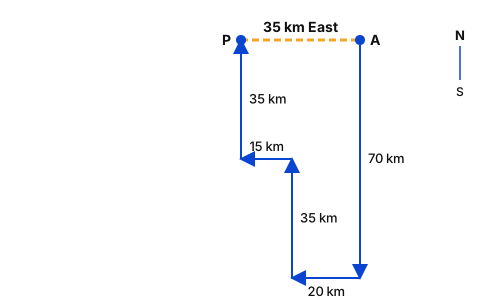
- 70 S ; right (W) 20
- Right (N) 35 ; left (W) 15
- Right (N) 35 P
- A is 35 km to the East of P
Trick: Net N–S: , so only the E–W shift ( km West) remains.
Answer: (D) 35 km towards East
अवधारणा: निर्देशांक लें: पूर्व , उत्तर ; A ।
- 70 दक्षिण ; दाएँ (पश्चिम) 20
- दाएँ (उत्तर) 35 ; बाएँ (पश्चिम) 15
- दाएँ (उत्तर) 35 P
- A, P से 35 km पूर्व में है
ट्रिक: कुल उत्तर–दक्षिण: , केवल पूर्व–पश्चिम विस्थापन ( km पश्चिम) बचा।
उत्तर: (D) पूर्व की ओर 35 km
RRB Technician Grade IIIGeneral Intelligence and ReasoningDirection senseRRB Technician Grade III 2024 · 24 Dec Shift 1
Q651.In the following number-pairs, the second number is obtained by applying certain mathematical operations to the first number. Which numbers should replace X and Y so that the pattern followed by the two numbers on the left side of :: is the same as that on the right side of ::?
(NOTE: Operations should be performed on the whole numbers, without breaking down the numbers into its constituent digits. E.g. 13 - Operations on 13 such as adding/subtracting/multiplying etc. to 13 can be performed. Breaking down 13 into 1 and 3 and then performing mathematical operations on 1 and 3 is not allowed.)
X : 38 :: 9 : Y
निम्नलिखित संख्या-युग्मों में, पहली संख्या पर कुछ गणितीय संक्रियाएँ करके दूसरी संख्या प्राप्त की जाती है। X और Y को किन संख्याओं से प्रतिस्थापित किया जाना चाहिए ताकि :: के बाईं ओर की दोनों संख्याओं द्वारा अनुसरण किया गया पैटर्न वही हो जो :: के दाईं ओर है?
(ध्यान दें: संक्रियाएँ पूर्ण संख्याओं पर की जानी चाहिए, संख्याओं को उनके घटक अंकों में तोड़े बिना। उदाहरण के लिए 13 - 13 पर संक्रियाएँ जैसे 13 में जोड़ना/घटाना/गुणा करना आदि किया जा सकता है। 13 को 1 और 3 में तोड़ना और फिर 1 और 3 पर गणितीय संक्रियाएँ करना वर्जित है।)
X : 38 :: 9 : Y
- AX = 14, Y = 28
- BX = 14, Y = 30
- CX = 15, Y = 48
- DX = 15, Y = 28
Show answer
Concept: Find one rule that works on both sides of :: for an option.
- Try (A):
- ✓
- Other options fail, e.g. (D): but
Trick: Test options: the rule found from X must also give Y.
Answer: (A) X = 14, Y = 28
अवधारणा: ऐसा एक नियम खोजें जो किसी विकल्प के लिए :: के दोनों ओर लागू हो।
- (A) जाँचें:
- ✓
- अन्य विकल्प असफल, जैसे (D): पर
ट्रिक: विकल्पों की जाँच करें: X से मिला नियम Y भी देना चाहिए।
उत्तर: (A) X = 14, Y = 28
RRB Technician Grade IIIGeneral Intelligence and ReasoningNumber analogyRRB Technician Grade III 2024 · 24 Dec Shift 1
Q652.In a certain code language, ‘travel know places’ is coded as ‘mh ca lu’ and ‘travel makes tourist’ is coded as ‘by ai ca’. What is the code for ‘travel’ in the given code language?
एक निश्चित कूट भाषा में, ‘travel know places’ को ‘mh ca lu’ के रूप में कूटबद्ध किया जाता है और ‘travel makes tourist’ को ‘by ai ca’ के रूप में कूटबद्ध किया जाता है। उस कूट भाषा में ‘travel’ के लिए कूट क्या है?
- Aby
- Bmh
- Clu
- Dca
Show answer
Concept: A word common to two sentences has the code common to both coded forms.
- 'travel' appears in both sentences
- Common code in 'mh ca lu' and 'by ai ca' is 'ca'
- travel ca
Yaad rakhein: Common word ↔ common code.
Answer: (D) ca
अवधारणा: दो वाक्यों में उभयनिष्ठ शब्द का कोड दोनों कूटों में उभयनिष्ठ होता है।
- 'travel' दोनों वाक्यों में है
- 'mh ca lu' और 'by ai ca' में उभयनिष्ठ कोड 'ca'
- travel ca
याद रखें: उभयनिष्ठ शब्द ↔ उभयनिष्ठ कोड।
उत्तर: (D) ca
RRB Technician Grade IIIGeneral Intelligence and ReasoningCoding – common wordsRRB Technician Grade III 2024 · 24 Dec Shift 1
Q653.Read the given statements and conclusions carefully. You have to take the given statements to be true even if they seem to be at variance from commonly known facts and decide which conclusion(s) logically follow(s) from the given statements.
Statements:
All legs are hands.
Some legs are ears.
Conclusions:
(I) Some hands are ears.
(II) Some ears are legs.
दिए गए कथनों और निष्कर्षों को ध्यानपूर्वक पढ़िए। आपको दिए गए कथनों को सत्य मानना है, भले ही वे सामान्यतः ज्ञात तथ्यों से भिन्न प्रतीत होते हों, और निर्णय लेना है कि कौन-सा/से निष्कर्ष दिए गए कथनों का तार्किक रूप से अनुसरण करता है/करते हैं।
कथन:
सभी पैर, हाथ हैं।
कुछ पैर, कान हैं।
निष्कर्ष:
(I) कुछ हाथ, कान हैं।
(II) कुछ कान, पैर हैं।
- AOnly conclusion II followsकेवल निष्कर्ष II अनुसरण करता है
- BOnly conclusion I followsकेवल निष्कर्ष I अनुसरण करता है
- CNeither conclusion I nor II followsन तो निष्कर्ष I और न ही II अनुसरण करता है
- DBoth conclusions I and II followनिष्कर्ष I और II दोनों अनुसरण करते हैं
Show answer
Concept: 'All A are B' puts A inside B; 'Some A are C' makes A and C overlap.
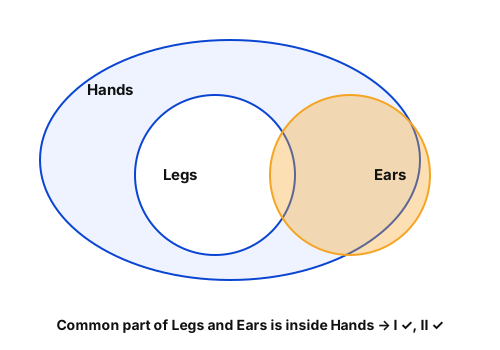
- Legs lie inside Hands
- The Legs–Ears overlap is therefore inside Hands some hands are ears: I ✓
- 'Some legs are ears' converts to 'some ears are legs': II ✓
Trick: All + Some Some (via the common term); a 'some' statement can always be reversed.
Answer: (D) Both conclusions I and II follow
अवधारणा: 'सभी A, B हैं' में A, B के अंदर; 'कुछ A, C हैं' में A और C आंशिक रूप से मिलते हैं।
- Legs, Hands के अंदर
- Legs–Ears का साझा भाग भी Hands के अंदर कुछ hands, ears हैं: I ✓
- 'कुछ legs, ears हैं' उलटकर 'कुछ ears, legs हैं': II ✓
ट्रिक: सभी + कुछ कुछ; 'कुछ' वाला कथन हमेशा उलटा जा सकता है।
उत्तर: (D) निष्कर्ष I और II दोनों अनुसरण करते हैं
RRB Technician Grade IIIGeneral Intelligence and ReasoningSyllogismRRB Technician Grade III 2024 · 24 Dec Shift 1
Q654.Select the set in which the numbers are related in the same way as are the numbers of the following sets.
(NOTE: Operations should be performed on the whole numbers, without breaking down the numbers into its constituent digits. E.g. 13 – Operations on 13 such as adding/subtracting/multiplying etc. to 13 can be performed. Breaking down 13 into 1 and 3 and then performing mathematical operations on 1 and 3 is not allowed.)
(2, 8, 32)
(5, 20, 80)
उस समुच्चय का चयन कीजिए जिसमें संख्याएँ उसी प्रकार संबंधित हैं जिस प्रकार निम्नलिखित समुच्चयों की संख्याएँ संबंधित हैं।
(ध्यान दें: संक्रियाएँ पूर्ण संख्याओं पर की जानी चाहिए, संख्याओं को उनके घटक अंकों में तोड़े बिना। उदाहरण के लिए 13 – 13 पर संक्रियाएँ जैसे 13 में जोड़ना/घटाना/गुणा करना आदि किया जा सकता है। 13 को 1 और 3 में तोड़ना और फिर 1 और 3 पर गणितीय संक्रियाएँ करना वर्जित है।)
(2, 8, 32)
(5, 20, 80)
- A(9, 36, 124)
- B(9, 36, 144)
- C(9, 36, 142)
- D(9, 39, 144)
Show answer
Concept: In each set, every number is times the previous one.
- : ,
- : ,
- : , ✓
Trick: Third number first : .
Answer: (B) (9, 36, 144)
अवधारणा: हर समूह में प्रत्येक संख्या पिछली की गुना है।
- : ,
- : ,
- : , ✓
ट्रिक: तीसरी संख्या पहली : ।
उत्तर: (B) (9, 36, 144)
RRB Technician Grade IIIGeneral Intelligence and ReasoningNumber set analogyRRB Technician Grade III 2024 · 24 Dec Shift 1
Q655.Based on the English alphabetical order, three of the following four letter-clusters are alike in a certain way and thus form a group. Which letter-cluster does not belong to that group?
(Note: The odd one out is not based on the number of consonants/vowels or their position in the letter cluster.)
अंग्रेज़ी वर्णमाला क्रम के आधार पर, निम्नलिखित चार अक्षर-समूहों में से तीन किसी निश्चित प्रकार से एकसमान हैं और इस प्रकार एक समूह बनाते हैं। कौन-सा अक्षर-समूह उस समूह से संबंधित नहीं है?
(ध्यान दें: असंगत अक्षर-समूह, अक्षर-समूह में व्यंजनों/स्वरों की संख्या या उनके स्थान पर आधारित नहीं है।)
- ABEH
- BRUX
- CFIL
- DCEG
Show answer
Concept: Check the gap between consecutive letters.
- BEH: ; RUX: ; FIL:
- CEG: – different
Trick: Position values help: B=2, E=5, H=8 (gap 3) vs C=3, E=5, G=7 (gap 2).
Answer: (D) CEG
अवधारणा: क्रमागत अक्षरों के बीच का अंतर जाँचें।
- BEH: ; RUX: ; FIL:
- CEG: – भिन्न
ट्रिक: स्थानीय मान: B=2, E=5, H=8 (अंतर 3) बनाम C=3, E=5, G=7 (अंतर 2)।
उत्तर: (D) CEG
RRB Technician Grade IIIGeneral Intelligence and ReasoningOdd one out – letter clustersRRB Technician Grade III 2024 · 24 Dec Shift 1
Q656.Which of the following options should come in place of the question mark (?) in the given series?
7 20 59 176 ? 1580
दी गई श्रृंखला में प्रश्न चिह्न (?) के स्थान पर निम्नलिखित में से कौन-सा विकल्प आना चाहिए?
7 20 59 176 ? 1580
- A527
- B510
- C557
- D517
Show answer
Concept: Each term previous .
- , ,
- Check: ✓
Trick: Ratio of terms is close to 3 try small number.
Answer: (A) 527
अवधारणा: प्रत्येक पद पिछला ।
- , ,
- जाँच: ✓
ट्रिक: पदों का अनुपात लगभग 3 छोटी संख्या आज़माएँ।
उत्तर: (A) 527
RRB Technician Grade IIIGeneral Intelligence and ReasoningNumber seriesRRB Technician Grade III 2024 · 24 Dec Shift 1
Q657.Read the given statements and conclusions carefully. You have to take the given statements to be true even if they seem to be at variance from commonly known facts and decide which conclusion(s) logically follow(s) from the given statements.
Statements:
Some doors are locks.
No lock is a key.
Conclusions:
(I) No door is a key.
(II) Some locks are doors.
दिए गए कथनों और निष्कर्षों को ध्यानपूर्वक पढ़िए। आपको दिए गए कथनों को सत्य मानना है, भले ही वे सामान्यतः ज्ञात तथ्यों से भिन्न प्रतीत होते हों, और निर्णय लेना है कि कौन-सा/से निष्कर्ष दिए गए कथनों का तार्किक रूप से अनुसरण करता है/करते हैं।
कथन:
कुछ दरवाज़े, ताले हैं।
कोई ताला, चाबी नहीं है।
निष्कर्ष:
(I) कोई दरवाज़ा, चाबी नहीं है।
(II) कुछ ताले, दरवाज़े हैं।
- ANeither conclusion I nor II followsन तो निष्कर्ष I और न ही II अनुसरण करता है
- BBoth conclusions I and II followनिष्कर्ष I और II दोनों अनुसरण करते हैं
- COnly conclusion I followsकेवल निष्कर्ष I अनुसरण करता है
- DOnly conclusion II followsकेवल निष्कर्ष II अनुसरण करता है
Show answer
Concept: 'No A is B' keeps A and B apart; other sets may or may not touch B.
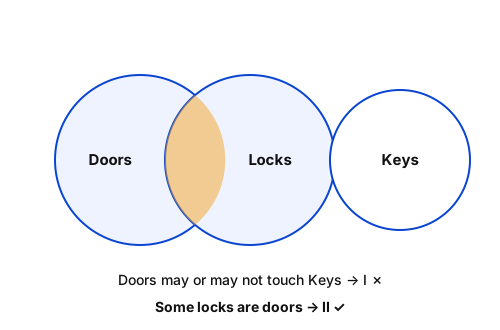
- Doors and Locks overlap; Locks and Keys are separate
- Doors may or may not overlap Keys 'No door is a key' is not certain: I ✗
- 'Some doors are locks' reverses to 'some locks are doors': II ✓
Trick: Some + No 'Some A are not C' only; a definite 'No' between the outer terms never follows.
Answer: (D) Only conclusion II follows
अवधारणा: 'कोई A, B नहीं' में A और B अलग; बाकी समूह B को छू भी सकते हैं, नहीं भी।
- Doors और Locks मिलते हैं; Locks और Keys अलग
- Doors, Keys से मिल भी सकता है 'कोई door, key नहीं' निश्चित नहीं: I ✗
- 'कुछ doors, locks हैं' उलटकर 'कुछ locks, doors हैं': II ✓
ट्रिक: कुछ + कोई नहीं केवल 'कुछ A, C नहीं हैं'; बाहरी पदों में निश्चित 'कोई नहीं' कभी नहीं निकलता।
उत्तर: (D) केवल निष्कर्ष II अनुसरण करता है
RRB Technician Grade IIIGeneral Intelligence and ReasoningSyllogismRRB Technician Grade III 2024 · 24 Dec Shift 1
Q658.Which of the following options should come in place of the question mark (?) in the given series based on the English alphabetical order?
CAN, FDP, IGR, LJT, ?
अंग्रेज़ी वर्णमाला क्रम के आधार पर दी गई श्रृंखला में प्रश्न चिह्न (?) के स्थान पर निम्नलिखित में से कौन-सा विकल्प आना चाहिए?
CAN, FDP, IGR, LJT, ?
- AOMV
- BLMV
- CLNV
- DLNR
Show answer
Concept: Track each letter position separately.
- 1st: C, F, I, L, O ()
- 2nd: A, D, G, J, M ()
- 3rd: N, P, R, T, V ()
Trick: First letters alone (C, F, I, L → O) leave only option (A).
Answer: (A) OMV
अवधारणा: हर स्थान के अक्षर को अलग से देखें।
- पहला: C, F, I, L, O ()
- दूसरा: A, D, G, J, M ()
- तीसरा: N, P, R, T, V ()
ट्रिक: केवल पहले अक्षर (C, F, I, L → O) से ही विकल्प (A) बचता है।
उत्तर: (A) OMV
RRB Technician Grade IIIGeneral Intelligence and ReasoningLetter seriesRRB Technician Grade III 2024 · 24 Dec Shift 1
Q659.Select the triad which follows the same pattern as that followed by the two triads given below. Both triads follow the same pattern.
ID-LG-OQ
LG-OJ-RT
उस त्रिक का चयन कीजिए जो उसी पैटर्न का अनुसरण करता है जिसका अनुसरण नीचे दिए गए दो त्रिकों द्वारा किया गया है। दोनों त्रिक एक ही पैटर्न का अनुसरण करते हैं।
ID-LG-OQ
LG-OJ-RT
- AMI-QL-TU
- BMI-QK-TV
- CNI-QL-TV
- DNI-QK-TU
Show answer
Concept: Follow first and second letters across the three pairs.
- ID-LG-OQ: I L O; D G Q
- LG-OJ-RT: L O R; G J T
- NI-QL-TV: N Q T; I L V ✓
Trick: First letters () leave A, C; then second letters () pick C.
Answer: (C) NI-QL-TV
अवधारणा: तीनों युग्मों में पहले और दूसरे अक्षर का अनुसरण करें।
- ID-LG-OQ: I L O; D G Q
- LG-OJ-RT: L O R; G J T
- NI-QL-TV: N Q T; I L V ✓
ट्रिक: पहले अक्षर () से A, C बचते हैं; दूसरे अक्षर () से C।
उत्तर: (C) NI-QL-TV
RRB Technician Grade IIIGeneral Intelligence and ReasoningLetter triads – patternRRB Technician Grade III 2024 · 24 Dec Shift 1
Q660.Refer to the given number and symbol series and answer the question that follows. Counting to be done from left to right only.
(Left) # 1 * £ 5 3 2 9 + % 8 4 6 @ $ 7 & Ω (Right)
How many such symbols are there, each of which is immediately preceded by a number and also immediately followed by another symbol?
दी गई संख्या और प्रतीक श्रृंखला को देखिए और उसके बाद आने वाले प्रश्न का उत्तर दीजिए। गिनती केवल बाएँ से दाएँ की जानी है।
(बाएँ) # 1 * £ 5 3 2 9 + % 8 4 6 @ $ 7 & Ω (दाएँ)
ऐसे कितने प्रतीक हैं, जिनमें से प्रत्येक के ठीक पहले एक संख्या है और ठीक बाद एक अन्य प्रतीक है?
- A5
- B3
- C2
- D4
Show answer
Concept: Check each symbol: the item just before must be a number and the item just after must be a symbol.
- * : before 1 (number), after £ (symbol) ✓.
- + : before 9, after % ✓.
- @ : before 6, after $ ✓.
- & : before 7, after Ω ✓. Others fail (e.g. £ is followed by 5).
- Total .
Trick: Scan for the pattern "number–symbol–symbol" and count the middle symbols.
Answer: (D) 4
अवधारणा: हर प्रतीक जाँचें: ठीक पहले संख्या और ठीक बाद में प्रतीक होना चाहिए।
- * : पहले 1 (संख्या), बाद में £ (प्रतीक) ✓।
- + : पहले 9, बाद में % ✓।
- @ : पहले 6, बाद में $ ✓।
- & : पहले 7, बाद में Ω ✓। बाकी असफल (जैसे £ के बाद 5)।
- कुल ।
ट्रिक: "संख्या–प्रतीक–प्रतीक" पैटर्न खोजें और बीच वाले प्रतीक गिनें।
उत्तर: (D) 4
RRB Technician Grade IIIGeneral Intelligence and ReasoningSymbol-Number SeriesRRB Technician Grade III 2024 · 23 Dec Shift 3

