Q641.Which of the following has two ends: one which is hydrophilic and the other which is hydrophobic?
निम्नलिखित में से किसके दो सिरे होते हैं: एक जलरागी (hydrophilic) और दूसरा जलविरागी (hydrophobic)?
- APerfumeइत्र
- BSoapसाबुन
- CWaterजल
- DCreamक्रीम
Show answer
Concept: A soap molecule is the sodium/potassium salt of a long-chain fatty acid with two ends of different nature.
- Ionic end () is hydrophilic — attracted to water.
- Long hydrocarbon tail is hydrophobic — dissolves in oil/grease.
- Molecules form micelles that trap oily dirt, which is rinsed away.
Yaad rakhein: Head loves water, tail hates water (loves oil) → micelle.
Answer: (B) Soap
अवधारणा: साबुन का अणु लंबी शृंखला वाले वसा अम्ल का सोडियम/पोटैशियम लवण है, जिसके दो सिरे भिन्न प्रकृति के होते हैं।
- आयनिक सिरा () जलरागी — जल की ओर आकर्षित।
- लंबी हाइड्रोकार्बन पूँछ जलविरागी — तेल/चिकनाई में घुलती है।
- अणु मिसेल बनाकर तैलीय मैल को फँसाते हैं, जो धुलकर निकल जाता है।
याद रखें: सिर जल-प्रेमी, पूँछ जल-विरोधी (तेल-प्रेमी) → मिसेल।
उत्तर: (B) साबुन
RRB Technician Grade IIIGeneral ScienceSoaps – cleansing actionRRB Technician Grade III 2024 · 28 Dec Shift 3
Q642.Nutrition is provided to the embryo from the mother’s blood with the help of the:
माँ के रक्त से भ्रूण को पोषण किसकी सहायता से प्रदान किया जाता है?
- Aoviductअंडवाहिनी (oviduct)
- Bplacentaअपरा (placenta)
- Covaryअंडाशय (ovary)
- Dscrotumवृषणकोष (scrotum)
Show answer
Concept: The placenta is a disc-shaped tissue embedded in the uterine wall that links the embryo with the mother's blood.
- Villi on the embryo side give a large surface area.
- Glucose and oxygen pass from mother's blood to the embryo.
- Wastes from the embryo pass into the mother's blood for removal.
Yaad rakhein: Oviduct → fertilisation site; Uterus → implantation; Placenta → nutrition of embryo.
Answer: (B) placenta
अवधारणा: अपरा (प्लेसेंटा) गर्भाशय की भित्ति में धँसा तश्तरी जैसा ऊतक है जो भ्रूण को माँ के रक्त से जोड़ता है।
- भ्रूण की ओर के विलाई बड़ा सतह क्षेत्र देते हैं।
- ग्लूकोज़ व ऑक्सीजन माँ के रक्त से भ्रूण तक पहुँचते हैं।
- भ्रूण के अपशिष्ट माँ के रक्त में जाकर बाहर निकाले जाते हैं।
याद रखें: अंडवाहिनी → निषेचन; गर्भाशय → रोपण; अपरा → भ्रूण का पोषण।
उत्तर: (B) अपरा (placenta)
RRB Technician Grade IIIGeneral ScienceHuman reproduction – placentaRRB Technician Grade III 2024 · 28 Dec Shift 3
Q643.Which of the following statements is correct related to male reproductive system?
पुरुष जनन तंत्र (male reproductive system) से संबंधित निम्नलिखित में से कौन-सा कथन सही है?
- ASperm formation requires higher temperature than the normal body temperature.शुक्राणु निर्माण के लिए शरीर के सामान्य ताप से अधिक ताप की आवश्यकता होती है।
- BTestes are located in the abdominal cavity.वृषण उदर गुहा में स्थित होते हैं।
- CTestes secrete testosterone hormone.वृषण टेस्टोस्टेरोन हॉर्मोन स्रावित करते हैं।
- DFormation of sperm takes place in seminal vessel.शुक्राणु का निर्माण शुक्राशय (seminal vesicle) में होता है।
Show answer
Concept: Testes are the male reproductive organs; they produce sperms and the hormone testosterone.
- Testes lie outside the abdominal cavity in the scrotum, because sperm formation needs a temperature lower than body temperature – so (A) and (B) are wrong.
- Sperms are formed in the testes, not in the seminal vesicles – (D) is wrong.
- Testes secrete testosterone, which controls sperm formation and male secondary sexual characters – (C) is correct.
Yaad rakhein: Testes = sperm + testosterone; scrotum keeps them cooler than the body.
Answer: (C) Testes secrete testosterone hormone.
अवधारणा: वृषण पुरुष जनन अंग हैं; ये शुक्राणु तथा टेस्टोस्टेरोन हॉर्मोन बनाते हैं।
- वृषण उदर गुहा के बाहर वृषणकोष में होते हैं, क्योंकि शुक्राणु बनने के लिए शरीर के ताप से कम ताप चाहिए – अतः (A) और (B) गलत हैं।
- शुक्राणु वृषण में बनते हैं, शुक्राशय में नहीं – (D) गलत है।
- वृषण टेस्टोस्टेरोन स्रावित करते हैं, जो शुक्राणु निर्माण व पुरुष लक्षणों को नियंत्रित करता है – (C) सही है।
याद रखें: वृषण = शुक्राणु + टेस्टोस्टेरोन; वृषणकोष इन्हें शरीर से ठंडा रखता है।
उत्तर: (C) वृषण टेस्टोस्टेरोन हॉर्मोन स्रावित करते हैं।
RRB Technician Grade IIIGeneral ScienceMale reproductive systemRRB Technician Grade III 2024 · 28 Dec Shift 2
Q644.Rough endoplasmic reticulum looks rough under a microscope because it has particles called __________ attached to its surface.
खुरदरी अंतर्द्रव्यी जालिका (rough endoplasmic reticulum) सूक्ष्मदर्शी में खुरदरी दिखाई देती है क्योंकि इसकी सतह पर __________ नामक कण जुड़े होते हैं।
- Achromosomesगुणसूत्र (chromosomes)
- Bribosomesराइबोसोम (ribosomes)
- Cprotein particlesप्रोटीन कण
- Dlysosomesलयनकाय (lysosomes)
Show answer
Concept: Endoplasmic reticulum (ER) is of two types: rough ER (RER) and smooth ER (SER).
- RER has ribosomes attached to its surface, which give it a rough, granular look.
- Ribosomes are the sites of protein synthesis, so RER makes proteins.
- SER has no ribosomes and helps make fats (lipids).
Trick: Rough = Ribosomes (both start with R); Smooth = no ribosomes, makes lipids.
Answer: (B) ribosomes
अवधारणा: अंतर्द्रव्यी जालिका (ER) दो प्रकार की होती है: खुरदरी (RER) और चिकनी (SER)।
- RER की सतह पर राइबोसोम जुड़े रहते हैं, जिससे यह खुरदरी दिखती है।
- राइबोसोम प्रोटीन संश्लेषण के स्थल हैं, इसलिए RER प्रोटीन बनाती है।
- SER पर राइबोसोम नहीं होते; यह वसा (लिपिड) बनाने में सहायक है।
ट्रिक: Rough = Ribosome (दोनों R से); चिकनी ER = लिपिड।
उत्तर: (B) राइबोसोम (ribosomes)
RRB Technician Grade IIIGeneral ScienceCell organelles – ERRRB Technician Grade III 2024 · 28 Dec Shift 2
Q645.When an object is thrown upward, the force of gravity is _____.
जब किसी वस्तु को ऊपर की ओर फेंका जाता है, तो गुरुत्व बल _____ होता है।
- AZeroशून्य
- Bopposite to the direction of motionगति की दिशा के विपरीत
- Cindependent of direction of motionगति की दिशा से स्वतंत्र
- Dthe same as the direction of motionगति की दिशा में ही
Show answer
Concept: Gravity always acts vertically downward, towards the centre of the Earth.
- When a body is thrown upward, its motion (velocity) is upward.
- Gravity acts downward, i.e. opposite to the motion, so the body slows down ().
- At the highest point , then the body falls back.
Trick: Going up → gravity opposes motion; coming down → gravity along motion.
Answer: (B) opposite to the direction of motion
अवधारणा: गुरुत्व बल सदैव ऊर्ध्वाधर नीचे की ओर, पृथ्वी के केंद्र की ओर लगता है।
- वस्तु को ऊपर फेंकने पर उसकी गति (वेग) ऊपर की ओर होती है।
- गुरुत्व नीचे की ओर, अर्थात गति के विपरीत लगता है, इसलिए वेग घटता है ()।
- उच्चतम बिंदु पर होता है, फिर वस्तु नीचे गिरती है।
ट्रिक: ऊपर जाते समय गुरुत्व गति का विरोध करता है; नीचे आते समय गति की दिशा में।
उत्तर: (B) गति की दिशा के विपरीत
RRB Technician Grade IIIGeneral ScienceMotion under gravityRRB Technician Grade III 2024 · 28 Dec Shift 2
Q646.Which of the following elements is extracted by electrolysis reduction?
निम्नलिखित में से किस तत्व का निष्कर्षण विद्युत-अपघटनी अपचयन (electrolytic reduction) द्वारा किया जाता है?
- AAg
- BZn
- CNa
- DPb
Show answer
Concept: Metals high in the reactivity series (K, Na, Ca, Mg, Al) cannot be reduced by carbon; they are obtained by electrolytic reduction.
- Sodium is obtained by electrolysis of molten sodium chloride.
- At cathode: ; at anode chlorine gas is released.
- Zn and Pb are reduced by carbon; Ag is low in the series.
Yaad rakhein: Top of reactivity series (K, Na, Ca, Mg, Al) → electrolysis of molten salt.
Answer: (C) Na
अवधारणा: सक्रियता श्रेणी में ऊपर स्थित धातुएँ (K, Na, Ca, Mg, Al) कार्बन से अपचयित नहीं होतीं; इन्हें विद्युत-अपघटनी अपचयन से प्राप्त करते हैं।
- सोडियम, गलित सोडियम क्लोराइड के विद्युत-अपघटन से प्राप्त होता है।
- कैथोड पर: ; एनोड पर क्लोरीन गैस निकलती है।
- Zn और Pb कार्बन से अपचयित होते हैं; Ag कम सक्रिय है।
याद रखें: सक्रियता श्रेणी के शीर्ष (K, Na, Ca, Mg, Al) → गलित लवण का विद्युत-अपघटन।
उत्तर: (C) Na
RRB Technician Grade IIIGeneral ScienceExtraction of metalsRRB Technician Grade III 2024 · 28 Dec Shift 2
Q647.Which of the following is a characteristic property of acids?
निम्नलिखित में से कौन-सा अम्लों का एक अभिलाक्षणिक गुण है?
- AThey turn red litmus paper blue.वे लाल लिटमस पत्र को नीला कर देते हैं।
- BThey turn blue litmus paper red.वे नीले लिटमस पत्र को लाल कर देते हैं।
- CThey have a pH greater than 7.उनका pH 7 से अधिक होता है।
- DThey have a slippery feel.वे छूने में चिकने (साबुन जैसे) होते हैं।
Show answer
Concept: Acids are sour, release ions in water and have pH less than 7.
- Acids turn blue litmus red – option (B).
- Turning red litmus blue, pH greater than 7 and slippery (soapy) feel are properties of bases.
- So only (B) is a property of acids.
Trick: Acid → Red (blue litmus turns red); Base → Blue.
Answer: (B) They turn blue litmus paper red.
अवधारणा: अम्ल खट्टे होते हैं, जल में आयन देते हैं और इनका pH 7 से कम होता है।
- अम्ल नीले लिटमस को लाल कर देते हैं – विकल्प (B)।
- लाल लिटमस को नीला करना, pH 7 से अधिक तथा साबुन जैसा चिकना स्पर्श – ये क्षारकों के गुण हैं।
- अतः केवल (B) अम्ल का गुण है।
ट्रिक: अम्ल → लाल (नीला लिटमस लाल); क्षारक → नीला।
उत्तर: (B) वे नीले लिटमस पत्र को लाल कर देते हैं।
RRB Technician Grade IIIGeneral ScienceProperties of acidsRRB Technician Grade III 2024 · 28 Dec Shift 2
Q648.A body is thrown up and it reaches a height of 5m and then falls down, the total displacement and the total distance covered by the body respectively would be:
एक पिंड को ऊपर की ओर फेंका जाता है और वह 5m की ऊँचाई तक पहुँचकर फिर नीचे गिर जाता है, पिंड द्वारा तय किया गया कुल विस्थापन और कुल दूरी क्रमशः होगी:
- A10m, 0m
- B0m, 0m
- C0m, 10m
- D5m, 5m
Show answer
Concept: Distance = total path length; displacement = shortest distance between initial and final positions.
- Upward journey , downward journey .
- Total distance .
- The body returns to the starting point, so displacement .
Trick: Back to the starting point → displacement is always zero, distance is not.
Answer: (C) 0m, 10m
अवधारणा: दूरी = तय किए गए पथ की कुल लंबाई; विस्थापन = प्रारंभिक व अंतिम स्थिति के बीच की न्यूनतम दूरी।
- ऊपर की यात्रा , नीचे की यात्रा ।
- कुल दूरी ।
- वस्तु प्रारंभिक बिंदु पर लौट आती है, इसलिए विस्थापन ।
ट्रिक: प्रारंभिक बिंदु पर वापसी → विस्थापन सदैव शून्य, दूरी नहीं।
उत्तर: (C) 0m, 10m
RRB Technician Grade IIIGeneral ScienceDistance and displacementRRB Technician Grade III 2024 · 28 Dec Shift 2
Q649.According to one of the laws of refraction, the _______ ray, the refracted ray and the normal to the interface of two transparent media at the point of incidence, all lie in the same plane.
अपवर्तन के नियमों में से एक के अनुसार, _______ किरण, अपवर्तित किरण तथा आपतन बिंदु पर दो पारदर्शी माध्यमों को पृथक करने वाले पृष्ठ पर अभिलंब, सभी एक ही तल में होते हैं।
- AParallelसमांतर
- BReflectedपरावर्तित
- CIncidentआपतित
- DEmergentनिर्गत
Show answer
Concept: First law of refraction: the incident ray, the refracted ray and the normal at the point of incidence all lie in the same plane.
- Second law (Snell's law): .
- The blank refers to the ray that strikes the interface – the incident ray.
- Reflected or emergent rays are not part of this law.
Yaad rakhein: Same-plane law has three members: incident ray, refracted ray, normal.
Answer: (C) Incident
अवधारणा: अपवर्तन का प्रथम नियम: आपतित किरण, अपवर्तित किरण और आपतन बिंदु पर अभिलंब तीनों एक ही तल में होते हैं।
- द्वितीय नियम (स्नेल का नियम): ।
- रिक्त स्थान में वह किरण आएगी जो सतह पर पड़ती है – आपतित किरण।
- परावर्तित या निर्गत किरण इस नियम में नहीं आतीं।
याद रखें: एक तल वाला नियम: आपतित किरण, अपवर्तित किरण, अभिलंब।
उत्तर: (C) आपतित
RRB Technician Grade IIIGeneral ScienceLaws of refractionRRB Technician Grade III 2024 · 28 Dec Shift 2
Q650.What compound is formed when a small amount of hydrochloric acid is added to a beaker containing copper oxide?
जब कॉपर ऑक्साइड युक्त बीकर में थोड़ी मात्रा में हाइड्रोक्लोरिक अम्ल मिलाया जाता है, तो कौन-सा यौगिक बनता है?
- ACopper (I) chlorideकॉपर (I) क्लोराइड
- BCopper (IV) chlorideकॉपर (IV) क्लोराइड
- CCopper (III) chlorideकॉपर (III) क्लोराइड
- DCopper (II) chlorideकॉपर (II) क्लोराइड
Show answer
Concept: Metal oxides are basic; they react with acids to form salt and water.
- Copper oxide is CuO, in which copper is in +2 state.
- is copper(II) chloride; the solution turns blue-green.
Yaad rakhein: Metal oxide + acid → salt + water; blue-green colour = .
Answer: (D) Copper (II) chloride
अवधारणा: धात्विक ऑक्साइड क्षारकीय होते हैं; ये अम्ल से अभिक्रिया कर लवण और जल बनाते हैं।
- कॉपर ऑक्साइड CuO है, जिसमें कॉपर +2 अवस्था में है।
- कॉपर(II) क्लोराइड है; विलयन नीला-हरा हो जाता है।
याद रखें: धात्विक ऑक्साइड + अम्ल → लवण + जल; नीला-हरा रंग = ।
उत्तर: (D) कॉपर (II) क्लोराइड
RRB Technician Grade IIIGeneral ScienceReaction of metal oxides with acidsRRB Technician Grade III 2024 · 28 Dec Shift 2
Q651.Which of the following is NOT the characteristic of particles of the matter?
निम्नलिखित में से कौन-सा द्रव्य के कणों का अभिलक्षण नहीं है?
- AThey attract each other.वे एक-दूसरे को आकर्षित करते हैं।
- BThey are continuously moving.वे निरंतर गतिशील रहते हैं।
- CThey are very large in size.उनका आकार बहुत बड़ा होता है।
- DThey have space between them.उनके बीच रिक्त स्थान होता है।
Show answer
Concept: Matter is made of extremely small particles.
- Particles of matter have spaces between them.
- They are continuously moving (they have kinetic energy).
- They attract each other.
- They are very small, not very large – so (C) is NOT a characteristic.
Yaad rakhein: Three properties: space between, constant motion, mutual attraction – and tiny size.
Answer: (C) They are very large in size.
अवधारणा: द्रव्य अत्यंत छोटे-छोटे कणों से बना होता है।
- द्रव्य के कणों के बीच रिक्त स्थान होता है।
- कण निरंतर गतिशील रहते हैं (इनमें गतिज ऊर्जा होती है)।
- कण एक-दूसरे को आकर्षित करते हैं।
- कण बहुत छोटे होते हैं, बड़े नहीं – अतः (C) अभिलक्षण नहीं है।
याद रखें: तीन गुण: कणों के बीच रिक्त स्थान, निरंतर गति, परस्पर आकर्षण – और अति सूक्ष्म आकार।
उत्तर: (C) उनका आकार बहुत बड़ा होता है।
RRB Technician Grade IIIGeneral ScienceCharacteristics of particles of matterRRB Technician Grade III 2024 · 28 Dec Shift 2
Q652.In a concave mirror, the object is placed between the pole and the focus point of the mirror. What is the nature of the image?
एक अवतल दर्पण में, वस्तु को दर्पण के ध्रुव और फोकस बिंदु के बीच रखा गया है। प्रतिबिंब की प्रकृति क्या है?
- AVirtual and invertedआभासी और उल्टा
- BReal and erectवास्तविक और सीधा
- CVirtual and erectआभासी और सीधा
- DReal and invertedवास्तविक और उल्टा
Show answer
Concept: For a concave mirror, an object placed between pole P and focus F gives an image behind the mirror.
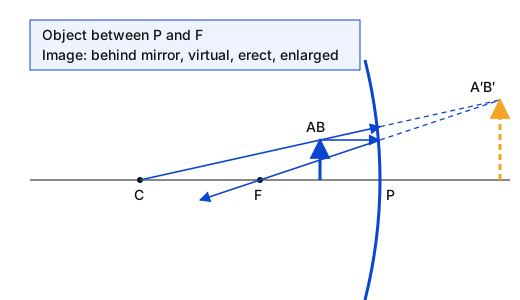
- A ray parallel to the axis reflects through F; a ray through C reflects back on itself.
- The reflected rays diverge, so they meet only when extended behind the mirror.
- Hence the image is virtual, erect and enlarged (used in shaving/make-up mirrors).
Yaad rakhein: Concave mirror gives a virtual, erect image only when the object is between P and F.
Answer: (C) Virtual and erect
अवधारणा: अवतल दर्पण में, ध्रुव P और फोकस F के बीच रखी वस्तु का प्रतिबिंब दर्पण के पीछे बनता है।
- मुख्य अक्ष के समांतर किरण परावर्तन के बाद F से गुजरती है; C से जाने वाली किरण उसी पथ पर लौटती है।
- परावर्तित किरणें अपसारी होती हैं, इसलिए ये दर्पण के पीछे बढ़ाने पर ही मिलती हैं।
- अतः प्रतिबिंब आभासी, सीधा और बड़ा होता है (दाढ़ी बनाने का दर्पण)।
याद रखें: अवतल दर्पण आभासी व सीधा प्रतिबिंब केवल तब देता है जब वस्तु P और F के बीच हो।
उत्तर: (C) आभासी और सीधा
RRB Technician Grade IIIGeneral ScienceImage by concave mirrorRRB Technician Grade III 2024 · 28 Dec Shift 2
Q653.Work done can be defined as _______.
किए गए कार्य को _______ के रूप में परिभाषित किया जा सकता है।
- Aforce × displacementबल × विस्थापन
- Bforce − displacementबल − विस्थापन
- Cforce + displacementबल + विस्थापन
- Dforce / displacementबल / विस्थापन
Show answer
Concept: Work is done when a force produces displacement in its direction.
- (force and displacement along the same direction).
- In general, .
- SI unit: joule ().
Trick: Work is a product, never a sum or difference: .
Answer: (A) force × displacement
अवधारणा: जब बल अपनी दिशा में विस्थापन उत्पन्न करता है, तब कार्य होता है।
- (बल और विस्थापन एक ही दिशा में)।
- सामान्यतः ।
- SI मात्रक: जूल ()।
ट्रिक: कार्य गुणनफल है: ।
उत्तर: (A) बल × विस्थापन
RRB Technician Grade IIIGeneral ScienceWorkRRB Technician Grade III 2024 · 28 Dec Shift 2
Q654.Iodine is necessary for which gland to make the thyroxine hormone?
थायरॉक्सिन हॉर्मोन बनाने के लिए किस ग्रंथि को आयोडीन आवश्यक है?
- AThyroid glandअवटु ग्रंथि (Thyroid gland)
- BPineal glandपीनियल ग्रंथि (Pineal gland)
- CThymusथाइमस (Thymus)
- DPancreasअग्न्याशय (Pancreas)
Show answer
Concept: The thyroid gland makes the hormone thyroxine, which needs iodine.
- Thyroxine regulates carbohydrate, protein and fat metabolism.
- Iodine deficiency → less thyroxine → swollen neck (goitre).
- That is why iodised salt is recommended.
Yaad rakhein: Iodine → Thyroid → Thyroxine; deficiency → Goitre.
Answer: (A) Thyroid gland
अवधारणा: थायरॉइड ग्रंथि थायरॉक्सिन हॉर्मोन बनाती है, जिसके लिए आयोडीन आवश्यक है।
- थायरॉक्सिन कार्बोहाइड्रेट, प्रोटीन व वसा के उपापचय को नियंत्रित करता है।
- आयोडीन की कमी → थायरॉक्सिन कम → गर्दन फूलना (घेंघा/गॉयटर)।
- इसीलिए आयोडीन युक्त नमक की सलाह दी जाती है।
याद रखें: आयोडीन → थायरॉइड → थायरॉक्सिन; कमी → घेंघा।
उत्तर: (A) अवटु ग्रंथि (Thyroid gland)
RRB Technician Grade IIIGeneral ScienceEndocrine glands – thyroidRRB Technician Grade III 2024 · 28 Dec Shift 2
Q655.When a body falls freely under gravity, then which of the following quantities DOES NOT remain constant:
जब कोई पिंड गुरुत्व के अधीन मुक्त रूप से गिरता है, तो निम्नलिखित में से कौन-सी राशि स्थिर नहीं रहती है:
- AMassद्रव्यमान
- BUniversal Gravitational Constantसार्वत्रिक गुरुत्वीय नियतांक
- CDistanceदूरी
- DAccelerationत्वरण
Show answer
Concept: In free fall, the body moves only under gravity with constant acceleration .
- Mass of the body does not change.
- is a universal constant.
- Acceleration stays constant near the Earth.
- Distance fallen keeps increasing: – it does NOT remain constant.
Trick: In free fall, velocity and distance change; , and mass stay fixed.
Answer: (C) Distance
अवधारणा: मुक्त पतन में वस्तु केवल गुरुत्व के अधीन, नियत त्वरण से गिरती है।
- वस्तु का द्रव्यमान नहीं बदलता।
- सार्वत्रिक नियतांक है।
- पृथ्वी के पास त्वरण नियत रहता है।
- तय दूरी लगातार बढ़ती है: – यह नियत नहीं रहती।
ट्रिक: मुक्त पतन में वेग और दूरी बदलते हैं; , और द्रव्यमान स्थिर रहते हैं।
उत्तर: (C) दूरी
RRB Technician Grade IIIGeneral ScienceFree fallRRB Technician Grade III 2024 · 28 Dec Shift 2
Q656.Which of the following compounds undergoes thermal decomposition to produce calcium oxide and carbon dioxide?
निम्नलिखित में से कौन-सा यौगिक ऊष्मीय वियोजन द्वारा कैल्सियम ऑक्साइड और कार्बन डाइऑक्साइड उत्पन्न करता है?
- ACalcium chlorideकैल्सियम क्लोराइड
- BCalcium carbonateकैल्सियम कार्बोनेट
- CCalcium nitrateकैल्सियम नाइट्रेट
- DCalcium sulphateकैल्सियम सल्फेट
Show answer
Concept: A decomposition reaction caused by heat is called thermal decomposition.
- Limestone (calcium carbonate) on heating gives quicklime and carbon dioxide.
- Only a carbonate can release , so the answer is calcium carbonate.
Trick: Need as product → look for carbonate ().
Answer: (B) Calcium carbonate
अवधारणा: ऊष्मा द्वारा होने वाली वियोजन अभिक्रिया को ऊष्मीय वियोजन कहते हैं।
- चूना पत्थर (कैल्सियम कार्बोनेट) गर्म करने पर बिना बुझा चूना और कार्बन डाइऑक्साइड देता है।
- केवल कार्बोनेट से ही निकल सकती है, अतः उत्तर कैल्सियम कार्बोनेट।
ट्रिक: उत्पाद में चाहिए → कार्बोनेट () चुनें।
उत्तर: (B) कैल्सियम कार्बोनेट
RRB Technician Grade IIIGeneral ScienceThermal decompositionRRB Technician Grade III 2024 · 28 Dec Shift 2
Q657.Which of the following is part of mechanical energy?
निम्नलिखित में से कौन-सी यांत्रिक ऊर्जा का भाग है?
- AOnly Light energyकेवल प्रकाश ऊर्जा
- BOnly Heat energyकेवल ऊष्मा ऊर्जा
- COnly Chemical energyकेवल रासायनिक ऊर्जा
- DPotential energyस्थितिज ऊर्जा
Show answer
Concept: Mechanical energy = kinetic energy + potential energy.
- Kinetic energy: (due to motion).
- Potential energy: (due to position or shape).
- Light, heat and chemical energy are other forms, not parts of mechanical energy.
Yaad rakhein: Mechanical energy = KE + PE only.
Answer: (D) Potential energy
अवधारणा: यांत्रिक ऊर्जा = गतिज ऊर्जा + स्थितिज ऊर्जा।
- गतिज ऊर्जा: (गति के कारण)।
- स्थितिज ऊर्जा: (स्थिति या आकृति के कारण)।
- प्रकाश, ऊष्मा व रासायनिक ऊर्जा अन्य रूप हैं, यांत्रिक ऊर्जा के भाग नहीं।
याद रखें: यांत्रिक ऊर्जा = गतिज + स्थितिज ऊर्जा।
उत्तर: (D) स्थितिज ऊर्जा
RRB Technician Grade IIIGeneral ScienceMechanical energyRRB Technician Grade III 2024 · 28 Dec Shift 2
Q658.Which of the following statements is /are true about the field around a current carrying solenoid:
(i)The field inside the solenoid is uniform.
(ii) The field outside the solenoid is same in magnitude as the field inside the solenoid.
(iii) The field around the solenoid is similar to the field around a bar magnet.
धारावाही परिनालिका (solenoid) के चारों ओर के क्षेत्र के बारे में निम्नलिखित में से कौन-सा/से कथन सत्य है/हैं:
(i) परिनालिका के भीतर क्षेत्र एकसमान होता है।
(ii) परिनालिका के बाहर क्षेत्र का परिमाण परिनालिका के भीतर के क्षेत्र के समान होता है।
(iii) परिनालिका के चारों ओर का क्षेत्र एक छड़ चुंबक के चारों ओर के क्षेत्र के समान होता है।
- ABoth (i) and (iii)(i) और (iii) दोनों
- BOnly (iii)केवल (iii)
- COnly(i)केवल (i)
- DBoth (ii) and (iii)(ii) और (iii) दोनों
Show answer
Concept: A solenoid is a long coil of many turns of insulated wire.
- Inside the solenoid the field lines are parallel straight lines → field is uniform. (i) true.
- Outside, the lines spread out, so the field is much weaker – not equal to inside. (ii) false.
- The field pattern resembles that of a bar magnet, with N and S ends. (iii) true.
Yaad rakhein: Solenoid = bar magnet; uniform field inside (used to make electromagnets).
Answer: (A) Both (i) and (iii)
अवधारणा: परिनालिका, विद्युतरोधी तार के अनेक फेरों वाली लंबी कुंडली है।
- परिनालिका के अंदर क्षेत्र रेखाएँ समांतर सीधी होती हैं → क्षेत्र एकसमान। (i) सत्य।
- बाहर रेखाएँ फैल जाती हैं, क्षेत्र बहुत दुर्बल होता है – अंदर के बराबर नहीं। (ii) असत्य।
- क्षेत्र का पैटर्न छड़ चुंबक जैसा होता है, जिसके N और S सिरे होते हैं। (iii) सत्य।
याद रखें: परिनालिका = छड़ चुंबक; अंदर एकसमान क्षेत्र (विद्युत चुंबक बनाने में उपयोग)।
उत्तर: (A) (i) और (iii) दोनों
RRB Technician Grade IIIGeneral ScienceMagnetic field of a solenoidRRB Technician Grade III 2024 · 28 Dec Shift 2
Q659.Asexual reproduction by fragmentation occurs:
खंडन (fragmentation) द्वारा अलैंगिक जनन होता है:
- Aonly in simple body organised multicellular organismsकेवल सरल शारीरिक संगठन वाले बहुकोशिकीय जीवों में
- Bin all multicellular organismsसभी बहुकोशिकीय जीवों में
- Conly in unicellular organismsकेवल एककोशिकीय जीवों में
- Donly in complex body organised multicellular organismsकेवल जटिल शारीरिक संगठन वाले बहुकोशिकीय जीवों में
Show answer
Concept: Fragmentation: the body breaks into pieces and each piece grows into a new individual.
- Example: Spirogyra (a filamentous alga).
- It is possible only when the body is simply organised, since every fragment can regrow the whole body.
- Complex organisms have specialised organs and cannot regrow from fragments; unicellular organisms use fission instead.
Yaad rakhein: Fragmentation → simple multicellular (Spirogyra); fission → unicellular.
Answer: (A) only in simple body organised multicellular organisms
अवधारणा: खंडन: शरीर टुकड़ों में टूटता है और प्रत्येक टुकड़ा नए जीव में विकसित होता है।
- उदाहरण: स्पाइरोगाइरा (तंतुमय शैवाल)।
- यह केवल सरल संरचना वाले जीवों में संभव है, क्योंकि हर टुकड़ा पूरा शरीर बना सकता है।
- जटिल जीवों में विशिष्ट अंग होते हैं, अतः खंडन संभव नहीं; एककोशिकीय जीव विखंडन करते हैं।
याद रखें: खंडन → सरल बहुकोशिकीय (स्पाइरोगाइरा); विखंडन → एककोशिकीय।
उत्तर: (A) केवल सरल शारीरिक संगठन वाले बहुकोशिकीय जीवों में
RRB Technician Grade IIIGeneral ScienceFragmentationRRB Technician Grade III 2024 · 28 Dec Shift 2
Q660.In the process of photosynthesis, what happens to the carbohydrates (glucose) that are produced?
प्रकाश संश्लेषण की प्रक्रिया में, उत्पन्न होने वाले कार्बोहाइड्रेट (ग्लूकोज) का क्या होता है?
- ACarbohydrates are stored in the form of glycogen.कार्बोहाइड्रेट ग्लाइकोजन के रूप में संचित होते हैं।
- BAll the carbohydrates are stored in the form of a starch.सभी कार्बोहाइड्रेट मंड (स्टार्च) के रूप में संचित होते हैं।
- CFirst, carbohydrates are utilised for energy production and the rest are stored in the form of starch.पहले, कार्बोहाइड्रेट का उपयोग ऊर्जा उत्पादन के लिए किया जाता है और शेष मंड (स्टार्च) के रूप में संचित होते हैं।
- DAll the carbohydrates are immediately used as energy.सभी कार्बोहाइड्रेट तुरंत ऊर्जा के रूप में उपयोग हो जाते हैं।
Show answer
Concept: Photosynthesis: (in presence of sunlight and chlorophyll).
- The glucose made is first used by the plant to provide energy (respiration).
- The remaining carbohydrate is stored as starch – the internal energy reserve of plants.
- Glycogen is the storage form in animals, not plants.
Yaad rakhein: Plants store starch; animals store glycogen.
Answer: (C) First, carbohydrates are utilised for energy production and the rest are stored in the form of starch.
अवधारणा: प्रकाश संश्लेषण: (सूर्य-प्रकाश व क्लोरोफिल की उपस्थिति में)।
- बना ग्लूकोज पहले पौधे को ऊर्जा देने (श्वसन) में प्रयुक्त होता है।
- शेष कार्बोहाइड्रेट मंड (स्टार्च) के रूप में संचित होता है – यह पौधों का आंतरिक ऊर्जा भंडार है।
- ग्लाइकोजन जंतुओं का संचय रूप है, पौधों का नहीं।
याद रखें: पौधे = स्टार्च; जंतु = ग्लाइकोजन।
उत्तर: (C) पहले, कार्बोहाइड्रेट का उपयोग ऊर्जा उत्पादन के लिए किया जाता है और शेष मंड (स्टार्च) के रूप में संचित होते हैं।
RRB Technician Grade IIIGeneral SciencePhotosynthesis – fate of glucoseRRB Technician Grade III 2024 · 28 Dec Shift 2

