Q661.Which of the following is the most common application of plaster of Paris?
प्लास्टर ऑफ़ पेरिस का सबसे सामान्य उपयोग निम्नलिखित में से कौन-सा है?
- ARemove the hardness of waterजल की कठोरता दूर करना
- BBakingबेकिंग
- CFire extinguisherअग्निशामक
- DCreating casts for supporting fractured bonesटूटी हड्डियों को सहारा देने के लिए प्लास्टर (कास्ट) बनाना
Show answer
Concept: Plaster of Paris (POP) is calcium sulphate hemihydrate, .
- On mixing with water it sets into a hard mass of gypsum: .
- This property is used for plaster casts supporting fractured bones, toys, decorative items and smooth surfaces.
- Washing soda removes hardness; baking soda is used in baking and fire extinguishers.
Trick: POP + water → hard gypsum → bone cast.
Answer: (D) Creating casts for supporting fractured bones
अवधारणा: प्लास्टर ऑफ पेरिस (POP) कैल्सियम सल्फेट हेमिहाइड्रेट है।
- जल मिलाने पर यह कठोर जिप्सम बन जाता है: ।
- इसी गुण के कारण टूटी हड्डियों को सहारा देने वाले प्लास्टर, खिलौने व सजावटी वस्तुएँ बनती हैं।
- धावन सोडा कठोरता हटाता है; खाने का सोडा बेकिंग व अग्निशामक में प्रयुक्त होता है।
ट्रिक: POP + जल → कठोर जिप्सम → हड्डी का प्लास्टर।
उत्तर: (D) टूटी हड्डियों को सहारा देने के लिए प्लास्टर (कास्ट) बनाना
RRB Technician Grade IIIGeneral SciencePlaster of ParisRRB Technician Grade III 2024 · 28 Dec Shift 2
Q662.Select the bisexual flower from the provided options.
दिए गए विकल्पों में से उभयलिंगी पुष्प (bisexual flower) का चयन कीजिए।
- APapayaपपीता
- BMustardसरसों
- CPumpkinकद्दू
- DWatermelonतरबूज
Show answer
Concept: A bisexual flower has both stamens (male) and pistil (female); a unisexual flower has only one of them.
- Mustard and Hibiscus flowers have both stamens and pistil → bisexual.
- Papaya and watermelon have separate male and female flowers → unisexual.
- Pumpkin (cucurbit) flowers are also unisexual.
Yaad rakhein: Bisexual: Mustard, Hibiscus; Unisexual: Papaya, Watermelon (and cucurbits).
Answer: (B) Mustard
अवधारणा: उभयलिंगी पुष्प में पुंकेसर (नर) और स्त्रीकेसर (मादा) दोनों होते हैं; एकलिंगी में केवल एक।
- सरसों व गुड़हल के पुष्प में दोनों होते हैं → उभयलिंगी।
- पपीता व तरबूज में नर व मादा पुष्प अलग होते हैं → एकलिंगी।
- कद्दू के पुष्प भी एकलिंगी होते हैं।
याद रखें: उभयलिंगी: सरसों, गुड़हल; एकलिंगी: पपीता, तरबूज (कद्दू वर्ग)।
उत्तर: (B) सरसों
RRB Technician Grade IIIGeneral ScienceBisexual and unisexual flowersRRB Technician Grade III 2024 · 28 Dec Shift 2
Q663.Apical meristem increases the _______ of the stem and the root.
शीर्षस्थ विभज्योतक (apical meristem) तने और जड़ की _______ बढ़ाता है।
- Aflowersफूलों
- Blengthलंबाई
- Cgirthमोटाई (घेरा)
- Dbranchesशाखाओं
Show answer
Concept: Meristems are growing tissues whose cells keep dividing.
- Apical meristem – at the tips of stem and root – increases the length.
- Lateral meristem (cambium) increases the girth (thickness).
- Intercalary meristem – at the base of leaves or internodes – also adds to length.
Yaad rakhein: Apical = Apex = Length; Lateral = Girth.
Answer: (B) length
अवधारणा: विभज्योतक वृद्धि करने वाले ऊतक हैं, जिनकी कोशिकाएँ लगातार विभाजित होती हैं।
- शीर्षस्थ विभज्योतक – तने व जड़ के शीर्ष पर – लंबाई बढ़ाता है।
- पार्श्व विभज्योतक (एधा) मोटाई (घेरा) बढ़ाता है।
- अंतर्वेशी विभज्योतक – पत्तियों के आधार या पर्व पर – भी लंबाई बढ़ाता है।
याद रखें: शीर्षस्थ = शीर्ष = लंबाई; पार्श्व = मोटाई।
उत्तर: (B) लंबाई
RRB Technician Grade IIIGeneral ScienceMeristematic tissueRRB Technician Grade III 2024 · 28 Dec Shift 2
Q664.Which of the following organisms have three-chambered hearts?
निम्नलिखित में से किन जीवों में तीन-कक्षीय हृदय होता है?
- AAmphibiansउभयचर (Amphibians)
- BBirdsपक्षी (Birds)
- CFishesमछलियाँ (Fishes)
- DMammalsस्तनधारी (Mammals)
Show answer
Concept: The number of heart chambers differs among vertebrate groups.
- Fishes: 2 chambers (1 atrium + 1 ventricle).
- Amphibians (and most reptiles): 3 chambers (2 atria + 1 ventricle), so oxygenated and deoxygenated blood mix slightly.
- Birds and mammals: 4 chambers – complete separation of blood.
Yaad rakhein: Fish 2, Amphibian 3, Bird/Mammal 4.
Answer: (A) Amphibians
अवधारणा: विभिन्न कशेरुकी वर्गों में हृदय के कक्षों की संख्या भिन्न होती है।
- मछलियाँ: 2 कक्ष (1 अलिंद + 1 निलय)।
- उभयचर (व अधिकांश सरीसृप): 3 कक्ष (2 अलिंद + 1 निलय), जिससे रक्त थोड़ा मिश्रित होता है।
- पक्षी और स्तनधारी: 4 कक्ष – रक्त का पूर्ण पृथक्करण।
याद रखें: मछली 2, उभयचर 3, पक्षी/स्तनधारी 4।
उत्तर: (A) उभयचर (Amphibians)
RRB Technician Grade IIIGeneral ScienceHeart chambers in vertebratesRRB Technician Grade III 2024 · 28 Dec Shift 2
Q665.Which of the following parts of a plant does NOT take part in vegetative propagation?
पौधे का निम्नलिखित में से कौन-सा भाग कायिक प्रवर्धन (vegetative propagation) में भाग नहीं लेता है?
- ALeavesपत्तियाँ
- BRootजड़
- CStemतना
- DFlowerफूल
Show answer
Concept: Vegetative propagation: new plants grow from vegetative parts – root, stem or leaf.
- Leaves: Bryophyllum (buds on leaf margins).
- Stem: potato, sugarcane, rose cuttings; Root: sweet potato, dahlia.
- The flower is a reproductive part used for sexual reproduction, so it does not take part.
Yaad rakhein: Vegetative = root, stem, leaf; flower = sexual reproduction.
Answer: (D) Flower
अवधारणा: कायिक प्रवर्धन: नए पौधे कायिक भागों – जड़, तना या पत्ती – से उगते हैं।
- पत्ती: ब्रायोफिलम (पत्ती के किनारों पर कलिकाएँ)।
- तना: आलू, गन्ना, गुलाब की कलम; जड़: शकरकंद, डहलिया।
- पुष्प लैंगिक जनन का अंग है, अतः यह कायिक प्रवर्धन में भाग नहीं लेता।
याद रखें: कायिक = जड़, तना, पत्ती; पुष्प = लैंगिक जनन।
उत्तर: (D) फूल
RRB Technician Grade IIIGeneral ScienceVegetative propagationRRB Technician Grade III 2024 · 28 Dec Shift 2
Q666.The magnetic field due to a current carrying coil increases when:
धारावाही कुंडली के कारण उत्पन्न चुंबकीय क्षेत्र कब बढ़ता है?
- Acurrent through the coil is decreasedकुंडली में प्रवाहित धारा घटाई जाती है
- Bnumber of turns of the coil is decreasedकुंडली के फेरों की संख्या घटाई जाती है
- COne moves way from the coilकोई कुंडली से दूर जाता है
- Dcurrent through the coil is increasedकुंडली में प्रवाहित धारा बढ़ाई जाती है
Show answer
Concept: The magnetic field at the centre of a current-carrying coil is .
- Field increases when current is increased.
- Field increases when number of turns is increased.
- Field decreases as we move away from the coil.
- So only 'current is increased' raises the field.
Trick: More current, more turns → stronger field; more distance → weaker.
Answer: (D) current through the coil is increased
अवधारणा: धारावाही कुंडली के केंद्र पर चुंबकीय क्षेत्र होता है।
- धारा बढ़ाने पर क्षेत्र बढ़ता है।
- फेरों की संख्या बढ़ाने पर क्षेत्र बढ़ता है।
- कुंडली से दूर जाने पर क्षेत्र घटता है।
- अतः केवल 'धारा बढ़ाना' क्षेत्र बढ़ाता है।
ट्रिक: अधिक धारा, अधिक फेरे → प्रबल क्षेत्र; अधिक दूरी → दुर्बल।
उत्तर: (D) कुंडली में प्रवाहित धारा बढ़ाई जाती है
RRB Technician Grade IIIGeneral ScienceMagnetic field of a coilRRB Technician Grade III 2024 · 28 Dec Shift 2
Q667.The force of gravitation between two bodies is F; if the mass of one of the bodies is increased to four times it's initial value, then the gravitational force between the bodies will now be:
दो पिंडों के बीच गुरुत्वाकर्षण बल F है; यदि किसी एक पिंड का द्रव्यमान उसके प्रारंभिक मान का चार गुना कर दिया जाए, तो अब पिंडों के बीच गुरुत्वाकर्षण बल कितना होगा?
- AF/4
- B2F
- CF
- D4F
Show answer
Concept: Newton's law: , so .
- New mass , and unchanged.
Trick: Force changes in the same ratio as the product of masses.
Answer: (D) 4F
अवधारणा: न्यूटन का नियम: , अर्थात ।
- नया द्रव्यमान ; और अपरिवर्तित।
ट्रिक: बल, द्रव्यमानों के गुणनफल के अनुपात में ही बदलता है।
उत्तर: (D) 4F
RRB Technician Grade IIIGeneral ScienceUniversal law of gravitationRRB Technician Grade III 2024 · 28 Dec Shift 2
Q668.Which of following pairs belongs to homologous series of alkenes?
निम्नलिखित में से कौन-सा युग्म एल्कीन (alkenes) की समजातीय श्रेणी (homologous series) से संबंधित है?
- A and और
- B and और
- C and और
- D and और
Show answer
Concept: Alkenes have general formula ; successive members differ by .
- : , ✓; : , ✓ – both alkenes, differ by .
- and are alkanes ().
- is not a valid hydrocarbon; so only (A) fits.
Yaad rakhein: Alkane , Alkene , Alkyne .
Answer: (A) and
अवधारणा: एल्कीन का सामान्य सूत्र है; क्रमागत सदस्यों में का अंतर होता है।
- : , ✓; : , ✓ – दोनों एल्कीन, अंतर ।
- और एल्केन () हैं।
- कोई मान्य हाइड्रोकार्बन नहीं है; अतः केवल (A) सही।
याद रखें: एल्केन , एल्कीन , एल्काइन ।
उत्तर: (A) और
RRB Technician Grade IIIGeneral ScienceHomologous series – alkenesRRB Technician Grade III 2024 · 28 Dec Shift 2
Q669.Which of the following is the longest part of the alimentary canal?
निम्नलिखित में से आहार नाल (alimentary canal) का सबसे लंबा भाग कौन-सा है?
- ALarge intestineबड़ी आँत
- BFood pipeग्रसिका (भोजन नली)
- CStomachआमाशय
- DSmall intestineछोटी आँत
Show answer
Concept: The alimentary canal runs from mouth to anus: oesophagus → stomach → small intestine → large intestine.
- The small intestine is the longest part (about 6–7 m in adults), highly coiled.
- Its length gives a large surface for complete digestion and absorption (villi).
- The large intestine is shorter (about 1.5 m) but wider.
Yaad rakhein: Small intestine = longest; large intestine = wider, not longer.
Answer: (D) Small intestine
अवधारणा: आहारनाल मुख से गुदा तक: ग्रसिका → आमाशय → क्षुद्रांत्र → बृहदांत्र।
- क्षुद्रांत्र (छोटी आँत) सबसे लंबा भाग है (वयस्क में लगभग 6–7 m), अत्यधिक कुंडलित।
- इसकी लंबाई पूर्ण पाचन व अवशोषण (दीर्घरोम) के लिए बड़ा क्षेत्र देती है।
- बृहदांत्र छोटा (लगभग 1.5 m) पर चौड़ा होता है।
याद रखें: छोटी आँत = सबसे लंबी; बड़ी आँत = चौड़ी, लंबी नहीं।
उत्तर: (D) छोटी आँत
RRB Technician Grade IIIGeneral ScienceHuman digestive systemRRB Technician Grade III 2024 · 28 Dec Shift 2
Q670.Consider a ray passing through the principal focus and not parallel to the principal axis of a concave mirror, after reflection, it will:
अवतल दर्पण के मुख्य फोकस से होकर गुजरने वाली और मुख्य अक्ष के समानांतर न होने वाली एक किरण पर विचार कीजिए, परावर्तन के बाद, वह:
- Apass through the principal focusमुख्य फोकस से होकर गुजरेगी
- Bemerge obliquely to the principal axisमुख्य अक्ष से तिरछी निकलेगी
- Cemerge parallel to the principal axisमुख्य अक्ष के समानांतर निकलेगी
- Dpass through the centre of curvatureवक्रता केंद्र से होकर गुजरेगी
Show answer
Concept: Standard rays for a concave mirror: a ray parallel to the principal axis passes through F after reflection, and vice versa.
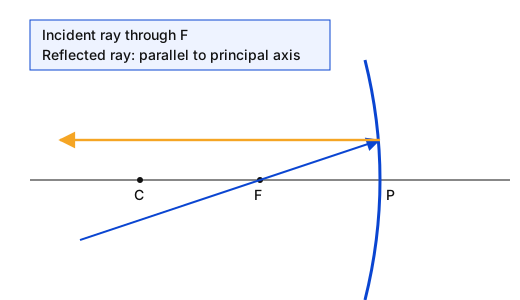
- The path of light is reversible.
- So a ray passing through the principal focus F, after reflection, emerges parallel to the principal axis.
- A ray through C retraces its path; a ray to the pole reflects at an equal angle.
Yaad rakhein: Parallel → F, and F → Parallel.
Answer: (C) emerge parallel to the principal axis
अवधारणा: अवतल दर्पण की मानक किरणें: मुख्य अक्ष के समांतर किरण परावर्तन के बाद F से गुजरती है, और इसका विलोम भी सत्य है।
- प्रकाश का पथ उत्क्रमणीय होता है।
- अतः मुख्य फोकस F से गुजरने वाली किरण परावर्तन के बाद मुख्य अक्ष के समांतर निकलती है।
- C से गुजरने वाली किरण उसी पथ पर लौटती है; ध्रुव पर पड़ने वाली किरण समान कोण पर परावर्तित होती है।
याद रखें: समांतर → F, और F → समांतर।
उत्तर: (C) मुख्य अक्ष के समानांतर निकलेगी
RRB Technician Grade IIIGeneral ScienceReflection rules for concave mirrorRRB Technician Grade III 2024 · 28 Dec Shift 2
Q671.Which of the following is NOT a characteristic of a solution?
निम्नलिखित में से कौन-सा विलयन (solution) का अभिलक्षण नहीं है?
- AThe particles of a solution are smaller than 1 nm ( metre) in diameter.विलयन के कणों का व्यास 1 nm ( मीटर) से छोटा होता है।
- BBecause of very small particle size, particles do not scatter a beam of light passing through the solution.कणों का आकार बहुत छोटा होने के कारण, कण विलयन से होकर गुजरने वाले प्रकाश के किरण-पुंज को प्रकीर्णित नहीं करते हैं।
- CA solution is a homogenous mixture.विलयन एक समांगी मिश्रण है।
- DThe solute particles can be separated from the mixture by the process of filtration.विलेय कणों को निस्पंदन (filtration) की प्रक्रिया द्वारा मिश्रण से अलग किया जा सकता है।
Show answer
Concept: A solution is a homogeneous mixture of two or more substances.
- Particle size is less than 1 nm ( m) – true.
- Particles are too small to scatter light, so no Tyndall effect – true.
- Solute particles pass through filter paper and cannot be separated by filtration – so (D) is NOT a characteristic.
Yaad rakhein: Solution: no Tyndall effect, no settling, not separable by filtration.
Answer: (D) The solute particles can be separated from the mixture by the process of filtration.
अवधारणा: विलयन दो या अधिक पदार्थों का समांगी मिश्रण है।
- कणों का आकार 1 nm ( m) से कम – सत्य।
- कण इतने छोटे होते हैं कि प्रकाश का प्रकीर्णन नहीं करते, टिंडल प्रभाव नहीं – सत्य।
- विलेय के कण फ़िल्टर पेपर से निकल जाते हैं, छानकर अलग नहीं होते – अतः (D) अभिलक्षण नहीं है।
याद रखें: विलयन: टिंडल प्रभाव नहीं, नीचे नहीं बैठता, छानकर अलग नहीं होता।
उत्तर: (D) विलेय कणों को निस्पंदन (filtration) की प्रक्रिया द्वारा मिश्रण से अलग किया जा सकता है।
RRB Technician Grade IIIGeneral ScienceSolutionsRRB Technician Grade III 2024 · 28 Dec Shift 2
Q672.The pH value of the neutral solution is _______.
उदासीन विलयन का pH मान _______ होता है।
- A5
- B14
- C0
- D7
Show answer
Concept: The pH scale runs from 0 to 14 and measures ion concentration.
- pH less than 7 → acidic.
- pH = 7 → neutral (e.g. pure water).
- pH greater than 7 → basic (alkaline).
Yaad rakhein: Pure water at room temperature has pH exactly 7.
Answer: (D) 7
अवधारणा: pH स्केल 0 से 14 तक होता है और आयन की सांद्रता बताता है।
- pH 7 से कम → अम्लीय।
- pH = 7 → उदासीन (जैसे शुद्ध जल)।
- pH 7 से अधिक → क्षारीय।
याद रखें: कमरे के ताप पर शुद्ध जल का pH ठीक 7 होता है।
उत्तर: (D) 7
RRB Technician Grade IIIGeneral SciencepH scaleRRB Technician Grade III 2024 · 28 Dec Shift 2
Q673.What is the mass number of an atom having 13 protons and 14 neutrons?
13 प्रोटॉन और 14 न्यूट्रॉन वाले परमाणु की द्रव्यमान संख्या क्या है?
- A13 u
- B14 u
- C1 u
- D27 u
Show answer
Concept: Mass number = number of protons + number of neutrons.
- Protons , neutrons .
- This is aluminium: .
Trick: Atomic number = protons; mass number = protons + neutrons.
Answer: (D) 27 u
अवधारणा: द्रव्यमान संख्या = प्रोटॉनों की संख्या + न्यूट्रॉनों की संख्या।
- प्रोटॉन , न्यूट्रॉन ।
- यह एल्युमिनियम है: ।
ट्रिक: परमाणु संख्या = प्रोटॉन; द्रव्यमान संख्या = प्रोटॉन + न्यूट्रॉन।
उत्तर: (D) 27 u
RRB Technician Grade IIIGeneral ScienceMass numberRRB Technician Grade III 2024 · 28 Dec Shift 2
Q674.In the Earth's crust, metal ores are present in the form of _______.
पृथ्वी की भूपर्पटी में, धातु अयस्क _______ के रूप में उपस्थित होते हैं।
- Aoxides, sulphides and carbonatesऑक्साइड, सल्फाइड और कार्बोनेट
- Bonly carbonatesकेवल कार्बोनेट
- Conly sulphidesकेवल सल्फाइड
- Donly oxidesकेवल ऑक्साइड
Show answer
Concept: Minerals from which metals can be extracted profitably are called ores.
- Many metals occur in the crust as oxides (e.g. bauxite, haematite).
- Others occur as sulphides (e.g. zinc blende, cinnabar) and carbonates (e.g. calamine, limestone).
- Since oxygen and sulphur are reactive, ores of oxides, sulphides and carbonates are the most common.
Yaad rakhein: Common ores = oxides, sulphides, carbonates.
Answer: (A) oxides, sulphides and carbonates
अवधारणा: जिन खनिजों से धातुओं का लाभप्रद निष्कर्षण हो सके उन्हें अयस्क कहते हैं।
- अनेक धातुएँ भूपर्पटी में ऑक्साइड रूप में मिलती हैं (जैसे बॉक्साइट, हेमेटाइट)।
- अन्य सल्फाइड (जैसे जिंक ब्लेंड, सिनाबार) और कार्बोनेट (जैसे कैलामाइन, चूना पत्थर) रूप में मिलती हैं।
- ऑक्सीजन व सल्फर अधिक क्रियाशील होने से ऑक्साइड, सल्फाइड व कार्बोनेट अयस्क सर्वाधिक हैं।
याद रखें: सामान्य अयस्क = ऑक्साइड, सल्फाइड, कार्बोनेट।
उत्तर: (A) ऑक्साइड, सल्फाइड और कार्बोनेट
RRB Technician Grade IIIGeneral ScienceOccurrence of metalsRRB Technician Grade III 2024 · 28 Dec Shift 2
Q675.Which of the following statements is/are correct related to eco-system?
(i) Non-biodegradable substance harms the various members of eco-system.
(ii) Non-biodegradable substances break-down by biological processes.
(iii) Non-biodegradable substances never persist in the environment.
पारितंत्र (eco-system) से संबंधित निम्नलिखित में से कौन-सा/से कथन सही है/हैं?
(i) अजैव-निम्नीकरणीय (non-biodegradable) पदार्थ पारितंत्र के विभिन्न सदस्यों को हानि पहुँचाता है।
(ii) अजैव-निम्नीकरणीय पदार्थ जैविक प्रक्रमों द्वारा विघटित होते हैं।
(iii) अजैव-निम्नीकरणीय पदार्थ पर्यावरण में कभी बने नहीं रहते हैं।
- AOnly (i)केवल (i)
- BOnly (ii) and (iii)केवल (ii) और (iii)
- COnly (i) and (ii)केवल (i) और (ii)
- D(i), (ii) and (iii)(i), (ii) और (iii)
Show answer
Concept: Non-biodegradable substances (plastic, DDT, glass) are not broken down by biological processes such as bacteria and decomposers.
- They harm various members of the ecosystem, e.g. through biological magnification – (i) true.
- They do not break down biologically – (ii) false.
- Hence they persist in the environment for a long time – (iii) false.
Yaad rakhein: Non-biodegradable = not broken by microbes + persists + harms the ecosystem.
Answer: (A) Only (i)
अवधारणा: अजैव निम्नीकरणीय पदार्थ (प्लास्टिक, DDT, काँच) जैविक प्रक्रमों – जीवाणु व अपघटक – से नहीं टूटते।
- ये पारितंत्र के विभिन्न सदस्यों को हानि पहुँचाते हैं, जैसे जैव आवर्धन द्वारा – (i) सत्य।
- ये जैविक प्रक्रम से नहीं टूटते – (ii) असत्य।
- इसलिए ये पर्यावरण में लंबे समय तक बने रहते हैं – (iii) असत्य।
याद रखें: अजैव निम्नीकरणीय = सूक्ष्मजीव नहीं तोड़ते + लंबे समय तक रहते हैं + पारितंत्र को हानि।
उत्तर: (A) केवल (i)
RRB Technician Grade IIIGeneral ScienceBiodegradable and non-biodegradable wastesRRB Technician Grade III 2024 · 28 Dec Shift 2
Q676.Which of the following pairs of metals are found in free state?
निम्नलिखित में से धातुओं का कौन-सा युग्म मुक्त अवस्था में पाया जाता है?
- AGold and silverसोना और चाँदी
- BGold and sodiumसोना और सोडियम
- CSodium and potassiumसोडियम और पोटैशियम
- DSilver and potassiumचाँदी और पोटैशियम
Show answer
Concept: Metals at the bottom of the reactivity series are least reactive and occur in the free (native) state.
- Gold, silver, platinum and copper are found free in nature.
- Sodium and potassium are highly reactive and are never found free; they occur only as compounds.
- So the pair with both metals free is gold and silver.
Yaad rakhein: Least reactive (Au, Ag, Pt, Cu) → free state; K, Na, Ca → always combined.
Answer: (A) Gold and silver
अवधारणा: सक्रियता श्रेणी में सबसे नीचे की धातुएँ कम क्रियाशील होती हैं और मुक्त (देशज) अवस्था में मिलती हैं।
- सोना, चाँदी, प्लैटिनम और ताँबा प्रकृति में मुक्त मिलते हैं।
- सोडियम व पोटैशियम अति क्रियाशील हैं, कभी मुक्त नहीं मिलते; केवल यौगिक रूप में मिलते हैं।
- अतः दोनों मुक्त धातुओं वाला युग्म सोना और चाँदी है।
याद रखें: कम क्रियाशील (Au, Ag, Pt, Cu) → मुक्त अवस्था; K, Na, Ca → सदैव संयुक्त।
उत्तर: (A) सोना और चाँदी
RRB Technician Grade IIIGeneral ScienceMetals in free stateRRB Technician Grade III 2024 · 28 Dec Shift 2
Q677.What is the SI unit of acceleration?
त्वरण का SI मात्रक क्या है?
- Am s
- Bm
- Cm
- Dm
Show answer
Concept: Acceleration = change in velocity ÷ time, .
- Unit of velocity , unit of time .
- Unit of .
- is the unit of speed/velocity, not acceleration.
Trick: Each division by time adds one more : distance m → velocity → acceleration .
Answer: (B) m
अवधारणा: त्वरण = वेग में परिवर्तन ÷ समय, ।
- वेग का मात्रक , समय का ।
- का मात्रक ।
- चाल/वेग का मात्रक है, त्वरण का नहीं।
ट्रिक: समय से हर बार भाग देने पर एक जुड़ता है: दूरी m → वेग → त्वरण ।
उत्तर: (B) m
RRB Technician Grade IIIGeneral ScienceSI unitsRRB Technician Grade III 2024 · 28 Dec Shift 2
Q678._______ is the process through which plants lose water in the form of water vapour.
_______ वह प्रक्रिया है जिसके द्वारा पौधे जल वाष्प के रूप में जल खोते हैं।
- ATransportationपरिवहन (Transportation)
- BImbibitionअंतःशोषण (Imbibition)
- CTranscriptionअनुलेखन (Transcription)
- DTranspirationवाष्पोत्सर्जन (Transpiration)
Show answer
Concept: Transpiration is the loss of water in the form of water vapour from the aerial parts of a plant, mainly through stomata of leaves.
- It creates a suction pull that helps upward movement of water and minerals in xylem.
- It also helps in temperature regulation (cooling).
- Imbibition = absorption of water by dry seeds; transcription = DNA → RNA.
Trick: Transpiration = water vapour out through stomata; 'trans-port' is a distractor.
Answer: (D) Transpiration
अवधारणा: वाष्पोत्सर्जन, पौधे के वायवीय भागों से – मुख्यतः पत्तियों के रंध्रों से – जल का वाष्प के रूप में ह्रास है।
- यह चूषण खिंचाव उत्पन्न करता है, जिससे जाइलम में जल व खनिज ऊपर चढ़ते हैं।
- यह ताप नियंत्रण (ठंडक) में भी सहायक है।
- अंतःशोषण = सूखे बीजों द्वारा जल सोखना; अनुलेखन = DNA → RNA।
ट्रिक: वाष्पोत्सर्जन = रंध्रों से जल वाष्प बाहर जाना।
उत्तर: (D) वाष्पोत्सर्जन (Transpiration)
RRB Technician Grade IIIGeneral ScienceTranspirationRRB Technician Grade III 2024 · 28 Dec Shift 2
Q679.Which of the following statements is INCORRECT?
निम्नलिखित में से कौन-सा कथन गलत है?
- ABinary fission occurs in a definite orientation in Leishmania.लीशमैनिया (Leishmania) में द्विखंडन एक निश्चित दिशा (अभिविन्यास) में होता है।
- BPlasmodium divides into many daughter cells simultaneously by binary fission.प्लाज्मोडियम (Plasmodium) द्विखंडन द्वारा एक साथ अनेक संतति कोशिकाओं में विभाजित होता है।
- CIn Amoeba, the splitting of the two cells during division can take place in any plane.अमीबा में, विभाजन के दौरान दो कोशिकाओं का पृथक्करण किसी भी तल में हो सकता है।
- DYeast can put out small buds that separate and grow further.यीस्ट छोटी कलिकाएँ (buds) उत्पन्न कर सकता है जो अलग होकर आगे वृद्धि करती हैं।
Show answer
Concept: Unicellular organisms reproduce by fission: binary (into two) or multiple (into many).
- Leishmania: binary fission in a definite orientation (due to flagellum) – correct.
- Amoeba: splitting can occur in any plane – correct.
- Yeast: reproduces by budding – correct.
- Plasmodium divides into many daughter cells simultaneously by multiple fission, not binary fission – so (B) is INCORRECT.
Yaad rakhein: Many cells at once = multiple fission (Plasmodium); two cells = binary fission (Amoeba, Leishmania).
Answer: (B) Plasmodium divides into many daughter cells simultaneously by binary fission.
अवधारणा: एककोशिकीय जीव विखंडन से जनन करते हैं: द्विविखंडन (दो में) या बहुविखंडन (अनेक में)।
- लीशमैनिया: निश्चित तल में द्विविखंडन (कशाभ के कारण) – सही।
- अमीबा: विभाजन किसी भी तल में – सही।
- यीस्ट: मुकुलन द्वारा जनन – सही।
- प्लाज्मोडियम एक साथ अनेक संतति कोशिकाओं में बहुविखंडन से बँटता है, द्विविखंडन से नहीं – अतः (B) गलत कथन है।
याद रखें: एक साथ अनेक कोशिकाएँ = बहुविखंडन (प्लाज्मोडियम); दो कोशिकाएँ = द्विविखंडन (अमीबा, लीशमैनिया)।
उत्तर: (B) प्लाज्मोडियम (Plasmodium) द्विखंडन द्वारा एक साथ अनेक संतति कोशिकाओं में विभाजित होता है।
RRB Technician Grade IIIGeneral ScienceAsexual reproduction – fissionRRB Technician Grade III 2024 · 28 Dec Shift 2
Q680.The natural tendency of objects to resist a change in their state of rest or of uniform motion is called_______.
वस्तुओं की अपनी विरामावस्था या एकसमान गति की अवस्था में परिवर्तन का विरोध करने की प्राकृतिक प्रवृत्ति _______ कहलाती है।
- Ainertiaजड़त्व (inertia)
- Bforceबल (force)
- Cmotionगति (motion)
- Dmomentumसंवेग (momentum)
Show answer
Concept: Newton's first law: a body stays at rest or in uniform motion unless an external force acts on it.
- This natural tendency to resist change in the state of rest or uniform motion is called inertia.
- Mass is the measure of inertia – heavier bodies have more inertia.
- Example: passengers jerk forward when a moving bus stops suddenly.
Yaad rakhein: First law = law of inertia; mass measures inertia.
Answer: (A) inertia
अवधारणा: न्यूटन का प्रथम नियम: कोई वस्तु विरामावस्था या एकसमान गति में बनी रहती है जब तक उस पर बाह्य बल न लगे।
- विराम या एकसमान गति की अवस्था में परिवर्तन का विरोध करने की प्राकृतिक प्रवृत्ति जड़त्व कहलाती है।
- द्रव्यमान जड़त्व का माप है – भारी वस्तु का जड़त्व अधिक।
- उदाहरण: चलती बस अचानक रुकने पर यात्री आगे की ओर झुकते हैं।
याद रखें: प्रथम नियम = जड़त्व का नियम; द्रव्यमान = जड़त्व का माप।
उत्तर: (A) जड़त्व (inertia)
RRB Technician Grade IIIGeneral ScienceInertiaRRB Technician Grade III 2024 · 28 Dec Shift 2

