Q721.In this question, a statement is given followed by two courses of action numbered I and II. You have to assume everything in the statement to be true and, on the basis of the information given in the statement, decide which of the course(s) of action logically follow(s).
Statement:
Despite an increase in employees in an organisation, the organisation has been placed under review by a committee for failing to run a dozen regular programmes and for failing to formulate a concrete action plan for studies and research.
Courses of action:
I. To implement a practically feasible action plan, the top-level objectives of the organisation should be redefined.
II. The organisation should submit a report on the factors that prevent the planned programmes from being executed.
इस प्रश्न में, एक कथन के बाद I और II क्रमांकित दो कार्यवाहियाँ दी गई हैं। आपको कथन में दी गई सभी बातों को सत्य मानना है और कथन में दी गई जानकारी के आधार पर निर्णय लेना है कि कौन-सी कार्यवाही/कार्यवाहियाँ तार्किक रूप से अनुसरण करती है/हैं।
कथन:
एक संगठन में कर्मचारियों की संख्या में वृद्धि होने के बावजूद, एक दर्जन नियमित कार्यक्रम चलाने में विफल रहने तथा अध्ययन और अनुसंधान के लिए एक ठोस कार्य-योजना तैयार करने में विफल रहने के कारण उस संगठन को एक समिति की समीक्षा के अधीन रखा गया है।
कार्यवाहियाँ:
I. व्यावहारिक रूप से संभव कार्य-योजना को लागू करने के लिए संगठन के शीर्ष-स्तरीय उद्देश्यों को पुनर्परिभाषित किया जाना चाहिए।
II. संगठन को उन कारकों पर एक रिपोर्ट प्रस्तुत करनी चाहिए जो नियोजित कार्यक्रमों के क्रियान्वयन में बाधा डालते हैं।
- ABoth I and II followI और II दोनों अनुसरण करती हैं
- BOnly II followsकेवल II अनुसरण करती है
- COnly I followsकेवल I अनुसरण करती है
- DNeither I nor II followsन तो I और न ही II अनुसरण करती है
Show answer
Concept: A course of action follows if it is practical and directly tackles the problem stated.
- Problem 1: no concrete action plan. Redefining top-level objectives to make a feasible plan (I) addresses this — follows.
- Problem 2: a dozen regular programmes not run. A report on the factors stopping them (II) helps fix the cause — follows.
Yaad rakhein: Action must solve or reduce the problem without being extreme; both steps here are reasonable.
Answer: (A) Both I and II follow
अवधारणा: कार्यवाही तभी अनुसरण करती है जब वह व्यावहारिक हो और बताई गई समस्या को सीधे हल करे।
- समस्या 1: कोई ठोस कार्य-योजना नहीं। व्यवहारिक योजना हेतु शीर्ष उद्देश्यों को फिर से तय करना (I) इसे हल करता है — अनुसरण करता है।
- समस्या 2: दर्जन भर नियमित कार्यक्रम नहीं चले। उन्हें रोकने वाले कारणों पर रिपोर्ट (II) कारण दूर करने में मदद करती है — अनुसरण करता है।
याद रखें: कार्यवाही समस्या को हल करे या घटाए और अतिवादी न हो; यहाँ दोनों उचित हैं।
उत्तर: (A) I और II दोनों अनुसरण करती हैं
RRB Technician Grade IIIGeneral Intelligence and ReasoningCourse of ActionRRB Technician Grade III 2024 · 23 Dec Shift 1
Q722.KPNS is related to QVTY in a certain way based on the English alphabetical order. In the same way, HMKP is related to NSQV. To which of the following options is DIGL related, following the same logic?
अंग्रेजी वर्णमाला क्रम के आधार पर KPNS एक निश्चित प्रकार से QVTY से संबंधित है। उसी प्रकार, HMKP, NSQV से संबंधित है। समान तर्क का अनुसरण करते हुए, DIGL निम्नलिखित में से किस विकल्प से संबंधित है?
- AOJMR
- BJORM
- COJRM
- DJOMR
Show answer
Concept: Find the shift applied to each letter.
- KPNS QVTY: KQ, PV, NT, SY.
- HMKP NSQV: also each.
- DIGL DJ, IO, GM, LR JOMR.
Trick: Same for every letter; (A), (C) reverse the order, (B) swaps the last two.
Answer: (D) JOMR
अवधारणा: हर अक्षर में लगा खिसकाव ज्ञात करें।
- KPNS QVTY: KQ, PV, NT, SY।
- HMKP NSQV: फिर से हर अक्षर ।
- DIGL DJ, IO, GM, LR JOMR।
ट्रिक: हर अक्षर ; (A), (C) में क्रम उलटा है, (B) में अंतिम दो बदले हैं।
उत्तर: (D) JOMR
RRB Technician Grade IIIGeneral Intelligence and ReasoningLetter AnalogyRRB Technician Grade III 2024 · 23 Dec Shift 1
Q723.Refer to the given series and answer the question that follows (all numbers are single-digit numbers only, and all counting is to be done from left to right).
(Left) 4 4 9 6 8 1 3 9 4 9 8 8 4 3 9 8 5 7 2 6 5 6 9 2 8 4 8 9 5 5 (Right)
How many such odd digits are there, each of which is immediately preceded by an even digit and also immediately followed by an odd digit?
दी गई श्रृंखला को देखें और उसके बाद दिए गए प्रश्न का उत्तर दें (सभी संख्याएँ केवल एक-अंकीय संख्याएँ हैं, और सभी गणना बाएँ से दाएँ की जानी है)।
(बाएँ) 4 4 9 6 8 1 3 9 4 9 8 8 4 3 9 8 5 7 2 6 5 6 9 2 8 4 8 9 5 5 (दाएँ)
ऐसे कितने विषम अंक हैं, जिनमें से प्रत्येक के ठीक पहले एक सम अंक है और ठीक बाद एक विषम अंक भी है?
- A5
- B0
- C4
- D3
Show answer
Concept: Look for the pattern Even – Odd – Odd and count the middle odd digits.
- Scan the series for an odd digit with an even digit before it and an odd digit after it.
- 8 1 3 (6th), 4 3 9 (14th), 8 5 7 (17th), 8 9 5 (28th).
- Total .
Trick: First mark every odd–odd pair, then keep only those whose left neighbour is even.
Answer: (C) 4
अवधारणा: सम – विषम – विषम का क्रम खोजें और बीच वाले विषम अंक गिनें।
- श्रृंखला में वह विषम अंक खोजें जिसके पहले सम और बाद में विषम अंक हो।
- 8 1 3 (6वाँ), 4 3 9 (14वाँ), 8 5 7 (17वाँ), 8 9 5 (28वाँ)।
- कुल ।
ट्रिक: पहले सभी विषम–विषम जोड़े चिह्नित करें, फिर केवल वे रखें जिनका बायाँ पड़ोसी सम हो।
उत्तर: (C) 4
RRB Technician Grade IIIGeneral Intelligence and ReasoningDigit Series – ConditionsRRB Technician Grade III 2024 · 23 Dec Shift 1
Q724.Gopi starts from Point A and drives 100 km towards East. He then takes a left turn, drives 55 km, turns left and drives 75 km. He then takes a left turn and drives 45 km. He takes a final right turn, drives 25 km and stops at Point P. How far (shortest distance) and towards which direction should he drive in order to reach Point A again?
(All turns are 90 degree turns only unless otherwise specified.)
गोपी बिंदु A से चलना शुरू करता है और पूर्व की ओर 100 km गाड़ी चलाता है। फिर वह बाएँ मुड़ता है, 55 km गाड़ी चलाता है, बाएँ मुड़ता है और 75 km गाड़ी चलाता है। फिर वह बाएँ मुड़ता है और 45 km गाड़ी चलाता है। वह अंतिम बार दाएँ मुड़ता है, 25 km गाड़ी चलाता है और बिंदु P पर रुक जाता है। बिंदु A पर फिर से पहुँचने के लिए उसे कितनी दूरी (न्यूनतम दूरी) तक और किस दिशा में गाड़ी चलानी चाहिए?
(जब तक अन्यथा निर्दिष्ट न हो, सभी मोड़ केवल 90 डिग्री के मोड़ हैं।)
- A8 km towards Southदक्षिण की ओर 8 km
- B8 km towards Northउत्तर की ओर 8 km
- C10 km towards Northउत्तर की ओर 10 km
- D10 km towards Southदक्षिण की ओर 10 km
Show answer
Concept: Take A as the origin; East/North are positive.
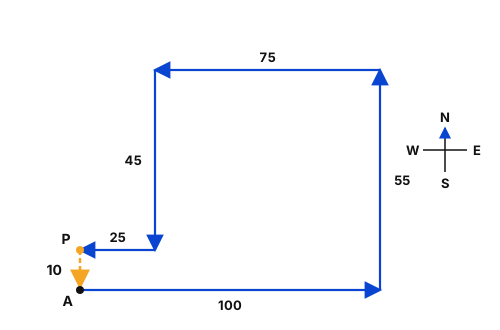
- East 100 ; left = North 55 .
- Left = West 75 ; left = South 45 .
- Right (facing South) = West 25 P .
- P is 10 km due North of A, so he must drive 10 km towards South.
Trick: Net East ; net North .
Answer: (D) 10 km towards South
अवधारणा: A को मूलबिंदु लें; पूर्व/उत्तर धनात्मक।
- पूर्व 100 ; बाएँ = उत्तर 55 ।
- बाएँ = पश्चिम 75 ; बाएँ = दक्षिण 45 ।
- दाएँ (दक्षिण की ओर मुख) = पश्चिम 25 P ।
- P, A से ठीक 10 km उत्तर में है, अतः उसे 10 km दक्षिण की ओर जाना होगा।
ट्रिक: कुल पूर्व ; कुल उत्तर ।
उत्तर: (D) दक्षिण की ओर 10 km
RRB Technician Grade IIIGeneral Intelligence and ReasoningDirection SenseRRB Technician Grade III 2024 · 23 Dec Shift 1
Q725.Based on the English alphabetical order, three of the following four letter-clusters are alike in a certain way and thus form a group. Which letter-cluster does not belong to that group?
(Note: The odd one out is not based on the number of consonants/vowels or their position in the letter-cluster.)
अंग्रेजी वर्णमाला क्रम के आधार पर, निम्नलिखित चार अक्षर-समूहों में से तीन किसी निश्चित प्रकार से एकसमान हैं और इस प्रकार एक समूह बनाते हैं। कौन-सा अक्षर-समूह उस समूह से संबंधित नहीं है?
(नोट: असंगत अक्षर-समूह, उस अक्षर-समूह में व्यंजनों/स्वरों की संख्या या उनके स्थान पर आधारित नहीं है।)
- AAGM
- BDJP
- CMUI
- DSYE
Show answer
Concept: Check the gap between consecutive letters (cycle back after Z).
- AGM: AGM. DJP: DJP.
- SYE: SYE (Y, Z, A, B, C, D, E).
- MUI: MU, UI — pattern breaks.
Trick: Three clusters follow the same rule; spot the one that doesn't.
Answer: (C) MUI
अवधारणा: क्रमागत अक्षरों का अंतर देखें (Z के बाद फिर A)।
- AGM: AGM। DJP: DJP।
- SYE: SYE (Y, Z, A, B, C, D, E)।
- MUI: MU, UI — नियम टूटता है।
ट्रिक: तीन समूह नियम मानते हैं; जो नहीं मानता वही उत्तर।
उत्तर: (C) MUI
RRB Technician Grade IIIGeneral Intelligence and ReasoningOdd One Out (Letter Clusters)RRB Technician Grade III 2024 · 23 Dec Shift 1
Q726.Read the given statements and conclusions carefully. You have to take the given statements to be true even if they seem to be at variance from commonly known facts and decide which conclusion(s) logically follow(s) from the given statements.
Statements:
Some files are photos.
All photos are pictures.
Conclusions:
(I) No pictures are files.
(II) Some pictures are files.
कथन और निष्कर्ष ध्यानपूर्वक पढ़ें। आपको दिए गए कथनों को सत्य मानना है, भले ही वे सामान्यतः ज्ञात तथ्यों से भिन्न प्रतीत होते हों, और निर्णय लेना है कि कौन-सा/से निष्कर्ष दिए गए कथनों का तार्किक रूप से अनुसरण करता है/करते हैं।
कथन:
कुछ फाइलें, फोटो हैं।
सभी फोटो, चित्र हैं।
निष्कर्ष:
(I) कोई भी चित्र, फाइल नहीं है।
(II) कुछ चित्र, फाइलें हैं।
- AOnly conclusion (II) followsकेवल निष्कर्ष (II) अनुसरण करता है
- BOnly conclusion (I) followsकेवल निष्कर्ष (I) अनुसरण करता है
- CBoth conclusions (I) and (II) followदोनों निष्कर्ष (I) और (II) अनुसरण करते हैं
- DNeither conclusion (I) nor (II) followsन तो निष्कर्ष (I) और न ही (II) अनुसरण करता है
Show answer
Concept: Draw the least-overlap Venn diagram that satisfies both statements.
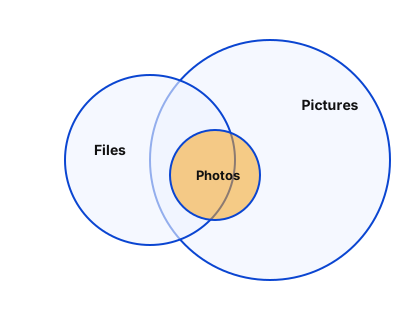
- Some files are photos and all photos lie inside pictures.
- So the files that are photos are also pictures Some pictures are files: II follows.
- Since some pictures are definitely files, 'No pictures are files' (I) is false.
Trick: Some A are B + All B are C Some A are C (and Some C are A).
Answer: (A) Only conclusion (II) follows
अवधारणा: दोनों कथनों को संतुष्ट करने वाला न्यूनतम आरेख बनाएँ।
- कुछ फाइलें फोटो हैं और सभी फोटो चित्रों के अंदर हैं।
- अतः जो फाइलें फोटो हैं वे चित्र भी हैं कुछ चित्र फाइलें हैं: II अनुसरण करता है।
- चूँकि कुछ चित्र निश्चित रूप से फाइलें हैं, 'कोई चित्र फाइल नहीं' (I) गलत है।
ट्रिक: कुछ A, B हैं + सभी B, C हैं कुछ A, C हैं (और कुछ C, A हैं)।
उत्तर: (A) केवल निष्कर्ष (II) अनुसरण करता है
RRB Technician Grade IIIGeneral Intelligence and ReasoningSyllogismRRB Technician Grade III 2024 · 23 Dec Shift 1
Q727.D, E, F, G, L, M and N are sitting around a circular table facing the centre. Only one person sits between L and E when counted from the left of E. G sits third to the right of N. M sits third to the left of F. G sits to the immediate right of M. D is not an immediate neighbour of M. How many people sit between D and E when counted from the right of D?
D, E, F, G, L, M और N एक वृत्ताकार मेज के चारों ओर केंद्र की ओर मुख करके बैठे हैं। E के बाएँ से गिनने पर L और E के बीच केवल एक व्यक्ति बैठा है। G, N के दाएँ से तीसरे स्थान पर बैठा है। M, F के बाएँ से तीसरे स्थान पर बैठा है। G, M के ठीक दाएँ बैठा है। D, M का निकटतम पड़ोसी नहीं है। D के दाएँ से गिनने पर D और E के बीच कितने व्यक्ति बैठे हैं?
- AFourचार
- BTwoदो
- CThreeतीन
- DOneएक
Show answer
Concept: Facing the centre: left = clockwise, right = anticlockwise.
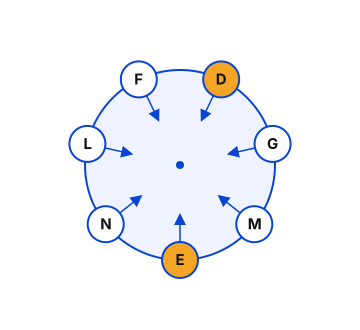
- M is third to the left of F and G is immediately right of M: F, _, G, M (clockwise).
- G is third to the right of N N is two seats clockwise from M, with E between them.
- L is second to the left of E L sits next to N; D (not next to M) takes the seat between F and G.
- Clockwise: E, N, L, F, D, G, M. From D going right: F, L, N, then E 3 people.
Trick: Start from the chain with most links (F–M–G–N), then fill the remaining seats.
Answer: (C) Three
अवधारणा: केंद्र की ओर मुख: बायाँ = दक्षिणावर्त, दायाँ = वामावर्त।
- M, F के बाएँ तीसरा है और G, M के ठीक दाएँ: F, _, G, M (दक्षिणावर्त)।
- G, N के दाएँ तीसरा N, M से दो स्थान दक्षिणावर्त, बीच में E।
- L, E के बाएँ दूसरा L, N के बगल में; D (M का पड़ोसी नहीं) F और G के बीच।
- दक्षिणावर्त: E, N, L, F, D, G, M। D से दाएँ: F, L, N, फिर E 3 व्यक्ति।
ट्रिक: सबसे अधिक जुड़ी कड़ी (F–M–G–N) से शुरू करें, फिर बाकी स्थान भरें।
उत्तर: (C) तीन
RRB Technician Grade IIIGeneral Intelligence and ReasoningCircular Seating ArrangementRRB Technician Grade III 2024 · 23 Dec Shift 1
Q728.In a certain code language, ‘metro city transport’ is coded as ‘qi de pu’ and ‘train national transport’ is coded as ‘la qi ti’. What is the code for ‘transport’ in the given code language?
एक निश्चित कूट भाषा में, ‘metro city transport’ को ‘qi de pu’ के रूप में कूटबद्ध किया जाता है और ‘train national transport’ को ‘la qi ti’ के रूप में कूटबद्ध किया जाता है। दी गई कूट भाषा में ‘transport’ के लिए कूट क्या है?
- Apu
- Bde
- Cla
- Dqi
Show answer
Concept: A word common to two sentences has the code common to both.
- 'metro city transport' = qi de pu; 'train national transport' = la qi ti.
- Common word: transport; common code: qi.
Yaad rakhein: Codes need not be in the same order as the words; match only common words with common codes.
Answer: (D) qi
अवधारणा: दो वाक्यों में उभयनिष्ठ शब्द का कोड भी दोनों में उभयनिष्ठ होता है।
- 'metro city transport' = qi de pu; 'train national transport' = la qi ti।
- उभयनिष्ठ शब्द: transport; उभयनिष्ठ कोड: qi।
याद रखें: कोड शब्दों के क्रम में होना ज़रूरी नहीं; उभयनिष्ठ शब्द को उभयनिष्ठ कोड से मिलाएँ।
उत्तर: (D) qi
RRB Technician Grade IIIGeneral Intelligence and ReasoningCoding–Decoding (Word Codes)RRB Technician Grade III 2024 · 23 Dec Shift 1
Q729.In the following number-pairs, the second number is obtained by applying certain mathematical operations to the first number. Which numbers should replace X and Y so that the pattern followed by the two numbers on the left side of :: is the same as that on the right side of ::?
(NOTE: Operations should be performed on the whole numbers, without breaking down the numbers into its constituent digits. E.g. 13 - Operations on 13 such as adding/subtracting/multiplying etc. to 13 can be performed. Breaking down 13 into 1 and 3 and then performing mathematical operations on 1 and 3 is not allowed.)
X : 59 :: 20 : Y
निम्नलिखित संख्या-युग्मों में, पहली संख्या पर कुछ गणितीय संक्रियाएँ करके दूसरी संख्या प्राप्त की जाती है। X और Y के स्थान पर कौन-सी संख्याएँ आनी चाहिए ताकि :: के बाईं ओर की दोनों संख्याओं द्वारा अनुसरित पैटर्न वही हो जो :: के दाईं ओर की संख्याओं द्वारा अनुसरित है?
(नोट: संख्याओं को उनके घटक अंकों में विभाजित किए बिना, पूर्ण संख्याओं पर संक्रियाएँ की जानी चाहिए। उदाहरण के लिए 13 - 13 पर संक्रियाएँ जैसे 13 में जोड़ना/घटाना/गुणा करना आदि किया जा सकता है। 13 को 1 और 3 में विभाजित करना और फिर 1 और 3 पर गणितीय संक्रियाएँ करना वर्जित है।)
X : 59 :: 20 : Y
- AX = 15, Y = 80
- BX = 16, Y = 80
- CX = 16, Y = 79
- DX = 15, Y = 79
Show answer
Concept: Test each option: one rule must turn X into 59 and 20 into Y.
- Option (D): X = 15, Y = 79.
- ✓ and ✓.
- (C) fails: but .
Trick: Both outputs are one less than a multiple of 4 (, ), pointing to .
Answer: (D) X = 15, Y = 79
अवधारणा: हर विकल्प जाँचें: एक ही नियम X को 59 और 20 को Y में बदले।
- विकल्प (D): X = 15, Y = 79।
- ✓ तथा ✓।
- (C) विफल: पर ।
ट्रिक: दोनों परिणाम 4 के गुणज से 1 कम हैं (, ), अतः नियम ।
उत्तर: (D) X = 15, Y = 79
RRB Technician Grade IIIGeneral Intelligence and ReasoningNumber Analogy (Pairs)RRB Technician Grade III 2024 · 23 Dec Shift 1
Q730.In a certain code language,
'A + B' means ‘A is the sister of B’,
'A – B' means ‘A is the husband of B’,
'A x B' means ‘A is the mother of B’
and 'A ÷ B' means ‘A is the son of B’.
How is M related to P if ‘K ÷ L – M + N x O + P’?
एक निश्चित कूट भाषा में,
'A + B' का अर्थ है ‘A, B की बहन है’,
'A – B' का अर्थ है ‘A, B का पति है’,
'A x B' का अर्थ है ‘A, B की माँ है’
और 'A ÷ B' का अर्थ है ‘A, B का पुत्र है’।
यदि ‘K ÷ L – M + N x O + P’ है, तो M का P से क्या संबंध है?
- ASisterबहन
- BMotherमाँ
- CDaughterपुत्री
- DMother's sisterमाँ की बहन (मौसी)
Show answer
Concept: Decode each symbol and build the family tree step by step.
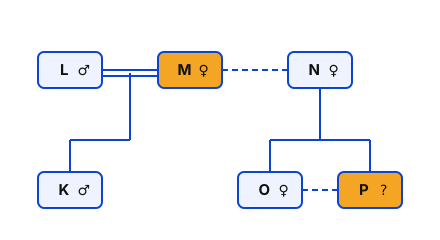
- K ÷ L: K is son of L. L – M: L is husband of M.
- M + N: M is sister of N. N × O: N is mother of O.
- O + P: O is sister of P, so N is also P's mother.
- M is the sister of P's mother M is P's mother's sister.
Yaad rakhein: Gender of P is not given, so choose the option that does not depend on it.
Answer: (D) Mother's sister
अवधारणा: हर चिह्न का अर्थ निकालकर क्रम से वंश-वृक्ष बनाएँ।
- K ÷ L: K, L का पुत्र है। L – M: L, M का पति है।
- M + N: M, N की बहन है। N × O: N, O की माँ है।
- O + P: O, P की बहन है, अतः N, P की भी माँ है।
- M, P की माँ की बहन है M, P की मौसी है।
याद रखें: P का लिंग नहीं दिया है, इसलिए वह विकल्प चुनें जो उस पर निर्भर न हो।
उत्तर: (D) माँ की बहन (मौसी)
RRB Technician Grade IIIGeneral Intelligence and ReasoningBlood Relation (Coded)RRB Technician Grade III 2024 · 23 Dec Shift 1
Q731.Read the given statements and conclusions carefully. You have to take the given statements to be true even if they seem to be at variance from commonly known facts and decide which conclusion(s) logically follow(s) from the given statements.
Statements:
All laptops are speakers.
All speakers are mics.
Conclusions:
(I) At least some speakers are laptops.
(II) All laptops are mics.
कथन और निष्कर्ष ध्यानपूर्वक पढ़ें। आपको दिए गए कथनों को सत्य मानना है, भले ही वे सामान्यतः ज्ञात तथ्यों से भिन्न प्रतीत होते हों, और निर्णय लेना है कि कौन-सा/से निष्कर्ष दिए गए कथनों का तार्किक रूप से अनुसरण करता है/करते हैं।
कथन:
सभी लैपटॉप, स्पीकर हैं।
सभी स्पीकर, माइक हैं।
निष्कर्ष:
(I) कम से कम कुछ स्पीकर, लैपटॉप हैं।
(II) सभी लैपटॉप, माइक हैं।
- ABoth conclusions I and II followदोनों निष्कर्ष I और II अनुसरण करते हैं
- BNeither conclusion I nor II followsन तो निष्कर्ष I और न ही II अनुसरण करता है
- COnly conclusion II followsकेवल निष्कर्ष II अनुसरण करता है
- DOnly conclusion I followsकेवल निष्कर्ष I अनुसरण करता है
Show answer
Concept: All A are B and All B are C give nested circles: Laptops Speakers Mics.
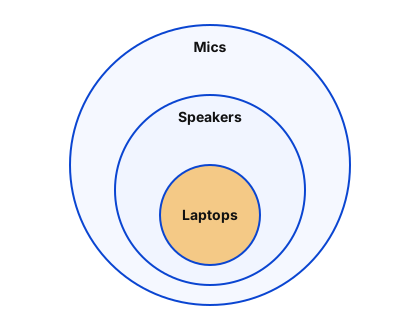
- All laptops are speakers at least some speakers are laptops: I follows.
- Laptops lie inside speakers, which lie inside mics all laptops are mics: II follows.
Trick: All A are B Some B are A (conversion); All A are B + All B are C All A are C.
Answer: (A) Both conclusions I and II follow
अवधारणा: सभी A, B हैं और सभी B, C हैं — एक-के-अंदर-एक वृत्त: लैपटॉप स्पीकर माइक।
- सभी लैपटॉप स्पीकर हैं कम से कम कुछ स्पीकर लैपटॉप हैं: I अनुसरण करता है।
- लैपटॉप स्पीकर के अंदर और स्पीकर माइक के अंदर सभी लैपटॉप माइक हैं: II अनुसरण करता है।
ट्रिक: सभी A, B हैं कुछ B, A हैं; सभी A, B + सभी B, C सभी A, C हैं।
उत्तर: (A) दोनों निष्कर्ष I और II अनुसरण करते हैं
RRB Technician Grade IIIGeneral Intelligence and ReasoningSyllogismRRB Technician Grade III 2024 · 23 Dec Shift 1
Q732.John, Kate, Lisa, Mary, Neil and Omar are sitting around a circular table facing the centre. John sits second to left of Kate. Lisa sits third to right of Kate. Mary sits to the immediate left of Lisa. Neil sits to the immediate right of Kate.
How many people Sit between Omar and Mary when counted from the right of Omar ?
John, Kate, Lisa, Mary, Neil और Omar एक वृत्ताकार मेज के चारों ओर केंद्र की ओर मुख करके बैठे हैं। John, Kate के बाएँ से दूसरे स्थान पर बैठा है। Lisa, Kate के दाएँ से तीसरे स्थान पर बैठी है। Mary, Lisa के ठीक बाएँ बैठी है। Neil, Kate के ठीक दाएँ बैठा है।
Omar के दाएँ से गिनने पर Omar और Mary के बीच कितने व्यक्ति बैठे हैं?
- AOneएक
- BThreeतीन
- CZeroशून्य
- DTwoदो
Show answer
Concept: Facing the centre, a person's left is clockwise and right is anticlockwise. Fix Kate and place the others.
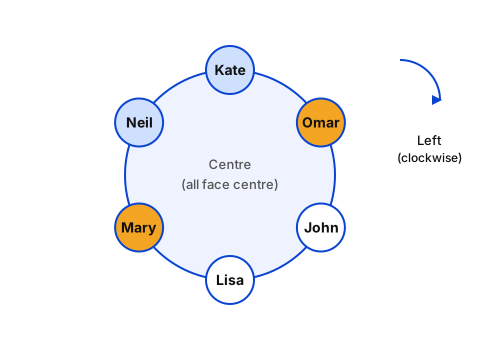
- Kate at the top; John is second to her left (clockwise), Neil is immediately to her right.
- Lisa is third to Kate's right, i.e. directly opposite; Mary is immediately to Lisa's left.
- The only empty seat (between Kate and John) goes to Omar.
- From Omar towards his right: Kate, Neil, then Mary → people between.
Trick: Facing centre: left = clockwise. In a 6-seat table, 'third to right/left' is always the opposite seat.
Answer: (D) Two
अवधारणा: केंद्र की ओर मुख होने पर व्यक्ति का बायाँ = दक्षिणावर्त, दायाँ = वामावर्त। केट को स्थिर करके बाकी बैठाएँ।
- केट ऊपर; जॉन उसके बाएँ से दूसरा (दक्षिणावर्त), नील तुरंत दाएँ।
- लिसा केट के दाएँ से तीसरी, यानी ठीक सामने; मैरी लिसा के तुरंत बाएँ।
- बची हुई सीट (केट और जॉन के बीच) ओमर की।
- ओमर के दाएँ से गिनें: केट, नील, फिर मैरी → बीच में लोग।
ट्रिक: केंद्र की ओर मुख: बायाँ = दक्षिणावर्त। 6 सीटों में 'तीसरा दाएँ/बाएँ' हमेशा ठीक सामने होता है।
उत्तर: (D) दो
RRB Technician Grade IIIGeneral Intelligence and ReasoningCircular Seating ArrangementRRB Technician Grade III 2024 · 20 Dec Shift 3
Q733.Read the given statements and conclusions carefully. You have to take the given statements to be true even if they seem to be at variance from commonly known facts and decide which conclusion(s) logically follow(s) from the given statements.
Statements:
All oranges are mangoes.
No mango is a banana.
Conclusions:
(I) No banana is a mango.
(II) All mangoes are oranges.
दिए गए कथनों और निष्कर्षों को ध्यानपूर्वक पढ़ें। आपको दिए गए कथनों को सत्य मानना है, भले ही वे सामान्यतः ज्ञात तथ्यों से भिन्न प्रतीत होते हों, और तय करें कि दिए गए कथनों से कौन-सा/से निष्कर्ष तार्किक रूप से अनुसरण करता/करते है/हैं।
कथन:
सभी संतरे, आम हैं।
कोई भी आम, केला नहीं है।
निष्कर्ष:
(I) कोई भी केला, आम नहीं है।
(II) सभी आम, संतरे हैं।
- ABoth conclusions I and II followनिष्कर्ष I और II दोनों अनुसरण करते हैं
- BOnly conclusion II followsकेवल निष्कर्ष II अनुसरण करता है
- COnly conclusion I followsकेवल निष्कर्ष I अनुसरण करता है
- DNeither conclusion I nor II followsन तो निष्कर्ष I और न ही II अनुसरण करता है
Show answer
Concept: Draw the Venn diagram: Oranges circle inside Mangoes; Bananas completely separate from Mangoes.
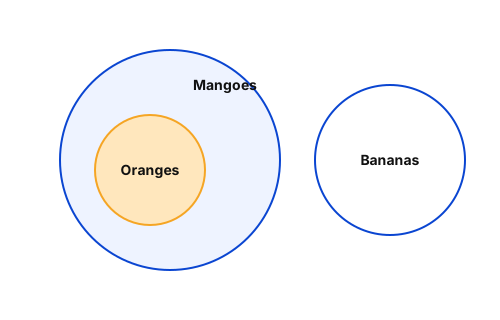
- I: 'No mango is a banana' ⇒ 'No banana is a mango' (an E-statement converts to itself) → follows.
- II: 'All oranges are mangoes' only means Oranges ⊂ Mangoes; mangoes outside oranges are possible → does not follow.
Yaad rakhein: 'All A are B' never gives 'All B are A' — it only gives 'Some B are A'. 'No A is B' = 'No B is A'.
Answer: (C) Only conclusion I follows
अवधारणा: वेन आरेख: संतरे का वृत्त आम के अंदर; केला आम से पूरी तरह अलग।
- I: 'कोई आम केला नहीं' ⇒ 'कोई केला आम नहीं' (E-कथन का विलोम वही रहता है) → अनुसरण करता है।
- II: 'सभी संतरे आम हैं' का अर्थ केवल संतरे ⊂ आम; संतरे के बाहर भी आम हो सकते हैं → अनुसरण नहीं करता।
याद रखें: 'सभी A, B हैं' से 'सभी B, A हैं' नहीं निकलता — केवल 'कुछ B, A हैं'। 'कोई A, B नहीं' = 'कोई B, A नहीं'।
उत्तर: (C) केवल निष्कर्ष I अनुसरण करता है
RRB Technician Grade IIIGeneral Intelligence and ReasoningSyllogismRRB Technician Grade III 2024 · 20 Dec Shift 3
Q734.P, Q, R, S, T, U, and V are sitting around a circular table facing the centre. Only 1 person sits between T and S when counted from the left of S. Only 2 people sit between V and R when counted from the right of R. T and Q are immediate neighbours of P. S sits immediately to the left of U. How many people sit between Q and R when counted from the left of Q?
P, Q, R, S, T, U और V एक वृत्ताकार मेज के चारों ओर केंद्र की ओर मुख करके बैठे हैं। S के बाएँ से गिनने पर T और S के बीच केवल 1 व्यक्ति बैठा है। R के दाएँ से गिनने पर V और R के बीच केवल 2 व्यक्ति बैठे हैं। T और Q, P के निकटतम पड़ोसी हैं। S, U के ठीक बाएँ बैठा है। Q के बाएँ से गिनने पर Q और R के बीच कितने व्यक्ति बैठे हैं?
- A2
- B3
- C1
- D4
Show answer
Concept: Facing the centre: left = clockwise, right = anticlockwise. Start with the S–U–T chain.
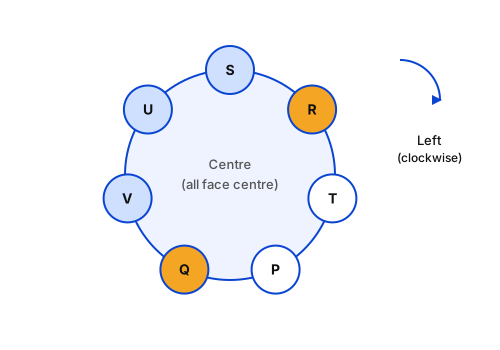
- S is immediately left of U; going left of S, one person is skipped and then T sits.
- P is a neighbour of T and of Q → P is next to T on the far side, then Q.
- Two seats remain between S and Q; R and V must have people between them counting from R's right → R next to S (left side), V next to Q.
- Order clockwise: S, R, T, P, Q, V, U. From Q to the left: V, U, S, then R → between.
Trick: Fix one person (S) and convert every 'left/right' into clockwise/anticlockwise before placing.
Answer: (B) 3
अवधारणा: केंद्र की ओर मुख: बायाँ = दक्षिणावर्त, दायाँ = वामावर्त। S–U–T से शुरू करें।
- S, U के तुरंत बाएँ; S के बाएँ से एक व्यक्ति छोड़कर T बैठा है।
- P, T और Q दोनों का पड़ोसी → T के दूसरी ओर P, फिर Q।
- S और Q के बीच दो सीटें बचीं; R के दाएँ से गिनने पर R और V के बीच लोग → R, S के पास और V, Q के पास।
- दक्षिणावर्त क्रम: S, R, T, P, Q, V, U. Q के बाएँ से: V, U, S फिर R → बीच में ।
ट्रिक: एक व्यक्ति (S) को स्थिर करें और हर 'बाएँ/दाएँ' को दक्षिणावर्त/वामावर्त में बदलकर बैठाएँ।
उत्तर: (B) 3
RRB Technician Grade IIIGeneral Intelligence and ReasoningCircular Seating ArrangementRRB Technician Grade III 2024 · 20 Dec Shift 3
Q735.NJQO is related to HDKI in a certain way based on the English alphabetical order. In the same way, SOVT is related to MIPN. To which of the following options is PLSQ related, following the same logic?
अंग्रेज़ी वर्णमाला क्रम के आधार पर NJQO एक निश्चित प्रकार से HDKI से संबंधित है। उसी प्रकार, SOVT, MIPN से संबंधित है। समान तर्क का अनुसरण करते हुए, PLSQ निम्नलिखित में से किस विकल्प से संबंधित है?
- AFJMK
- BJFKM
- CFJKM
- DJFMK
Show answer
Concept: Compare letter positions of NJQO and HDKI.
- N(14)→H(8), J(10)→D(4), Q(17)→K(11), O(15)→I(9): each .
- Check SOVT→MIPN: each ✓.
- PLSQ : P→J, L→F, S→M, Q→K = JFMK.
Trick: Same shift on all four letters — just move each letter back .
Answer: (D) JFMK
अवधारणा: NJQO और HDKI के अक्षरों की स्थितियाँ मिलाएँ।
- N(14)→H(8), J(10)→D(4), Q(17)→K(11), O(15)→I(9): प्रत्येक ।
- जाँच SOVT→MIPN: प्रत्येक ✓।
- PLSQ : P→J, L→F, S→M, Q→K = JFMK।
ट्रिक: चारों अक्षरों पर एक-सा खिसकाव — हर अक्षर पीछे।
उत्तर: (D) JFMK
RRB Technician Grade IIIGeneral Intelligence and ReasoningLetter AnalogyRRB Technician Grade III 2024 · 20 Dec Shift 3
Q736.Prakash starts from Point A and drives 30 km towards East. He then takes a right turn, drives 18 km, turns right and drives 17 km. He then takes a right turn and drives 9 km. He takes a final left turn, drives 13 km and stops at Point P. How far (shortest distance) and towards which direction should he drive in order to reach Point A again?
(All turns are 90 degree turns only unless otherwise specified.)
प्रकाश बिंदु A से चलना शुरू करता है और पूर्व की ओर 30 km गाड़ी चलाता है। फिर वह दाएँ मुड़ता है, 18 km गाड़ी चलाता है, दाएँ मुड़ता है और 17 km गाड़ी चलाता है। फिर वह दाएँ मुड़ता है और 9 km गाड़ी चलाता है। वह अंतिम बार बाएँ मुड़ता है, 13 km गाड़ी चलाता है और बिंदु P पर रुक जाता है। बिंदु A पर पुनः पहुँचने के लिए उसे कितनी दूरी (न्यूनतम दूरी) और किस दिशा में गाड़ी चलानी चाहिए?
(जब तक अन्यथा निर्दिष्ट न हो, सभी मोड़ केवल 90 डिग्री के हैं।)
- A10 km towards Northउत्तर की ओर 10 km
- B9 km towards Northउत्तर की ओर 9 km
- C9 km towards Westपश्चिम की ओर 9 km
- D10 km towards Eastपूर्व की ओर 10 km
Show answer
Concept: Track the path with coordinates (East , North ), starting at A .
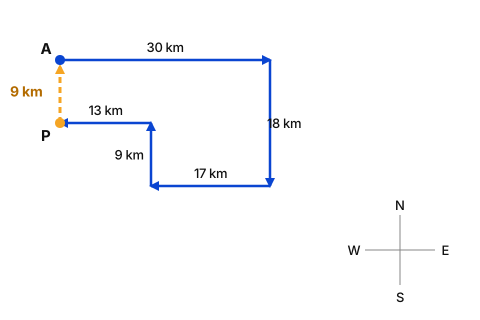
- km East → ; right = South → .
- Right = West → ; right = North → .
- Left = West → P .
- A is km straight North of P.
Trick: East–west: , North–south: → only a km gap, P is south of A.
Answer: (B) 9 km towards North
अवधारणा: निर्देशांक से पथ देखें (पूर्व , उत्तर ), A से शुरू।
- km पूर्व → ; दाएँ = दक्षिण → ।
- दाएँ = पश्चिम → ; दाएँ = उत्तर → ।
- बाएँ = पश्चिम → P ।
- A, P से ठीक km उत्तर में है।
ट्रिक: पूर्व–पश्चिम: , उत्तर–दक्षिण: → केवल km का अंतर, P, A के दक्षिण में।
उत्तर: (B) उत्तर की ओर 9 km
RRB Technician Grade IIIGeneral Intelligence and ReasoningDirection SenseRRB Technician Grade III 2024 · 20 Dec Shift 3
Q737.Select the triad which follows the same pattern as that followed by the two triads given below. Both triads follow the same pattern.
JE-KF-LM
NI-OJ-PQ
उस त्रिक का चयन करें जो नीचे दिए गए दो त्रिकों द्वारा अनुसरण किए गए पैटर्न का ही अनुसरण करता है। दोनों त्रिक एक ही पैटर्न का अनुसरण करते हैं।
JE-KF-LM
NI-OJ-PQ
- AOJ-PK-QS
- BQL-RM-SU
- CLG-MH-NO
- DPK-QL-RT
Show answer
Concept: Check the position gaps inside each triad.
- JE-KF-LM: J, E J; K, F (each ); L K, M L.
- NI-OJ-PQ follows the same: N, I; O, J; P, Q.
- LG-MH-NO: L, G L; M, H; N, O N ✓.
- Others fail in the last pair (QS, SU, RT jump by ).
Trick: Look at the 3rd pair first — its two letters must be consecutive.
Answer: (C) LG-MH-NO
अवधारणा: प्रत्येक त्रिक में अक्षरों का अंतर देखें।
- JE-KF-LM: J, E J; K, F (दोनों ); L K, M L।
- NI-OJ-PQ भी यही: N, I; O, J; P, Q।
- LG-MH-NO: L, G L; M, H; N, O N ✓।
- अन्य विकल्पों के अंतिम युग्म (QS, SU, RT) में का अंतर है।
ट्रिक: पहले तीसरा युग्म देखें — उसके दोनों अक्षर क्रमागत होने चाहिए।
उत्तर: (C) LG-MH-NO
RRB Technician Grade IIIGeneral Intelligence and ReasoningLetter TriadsRRB Technician Grade III 2024 · 20 Dec Shift 3
Q738.Seven boxes A, B, C, L, X, Y and Z are kept one over the other but not necessarily in the same order. Only three boxes are kept below L. Only two boxes are kept between L and Z. Only A is kept above B. X is kept at some place below Y and at some place above C.
Which box is kept at second position from the bottom?
सात बक्से A, B, C, L, X, Y और Z एक के ऊपर एक रखे गए हैं, लेकिन जरूरी नहीं कि इसी क्रम में हों। L के नीचे केवल तीन बक्से रखे गए हैं। L और Z के बीच केवल दो बक्से रखे गए हैं। केवल A, B के ऊपर रखा गया है। X, Y के नीचे किसी स्थान पर और C के ऊपर किसी स्थान पर रखा गया है।
नीचे से दूसरे स्थान पर कौन-सा बक्सा रखा गया है?
- AY
- BX
- CA
- DC
Show answer
Concept: Number the positions 1 (bottom) to 7 (top) and place the boxes with fixed positions first.
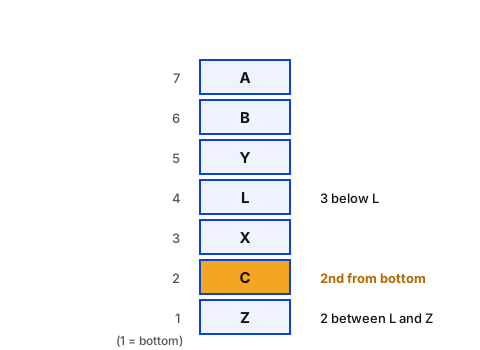
- Only three boxes below L → L is at position .
- Only A is above B → B is at and A at (the top).
- Two boxes between L and Z → Z is at or ; position is A, so Z is at (the bottom).
- Remaining positions for Y, X, C with Y above X above C → C , X , Y .
- Order from bottom: Z, C, X, L, Y, B, A. Second from the bottom = C.
Trick: Fill 'only below/above' clues first — they fix exact positions.
Answer: (D) C
अवधारणा: स्थान 1 (नीचे) से 7 (ऊपर) लें और पहले निश्चित स्थान वाले बक्से रखें।
- L के नीचे केवल तीन बक्से → L स्थान पर।
- B के ऊपर केवल A → B स्थान पर और A स्थान (सबसे ऊपर) पर।
- L और Z के बीच दो बक्से → Z स्थान या पर; स्थान पर A है, अतः Z स्थान (सबसे नीचे) पर।
- शेष स्थान में Y, X के ऊपर और X, C के ऊपर → C , X , Y ।
- नीचे से क्रम: Z, C, X, L, Y, B, A। नीचे से दूसरा = C।
ट्रिक: 'केवल नीचे/ऊपर' वाले संकेत पहले भरें — वे सटीक स्थान तय करते हैं।
उत्तर: (D) C
RRB Technician Grade IIIGeneral Intelligence and ReasoningBox Arrangement (Vertical)RRB Technician Grade III 2024 · 20 Dec Shift 3
Q739.In a certain code language, 'gentle breeze rustles' is coded as 'jb eg lz', and 'breeze rustles softly' is coded as 'lz cw eg'. What is the code for 'softly' in the given code language?
एक निश्चित कूट भाषा में, 'gentle breeze rustles' को 'jb eg lz' के रूप में कूटबद्ध किया जाता है, और 'breeze rustles softly' को 'lz cw eg' के रूप में कूटबद्ध किया जाता है। दी गई कूट भाषा में 'softly' का कूट क्या है?
- Acw
- Beg
- Clz
- Djb
Show answer
Concept: Words common to two sentences share the common codes.
- 'breeze rustles' is common → codes 'eg lz'.
- Sentence 2 left with 'softly' and code 'cw'.
- So softly = cw.
Trick: Remove common words and common codes; what remains pairs up.
Answer: (A) cw
अवधारणा: दोनों वाक्यों में समान शब्दों के कोड भी समान होते हैं।
- 'breeze rustles' दोनों में → कोड 'eg lz'।
- वाक्य 2 में बचा 'softly' और कोड 'cw'।
- अतः softly = cw।
ट्रिक: समान शब्द और समान कोड हटाइए; जो बचे उनका मिलान करें।
उत्तर: (A) cw
RRB Technician Grade IIIGeneral Intelligence and ReasoningCoding–DecodingRRB Technician Grade III 2024 · 20 Dec Shift 3
Q740.Refer to the given series and answer the question that follows (all numbers are single-digit numbers only).
(Left) 1 4 3 0 2 2 4 6 3 7 2 4 8 4 0 3 3 4 2 4 0 7 0 0 4 9 2 9 9 0 (Right)
What is the sum of the digit from the left and the digit from the right?
दी गई श्रृंखला को देखें और उसके बाद दिए गए प्रश्न का उत्तर दें (सभी संख्याएँ केवल एक-अंकीय संख्याएँ हैं)।
(बाएँ) 1 4 3 0 2 2 4 6 3 7 2 4 8 4 0 3 3 4 2 4 0 7 0 0 4 9 2 9 9 0 (दाएँ)
बाएँ से (पहले) अंक और दाएँ से (बारहवें) अंक का योग क्या है?
- A0
- B5
- C4
- D3
Show answer
Concept: In a series of terms, from right from left.
- There are digits; 1st from left .
- 12th from right from left .
- Sum .
Trick: Count backwards from the right end directly: … → the is .
Answer: (D) 3
अवधारणा: पदों की श्रृंखला में दाएँ से वाँ बाएँ से वाँ।
- कुल अंक; बाएँ से पहला ।
- दाएँ से 12वाँ वाँ बाएँ से ।
- योग ।
ट्रिक: दाएँ छोर से सीधे गिनें: … → वाँ है।
उत्तर: (D) 3
RRB Technician Grade IIIGeneral Intelligence and ReasoningNumber Series – PositionRRB Technician Grade III 2024 · 20 Dec Shift 3

