Q721.Which of the following is NOT an example of a homogeneous mixture?
निम्नलिखित में से कौन-सा समांगी मिश्रण का उदाहरण नहीं है?
- AOrange juice with pulpगूदे सहित संतरे का रस
- BSugar solutionचीनी का विलयन
- CVinegarसिरका
- DPure Airशुद्ध वायु
Show answer
Concept: A homogeneous mixture has the same composition throughout; no separate parts are visible.
- Sugar solution, vinegar (acetic acid in water) and air are uniform → homogeneous.
- Orange juice with pulp contains visible pulp pieces that settle → heterogeneous.
- So it is NOT a homogeneous mixture.
Trick: If you can see bits/pulp/layers, it is heterogeneous.
Answer: (A) Orange juice with pulp
अवधारणा: समांगी मिश्रण का संघटन सर्वत्र एकसमान होता है; अलग भाग दिखाई नहीं देते।
- चीनी का घोल, सिरका (पानी में एसिटिक अम्ल) और वायु एकसमान हैं → समांगी।
- गूदे वाले संतरे के रस में गूदे के टुकड़े दिखते हैं और नीचे बैठते हैं → विषमांगी।
- अतः यह समांगी मिश्रण नहीं है।
ट्रिक: यदि टुकड़े/गूदा/परतें दिखें तो मिश्रण विषमांगी है।
उत्तर: (A) गूदे सहित संतरे का रस
RRB Technician Grade IIIGeneral ScienceHomogeneous mixturesRRB Technician Grade III 2024 · 28 Dec Shift 1
Q722.What is the cause of the apparent elevation of a star's position when viewed near the horizon?
क्षितिज के निकट देखने पर किसी तारे की स्थिति के आभासी रूप से ऊपर उठे होने का कारण क्या है?
- AAtmospheric absorption of starlightतारे के प्रकाश का वायुमंडलीय अवशोषण
- BReflection of starlight away from the normalतारे के प्रकाश का अभिलंब से दूर परावर्तन
- CAtmospheric refraction of starlight towards the normalतारे के प्रकाश का अभिलंब की ओर वायुमंडलीय अपवर्तन
- DThe gravitational force of Earth on starlightतारे के प्रकाश पर पृथ्वी का गुरुत्वाकर्षण बल
Show answer
Concept: Air density increases towards the Earth, so starlight entering the atmosphere travels from rarer to denser layers.
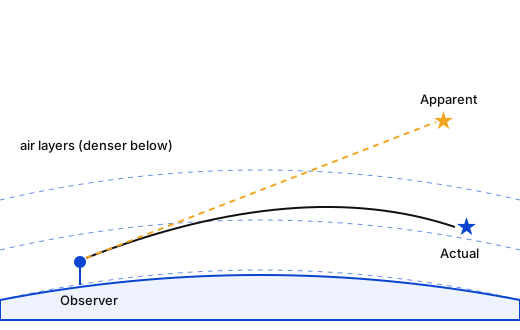
- At each layer, light bends towards the normal (atmospheric refraction).
- The ray reaches the eye along a curved path.
- The eye traces it back in a straight line, so the star appears higher than its actual position – especially near the horizon.
Yaad rakhein: Same reason: twinkling of stars, sunrise 2 min early and sunset 2 min late.
Answer: (C) Atmospheric refraction of starlight towards the normal
अवधारणा: पृथ्वी की ओर वायु का घनत्व बढ़ता है, इसलिए तारे का प्रकाश वायुमंडल में विरल से सघन परतों की ओर जाता है।
- हर परत पर प्रकाश अभिलंब की ओर मुड़ता है (वायुमंडलीय अपवर्तन)।
- किरण वक्र मार्ग से आँख तक पहुँचती है।
- आँख उसे सीधी रेखा में पीछे ले जाकर देखती है, इसलिए तारा वास्तविक स्थिति से ऊँचा दिखता है – विशेषकर क्षितिज के पास।
याद रखें: इसी कारण: तारों का टिमटिमाना, सूर्योदय 2 मिनट पहले और सूर्यास्त 2 मिनट बाद।
उत्तर: (C) तारे के प्रकाश का अभिलंब की ओर वायुमंडलीय अपवर्तन
RRB Technician Grade IIIGeneral ScienceApparent position of starsRRB Technician Grade III 2024 · 28 Dec Shift 1
Q723.Which products are formed in the chlor-alkali process when electricity is passed through an aqueous sodium chloride solution?
क्लोर-क्षार प्रक्रम (chlor-alkali process) में जब सोडियम क्लोराइड के जलीय विलयन से विद्युत प्रवाहित की जाती है, तो कौन-से उत्पाद बनते हैं?
- A
- B
- C
- D
Show answer
Concept: Electrolysis of brine (aqueous NaCl) is called the chlor-alkali process because it gives chlorine and an alkali (NaOH).
- Equation: .
- gas is released at the anode.
- gas is released at the cathode; NaOH solution forms near the cathode.
Yaad rakhein: "Chlor" = , "alkali" = NaOH, plus as a by-product – three products.
Answer: (B)
अवधारणा: नमक के जलीय विलयन (ब्राइन) का विद्युत अपघटन क्लोर-क्षार प्रक्रिया कहलाता है, क्योंकि इससे क्लोरीन और क्षार (NaOH) बनते हैं।
- समीकरण: ।
- एनोड पर गैस निकलती है।
- कैथोड पर गैस निकलती है और कैथोड के पास NaOH विलयन बनता है।
याद रखें: "क्लोर" = , "क्षार" = NaOH, साथ में – कुल तीन उत्पाद।
उत्तर: (B)
RRB Technician Grade IIIGeneral ScienceChlor-alkali processRRB Technician Grade III 2024 · 27 Dec Shift 3
Q724.Select the INCORRECT pair.
गलत युग्म का चयन कीजिए।
- APlastic glass – non-biodegradableप्लास्टिक गिलास – जैव-अनिम्नीकरणीय (non-biodegradable)
- BVegetable – biodegradableसब्जी – जैव-निम्नीकरणीय (biodegradable)
- CPaper cup – biodegradableकागज़ का कप – जैव-निम्नीकरणीय
- DKulhad – non-biodegradableकुल्हड़ – जैव-अनिम्नीकरणीय
Show answer
Concept: Biodegradable materials are broken down by microbes (bacteria, fungi); non-biodegradable ones (plastic, glass, metals) are not.
- Plastic glass – non-biodegradable: correct.
- Vegetable peels – biodegradable: correct.
- Paper cup – made of paper (cellulose), biodegradable: correct.
- Kulhad – baked clay cup; it breaks down and mixes back into the soil, so it is eco-friendly/biodegradable. Calling it non-biodegradable is wrong.
Yaad rakhein: Kulhads replaced plastic cups on railways precisely because they are eco-friendly and return to soil.
Answer: (D) Kulhad – non-biodegradable
अवधारणा: जैव-निम्नीकरणीय पदार्थ सूक्ष्मजीवों (बैक्टीरिया, कवक) द्वारा अपघटित हो जाते हैं; अजैव-निम्नीकरणीय (प्लास्टिक, काँच, धातु) नहीं होते।
- प्लास्टिक गिलास – अजैव-निम्नीकरणीय: सही।
- सब्ज़ी के छिलके – जैव-निम्नीकरणीय: सही।
- कागज़ का कप – सेलुलोज़ से बना, जैव-निम्नीकरणीय: सही।
- कुल्हड़ – पकी मिट्टी का कप, जो टूटकर फिर मिट्टी में मिल जाता है, अतः पर्यावरण-अनुकूल है। इसे अजैव-निम्नीकरणीय कहना गलत है।
याद रखें: रेलवे में प्लास्टिक कप की जगह कुल्हड़ इसलिए लाए गए क्योंकि वे मिट्टी में मिल जाते हैं।
उत्तर: (D) कुल्हड़ – जैव-अनिम्नीकरणीय
RRB Technician Grade IIIGeneral ScienceBiodegradable substancesRRB Technician Grade III 2024 · 27 Dec Shift 3
Q725.A combination of two lenses of power +2.0 D and −0.25 D is equivalent to a single lens of power:
+2.0 D और −0.25 D क्षमता वाले दो लेंसों का संयोजन किस क्षमता के एकल लेंस के तुल्य है?
- A+2.25 D
- B+1.75 D
- C+1.25 D
- D−3.5 D
Show answer
Concept: For lenses in contact, the net power is the algebraic sum of the individual powers: .
- , .
- .
- Positive sign → the combination acts as a converging lens.
Trick: Just add with signs – convex (+) and concave (−) partly cancel each other.
Answer: (B) +1.75 D
अवधारणा: संपर्क में रखे लेंसों की कुल क्षमता उनकी क्षमताओं का बीजगणितीय योग होती है: ।
- , ।
- ।
- धनात्मक चिह्न → संयोजन अभिसारी लेंस की तरह कार्य करता है।
ट्रिक: चिह्न सहित सीधे जोड़ दें – उत्तल (+) और अवतल (−) एक-दूसरे को आंशिक रूप से काटते हैं।
उत्तर: (B) +1.75 D
RRB Technician Grade IIIGeneral SciencePower of lens combinationRRB Technician Grade III 2024 · 27 Dec Shift 3
Q726.Which statement is NOT true for magnetic field lines?
चुंबकीय क्षेत्र रेखाओं के लिए कौन-सा कथन सत्य नहीं है?
- AThe relative strength of the magnetic field is shown by the degree of closeness of the field lines.चुंबकीय क्षेत्र की आपेक्षिक प्रबलता को क्षेत्र रेखाओं की निकटता की कोटि द्वारा दर्शाया जाता है।
- BNo two field lines are found to cross each other.कोई भी दो क्षेत्र रेखाएँ एक-दूसरे को प्रतिच्छेद करती हुई नहीं पाई जातीं।
- CMagnetic field lines are not closed curves.चुंबकीय क्षेत्र रेखाएँ बंद वक्र नहीं होतीं।
- DInside the magnet, the direction of field lines is from its south pole to its north pole.चुंबक के भीतर, क्षेत्र रेखाओं की दिशा उसके दक्षिणी ध्रुव से उत्तरी ध्रुव की ओर होती है।
Show answer
Concept: Magnetic field lines of a magnet are continuous closed curves.
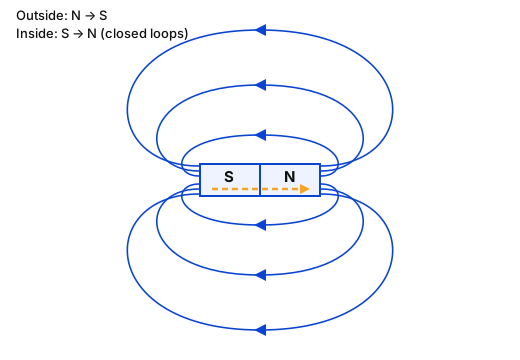
- Outside the magnet they go from N to S; inside, from S to N – so each line forms a closed loop. Hence (C) is NOT true.
- Closer lines mean stronger field – (A) true.
- Two lines never cross, otherwise the field would have two directions at one point – (B) true.
- Inside the magnet the direction is S → N – (D) true.
Yaad rakhein: Field lines never start or end – they always form closed loops.
Answer: (C) Magnetic field lines are not closed curves.
अवधारणा: चुंबक की चुंबकीय क्षेत्र रेखाएँ सतत बंद वक्र होती हैं।
- चुंबक के बाहर ये N से S तथा अंदर S से N जाती हैं – अतः प्रत्येक रेखा बंद लूप बनाती है। इसलिए (C) सत्य नहीं है।
- रेखाएँ जितनी पास, क्षेत्र उतना प्रबल – (A) सत्य।
- दो रेखाएँ कभी नहीं काटतीं, वरना एक बिंदु पर क्षेत्र की दो दिशाएँ होतीं – (B) सत्य।
- चुंबक के अंदर दिशा S → N – (D) सत्य।
याद रखें: क्षेत्र रेखाएँ न शुरू होती हैं न खत्म – हमेशा बंद लूप बनाती हैं।
उत्तर: (C) चुंबकीय क्षेत्र रेखाएँ बंद वक्र नहीं होतीं।
RRB Technician Grade IIIGeneral ScienceMagnetic field linesRRB Technician Grade III 2024 · 27 Dec Shift 3
Q727.A change of state directly from gas to solid without changing into liquid state is called:
द्रव अवस्था में परिवर्तित हुए बिना गैस से सीधे ठोस में अवस्था परिवर्तन को क्या कहा जाता है?
- Adepositionनिक्षेपण (deposition)
- Bfusionसंगलन (fusion)
- Csolidificationठोसीकरण (solidification)
- Dvaporisationवाष्पन (vaporisation)
Show answer
Concept: Gas → solid directly (skipping the liquid state) is deposition (desublimation); the reverse, solid → gas, is sublimation.
- Fusion = solid → liquid (melting).
- Solidification = liquid → solid.
- Vaporisation = liquid → gas.
- Gas → solid directly = deposition, e.g. frost forming from water vapour.
Yaad rakhein: Sublimation and deposition are opposite pairs that skip the liquid state.
Answer: (A) deposition
अवधारणा: गैस का सीधे ठोस में बदलना (द्रव अवस्था छोड़कर) निक्षेपण (deposition) कहलाता है; इसका उल्टा, ठोस → गैस, ऊर्ध्वपातन है।
- संगलन (fusion) = ठोस → द्रव।
- ठोसीकरण = द्रव → ठोस।
- वाष्पन = द्रव → गैस।
- गैस → सीधे ठोस = निक्षेपण, जैसे जलवाष्प से पाला (frost) बनना।
याद रखें: ऊर्ध्वपातन और निक्षेपण उल्टे जोड़े हैं, दोनों में द्रव अवस्था नहीं आती।
उत्तर: (A) निक्षेपण (deposition)
RRB Technician Grade IIIGeneral ScienceChange of stateRRB Technician Grade III 2024 · 27 Dec Shift 3
Q728.Vacuoles are present mainly of large size in ______.
रिक्तिकाएँ (vacuoles) मुख्य रूप से बड़े आकार की ______ में उपस्थित होती हैं।
- Aboth plant cells and animal cellsपादप कोशिकाओं और जंतु कोशिकाओं दोनों
- Bplant cellsपादप कोशिकाओं
- Canimal cellsजंतु कोशिकाओं
- Dbacteriaजीवाणुओं
Show answer
Concept: Vacuoles are storage sacs filled with cell sap. Plant cells have one very large central vacuole; animal cells have small ones or none.
- A mature plant cell vacuole can occupy 50–90% of the cell volume.
- It stores water, salts, sugars and wastes and keeps the cell turgid.
- Animal cells have only small, temporary vacuoles.
Yaad rakhein: Large central vacuole + cell wall + chloroplast → plant cell.
Answer: (B) plant cells
अवधारणा: रिक्तिकाएँ कोशिका रस से भरी भंडारण थैलियाँ हैं। पादप कोशिका में एक बहुत बड़ी केंद्रीय रिक्तिका होती है; जंतु कोशिका में छोटी या नहीं होतीं।
- परिपक्व पादप कोशिका में रिक्तिका कोशिका के 50–90% आयतन तक घेर सकती है।
- यह जल, लवण, शर्करा और अपशिष्ट संग्रहित करती है तथा कोशिका को स्फीत रखती है।
- जंतु कोशिकाओं में केवल छोटी, अस्थायी रिक्तिकाएँ होती हैं।
याद रखें: बड़ी केंद्रीय रिक्तिका + कोशिका भित्ति + हरितलवक → पादप कोशिका।
उत्तर: (B) पादप कोशिकाओं
RRB Technician Grade IIIGeneral ScienceVacuolesRRB Technician Grade III 2024 · 27 Dec Shift 3
Q729.Which of the following metals does NOT react with cold water?
निम्नलिखित में से कौन-सी धातु ठंडे जल के साथ अभिक्रिया नहीं करती है?
- AMagnesiumमैग्नीशियम
- BSodiumसोडियम
- CCalciumकैल्शियम
- DPotassiumपोटैशियम
Show answer
Concept: Reactivity series: K > Na > Ca > Mg > Al > Zn > Fe … Very reactive metals react even with cold water.
- K and Na react violently with cold water: .
- Ca reacts with cold water less violently (the bubbles make it float).
- Mg does not react with cold water; it reacts with hot water and with steam to form MgO and .
Yaad rakhein: K, Na, Ca – cold water; Mg – hot water; Al, Zn, Fe – only steam.
Answer: (A) Magnesium
अवधारणा: सक्रियता श्रेणी: K > Na > Ca > Mg > Al > Zn > Fe … अत्यधिक सक्रिय धातुएँ ठंडे जल से भी अभिक्रिया करती हैं।
- K और Na ठंडे जल से तीव्र अभिक्रिया करते हैं: ।
- Ca ठंडे जल से कम तीव्रता से अभिक्रिया करता है ( के बुलबुलों से तैरने लगता है)।
- Mg ठंडे जल से अभिक्रिया नहीं करता; गर्म जल और भाप से MgO तथा बनाता है।
याद रखें: K, Na, Ca – ठंडा जल; Mg – गर्म जल; Al, Zn, Fe – केवल भाप।
उत्तर: (A) मैग्नीशियम
RRB Technician Grade IIIGeneral ScienceReaction of metals with waterRRB Technician Grade III 2024 · 27 Dec Shift 3
Q730.A worker lifts a rice bag of 10 kg from the ground and puts it on the truck 2 m above the ground. Calculate the work done by him on the rice bag. (Given, g = )
एक श्रमिक 10 kg के चावल के बोरे को जमीन से उठाकर जमीन से 2 m ऊपर ट्रक पर रखता है। उसके द्वारा चावल के बोरे पर किए गए कार्य की गणना कीजिए। (दिया है, g = )
- A100 J
- B59 J
- C200 J
- D153 J
Show answer
Concept: Work done in lifting a body = gain in potential energy: .
- , , .
- .
Trick: Lifting work = weight × height: .
Answer: (C) 200 J
अवधारणा: किसी वस्तु को ऊपर उठाने में किया गया कार्य = स्थितिज ऊर्जा में वृद्धि: ।
- , , ।
- ।
ट्रिक: उठाने का कार्य = भार × ऊँचाई: ।
उत्तर: (C) 200 J
RRB Technician Grade IIIGeneral ScienceWork done against gravityRRB Technician Grade III 2024 · 27 Dec Shift 3
Q731.Select the correct option related to the function of auxin in plants.
पौधों में ऑक्सिन (auxin) के कार्य से संबंधित सही विकल्प का चयन कीजिए।
- AHelps the cells to grow longerकोशिकाओं को लंबा होने में सहायता करता है
- BInduce floweringपुष्पन को प्रेरित करना
- CIncreases stem widthतने की चौड़ाई बढ़ाता है
- DMake plants insect resistantपौधों को कीट प्रतिरोधी बनाना
Show answer
Concept: Auxin is a growth hormone made at shoot tips; it promotes cell elongation.
- Auxin makes cells grow longer – this causes bending of shoots towards light (phototropism).
- Inducing flowering is linked to florigen/gibberellins, not mainly auxin.
- Increase in stem girth is due to cytokinin-driven cell division / cambium activity, not auxin elongation.
Yaad rakhein: Auxin → elongation; gibberellin → stem growth; cytokinin → cell division; abscisic acid → inhibits growth.
Answer: (A) Helps the cells to grow longer
अवधारणा: ऑक्सिन तने के शीर्ष पर बनने वाला वृद्धि हार्मोन है; यह कोशिकाओं को लंबा करता है।
- ऑक्सिन कोशिकाओं को लंबा बढ़ाता है – इसी से तना प्रकाश की ओर मुड़ता है (प्रकाशानुवर्तन)।
- पुष्पन प्रेरित करना फ्लोरिजन/जिबरेलिन से जुड़ा है, मुख्यतः ऑक्सिन से नहीं।
- तने की मोटाई कोशिका विभाजन/कैंबियम सक्रियता से बढ़ती है, ऑक्सिन से नहीं।
याद रखें: ऑक्सिन → लंबाई; जिबरेलिन → तने की वृद्धि; साइटोकाइनिन → कोशिका विभाजन; एब्सिसिक अम्ल → वृद्धि रोकता है।
उत्तर: (A) कोशिकाओं को लंबा होने में सहायता करता है
RRB Technician Grade IIIGeneral SciencePlant hormones – auxinRRB Technician Grade III 2024 · 27 Dec Shift 3
Q732.Which of the following statements is/are correct regarding the atomic number of an element?
Statement I: The atomic number of an element represents the number of protons present in the nucleus of an atom.
Statement II: The atomic number of an element represents the number of neutrons present in the nucleus of an atom.
किसी तत्व के परमाणु क्रमांक के संबंध में निम्नलिखित में से कौन-सा/से कथन सही है/हैं?
कथन I: किसी तत्व का परमाणु क्रमांक, परमाणु के नाभिक में उपस्थित प्रोटॉनों की संख्या को दर्शाता है।
कथन II: किसी तत्व का परमाणु क्रमांक, परमाणु के नाभिक में उपस्थित न्यूट्रॉनों की संख्या को दर्शाता है।
- AOnly statement I is correct.केवल कथन I सही है।
- BOnly statement II is correct.केवल कथन II सही है।
- CBoth statements I and II are correct.कथन I और II दोनों सही हैं।
- DNeither statement I nor II is correct.न तो कथन I और न ही II सही है।
Show answer
Concept: Atomic number (Z) = number of protons in the nucleus (= electrons in a neutral atom).
- Statement I: Z = number of protons – correct.
- Statement II: neutrons are given by mass number − atomic number (), not by Z – incorrect.
Yaad rakhein: Z = protons; A = protons + neutrons; neutrons = .
Answer: (A) Only statement I is correct.
अवधारणा: परमाणु क्रमांक (Z) = नाभिक में प्रोटॉनों की संख्या (उदासीन परमाणु में इलेक्ट्रॉनों के बराबर)।
- कथन I: Z = प्रोटॉनों की संख्या – सही।
- कथन II: न्यूट्रॉन = द्रव्यमान संख्या − परमाणु क्रमांक (), Z नहीं – गलत।
याद रखें: Z = प्रोटॉन; A = प्रोटॉन + न्यूट्रॉन; न्यूट्रॉन = ।
उत्तर: (A) केवल कथन I सही है।
RRB Technician Grade IIIGeneral ScienceAtomic numberRRB Technician Grade III 2024 · 27 Dec Shift 3
Q733.Which of the following statements is correct about the ozone?
ओज़ोन के बारे में निम्नलिखित में से कौन-सा कथन सही है?
- AIt is formed by combining only two atoms of oxygen.यह ऑक्सीजन के केवल दो परमाणुओं के संयोजन से बनती है।
- BIt causes blood cancer.यह रक्त कैंसर का कारण बनती है।
- CDecrease in the amount of ozone in the atmosphere is due to chlorofluorocarbons (CFC).वायुमंडल में ओज़ोन की मात्रा में कमी क्लोरोफ्लोरोकार्बन (CFC) के कारण होती है।
- DIt is not poisonous.यह विषैली नहीं है।
Show answer
Concept: Ozone () has three oxygen atoms. It is poisonous at ground level, but in the stratosphere it shields us from UV rays.
- (A) wrong – ozone is , three atoms, not two.
- (B) wrong – UV radiation reaching Earth due to ozone loss causes skin cancer, not blood cancer from ozone.
- (D) wrong – ozone is a deadly poison.
- (C) correct – chlorofluorocarbons (CFCs) used in refrigerants and aerosols release chlorine that destroys ozone.
Yaad rakhein: CFC → ozone depletion (Montreal Protocol, 1987).
Answer: (C) Decrease in the amount of ozone in the atmosphere is due to chlorofluorocarbons (CFC).
अवधारणा: ओज़ोन () में तीन ऑक्सीजन परमाणु होते हैं। धरातल पर यह विषैली है, पर समताप मंडल में यह पराबैंगनी (UV) किरणों से हमारी रक्षा करती है।
- (A) गलत – ओज़ोन है, तीन परमाणु, दो नहीं।
- (B) गलत – ओज़ोन क्षय से पृथ्वी पर पहुँचने वाली UV किरणें त्वचा कैंसर करती हैं, ओज़ोन रक्त कैंसर नहीं।
- (D) गलत – ओज़ोन घातक विष है।
- (C) सही – रेफ्रिजरेंट व एरोसोल में प्रयुक्त क्लोरोफ्लोरोकार्बन (CFC) क्लोरीन मुक्त कर ओज़ोन नष्ट करते हैं।
याद रखें: CFC → ओज़ोन क्षय (मॉन्ट्रियल प्रोटोकॉल, 1987)।
उत्तर: (C) वायुमंडल में ओज़ोन की मात्रा में कमी क्लोरोफ्लोरोकार्बन (CFC) के कारण होती है।
RRB Technician Grade IIIGeneral ScienceOzone layerRRB Technician Grade III 2024 · 27 Dec Shift 3
Q734.Which of the following metals reacts with very dilute nitric acid to evolve hydrogen gas?
निम्नलिखित में से कौन-सी धातु अति तनु नाइट्रिक अम्ल के साथ अभिक्रिया करके हाइड्रोजन गैस मुक्त करती है?
- AZn
- BMn
- CFe
- DAl
Show answer
Concept: Nitric acid is a strong oxidising agent: it oxidises the formed to water and itself is reduced to oxides of nitrogen, so usually no is released.
- Exception: magnesium (Mg) and manganese (Mn) react with very dilute to give gas.
- .
- Zn, Fe and Al give nitrogen oxides instead.
Yaad rakhein: Only "M-M" – Mg and Mn – give with very dilute nitric acid.
Answer: (B) Mn
अवधारणा: नाइट्रिक अम्ल प्रबल ऑक्सीकारक है: यह बनने वाली को जल में ऑक्सीकृत कर देता है और स्वयं नाइट्रोजन के ऑक्साइडों में अपचयित हो जाता है, अतः सामान्यतः नहीं निकलती।
- अपवाद: मैग्नीशियम (Mg) और मैंगनीज़ (Mn) अति तनु से गैस देते हैं।
- ।
- Zn, Fe और Al इसके बजाय नाइट्रोजन के ऑक्साइड देते हैं।
याद रखें: केवल "M-M" – Mg और Mn – अति तनु नाइट्रिक अम्ल से देते हैं।
उत्तर: (B) Mn
RRB Technician Grade IIIGeneral ScienceMetals with nitric acidRRB Technician Grade III 2024 · 27 Dec Shift 3
Q735.Use of regenerative cells in the process of budding is present in:
मुकुलन (budding) की प्रक्रिया में पुनर्योजी कोशिकाओं (regenerative cells) का उपयोग किसमें होता है?
- ASpirogyraस्पाइरोगायरा
- BAmoebaअमीबा
- CHydraहाइड्रा
- DPlanariaप्लेनेरिया
Show answer
Concept: In Hydra, regenerative cells divide repeatedly at one site to form a bud, which grows into a new individual and detaches.
- Spirogyra – fragmentation.
- Amoeba – binary fission.
- Planaria – regeneration from body pieces.
- Hydra – budding using regenerative cells.
Yaad rakhein: Hydra and yeast → budding.
Answer: (C) Hydra
अवधारणा: हाइड्रा में पुनर्जनन कोशिकाएँ एक स्थान पर बार-बार विभाजित होकर मुकुल (bud) बनाती हैं, जो नया जीव बनकर अलग हो जाता है।
- स्पाइरोगायरा – खंडन।
- अमीबा – द्विविभाजन।
- प्लेनेरिया – शरीर के टुकड़ों से पुनर्जनन।
- हाइड्रा – पुनर्जनन कोशिकाओं द्वारा मुकुलन।
याद रखें: हाइड्रा और यीस्ट → मुकुलन।
उत्तर: (C) हाइड्रा
RRB Technician Grade IIIGeneral ScienceAsexual reproduction – buddingRRB Technician Grade III 2024 · 27 Dec Shift 3
Q736.A girl pushes a trolley with a constant force F through a distance s, the work done will be:
एक लड़की एक ट्रॉली को नियत बल F से दूरी s तक धकेलती है, किया गया कार्य होगा:
- A
- B
- C
- D
Show answer
Concept: Work done by a constant force along the direction of displacement = force × displacement.
- Force = F, displacement in the direction of force = s.
- (SI unit joule, ).
Yaad rakhein: Work needs both force and displacement – multiply them.
Answer: (D)
अवधारणा: नियत बल द्वारा विस्थापन की दिशा में किया गया कार्य = बल × विस्थापन।
- बल = F, बल की दिशा में विस्थापन = s।
- (SI मात्रक जूल, )।
याद रखें: कार्य के लिए बल और विस्थापन दोनों चाहिए – दोनों का गुणा करें।
उत्तर: (D)
RRB Technician Grade IIIGeneral ScienceWork doneRRB Technician Grade III 2024 · 27 Dec Shift 3
Q737.Which of the following processes involves the transfer of a source of energy (food) from outside the body of an organism to inside?
निम्नलिखित में से किस प्रक्रम में ऊर्जा के स्रोत (भोजन) का किसी जीव के शरीर के बाहर से अंदर की ओर स्थानांतरण होता है?
- ANutritionपोषण (Nutrition)
- BMetabolismउपापचय (Metabolism)
- CTransportationपरिवहन (Transportation)
- DTranslocationस्थानांतरण (Translocation)
Show answer
Concept: Nutrition is the process of taking in food (a source of energy and raw materials) from outside into the body of an organism.
- Metabolism = all chemical reactions inside the body.
- Transportation = moving substances within the body.
- Translocation = transport of food in plants through phloem.
- Taking food from outside to inside = nutrition.
Yaad rakhein: Outside → inside (food) = nutrition; inside → outside (waste) = excretion.
Answer: (A) Nutrition
अवधारणा: पोषण वह प्रक्रम है जिसमें ऊर्जा के स्रोत (भोजन) को बाहर से जीव के शरीर के अंदर लिया जाता है।
- उपापचय = शरीर में होने वाली सभी रासायनिक अभिक्रियाएँ।
- परिवहन = शरीर के भीतर पदार्थों का एक स्थान से दूसरे स्थान जाना।
- स्थानांतरण (translocation) = पौधों में फ्लोएम द्वारा भोजन का परिवहन।
- भोजन को बाहर से अंदर लेना = पोषण।
याद रखें: बाहर → अंदर (भोजन) = पोषण; अंदर → बाहर (अपशिष्ट) = उत्सर्जन।
उत्तर: (A) पोषण (Nutrition)
RRB Technician Grade IIIGeneral ScienceLife processes – nutritionRRB Technician Grade III 2024 · 27 Dec Shift 3
Q738.Which of the following is produced when zinc oxide reacts with carbon?
जब ज़िंक ऑक्साइड, कार्बन के साथ अभिक्रिया करता है, तो निम्नलिखित में से क्या उत्पन्न होता है?
- ABoth Zn and COZn और CO दोनों
- BOnly COकेवल CO
- COnly Znकेवल Zn
- DZn and Zn और
Show answer
Concept: Carbon is a reducing agent: it removes oxygen from zinc oxide (smelting).
- .
- ZnO is reduced to zinc metal; carbon is oxidised to carbon monoxide.
Yaad rakhein: Metal oxide + C → metal + CO (standard NCERT reaction for zinc).
Answer: (A) Both Zn and CO
अवधारणा: कार्बन अपचायक है: यह जिंक ऑक्साइड से ऑक्सीजन हटा देता है (प्रगलन)।
- ।
- ZnO अपचयित होकर जिंक धातु बनता है; कार्बन ऑक्सीकृत होकर कार्बन मोनोऑक्साइड बनता है।
याद रखें: धातु ऑक्साइड + C → धातु + CO (जिंक के लिए NCERT की मानक अभिक्रिया)।
उत्तर: (A) Zn और CO दोनों
RRB Technician Grade IIIGeneral ScienceReduction of metal oxideRRB Technician Grade III 2024 · 27 Dec Shift 3
Q739.The kind of energy possessed by a moving body by virtue of its motion is ______.
किसी गतिशील वस्तु में उसकी गति के कारण निहित ऊर्जा का प्रकार ______ है।
- Aelectromagnetic energyविद्युत-चुंबकीय ऊर्जा
- Bpotential energyस्थितिज ऊर्जा
- Ckinetic energyगतिज ऊर्जा
- Dnuclear energyनाभिकीय ऊर्जा
Show answer
Concept: Energy possessed by a body due to its motion is kinetic energy: .
- Potential energy is due to position or configuration.
- Nuclear energy comes from the nucleus; electromagnetic energy is carried by radiation.
- Energy due to motion = kinetic energy.
Yaad rakhein: "Kinetic" comes from the Greek word for motion.
Answer: (C) kinetic energy
अवधारणा: किसी वस्तु में उसकी गति के कारण निहित ऊर्जा गतिज ऊर्जा है: ।
- स्थितिज ऊर्जा स्थिति या आकृति के कारण होती है।
- नाभिकीय ऊर्जा नाभिक से और विद्युतचुंबकीय ऊर्जा विकिरण से जुड़ी है।
- गति के कारण ऊर्जा = गतिज ऊर्जा।
याद रखें: "काइनेटिक" का अर्थ ही गति है।
उत्तर: (C) गतिज ऊर्जा
RRB Technician Grade IIIGeneral ScienceKinetic energyRRB Technician Grade III 2024 · 27 Dec Shift 3
Q740.In the rear-view mirror of cars, people use which of the following?
कारों के पश्च-दृश्य दर्पण (rear-view mirror) में लोग निम्नलिखित में से किसका उपयोग करते हैं?
- APlano-convex lensसमतल-उत्तल लेंस (Plano-convex lens)
- BConcave mirrorअवतल दर्पण
- CBiconvex lensउभयोत्तल लेंस (Biconvex lens)
- DConvex mirrorउत्तल दर्पण
Show answer
Concept: A convex mirror always forms a virtual, erect and diminished image, and has a wide field of view.
- Because the image is erect and small, a large area of traffic behind fits in the mirror.
- Concave mirrors are used in shaving mirrors, torches and headlights.
- Lenses are not used as rear-view devices.
Yaad rakhein: Rear-view / street-corner mirrors → convex; headlights/dentist → concave.
Answer: (D) Convex mirror
अवधारणा: उत्तल दर्पण सदैव आभासी, सीधा और छोटा प्रतिबिंब बनाता है तथा इसका दृष्टि-क्षेत्र विस्तृत होता है।
- प्रतिबिंब सीधा और छोटा होने से पीछे का बड़ा क्षेत्र दर्पण में दिख जाता है।
- अवतल दर्पण शेविंग दर्पण, टॉर्च और हेडलाइट में प्रयुक्त होते हैं।
- लेंस पश्च-दृश्य के लिए प्रयोग नहीं होते।
याद रखें: पश्च-दृश्य / मोड़ वाले दर्पण → उत्तल; हेडलाइट/दंत चिकित्सक → अवतल।
उत्तर: (D) उत्तल दर्पण
RRB Technician Grade IIIGeneral ScienceUses of spherical mirrorsRRB Technician Grade III 2024 · 27 Dec Shift 3

