Q741.The weight of an object on the Moon is ______
चंद्रमा पर किसी वस्तु का भार ______ होता है।
- Agreater than the weight on the earthपृथ्वी पर भार से अधिक
- Bless than the weight on the earthपृथ्वी पर भार से कम
- Cequal to the weight on the earthपृथ्वी पर भार के बराबर
- Dmay be greater than or less than depending on the density of the objectवस्तु के घनत्व के आधार पर अधिक या कम हो सकता है
Show answer
Concept: Weight . Mass stays the same, but g on the Moon is about one-sixth of g on Earth.
- .
- So – less than on Earth.
- This does not depend on the object's density.
Yaad rakhein: Mass is constant everywhere; weight changes with g.
Answer: (B) less than the weight on the earth
अवधारणा: भार । द्रव्यमान वही रहता है, पर चंद्रमा पर g पृथ्वी के g का लगभग छठा भाग है।
- ।
- अतः – पृथ्वी से कम।
- यह वस्तु के घनत्व पर निर्भर नहीं करता।
याद रखें: द्रव्यमान हर जगह समान; भार g के साथ बदलता है।
उत्तर: (B) पृथ्वी पर भार से कम
RRB Technician Grade IIIGeneral ScienceWeight on the MoonRRB Technician Grade III 2024 · 27 Dec Shift 3
Q742.Which of the following compounds is used in a soda-acid fire extinguisher?
सोडा-अम्ल अग्निशामक में निम्नलिखित में से किस यौगिक का उपयोग किया जाता है?
- A
- B
- C
- D
Show answer
Concept: A soda-acid extinguisher contains sodium hydrogencarbonate (baking soda) solution and sulphuric acid, which react to give .
- .
- is heavier than air and cuts off oxygen supply to the fire.
Yaad rakhein: Soda-acid = (soda) + (acid).
Answer: (D)
अवधारणा: सोडा-अम्ल अग्निशामक में सोडियम हाइड्रोजनकार्बोनेट (बेकिंग सोडा) का विलयन और सल्फ्यूरिक अम्ल होता है, जो अभिक्रिया कर देते हैं।
- ।
- वायु से भारी है और आग की ऑक्सीजन आपूर्ति रोक देती है।
याद रखें: सोडा-अम्ल = (सोडा) + (अम्ल)।
उत्तर: (D)
RRB Technician Grade IIIGeneral ScienceSoda-acid fire extinguisherRRB Technician Grade III 2024 · 27 Dec Shift 3
Q743.Accumulation of which substance in our muscles during sudden activity causes cramps?
अचानक गतिविधि के दौरान हमारी पेशियों में किस पदार्थ का संचय ऐंठन (cramps) का कारण बनता है?
- AGlucoseग्लूकोज़
- BPyruvic acidपाइरुविक अम्ल
- CSucroseसुक्रोज़
- DLactic acidलैक्टिक अम्ल
Show answer
Concept: During sudden heavy exercise, oxygen falls short in muscle cells, so pyruvate is converted into lactic acid (anaerobic respiration).
- Glucose → pyruvate (in cytoplasm).
- Lack of oxygen: pyruvate → lactic acid + energy.
- Build-up of lactic acid in muscles causes cramps.
Yaad rakhein: Muscles (no ) → lactic acid; yeast (no ) → ethanol + .
Answer: (D) Lactic acid
अवधारणा: अचानक भारी व्यायाम में मांसपेशी कोशिकाओं में ऑक्सीजन कम पड़ जाती है, अतः पाइरुवेट लैक्टिक अम्ल में बदल जाता है (अवायवीय श्वसन)।
- ग्लूकोज़ → पाइरुवेट (कोशिकाद्रव्य में)।
- ऑक्सीजन की कमी: पाइरुवेट → लैक्टिक अम्ल + ऊर्जा।
- मांसपेशियों में लैक्टिक अम्ल जमा होने से ऐंठन (cramps) होती है।
याद रखें: मांसपेशी ( नहीं) → लैक्टिक अम्ल; यीस्ट ( नहीं) → एथेनॉल + ।
उत्तर: (D) लैक्टिक अम्ल
RRB Technician Grade IIIGeneral ScienceAnaerobic respiration in musclesRRB Technician Grade III 2024 · 27 Dec Shift 3
Q744.Which of the following is/are NOT a parasitic organism?
निम्नलिखित में से कौन-सा/से परजीवी जीव नहीं है/हैं?
- ATicksकिलनी (Ticks)
- BLiceजूँ (Lice)
- CAmoebaअमीबा
- DCuscutaअमरबेल (Cuscuta)
Show answer
Concept: Parasites obtain food from a living host and harm it.
- Ticks – blood-sucking parasites on animals.
- Lice – parasites living on human hair/skin.
- Cuscuta (amarbel) – parasitic plant that takes food from the host plant.
- Amoeba – free-living; it engulfs food particles (holozoic nutrition), so it is not a parasite.
Yaad rakhein: Amoeba = holozoic; Plasmodium/Entamoeba = parasites – do not confuse them.
Answer: (C) Amoeba
अवधारणा: परजीवी जीवित परपोषी से भोजन लेते हैं और उसे हानि पहुँचाते हैं।
- किलनी (ticks) – जानवरों का रक्त चूसने वाले परजीवी।
- जूँ (lice) – मनुष्य के बालों/त्वचा पर रहने वाले परजीवी।
- अमरबेल (Cuscuta) – परपोषी पौधे से भोजन लेने वाला परजीवी पौधा।
- अमीबा – स्वतंत्र रूप से रहता है और भोजन कणों को निगलता है (प्राणिसम पोषण), अतः परजीवी नहीं।
याद रखें: अमीबा = प्राणिसम पोषण; प्लाज़्मोडियम/एंटअमीबा = परजीवी – इन्हें न मिलाएँ।
उत्तर: (C) अमीबा
RRB Technician Grade IIIGeneral ScienceParasitic nutritionRRB Technician Grade III 2024 · 27 Dec Shift 3
Q745.What is the colour of the flame when magnesium burns in air?
जब मैग्नीशियम वायु में जलता है, तो ज्वाला का रंग क्या होता है?
- AWhiteसफेद
- BRedलाल
- CGreenहरा
- DPinkगुलाबी
Show answer
Concept: Magnesium ribbon burns in air with a dazzling white flame, forming white powder of magnesium oxide.
- .
- The light is so bright that it should not be looked at directly.
- MgO dissolves in water to give the base .
Yaad rakhein: Mg burns with a dazzling white light – used in fireworks and flares.
Answer: (A) White
अवधारणा: मैग्नीशियम रिबन वायु में चमकदार सफ़ेद ज्वाला के साथ जलता है और मैग्नीशियम ऑक्साइड का सफ़ेद चूर्ण बनता है।
- ।
- प्रकाश इतना तेज़ होता है कि इसे सीधे नहीं देखना चाहिए।
- MgO जल में घुलकर क्षार बनाता है।
याद रखें: Mg चमकदार सफ़ेद प्रकाश के साथ जलता है – आतिशबाज़ी व फ्लेयर में प्रयोग।
उत्तर: (A) सफेद
RRB Technician Grade IIIGeneral ScienceBurning of magnesiumRRB Technician Grade III 2024 · 27 Dec Shift 3
Q746.Which one of the following plant parts is NOT used for vegetative propagation?
निम्नलिखित में से कौन-सा पादप भाग कायिक प्रवर्धन (vegetative propagation) के लिए उपयोग नहीं किया जाता है?
- ALeavesपत्तियाँ
- BStemतना
- CSeedबीज
- DRootजड़
Show answer
Concept: Vegetative propagation produces new plants from vegetative parts – root, stem or leaf – without seeds.
- Leaves – Bryophyllum (buds on leaf margins).
- Stem – potato, sugarcane, rose cuttings.
- Root – sweet potato, dahlia.
- Seed is formed by sexual reproduction, so it is not a vegetative part.
Yaad rakhein: Vegetative = root, stem, leaf; seed/flower = sexual.
Answer: (C) Seed
अवधारणा: कायिक प्रवर्धन में बिना बीज के कायिक भागों – जड़, तना या पत्ती – से नए पौधे बनते हैं।
- पत्ती – ब्रायोफिलम (पत्ती के किनारों पर कलिकाएँ)।
- तना – आलू, गन्ना, गुलाब की कलम।
- जड़ – शकरकंद, डहेलिया।
- बीज लैंगिक जनन से बनता है, अतः यह कायिक भाग नहीं है।
याद रखें: कायिक = जड़, तना, पत्ती; बीज/पुष्प = लैंगिक।
उत्तर: (C) बीज
RRB Technician Grade IIIGeneral ScienceVegetative propagationRRB Technician Grade III 2024 · 27 Dec Shift 3
Q747.Which of the following equations is true, when two objects A and B of masses M and m are separated by a distance d, F is the force of attraction between them and G is the universal gravitational constant?
जब द्रव्यमान M और m वाली दो वस्तुएँ A और B एक-दूसरे से d दूरी पर स्थित हों, F उनके बीच आकर्षण बल हो और G सार्वत्रिक गुरुत्वाकर्षण नियतांक हो, तो निम्नलिखित में से कौन-सा समीकरण सत्य है?
- A
- B
- C
- D
Show answer
Concept: Force between two masses is directly proportional to the product of masses and inversely proportional to the square of the distance between them.
- and .
- So , where .
Yaad rakhein: Inverse-square law – distance is always squared, and both masses appear.
Answer: (A)
अवधारणा: दो द्रव्यमानों के बीच बल उनके द्रव्यमानों के गुणनफल के अनुक्रमानुपाती तथा उनके बीच की दूरी के वर्ग के व्युत्क्रमानुपाती होता है।
- तथा ।
- अतः , जहाँ ।
याद रखें: व्युत्क्रम-वर्ग नियम – दूरी का हमेशा वर्ग, और दोनों द्रव्यमान आते हैं।
उत्तर: (A)
RRB Technician Grade IIIGeneral ScienceUniversal law of gravitationRRB Technician Grade III 2024 · 27 Dec Shift 3
Q748.A ball of mass 0.5 kg is moving with a uniform velocity of 6 m/s. The kinetic energy of the ball is:
0.5 kg द्रव्यमान की एक गेंद 6 m/s के एकसमान वेग से गतिमान है। गेंद की गतिज ऊर्जा है:
- A15 J
- B12 J
- C6 J
- D9 J
Show answer
Concept: .
- , .
- .
Trick: Half of 0.5 is 0.25 = ; so KE = .
Answer: (D) 9 J
अवधारणा: ।
- , ।
- ।
ट्रिक: 0.5 का आधा 0.25 = ; अतः KE = ।
उत्तर: (D) 9 J
RRB Technician Grade IIIGeneral ScienceKinetic energy calculationRRB Technician Grade III 2024 · 27 Dec Shift 3
Q749.What is the position of the image formed by a concave mirror if the object is placed just beyond the centre of curvature of the mirror?
यदि वस्तु को दर्पण के वक्रता केंद्र से ठीक आगे रखा जाए, तो अवतल दर्पण द्वारा बने प्रतिबिंब की स्थिति क्या होगी?
- AAt infinityअनंत पर
- BAt the focusफोकस पर
- CBetween the centre of curvature and the focus pointवक्रता केंद्र और फोकस बिंदु के बीच
- DAt the centre of curvatureवक्रता केंद्र पर
Show answer
Concept: For a concave mirror, the image position depends on where the object is placed with respect to C and F.
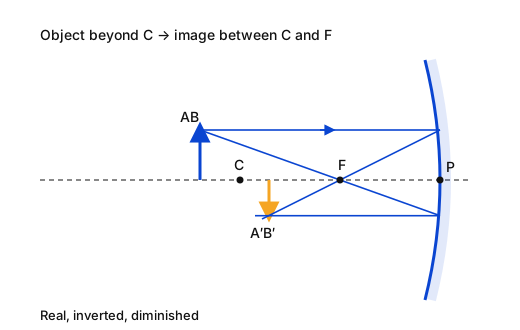
- A ray parallel to the axis reflects through F.
- A ray through F reflects parallel to the axis.
- For an object beyond C, these rays meet between C and F – the image is real, inverted and diminished.
Yaad rakhein: Object and image swap: beyond C ↔ between C and F; at C ↔ at C; at F ↔ at infinity.
Answer: (C) Between the centre of curvature and the focus point
अवधारणा: अवतल दर्पण में प्रतिबिंब की स्थिति इस पर निर्भर करती है कि वस्तु C और F के सापेक्ष कहाँ रखी है।
- मुख्य अक्ष के समांतर किरण परावर्तन के बाद F से गुज़रती है।
- F से गुज़रने वाली किरण परावर्तन के बाद अक्ष के समांतर जाती है।
- C से परे रखी वस्तु के लिए ये किरणें C और F के बीच मिलती हैं – प्रतिबिंब वास्तविक, उल्टा और छोटा।
याद रखें: वस्तु और प्रतिबिंब की अदला-बदली: C से परे ↔ C और F के बीच; C पर ↔ C पर; F पर ↔ अनंत पर।
उत्तर: (C) वक्रता केंद्र और फोकस बिंदु के बीच
RRB Technician Grade IIIGeneral ScienceImage by concave mirrorRRB Technician Grade III 2024 · 27 Dec Shift 3
Q750.What is the SI unit of momentum?
संवेग का SI मात्रक क्या है?
- Akg
- Bkg m s
- Ckg m
- Dkg m
Show answer
Concept: Momentum .
- Unit of mass = kg, unit of velocity = .
- Unit of momentum = (same as ).
Yaad rakhein: Momentum unit = force unit × time: .
Answer: (C) kg m
अवधारणा: संवेग ।
- द्रव्यमान का मात्रक = kg, वेग का मात्रक = ।
- संवेग का मात्रक = ( के बराबर)।
याद रखें: संवेग का मात्रक = बल का मात्रक × समय: ।
उत्तर: (C) kg m
RRB Technician Grade IIIGeneral ScienceMomentumRRB Technician Grade III 2024 · 27 Dec Shift 3
Q751.The atomic mass of carbon-12 isotope is:
कार्बन-12 समस्थानिक (isotope) का परमाणु द्रव्यमान है:
- A12 u
- B6 u
- C16 u
- D14 u
Show answer
Concept: One atomic mass unit (u) is defined as exactly of the mass of one carbon-12 atom.
- So the mass of a C-12 atom is exactly 12 u by definition.
- C-12 has 6 protons + 6 neutrons; mass number = 12.
Yaad rakhein: C-12 is the reference standard: 12 u exactly.
Answer: (A) 12 u
अवधारणा: एक परमाणु द्रव्यमान इकाई (u) को कार्बन-12 के एक परमाणु के द्रव्यमान का ठीक भाग माना गया है।
- अतः परिभाषा से C-12 परमाणु का द्रव्यमान ठीक 12 u है।
- C-12 में 6 प्रोटॉन + 6 न्यूट्रॉन; द्रव्यमान संख्या = 12।
याद रखें: C-12 मानक संदर्भ है: ठीक 12 u।
उत्तर: (A) 12 u
RRB Technician Grade IIIGeneral ScienceAtomic mass unitRRB Technician Grade III 2024 · 27 Dec Shift 3
Q752.Which organ of the human body pumps blood?
मानव शरीर का कौन-सा अंग रक्त को पंप करता है?
- APancreasअग्न्याशय
- BHeartहृदय
- CLiverयकृत
- DStomachआमाशय
Show answer
Concept: The heart is a muscular organ that pumps blood to all parts of the body through arteries.
- Human heart has four chambers – two atria and two ventricles.
- Pancreas secretes enzymes and insulin; liver makes bile; stomach digests food.
Yaad rakhein: Heart – pump; blood vessels – pipes; blood – fluid carrier.
Answer: (B) Heart
अवधारणा: हृदय एक पेशीय अंग है जो धमनियों द्वारा शरीर के सभी भागों में रक्त पंप करता है।
- मानव हृदय में चार कक्ष होते हैं – दो अलिंद और दो निलय।
- अग्न्याशय एंजाइम व इंसुलिन बनाता है; यकृत पित्त बनाता है; आमाशय भोजन पचाता है।
याद रखें: हृदय – पंप; रक्त वाहिकाएँ – पाइप; रक्त – वाहक द्रव।
उत्तर: (B) हृदय
RRB Technician Grade IIIGeneral ScienceHuman circulatory systemRRB Technician Grade III 2024 · 27 Dec Shift 3
Q753.A cube-shaped metal box of 1 kg mass is kept on the horizontal surface of a table. Assuming acceleration due to gravity is 10 , the thrust acting on the table surface is ______.
1 kg द्रव्यमान का एक घनाकार धातु का डिब्बा एक मेज की क्षैतिज सतह पर रखा है। गुरुत्वीय त्वरण 10 मानते हुए, मेज की सतह पर लगने वाला प्रणोद (thrust) ______ है।
- A1 N
- B1000 N
- C10 N
- D100 N
Show answer
Concept: Thrust is the force acting perpendicular to a surface. A box resting on a table presses it with its weight.
- Thrust = weight = .
- .
Yaad rakhein: Thrust is total force (N); pressure = (Pa).
Answer: (C) 10 N
अवधारणा: प्रणोद किसी सतह पर लंबवत लगने वाला बल है। मेज़ पर रखा डिब्बा अपने भार से मेज़ को दबाता है।
- प्रणोद = भार = ।
- ।
याद रखें: प्रणोद कुल बल (N) है; दाब = (Pa)।
उत्तर: (C) 10 N
RRB Technician Grade IIIGeneral ScienceThrustRRB Technician Grade III 2024 · 27 Dec Shift 3
Q754.Which of the following is INCORRECTLY matched related to the excretory system of humans?
मनुष्यों के उत्सर्जन तंत्र से संबंधित निम्नलिखित में से कौन-सा युग्म गलत सुमेलित है?
- AUreter - a pairमूत्रवाहिनी (Ureter) - एक जोड़ी
- BKidney - a pairवृक्क (Kidney) - एक जोड़ी
- CUrinary bladder - unpairedमूत्राशय (Urinary bladder) - अयुग्मित
- DUrethra - a pairमूत्रमार्ग (Urethra) - एक जोड़ी
Show answer
Concept: The human excretory system has a pair of kidneys, a pair of ureters, one urinary bladder and one urethra.
- Kidney – a pair: correct.
- Ureter – a pair (one from each kidney): correct.
- Urinary bladder – single: correct.
- Urethra – single tube that carries urine out of the body; "a pair" is wrong.
Yaad rakhein: Two kidneys → two ureters → one bladder → one urethra.
Answer: (D) Urethra - a pair
अवधारणा: मानव उत्सर्जन तंत्र में एक जोड़ी वृक्क, एक जोड़ी मूत्रवाहिनी, एक मूत्राशय और एक मूत्रमार्ग होता है।
- वृक्क – एक जोड़ी: सही।
- मूत्रवाहिनी (ureter) – एक जोड़ी (प्रत्येक वृक्क से एक): सही।
- मूत्राशय – एक: सही।
- मूत्रमार्ग (urethra) – मूत्र बाहर निकालने वाली एक ही नली; "एक जोड़ी" गलत है।
याद रखें: दो वृक्क → दो मूत्रवाहिनी → एक मूत्राशय → एक मूत्रमार्ग।
उत्तर: (D) मूत्रमार्ग (Urethra) - एक जोड़ी
RRB Technician Grade IIIGeneral ScienceHuman excretory systemRRB Technician Grade III 2024 · 27 Dec Shift 3
Q755.A series of compounds in which the same functional group substitutes for hydrogen in a carbon chain is called ______.
यौगिकों की वह श्रेणी जिसमें एक ही प्रकार्यात्मक समूह (functional group) कार्बन श्रृंखला में हाइड्रोजन को प्रतिस्थापित करता है, ______ कहलाती है।
- Aisochoresसमआयतनिक (isochores)
- Bisobarsसमभारिक (isobars)
- Chomologous seriesसमजातीय श्रेणी (homologous series)
- Disomersसमावयवी (isomers)
Show answer
Concept: A homologous series is a family of carbon compounds with the same functional group, where successive members differ by a unit.
- Example: , , (all –OH).
- Successive members differ in mass by 14 u; chemical properties are similar.
- Isomers = same formula, different structure; isobars = same mass number.
Yaad rakhein: Same functional group + difference of → homologous series.
Answer: (C) homologous series
अवधारणा: समजातीय श्रेणी समान प्रकार्यात्मक समूह वाले कार्बन यौगिकों का समूह है, जिसके क्रमागत सदस्यों में का अंतर होता है।
- उदाहरण: , , (सभी में –OH)।
- क्रमागत सदस्यों के द्रव्यमान में 14 u का अंतर; रासायनिक गुण समान।
- समावयवी = समान सूत्र, भिन्न संरचना; समभारिक = समान द्रव्यमान संख्या।
याद रखें: समान प्रकार्यात्मक समूह + का अंतर → समजातीय श्रेणी।
उत्तर: (C) समजातीय श्रेणी (homologous series)
RRB Technician Grade IIIGeneral ScienceHomologous seriesRRB Technician Grade III 2024 · 27 Dec Shift 3
Q756.Which of the following is a connective tissue?
निम्नलिखित में से कौन-सा एक संयोजी ऊतक (connective tissue) है?
- ACuboidal epitheliumघनाकार उपकला (Cuboidal epithelium)
- BBloodरक्त
- CMuscleपेशी
- DColumnar epitheliumस्तंभाकार उपकला (Columnar epithelium)
Show answer
Concept: Connective tissues connect and support other tissues; their cells lie in a matrix. Blood is a fluid connective tissue with plasma as its matrix.
- Cuboidal and columnar epithelium – epithelial tissues (covering/lining).
- Muscle – muscular tissue (movement).
- Blood – fluid connective tissue (plasma + RBC, WBC, platelets).
Yaad rakhein: Connective tissues: blood, bone, cartilage, ligament, tendon, areolar, adipose.
Answer: (B) Blood
अवधारणा: संयोजी ऊतक अन्य ऊतकों को जोड़ते और सहारा देते हैं; इनकी कोशिकाएँ आधात्री (matrix) में रहती हैं। रक्त एक तरल संयोजी ऊतक है जिसका आधात्री प्लाज़्मा है।
- घनाकार और स्तंभाकार उपकला – उपकला ऊतक (आवरण/अस्तर)।
- पेशी – पेशीय ऊतक (गति)।
- रक्त – तरल संयोजी ऊतक (प्लाज़्मा + RBC, WBC, प्लेटलेट्स)।
याद रखें: संयोजी ऊतक: रक्त, अस्थि, उपास्थि, स्नायु, कंडरा, एरिओलर, वसा ऊतक।
उत्तर: (B) रक्त
RRB Technician Grade IIIGeneral ScienceConnective tissueRRB Technician Grade III 2024 · 27 Dec Shift 3
Q757.Which of the following statements regarding saturated and unsaturated carbon compounds is correct?
Statement I: Saturated carbon compounds are hydrocarbons where carbon atoms are connected by single covalent bonds.
Statement II: Unsaturated carbon compounds are hydrocarbons where carbon atoms are connected by single covalent bonds.
संतृप्त और असंतृप्त कार्बन यौगिकों के संबंध में निम्नलिखित में से कौन-सा कथन सही है?
कथन I: संतृप्त कार्बन यौगिक वे हाइड्रोकार्बन हैं जिनमें कार्बन परमाणु एकल सहसंयोजी आबंधों द्वारा जुड़े होते हैं।
कथन II: असंतृप्त कार्बन यौगिक वे हाइड्रोकार्बन हैं जिनमें कार्बन परमाणु एकल सहसंयोजी आबंधों द्वारा जुड़े होते हैं।
- AOnly statement II is correct.केवल कथन II सही है।
- BBoth statements I and II are correct.कथन I और II दोनों सही हैं।
- COnly statement I is correct.केवल कथन I सही है।
- DNeither statement I nor II is correct.न तो कथन I और न ही II सही है।
Show answer
Concept: Saturated hydrocarbons have only single C–C bonds; unsaturated ones have at least one double or triple bond between carbon atoms.
- Statement I: saturated → single bonds (e.g. ethane ) – correct.
- Statement II: unsaturated compounds contain double/triple bonds (ethene , ethyne ), not only single bonds – incorrect.
Yaad rakhein: Alkane (–ane) = saturated; alkene (–ene), alkyne (–yne) = unsaturated.
Answer: (C) Only statement I is correct.
अवधारणा: संतृप्त हाइड्रोकार्बनों में केवल एकल C–C बंध होते हैं; असंतृप्त में कार्बन परमाणुओं के बीच कम से कम एक द्वि या त्रि-बंध होता है।
- कथन I: संतृप्त → एकल बंध (जैसे एथेन ) – सही।
- कथन II: असंतृप्त यौगिकों में द्वि/त्रि-बंध होते हैं (एथीन , एथाइन ), केवल एकल बंध नहीं – गलत।
याद रखें: एल्केन (–ane) = संतृप्त; एल्कीन (–ene), एल्काइन (–yne) = असंतृप्त।
उत्तर: (C) केवल कथन I सही है।
RRB Technician Grade IIIGeneral ScienceSaturated and unsaturated hydrocarbonsRRB Technician Grade III 2024 · 27 Dec Shift 3
Q758.Which of the following reactions is NOT an exothermic reaction?
निम्नलिखित में से कौन-सी अभिक्रिया ऊष्माक्षेपी (exothermic) अभिक्रिया नहीं है?
- ADilution of a strong acidप्रबल अम्ल का तनुकरण
- BRespirationश्वसन
- CPhotosynthesisप्रकाश-संश्लेषण
- DBurning of natural gasप्राकृतिक गैस का दहन
Show answer
Concept: Exothermic processes release heat; endothermic ones absorb energy.
- Dilution of a strong acid releases a lot of heat – exothermic (so acid is added to water, slowly).
- Respiration releases energy – exothermic.
- Burning of natural gas: + heat – exothermic.
- Photosynthesis absorbs sunlight energy – endothermic.
Yaad rakhein: Photosynthesis needs energy (absorbs); respiration gives energy (releases).
Answer: (C) Photosynthesis
अवधारणा: ऊष्माक्षेपी प्रक्रम ऊष्मा मुक्त करते हैं; ऊष्माशोषी प्रक्रम ऊर्जा अवशोषित करते हैं।
- प्रबल अम्ल का तनुकरण बहुत ऊष्मा मुक्त करता है – ऊष्माक्षेपी (इसीलिए अम्ल को धीरे-धीरे जल में डालते हैं)।
- श्वसन ऊर्जा मुक्त करता है – ऊष्माक्षेपी।
- प्राकृतिक गैस का दहन: + ऊष्मा – ऊष्माक्षेपी।
- प्रकाश संश्लेषण सूर्य के प्रकाश की ऊर्जा अवशोषित करता है – ऊष्माशोषी।
याद रखें: प्रकाश संश्लेषण ऊर्जा लेता है; श्वसन ऊर्जा देता है।
उत्तर: (C) प्रकाश-संश्लेषण
RRB Technician Grade IIIGeneral ScienceExothermic and endothermic reactionsRRB Technician Grade III 2024 · 27 Dec Shift 3
Q759.Which tissue is responsible for the movement in our body?
हमारे शरीर में गति के लिए कौन-सा ऊतक उत्तरदायी है?
- ACartilageउपास्थि (Cartilage)
- BEpithelial tissueउपकला ऊतक
- CMuscular tissueपेशीय ऊतक
- DAreolar tissueएरिओलर ऊतक (Areolar tissue)
Show answer
Concept: Muscle cells contain contractile proteins that contract and relax, causing movement.
- Muscular tissue (striated, smooth, cardiac) – movement of body parts and organs.
- Cartilage – support and smooth joint surfaces.
- Epithelial tissue – protective covering.
- Areolar tissue – fills spaces between organs.
Yaad rakhein: Movement = muscle; covering = epithelium; support = connective tissue.
Answer: (C) Muscular tissue
अवधारणा: पेशी कोशिकाओं में संकुचनशील प्रोटीन होते हैं जो संकुचित व शिथिल होकर गति उत्पन्न करते हैं।
- पेशीय ऊतक (रेखित, अरेखित, हृदय) – शरीर के अंगों की गति।
- उपास्थि – सहारा और जोड़ों की चिकनी सतह।
- उपकला ऊतक – सुरक्षात्मक आवरण।
- एरिओलर ऊतक – अंगों के बीच की जगह भरता है।
याद रखें: गति = पेशी; आवरण = उपकला; सहारा = संयोजी ऊतक।
उत्तर: (C) पेशीय ऊतक
RRB Technician Grade IIIGeneral ScienceMuscular tissueRRB Technician Grade III 2024 · 27 Dec Shift 3
Q760.Which of the following is/are NOT present in the plasma?
निम्नलिखित में से कौन-सा/से प्लाज्मा में उपस्थित नहीं है/हैं?
- AUndigested foodअपचित भोजन
- BHormonesहॉर्मोन
- CSaltsलवण
- DProteinsप्रोटीन
Show answer
Concept: Plasma is the fluid part of blood; it transports digested (absorbed) food, salts, hormones, proteins, and nitrogenous wastes.
- Hormones, salts and proteins (albumin, fibrinogen) are present in plasma.
- Undigested food never enters blood; it passes into the large intestine and is egested.
Yaad rakhein: Only digested, absorbed food reaches blood; undigested food leaves through the anus.
Answer: (A) Undigested food
अवधारणा: प्लाज़्मा रक्त का तरल भाग है; यह पचे हुए (अवशोषित) भोजन, लवण, हार्मोन, प्रोटीन, और नाइट्रोजनी अपशिष्टों का परिवहन करता है।
- हार्मोन, लवण और प्रोटीन (एल्ब्यूमिन, फाइब्रिनोजन) प्लाज़्मा में होते हैं।
- अपचित भोजन कभी रक्त में नहीं जाता; वह बड़ी आँत में जाकर बाहर निकलता है।
याद रखें: केवल पचा और अवशोषित भोजन रक्त में पहुँचता है; अपचित भोजन गुदा से बाहर जाता है।
उत्तर: (A) अपचित भोजन
RRB Technician Grade IIIGeneral ScienceBlood plasmaRRB Technician Grade III 2024 · 27 Dec Shift 3

