RRB Technician Grade III · 3,200 questions

RRB Technician Grade III 2024, 2025 PYQs

Real previous year questions, subject-wise. Try the question, then open the answer and the explanation in Hindi & English – free, no login.

Courses – airGurukul

819 questions in Mathematics.

Q61.
A dealer buys two articles X and Y for ₹700 each. He marks each of them at the same price. He sells X by giving two successive discounts of 60% and 20% and still earns ₹630 as profit. If he sells Y at a single discount of 76%, then what is the profit
percentage on Y?
एक व्यापारी दो वस्तुएँ X और Y प्रत्येक ₹700 में खरीदता है। वह उनमें से प्रत्येक पर समान मूल्य अंकित करता है। वह X को 60% और 20% की दो क्रमिक छूट देकर बेचता है और फिर भी ₹630 का लाभ अर्जित करता है। यदि वह Y को 76% की एकल छूट पर बेचता है, तो Y पर लाभ
प्रतिशत कितना है?
  1. A42.5%
  2. B41%
  3. C42%
  4. D41.5%
Show answer

Concept: Find the marked price from X's selling price, then compute Y's selling price.

  1. SP of X = 700+630= ₹1330
  2. Two discounts 60%, 20% → SP=MP×0.4×0.8=0.32MP → MP=1330÷0.32= ₹4156.25
  3. SP of Y = 24% of MP = 0.24×4156.25= ₹997.50
  4. Profit % = 297.5700×100=42.5%

Trick: SP of Y = 1330×0.240.32=1330×34= ₹997.5 – no need to find MP.

Answer: (A) 42.5%

अवधारणा: X के विक्रय मूल्य से अंकित मूल्य निकालें, फिर Y का विक्रय मूल्य।

  1. X का SP = 700+630= ₹1330
  2. 60% और 20% छूट → SP=MP×0.4×0.8=0.32MP → MP = ₹4156.25
  3. Y का SP = MP का 24% = ₹997.50
  4. लाभ % = 297.5700×100=42.5%

ट्रिक: Y का SP = 1330×0.240.32=1330×34= ₹997.5 – MP निकालने की ज़रूरत नहीं।

उत्तर: (A) 42.5%
RRB Technician Grade IIIMathematicsSuccessive discounts and profit %RRB Technician Grade III 2025 · 10 Mar Shift 1
Q62.
What sum of money (in ₹) will yield ₹720 as simple interest in 3 years at 6% per annum?
कितनी धनराशि (₹ में) 6% वार्षिक दर से 3 वर्षों में ₹720 साधारण ब्याज देगी?
  1. A4000
  2. B4200
  3. C4400
  4. D3500
Show answer

Concept: P=SI×100R×T.

  1. P=720×1006×3
  2. =7200018= ₹4000

Trick: Total rate = 6×3=18%; 18%=720 → 1%=40 → 100%=4000.

Answer: (A) 4000

अवधारणा: मूलधन P=SI×100R×T।

  1. P=720×1006×3
  2. =7200018= ₹4000

ट्रिक: कुल दर = 18%; 18%=720 → 1%=40 → 100%=4000।

उत्तर: (A) 4000

RRB Technician Grade IIIMathematicsSimple interest – finding principalRRB Technician Grade III 2025 · 10 Mar Shift 1
Q63.
A quantity is first decreased by 12% and then again decreased by 8%. What is the overall percentage decrease?
एक राशि को पहले 12% घटाया जाता है और फिर पुनः 8% घटाया जाता है। कुल प्रतिशत कमी कितनी है?
  1. A21.04%
  2. B18.96%
  3. C19.04%
  4. D20.96%
Show answer

Concept: Net change for −a% and −b% = −a−b+ab100.

  1. Net = −12−8+12×8100
  2. =−20+0.96=−19.04%
  3. So overall decrease = 19.04%

Trick: Two decreases always give slightly less than their sum (20%) – only 19.04% fits.

Answer: (C) 19.04%

अवधारणा: −a% और −b% का कुल परिवर्तन = −a−b+ab100।

  1. कुल = −12−8+96100
  2. =−20+0.96=−19.04%
  3. कुल कमी = 19.04%

ट्रिक: दो कमियों का कुल प्रभाव उनके योग (20%) से थोड़ा कम होता है – केवल 19.04% सही बैठता है।

उत्तर: (C) 19.04%

RRB Technician Grade IIIMathematicsSuccessive percentage decreaseRRB Technician Grade III 2025 · 10 Mar Shift 1
Q64.
What is the amount on ₹20,000 for six months at 12% annual interest, compounded quarterly?
₹20,000 पर 12% वार्षिक ब्याज दर से छह महीने के लिए, ब्याज तिमाही रूप से संयोजित होने पर, मिश्रधन कितना होगा?
  1. A₹21823
  2. B₹21218
  3. C₹21335
  4. D₹21934
Show answer

Concept: Quarterly: rate = 124=3% per quarter; 6 months = 2 quarters.

  1. A=20000×(1.03)2
  2. (1.03)2=1.0609
  3. A=20000×1.0609= ₹21218

Trick: CI for 2 periods at 3% = 3+3+0.09=6.09% → 6.09% of 20000 = 1218.

Answer: (B) ₹21218

अवधारणा: त्रैमासिक: दर = 124=3% प्रति तिमाही; 6 माह = 2 तिमाही।

  1. A=20000×(1.03)2
  2. (1.03)2=1.0609
  3. A=20000×1.0609= ₹21218

ट्रिक: 3% पर 2 अवधि का प्रभावी ब्याज = 6.09% → 20000 का 6.09% = 1218।

उत्तर: (B) ₹21218

RRB Technician Grade IIIMathematicsCompound interest – quarterlyRRB Technician Grade III 2025 · 10 Mar Shift 1
Q65.
If cotθ=13, (0∘<θ<90∘), then the value of 2−sin2θ1+cos2θ+(csc2θ+sec2θ) is:
यदि cotθ=13, (0∘<θ<90∘) है, तो 2−sin2θ1+cos2θ+(csc2θ+sec2θ) का मान है:
  1. A113
  2. B173
  3. C193
  4. D293
Show answer

Concept: cotθ=13 → θ=60∘; substitute standard values.

  1. sin260∘=34, cos260∘=14
  2. 2−341+14=5/45/4=1
  3. csc260∘=43, sec260∘=4
  4. Total = 1+43+4=193

Trick: 2−sin2θ=1+cos2θ always, so the first fraction is always 1.

Answer: (C) 193

अवधारणा: cotθ=13 → θ=60∘; मानक मान रखें।

  1. sin260∘=34, cos260∘=14
  2. 2−341+14=1
  3. csc260∘=43, sec260∘=4
  4. कुल = 1+43+4=193

ट्रिक: 2−sin2θ=1+cos2θ हमेशा, इसलिए पहला भिन्न सदैव 1 है।

उत्तर: (C) 193

RRB Technician Grade IIIMathematicsTrigonometric ratios of standard anglesRRB Technician Grade III 2025 · 10 Mar Shift 1
Q66.
In a college, class A has 25 students and class B has 30 students. If the number of students in class A increases by 20% in the first year and by 10% in the second year, and the number of students in class B increases by a total of 20% in two years, what is the overall percentage increase in the total number of students in the college over the two years? (Give your answer rounded off to 2 decimal places.)
एक कॉलेज में, कक्षा A में 25 विद्यार्थी हैं और कक्षा B में 30 विद्यार्थी हैं। यदि कक्षा A में विद्यार्थियों की संख्या पहले वर्ष में 20% और दूसरे वर्ष में 10% बढ़ती है, और कक्षा B में विद्यार्थियों की संख्या दो वर्षों में कुल 20% बढ़ती है, तो दो वर्षों में कॉलेज के विद्यार्थियों की कुल संख्या में समग्र प्रतिशत वृद्धि कितनी है? (अपना उत्तर दशमलव के 2 स्थानों तक पूर्णांकित करके दीजिए।)
  1. A20.85%
  2. B20.45%
  3. C25.45%
  4. D25.85%
Show answer

Concept: Find each class's final strength, then overall % increase on the total.

  1. Class A: 25×1.2×1.1=33
  2. Class B: 30×1.2=36
  3. Total: 55 → 69, increase = 14
  4. % increase = 1455×100=25.45%

Trick: 1455=0.2545… (since 155=0.01818…).

Answer: (C) 25.45%

अवधारणा: दोनों कक्षाओं की अंतिम संख्या निकालें, फिर कुल पर % वृद्धि।

  1. कक्षा A: 25×1.2×1.1=33
  2. कक्षा B: 30×1.2=36
  3. कुल: 55 → 69, वृद्धि = 14
  4. % वृद्धि = 1455×100=25.45%

ट्रिक: 155=0.01818… → 1455=0.2545…

उत्तर: (C) 25.45%

RRB Technician Grade IIIMathematicsPercentage increase – population growthRRB Technician Grade III 2025 · 10 Mar Shift 1
Q67.
The difference between the present ages of Juhi and Surbhi is 24 years. Five years ago from now, the sum of their ages was 66 years. If Juhi is older than Surbhi, find Surbhi's present age (in years).
जूही और सुरभि की वर्तमान आयु का अंतर 24 वर्ष है। अब से पाँच वर्ष पहले, उनकी आयु का योग 66 वर्ष था। यदि जूही, सुरभि से बड़ी है, तो सुरभि की वर्तमान आयु (वर्षों में) ज्ञात कीजिए।
  1. A20
  2. B26
  3. C33
  4. D18
Show answer

Concept: Convert the past sum to present, then younger=sum−difference2.

  1. 5 years ago sum = 66 → present sum = 66+10=76
  2. Difference = 24
  3. Surbhi (younger) = 76−242=26 years

Trick: Check: Juhi = 50, Surbhi = 26 → (45+21)=66 ✓.

Answer: (B) 26

अवधारणा: पिछला योग वर्तमान में बदलें, फिर छोटा=योग−अंतर2।

  1. 5 वर्ष पहले योग = 66 → वर्तमान योग = 76
  2. अंतर = 24
  3. सुरभि (छोटी) = 76−242=26 वर्ष

ट्रिक: जाँच: जूही = 50, सुरभि = 26 → 45+21=66 ✓।

उत्तर: (B) 26

RRB Technician Grade IIIMathematicsProblems on ages – sum and differenceRRB Technician Grade III 2025 · 10 Mar Shift 1
Q68.
Find the perimeter of the semi-circle of radius 21 cm (Take π=227).
21 cm त्रिज्या वाले अर्धवृत्त का परिमाप ज्ञात कीजिए (π=227 लीजिए)।
  1. A108 cm
  2. B174 cm
  3. C87 cm
  4. D66 cm
Show answer

Concept: Perimeter of semicircle = πr+2r (curved part + diameter).

  1. πr=227×21=66 cm
  2. 2r=42 cm
  3. Perimeter = 66+42=108 cm

Trick: Perimeter = r(π+2)=r×367=21×367=108.

Answer: (A) 108 cm

अवधारणा: अर्धवृत्त का परिमाप = πr+2r (वक्र भाग + व्यास)।

  1. πr=227×21=66 cm
  2. 2r=42 cm
  3. परिमाप = 66+42=108 cm

ट्रिक: परिमाप = r×367=21×367=108।

उत्तर: (A) 108 cm

RRB Technician Grade IIIMathematicsPerimeter of a semicircleRRB Technician Grade III 2025 · 10 Mar Shift 1
Q69.
A traveller moves from City A to City B at 48 km/h and returns at 60 km/h. If the total time taken for the whole journey is 9 hours, find the distance between A and B.
एक यात्री शहर A से शहर B तक 48 km/h की चाल से जाता है और 60 km/h की चाल से लौटता है। यदि पूरी यात्रा में लगा कुल समय 9 घंटे है, तो A और B के बीच की दूरी ज्ञात कीजिए।
  1. A240 km
  2. B270 km
  3. C250 km
  4. D260 km
Show answer

Concept: Total time = d48+d60.

  1. d48+d60=9
  2. d(5+4)240=9 → 9d240=9
  3. d=240 km

Trick: Average speed = 2×48×60108=1603 km/h; total distance = 1603×9=480 → one way 240 km.

Answer: (A) 240 km

अवधारणा: कुल समय = d48+d60।

  1. d48+d60=9
  2. 9d240=9
  3. d=240 km

ट्रिक: औसत चाल = 2×48×60108=1603; कुल दूरी = 480 → एक तरफ 240 km।

उत्तर: (A) 240 km

RRB Technician Grade IIIMathematicsAverage speed – to and fro journeyRRB Technician Grade III 2025 · 10 Mar Shift 1
Q70.
Aarju starts a business with ₹55,000 and after 3 months, Bimla joins Aarju as her partner. After a year, the profit is divided in the ratio 8 : 9. What is Bimla's contribution in the capital?
आरजू ₹55,000 से एक व्यवसाय शुरू करती है और 3 महीने बाद, बिमला आरजू के साथ उसकी साझेदार के रूप में जुड़ती है। एक वर्ष के बाद, लाभ 8 : 9 के अनुपात में बाँटा जाता है। पूँजी में बिमला का योगदान कितना है?
  1. A₹82,355
  2. B₹82,500
  3. C₹84,240
  4. D₹84,080
Show answer

Concept: Profit ratio = capital × time. Bimla invests for 12−3=9 months.

  1. 55000×12:B×9=8:9
  2. 9B=660000×98
  3. B=6600008= ₹82,500

Trick: Since Bimla's months (9) equal her ratio term (9), B=55000×128 directly.

Answer: (B) ₹82,500

अवधारणा: लाभ अनुपात = पूँजी × समय। बिमला का समय = 12−3=9 माह।

  1. 55000×12:B×9=8:9
  2. 9B=660000×98
  3. B=6600008= ₹82,500

ट्रिक: बिमला के माह (9) और अनुपात (9) बराबर हैं, इसलिए सीधे B=55000×128।

उत्तर: (B) ₹82,500

RRB Technician Grade IIIMathematicsPartnership – capital × timeRRB Technician Grade III 2025 · 10 Mar Shift 1
Q71.
A man sells two articles for ₹42000 each. He gets a profit of 45% on one article and loses 45% on the other article. What is his overall profit or loss (to the nearest integer) in this transaction?
एक व्यक्ति दो वस्तुएँ प्रत्येक ₹42000 में बेचता है। उसे एक वस्तु पर 45% का लाभ होता है और दूसरी वस्तु पर 45% की हानि होती है। इस लेन-देन में उसका कुल लाभ या हानि (निकटतम पूर्णांक तक) कितना है?
  1. A₹21329 profit₹21329 लाभ
  2. B₹21429 profit₹21429 लाभ
  3. C₹21329 loss₹21329 हानि
  4. D₹21429 loss₹21429 हानि
Show answer

Concept: When two items are sold at the same SP with x% gain and x% loss, there is always a loss.

  1. CP1=420001.45= ₹28,965.52
  2. CP2=420000.55= ₹76,363.64
  3. Total CP = ₹1,05,329.16; Total SP = ₹84,000
  4. Loss = ₹21,329 (to nearest rupee)

Trick: 'Profit' options are eliminated instantly – equal x% gain/loss on same SP is always a loss (x2100%=20.25%).

Answer: (C) ₹21329 loss

अवधारणा: समान SP पर x% लाभ और x% हानि हो तो कुल मिलाकर हमेशा हानि होती है।

  1. CP1=420001.45= ₹28,965.52
  2. CP2=420000.55= ₹76,363.64
  3. कुल CP = ₹1,05,329.16; कुल SP = ₹84,000
  4. हानि = ₹21,329

ट्रिक: 'लाभ' वाले विकल्प तुरंत हटाएँ – ऐसी स्थिति में सदा हानि (x2100%=20.25%)।

उत्तर: (C) ₹21329 हानि

RRB Technician Grade IIIMathematicsSame SP, equal profit and loss %RRB Technician Grade III 2025 · 10 Mar Shift 1
Q72.
Pipe A can fill a tank in 12 hours, pipe B in 15 hours, and an outlet C can empty it in 20 hours. A and B are opened together for 5 hours, and then C is also opened. Find the total time to fill the tank.
पाइप A एक टंकी को 12 घंटे में, पाइप B 15 घंटे में भर सकता है, और एक निकास पाइप C इसे 20 घंटे में खाली कर सकता है। A और B को एक साथ 5 घंटे के लिए खोला जाता है, और फिर C को भी खोल दिया जाता है। टंकी को भरने में लगने वाला कुल समय ज्ञात कीजिए।
  1. A7.5 hours7.5 घंटे
  2. B6 hours6 घंटे
  3. C5.5 hours5.5 घंटे
  4. D6.5 hours6.5 घंटे
Show answer

Concept: Take LCM of 12, 15, 20 = 60 units as tank capacity.

  1. Rates: A = 5, B = 4, C = −3 units/h
  2. A + B for 5 h = 9×5=45 units; left = 15
  3. A + B + C = 6 units/h → 15÷6=2.5 h
  4. Total = 5+2.5=7.5 hours

Trick: LCM-unit method avoids fractions completely.

Answer: (A) 7.5 hours

अवधारणा: टंकी की क्षमता = LCM(12, 15, 20) = 60 इकाई मानें।

  1. दर: A = 5, B = 4, C = −3 इकाई/घंटा
  2. A + B, 5 घंटे में = 45 इकाई; शेष = 15
  3. A + B + C = 6 इकाई/घंटा → 15÷6=2.5 घंटे
  4. कुल = 5+2.5=7.5 घंटे

ट्रिक: LCM-इकाई विधि से भिन्नों से बचें।

उत्तर: (A) 7.5 घंटे

RRB Technician Grade IIIMathematicsPipes and cisterns – inlet with outletRRB Technician Grade III 2025 · 10 Mar Shift 1
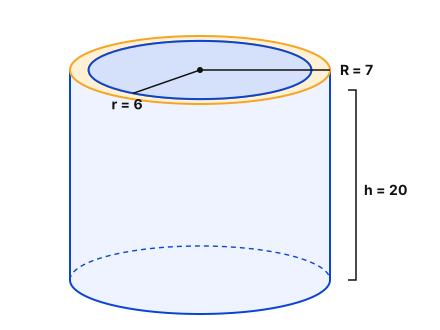
Q73.
A hollow cylindrical pipe has an external radius of 7 cm, internal radius of 6 cm, and height of 20 cm. Find the total surface area of the pipe (both ends included). (Use π=227)
एक खोखले बेलनाकार पाइप की बाह्य त्रिज्या 7 cm, आंतरिक त्रिज्या 6 cm और ऊँचाई 20 cm है। पाइप का संपूर्ण पृष्ठीय क्षेत्रफल (दोनों सिरों सहित) ज्ञात कीजिए। (π=227 लीजिए)
  1. A1600 cm²
  2. B1716 cm²
  3. C1485 cm²
  4. D1670 cm²
Show answer

Concept: TSA=2πh(R+r)+2π(R2−r2).

  1. Curved (outer + inner) = 2×227×20×13=114407
  2. Two rings = 2×227×(49−36)=5727
  3. TSA = 11440+5727=120127=1716cm2

Trick: Take 2π(R+r) common: 2×227×13×(h+R−r)=5727×21=1716.

Answer: (B) 1716 cm²

अवधारणा: TSA=2πh(R+r)+2π(R2−r2)।

  1. वक्र (बाहरी + भीतरी) = 2×227×20×13=114407
  2. दोनों छल्ले = 2×227×13=5727
  3. TSA = 120127=1716cm2

ट्रिक: 2π(R+r) सामान्य लें: 2×227×13×(20+1)=1716।

उत्तर: (B) 1716 cm²

RRB Technician Grade IIIMathematicsHollow cylinder – total surface areaRRB Technician Grade III 2025 · 10 Mar Shift 1
Q74.
What is the mode of the following data?
47, 43, 50, 46, 46, 40, 54, 54, 40, 54, 42, 48, 44, 55, 52, 45, 41, 41
निम्नलिखित आँकड़ों का बहुलक क्या है?
47, 43, 50, 46, 46, 40, 54, 54, 40, 54, 42, 48, 44, 55, 52, 45, 41, 41
  1. A40
  2. B46
  3. C41
  4. D54
Show answer

Concept: Mode = the value that occurs most often.

  1. 54 appears 3 times
  2. 40, 41, 46 appear only 2 times each
  3. Mode = 54

Trick: Scan only the option values and count them – fastest way.

Answer: (D) 54

अवधारणा: बहुलक = सबसे अधिक बार आने वाला मान।

  1. 54 तीन बार आता है
  2. 40, 41, 46 केवल दो-दो बार
  3. बहुलक = 54

ट्रिक: केवल विकल्पों वाली संख्याएँ गिनें – सबसे तेज़ तरीका।

उत्तर: (D) 54

RRB Technician Grade IIIMathematicsMode of ungrouped dataRRB Technician Grade III 2025 · 10 Mar Shift 1
Q75.
Which number, when added to each of the numbers 2, 3, 11 and 13, will make the resulting numbers in proportion?
संख्याओं 2, 3, 11 और 13 में से प्रत्येक में कौन-सी संख्या जोड़ने पर परिणामी संख्याएँ समानुपात में होंगी?
  1. A6
  2. B4
  3. C5
  4. D7
Show answer

Concept: For a : b = c : d, product of extremes = product of means.

  1. (2+x)(13+x)=(3+x)(11+x)
  2. 26+15x+x2=33+14x+x2
  3. x=7

Trick: Shortcut x=bc−ada+d−b−c=33−2615−14=7. Check: 9 : 10 = 18 : 20 ✓.

Answer: (D) 7

अवधारणा: a : b = c : d में बाह्य पदों का गुणनफल = मध्य पदों का गुणनफल।

  1. (2+x)(13+x)=(3+x)(11+x)
  2. 26+15x=33+14x
  3. x=7

ट्रिक: x=bc−ada+d−b−c=71=7। जाँच: 9 : 10 = 18 : 20 ✓।

उत्तर: (D) 7

RRB Technician Grade IIIMathematicsProportion – number to be addedRRB Technician Grade III 2025 · 10 Mar Shift 1
Q76.
What is the mode of the following data?
40, 53, 47, 55, 42, 46, 50, 42, 54, 49, 40, 54, 43, 40, 44, 55, 49, 53
निम्नलिखित आँकड़ों का बहुलक (mode) क्या है?
40, 53, 47, 55, 42, 46, 50, 42, 54, 49, 40, 54, 43, 40, 44, 55, 49, 53
  1. A53
  2. B55
  3. C40
  4. D49
Show answer

Concept: Mode = the value that occurs most often.

  1. Count repeats: 40 → 3 times (positions 1, 11, 14).
  2. 42, 49, 53, 54, 55 → 2 times each; others once.
  3. Highest frequency = 3, for 40.

Trick: Just check the options — count only 53, 55, 40, 49 in the list instead of tallying every number.

Answer: (C) 40

अवधारणा: बहुलक (Mode) = सबसे अधिक बार आने वाला मान।

  1. 40 तीन बार आता है।
  2. 42, 49, 53, 54, 55 दो-दो बार; बाकी एक-एक बार।
  3. सबसे अधिक बारंबारता 3 → 40 की।

ट्रिक: पूरी सूची गिनने के बजाय सिर्फ विकल्पों (53, 55, 40, 49) को गिनें।

उत्तर: (C) 40

RRB Technician Grade IIIMathematicsMode of ungrouped dataRRB Technician Grade III 2025 · 9 Mar Shift 3
Q77.
Simplify: (1524÷152)÷(18×163+18)+211÷1923 of 2311
सरल कीजिए: (1524÷152)÷(18×163+18)+211÷1923 of 2311
  1. A−424
  2. B419
  3. C718
  4. D−523
Show answer

Concept: BODMAS – brackets first, then 'of', then ÷ and ×, then + and −.

  1. (1524÷152)=1524×215=112
  2. (18×163+18)=23+18=1924
  3. 112÷1924=112×2419=219
  4. 'of' first: 1923 of 2311=1911; so 211÷1911=219
  5. Total = 219+219=419

Trick: 'of' is solved before ÷ — that turns the last part into 211×1119=219 instantly.

Answer: (B) 419

अवधारणा: BODMAS – पहले कोष्ठक, फिर 'का' (of), फिर ÷ व ×, फिर + व −।

  1. (1524÷152)=1524×215=112
  2. (18×163+18)=23+18=1924
  3. 112÷1924=219
  4. पहले 'of': 1923 of 2311=1911; फिर 211÷1911=219
  5. कुल = 219+219=419

ट्रिक: 'of' को ÷ से पहले हल करें — अंतिम भाग सीधे 219 बन जाता है।

उत्तर: (B) 419

RRB Technician Grade IIIMathematicsSimplification of fractions (BODMAS)RRB Technician Grade III 2025 · 9 Mar Shift 3
Q78.
Which of the following numbers is divisible by 11?
निम्नलिखित में से कौन-सी संख्या 11 से विभाज्य है?
  1. A502579
  2. B513589
  3. C502589
  4. D512579
Show answer

Concept: A number is divisible by 11 if (sum of digits at odd places) − (sum at even places) = 0 or a multiple of 11.

  1. 502579: odd places from right 9 + 5 + 0 = 14; even places 7 + 2 + 5 = 14.
  2. Difference = 0 → divisible by 11.
  3. Others: 513589 → 15 − 16, 502589 → 14 − 15, 512579 → 15 − 14; difference 1 → not divisible.

Trick: Options differ in one or two digits — test one option fully, then adjust: changing a digit by 1 changes the difference by 1, so only one can give 0.

Answer: (A) 502579

अवधारणा: विषम स्थानों के अंकों का योग − सम स्थानों के अंकों का योग = 0 या 11 का गुणज हो, तो संख्या 11 से विभाज्य है।

  1. 502579: दाएँ से विषम स्थान 9 + 5 + 0 = 14; सम स्थान 7 + 2 + 5 = 14।
  2. अंतर = 0 → 11 से विभाज्य।
  3. बाकी: 513589 → 15 − 16, 502589 → 14 − 15, 512579 → 15 − 14; अंतर 1 → विभाज्य नहीं।

ट्रिक: विकल्प केवल एक-दो अंकों में अलग हैं; एक अंक 1 बदलने पर अंतर भी 1 बदलता है, इसलिए केवल एक ही विकल्प 0 देगा।

उत्तर: (A) 502579

RRB Technician Grade IIIMathematicsDivisibility rule of 11RRB Technician Grade III 2025 · 9 Mar Shift 3
Q79.
Three inlet pipes A, B, and C can fill a tank in 8 hours, 12 hours, and 24 hours, respectively. First, pipe A is opened alone for 1 hour. Then pipe B is opened, and both A and B run together for the next 2 hours. After that, pipe C is also opened, and all three pipes run together until the tank is full. How much total time, from the start, will it take to fill the tank?
तीन इनलेट पाइप A, B और C एक टंकी को क्रमशः 8 घंटे, 12 घंटे और 24 घंटे में भर सकते हैं। पहले, पाइप A को अकेले 1 घंटे के लिए खोला जाता है। फिर पाइप B को खोला जाता है, और अगले 2 घंटे तक A और B दोनों एक साथ चलते हैं। उसके बाद, पाइप C को भी खोल दिया जाता है, और टंकी भरने तक तीनों पाइप एक साथ चलते हैं। आरंभ से टंकी को भरने में कुल कितना समय लगेगा?
  1. A4 hour 30 minutes4 घंटे 30 मिनट
  2. B4 hour 40 minutes4 घंटे 40 मिनट
  3. C4 hour 20 minutes4 घंटे 20 मिनट
  4. D4 hour 50 minutes4 घंटे 50 मिनट
Show answer

Concept: Take tank = LCM(8,12,24)=24 units; add work done in each stage.

  1. Rates: A=3,B=2,C=1 unit/h.
  2. 1st hour (A): 3 units.
  3. Next 2 h (A+B=5): 10 units → total 13.
  4. Left 11 units; A+B+C=6 units/h → 116 h = 1 h 50 min.
  5. Total = 1 + 2 + 1 h 50 min = 4 h 50 min.

Trick: LCM-units method avoids fractions: just add 3 + 10, then divide the rest by 6.

Answer: (D) 4 hour 50 minutes

अवधारणा: टंकी = LCM(8,12,24)=24 इकाई मानें; हर चरण का काम जोड़ें।

  1. दर: A=3,B=2,C=1 इकाई/घंटा।
  2. पहला घंटा (A): 3 इकाई।
  3. अगले 2 घंटे (A+B=5): 10 इकाई → कुल 13।
  4. बचे 11 इकाई; A+B+C=6 इकाई/घंटा → 116 घंटा = 1 घंटा 50 मिनट।
  5. कुल = 1 + 2 + 1 घंटा 50 मिनट = 4 घंटे 50 मिनट।

ट्रिक: LCM-इकाई विधि से भिन्न नहीं बनते — 3 + 10 जोड़ें, बाकी को 6 से भाग दें।

उत्तर: (D) 4 घंटे 50 मिनट

RRB Technician Grade IIIMathematicsPipes and cisterns – pipes opened in stagesRRB Technician Grade III 2025 · 9 Mar Shift 3
Q80.
One pipe can fill the tank in 18 min, while another pipe can empty the completely filled tank in 72 min. If both the pipes are operated together on empty tank, how long (in min) will it take to fill two-third of the tank?
एक पाइप टंकी को 18 मिनट में भर सकता है, जबकि दूसरा पाइप पूरी भरी हुई टंकी को 72 मिनट में खाली कर सकता है। यदि दोनों पाइपों को खाली टंकी पर एक साथ चलाया जाए, तो टंकी का दो-तिहाई भाग भरने में कितना समय (मिनट में) लगेगा?
  1. A48
  2. B16
  3. C64
  4. D32
Show answer

Concept: Net rate = filling rate − emptying rate.

  1. Tank = LCM(18,72)=72 units.
  2. Filler = 4 units/min, emptier = 1 unit/min → net 3 units/min.
  3. 23 of tank = 48 units → 48÷3=16 min.

Trick: Full tank takes 723=24 min, so 23 of it takes 23×24=16 min.

Answer: (B) 16

अवधारणा: शुद्ध दर = भरने की दर − खाली करने की दर।

  1. टंकी = LCM(18,72)=72 इकाई।
  2. भरने वाला = 4 इकाई/मिनट, खाली करने वाला = 1 इकाई/मिनट → शुद्ध 3 इकाई/मिनट।
  3. 23 टंकी = 48 इकाई → 48÷3=16 मिनट।

ट्रिक: पूरी टंकी 723=24 मिनट में, तो 23 भाग 23×24=16 मिनट में।

उत्तर: (B) 16

RRB Technician Grade IIIMathematicsPipes and cisterns – inlet and outlet togetherRRB Technician Grade III 2025 · 9 Mar Shift 3