Q781.Which of the following statements is/are correct related to respiration?
(i) Pyruvate is converted into ethanol and carbon dioxide in yeast during fermentation.
(ii) The break-down of pyruvate using oxygen takes place in chloroplast.
(iii) In muscle cells, pyruvate is converted into lactic acid.
श्वसन से संबंधित निम्नलिखित में से कौन-सा/से कथन सही है/हैं?
(i) किण्वन के दौरान यीस्ट में पाइरुवेट, एथेनॉल और कार्बन डाइऑक्साइड में परिवर्तित होता है।
(ii) ऑक्सीजन का उपयोग करके पाइरुवेट का विखंडन हरितलवक (क्लोरोप्लास्ट) में होता है।
(iii) पेशी कोशिकाओं में पाइरुवेट, लैक्टिक अम्ल में परिवर्तित होता है।
- A(i), (ii) and (iii)(i), (ii) और (iii)
- BOnly (i)केवल (i)
- COnly (i) and (iii)केवल (i) और (iii)
- DOnly (i) and (ii)केवल (i) और (ii)
Show answer
Concept: Glucose → pyruvate (cytoplasm); pyruvate's fate depends on oxygen and organism.
- (i) Yeast, no oxygen: pyruvate → ethanol + — correct.
- (ii) Aerobic breakdown of pyruvate occurs in mitochondria, not chloroplast — wrong.
- (iii) Muscles, lack of oxygen: pyruvate → lactic acid — correct.
Yaad rakhein: Chloroplast = photosynthesis; mitochondria = aerobic respiration.
Answer: (C) Only (i) and (iii)
अवधारणा: ग्लूकोज → पाइरुवेट (कोशिकाद्रव्य में); आगे पाइरुवेट का भाग्य ऑक्सीजन और जीव पर निर्भर है।
- (i) यीस्ट, ऑक्सीजन रहित: पाइरुवेट → एथेनॉल + — सही।
- (ii) ऑक्सीजन से पाइरुवेट का विखंडन माइटोकॉन्ड्रिया में होता है, क्लोरोप्लास्ट में नहीं — गलत।
- (iii) पेशियों में ऑक्सीजन की कमी पर: पाइरुवेट → लैक्टिक अम्ल — सही।
याद रखें: क्लोरोप्लास्ट = प्रकाश-संश्लेषण; माइटोकॉन्ड्रिया = वायवीय श्वसन।
उत्तर: (C) केवल (i) और (iii)
RRB Technician Grade IIIGeneral ScienceRespiration – pathwaysRRB Technician Grade III 2024 · 27 Dec Shift 2
Q782.Complete the given statement by selecting the correct option.
Isobars have different atomic numbers but the __________.
सही विकल्प का चयन करके दिए गए कथन को पूरा करें।
समभारिकों (Isobars) की परमाणु संख्याएँ भिन्न होती हैं, लेकिन __________।
- Asame number of electronsइलेक्ट्रॉनों की संख्या समान होती है
- Bsame atomic massपरमाणु द्रव्यमान समान होता है
- Csame number of protonsप्रोटॉनों की संख्या समान होती है
- Ddifferent atomic massपरमाणु द्रव्यमान भिन्न होता है
Show answer
Concept: Isobars are atoms of different elements having the same mass number but different atomic numbers.
- Example: and .
- Different atomic numbers → different protons and electrons.
- Same mass number (total nucleons) → same atomic mass.
Trick: Isobars = same atomic mass; Isotopes = same atomic number (protons).
Answer: (B) same atomic mass
अवधारणा: समभारिक विभिन्न तत्वों के वे परमाणु हैं जिनकी द्रव्यमान संख्या समान पर परमाणु संख्या भिन्न होती है।
- उदाहरण: और ।
- भिन्न परमाणु संख्या → भिन्न प्रोटॉन व इलेक्ट्रॉन।
- समान द्रव्यमान संख्या → समान परमाणु द्रव्यमान।
ट्रिक: समभारिक = समान 'भार' (द्रव्यमान); समस्थानिक = समान 'स्थान' (परमाणु संख्या)।
उत्तर: (B) परमाणु द्रव्यमान समान होता है
RRB Technician Grade IIIGeneral ScienceIsobarsRRB Technician Grade III 2024 · 27 Dec Shift 2
Q783.What is the unit of universal gravitational constant (G)?
सार्वत्रिक गुरुत्वाकर्षण नियतांक (G) का मात्रक क्या है?
- A
- B
- C
- D
Show answer
Concept: From Newton's law, , so .
- Units: .
- .
- Value: .
Trick: Two masses in the denominator → .
Answer: (B)
अवधारणा: न्यूटन के नियम से , अतः ।
- मात्रक: ।
- ।
- मान: ।
ट्रिक: हर में दो द्रव्यमान → ।
उत्तर: (B)
RRB Technician Grade IIIGeneral ScienceGravitation – unit of GRRB Technician Grade III 2024 · 27 Dec Shift 2
Q784.The apparent position of a star keeps on changing slightly because:
किसी तारे की आभासी स्थिति थोड़ी-थोड़ी बदलती रहती है, क्योंकि:
- AStars are very close to the surface of the earth.तारे पृथ्वी की सतह के बहुत निकट होते हैं।
- BDifferent layers of the atmosphere are of same densityवायुमंडल की विभिन्न परतों का घनत्व समान होता है
- CDifferent layers of the atmosphere have different densityवायुमंडल की विभिन्न परतों का घनत्व भिन्न-भिन्न होता है
- DStar doesn't have it's own lightतारे का अपना प्रकाश नहीं होता है
Show answer
Concept: Earth's atmosphere has layers of different density, hence different refractive index.
- Starlight bends towards the normal as it passes into denser layers.
- So the star appears slightly higher than its actual position.
- Because these layers keep shifting, the apparent position keeps changing slightly.
Yaad rakhein: Same cause explains twinkling of stars — changing atmospheric refraction.
Answer: (C) Different layers of the atmosphere have different density
अवधारणा: पृथ्वी के वायुमंडल की परतों का घनत्व, और इसलिए अपवर्तनांक, अलग-अलग होता है।
- तारे का प्रकाश सघन परतों में जाते समय अभिलंब की ओर मुड़ता है।
- इसलिए तारा अपनी वास्तविक स्थिति से थोड़ा ऊपर दिखता है।
- परतें लगातार बदलती रहती हैं, अतः आभासी स्थिति भी थोड़ी बदलती रहती है।
याद रखें: तारों के टिमटिमाने का कारण भी यही है — बदलता वायुमंडलीय अपवर्तन।
उत्तर: (C) वायुमंडल की विभिन्न परतों का घनत्व भिन्न-भिन्न होता है
RRB Technician Grade IIIGeneral ScienceAtmospheric refraction – star positionRRB Technician Grade III 2024 · 27 Dec Shift 2
Q785.Spinal cord is made up of which tissue?
मेरुरज्जु (Spinal cord) किस ऊतक से बना होता है?
- ANervous tissueतंत्रिका ऊतक
- BConnective tissueसंयोजी ऊतक
- CEpithelial tissueउपकला ऊतक
- DMuscular tissueपेशीय ऊतक
Show answer
Concept: Brain, spinal cord and nerves are all made of nervous tissue.
- Nervous tissue consists of neurons that receive and conduct impulses.
- The spinal cord carries messages between the brain and the body and controls reflexes.
- Other tissues (connective, epithelial, muscular) only support or protect it.
Yaad rakhein: Nervous system (brain + spinal cord + nerves) = nervous tissue (neurons).
Answer: (A) Nervous tissue
अवधारणा: मस्तिष्क, मेरुरज्जु और तंत्रिकाएँ सभी तंत्रिका ऊतक से बनी हैं।
- तंत्रिका ऊतक न्यूरॉनों से बना है जो आवेग ग्रहण व संचालित करते हैं।
- मेरुरज्जु मस्तिष्क और शरीर के बीच संदेश ले जाती है और प्रतिवर्त क्रियाएँ नियंत्रित करती है।
- अन्य ऊतक केवल सहारा या सुरक्षा देते हैं।
याद रखें: तंत्रिका तंत्र (मस्तिष्क + मेरुरज्जु + तंत्रिकाएँ) = तंत्रिका ऊतक।
उत्तर: (A) तंत्रिका ऊतक
RRB Technician Grade IIIGeneral ScienceAnimal tissues – nervous tissueRRB Technician Grade III 2024 · 27 Dec Shift 2
Q786.Which of the following statements is/are correct?
1. Some metals can be beaten into thin sheets. This property is called malleability.
2. Metals can be drawn into thin wires.
3. Metals are good conductors of heat.
निम्नलिखित में से कौन-सा/से कथन सही है/हैं?
1. कुछ धातुओं को पीटकर पतली चादरों में बदला जा सकता है। इस गुण को आघातवर्धनीयता (malleability) कहते हैं।
2. धातुओं को खींचकर पतले तारों में बदला जा सकता है।
3. धातुएँ ऊष्मा की सुचालक होती हैं।
- AOnly 1केवल 1
- BOnly 1 and 2केवल 1 और 2
- C1, 2 and 31, 2 और 3
- DOnly 1 and 3केवल 1 और 3
Show answer
Concept: Check each statement about general properties of metals.
- 1. Beating into thin sheets = malleability — correct (e.g. gold, aluminium foil).
- 2. Drawing into wires = ductility — correct (e.g. copper wire).
- 3. Metals are good conductors of heat — correct (silver and copper are best).
Yaad rakhein: Malleable → sheets; Ductile → wires; lead and mercury are poor heat conductors among metals.
Answer: (C) 1, 2 and 3
अवधारणा: धातुओं के सामान्य गुणों से जुड़े प्रत्येक कथन की जाँच करें।
- 1. पीटकर पतली चादर बनाना = आघातवर्धनीयता — सही।
- 2. खींचकर तार बनाना = तन्यता — सही (जैसे ताँबे का तार)।
- 3. धातुएँ ऊष्मा की सुचालक हैं — सही (चाँदी व ताँबा सर्वश्रेष्ठ)।
याद रखें: आघातवर्धनीय → चादर; तन्य → तार; सीसा और पारा ऊष्मा के कुचालक धातु हैं।
उत्तर: (C) 1, 2 और 3
RRB Technician Grade IIIGeneral SciencePhysical properties of metalsRRB Technician Grade III 2024 · 27 Dec Shift 2
Q787.The planets go around the sun due to ________ force.
ग्रह ________ बल के कारण सूर्य के चारों ओर चक्कर लगाते हैं।
- AMagneticचुंबकीय
- BFrictionalघर्षण
- CElectricalविद्युत
- DGravitationalगुरुत्वाकर्षण
Show answer
Concept: Every two masses attract each other by the gravitational force.
- The Sun's gravitational pull provides the centripetal force on each planet.
- This force keeps the planets moving in nearly circular (elliptical) orbits.
- Similarly, Earth's gravity keeps the Moon in orbit.
Yaad rakhein: Orbits of planets, Moon and satellites → gravitational force.
Answer: (D) Gravitational
अवधारणा: कोई भी दो द्रव्यमान गुरुत्वाकर्षण बल से एक-दूसरे को आकर्षित करते हैं।
- सूर्य का गुरुत्वाकर्षण प्रत्येक ग्रह को आवश्यक अभिकेंद्र बल देता है।
- यही बल ग्रहों को लगभग वृत्तीय (दीर्घवृत्तीय) कक्षाओं में रखता है।
- इसी प्रकार पृथ्वी का गुरुत्व चंद्रमा को कक्षा में रखता है।
याद रखें: ग्रह, चंद्रमा, उपग्रहों की कक्षाएँ → गुरुत्वाकर्षण बल।
उत्तर: (D) गुरुत्वाकर्षण
RRB Technician Grade IIIGeneral ScienceGravitationRRB Technician Grade III 2024 · 27 Dec Shift 2
Q788.What did Rutherford's gold foil experiment conclude about the structure of an atom?
रदरफोर्ड के स्वर्ण पन्नी प्रयोग से परमाणु की संरचना के बारे में क्या निष्कर्ष निकला?
- AAtoms are composed of protons, neutrons, and electrons in a random arrangement.परमाणु, यादृच्छिक व्यवस्था में प्रोटॉन, न्यूट्रॉन और इलेक्ट्रॉन से बने होते हैं।
- BAtoms have a uniform positive charge spread throughout their volume.परमाणुओं में एकसमान धनावेश उनके पूरे आयतन में फैला होता है।
- CAtoms consist of a positively charged nucleus and negatively charged electrons.परमाणु एक धनावेशित नाभिक और ऋणावेशित इलेक्ट्रॉनों से मिलकर बने होते हैं।
- DAtoms are indivisible and are solid spheres.परमाणु अविभाज्य होते हैं और ठोस गोले होते हैं।
Show answer
Concept: Alpha particles fired at thin gold foil showed how mass and charge are arranged in an atom.
- Most passed straight → most of the atom is empty space.
- A few deflected and very few (about 1 in 12000) bounced back → a tiny, dense, positively charged nucleus.
- Negatively charged electrons revolve around the nucleus.
Yaad rakhein: Uniform positive sphere = Thomson; indivisible solid sphere = Dalton; nucleus + electrons = Rutherford.
Answer: (C) Atoms consist of a positively charged nucleus and negatively charged electrons.
अवधारणा: पतली स्वर्ण पन्नी पर अल्फा कण डालकर परमाणु में द्रव्यमान व आवेश की व्यवस्था पता चली।
- अधिकांश कण सीधे निकल गए → परमाणु का अधिकांश भाग खाली है।
- कुछ विचलित हुए और बहुत कम (लगभग 12000 में 1) लौट आए → छोटा, सघन, धनावेशित नाभिक।
- ऋणावेशित इलेक्ट्रॉन नाभिक के चारों ओर घूमते हैं।
याद रखें: समान धनावेशित गोला = थॉमसन; अविभाज्य ठोस गोला = डाल्टन; नाभिक + इलेक्ट्रॉन = रदरफोर्ड।
उत्तर: (C) परमाणु एक धनावेशित नाभिक और ऋणावेशित इलेक्ट्रॉनों से मिलकर बने होते हैं।
RRB Technician Grade IIIGeneral ScienceRutherford's model of atomRRB Technician Grade III 2024 · 27 Dec Shift 2
Q789.If the magnetic field due to a single turn circular coil is B. Then the value of magnetic field due a circular coil with 10 turns will be:
(Other parameters are to be kept same)
यदि एकल फेरे वाली वृत्ताकार कुंडली के कारण चुंबकीय क्षेत्र B है, तो 10 फेरों वाली वृत्ताकार कुंडली के कारण चुंबकीय क्षेत्र का मान होगा:
(अन्य मापदंडों को समान रखा जाना है)
- A10B
- B5B
- C100B
- DB
Show answer
Concept: Field at the centre of a coil: , so .
- Each turn adds its own field in the same direction.
- With turns and same , : .
- So the field becomes .
Trick: turns → times the field of one turn.
Answer: (A) 10B
अवधारणा: कुंडली के केंद्र पर क्षेत्र: , अतः ।
- प्रत्येक फेरा उसी दिशा में अपना क्षेत्र जोड़ता है।
- फेरे और समान , पर: ।
- अतः क्षेत्र होगा।
ट्रिक: फेरे → एक फेरे के क्षेत्र का गुना।
उत्तर: (A) 10B
RRB Technician Grade IIIGeneral ScienceMagnetic field of a circular coilRRB Technician Grade III 2024 · 27 Dec Shift 2
Q790.Which of the following statements is/are correct?
Statements:
I) A current carrying coil produces magnetic field.
II) A current carrying solenoid behaves like a bar magnet.
निम्नलिखित में से कौन-सा/से कथन सही है/हैं?
कथन:
I) धारावाही कुंडली चुंबकीय क्षेत्र उत्पन्न करती है।
II) धारावाही परिनालिका (solenoid) एक छड़ चुंबक की तरह व्यवहार करती है।
- ANeither Statement I nor IIन तो कथन I और न ही II
- BStatement I onlyकेवल कथन I
- CStatement II onlyकेवल कथन II
- DBoth Statements I and IIकथन I और II दोनों
Show answer
Concept: Any current-carrying conductor produces a magnetic field around it.
- I: A current-carrying coil produces a magnetic field (Oersted's discovery) — correct.
- II: A solenoid's field lines are like a bar magnet's; one end acts as N, the other as S — correct.
- Both statements are true.
Yaad rakhein: Solenoid + soft iron core = electromagnet.
Answer: (D) Both Statements I and II
अवधारणा: धारावाही चालक अपने चारों ओर चुंबकीय क्षेत्र उत्पन्न करता है।
- I: धारावाही कुंडली चुंबकीय क्षेत्र उत्पन्न करती है (ओर्स्टेड) — सही।
- II: परिनालिका की क्षेत्र रेखाएँ छड़ चुंबक जैसी होती हैं; एक सिरा N, दूसरा S — सही।
- दोनों कथन सत्य हैं।
याद रखें: परिनालिका + नरम लोहे की क्रोड = विद्युत चुंबक।
उत्तर: (D) कथन I और II दोनों
RRB Technician Grade IIIGeneral ScienceMagnetic effect of currentRRB Technician Grade III 2024 · 27 Dec Shift 2
Q791.The male organ, the penis, helps in transfer of:
नर अंग, शिश्न (penis), किसके स्थानांतरण में सहायता करता है?
- Aspermsशुक्राणु
- Bzygotesयुग्मनज
- Ceggsअंडाणु
- Dpolar bodiesध्रुवीय काय
Show answer
Concept: The penis is the male copulatory organ.
- Sperms made in testes pass through vas deferens and urethra.
- During mating, the penis delivers sperms into the female reproductive tract (vagina).
- Eggs and polar bodies are female cells; the zygote forms only after fertilisation.
Yaad rakhein: Testes → make sperms; penis → transfers sperms.
Answer: (A) sperms
अवधारणा: शिश्न नर का मैथुन अंग है।
- वृषण में बने शुक्राणु शुक्रवाहिका और मूत्रमार्ग से गुजरते हैं।
- मैथुन के समय शिश्न शुक्राणुओं को मादा जनन मार्ग (योनि) में पहुँचाता है।
- अंडाणु और ध्रुवीय काय मादा कोशिकाएँ हैं; युग्मनज निषेचन के बाद बनता है।
याद रखें: वृषण → शुक्राणु बनाते हैं; शिश्न → शुक्राणु स्थानांतरित करता है।
उत्तर: (A) शुक्राणु
RRB Technician Grade IIIGeneral ScienceMale reproductive systemRRB Technician Grade III 2024 · 27 Dec Shift 2
Q792.Which of the following is a property of isomers in organic chemistry?
कार्बनिक रसायन में निम्नलिखित में से कौन-सा समावयवियों (isomers) का एक गुण है?
- AThey have different molecular formulas but the same structural arrangement.उनके आण्विक सूत्र भिन्न होते हैं परंतु संरचनात्मक व्यवस्था समान होती है।
- BThey have no carbon atoms in their structure.उनकी संरचना में कोई कार्बन परमाणु नहीं होता है।
- CThey have the same molecular formula but different structural arrangements.उनका आण्विक सूत्र समान होता है परंतु संरचनात्मक व्यवस्थाएँ भिन्न होती हैं।
- DThey have the same molecular formula and the same structural arrangement.उनका आण्विक सूत्र समान होता है और संरचनात्मक व्यवस्था भी समान होती है।
Show answer
Concept: Isomers are compounds with the same molecular formula but different structures.
- Example: exists as n-butane (straight chain) and iso-butane (branched).
- Same atoms, different arrangement → different properties.
- Same formula + same structure would be the same compound, not isomers.
Trick: Iso = same (formula); mer = parts arranged differently.
Answer: (C) They have the same molecular formula but different structural arrangements.
अवधारणा: समावयवी वे यौगिक हैं जिनका आण्विक सूत्र समान पर संरचना भिन्न होती है।
- उदाहरण: के n-ब्यूटेन (सीधी श्रृंखला) और आइसो-ब्यूटेन (शाखित)।
- परमाणु समान, व्यवस्था भिन्न → गुण भिन्न।
- समान सूत्र + समान संरचना = एक ही यौगिक, समावयवी नहीं।
ट्रिक: समावयवी = समान सूत्र, भिन्न संरचना।
उत्तर: (C) उनका आण्विक सूत्र समान होता है परंतु संरचनात्मक व्यवस्थाएँ भिन्न होती हैं।
RRB Technician Grade IIIGeneral ScienceIsomerismRRB Technician Grade III 2024 · 27 Dec Shift 2
Q793.If the magnification of any mirror is +2.3, which type of mirror is it?
यदि किसी दर्पण का आवर्धन +2.3 है, तो वह किस प्रकार का दर्पण है?
- AConvex mirrorउत्तल दर्पण
- BPlane mirrorसमतल दर्पण
- CConcave mirrorअवतल दर्पण
- DPlanoconvex mirrorसमतलोत्तल दर्पण
Show answer
Concept: . Positive → virtual, erect image; → enlarged.
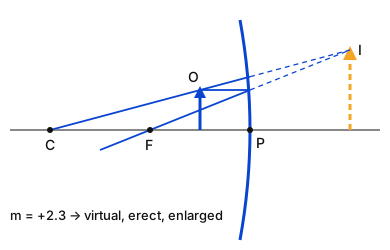
- : image is virtual, erect and times enlarged.
- Plane mirror always gives ; convex mirror gives .
- Only a concave mirror (object between P and F) gives a virtual, enlarged image.
Trick: → concave; → plane; → convex.
Answer: (C) Concave mirror
अवधारणा: । धनात्मक → आभासी, सीधा प्रतिबिंब; → बड़ा।
- : प्रतिबिंब आभासी, सीधा और गुना बड़ा है।
- समतल दर्पण सदा ; उत्तल दर्पण देता है।
- केवल अवतल दर्पण (वस्तु P और F के बीच) आभासी, बड़ा प्रतिबिंब देता है।
ट्रिक: → अवतल; → समतल; → उत्तल।
उत्तर: (C) अवतल दर्पण
RRB Technician Grade IIIGeneral ScienceMirror magnificationRRB Technician Grade III 2024 · 27 Dec Shift 2
Q794.Which of the following glands secretes trypsin enzyme?
निम्नलिखित में से कौन-सी ग्रंथि ट्रिप्सिन एंजाइम स्रावित करती है?
- AGastric glandजठर ग्रंथि
- BSalivary glandलार ग्रंथि
- CPancreasअग्न्याशय
- DLiverयकृत
Show answer
Concept: Pancreatic juice contains trypsin (proteins) and lipase (fats).
- Trypsin digests proteins in the small intestine.
- Gastric glands secrete pepsin and HCl; salivary glands secrete salivary amylase.
- Liver secretes bile, which has no digestive enzyme.
Yaad rakhein: Pancreas → trypsin + lipase; stomach → pepsin; saliva → amylase.
Answer: (C) Pancreas
अवधारणा: अग्नाशयी रस में ट्रिप्सिन (प्रोटीन हेतु) और लाइपेज (वसा हेतु) होते हैं।
- ट्रिप्सिन छोटी आँत में प्रोटीन का पाचन करता है।
- जठर ग्रंथियाँ पेप्सिन व HCl; लार ग्रंथियाँ लार एमाइलेज स्रावित करती हैं।
- यकृत पित्त बनाता है, जिसमें कोई पाचक एंजाइम नहीं होता।
याद रखें: अग्न्याशय → ट्रिप्सिन + लाइपेज; आमाशय → पेप्सिन; लार → एमाइलेज।
उत्तर: (C) अग्न्याशय
RRB Technician Grade IIIGeneral ScienceDigestive enzymesRRB Technician Grade III 2024 · 27 Dec Shift 2
Q795.Which of the following statements is/are NOT correct?
(i) Resistance of a conductor is independent of temperature.
(ii) The more the voltage across a resistor, the more is the current flowing through it.
(iii) The S.I unit of resistance is ohm.
निम्नलिखित में से कौन-सा/से कथन सही नहीं है/हैं?
(i) किसी चालक का प्रतिरोध ताप पर निर्भर नहीं करता है।
(ii) किसी प्रतिरोधक के सिरों पर विभवांतर जितना अधिक होगा, उससे प्रवाहित होने वाली धारा उतनी ही अधिक होगी।
(iii) प्रतिरोध का SI मात्रक ओम है।
- ABoth (ii) and (iii)(ii) और (iii) दोनों
- BOnly (i)केवल (i)
- COnly (ii)केवल (ii)
- DBoth (i) and (ii)(i) और (ii) दोनों
Show answer
Concept: Find the statement(s) that are NOT correct.
- (i) Resistance depends on temperature (for metals it rises with temperature) — NOT correct.
- (ii) Ohm's law: , so — more voltage, more current — correct.
- (iii) SI unit of resistance is ohm () — correct.
Yaad rakhein: depends on length, area, material and temperature.
Answer: (B) Only (i)
अवधारणा: वे कथन खोजें जो सही नहीं हैं।
- (i) प्रतिरोध ताप पर निर्भर करता है (धातुओं में ताप बढ़ने पर बढ़ता है) — सही नहीं।
- (ii) ओम का नियम: , अतः — सही।
- (iii) प्रतिरोध का SI मात्रक ओम () है — सही।
याद रखें: लंबाई, अनुप्रस्थ क्षेत्रफल, पदार्थ और ताप पर निर्भर करता है।
उत्तर: (B) केवल (i)
RRB Technician Grade IIIGeneral ScienceResistance and Ohm's lawRRB Technician Grade III 2024 · 27 Dec Shift 2
Q796.Conventionally, the germ-cell containing the stored food is called the:
परंपरागत रूप से, संचित भोजन वाली जनन-कोशिका को क्या कहा जाता है?
- Aimmature eggअपरिपक्व अंडाणु
- Bfemale gameteमादा युग्मक
- Cmotile gameteगतिशील युग्मक
- Dmale gameteनर युग्मक
Show answer
Concept: In sexual reproduction, the two germ cells differ in size and motility.
- One germ cell is large and contains stored food — the female gamete (egg).
- The other is small and motile — the male gamete (sperm).
- So the germ cell with stored food is conventionally called the female gamete.
Yaad rakhein: Female gamete: large, non-motile, stores food; male gamete: small, motile.
Answer: (B) female gamete
अवधारणा: लैंगिक जनन में दोनों जनन कोशिकाएँ आकार और गतिशीलता में भिन्न होती हैं।
- एक जनन कोशिका बड़ी होती है और उसमें भोजन संचित रहता है — मादा युग्मक (अंडाणु)।
- दूसरी छोटी व गतिशील होती है — नर युग्मक (शुक्राणु)।
- अतः संचित भोजन वाली जनन कोशिका को मादा युग्मक कहा जाता है।
याद रखें: मादा युग्मक: बड़ा, अचल, भोजन-संचित; नर युग्मक: छोटा, गतिशील।
उत्तर: (B) मादा युग्मक
RRB Technician Grade IIIGeneral ScienceGametesRRB Technician Grade III 2024 · 27 Dec Shift 2
Q797.Out of the following, which is a unit used for measuring the amount of work done on a body:
निम्नलिखित में से कौन-सा किसी वस्तु पर किए गए कार्य की मात्रा को मापने के लिए प्रयुक्त मात्रक है:
- ANewtonन्यूटन
- BMeterमीटर
- CJouleजूल
- DKilogramकिलोग्राम
Show answer
Concept: Work ; its SI unit is the joule (J).
- .
- Newton is the unit of force, metre of length, kilogram of mass.
- So work is measured in joule.
Trick: Work and energy share the same unit — joule.
Answer: (C) Joule
अवधारणा: कार्य ; इसका SI मात्रक जूल (J) है।
- ।
- न्यूटन बल का, मीटर लंबाई का, किलोग्राम द्रव्यमान का मात्रक है।
- अतः कार्य जूल में मापा जाता है।
ट्रिक: कार्य और ऊर्जा का मात्रक एक ही है — जूल।
उत्तर: (C) जूल
RRB Technician Grade IIIGeneral ScienceWork and energy – unitRRB Technician Grade III 2024 · 27 Dec Shift 2
Q798.The Chlor-alkali process is used for the formation of which of the following?
क्लोर-क्षार प्रक्रिया का उपयोग निम्नलिखित में से किसके निर्माण के लिए किया जाता है?
- ASodium carbonateसोडियम कार्बोनेट
- BSodium chlorideसोडियम क्लोराइड
- CSodium hydroxideसोडियम हाइड्रॉक्साइड
- DSodium bicarbonateसोडियम बाइकार्बोनेट
Show answer
Concept: Electrolysis of brine (aqueous NaCl) is called the chlor-alkali process.
- at anode, at cathode, NaOH near the cathode.
- Name: chlor (chlorine) + alkali (sodium hydroxide).
Trick: → Solvay process; → from ; NaOH → chlor-alkali.
Answer: (C) Sodium hydroxide
अवधारणा: ब्राइन (NaCl का जलीय विलयन) का विद्युत अपघटन क्लोर-क्षार प्रक्रम कहलाता है।
- ऐनोड पर , कैथोड पर , कैथोड के पास NaOH बनता है।
- नाम: क्लोर (क्लोरीन) + क्षार (सोडियम हाइड्रॉक्साइड)।
ट्रिक: धोने का सोडा → सॉल्वे प्रक्रम; NaOH → क्लोर-क्षार प्रक्रम।
उत्तर: (C) सोडियम हाइड्रॉक्साइड
RRB Technician Grade IIIGeneral ScienceChlor-alkali processRRB Technician Grade III 2024 · 27 Dec Shift 2
Q799.Which of the following scientists made the following statement?
“All cells arise from preexisting cells.”
निम्नलिखित में से किस वैज्ञानिक ने निम्नलिखित कथन दिया था?
“सभी कोशिकाएँ पूर्व-विद्यमान कोशिकाओं से उत्पन्न होती हैं।”
- ARudolf Virchowरुडोल्फ विर्शो
- BRobert Brownरॉबर्ट ब्राउन
- CPurkinjeपुरकिंजे
- DRobert Hookeरॉबर्ट हुक
Show answer
Concept: Schleiden and Schwann proposed the cell theory; Rudolf Virchow (1855) expanded it.
- Virchow stated: “Omnis cellula e cellula” — all cells arise from pre-existing cells.
- Robert Hooke discovered cells (1665); Robert Brown discovered the nucleus (1831).
- Purkinje coined the term protoplasm (1839).
Yaad rakhein: Hooke – cell; Brown – nucleus; Purkinje – protoplasm; Virchow – cells from cells.
Answer: (A) Rudolf Virchow
अवधारणा: श्लाइडेन और श्वान ने कोशिका सिद्धांत दिया; रुडोल्फ विरचो (1855) ने इसे आगे बढ़ाया।
- विरचो का कथन: “Omnis cellula e cellula” — सभी कोशिकाएँ पूर्ववर्ती कोशिकाओं से बनती हैं।
- रॉबर्ट हुक ने कोशिका (1665) और रॉबर्ट ब्राउन ने केंद्रक (1831) खोजा।
- पुरकिंजे ने 'प्रोटोप्लाज्म' शब्द (1839) दिया।
याद रखें: हुक – कोशिका; ब्राउन – केंद्रक; पुरकिंजे – जीवद्रव्य; विरचो – कोशिका से कोशिका।
उत्तर: (A) रुडोल्फ विर्शो
RRB Technician Grade IIIGeneral ScienceCell theoryRRB Technician Grade III 2024 · 27 Dec Shift 2
Q800.Which of the following cell organelles have their own DNA and ribosomes?
निम्नलिखित में से किस कोशिकांग का अपना DNA और राइबोसोम होता है?
- AGolgi apparatusगॉल्जी उपकरण
- BLysosomesलयनकाय (लाइसोसोम)
- CEndoplasmic reticulumअंतर्द्रव्यी जालिका
- DMitochondriaसूत्रकणिका (माइटोकॉन्ड्रिया)
Show answer
Concept: Some organelles are semi-autonomous: they have their own DNA and ribosomes.
- Mitochondria (and plastids) contain their own DNA and ribosomes.
- So they can make some of their own proteins.
- Golgi apparatus, lysosomes and ER have no DNA of their own.
Yaad rakhein: Own DNA + ribosomes → mitochondria and plastids (chloroplasts).
Answer: (D) Mitochondria
अवधारणा: कुछ कोशिकांग अर्ध-स्वायत्त होते हैं: उनमें अपना DNA और राइबोसोम होते हैं।
- माइटोकॉन्ड्रिया (और लवक) में अपना DNA व राइबोसोम होते हैं।
- इसलिए वे अपने कुछ प्रोटीन स्वयं बना सकते हैं।
- गॉल्जी उपकरण, लाइसोसोम और ER में अपना DNA नहीं होता।
याद रखें: अपना DNA + राइबोसोम → माइटोकॉन्ड्रिया और लवक (क्लोरोप्लास्ट)।
उत्तर: (D) सूत्रकणिका (माइटोकॉन्ड्रिया)
RRB Technician Grade IIIGeneral ScienceCell organelles – mitochondriaRRB Technician Grade III 2024 · 27 Dec Shift 2

