Q821.If multiple fission :: many cells, then binary fission :: ______.
यदि बहुखंडन :: अनेक कोशिकाएँ, तो द्विखंडन :: ______।
- Afour cellsचार कोशिकाएँ
- Btwo cellsदो कोशिकाएँ
- Cthree cellsतीन कोशिकाएँ
- Done cellएक कोशिका
Show answer
Concept: In fission a unicellular organism divides to form daughter cells.
- Multiple fission (e.g. Plasmodium) – one cell gives many daughter cells.
- Binary fission (e.g. Amoeba) – one cell divides into two cells.
- So the analogy gives 'two cells'.
Yaad rakhein: Binary = two (bi = 2).
Answer: (B) two cells
अवधारणा: विखंडन में एककोशिकीय जीव विभाजित होकर संतति कोशिकाएँ बनाता है।
- बहुखंडन (जैसे प्लाज़्मोडियम) – एक कोशिका से अनेक कोशिकाएँ।
- द्विखंडन (जैसे अमीबा) – एक कोशिका दो में बँटती है।
- अतः उत्तर 'दो कोशिकाएँ'।
याद रखें: द्वि = दो।
उत्तर: (B) दो कोशिकाएँ
RRB Technician Grade IIIGeneral ScienceReproduction – FissionRRB Technician Grade III 2024 · 27 Dec Shift 1
Q822.A bus travel the first 60 m in 30 s and then another 80 m in 40 s. Calculate the average speed of the bus in m s.
एक बस पहले 60 m की दूरी 30 s में और फिर अगले 80 m की दूरी 40 s में तय करती है। बस की औसत चाल m s में परिकलित कीजिए।
- A2.28 m s
- B1 m s
- C0.15 m s
- D2 m s
Show answer
Concept:
- Total distance
- Total time
- Average speed
Trick: Both parts have speed ; equal speeds give the same average.
Answer: (D) 2 m s
अवधारणा:
- कुल दूरी
- कुल समय
- औसत चाल
ट्रिक: दोनों भागों की चाल ; बराबर चाल का औसत भी वही।
उत्तर: (D) 2 m s
RRB Technician Grade IIIGeneral ScienceMotion – Average SpeedRRB Technician Grade III 2024 · 27 Dec Shift 1
Q823.A student has an eye-power of −0.5D. What is the focal length and type of lens of spectacles that she should use for correcting this defect?
एक छात्रा की आँख की क्षमता −0.5D है। इस दोष को ठीक करने के लिए उसे जिस चश्मे का उपयोग करना चाहिए, उसके लेंस की फोकस दूरी और प्रकार क्या है?
- A–2.5 m, concave lens–2.5 m, अवतल लेंस (concave lens)
- B2.5 m, convex lens2.5 m, उत्तल लेंस (convex lens)
- C–2.0 m, concave lens–2.0 m, अवतल लेंस (concave lens)
- D2.0 m, convex lens2.0 m, उत्तल लेंस (convex lens)
Show answer
Concept: Power ( in metres). Negative power means a concave (diverging) lens.
- Negative → concave lens (used to correct myopia).
Yaad rakhein: Minus power = concave lens = myopia correction.
Answer: (C) –2.0 m, concave lens
अवधारणा: क्षमता ( मीटर में)। ऋणात्मक क्षमता का अर्थ अवतल (अपसारी) लेंस।
- ऋणात्मक → अवतल लेंस (निकट-दृष्टि दोष के लिए)।
याद रखें: ऋण क्षमता = अवतल लेंस = निकट-दृष्टि सुधार।
उत्तर: (C) –2.0 m, अवतल लेंस (concave lens)
RRB Technician Grade IIIGeneral SciencePower of LensRRB Technician Grade III 2024 · 27 Dec Shift 1
Q824.Which of the following statements is true about a compound?
यौगिक के बारे में निम्नलिखित में से कौन-सा कथन सत्य है?
- AThe constituents can be separated by physical process.घटकों को भौतिक प्रक्रिया द्वारा पृथक किया जा सकता है।
- BIt is a physical change.यह एक भौतिक परिवर्तन है।
- CThe new product formed has totally different properties.बनने वाले नए उत्पाद के गुण पूर्णतः भिन्न होते हैं।
- DThe new product formed has similar properties to the constituents.बनने वाले नए उत्पाद के गुण घटकों के समान होते हैं।
Show answer
Concept: A compound is formed by chemical combination of elements in a fixed ratio.
- It is a chemical change, not a physical one.
- Its constituents cannot be separated by physical methods.
- The compound has properties totally different from its elements, e.g. is not magnetic though iron is.
Yaad rakhein: Compound = new substance, new properties; mixture keeps old properties.
Answer: (C) The new product formed has totally different properties.
अवधारणा: यौगिक तत्वों के निश्चित अनुपात में रासायनिक संयोग से बनता है।
- यह रासायनिक परिवर्तन है, भौतिक नहीं।
- इसके अवयव भौतिक विधियों से अलग नहीं होते।
- यौगिक के गुण तत्वों से बिल्कुल अलग होते हैं, जैसे चुंबकीय नहीं, जबकि लोहा है।
याद रखें: यौगिक = नया पदार्थ, नए गुण; मिश्रण पुराने गुण रखता है।
उत्तर: (C) बनने वाले नए उत्पाद के गुण पूर्णतः भिन्न होते हैं।
RRB Technician Grade IIIGeneral ScienceMixtures and CompoundsRRB Technician Grade III 2024 · 27 Dec Shift 1
Q825.Which of the following is the correct formula for pentane?
निम्नलिखित में से कौन-सा पेंटेन (pentane) का सही सूत्र है?
- AC5H12
- BC5H10
- CC5H14
- DC5H9
Show answer
Concept: Pentane is an alkane (saturated); alkanes follow .
- 'Pent' means 5 carbons: .
- Formula:
Yaad rakhein: Alkane , alkene , alkyne .
Answer: (A) C5H12
अवधारणा: पेंटेन एक ऐल्केन (संतृप्त) है; ऐल्केन का सूत्र है।
- 'पेंट' = 5 कार्बन: ।
- सूत्र:
याद रखें: ऐल्केन , ऐल्कीन , ऐल्काइन ।
उत्तर: (A) C5H12
RRB Technician Grade IIIGeneral ScienceHydrocarbons – AlkanesRRB Technician Grade III 2024 · 27 Dec Shift 1
Q826.If a ligament connects two bones, which of the following connects muscles to bones?
यदि स्नायुबंधन (ligament) दो हड्डियों को जोड़ता है, तो निम्नलिखित में से कौन-सा पेशियों को हड्डियों से जोड़ता है?
- ACartilageउपास्थि (Cartilage)
- BFibroblastफाइब्रोब्लास्ट (Fibroblast)
- CTendonकंडरा (Tendon)
- DBloodरक्त (Blood)
Show answer
Concept: Ligaments and tendons are fibrous connective tissues that join body parts.
- Ligament – joins bone to bone; it is elastic.
- Tendon – joins muscle to bone; it is strong with limited flexibility.
- Cartilage smoothens joint surfaces; blood is a fluid connective tissue.
Yaad rakhein: Ligament: Bone–Bone; Tendon: Muscle–Bone.
Answer: (C) Tendon
अवधारणा: स्नायु (लिगामेंट) और कंडरा (टेंडन) रेशेदार संयोजी ऊतक हैं जो अंगों को जोड़ते हैं।
- स्नायु – हड्डी को हड्डी से जोड़ता है; लचीला होता है।
- कंडरा – पेशी को हड्डी से जोड़ता है; मज़बूत, कम लचीला।
- उपास्थि जोड़ों की सतह चिकनी करती है; रक्त तरल संयोजी ऊतक है।
याद रखें: स्नायु: हड्डी–हड्डी; कंडरा: पेशी–हड्डी।
उत्तर: (C) कंडरा (Tendon)
RRB Technician Grade IIIGeneral ScienceConnective TissueRRB Technician Grade III 2024 · 27 Dec Shift 1
Q827.Which of the following statements is NOT true about a solution?
विलयन के बारे में निम्नलिखित में से कौन-सा कथन सत्य नहीं है?
- AParticles of the solution can be seen by the naked eye.विलयन के कणों को नंगी आँखों से देखा जा सकता है।
- BThe solute particles do not settle down when left undisturbed.अविचलित छोड़ देने पर विलेय के कण नीचे नहीं बैठते हैं।
- CA solution is a homogeneous mixture.विलयन एक समांगी मिश्रण है।
- DThe solute particles cannot be separated by filtration.विलेय के कणों को निस्पंदन द्वारा पृथक नहीं किया जा सकता है।
Show answer
Concept: A true solution is a homogeneous mixture with particles smaller than about .
- Particles are too small to be seen with the naked eye – statement A is false.
- They do not settle down when left undisturbed – true.
- They cannot be separated by filtration – true; it is homogeneous – true.
Yaad rakhein: Solution particles: invisible, non-settling, pass through filter paper.
Answer: (A) Particles of the solution can be seen by the naked eye.
अवधारणा: वास्तविक विलयन समांगी मिश्रण है जिसके कण लगभग से छोटे होते हैं।
- कण नंगी आँखों से नहीं दिखते – कथन A असत्य है।
- छोड़ देने पर कण नीचे नहीं बैठते – सत्य।
- छानकर अलग नहीं होते – सत्य; विलयन समांगी है – सत्य।
याद रखें: विलयन के कण: अदृश्य, नीचे नहीं बैठते, फ़िल्टर पेपर से निकल जाते हैं।
उत्तर: (A) विलयन के कणों को नंगी आँखों से देखा जा सकता है।
RRB Technician Grade IIIGeneral ScienceSolutions – PropertiesRRB Technician Grade III 2024 · 27 Dec Shift 1
Q828.The pH of gastric juice is _______.
जठर रस (gastric juice) का pH _______ होता है।
- A7.4
- B2.2
- C1.2
- D10.0
Show answer
Concept: The stomach secretes hydrochloric acid, so gastric juice is strongly acidic.
- HCl in the stomach activates pepsin and kills germs.
- pH of gastric juice ≈ 1.2.
- For comparison: blood ≈ 7.4 (slightly basic); lemon juice ≈ 2.2.
Yaad rakhein: Stomach ≈ 1.2, Lemon ≈ 2.2, Blood ≈ 7.4.
Answer: (C) 1.2
अवधारणा: आमाशय हाइड्रोक्लोरिक अम्ल स्रावित करता है, इसलिए जठर रस प्रबल अम्लीय होता है।
- आमाशय का HCl पेप्सिन को सक्रिय करता है और कीटाणु मारता है।
- जठर रस का pH ≈ 1.2।
- तुलना: रक्त ≈ 7.4 (हल्का क्षारीय); नींबू रस ≈ 2.2।
याद रखें: आमाशय ≈ 1.2, नींबू ≈ 2.2, रक्त ≈ 7.4।
उत्तर: (C) 1.2
RRB Technician Grade IIIGeneral SciencepH in Daily LifeRRB Technician Grade III 2024 · 27 Dec Shift 1
Q829.In the electrolytic refining process of metals, electrolyte is made up of which of the following?
धातुओं के विद्युत-अपघटनी परिष्करण (electrolytic refining) की प्रक्रम में, विद्युत-अपघट्य (electrolyte) निम्नलिखित में से किससे बना होता है?
- ACombination of pure metal and metal saltशुद्ध धातु और धातु लवण का संयोजन
- BImpure metalअशुद्ध धातु
- CMetal saltधातु लवण
- DPure metalशुद्ध धातु
Show answer
Concept: In electrolytic refining, impure metal is the anode, pure metal is the cathode and a solution of a soluble salt of that metal is the electrolyte.
- Example (copper): anode – impure Cu; cathode – thin strip of pure Cu.
- Electrolyte – acidified solution (a metal salt).
- On passing current, pure metal deposits on the cathode; impurities fall as anode mud.
Yaad rakhein: Anode = impure, Cathode = pure, Electrolyte = metal salt solution.
Answer: (C) Metal salt
अवधारणा: विद्युत अपघटनी परिष्करण में अशुद्ध धातु एनोड, शुद्ध धातु कैथोड और उसी धातु के घुलनशील लवण का विलयन विद्युत अपघट्य होता है।
- उदाहरण (ताँबा): एनोड – अशुद्ध Cu; कैथोड – शुद्ध Cu की पतली पट्टी।
- विद्युत अपघट्य – अम्लीकृत विलयन (धातु लवण)।
- धारा प्रवाहित करने पर शुद्ध धातु कैथोड पर जमती है; अशुद्धियाँ एनोड पंक बनती हैं।
याद रखें: एनोड = अशुद्ध, कैथोड = शुद्ध, विद्युत अपघट्य = धातु लवण विलयन।
उत्तर: (C) धातु लवण
RRB Technician Grade IIIGeneral ScienceMetallurgy – Electrolytic RefiningRRB Technician Grade III 2024 · 27 Dec Shift 1
Q830.If an object takes 2 seconds to travel once around a circular path with radius '', its speed 'v' is given by _____.
यदि कोई वस्तु त्रिज्या '' वाले वृत्ताकार पथ का एक चक्कर लगाने में 2 सेकंड लेती है, तो उसकी चाल 'v' _____ द्वारा दी जाती है।
- A metre/second मीटर/सेकंड
- B metre/second मीटर/सेकंड
- C metre/second मीटर/सेकंड
- D metre/second मीटर/सेकंड
Show answer
Concept: Speed = distance ÷ time; one round of a circle covers its circumference .
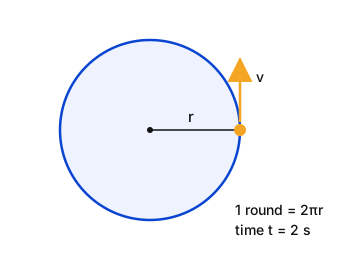
- Distance in one round
- Time taken
- metre/second
Trick: ; put and the 2's cancel.
Answer: (B) metre/second
अवधारणा: चाल = दूरी ÷ समय; वृत्त के एक चक्कर में परिधि तय होती है।
- एक चक्कर की दूरी
- लगा समय
- मीटर/सेकंड
ट्रिक: ; रखें तो 2 कट जाता है।
उत्तर: (B) मीटर/सेकंड
RRB Technician Grade IIIGeneral ScienceUniform Circular MotionRRB Technician Grade III 2024 · 27 Dec Shift 1
Q831.Ozone shields the surface of the earth from ultraviolet (UV) radiation from the Sun and the amount of ozone in the atmosphere begins to drop sharply due to which of the following synthetic chemicals?
ओज़ोन पृथ्वी की सतह को सूर्य से आने वाले पराबैंगनी (UV) विकिरण से बचाती है और निम्नलिखित में से किस संश्लेषित रसायन के कारण वायुमंडल में ओज़ोन की मात्रा तेजी से घटने लगती है?
- ACarbon monoxideकार्बन मोनोऑक्साइड
- BChlorofluorocarbonsक्लोरोफ्लोरोकार्बन
- CPesticidesपीड़कनाशी (Pesticides)
- DInsecticidesकीटनाशी (Insecticides)
Show answer
Concept: Ozone () in the stratosphere absorbs harmful UV rays; synthetic CFCs destroy it.
- CFCs were used as refrigerants and in fire extinguishers/aerosols.
- In the upper atmosphere UV light releases chlorine atoms from CFCs.
- Chlorine breaks down ozone, so ozone levels dropped sharply (from 1980s).
Yaad rakhein: CFC → chlorine → ozone hole. Montreal Protocol (1987) limits CFCs.
Answer: (B) Chlorofluorocarbons
अवधारणा: समतापमंडल की ओज़ोन () हानिकारक UV किरणें सोखती है; कृत्रिम CFC इसे नष्ट करते हैं।
- CFC प्रशीतक तथा अग्निशामक/एरोसोल में प्रयुक्त होते थे।
- ऊपरी वायुमंडल में UV प्रकाश CFC से क्लोरीन परमाणु मुक्त करता है।
- क्लोरीन ओज़ोन को तोड़ता है, जिससे (1980 के दशक से) ओज़ोन तेज़ी से घटी।
याद रखें: CFC → क्लोरीन → ओज़ोन छिद्र। मॉन्ट्रियल प्रोटोकॉल (1987) CFC को सीमित करता है।
उत्तर: (B) क्लोरोफ्लोरोकार्बन
RRB Technician Grade IIIGeneral ScienceOzone DepletionRRB Technician Grade III 2024 · 27 Dec Shift 1
Q832.In what direction is fluid pressure transmitted in any confined mass of fluid?
किसी परिरुद्ध तरल द्रव्यमान में तरल दाब किस दिशा में संचरित होता है?
- AIn two directions only.केवल दो दिशाओं में।
- BUndiminished in all directions.सभी दिशाओं में बिना घटे (समान रूप से)।
- CIn one direction only.केवल एक दिशा में।
- DIn three directions only.केवल तीन दिशाओं में।
Show answer
Concept: Pascal's law: pressure applied to a confined fluid is transmitted undiminished in all directions.
- Fluid particles push equally on every side.
- Pressure applied at one point reaches every part of the fluid and the container walls equally.
- Used in hydraulic lifts, hydraulic brakes and presses.
Yaad rakhein: Pascal = all directions, undiminished → hydraulic lift.
Answer: (B) Undiminished in all directions.
अवधारणा: पास्कल का नियम: बंद तरल पर लगाया गया दाब बिना घटे सभी दिशाओं में संचरित होता है।
- तरल के कण हर ओर बराबर धक्का देते हैं।
- एक बिंदु पर लगाया दाब तरल के हर भाग व पात्र की दीवारों तक समान पहुँचता है।
- उपयोग: हाइड्रोलिक लिफ्ट, हाइड्रोलिक ब्रेक, प्रेस।
याद रखें: पास्कल = सभी दिशाएँ, बिना घटे → हाइड्रोलिक लिफ्ट।
उत्तर: (B) सभी दिशाओं में बिना घटे (समान रूप से)।
RRB Technician Grade IIIGeneral SciencePascal's LawRRB Technician Grade III 2024 · 27 Dec Shift 1
Q833.A student in the lab observes the temperature of water on the Kelvin scale as 298K. What is the correct conversion of this temperature in the Celsius scale?
प्रयोगशाला में एक छात्र केल्विन पैमाने पर पानी का तापमान 298K देखता है। सेल्सियस पैमाने में इस तापमान का सही रूपांतरण क्या है?
- A32 degree Celsius32 डिग्री सेल्सियस
- B28 degree Celsius28 डिग्री सेल्सियस
- C25 degree Celsius25 डिग्री सेल्सियस
- D30 degree Celsius30 डिग्री सेल्सियस
Show answer
Concept:
- Given
- So the temperature is (room temperature).
Yaad rakhein: K → °C: subtract 273; °C → K: add 273.
Answer: (C) 25 degree Celsius
अवधारणा:
- दिया है
- अतः ताप (कमरे का ताप) है।
याद रखें: K → °C: 273 घटाएँ; °C → K: 273 जोड़ें।
उत्तर: (C) 25 डिग्री सेल्सियस
RRB Technician Grade IIIGeneral ScienceTemperature ScalesRRB Technician Grade III 2024 · 27 Dec Shift 1
Q834.In an aqueous solution, acid and base produce:
जलीय विलयन में, अम्ल और क्षारक क्रमशः क्या उत्पन्न करते हैं?
- ANa+ ions and CO32- ions, respectivelyक्रमशः Na+ आयन और CO32- आयन
- BH+ ions and OH- ions, respectivelyक्रमशः H+ आयन और OH- आयन
- CLi+ ions and CO32- ions, respectivelyक्रमशः Li+ आयन और CO32- आयन
- DK+ ions and CO32- ions, respectivelyक्रमशः K+ आयन और CO32- आयन
Show answer
Concept: Arrhenius idea: acids give ions and bases give ions in water.
- (in water forms ).
- So acid → , base → .
Yaad rakhein: Acid – ; Base – ; together they form water (neutralisation).
Answer: (B) H+ ions and OH- ions, respectively
अवधारणा: आर्रेनियस धारणा: जल में अम्ल आयन और क्षारक आयन देते हैं।
- (जल में से बनता है)।
- अतः अम्ल → , क्षारक → ।
याद रखें: अम्ल – ; क्षारक – ; दोनों मिलकर जल बनाते हैं (उदासीनीकरण)।
उत्तर: (B) क्रमशः H+ आयन और OH- आयन
RRB Technician Grade IIIGeneral ScienceAcids and BasesRRB Technician Grade III 2024 · 27 Dec Shift 1
Q835.A current of 2 A is flowing through a conductor of resistance 12 Ω. Then the potential difference across the conductor is:
12 Ω प्रतिरोध वाले एक चालक से 2 A की धारा प्रवाहित हो रही है। तो चालक के सिरों के बीच विभवांतर है:
- A12 V
- B24 V
- C6 V
- D35 V
Show answer
Concept: Ohm's law:
- ,
Trick: Remember the triangle V on top, I and R below: , , .
Answer: (B) 24 V
अवधारणा: ओम का नियम:
- ,
ट्रिक: त्रिभुज याद रखें – ऊपर V, नीचे I और R: , , ।
उत्तर: (B) 24 V
RRB Technician Grade IIIGeneral ScienceOhm's LawRRB Technician Grade III 2024 · 27 Dec Shift 1
Q836.If a 5 N force applied to an object displaces it by 3 m from it’s initial position, then what is the work done by the force?
यदि किसी वस्तु पर लगाया गया 5 N का बल उसे उसकी प्रारंभिक स्थिति से 3 m विस्थापित कर देता है, तो बल द्वारा किया गया कार्य कितना है?
- A20 J
- B5/3 J
- C50 J
- D15 J
Show answer
Concept: Work done (force along the displacement).
- ,
Yaad rakhein: .
Answer: (D) 15 J
अवधारणा: किया गया कार्य (विस्थापन की दिशा में बल)।
- ,
याद रखें: ।
उत्तर: (D) 15 J
RRB Technician Grade IIIGeneral ScienceWork DoneRRB Technician Grade III 2024 · 27 Dec Shift 1
Q837.Which of the following statement is NOT true for the magnetic field lines inside a current-carrying solenoid?
धारावाही परिनालिका (solenoid) के भीतर चुंबकीय क्षेत्र रेखाओं के लिए निम्नलिखित में से कौन-सा कथन सत्य नहीं है?
- AAlong the axis and parallel to each otherअक्ष के अनुदिश और एक-दूसरे के समानांतर
- BEllipsoidal and intersects with each otherदीर्घवृत्ताकार और एक-दूसरे को प्रतिच्छेदित करती हैं
- CUniform inside the solenoidपरिनालिका के भीतर एकसमान
- DThe same at all points inside the solenoidपरिनालिका के भीतर सभी बिंदुओं पर समान
Show answer
Concept: Inside a long current-carrying solenoid the field lines are straight, parallel to the axis and equally spaced – a uniform field.
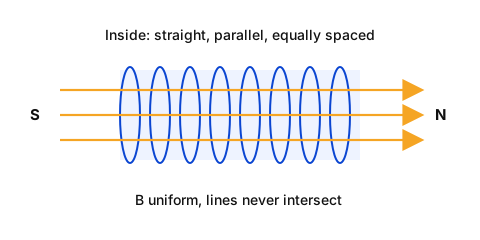
- Uniform field ⇒ same at all points inside (C, D true).
- Lines run along the axis, parallel to each other (A true).
- Magnetic field lines never intersect and are not ellipsoidal inside – B is NOT true.
Yaad rakhein: Field lines never cross – two directions at one point is impossible.
Answer: (B) Ellipsoidal and intersects with each other
अवधारणा: लंबी धारावाही परिनालिका के अंदर क्षेत्र रेखाएँ सीधी, अक्ष के समांतर और समान दूरी पर होती हैं – एकसमान क्षेत्र।
- एकसमान क्षेत्र ⇒ अंदर हर बिंदु पर समान (C, D सत्य)।
- रेखाएँ अक्ष के अनुदिश, एक-दूसरे के समांतर (A सत्य)।
- चुंबकीय रेखाएँ कभी नहीं काटतीं और अंदर दीर्घवृत्ताकार नहीं होतीं – B सत्य नहीं।
याद रखें: क्षेत्र रेखाएँ कभी नहीं काटतीं – एक बिंदु पर दो दिशाएँ असंभव।
उत्तर: (B) दीर्घवृत्ताकार और एक-दूसरे को प्रतिच्छेदित करती हैं
RRB Technician Grade IIIGeneral ScienceMagnetic Field of a SolenoidRRB Technician Grade III 2024 · 27 Dec Shift 1
Q838.The work done by a person pushing a brick parallel to the ground with a force of 2 N is 3 J. The displacement caused by the force is equal to _______.
एक व्यक्ति द्वारा 2 N के बल से एक ईंट को जमीन के समानांतर धकेलने में किया गया कार्य 3 J है। बल के कारण हुआ विस्थापन _______ के बराबर है।
- A1.5 m
- B6 m
- C5 m
- D0.66 m
Show answer
Concept:
- ,
Trick: Check: ✔.
Answer: (A) 1.5 m
अवधारणा:
- ,
ट्रिक: जाँच: ✔।
उत्तर: (A) 1.5 m
RRB Technician Grade IIIGeneral ScienceWork DoneRRB Technician Grade III 2024 · 27 Dec Shift 1
Q839.Which of the following compounds is NOT formed when ferrous sulphate is heated?
फेरस सल्फेट को गर्म करने पर निम्नलिखित में से कौन-सा यौगिक नहीं बनता है?
- AFerric oxideफेरिक ऑक्साइड
- BSulphur dioxideसल्फर डाइऑक्साइड
- CSulphur trioxideसल्फर ट्राइऑक्साइड
- DSulphuric acidसल्फ्यूरिक अम्ल
Show answer
Concept: Heating ferrous sulphate crystals is a thermal decomposition reaction.
- Products: ferric oxide, sulphur dioxide, sulphur trioxide.
- Sulphuric acid is not formed; green crystals first lose water and turn white, then brown.
Yaad rakhein: on heating → + + (smell of burning sulphur).
Answer: (D) Sulphuric acid
अवधारणा: फेरस सल्फेट क्रिस्टल को गर्म करना ऊष्मीय वियोजन अभिक्रिया है।
- उत्पाद: फेरिक ऑक्साइड, सल्फर डाइऑक्साइड, सल्फर ट्राइऑक्साइड।
- सल्फ्यूरिक अम्ल नहीं बनता; हरे क्रिस्टल पहले जल खोकर सफ़ेद, फिर भूरे हो जाते हैं।
याद रखें: गर्म करने पर → + + (जलते सल्फर की गंध)।
उत्तर: (D) सल्फ्यूरिक अम्ल
RRB Technician Grade IIIGeneral ScienceDecomposition ReactionRRB Technician Grade III 2024 · 27 Dec Shift 1
Q840.Consider an object moving along a straight line, it starts from point A, reaches point B, and then returns to point A. If the distance between A and B is 20 m, then the net displacement of the object is:
एक सरल रेखा के अनुदिश गतिमान एक वस्तु पर विचार कीजिए, यह बिंदु A से चलना शुरू करती है, बिंदु B पर पहुँचती है, और फिर बिंदु A पर लौट आती है। यदि A और B के बीच की दूरी 20 m है, तो वस्तु का कुल विस्थापन है:
- A10 m
- B0 m
- C40 m
- D20 m
Show answer
Concept: Displacement is the shortest distance from the initial to the final position.
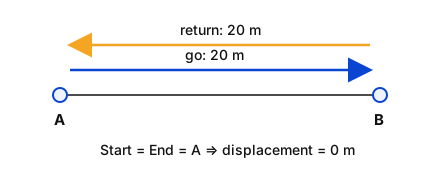
- Path: A → B (20 m) → A (20 m).
- Distance travelled .
- Initial and final positions are both A, so displacement .
Yaad rakhein: Back to start ⇒ displacement zero, though distance is not.
Answer: (B) 0 m
अवधारणा: विस्थापन प्रारंभिक से अंतिम स्थिति तक की न्यूनतम दूरी है।
- पथ: A → B (20 m) → A (20 m)।
- तय दूरी ।
- प्रारंभिक और अंतिम दोनों स्थितियाँ A हैं, अतः विस्थापन ।
याद रखें: वापस प्रारंभ पर ⇒ विस्थापन शून्य, पर दूरी नहीं।
उत्तर: (B) 0 m
RRB Technician Grade IIIGeneral ScienceDistance and DisplacementRRB Technician Grade III 2024 · 27 Dec Shift 1

