Q881.In which year were cells first discovered by Robert Hooke?
रॉबर्ट हुक द्वारा कोशिकाओं की खोज सर्वप्रथम किस वर्ष में की गई थी?
- A1665
- B1670
- C1667
- D1664
Show answer
Concept: Robert Hooke discovered cells in 1665 while observing a thin slice of cork with a self-designed microscope.
- The cork showed honeycomb-like compartments; he named them 'cells'.
- He published this in his book 'Micrographia'.
- Leeuwenhoek (1674) first saw free-living cells.
Yaad rakhein: 1665 – Hooke – cork – cell.
Answer: (A) 1665
अवधारणा: रॉबर्ट हुक ने 1665 में स्वनिर्मित सूक्ष्मदर्शी से कॉर्क की पतली काट देखते हुए कोशिका की खोज की।
- कॉर्क में मधुमक्खी के छत्ते जैसे कोष्ठ दिखे; उन्होंने इन्हें 'सेल' नाम दिया।
- यह उनकी पुस्तक 'माइक्रोग्राफ़िया' में प्रकाशित हुआ।
- ल्यूवेनहॉक (1674) ने पहली बार जीवित स्वतंत्र कोशिकाएँ देखीं।
याद रखें: 1665 – हुक – कॉर्क – कोशिका।
उत्तर: (A) 1665
RRB Technician Grade IIIGeneral ScienceDiscovery of cellRRB Technician Grade III 2024 · 26 Dec Shift 3
Q882.After the process of fertilisation which part of the flower undergoes transformation to develop into a seed?
निषेचन की प्रक्रिया के बाद फूल का कौन-सा भाग रूपांतरित होकर बीज के रूप में विकसित होता है?
- AStigmaवर्तिकाग्र (Stigma)
- BOvuleबीजांड (Ovule)
- CStyleवर्तिका (Style)
- DOvaryअंडाशय (Ovary)
Show answer
Concept: After fertilisation, the parts of the flower change: ovule → seed, ovary → fruit, zygote → embryo.
- The fertilised ovule develops a tough coat and becomes the seed.
- The ovary ripens into the fruit.
- Sepals, petals, stamens, stigma and style usually wither and fall.
Yaad rakhein: OVULE → SEED; OVARY → FRUIT.
Answer: (B) Ovule
अवधारणा: निषेचन के बाद पुष्प के भाग बदलते हैं: बीजांड → बीज, अंडाशय → फल, युग्मनज → भ्रूण।
- निषेचित बीजांड पर कठोर आवरण बनता है और वह बीज बन जाता है।
- अंडाशय पककर फल बनता है।
- बाह्यदल, दल, पुंकेसर, वर्तिकाग्र और वर्तिका प्रायः मुरझाकर गिर जाते हैं।
याद रखें: बीजांड → बीज; अंडाशय → फल।
उत्तर: (B) बीजांड (Ovule)
RRB Technician Grade IIIGeneral ScienceFertilisation in plantsRRB Technician Grade III 2024 · 26 Dec Shift 3
Q883.A pea plant climbs on other plants or fences with the help of:
मटर का पौधा किसकी सहायता से अन्य पौधों या बाड़ पर चढ़ता है?
- Asepalsबाह्यदल (sepals)
- Bpricklesकांटे (prickles)
- Ctendrilsप्रतान (tendrils)
- Drootsजड़ें (roots)
Show answer
Concept: Weak-stemmed climbers like pea have thin, thread-like tendrils that are sensitive to touch.
- When a tendril touches a support, the part away from the support grows faster.
- So the tendril coils around the fence or plant and the pea plant climbs up.
- Sepals protect the bud, prickles give defence, roots absorb water – none help in climbing.
Yaad rakhein: Pea, cucumber, grapes, gourd climb using tendrils (touch-sensitive growth = thigmotropism).
Answer: (C) tendrils
अवधारणा: मटर जैसी कमज़ोर तने वाली बेलों में पतले, धागे जैसे प्रतान (tendrils) होते हैं जो स्पर्श के प्रति संवेदनशील होते हैं।
- सहारे को छूने पर प्रतान का दूर वाला भाग तेज़ी से बढ़ता है।
- इससे प्रतान सहारे के चारों ओर लिपट जाता है और पौधा ऊपर चढ़ता है।
- बाह्यदल कली की रक्षा, काँटे सुरक्षा और जड़ें जल-अवशोषण करती हैं – चढ़ने में नहीं।
याद रखें: मटर, खीरा, अंगूर, लौकी – सभी प्रतान से चढ़ते हैं (स्पर्श-अनुवर्तन)।
उत्तर: (C) प्रतान (tendrils)
RRB Technician Grade IIIGeneral SciencePlant movement – tendrilsRRB Technician Grade III 2024 · 26 Dec Shift 2
Q884.Which of the following observable changes indicate that a chemical reaction has occurred?
(a) Formation of gas
(b) Formation of precipitates
(c) Change in physical state
(d) Colour change
निम्नलिखित में से कौन-से प्रेक्षणीय परिवर्तन यह दर्शाते हैं कि एक रासायनिक अभिक्रिया हुई है?
(a) गैस का बनना
(b) अवक्षेप का बनना
(c) भौतिक अवस्था में परिवर्तन
(d) रंग में परिवर्तन
- AAll (a), (b), (c) and (d)(a), (b), (c) और (d) सभी
- BOnly (a) and (b)केवल (a) और (b)
- COnly (a), (b) and (c)केवल (a), (b) और (c)
- DOnly (c) and (d)केवल (c) और (d)
Show answer
Concept: A chemical reaction is recognised by observable signs: gas evolution, precipitate formation, change in state, colour change and temperature change.
- (a) Gas: Zn + dil. gives bubbles.
- (b) Precipitate: + KI gives yellow .
- (c) State change: burning candle wax; (d) colour change: iron nail in solution.
Yaad rakhein: NCERT list – gas, precipitate, state, colour, temperature: all indicate a chemical reaction.
Answer: (A) All (a), (b), (c) and (d)
अवधारणा: रासायनिक अभिक्रिया की पहचान इन परिवर्तनों से होती है: गैस निकलना, अवक्षेप बनना, अवस्था परिवर्तन, रंग परिवर्तन और ताप परिवर्तन।
- (a) गैस: Zn + तनु से के बुलबुले।
- (b) अवक्षेप: + KI से पीला ।
- (c) अवस्था परिवर्तन: मोमबत्ती का जलना; (d) रंग परिवर्तन: विलयन में लोहे की कील।
याद रखें: NCERT सूची – गैस, अवक्षेप, अवस्था, रंग, ताप – सभी रासायनिक अभिक्रिया के संकेत हैं।
उत्तर: (A) (a), (b), (c) और (d) सभी
RRB Technician Grade IIIGeneral ScienceChemical reactions – observable changesRRB Technician Grade III 2024 · 26 Dec Shift 2
Q885.Which hormone regulates carbohydrate, protein and fat metabolism in the body and iodine is essential for the synthesis of it?
कौन-सा हार्मोन शरीर में कार्बोहाइड्रेट, प्रोटीन और वसा के उपापचय का नियंत्रण करता है और इसके संश्लेषण के लिए आयोडीन आवश्यक है?
- AAdrenaline hormoneएड्रीनलीन हार्मोन
- BTestosterone hormoneटेस्टोस्टेरोन हार्मोन
- CInsulin hormoneइंसुलिन हार्मोन
- DThyroxin hormoneथायरॉक्सिन हार्मोन
Show answer
Concept: The thyroid gland secretes thyroxin, which controls carbohydrate, protein and fat metabolism.
- Iodine is an essential part of the thyroxin molecule.
- Iodine deficiency → less thyroxin → goitre (swollen neck).
- Adrenaline – emergency; insulin – blood sugar; testosterone – male characters.
Trick: Iodine → Thyroid → Thyroxin → Metabolism; that is why iodised salt is advised.
Answer: (D) Thyroxin hormone
अवधारणा: थायरॉयड ग्रंथि थायरॉक्सिन स्रावित करती है, जो कार्बोहाइड्रेट, प्रोटीन और वसा के उपापचय को नियंत्रित करता है।
- थायरॉक्सिन बनाने के लिए आयोडीन आवश्यक है।
- आयोडीन की कमी → थायरॉक्सिन कम → घेंघा (गॉयटर)।
- एड्रीनलिन – आपातकाल; इंसुलिन – रक्त शर्करा; टेस्टोस्टेरोन – नर लक्षण।
ट्रिक: आयोडीन → थायरॉयड → थायरॉक्सिन → उपापचय; इसलिए आयोडीन युक्त नमक की सलाह दी जाती है।
उत्तर: (D) थायरॉक्सिन हार्मोन
RRB Technician Grade IIIGeneral ScienceThyroxin hormoneRRB Technician Grade III 2024 · 26 Dec Shift 2
Q886.Which of the following correctly describes the sum of kinetic energy and potential energy of an object?
निम्नलिखित में से कौन-सा किसी वस्तु की गतिज ऊर्जा और स्थितिज ऊर्जा के योग का सही वर्णन करता है?
- ATotal mechanical energyकुल यांत्रिक ऊर्जा
- BTotal thermal energyकुल तापीय ऊर्जा
- CTotal chemical energyकुल रासायनिक ऊर्जा
- DTotal electrical energyकुल विद्युत ऊर्जा
Show answer
Concept: Energy due to motion is kinetic energy and energy due to position/height is potential energy.
- and .
- Their sum is the total mechanical energy: .
- For a freely falling body (no air resistance), this total stays constant.
Yaad rakhein: Mechanical = Kinetic + Potential; thermal, chemical, electrical are other forms.
Answer: (A) Total mechanical energy
अवधारणा: गति के कारण ऊर्जा गतिज ऊर्जा और स्थिति/ऊँचाई के कारण ऊर्जा स्थितिज ऊर्जा कहलाती है।
- तथा ।
- दोनों का योग कुल यांत्रिक ऊर्जा है: ।
- मुक्त रूप से गिरती वस्तु (वायु प्रतिरोध नहीं) में यह योग स्थिर रहता है।
याद रखें: यांत्रिक = गतिज + स्थितिज; ऊष्मीय, रासायनिक, विद्युत अलग रूप हैं।
उत्तर: (A) कुल यांत्रिक ऊर्जा
RRB Technician Grade IIIGeneral ScienceMechanical energyRRB Technician Grade III 2024 · 26 Dec Shift 2
Q887.Which of the following is NOT a phase transition between the states of matter?
निम्नलिखित में से कौन-सा पदार्थ की अवस्थाओं के बीच प्रावस्था संक्रमण (phase transition) नहीं है?
- ASublimationऊर्ध्वपातन (Sublimation)
- BEmissionउत्सर्जन (Emission)
- CVaporizationवाष्पन (Vaporization)
- DCondensationसंघनन (Condensation)
Show answer
Concept: A phase transition is a change of matter from one state (solid, liquid, gas) to another.
- Sublimation: solid → gas directly (camphor).
- Vaporization: liquid → gas; Condensation: gas → liquid.
- Emission (e.g. of light or gases) is not a change of state.
Yaad rakhein: State changes: melting, freezing, vaporization, condensation, sublimation, deposition.
Answer: (B) Emission
अवधारणा: अवस्था परिवर्तन में पदार्थ एक अवस्था (ठोस, द्रव, गैस) से दूसरी में बदलता है।
- ऊर्ध्वपातन: ठोस → सीधे गैस (कपूर)।
- वाष्पन: द्रव → गैस; संघनन: गैस → द्रव।
- उत्सर्जन (प्रकाश या गैसों का निकलना) अवस्था परिवर्तन नहीं है।
याद रखें: अवस्था परिवर्तन: गलन, हिमीकरण, वाष्पन, संघनन, ऊर्ध्वपातन, निक्षेपण।
उत्तर: (B) उत्सर्जन (Emission)
RRB Technician Grade IIIGeneral ScienceChange of stateRRB Technician Grade III 2024 · 26 Dec Shift 2
Q888.The magnetic field lines inside a current carrying solenoid are in the form of:
विद्युत धारावाही परिनालिका (solenoid) के अंदर चुंबकीय क्षेत्र रेखाएँ किस रूप में होती हैं?
- Aperpendicular straight linesलंबवत सरल रेखाएँ
- Bconcentric circlesसंकेंद्री वृत्त
- Cparallel straight linesसमांतर सरल रेखाएँ
- Dcurved linesवक्र रेखाएँ
Show answer
Concept: A solenoid is a long coil of many turns of insulated wire. The field produced by all turns adds up inside it.
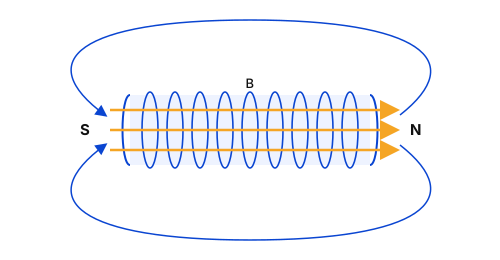
- Inside the solenoid the field is uniform (same everywhere).
- A uniform field is shown by parallel straight lines, equally spaced.
- Outside, lines curve from N to S like a bar magnet.
Yaad rakhein: Concentric circles = straight wire; parallel straight lines = inside a solenoid.
Answer: (C) parallel straight lines
अवधारणा: परिनालिका विद्युतरोधी तार के अनेक फेरों की लंबी कुंडली है। सभी फेरों का क्षेत्र भीतर जुड़ जाता है।
- परिनालिका के भीतर चुंबकीय क्षेत्र एकसमान होता है।
- एकसमान क्षेत्र को समान दूरी वाली समांतर सीधी रेखाओं से दिखाते हैं।
- बाहर रेखाएँ छड़ चुंबक की तरह N से S की ओर मुड़ती हैं।
याद रखें: संकेंद्री वृत्त = सीधा तार; समांतर सीधी रेखाएँ = परिनालिका के भीतर।
उत्तर: (C) समांतर सरल रेखाएँ
RRB Technician Grade IIIGeneral ScienceMagnetic field of a solenoidRRB Technician Grade III 2024 · 26 Dec Shift 2
Q889.Which of the following changes take place in plants by environmental triggers such as light, or gravity?
प्रकाश या गुरुत्व जैसे पर्यावरणीय उद्दीपकों द्वारा पौधों में निम्नलिखित में से कौन-से परिवर्तन होते हैं?
- AChange in the size of ovary and anther of the flower they produceउनके द्वारा उत्पन्न पुष्प के अंडाशय और परागकोश के आकार में परिवर्तन
- BChange in the directions that plant parts grow inपौधे के भागों के वृद्धि करने की दिशाओं में परिवर्तन
- CChange in the shape of the leaves and fruits they provideउनके द्वारा दी जाने वाली पत्तियों और फलों की आकृति में परिवर्तन
- DChange in the branching pattern of their rootsउनकी जड़ों के शाखन प्रतिरूप में परिवर्तन
Show answer
Concept: Plants respond to environmental stimuli like light, gravity, water and chemicals by directional growth called tropism.
- Phototropism: shoot grows towards light.
- Geotropism: root grows downward with gravity, shoot upward.
- So these triggers change the direction in which plant parts grow.
Yaad rakhein: Photo – light, Geo – gravity, Hydro – water, Chemo – chemicals.
Answer: (B) Change in the directions that plant parts grow in
अवधारणा: पौधे प्रकाश, गुरुत्व, जल और रसायन जैसे उद्दीपनों पर दिशात्मक वृद्धि द्वारा अनुक्रिया करते हैं, जिसे अनुवर्तन कहते हैं।
- प्रकाशानुवर्तन: तना प्रकाश की ओर बढ़ता है।
- गुरुत्वानुवर्तन: जड़ नीचे और तना ऊपर बढ़ता है।
- अतः ये उद्दीपन पौधों के भागों की वृद्धि की दिशा बदलते हैं।
याद रखें: प्रकाश – Photo, गुरुत्व – Geo, जल – Hydro, रसायन – Chemo।
उत्तर: (B) पौधे के भागों के वृद्धि करने की दिशाओं में परिवर्तन
RRB Technician Grade IIIGeneral ScienceTropic movements in plantsRRB Technician Grade III 2024 · 26 Dec Shift 2
Q890.If 400 J of heat is produced each second in a 4 resistance, then the current flowing across the resistor is:
यदि 4 के प्रतिरोध में प्रत्येक सेकंड 400 J ऊष्मा उत्पन्न होती है, तो प्रतिरोधक से प्रवाहित होने वाली धारा है:
- A40 A
- B20 A
- C30 A
- D10 A
Show answer
Concept: Heat produced per second (power) in a resistor: .
- (400 J each second), .
- .
- .
Trick: Check option: ✓ – just square each option and multiply by 4.
Answer: (D) 10 A
अवधारणा: प्रतिरोध में प्रति सेकंड उत्पन्न ऊष्मा (शक्ति): ।
- (प्रति सेकंड 400 J), ।
- ।
- ।
ट्रिक: विकल्प जाँचें: ✓ – हर विकल्प का वर्ग करके 4 से गुणा करें।
उत्तर: (D) 10 A
RRB Technician Grade IIIGeneral ScienceHeating effect of currentRRB Technician Grade III 2024 · 26 Dec Shift 2
Q891.As the temperature increases, the kinetic energy of particles of matter _______.
जैसे-जैसे तापमान बढ़ता है, पदार्थ के कणों की गतिज ऊर्जा _______।
- Aremains the sameसमान रहती है
- Bbecomes zeroशून्य हो जाती है
- Cdecreasesघटती है
- Dincreasesबढ़ती है
Show answer
Concept: Temperature is a measure of the average kinetic energy of the particles of matter.
- On heating, particles absorb energy and vibrate/move faster.
- Faster motion means higher kinetic energy.
- That is why heated solids melt and liquids evaporate faster.
Yaad rakhein: Temperature ↑ ⇒ KE of particles ↑ (and diffusion becomes faster).
Answer: (D) increases
अवधारणा: ताप पदार्थ के कणों की औसत गतिज ऊर्जा का माप है।
- गर्म करने पर कण ऊर्जा लेकर तेज़ी से गति/कंपन करते हैं।
- तेज़ गति का अर्थ अधिक गतिज ऊर्जा है।
- इसी कारण गर्म ठोस पिघलते हैं और द्रव तेज़ी से वाष्पित होते हैं।
याद रखें: ताप ↑ ⇒ कणों की गतिज ऊर्जा ↑ (विसरण भी तेज़)।
उत्तर: (D) बढ़ती है
RRB Technician Grade IIIGeneral ScienceKinetic energy and temperatureRRB Technician Grade III 2024 · 26 Dec Shift 2
Q892.In which of the following types of reaction is there an exchange of ions between the reactants?
निम्नलिखित में से किस प्रकार की अभिक्रिया में अभिकारकों के बीच आयनों का आदान-प्रदान होता है?
- ADouble displacement reactionद्विविस्थापन अभिक्रिया
- BDisproportion reactionअसमानुपातन अभिक्रिया
- CDecompositionवियोजन (अपघटन)
- DAddition reactionयोगात्मक अभिक्रिया
Show answer
Concept: In a double displacement reaction, two compounds exchange their ions to form two new compounds.
- General form: .
- Example: .
- Decomposition breaks one compound; addition joins molecules – no ion exchange.
Trick: “Partners swap” = double displacement; often a precipitate forms.
Answer: (A) Double displacement reaction
अवधारणा: द्वि-विस्थापन अभिक्रिया में दो यौगिक आपस में आयनों का आदान-प्रदान करके दो नए यौगिक बनाते हैं।
- सामान्य रूप: ।
- उदाहरण: ।
- अपघटन में एक यौगिक टूटता है; योगात्मक में अणु जुड़ते हैं – आयन विनिमय नहीं।
ट्रिक: “साथी बदलो” = द्वि-विस्थापन; प्रायः अवक्षेप बनता है।
उत्तर: (A) द्विविस्थापन अभिक्रिया
RRB Technician Grade IIIGeneral ScienceDouble displacement reactionRRB Technician Grade III 2024 · 26 Dec Shift 2
Q893.For a given colour and given pair of media, and light is going from rarer to denser media, the ratio of sine of the angle of incidence to the sine of angle of refraction is:
किसी दिए गए रंग और माध्यमों के दिए गए युग्म के लिए, जब प्रकाश विरल माध्यम से सघन माध्यम में जा रहा हो, तो आपतन कोण की ज्या (sine) और अपवर्तन कोण की ज्या का अनुपात होता है:
- Aalways zeroसदैव शून्य
- Ba constant greater than 11 से अधिक एक नियतांक
- Ca constant less than 11 से कम एक नियतांक
- Dalways 1सदैव 1
Show answer
Concept: Snell's law: for a given colour and pair of media, .
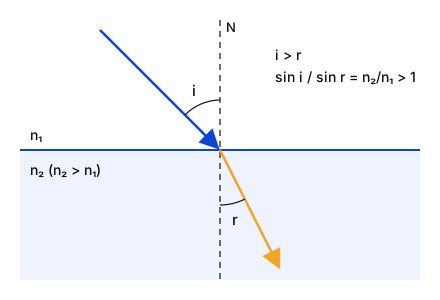
- Going from rarer to denser medium, light bends towards the normal, so .
- Hence , so .
- This constant is the refractive index of the denser medium w.r.t. the rarer one.
Yaad rakhein: Rarer → denser: bends towards normal, ratio ; denser → rarer: ratio .
Answer: (B) a constant greater than 1
अवधारणा: स्नेल नियम: किसी रंग और माध्यम-युग्म के लिए ।
- विरल से सघन माध्यम में प्रकाश अभिलंब की ओर मुड़ता है, अतः ।
- इसलिए , यानी ।
- यह नियतांक विरल के सापेक्ष सघन माध्यम का अपवर्तनांक है।
याद रखें: विरल → सघन: अभिलंब की ओर, अनुपात ; सघन → विरल: अनुपात ।
उत्तर: (B) 1 से अधिक एक नियतांक
RRB Technician Grade IIIGeneral ScienceSnell's law of refractionRRB Technician Grade III 2024 · 26 Dec Shift 2
Q894.Sporangia blobs contain cells or spores that can eventually develop into new Rhizopus individuals. Such asexual reproduction is known as:
बीजाणुधानी (sporangia) के गोलकों में कोशिकाएँ या बीजाणु होते हैं जो अंततः नए राइजोपस जीवों में विकसित हो सकते हैं। ऐसे अलैंगिक जनन को क्या कहा जाता है?
- Abuddingमुकुलन (budding)
- Bvegetative propagationकायिक प्रवर्धन (vegetative propagation)
- Cspore formationबीजाणु समासंघ (spore formation)
- Dregenerationपुनरुद्भवन (regeneration)
Show answer
Concept: In Rhizopus (bread mould), the blob-like sporangia on hyphae contain many spores.
- Spores are covered by thick walls that protect them until they reach a moist surface.
- On a suitable surface each spore grows into a new Rhizopus.
- This asexual method is called spore formation.
Yaad rakhein: Rhizopus – spores; Hydra/yeast – budding; Spirogyra – fragmentation; Planaria – regeneration.
Answer: (C) spore formation
अवधारणा: राइजोपस (ब्रेड मोल्ड) के कवक तंतुओं पर बने गोल बीजाणुधानी (sporangia) में अनेक बीजाणु होते हैं।
- बीजाणु मोटी भित्ति से ढके रहते हैं जो नम सतह मिलने तक उनकी रक्षा करती है।
- उपयुक्त सतह पर हर बीजाणु नए राइजोपस में विकसित होता है।
- इस अलैंगिक विधि को बीजाणु निर्माण कहते हैं।
याद रखें: राइजोपस – बीजाणु; हाइड्रा/यीस्ट – मुकुलन; स्पाइरोगायरा – खंडन; प्लेनेरिया – पुनर्जनन।
उत्तर: (C) बीजाणु समासंघ (spore formation)
RRB Technician Grade IIIGeneral ScienceSpore formationRRB Technician Grade III 2024 · 26 Dec Shift 2
Q895.The rate of diffusion of liquids is higher than that of solids because:
द्रवों की विसरण दर ठोसों की तुलना में अधिक होती है, क्योंकि:
- Ain the liquid state, particles do not move freely, but have greater space between each otherद्रव अवस्था में, कण स्वतंत्र रूप से गति नहीं करते, परंतु उनके बीच अधिक रिक्त स्थान होता है
- Bin the liquid state, particles move freely and have greater space between each otherद्रव अवस्था में, कण स्वतंत्र रूप से गति करते हैं और उनके बीच अधिक रिक्त स्थान होता है
- Cin the liquid state, particles only move freely and do not have greater space between each otherद्रव अवस्था में, कण केवल स्वतंत्र रूप से गति करते हैं और उनके बीच अधिक रिक्त स्थान नहीं होता
- Din the liquid state, particles do not move freely and do not have greater space between each otherद्रव अवस्था में, कण न तो स्वतंत्र रूप से गति करते हैं और न ही उनके बीच अधिक रिक्त स्थान होता है
Show answer
Concept: Diffusion depends on how freely particles move and how much space lies between them.
- In solids, particles are tightly packed and only vibrate in place.
- In liquids, particles move freely and have more space between them.
- So particles of another substance mix faster in liquids – diffusion rate is higher.
Yaad rakhein: Diffusion rate: gas > liquid > solid (more space and freedom → faster).
Answer: (B) in the liquid state, particles move freely and have greater space between each other
अवधारणा: विसरण इस पर निर्भर है कि कण कितनी स्वतंत्रता से गति करते हैं और उनके बीच कितना स्थान है।
- ठोस में कण सघन रूप से बँधे होते हैं, केवल अपने स्थान पर कंपन करते हैं।
- द्रव में कण स्वतंत्र रूप से गति करते हैं और उनके बीच अधिक स्थान होता है।
- इसलिए द्रव में दूसरे पदार्थ के कण तेज़ी से मिलते हैं – विसरण दर अधिक।
याद रखें: विसरण दर: गैस > द्रव > ठोस (अधिक स्थान व स्वतंत्रता → तेज़)।
उत्तर: (B) द्रव अवस्था में, कण स्वतंत्र रूप से गति करते हैं और उनके बीच अधिक रिक्त स्थान होता है
RRB Technician Grade IIIGeneral ScienceDiffusion in liquids and solidsRRB Technician Grade III 2024 · 26 Dec Shift 2
Q896.Which of the following molecules is diatomic in nature?
निम्नलिखित में से कौन-सा अणु प्रकृति में द्विपरमाणुक है?
- AArgonआर्गन
- BOxygenऑक्सीजन
- CPhosphorusफॉस्फोरस
- DHeliumहीलियम
Show answer
Concept: Atomicity = number of atoms in one molecule of an element.
- Oxygen exists as – two atoms, so diatomic.
- Argon and helium are noble gases – monoatomic (Ar, He).
- Phosphorus exists as – tetra-atomic.
Yaad rakhein: Diatomic elements: .
Answer: (B) Oxygen
अवधारणा: परमाणुकता = किसी तत्व के एक अणु में परमाणुओं की संख्या।
- ऑक्सीजन रूप में रहती है – दो परमाणु, अतः द्विपरमाणुक।
- आर्गन और हीलियम उत्कृष्ट गैसें हैं – एकपरमाणुक (Ar, He)।
- फॉस्फोरस रूप में – चतुःपरमाणुक।
याद रखें: द्विपरमाणुक तत्व: ।
उत्तर: (B) ऑक्सीजन
RRB Technician Grade IIIGeneral ScienceAtomicity of moleculesRRB Technician Grade III 2024 · 26 Dec Shift 2
Q897.The acceleration due to gravity on an object of mass m placed near the surface of the earth is:
पृथ्वी की सतह के निकट रखी m द्रव्यमान की किसी वस्तु पर गुरुत्वीय त्वरण होता है:
- Aindependent of mm पर निर्भर नहीं करता
- Blinearly proportional to mm के रैखिक रूप से समानुपाती
- Clinearly proportional to के रैखिक रूप से समानुपाती
- Dinversely proportional to mm के व्युत्क्रमानुपाती
Show answer
Concept: Force on mass near the earth: , and .
- Equate: .
- cancels: .
- depends only on the earth's mass and radius, not on the object's mass.
Trick: A feather and a coin fall together in vacuum – proof that is independent of .
Answer: (A) independent of m
अवधारणा: पृथ्वी के पास द्रव्यमान पर बल: तथा ।
- बराबर करें: ।
- कट जाता है: ।
- केवल पृथ्वी के द्रव्यमान और त्रिज्या पर निर्भर है, वस्तु के द्रव्यमान पर नहीं।
ट्रिक: निर्वात में पंख और सिक्का साथ गिरते हैं – , से स्वतंत्र है।
उत्तर: (A) m पर निर्भर नहीं करता
RRB Technician Grade IIIGeneral ScienceAcceleration due to gravityRRB Technician Grade III 2024 · 26 Dec Shift 2
Q898.Select the correct pairs from the following options.
निम्नलिखित विकल्पों में से सही युग्मों का चयन कीजिए।
- A(a) Resistance - volt/ampere
(b) Resistivity - ohm(a) प्रतिरोध - वोल्ट/ऐम्पियर
(b) प्रतिरोधकता - ओम - B(a) Resistance - ampere metre
(b) Resistivity - volt/metre(a) प्रतिरोध - ऐम्पियर मीटर
(b) प्रतिरोधकता - वोल्ट/मीटर - C(a) Resistance - ohm
(b) Resistivity - volt/metre(a) प्रतिरोध - ओम
(b) प्रतिरोधकता - वोल्ट/मीटर - D(a) Resistance - ohm
(b) Resistivity - ohm metre(a) प्रतिरोध - ओम
(b) प्रतिरोधकता - ओम मीटर
Show answer
Concept: , so unit of resistance = (ohm). Also .
- → unit .
- (A) is wrong as resistivity is not ohm; (C) is wrong as resistivity is not volt/metre.
- Only (D): resistance – ohm, resistivity – ohm metre.
Trick: Resistivity always carries an extra “metre”: ohm-metre.
Answer: (D) (a) Resistance - ohm (b) Resistivity - ohm metre
अवधारणा: , अतः प्रतिरोध का मात्रक (ओम)। साथ ही ।
- → मात्रक ।
- (A) ग़लत – प्रतिरोधकता ओम नहीं; (C) ग़लत – प्रतिरोधकता वोल्ट/मीटर नहीं।
- केवल (D): प्रतिरोध – ओम, प्रतिरोधकता – ओम मीटर।
ट्रिक: प्रतिरोधकता में हमेशा एक अतिरिक्त “मीटर” होता है: ओम-मीटर।
उत्तर: (D) (a) प्रतिरोध - ओम (b) प्रतिरोधकता - ओम मीटर
RRB Technician Grade IIIGeneral ScienceSI units of resistance and resistivityRRB Technician Grade III 2024 · 26 Dec Shift 2
Q899.During meiosis, a cell divides to create _______ new cells.
अर्धसूत्री विभाजन (meiosis) के दौरान, एक कोशिका विभाजित होकर _______ नई कोशिकाएँ बनाती है।
- AFourचार
- BTwenty-fourचौबीस
- CSixteenसोलह
- DEightआठ
Show answer
Concept: Meiosis is reduction division that forms gametes with half the chromosome number.
- Meiosis I: 1 diploid cell → 2 cells.
- Meiosis II: each of these divides again → 4 cells.
- All four daughter cells are haploid.
Yaad rakhein: Mitosis → 2 identical cells; Meiosis → 4 haploid cells.
Answer: (A) Four
अवधारणा: अर्धसूत्री विभाजन (meiosis) न्यूनीकरण विभाजन है जिससे आधे गुणसूत्र वाले युग्मक बनते हैं।
- अर्धसूत्री I: 1 द्विगुणित कोशिका → 2 कोशिकाएँ।
- अर्धसूत्री II: प्रत्येक फिर विभाजित → 4 कोशिकाएँ।
- चारों संतति कोशिकाएँ अगुणित होती हैं।
याद रखें: समसूत्री → 2 समान कोशिकाएँ; अर्धसूत्री → 4 अगुणित कोशिकाएँ।
उत्तर: (A) चार
RRB Technician Grade IIIGeneral ScienceMeiosisRRB Technician Grade III 2024 · 26 Dec Shift 2
Q900.During the decomposition reaction of lead nitrate, the observed brown colour fumes are of which gas?
लेड नाइट्रेट की वियोजन अभिक्रिया के दौरान, दिखाई देने वाला भूरे रंग का धुआँ किस गैस का होता है?
- AHydrogen gasहाइड्रोजन गैस
- BNitrogen gasनाइट्रोजन गैस
- CNitrogen dioxide gasनाइट्रोजन डाइऑक्साइड गैस
- DOzone gasओज़ोन गैस
Show answer
Concept: Heating lead nitrate is a thermal decomposition reaction.
- .
- (nitrogen dioxide) is a brown gas – the brown fumes seen.
- remains as yellow residue; is colourless.
Yaad rakhein: Brown fumes = (from heating nitrates like lead nitrate).
Answer: (C) Nitrogen dioxide gas
अवधारणा: लेड नाइट्रेट को गर्म करना ऊष्मीय अपघटन अभिक्रिया है।
- ।
- (नाइट्रोजन डाइऑक्साइड) भूरी गैस है – यही भूरा धुआँ है।
- पीले अवशेष के रूप में बचता है; रंगहीन है।
याद रखें: भूरा धुआँ = (लेड नाइट्रेट जैसे नाइट्रेट गर्म करने पर)।
उत्तर: (C) नाइट्रोजन डाइऑक्साइड गैस
RRB Technician Grade IIIGeneral ScienceDecomposition of lead nitrateRRB Technician Grade III 2024 · 26 Dec Shift 2

