Q1021.Which tissue is a distinctive feature of complex plants, one that has made possible their survival in the terrestrial environment?
कौन-सा ऊतक जटिल पादपों की एक विशिष्ट विशेषता है, जिसने स्थलीय पर्यावरण में उनके अस्तित्व को संभव बनाया है?
- AVascular tissueसंवहनी ऊतक (Vascular tissue)
- BConnective tissueसंयोजी ऊतक (Connective tissue)
- CEpithelial tissueउपकला ऊतक (Epithelial tissue)
- DMeristematic tissueविभज्योतक ऊतक (Meristematic tissue)
Show answer
Concept: Vascular (conducting) tissue – xylem and phloem – is a distinctive feature of complex plants and made their survival on land possible.
- Xylem carries water and minerals from roots upward.
- Phloem carries food from leaves to other parts.
- This allows plants to grow tall and live away from water.
- Connective and epithelial tissues are animal tissues.
Yaad rakhein: Xylem → water (one way, up); phloem → food (both ways).
Answer: (A) Vascular tissue
अवधारणा: संवहनी (चालक) ऊतक – जाइलम और फ्लोएम – जटिल पौधों की विशेषता है जिसने उन्हें स्थल पर जीवित रहना संभव बनाया।
- जाइलम जल और खनिज जड़ से ऊपर ले जाता है।
- फ्लोएम पत्तियों से भोजन अन्य भागों तक ले जाता है।
- इससे पौधे ऊँचे बढ़ सकते हैं और जल से दूर रह सकते हैं।
- संयोजी और उपकला ऊतक जंतु ऊतक हैं।
याद रखें: जाइलम → जल (ऊपर की ओर); फ्लोएम → भोजन (दोनों दिशाओं में)।
उत्तर: (A) संवहनी ऊतक (Vascular tissue)
RRB Technician Grade IIIGeneral SciencePlant tissuesRRB Technician Grade III 2024 · 24 Dec Shift 2
Q1022.Which of the following is a common drawback of using soap in hard water?
कठोर जल में साबुन का उपयोग करने की एक सामान्य कमी निम्नलिखित में से कौन-सी है?
- ASoap loses its colour in hard water.कठोर जल में साबुन अपना रंग खो देता है।
- BSoap creates too much lather.साबुन बहुत अधिक झाग बनाता है।
- CFormation of soap scum due to the reaction with calcium and magnesium ions.कैल्शियम और मैग्नीशियम आयनों के साथ अभिक्रिया के कारण साबुन के मैल (scum) का निर्माण।
- DSoap dissolves too quickly in hard water.साबुन कठोर जल में बहुत जल्दी घुल जाता है।
Show answer
Concept: Hard water contains and ions, which react with soap.
- Soap (sodium salt of fatty acid) reacts with these ions.
- An insoluble precipitate called scum forms.
- Much soap is wasted and little lather forms – so (B) is wrong.
Yaad rakhein: Detergents work well even in hard water because they do not form scum.
Answer: (C) Formation of soap scum due to the reaction with calcium and magnesium ions.
अवधारणा: कठोर जल में और आयन होते हैं जो साबुन से अभिक्रिया करते हैं।
- साबुन (वसा अम्ल का सोडियम लवण) इन आयनों से अभिक्रिया करता है।
- एक अघुलनशील अवक्षेप – स्कम (मैल) – बनता है।
- बहुत साबुन व्यर्थ होता है और झाग कम बनता है – अतः (B) गलत।
याद रखें: अपमार्जक (डिटर्जेंट) कठोर जल में भी अच्छा काम करते हैं क्योंकि वे स्कम नहीं बनाते।
उत्तर: (C) कैल्शियम और मैग्नीशियम आयनों के साथ अभिक्रिया के कारण साबुन के मैल (scum) का निर्माण।
RRB Technician Grade IIIGeneral ScienceSoaps and hard waterRRB Technician Grade III 2024 · 24 Dec Shift 2
Q1023.In which of the following phenomena is solid state directly transformed into gaseous state without changing into liquid state?
निम्नलिखित में से किस परिघटना में ठोस अवस्था, द्रव अवस्था में परिवर्तित हुए बिना सीधे गैसीय अवस्था में परिवर्तित हो जाती है?
- ADepositionनिक्षेपण (Deposition)
- BSublimationऊर्ध्वपातन (Sublimation)
- CFusionसंगलन (Fusion)
- DSolidificationठोसीकरण (Solidification)
Show answer
Concept: Sublimation is the direct change of a solid into vapour (gas) without passing through the liquid state.
- Examples: camphor, naphthalene, ammonium chloride, iodine, dry ice.
- Deposition is the reverse: gas → solid directly.
- Fusion: solid → liquid; solidification: liquid → solid.
Yaad rakhein: Solid → gas = sublimation; gas → solid = deposition.
Answer: (B) Sublimation
अवधारणा: ऊर्ध्वपातन ठोस का द्रव अवस्था में आए बिना सीधे वाष्प (गैस) में बदलना है।
- उदाहरण: कपूर, नैफ्थलीन, अमोनियम क्लोराइड, आयोडीन, शुष्क बर्फ।
- निक्षेपण इसका उल्टा है: गैस → ठोस सीधे।
- संगलन: ठोस → द्रव; जमना: द्रव → ठोस।
याद रखें: ठोस → गैस = ऊर्ध्वपातन; गैस → ठोस = निक्षेपण।
उत्तर: (B) ऊर्ध्वपातन (Sublimation)
RRB Technician Grade IIIGeneral ScienceSublimationRRB Technician Grade III 2024 · 24 Dec Shift 2
Q1024.Which of the following parts of a plant does NOT take part in vegetative propagation?
पादप का निम्नलिखित में से कौन-सा भाग कायिक प्रवर्धन में भाग नहीं लेता है?
- AStemतना
- BRootजड़
- CFlowerपुष्प
- DLeavesपत्तियाँ
Show answer
Concept: Vegetative propagation is the formation of new plants from vegetative parts – root, stem and leaves.
- Stem: potato tuber, ginger, sugarcane.
- Root: sweet potato, dahlia.
- Leaves: Bryophyllum (buds on leaf margin).
- The flower is a reproductive part (sexual reproduction), not vegetative.
Yaad rakhein: Vegetative = non-flower parts; flower = sexual reproduction.
Answer: (C) Flower
अवधारणा: कायिक प्रवर्धन में नए पौधे कायिक भागों – जड़, तना और पत्ती – से बनते हैं।
- तना: आलू, अदरक, गन्ना।
- जड़: शकरकंद, डहेलिया।
- पत्ती: ब्रायोफिलम (पत्ती के किनारे की कलिकाएँ)।
- फूल जनन अंग है (लैंगिक जनन), कायिक नहीं।
याद रखें: कायिक = फूल के अलावा भाग; फूल = लैंगिक जनन।
उत्तर: (C) पुष्प
RRB Technician Grade IIIGeneral ScienceVegetative propagationRRB Technician Grade III 2024 · 24 Dec Shift 2
Q1025.Which of the following is the rod-shaped structure found in the nucleus only when the cell is about to divide?
निम्नलिखित में से कौन-सी छड़ के आकार की संरचना केंद्रक में केवल तभी पाई जाती है जब कोशिका विभाजित होने वाली होती है?
- AChromosomesगुणसूत्र (Chromosomes)
- BChromatinक्रोमैटिन (Chromatin)
- CMitochondriaसूत्रकणिका (Mitochondria)
- DLysosomesलयनकाय (Lysosomes)
Show answer
Concept: In a non-dividing nucleus, DNA and protein exist as a thread-like network called chromatin.
- When the cell is about to divide, chromatin condenses.
- It becomes compact rod-shaped structures called chromosomes.
- Chromosomes carry genes and pass them to daughter cells.
Yaad rakhein: Chromatin (thread, interphase) → chromosomes (rods, division).
Answer: (A) Chromosomes
अवधारणा: विभाजित न होने वाले केन्द्रक में DNA और प्रोटीन धागेनुमा जाल – क्रोमैटिन – के रूप में होते हैं।
- जब कोशिका विभाजित होने वाली होती है, क्रोमैटिन संघनित होता है।
- यह छड़ के आकार की संरचनाएँ – गुणसूत्र – बन जाता है।
- गुणसूत्र जीन ले जाते हैं और संतति कोशिकाओं को देते हैं।
याद रखें: क्रोमैटिन (धागा, अंतरावस्था) → गुणसूत्र (छड़, विभाजन)।
उत्तर: (A) गुणसूत्र (Chromosomes)
RRB Technician Grade IIIGeneral ScienceChromosomesRRB Technician Grade III 2024 · 24 Dec Shift 2
Q1026.Carbon monoxide reacts with hydrogen molecule to yield which of the following compounds?
कार्बन मोनोऑक्साइड हाइड्रोजन अणु के साथ अभिक्रिया करके निम्नलिखित में से कौन-सा यौगिक बनाता है?
- A
- B
- C
- D
Show answer
Concept: Carbon monoxide combines with hydrogen (catalyst, high pressure) to form methanol – a combination reaction.
- Atoms: C = 1, O = 1, H = 4 on both sides – balanced.
- Other options contain O or extra products that cannot come only from CO and H₂ without balance.
Yaad rakhein: Methanol is made industrially from 'syn gas' (CO + H₂).
Answer: (C)
अवधारणा: कार्बन मोनोऑक्साइड हाइड्रोजन से (उत्प्रेरक, उच्च दाब) संयोग करके मेथेनॉल बनाती है – संयोजन अभिक्रिया।
- परमाणु: C = 1, O = 1, H = 4 दोनों ओर – संतुलित।
- अन्य विकल्प संतुलित रूप से केवल CO और H₂ से नहीं बन सकते।
याद रखें: मेथेनॉल उद्योग में 'सिन गैस' (CO + H₂) से बनाया जाता है।
उत्तर: (C)
RRB Technician Grade IIIGeneral ScienceCombination reactionRRB Technician Grade III 2024 · 24 Dec Shift 2
Q1027.Which of the following statements is true with respect to regeneration?
पुनर्जनन (regeneration) के संबंध में निम्नलिखित में से कौन-सा कथन सत्य है?
- ARegeneration and reproduction are the same process with different names in all organisms.सभी जीवों में पुनर्जनन और जनन (reproduction) अलग-अलग नामों वाली एक ही प्रक्रिया हैं।
- BRegeneration is not the same as reproduction.पुनर्जनन, जनन के समान नहीं है।
- CNo organism on earth has the ability to regenerate.पृथ्वी पर किसी भी जीव में पुनर्जनन की क्षमता नहीं होती है।
- DRegeneration gives rise to a totally new organism.पुनर्जनन से एक पूर्णतः नए जीव की उत्पत्ति होती है।
Show answer
Concept: Regeneration is the ability of an organism to regrow lost or cut body parts (e.g. Planaria, Hydra).
- Reproduction is the normal process of producing new individuals.
- Regeneration is carried out by specialised cells and is not the usual way most organisms reproduce.
- So regeneration is not the same as reproduction; many organisms can regenerate, so (C) is wrong.
Yaad rakhein: Planaria cut into pieces – each piece grows into a complete Planaria.
Answer: (B) Regeneration is not the same as reproduction.
अवधारणा: पुनरुद्भवन जीव की खोए या कटे अंगों को फिर से उगाने की क्षमता है (जैसे प्लेनेरिया, हाइड्रा)।
- जनन नए जीव उत्पन्न करने की सामान्य प्रक्रिया है।
- पुनरुद्भवन विशिष्ट कोशिकाओं द्वारा होता है और अधिकांश जीवों के जनन का सामान्य तरीका नहीं है।
- अतः पुनरुद्भवन जनन के समान नहीं; कई जीव पुनरुद्भवन कर सकते हैं, अतः (C) गलत।
याद रखें: प्लेनेरिया को टुकड़ों में काटें – हर टुकड़ा पूरा प्लेनेरिया बन जाता है।
उत्तर: (B) पुनर्जनन, जनन के समान नहीं है।
RRB Technician Grade IIIGeneral ScienceRegenerationRRB Technician Grade III 2024 · 24 Dec Shift 2
Q1028.Which of the following is true regarding the principal axis of a spherical mirror?
गोलीय दर्पण के मुख्य अक्ष (principal axis) के संबंध में निम्नलिखित में से कौन-सा सत्य है?
- AIt is located at the edge of the mirror.यह दर्पण के किनारे पर स्थित होता है।
- BIt is normal to the mirror at its pole.यह दर्पण के ध्रुव (pole) पर दर्पण के अभिलंबवत (normal) होता है।
- CIt intersects the surface of the mirror at an angle of 45 degrees.यह दर्पण की सतह को 45 डिग्री के कोण पर प्रतिच्छेदित करता है।
- DIt is parallel to the surface of the mirror.यह दर्पण की सतह के समांतर होता है।
Show answer
Concept: The principal axis is the straight line passing through the pole (P) and the centre of curvature (C) of a spherical mirror.
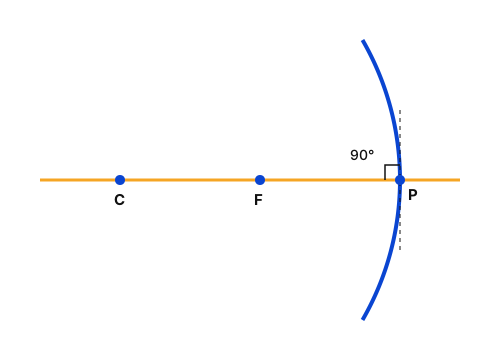
- Any radius (line from C) meets the mirror surface at right angles.
- The principal axis is the radius through P.
- So it is normal to the mirror at its pole, making with the surface there.
Yaad rakhein: P, F and C all lie on the principal axis; F is midway between P and C.
Answer: (B) It is normal to the mirror at its pole.
अवधारणा: मुख्य अक्ष गोलीय दर्पण के ध्रुव (P) और वक्रता केन्द्र (C) से गुज़रने वाली सरल रेखा है।
- C से खींची कोई भी त्रिज्या दर्पण की सतह पर लंबवत होती है।
- मुख्य अक्ष P से होकर जाने वाली त्रिज्या है।
- अतः यह ध्रुव पर दर्पण के अभिलंब है, सतह से बनाती है।
याद रखें: P, F और C तीनों मुख्य अक्ष पर होते हैं; F, P और C के बीच में।
उत्तर: (B) यह दर्पण के ध्रुव (pole) पर दर्पण के अभिलंबवत (normal) होता है।
RRB Technician Grade IIIGeneral ScienceSpherical mirrorsRRB Technician Grade III 2024 · 24 Dec Shift 2
Q1029.Which technique is useful for the separation of colloidal particles?
कोलॉइडी कणों (colloidal particles) को पृथक करने के लिए कौन-सी तकनीक उपयोगी है?
- AFiltration techniqueनिस्यंदन (filtration) तकनीक
- BCentrifugation techniqueअपकेंद्रण (centrifugation) तकनीक
- CRecrystallisation techniqueपुनःक्रिस्टलन (recrystallisation) तकनीक
- DSublimation techniqueऊर्ध्वपातन (sublimation) तकनीक
Show answer
Concept: Colloidal particles are too small to be stopped by filter paper and do not settle on standing; they are separated by centrifugation.
- In a centrifuge, the mixture is spun very fast.
- Denser particles are forced to the bottom; lighter liquid stays on top.
- Examples: separating cream from milk, blood tests, butter making.
Yaad rakhein: Filtration → suspension; sublimation → camphor/NH₄Cl; centrifugation → colloid (cream from milk).
Answer: (B) Centrifugation technique
अवधारणा: कोलॉइडी कण फ़िल्टर पेपर से नहीं रुकते और रखने पर नीचे नहीं बैठते; इन्हें अपकेन्द्रण (सेंट्रीफ्यूगेशन) से अलग करते हैं।
- अपकेन्द्रण यंत्र में मिश्रण को तेज़ी से घुमाया जाता है।
- भारी कण नीचे चले जाते हैं; हल्का द्रव ऊपर रहता है।
- उदाहरण: दूध से क्रीम अलग करना, रक्त जाँच, मक्खन बनाना।
याद रखें: निस्पंदन → निलंबन; ऊर्ध्वपातन → कपूर/NH₄Cl; अपकेन्द्रण → कोलॉइड (दूध से क्रीम)।
उत्तर: (B) अपकेंद्रण (centrifugation) तकनीक
RRB Technician Grade IIIGeneral ScienceSeparation techniquesRRB Technician Grade III 2024 · 24 Dec Shift 2
Q1030.Which of the following terms is used for the impurities found in ores mining ?
अयस्कों के खनन में पाई जाने वाली अशुद्धियों के लिए निम्नलिखित में से किस शब्द का प्रयोग किया जाता है?
- AGangueगैंग / आधात्री (Gangue)
- BRoastingभर्जन (Roasting)
- CAnode mudएनोड पंक (Anode mud)
- DCalcinationsनिस्तापन (Calcinations)
Show answer
Concept: Ores mined from the earth contain large amounts of impurities such as soil, sand and rock; these impurities are called gangue.
- Gangue is removed first (concentration/enrichment of ore).
- Roasting: heating sulphide ore in excess air.
- Calcination: heating carbonate ore in limited air.
- Anode mud: impurities settling below the anode in electrolytic refining.
Yaad rakhein: Gangue + flux → slag.
Answer: (A) Gangue
अवधारणा: पृथ्वी से निकाले गए अयस्कों में मिट्टी, रेत, चट्टान जैसी अशुद्धियाँ होती हैं; इन्हें गैंग (आधात्री) कहते हैं।
- सबसे पहले गैंग हटाया जाता है (अयस्क का सांद्रण)।
- भर्जन: सल्फाइड अयस्क को अधिक वायु में गर्म करना।
- निस्तापन: कार्बोनेट अयस्क को सीमित वायु में गर्म करना।
- एनोड पंक: विद्युत-अपघटनी परिष्करण में एनोड के नीचे जमी अशुद्धियाँ।
याद रखें: गैंग + फ्लक्स → धातुमल (स्लैग)।
उत्तर: (A) गैंग / आधात्री (Gangue)
RRB Technician Grade IIIGeneral ScienceMetallurgyRRB Technician Grade III 2024 · 24 Dec Shift 2
Q1031.Identify the INCORRECT statement related to transportation in plants.
a. Phloem helps in mineral and water absorption from the soil.
b. Root hair increases the root's surface area for water and mineral absorption.
c. Special vascular tissue in plants transports water and nutrients from the soil.
d. Roots and leaves are joined by a continuous network of xylem channels.
पौधों में परिवहन से संबंधित गलत कथन की पहचान कीजिए।
a. फ्लोएम (phloem) मृदा से खनिज और जल के अवशोषण में सहायता करता है।
b. मूल रोम (root hair) जल और खनिज अवशोषण के लिए जड़ के पृष्ठीय क्षेत्रफल को बढ़ाते हैं।
c. पौधों में विशेष संवहन ऊतक (vascular tissue) मृदा से जल और पोषक तत्वों का परिवहन करते हैं।
d. जड़ें और पत्तियाँ जाइलम (xylem) वाहिकाओं के एक सतत जाल द्वारा जुड़ी होती हैं।
- AOnly dकेवल d
- Bc and dc और d
- COnly aकेवल a
- Db and cb और c
Show answer
Concept: In plants, xylem carries water and minerals absorbed by roots; phloem carries food (translocation).
- a. Phloem absorbs water and minerals from soil – incorrect (this is xylem's role with root hairs).
- b. Root hairs increase surface area for absorption – correct.
- c. Vascular tissue transports water and nutrients – correct.
- d. Xylem forms a continuous channel from roots to leaves – correct.
Yaad rakhein: Xylem = water up; phloem = food (sugar) everywhere.
Answer: (C) Only a
अवधारणा: पौधों में जाइलम जड़ों द्वारा अवशोषित जल व खनिज ले जाता है; फ्लोएम भोजन ले जाता है (स्थानांतरण)।
- a. फ्लोएम मिट्टी से जल और खनिज अवशोषित करता है – गलत (यह जाइलम/मूलरोम का कार्य है)।
- b. मूलरोम अवशोषण के लिए सतह क्षेत्र बढ़ाते हैं – सही।
- c. संवहनी ऊतक जल और पोषक तत्व पहुँचाता है – सही।
- d. जाइलम जड़ से पत्ती तक सतत नलिका बनाता है – सही।
याद रखें: जाइलम = जल ऊपर; फ्लोएम = भोजन (शर्करा) सब ओर।
उत्तर: (C) केवल a
RRB Technician Grade IIIGeneral ScienceTransportation in plantsRRB Technician Grade III 2024 · 24 Dec Shift 2
Q1032.The atomic mass of an atom is primarily determined by the number of:
किसी परमाणु का परमाणु द्रव्यमान मुख्य रूप से किसकी संख्या द्वारा निर्धारित होता है?
- Aneutronsन्यूट्रॉन
- Belectronsइलेक्ट्रॉन
- Cnucleonsन्यूक्लिऑन (nucleons)
- Dprotonsप्रोटॉन
Show answer
Concept: Almost the entire mass of an atom lies in its nucleus, which contains protons and neutrons (together called nucleons).
- Mass of proton ≈ neutron ≈ .
- Electron mass is about of a proton – negligible.
- Mass number A = protons + neutrons = number of nucleons.
Trick: Example: has 23 nucleons → mass ≈ .
Answer: (C) nucleons
अवधारणा: परमाणु का लगभग पूरा द्रव्यमान उसके नाभिक में होता है, जिसमें प्रोटॉन और न्यूट्रॉन (मिलकर न्यूक्लिऑन) होते हैं।
- प्रोटॉन ≈ न्यूट्रॉन का द्रव्यमान ≈ ।
- इलेक्ट्रॉन का द्रव्यमान प्रोटॉन का लगभग – नगण्य।
- द्रव्यमान संख्या A = प्रोटॉन + न्यूट्रॉन = न्यूक्लिऑन की संख्या।
ट्रिक: उदाहरण: में 23 न्यूक्लिऑन → द्रव्यमान ≈ ।
उत्तर: (C) न्यूक्लिऑन (nucleons)
RRB Technician Grade IIIGeneral ScienceAtomic massRRB Technician Grade III 2024 · 24 Dec Shift 2
Q1033.Which of the listed cellular organelles is/are found exclusively in plant cells?
a. Mitochondria
b. Plastids
c. Golgi apparatus
d. Vacuoles
e. Cell wall
f. Lysosomes
सूचीबद्ध कोशिकांगों में से कौन-सा/से केवल पादप कोशिकाओं में पाया/पाए जाता/जाते है/हैं?
a. माइटोकॉन्ड्रिया (Mitochondria)
b. लवक (Plastids)
c. गॉल्जी उपकरण (Golgi apparatus)
d. रिक्तिकाएँ (Vacuoles)
e. कोशिका भित्ति (Cell wall)
f. लयनकाय (Lysosomes)
- Aa and ca और c
- Bb, d and eb, d और e
- Cf
- Dc and dc और d
Show answer
Concept: Some organelles are present only in plant cells, while others are common to both plant and animal cells.
- Mitochondria and Golgi apparatus – present in both.
- Lysosomes – mainly in animal cells.
- Plastids and cell wall – only in plant cells.
- Large central vacuole – characteristic of plant cells (animal cells have small or no vacuoles).
Yaad rakhein: Plant-only trio: cell wall, plastids, large vacuole.
Answer: (B) b, d and e
अवधारणा: कुछ कोशिकांग केवल पादप कोशिका में होते हैं, जबकि कुछ पादप और जंतु दोनों कोशिकाओं में।
- माइटोकॉन्ड्रिया और गॉल्जी उपकरण – दोनों में।
- लाइसोसोम – मुख्यतः जंतु कोशिका में।
- लवक और कोशिका भित्ति – केवल पादप कोशिका में।
- बड़ी केंद्रीय रिक्तिका – पादप कोशिका की विशेषता (जंतु कोशिका में छोटी या नहीं)।
याद रखें: पादप की तिकड़ी: कोशिका भित्ति, लवक, बड़ी रिक्तिका।
उत्तर: (B) b, d और e
RRB Technician Grade IIIGeneral SciencePlant cell vs animal cellRRB Technician Grade III 2024 · 24 Dec Shift 2
Q1034.Which of the following is correct about the relationship between power and focal length of a lens?
लेंस की क्षमता (power) और फोकस दूरी (focal length) के बीच संबंध के बारे में निम्नलिखित में से कौन-सा सही है?
- APower is inversely proportional to square of the focal length.क्षमता, फोकस दूरी के वर्ग के व्युत्क्रमानुपाती होती है।
- BPower is inversely proportional to focal length.क्षमता, फोकस दूरी के व्युत्क्रमानुपाती होती है।
- CPower is directly proportional to focal length.क्षमता, फोकस दूरी के अनुक्रमानुपाती होती है।
- DPower is directly proportional to square of the focal length.क्षमता, फोकस दूरी के वर्ग के अनुक्रमानुपाती होती है।
Show answer
Concept: Power of a lens is the reciprocal of its focal length: (f in metre, P in dioptre).
- So – inversely proportional to focal length.
- Not , so (A) is wrong.
- Example: .
Trick: Halve the focal length → power doubles.
Answer: (B) Power is inversely proportional to focal length.
अवधारणा: लेंस की क्षमता उसकी फोकस दूरी का व्युत्क्रम है: (f मीटर में, P डायॉप्टर में)।
- अतः – फोकस दूरी के व्युत्क्रमानुपाती।
- नहीं, अतः (A) गलत।
- उदाहरण: ।
ट्रिक: फोकस दूरी आधी → क्षमता दोगुनी।
उत्तर: (B) क्षमता, फोकस दूरी के व्युत्क्रमानुपाती होती है।
RRB Technician Grade IIIGeneral SciencePower of a lensRRB Technician Grade III 2024 · 24 Dec Shift 2
Q1035.Considering magnetic field lines, which of the following statements is NOT true?
चुंबकीय क्षेत्र रेखाओं (magnetic field lines) को ध्यान में रखते हुए, निम्नलिखित में से कौन-सा कथन सत्य नहीं है?
- AThe relative strength of magnetic field exists and can be shown by the degree of closeness of the field lines.चुंबकीय क्षेत्र की आपेक्षिक प्रबलता होती है और इसे क्षेत्र रेखाओं की निकटता की कोटि द्वारा दर्शाया जा सकता है।
- BIf magnetic field lines are parallel and equidistant, they represent zero field strength.यदि चुंबकीय क्षेत्र रेखाएँ समांतर और समदूरस्थ हों, तो वे शून्य क्षेत्र प्रबलता को दर्शाती हैं।
- CMagnetic field lines are closed curves.चुंबकीय क्षेत्र रेखाएँ बंद वक्र होती हैं।
- DThe direction of the magnetic field at a point is taken to be the direction in which the north pole of a magnetic compass needle points.किसी बिंदु पर चुंबकीय क्षेत्र की दिशा वह दिशा मानी जाती है, जिस ओर चुंबकीय दिक्सूचक सुई का उत्तरी ध्रुव संकेत करता है।
Show answer
Concept: Magnetic field lines show the direction and strength of a magnetic field.
- Closer lines → stronger field – (A) true.
- Lines are closed curves (N to S outside, S to N inside) – (C) true.
- Direction = where the compass north pole points – (D) true.
- Parallel, equidistant lines show a uniform field (e.g. inside a solenoid), not zero field – (B) false.
Yaad rakhein: Two field lines never intersect.
Answer: (B) If magnetic field lines are parallel and equidistant, they represent zero field strength.
अवधारणा: चुंबकीय क्षेत्र रेखाएँ क्षेत्र की दिशा और प्रबलता दर्शाती हैं।
- रेखाएँ पास-पास → प्रबल क्षेत्र – (A) सत्य।
- रेखाएँ बंद वक्र हैं (बाहर N से S, अंदर S से N) – (C) सत्य।
- दिशा = कम्पास के उत्तरी ध्रुव की दिशा – (D) सत्य।
- समांतर व समान दूरी वाली रेखाएँ एकसमान क्षेत्र दर्शाती हैं (जैसे परिनालिका के अंदर), शून्य नहीं – (B) असत्य।
याद रखें: दो क्षेत्र रेखाएँ कभी एक-दूसरे को नहीं काटतीं।
उत्तर: (B) यदि चुंबकीय क्षेत्र रेखाएँ समांतर और समदूरस्थ हों, तो वे शून्य क्षेत्र प्रबलता को दर्शाती हैं।
RRB Technician Grade IIIGeneral ScienceMagnetic field linesRRB Technician Grade III 2024 · 24 Dec Shift 2
Q1036.The two isotopic forms of chlorine, with masses 35 u and 37 u, are found in which of the following ratios in nature?
क्लोरीन के दो समस्थानिक रूप, जिनके द्रव्यमान 35 u और 37 u हैं, प्रकृति में निम्नलिखित में से किस अनुपात में पाए जाते हैं?
- A3 : 1
- B1 : 5
- C1 : 1
- D1 : 3
Show answer
Concept: Chlorine occurs as and in the ratio , which explains its fractional atomic mass .
- Average mass
- This matches the known atomic mass of chlorine.
Trick: Check any ratio with the average: only gives .
Answer: (A) 3 : 1
अवधारणा: क्लोरीन और के रूप में अनुपात में पाई जाती है, जिससे इसका भिन्नात्मक परमाणु द्रव्यमान है।
- औसत द्रव्यमान
- यह क्लोरीन के ज्ञात परमाणु द्रव्यमान से मेल खाता है।
ट्रिक: औसत से अनुपात जाँचें: केवल से आता है।
उत्तर: (A) 3 : 1
RRB Technician Grade IIIGeneral ScienceIsotopesRRB Technician Grade III 2024 · 24 Dec Shift 2
Q1037.Which of the following is/are correct about non-biodegradable substances?
A. These substances are not broken down through biological processes.
B. These substances persist in the environment for a short period.
C. These substances may harm the various members of the ecosystem.
अजैव निम्नीकरणीय (non-biodegradable) पदार्थों के बारे में निम्नलिखित में से कौन-सा/से सही है/हैं?
A. ये पदार्थ जैविक प्रक्रियाओं द्वारा अपघटित नहीं होते हैं।
B. ये पदार्थ पर्यावरण में अल्प अवधि तक बने रहते हैं।
C. ये पदार्थ पारितंत्र के विभिन्न सदस्यों को हानि पहुँचा सकते हैं।
- AA, B and CA, B और C
- BOnly Bकेवल B
- CBoth B and CB और C दोनों
- DBoth A and CA और C दोनों
Show answer
Concept: Non-biodegradable substances (plastics, DDT, glass) cannot be broken down by microbes.
- A. Not broken down by biological processes – correct.
- B. They persist for a long time, not a short period – incorrect.
- C. They harm organisms and can accumulate in food chains (biomagnification) – correct.
Yaad rakhein: DDT concentration increases at each trophic level – biological magnification.
Answer: (D) Both A and C
अवधारणा: अजैव-निम्नीकरणीय पदार्थ (प्लास्टिक, DDT, काँच) सूक्ष्मजीवों द्वारा नहीं टूटते।
- A. जैविक प्रक्रमों से नहीं टूटते – सही।
- B. ये लंबे समय तक बने रहते हैं, कम समय नहीं – गलत।
- C. ये जीवों को हानि पहुँचाते हैं और खाद्य शृंखला में संचित होते हैं (जैव-आवर्धन) – सही।
याद रखें: DDT की सांद्रता हर पोषी स्तर पर बढ़ती है – जैव-आवर्धन।
उत्तर: (D) A और C दोनों
RRB Technician Grade IIIGeneral ScienceBiodegradable and non-biodegradableRRB Technician Grade III 2024 · 24 Dec Shift 2
Q1038.How many types of endoplasmic reticulum are there in cells?
कोशिकाओं में अंतर्द्रव्यी जालिका (endoplasmic reticulum) कितने प्रकार की होती है?
- AFiveपाँच
- BThreeतीन
- CFourचार
- DTwoदो
Show answer
Concept: Endoplasmic reticulum (ER) is a network of membrane-bound tubes and sheets in the cell.
- Rough ER (RER): has ribosomes on its surface; makes proteins.
- Smooth ER (SER): no ribosomes; makes lipids and helps detoxify poisons and drugs.
- So there are two types.
Yaad rakhein: SER also helps in making membrane lipids (membrane biogenesis).
Answer: (D) Two
अवधारणा: अंतर्द्रव्यी जालिका (ER) कोशिका में झिल्ली से बनी नलिकाओं और थैलियों का जाल है।
- खुरदरी ER (RER): सतह पर राइबोसोम; प्रोटीन बनाती है।
- चिकनी ER (SER): राइबोसोम नहीं; वसा/लिपिड बनाती है और विष व दवाओं का विषहरण करती है।
- अतः इसके दो प्रकार हैं।
याद रखें: SER झिल्ली लिपिड बनाकर झिल्ली-जैवजनन में भी सहायक है।
उत्तर: (D) दो
RRB Technician Grade IIIGeneral ScienceEndoplasmic reticulumRRB Technician Grade III 2024 · 24 Dec Shift 2
Q1039.Suppose a number of rays parallel to the principal axis are falling on a concave mirror, then all the reflected rays will intersect:
मान लीजिए मुख्य अक्ष के समांतर कई किरणें एक अवतल दर्पण पर पड़ रही हैं, तो सभी परावर्तित किरणें प्रतिच्छेद करेंगी:
- Aat the principal focusमुख्य फोकस पर
- Bin between the pole and infinityध्रुव और अनंत के बीच
- Cat the poleध्रुव पर
- Dat infinityअनंत पर
Show answer
Concept: For a concave mirror, rays parallel to the principal axis, after reflection, converge at a single point on the axis – the principal focus (F).
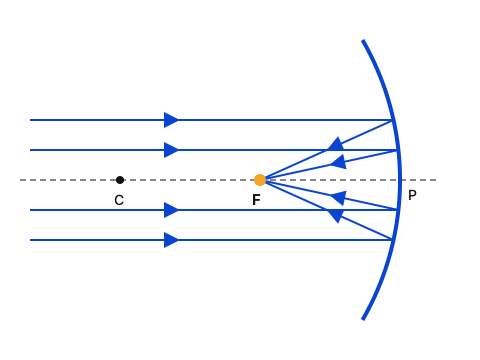
- Parallel rays strike the mirror (see figure).
- After reflection all of them pass through F.
- F lies midway between P and C: .
Yaad rakhein: Concave mirror: real focus (rays actually meet); convex mirror: rays only appear to come from F.
Answer: (A) at the principal focus
अवधारणा: अवतल दर्पण में मुख्य अक्ष के समांतर किरणें परावर्तन के बाद अक्ष के एक बिंदु – मुख्य फोकस (F) – पर मिलती हैं।
- समांतर किरणें दर्पण पर पड़ती हैं (चित्र देखें)।
- परावर्तन के बाद सभी F से होकर गुज़रती हैं।
- F, P और C के बीच में है: ।
याद रखें: अवतल दर्पण: वास्तविक फोकस (किरणें वास्तव में मिलती हैं); उत्तल दर्पण: किरणें F से आती प्रतीत होती हैं।
उत्तर: (A) मुख्य फोकस पर
RRB Technician Grade IIIGeneral ScienceReflection by concave mirrorRRB Technician Grade III 2024 · 24 Dec Shift 2
Q1040.An object of height 30 cm is placed in front of a concave lens and an image of height 10 cm is formed. The magnification of the lens is:
30 cm ऊँचाई की एक वस्तु को एक अवतल लेंस के सामने रखा जाता है और 10 cm ऊँचाई का प्रतिबिंब बनता है। लेंस का आवर्धन (magnification) है:
- A20
- B
- C
- D3
Show answer
Concept: Magnification .
- A concave lens always forms a virtual, erect, diminished image, so m is positive and less than 1.
Trick: Concave lens → ; only fits among the options.
Answer: (B)
अवधारणा: आवर्धन ।
- अवतल लेंस सदैव आभासी, सीधा, छोटा प्रतिबिंब बनाता है, अतः m धनात्मक और 1 से कम।
ट्रिक: अवतल लेंस → ; विकल्पों में केवल उपयुक्त है।
उत्तर: (B)
RRB Technician Grade IIIGeneral ScienceMagnification by lensesRRB Technician Grade III 2024 · 24 Dec Shift 2

