Q1041.The work done (in Joule) by a constant force of 10 N on an object that is displaced by an amount D meter in the direction of the force is:
10 N के एक नियत बल द्वारा किसी वस्तु पर किया गया कार्य (जूल में), जो बल की दिशा में D मीटर विस्थापित होती है, है:
- A0
- B
- C
- DD
Show answer
Concept: Work done by a constant force: .
- Displacement is in the direction of the force, so and .
- Force and displacement are in the same direction, so work is positive.
Yaad rakhein: → zero work; → negative work.
Answer: (C)
अवधारणा: स्थिर बल द्वारा कार्य: ।
- विस्थापन बल की दिशा में है, अतः और ।
- बल और विस्थापन एक ही दिशा में, अतः कार्य धनात्मक।
याद रखें: → शून्य कार्य; → ऋणात्मक कार्य।
उत्तर: (C)
RRB Technician Grade IIIGeneral ScienceWork doneRRB Technician Grade III 2024 · 24 Dec Shift 2
Q1042.The motion of a freely falling body is an example of a:
स्वतंत्र रूप से गिरती हुई वस्तु की गति किसका उदाहरण है?
- Auniformly accelerated motionएकसमान त्वरित गति (uniformly accelerated motion)
- Bnon-uniformly accelerated motionअसमान त्वरित गति (non-uniformly accelerated motion)
- Cuniform speed motionएकसमान चाल वाली गति (uniform speed motion)
- Duniform velocity motionएकसमान वेग वाली गति (uniform velocity motion)
Show answer
Concept: A freely falling body moves only under gravity, so its acceleration is constant: (air resistance neglected).
- Velocity increases by the same amount every second ().
- Equal change in velocity in equal time intervals = uniform acceleration.
- Speed and velocity keep changing, so options (C) and (D) are wrong; acceleration is not changing, so (B) is wrong.
Yaad rakhein: Free fall = constant = uniformly accelerated motion.
Answer: (A) uniformly accelerated motion
अवधारणा: स्वतंत्र रूप से गिरती वस्तु केवल गुरुत्व के अधीन चलती है, अतः उसका त्वरण नियत रहता है: (वायु प्रतिरोध नगण्य)।
- हर सेकंड वेग समान मात्रा में बढ़ता है ()।
- समान समय में वेग में समान परिवर्तन = एकसमान त्वरण।
- चाल और वेग बदलते रहते हैं, अतः (C) व (D) गलत; त्वरण नहीं बदलता, अतः (B) गलत।
याद रखें: मुक्त पतन = नियत = एकसमान त्वरित गति।
उत्तर: (A) एकसमान त्वरित गति (uniformly accelerated motion)
RRB Technician Grade IIIGeneral ScienceUniformly accelerated motionRRB Technician Grade III 2024 · 24 Dec Shift 1
Q1043.In a common salt/sodium chloride (NaCl), ions of which element is positively charged and negatively charged, respectively?
साधारण नमक/सोडियम क्लोराइड (NaCl) में, क्रमशः किस तत्व के आयन धनावेशित और ऋणावेशित होते हैं?
- ANa ions are positively charged, and Cl ions are negatively charged.Na आयन धनावेशित होते हैं, और Cl आयन ऋणावेशित होते हैं।
- BCl ions are positively charged, and Na ions are negatively charged.Cl आयन धनावेशित होते हैं, और Na आयन ऋणावेशित होते हैं।
- CIons of both Na and Cl are negatively charged.Na और Cl दोनों के आयन ऋणावेशित होते हैं।
- DIons of both Na and Cl are positively charged.Na और Cl दोनों के आयन धनावेशित होते हैं।
Show answer
Concept: NaCl is formed by transfer of one electron from sodium to chlorine.
- Na (2, 8, 1) loses 1 electron → (cation, positive).
- Cl (2, 8, 7) gains 1 electron → (anion, negative).
- Opposite charges attract strongly → ionic bond in .
Yaad rakhein: Metals lose electrons → positive ions; non-metals gain electrons → negative ions.
Answer: (A) Na ions are positively charged, and Cl ions are negatively charged.
अवधारणा: NaCl सोडियम से क्लोरीन में एक इलेक्ट्रॉन के स्थानांतरण से बनता है।
- Na (2, 8, 1) 1 इलेक्ट्रॉन खोता है → (धनायन, धनावेशित)।
- Cl (2, 8, 7) 1 इलेक्ट्रॉन ग्रहण करता है → (ऋणायन, ऋणावेशित)।
- विपरीत आवेश प्रबल आकर्षण से में आयनिक बंध बनाते हैं।
याद रखें: धातुएँ इलेक्ट्रॉन खोकर धनायन बनाती हैं; अधातुएँ इलेक्ट्रॉन लेकर ऋणायन।
उत्तर: (A) Na आयन धनावेशित होते हैं, और Cl आयन ऋणावेशित होते हैं।
RRB Technician Grade IIIGeneral ScienceIonic compound – NaClRRB Technician Grade III 2024 · 24 Dec Shift 1
Q1044.Which of the following statements is/are correct regarding the effects of changes in pressure on the states of matter?
Statement I: Applying pressure and reducing temperature can liquefy gases.
Statement II: Solid carbon dioxide is stored under high pressure.
द्रव्य की अवस्थाओं पर दाब में परिवर्तन के प्रभावों के संबंध में निम्नलिखित में से कौन-सा/से कथन सही है/हैं?
कथन I: दाब लगाने और ताप कम करने से गैसों को द्रवित किया जा सकता है।
कथन II: ठोस कार्बन डाइऑक्साइड को उच्च दाब पर भंडारित किया जाता है।
- ANeither statement I nor II is correct.न तो कथन I और न ही II सही है।
- BOnly statement I is correct.केवल कथन I सही है।
- COnly statement II is correct.केवल कथन II सही है।
- DBoth statements I and II are correct.कथन I और II दोनों सही हैं।
Show answer
Concept: Pressure brings particles closer; lowering temperature reduces their kinetic energy. Both help change gas → liquid/solid.
- Statement I: gases (e.g. LPG) are liquefied by high pressure and low temperature – correct.
- Statement II: solid (dry ice) is stored under high pressure; when pressure drops to 1 atm it sublimes directly to gas – correct.
- So both statements are correct.
Yaad rakhein: Dry ice = solid ; at 1 atm it changes directly into gas (sublimation).
Answer: (D) Both statements I and II are correct.
अवधारणा: दाब कणों को पास लाता है; ताप घटाने से उनकी गतिज ऊर्जा कम होती है। दोनों मिलकर गैस को द्रव/ठोस में बदलने में सहायक हैं।
- कथन I: गैसें (जैसे LPG) उच्च दाब व निम्न ताप से द्रवित होती हैं – सही।
- कथन II: ठोस (शुष्क बर्फ) उच्च दाब पर रखी जाती है; दाब 1 atm होने पर यह सीधे गैस बन जाती है – सही।
- अतः दोनों कथन सही हैं।
याद रखें: शुष्क बर्फ = ठोस ; 1 atm पर सीधे गैस में बदलती है (ऊर्ध्वपातन)।
उत्तर: (D) कथन I और II दोनों सही हैं।
RRB Technician Grade IIIGeneral ScienceEffect of pressure on states of matterRRB Technician Grade III 2024 · 24 Dec Shift 1
Q1045.Unit of pressure is:
दाब का मात्रक है:
- ANewton/meterन्यूटन/मीटर
- BNewtonन्यूटन
- CAngstromएंगस्ट्रॉम
- DPascalपास्कल
Show answer
Concept: Pressure is force acting per unit area: .
- SI unit = , named pascal (Pa).
- Newton is the unit of force; Newton/metre is the unit of surface tension or spring constant.
- Angstrom () is a unit of length.
Yaad rakhein: (area in the denominator, not length).
Answer: (D) Pascal
अवधारणा: दाब प्रति एकांक क्षेत्रफल पर लगने वाला बल है: ।
- SI मात्रक = , जिसे पास्कल (Pa) कहते हैं।
- न्यूटन बल का मात्रक है; न्यूटन/मीटर पृष्ठ तनाव या स्प्रिंग नियतांक का मात्रक है।
- एंगस्ट्रॉम () लंबाई का मात्रक है।
याद रखें: (हर में क्षेत्रफल, लंबाई नहीं)।
उत्तर: (D) पास्कल
RRB Technician Grade IIIGeneral ScienceSI unit of pressureRRB Technician Grade III 2024 · 24 Dec Shift 1
Q1046.If glucose :: six-carbon molecule, then pyruvate :: ________.
यदि ग्लूकोज़ :: छह-कार्बन अणु, तो पाइरुवेट :: ________।
- Afour-carbon moleculeचार-कार्बन अणु
- Bfive-carbon moleculeपाँच-कार्बन अणु
- Ctwo-carbon moleculeदो-कार्बन अणु
- Dthree-carbon moleculeतीन-कार्बन अणु
Show answer
Concept: In the first step of respiration (glycolysis, in the cytoplasm), glucose is broken into pyruvate.
- Glucose = , a six-carbon molecule.
- One glucose splits into two molecules of pyruvate.
- So each pyruvate has carbon atoms.
Trick: Glucose (6C) ÷ 2 = pyruvate (3C) – think 'half'.
Answer: (D) three-carbon molecule
अवधारणा: श्वसन के पहले चरण (ग्लाइकोलाइसिस, कोशिकाद्रव्य में) में ग्लूकोज़ पाइरुवेट में टूटता है।
- ग्लूकोज़ = , छह-कार्बन अणु।
- एक ग्लूकोज़ टूटकर पाइरुवेट के दो अणु बनाता है।
- अतः प्रत्येक पाइरुवेट में कार्बन परमाणु।
ट्रिक: ग्लूकोज़ (6C) ÷ 2 = पाइरुवेट (3C) – 'आधा' याद रखें।
उत्तर: (D) तीन-कार्बन अणु
RRB Technician Grade IIIGeneral ScienceGlycolysis – pyruvateRRB Technician Grade III 2024 · 24 Dec Shift 1
Q1047.An object of height 30 cm is placed in front of a concave lens and an image of height 10 cm is formed. The magnification of the lens is:
30 cm ऊँचाई की एक वस्तु को एक अवतल लेंस (concave lens) के सामने रखा जाता है और 10 cm ऊँचाई का प्रतिबिंब बनता है। लेंस का आवर्धन (magnification) है:
- A
- B
- C3
- D20
Show answer
Concept: Magnification . A concave lens always forms a virtual, erect, diminished image, so is positive and less than 1.
- Object height , image height (erect, so positive).
- .
- Positive and – matches a concave lens.
Trick: Concave lens: always – pick the positive fraction.
Answer: (A)
अवधारणा: आवर्धन । अवतल लेंस सदैव आभासी, सीधा, छोटा प्रतिबिंब बनाता है, अतः धनात्मक और 1 से कम होता है।
- वस्तु की ऊँचाई , प्रतिबिंब की ऊँचाई (सीधा, अतः धनात्मक)।
- ।
- धनात्मक और – अवतल लेंस से मेल खाता है।
ट्रिक: अवतल लेंस: सदैव – धनात्मक भिन्न चुनें।
उत्तर: (A)
RRB Technician Grade IIIGeneral ScienceMagnification of a lensRRB Technician Grade III 2024 · 24 Dec Shift 1
Q1048.Inside a bar magnet, the direction of magnetic field lines is from its:
एक छड़ चुंबक के अंदर, चुंबकीय क्षेत्र रेखाओं की दिशा होती है:
- ASouth pole to its North poleदक्षिण ध्रुव से उत्तर ध्रुव की ओर
- Balways perpendicular to the North poleसदैव उत्तर ध्रुव के लंबवत
- CNorth pole to its South poleउत्तर ध्रुव से दक्षिण ध्रुव की ओर
- Dalways perpendicular to the South poleसदैव दक्षिण ध्रुव के लंबवत
Show answer
Concept: Magnetic field lines are closed continuous curves.
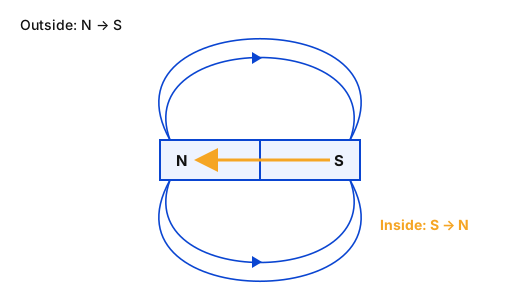
- Outside the magnet they emerge from the North pole and enter the South pole.
- To complete the closed loop, inside the magnet they go from the South pole to the North pole.
- They never intersect and are not 'perpendicular to a pole'.
Yaad rakhein: Outside N → S, inside S → N: a closed loop.
Answer: (A) South pole to its North pole
अवधारणा: चुंबकीय क्षेत्र रेखाएँ बंद, सतत वक्र होती हैं।
- चुंबक के बाहर ये उत्तरी ध्रुव से निकलकर दक्षिणी ध्रुव में प्रवेश करती हैं।
- बंद लूप पूरा करने के लिए चुंबक के अंदर ये दक्षिणी ध्रुव से उत्तरी ध्रुव की ओर जाती हैं।
- ये कभी एक-दूसरे को नहीं काटतीं।
याद रखें: बाहर N → S, अंदर S → N: बंद लूप।
उत्तर: (A) दक्षिण ध्रुव से उत्तर ध्रुव की ओर
RRB Technician Grade IIIGeneral ScienceMagnetic field lines of a bar magnetRRB Technician Grade III 2024 · 24 Dec Shift 1
Q1049.Match the following columns I and II.
Column I | Column II
A. Placenta | i. Nutrition
B. Fallopian tube | ii. Fertilization
C. Uterus | iii. Implantation
निम्नलिखित स्तंभ I और II का मिलान कीजिए।
स्तंभ I | स्तंभ II
A. अपरा (Placenta) | i. पोषण (Nutrition)
B. अंडवाहिनी (Fallopian tube) | ii. निषेचन (Fertilization)
C. गर्भाशय (Uterus) | iii. रोपण (Implantation)
- AA-ii, B-i, C-iii
- BA-iii, B-ii, C-i
- CA-i, B-iii, C-ii
- DA-i, B-ii, C-iii
Show answer
Concept: Each part of the female reproductive system has a specific role in pregnancy.
- Placenta: disc-like tissue that passes nutrition (and oxygen) from mother's blood to the embryo → A-i.
- Fallopian tube (oviduct): site where sperm meets egg → fertilization → B-ii.
- Uterus: the embryo gets embedded (implanted) in its thick lining → C-iii.
Yaad rakhein: Tube = fertilization, Uterus = implantation, Placenta = nutrition.
Answer: (D) A-i, B-ii, C-iii
अवधारणा: मादा जनन तंत्र के प्रत्येक भाग की गर्भावस्था में विशिष्ट भूमिका है।
- अपरा (प्लेसेंटा): माँ के रक्त से भ्रूण तक पोषण (और ऑक्सीजन) पहुँचाती है → A-i।
- अंडवाहिनी (फैलोपियन नलिका): शुक्राणु व अंडाणु का मिलन → निषेचन → B-ii।
- गर्भाशय: भ्रूण इसकी मोटी भित्ति में स्थापित (रोपित) होता है → C-iii।
याद रखें: नलिका = निषेचन, गर्भाशय = रोपण, अपरा = पोषण।
उत्तर: (D) A-i, B-ii, C-iii
RRB Technician Grade IIIGeneral ScienceHuman female reproductive systemRRB Technician Grade III 2024 · 24 Dec Shift 1
Q1050.Muscles present in our limbs move when we want them to and stop when we so decide. Such muscles are called:
हमारे अंगों में उपस्थित पेशियाँ तब गति करती हैं जब हम चाहते हैं और तब रुक जाती हैं जब हम ऐसा निर्णय लेते हैं। ऐसी पेशियों को कहा जाता है:
- Avoluntary musclesऐच्छिक पेशियाँ (voluntary muscles)
- Binvoluntary musclesअनैच्छिक पेशियाँ (involuntary muscles)
- Ccardiac musclesहृदय पेशियाँ (cardiac muscles)
- Dunstriated musclesअरेखित पेशियाँ (unstriated muscles)
Show answer
Concept: Muscles that move according to our will are called voluntary (striated/skeletal) muscles.
- Limb muscles (arms, legs) contract and relax when we decide – voluntary.
- Involuntary (unstriated/smooth) muscles, e.g. in the stomach and intestine, work on their own.
- Cardiac muscles of the heart are also involuntary and work rhythmically all life.
Yaad rakhein: Will = voluntary = striated (limbs); heart and gut = involuntary.
Answer: (A) voluntary muscles
अवधारणा: जो पेशियाँ हमारी इच्छा के अनुसार गति करती हैं, वे ऐच्छिक (रेखित/कंकाल) पेशियाँ कहलाती हैं।
- हाथ-पैर की पेशियाँ हमारी इच्छा से संकुचित व शिथिल होती हैं – ऐच्छिक।
- अनैच्छिक (अरेखित/चिकनी) पेशियाँ, जैसे आमाशय व आँत की, स्वतः कार्य करती हैं।
- हृदय की हृदय पेशियाँ भी अनैच्छिक हैं और जीवनभर लयबद्ध कार्य करती हैं।
याद रखें: इच्छा = ऐच्छिक = रेखित (अंग); हृदय व आँत = अनैच्छिक।
उत्तर: (A) ऐच्छिक पेशियाँ (voluntary muscles)
RRB Technician Grade IIIGeneral ScienceVoluntary musclesRRB Technician Grade III 2024 · 24 Dec Shift 1
Q1051.A gas can be liquefied by ______.
किसी गैस को ______ द्वारा द्रवित किया जा सकता है।
- Alow pressure and high temperatureनिम्न दाब और उच्च ताप
- Blow pressure and low temperatureनिम्न दाब और निम्न ताप
- Chigh pressure and low temperatureउच्च दाब और निम्न ताप
- Dhigh pressure and high temperatureउच्च दाब और उच्च ताप
Show answer
Concept: In a gas, particles are far apart and move fast. To liquefy it, particles must be brought close and slowed down.
- High pressure compresses the gas → particles come closer.
- Low temperature reduces kinetic energy → attraction can hold particles together.
- Hence high pressure + low temperature liquefies a gas (e.g. LPG, liquid ).
Trick: 'HP–LT': High Pressure, Low Temperature → liquid.
Answer: (C) high pressure and low temperature
अवधारणा: गैस में कण दूर-दूर व तीव्र गति में होते हैं। द्रवित करने हेतु कणों को पास लाना और धीमा करना पड़ता है।
- उच्च दाब गैस को संपीडित करता है → कण पास आते हैं।
- निम्न ताप गतिज ऊर्जा घटाता है → आकर्षण बल कणों को बाँध पाता है।
- अतः उच्च दाब + निम्न ताप से गैस द्रवित होती है (जैसे LPG, द्रव )।
ट्रिक: 'उच्च दाब–निम्न ताप' → द्रव।
उत्तर: (C) उच्च दाब और निम्न ताप
RRB Technician Grade IIIGeneral ScienceLiquefaction of gasesRRB Technician Grade III 2024 · 24 Dec Shift 1
Q1052.The image formed by a concave mirror is real, inverted and with the same size as the object. The position of the object is kept:
एक अवतल दर्पण (concave mirror) द्वारा बना प्रतिबिंब वास्तविक, उल्टा और वस्तु के समान आकार का है। वस्तु की स्थिति रखी गई है:
- Afar away from the centre of curvatureवक्रता केंद्र से बहुत दूर
- Bat the centre of curvatureवक्रता केंद्र पर
- Cbetween the focus and the centre of curvatureफोकस और वक्रता केंद्र के बीच
- Dat the focusफोकस पर
Show answer
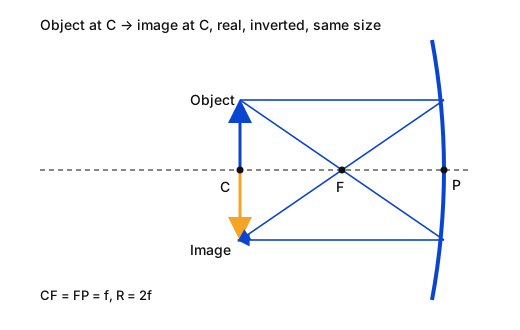
Concept: For a concave mirror, the image position depends on where the object is placed relative to F and C (radius ).
- Object beyond C → image between F and C, diminished.
- Object at C → image also at C, real, inverted and of the same size.
- Object between F and C → image beyond C, enlarged; object at F → image at infinity.
Yaad rakhein: Same size real image only when object is at C (, ).
Answer: (B) at the centre of curvature
अवधारणा: अवतल दर्पण में प्रतिबिंब की स्थिति इस पर निर्भर करती है कि वस्तु F और C (त्रिज्या ) के सापेक्ष कहाँ है।
- वस्तु C से परे → प्रतिबिंब F और C के बीच, छोटा।
- वस्तु C पर → प्रतिबिंब भी C पर, वास्तविक, उल्टा और समान आकार का।
- वस्तु F और C के बीच → प्रतिबिंब C से परे, बड़ा; वस्तु F पर → प्रतिबिंब अनंत पर।
याद रखें: समान आकार का वास्तविक प्रतिबिंब केवल तब जब वस्तु C पर हो (, )।
उत्तर: (B) वक्रता केंद्र पर
RRB Technician Grade IIIGeneral ScienceConcave mirror – object at CRRB Technician Grade III 2024 · 24 Dec Shift 1
Q1053.Which of the following options is correct in the relation between mass and inertia?
द्रव्यमान और जड़त्व के बीच संबंध के विषय में निम्नलिखित में से कौन-सा विकल्प सही है?
- AThe data provided here is not adequate to draw any conclusion.यहाँ दिए गए आँकड़े कोई निष्कर्ष निकालने के लिए पर्याप्त नहीं हैं।
- BInertia is inversely proportional to mass.जड़त्व द्रव्यमान के व्युत्क्रमानुपाती होता है।
- CInertia is proportional to mass.जड़त्व द्रव्यमान के समानुपाती होता है।
- DInertia is independent of mass.जड़त्व द्रव्यमान से स्वतंत्र होता है।
Show answer
Concept: Inertia is the tendency of a body to resist a change in its state of rest or uniform motion. Mass is the measure of inertia.
- A heavier body (more mass) is harder to start, stop or turn.
- Pushing a loaded truck vs. an empty cart shows greater mass → greater inertia.
- So inertia increases directly with mass: inertia mass.
Yaad rakhein: Mass = measure of inertia; more mass, more inertia.
Answer: (C) Inertia is proportional to mass.
अवधारणा: जड़त्व किसी वस्तु की विराम या एकसमान गति की अवस्था में परिवर्तन का विरोध करने की प्रवृत्ति है। द्रव्यमान जड़त्व का माप है।
- भारी वस्तु (अधिक द्रव्यमान) को चलाना, रोकना या मोड़ना कठिन होता है।
- भरे ट्रक व खाली ठेले को धकेलने से स्पष्ट है – अधिक द्रव्यमान → अधिक जड़त्व।
- अतः जड़त्व द्रव्यमान।
याद रखें: द्रव्यमान = जड़त्व का माप; द्रव्यमान अधिक तो जड़त्व अधिक।
उत्तर: (C) जड़त्व द्रव्यमान के समानुपाती होता है।
RRB Technician Grade IIIGeneral ScienceInertia and massRRB Technician Grade III 2024 · 24 Dec Shift 1
Q1054.Which of the following phenomena is the reason behind wearing cotton clothes in summer?
गर्मियों में सूती कपड़े पहनने के पीछे निम्नलिखित में से कौन-सी परिघटना कारण है?
- ASublimationऊर्ध्वपातन (Sublimation)
- BCondensationसंघनन (Condensation)
- CEvaporationवाष्पीकरण (Evaporation)
- DFusionसंगलन (Fusion)
Show answer
Concept: Evaporation takes latent heat from the surface, producing cooling.
- In summer we sweat more.
- Cotton absorbs sweat and exposes it to the air, so it evaporates quickly.
- The evaporating sweat takes heat from the body → body feels cool.
Yaad rakhein: Sweat + cotton + evaporation = cooling (same reason earthen pots keep water cool).
Answer: (C) Evaporation
अवधारणा: वाष्पन सतह से गुप्त ऊष्मा लेता है, जिससे ठंडक होती है।
- गर्मियों में पसीना अधिक आता है।
- सूती कपड़े पसीना सोखकर उसे हवा के संपर्क में लाते हैं, जिससे वह जल्दी वाष्पित होता है।
- वाष्पित होता पसीना शरीर से ऊष्मा लेता है → शरीर ठंडा महसूस होता है।
याद रखें: पसीना + सूती कपड़ा + वाष्पन = शीतलन (मटके का पानी भी इसी कारण ठंडा रहता है)।
उत्तर: (C) वाष्पीकरण (Evaporation)
RRB Technician Grade IIIGeneral ScienceEvaporation causes coolingRRB Technician Grade III 2024 · 24 Dec Shift 1
Q1055.Which of the following is an example of an ionic compound?
निम्नलिखित में से कौन-सा आयनिक यौगिक (ionic compound) का उदाहरण है?
- AGlucoseग्लूकोज़
- BSugarशर्करा
- CTable saltखाने का नमक
- DTurmericहल्दी
Show answer
Concept: Ionic compounds are formed by transfer of electrons between a metal and a non-metal.
- Table salt = and ions → ionic.
- Glucose () and sugar (sucrose) are covalent compounds of C, H, O.
- Turmeric is a natural mixture (mainly the organic compound curcumin), not ionic.
Trick: Metal + non-metal → usually ionic; only non-metals (C, H, O) → covalent.
Answer: (C) Table salt
अवधारणा: आयनिक यौगिक धातु और अधातु के बीच इलेक्ट्रॉन स्थानांतरण से बनते हैं।
- साधारण नमक = व आयन → आयनिक।
- ग्लूकोज़ () और चीनी (सुक्रोज़) C, H, O के सहसंयोजक यौगिक हैं।
- हल्दी एक प्राकृतिक मिश्रण है (मुख्यतः कार्बनिक यौगिक करक्यूमिन), आयनिक नहीं।
ट्रिक: धातु + अधातु → प्रायः आयनिक; केवल अधातुएँ (C, H, O) → सहसंयोजक।
उत्तर: (C) खाने का नमक
RRB Technician Grade IIIGeneral ScienceIonic compoundsRRB Technician Grade III 2024 · 24 Dec Shift 1
Q1056.Which of the following constant values given in the options is equal to the universal gravitational constant 'G'?
विकल्पों में दिए गए निम्नलिखित स्थिरांक मानों में से कौन-सा सार्वत्रिक गुरुत्वाकर्षण स्थिरांक 'G' के बराबर है?
- A
- B
- C
- D
Show answer
Concept: From , , so its unit is .
- – option (C).
- = mass of an electron; = charge of an electron.
- = , acceleration due to gravity (not ).
Trick: Match by unit: only has .
Answer: (C)
अवधारणा: से , अतः इसका मात्रक है।
- – विकल्प (C)।
- = इलेक्ट्रॉन का द्रव्यमान; = इलेक्ट्रॉन का आवेश।
- = , गुरुत्वीय त्वरण ( नहीं)।
ट्रिक: मात्रक से पहचानें: केवल का मात्रक है।
उत्तर: (C)
RRB Technician Grade IIIGeneral ScienceUniversal gravitational constantRRB Technician Grade III 2024 · 24 Dec Shift 1
Q1057.Select the option that completes the given sentence correctly.
The pH scale is used to measure the level of ______ of a solution.
उस विकल्प का चयन कीजिए जो दिए गए वाक्य को सही ढंग से पूरा करता है।
pH पैमाने का उपयोग किसी विलयन की ______ के स्तर को मापने के लिए किया जाता है।
- Apollutionप्रदूषण
- Bacidity or basicityअम्लता या क्षारकता
- Cdensityघनत्व
- Dvolumeआयतन
Show answer
Concept: pH scale (0 to 14) measures the hydrogen-ion concentration, i.e. how acidic or basic a solution is.
- pH → acidic; pH → neutral; pH → basic.
- Lower pH = stronger acid; higher pH = stronger base.
- It does not measure pollution, density or volume.
Yaad rakhein: 'p' = potenz (power) of ; 7 is neutral.
Answer: (B) acidity or basicity
अवधारणा: pH पैमाना (0 से 14) हाइड्रोजन आयन सांद्रता, अर्थात विलयन कितना अम्लीय या क्षारीय है, मापता है।
- pH → अम्लीय; pH → उदासीन; pH → क्षारीय।
- कम pH = प्रबल अम्ल; अधिक pH = प्रबल क्षार।
- यह प्रदूषण, घनत्व या आयतन नहीं मापता।
याद रखें: 'p' = पोटेंज़ (शक्ति), की; 7 उदासीन।
उत्तर: (B) अम्लता या क्षारकता
RRB Technician Grade IIIGeneral SciencepH scaleRRB Technician Grade III 2024 · 24 Dec Shift 1
Q1058.Formation of the mixture is a _______ change whereas formation of a compound is a _______ change, respectively.
मिश्रण का बनना एक _______ परिवर्तन है जबकि यौगिक का बनना एक _______ परिवर्तन है, क्रमशः।
- Aphysical, physicalभौतिक, भौतिक
- Bphysical, chemicalभौतिक, रासायनिक
- Cchemical, chemicalरासायनिक, रासायनिक
- Dchemical, physicalरासायनिक, भौतिक
Show answer
Concept: In a mixture components keep their own properties; in a compound elements combine chemically in a fixed ratio to form a new substance.
- Mixture (e.g. iron filings + sulphur powder): no new substance → physical change.
- Compound (heating Fe + S → ): new substance with new properties → chemical change.
- So the answer is physical, chemical.
Yaad rakhein: Mixture = separable by physical methods; compound = new substance, needs chemical methods.
Answer: (B) physical, chemical
अवधारणा: मिश्रण में घटक अपने गुण बनाए रखते हैं; यौगिक में तत्व निश्चित अनुपात में रासायनिक रूप से जुड़कर नया पदार्थ बनाते हैं।
- मिश्रण (जैसे लोहे का बुरादा + सल्फर चूर्ण): कोई नया पदार्थ नहीं → भौतिक परिवर्तन।
- यौगिक (Fe + S गर्म करने पर → ): नए गुणों वाला नया पदार्थ → रासायनिक परिवर्तन।
- अतः उत्तर: भौतिक, रासायनिक।
याद रखें: मिश्रण = भौतिक विधियों से पृथक्करण; यौगिक = नया पदार्थ, रासायनिक विधियाँ आवश्यक।
उत्तर: (B) भौतिक, रासायनिक
RRB Technician Grade IIIGeneral ScienceMixture vs compoundRRB Technician Grade III 2024 · 24 Dec Shift 1
Q1059.Which of the following endocrine glands secretes growth hormone?
निम्नलिखित में से कौन-सी अंतःस्रावी ग्रंथि वृद्धि हॉर्मोन (growth hormone) स्रावित करती है?
- AAdrenalअधिवृक्क (Adrenal)
- BPituitaryपीयूष (Pituitary)
- CPancreasअग्न्याशय (Pancreas)
- DThyroidअवटु (Thyroid)
Show answer
Concept: The pituitary gland (at the base of the brain) secretes growth hormone, which regulates growth and development of the body.
- Deficiency in childhood → dwarfism; excess → gigantism.
- Adrenal → adrenaline; pancreas → insulin; thyroid → thyroxin.
- So growth hormone comes from the pituitary.
Yaad rakhein: Pituitary = 'master gland' and source of growth hormone.
Answer: (B) Pituitary
अवधारणा: पीयूष ग्रंथि (मस्तिष्क के आधार पर) वृद्धि हॉर्मोन स्रावित करती है, जो शरीर की वृद्धि व विकास नियंत्रित करता है।
- बचपन में कमी → बौनापन; अधिकता → अतिकायता (भीमकायता)।
- अधिवृक्क → एड्रिनलीन; अग्न्याशय → इंसुलिन; थायरॉइड → थायरॉक्सिन।
- अतः वृद्धि हॉर्मोन पीयूष ग्रंथि से आता है।
याद रखें: पीयूष = 'मास्टर ग्रंथि' और वृद्धि हॉर्मोन का स्रोत।
उत्तर: (B) पीयूष (Pituitary)
RRB Technician Grade IIIGeneral SciencePituitary gland – growth hormoneRRB Technician Grade III 2024 · 24 Dec Shift 1
Q1060.A ball is dropped from the top of a tower. At the midpoint of the motion of the ball, the energy possessed by the ball is:
एक गेंद को एक मीनार के शीर्ष से गिराया जाता है। गेंद की गति के मध्य बिंदु पर, गेंद में निहित ऊर्जा है:
- AKineticगतिज
- BSoundध्वनि
- CPotentialस्थितिज
- DBoth Potential and Kineticस्थितिज और गतिज दोनों
Show answer
Concept: For a freely falling body, total mechanical energy (PE + KE) remains constant; PE changes into KE as it falls.
- At the top: all potential energy , KE .
- At the midpoint: height , so PE and KE .
- Just before the ground: almost all KE. So at the midpoint it has both PE and KE.
Yaad rakhein: Midway in free fall: PE = KE = half of total energy.
Answer: (D) Both Potential and Kinetic
अवधारणा: स्वतंत्र रूप से गिरती वस्तु की कुल यांत्रिक ऊर्जा (स्थितिज + गतिज) नियत रहती है; गिरते समय स्थितिज ऊर्जा गतिज में बदलती है।
- शीर्ष पर: पूरी स्थितिज ऊर्जा , गतिज ।
- मध्य बिंदु पर: ऊँचाई , अतः स्थितिज और गतिज ।
- भूमि से ठीक पहले: लगभग पूरी गतिज। अतः मध्य बिंदु पर दोनों ऊर्जाएँ।
याद रखें: मुक्त पतन के मध्य में: स्थितिज = गतिज = कुल ऊर्जा का आधा।
उत्तर: (D) स्थितिज और गतिज दोनों
RRB Technician Grade IIIGeneral ScienceConservation of mechanical energyRRB Technician Grade III 2024 · 24 Dec Shift 1

