Q1141.Which of the following terms defines the ability of metals to be drawn into thin wires?
निम्नलिखित में से कौन-सा पद धातुओं के पतले तारों में खींचे जा सकने के गुण को परिभाषित करता है?
- ADuctilityतन्यता (Ductility)
- BNeither malleability nor ductilityन तो आघातवर्ध्यता और न ही तन्यता
- CBoth malleability and ductilityआघातवर्ध्यता और तन्यता दोनों
- DMalleabilityआघातवर्ध्यता (Malleability)
Show answer
Concept: Ductility is the ability of a metal to be drawn into thin wires; malleability is the ability to be beaten into thin sheets.
- Wires → ductility (gold and silver are the most ductile; copper, aluminium wires).
- Sheets/foils → malleability (aluminium foil, silver foil).
Trick: Ductile → Drawn into wires; Malleable → hammered into sheets.
Answer: (A) Ductility
अवधारणा: तन्यता (डक्टिलिटी) = धातु को पतले तारों में खींचने का गुण; आघातवर्धनीयता = पीटकर पतली चादर बनाने का गुण।
- तार → तन्यता (सोना व चाँदी सबसे अधिक तन्य; तांबे, एल्युमिनियम के तार)।
- चादर/पन्नी → आघातवर्धनीयता (एल्युमिनियम पन्नी, चाँदी का वर्क)।
ट्रिक: तन्यता → तार; आघातवर्धनीयता → चादर।
उत्तर: (A) तन्यता (Ductility)
RRB Technician Grade IIIGeneral ScienceProperties of MetalsRRB Technician Grade III 2024 · 23 Dec Shift 2
Q1142.One atmosphere is equal to _______.
एक वायुमंडल (atmosphere) _______ के बराबर होता है।
- A Pa
- B Pa
- C Pa
- D Pa
Show answer
Concept: Atmospheric pressure at sea level is called 1 atmosphere (atm).
- (about ).
- This equals the pressure of a column of mercury.
Yaad rakhein: approximately.
Answer: (A) Pa
अवधारणा: समुद्र तल पर वायुमंडलीय दाब को 1 वायुमंडल (atm) कहते हैं।
- (लगभग )।
- यह पारे के स्तंभ के दाब के बराबर है।
याद रखें: , लगभग 1 bar।
उत्तर: (A) Pa
RRB Technician Grade IIIGeneral SciencePressureRRB Technician Grade III 2024 · 23 Dec Shift 2
Q1143.Which of the following are small-sized in animal cells while in plant cells these are very large in size?
निम्नलिखित में से कौन-से जंतु कोशिकाओं में छोटे आकार के होते हैं, जबकि पादप कोशिकाओं में ये बहुत बड़े आकार के होते हैं?
- AVacuolesरिक्तिकाएँ (Vacuoles)
- BLysosomesलयनकाय (Lysosomes)
- CGolgi apparatusगॉल्जी उपकरण (Golgi apparatus)
- DPlastidsलवक (Plastids)
Show answer
Concept: Vacuoles are storage sacs: small in animal cells but very large in plant cells.
- A mature plant cell often has one large central vacuole occupying 50–90% of the cell volume.
- It gives turgidity and rigidity to the plant cell and stores sap, water and wastes.
- Animal cells have small (often temporary) vacuoles; plastids are absent in animal cells.
Yaad rakhein: Plant cell = big central vacuole + cell wall + plastids.
Answer: (A) Vacuoles
अवधारणा: रिक्तिकाएँ भंडारण थैलियाँ हैं: जंतु कोशिका में छोटी, पादप कोशिका में बहुत बड़ी।
- परिपक्व पादप कोशिका में प्रायः एक बड़ी केंद्रीय रिक्तिका होती है जो कोशिका आयतन का 50–90% घेरती है।
- यह पादप कोशिका को स्फीति व दृढ़ता देती है तथा रस, जल और अपशिष्ट संचित करती है।
- जंतु कोशिका में रिक्तिकाएँ छोटी होती हैं; लवक जंतु कोशिका में नहीं होते।
याद रखें: पादप कोशिका = बड़ी केंद्रीय रिक्तिका + कोशिका भित्ति + लवक।
उत्तर: (A) रिक्तिकाएँ (Vacuoles)
RRB Technician Grade IIIGeneral ScienceCell OrganellesRRB Technician Grade III 2024 · 23 Dec Shift 2
Q1144.Among all the seven-coloured lights, which colour deviates the most after falling on a prism?
सात रंगों वाले सभी प्रकाशों में से, प्रिज़्म पर पड़ने के बाद कौन-सा रंग सबसे अधिक विचलित होता है?
- AYellowपीला
- BIndigoजामुनी (Indigo)
- CVioletबैंगनी (Violet)
- DRedलाल
Show answer
Concept: White light splits into seven colours in a prism because each colour bends by a different amount (dispersion). Deviation is greater for smaller wavelength.
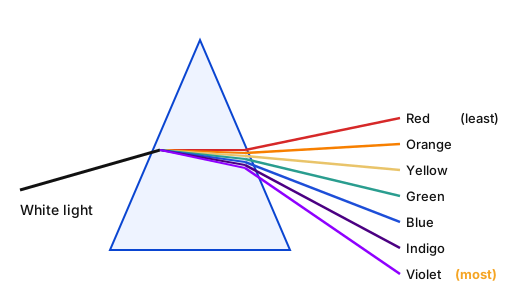
- Order VIBGYOR: violet has the shortest wavelength, red the longest.
- Refractive index of glass is highest for violet, so violet bends (deviates) the most.
- Red bends the least and appears at the top of the spectrum.
Yaad rakhein: VIBGYOR: V = most deviated, R = least deviated.
Answer: (C) Violet
अवधारणा: प्रिज़्म में श्वेत प्रकाश सात रंगों में बँट जाता है क्योंकि हर रंग अलग कोण से मुड़ता है (विक्षेपण)। कम तरंगदैर्घ्य वाला रंग अधिक विचलित होता है।
- क्रम VIBGYOR (बैंजानीहपीनाला): बैंगनी की तरंगदैर्घ्य सबसे कम, लाल की सबसे अधिक।
- काँच का अपवर्तनांक बैंगनी के लिए सबसे अधिक, अतः बैंगनी सबसे अधिक मुड़ता है।
- लाल सबसे कम मुड़ता है और स्पेक्ट्रम में सबसे ऊपर दिखता है।
याद रखें: VIBGYOR: V (बैंगनी) = सर्वाधिक विचलन, R (लाल) = न्यूनतम।
उत्तर: (C) बैंगनी (Violet)
RRB Technician Grade IIIGeneral ScienceDispersion of LightRRB Technician Grade III 2024 · 23 Dec Shift 2
Q1145.Which of the following statements is/are correct related to transportation?
(i) Arteries are the vessels which carry blood away from the heart to various organs of the body.
(ii) The arteries have thin and elastic walls.
(iii) Veins have valves that ensure that blood flows only in one direction.
परिवहन से संबंधित निम्नलिखित में से कौन-सा/से कथन सही है/हैं?
(i) धमनियाँ (Arteries) वे वाहिकाएँ हैं जो रुधिर को हृदय से शरीर के विभिन्न अंगों तक ले जाती हैं।
(ii) धमनियों की भित्तियाँ पतली और लचीली होती हैं।
(iii) शिराओं (Veins) में वाल्व होते हैं जो यह सुनिश्चित करते हैं कि रुधिर केवल एक ही दिशा में प्रवाहित हो।
- AOnly (i)केवल (i)
- BOnly (i) and (iii)केवल (i) और (iii)
- C(i), (ii) and (iii)(i), (ii) और (iii)
- DOnly (i) and (ii)केवल (i) और (ii)
Show answer
Concept: Arteries carry blood away from the heart under high pressure; veins bring blood back to the heart.
- (i) Arteries carry blood from the heart to organs – correct.
- (ii) Since blood in arteries is under high pressure, arteries have thick elastic walls – statement says thin, so wrong.
- (iii) Veins have valves so blood flows only towards the heart – correct.
Yaad rakhein: Artery = Away + thick wall; Vein = to heart + valves.
Answer: (B) Only (i) and (iii)
अवधारणा: धमनियाँ उच्च दाब पर रक्त को हृदय से दूर ले जाती हैं; शिराएँ रक्त को हृदय तक वापस लाती हैं।
- (i) धमनियाँ हृदय से अंगों तक रक्त ले जाती हैं – सही।
- (ii) धमनियों में रक्त उच्च दाब पर होता है, इसलिए उनकी भित्ति मोटी व लचीली होती है – 'पतली' गलत।
- (iii) शिराओं में वाल्व होते हैं जिससे रक्त एक ही दिशा में (हृदय की ओर) बहता है – सही।
याद रखें: धमनी = हृदय से दूर + मोटी भित्ति; शिरा = हृदय की ओर + वाल्व।
उत्तर: (B) केवल (i) और (iii)
RRB Technician Grade IIIGeneral ScienceTransportation in HumansRRB Technician Grade III 2024 · 23 Dec Shift 2
Q1146.An organism simply splits into two equal halves during cell division. What is it known as?
कोशिका विभाजन के दौरान एक जीव साधारण रूप से दो समान भागों में विभाजित हो जाता है। इसे क्या कहा जाता है?
- ARegenerationपुनर्जनन (Regeneration)
- BSpore formationबीजाणु समासंघ (Spore formation)
- CBuddingमुकुलन (Budding)
- DBinary fissionद्विखंडन (Binary fission)
Show answer
Concept: Binary fission: a unicellular organism divides into two equal daughter cells.
- Example: Amoeba, Paramecium, bacteria – the nucleus divides, then the cytoplasm.
- Budding (Hydra, yeast) gives a small outgrowth, not two equal halves.
- Spore formation (Rhizopus) and regeneration (Planaria) are different methods.
Yaad rakhein: Binary = two equal halves.
Answer: (D) Binary fission
अवधारणा: द्विखंडन: एककोशिकीय जीव दो बराबर संतति कोशिकाओं में बँट जाता है।
- उदाहरण: अमीबा, पैरामीशियम, जीवाणु – पहले केंद्रक, फिर कोशिकाद्रव्य विभाजित होता है।
- मुकुलन (हाइड्रा, यीस्ट) में छोटा उभार बनता है, दो बराबर भाग नहीं।
- बीजाणु निर्माण (राइज़ोपस) और पुनर्जनन (प्लेनेरिया) अलग विधियाँ हैं।
याद रखें: द्वि = दो बराबर भाग।
उत्तर: (D) द्विखंडन (Binary fission)
RRB Technician Grade IIIGeneral ScienceAsexual ReproductionRRB Technician Grade III 2024 · 23 Dec Shift 2
Q1147.Select the INCORRECT statement from the following options.
निम्नलिखित विकल्पों में से गलत कथन का चयन कीजिए।
- AThe kinetic energy of an object increases with the increase of its mass.किसी वस्तु की गतिज ऊर्जा उसके द्रव्यमान में वृद्धि के साथ बढ़ती है।
- BThe kinetic energy is the energy possessed by an object due to its position.गतिज ऊर्जा वह ऊर्जा है जो किसी वस्तु में उसकी स्थिति के कारण होती है।
- CThe kinetic energy is the energy possessed by an object due to its motion.गतिज ऊर्जा वह ऊर्जा है जो किसी वस्तु में उसकी गति के कारण होती है।
- DThe kinetic energy of an object increases with the increase of its velocity.किसी वस्तु की गतिज ऊर्जा उसके वेग में वृद्धि के साथ बढ़ती है।
Show answer
Concept: Kinetic energy is the energy due to motion: .
- KE increases with mass and with velocity – (A), (C), (D) are correct.
- Energy due to position or configuration is potential energy (), not kinetic energy.
- So statement (B) is incorrect.
Yaad rakhein: Kinetic → motion; Potential → position.
Answer: (B) The kinetic energy is the energy possessed by an object due to its position.
अवधारणा: गतिज ऊर्जा गति के कारण ऊर्जा है: ।
- KE द्रव्यमान और वेग बढ़ने पर बढ़ती है – (A), (C), (D) सही।
- स्थिति के कारण ऊर्जा स्थितिज ऊर्जा है (), गतिज नहीं।
- अतः कथन (B) गलत है।
याद रखें: गतिज → गति; स्थितिज → स्थिति।
उत्तर: (B) गतिज ऊर्जा वह ऊर्जा है जो किसी वस्तु में उसकी स्थिति के कारण होती है।
RRB Technician Grade IIIGeneral ScienceKinetic EnergyRRB Technician Grade III 2024 · 23 Dec Shift 2
Q1148.An object weighs 60 N when measured on the Earth. What would be its weight when measured on the moon? (Given, acceleration due to gravity (g) of the moon is 1/6 th of the g of the earth)
पृथ्वी पर मापे जाने पर एक वस्तु का भार 60 N है। चंद्रमा पर मापे जाने पर इसका भार कितना होगा? (दिया गया है, चंद्रमा का गुरुत्वीय त्वरण (g), पृथ्वी के g का 1/6 वाँ भाग है)
- A70 N
- B10 N
- C40 N
- D60 N
Show answer
Concept: Weight ; mass stays the same everywhere, so weight changes in proportion to .
- On the moon, .
- .
Trick: Moon weight = Earth weight .
Answer: (B) 10 N
अवधारणा: भार ; द्रव्यमान हर जगह समान रहता है, इसलिए भार के अनुपात में बदलता है।
- चंद्रमा पर ।
- ।
ट्रिक: चंद्रमा पर भार = पृथ्वी पर भार ।
उत्तर: (B) 10 N
RRB Technician Grade IIIGeneral ScienceGravitationRRB Technician Grade III 2024 · 23 Dec Shift 2
Q1149.Starting from rest, Raju attains a velocity of 24 m/s in a minute with his bicycle. The acceleration of the bicycle is:
विरामावस्था से शुरू करके, राजू अपनी साइकिल से एक मिनट में 24 m/s का वेग प्राप्त कर लेता है। साइकिल का त्वरण है:
- A
- B
- C
- D
Show answer
Concept: Acceleration , with time in seconds.
- Starting from rest: , .
- .
- .
Trick: Always convert minutes to seconds before dividing.
Answer: (C)
अवधारणा: त्वरण , समय सेकंड में।
- विराम से प्रारंभ: , ।
- ।
- ।
ट्रिक: भाग देने से पहले मिनट को सेकंड में बदलें।
उत्तर: (C)
RRB Technician Grade IIIGeneral ScienceAccelerationRRB Technician Grade III 2024 · 23 Dec Shift 2
Q1150.How are three resistances 3 Ω, 4 Ω, and 6 Ω connected in combination, so that their total resistance will be 13 Ω?
तीन प्रतिरोधों 3 Ω, 4 Ω और 6 Ω को किस संयोजन में जोड़ा जाए ताकि उनका कुल प्रतिरोध 13 Ω हो?
- A3 Ω in series with 6 Ω and 4 Ω in parallel3 Ω, समांतर क्रम में जुड़े 6 Ω और 4 Ω के साथ श्रेणीक्रम में
- BAll in parallelसभी समांतर क्रम (पार्श्वक्रम) में
- CAll in seriesसभी श्रेणीक्रम में
- DDoes not depend on any combinationकिसी भी संयोजन पर निर्भर नहीं करता
Show answer
Concept: In series, resistances add: . In parallel, the total is less than the smallest resistance.
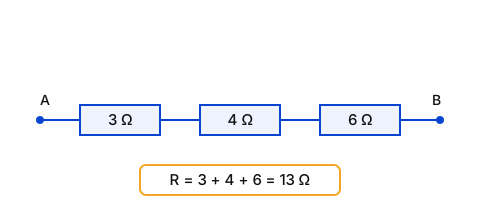
- Series: – matches.
- All parallel: , so .
- Option (A): .
Trick: Total equals the plain sum (13) only in series.
Answer: (C) All in series
अवधारणा: श्रेणी क्रम में प्रतिरोध जुड़ते हैं: । समांतर क्रम में कुल प्रतिरोध सबसे छोटे से भी कम होता है।
- श्रेणी: – मेल खाता है।
- सभी समांतर: , अतः ।
- विकल्प (A): ।
ट्रिक: कुल प्रतिरोध साधारण योग (13) के बराबर केवल श्रेणी क्रम में होता है।
उत्तर: (C) सभी श्रेणीक्रम में
RRB Technician Grade IIIGeneral ScienceCombination of ResistorsRRB Technician Grade III 2024 · 23 Dec Shift 2
Q1151.Which of the following expressions gives the correct formula for mass by mass percentage of a solution?
निम्नलिखित में से कौन-सा व्यंजक किसी विलयन के द्रव्यमान द्वारा द्रव्यमान प्रतिशत का सही सूत्र देता है?
- A((Mass of solvent)/(Mass of solution)) × 100((विलायक का द्रव्यमान)/(विलयन का द्रव्यमान)) × 100
- B((Volume of solute)/(Mass of solution)) × 100((विलेय का आयतन)/(विलयन का द्रव्यमान)) × 100
- C((Mass of solute)/(Volume of solution)) × 100((विलेय का द्रव्यमान)/(विलयन का आयतन)) × 100
- D((Mass of solute)/(Mass of solution)) × 100((विलेय का द्रव्यमान)/(विलयन का द्रव्यमान)) × 100
Show answer
Concept: Concentration of a solution can be expressed as mass by mass percentage.
- .
- Mass of solution = mass of solute + mass of solvent.
- Mixing mass with volume gives mass by volume %, not mass by mass.
Trick: Mass by mass → both numerator and denominator in mass; numerator is always the solute.
Answer: (D) ((Mass of solute)/(Mass of solution)) × 100
अवधारणा: विलयन की सांद्रता को द्रव्यमान द्वारा द्रव्यमान प्रतिशत में व्यक्त कर सकते हैं।
- ।
- विलयन का द्रव्यमान = विलेय + विलायक का द्रव्यमान।
- द्रव्यमान और आयतन मिलाने पर द्रव्यमान/आयतन % बनता है।
ट्रिक: द्रव्यमान/द्रव्यमान → अंश व हर दोनों द्रव्यमान में; अंश में सदैव विलेय।
उत्तर: (D) ((विलेय का द्रव्यमान)/(विलयन का द्रव्यमान)) × 100
RRB Technician Grade IIIGeneral ScienceConcentration of SolutionsRRB Technician Grade III 2024 · 23 Dec Shift 2
Q1152.Which of the following reactions is an example of decomposition reaction?
निम्नलिखित में से कौन-सी अभिक्रिया वियोजन अभिक्रिया (decomposition reaction) का उदाहरण है?
- ABurning of natural gasप्राकृतिक गैस का दहन
- BFormation of water from H2(g) and O2(g)H2(g) और O2(g) से जल का बनना
- CBurning of coalकोयले का दहन
- DSilver chloride turns grey in sunlightसूर्य के प्रकाश में सिल्वर क्लोराइड का धूसर हो जाना
Show answer
Concept: In a decomposition reaction, a single reactant breaks down into simpler products (by heat, light or electricity).
- Sunlight decomposes silver chloride: ; grey silver forms – photolytic decomposition.
- Burning natural gas and coal: combustion (combination with oxygen).
- : combination.
Yaad rakhein: AgCl, AgBr in sunlight → decomposition (used in black-and-white photography).
Answer: (D) Silver chloride turns grey in sunlight
अवधारणा: वियोजन अभिक्रिया में एक अभिकारक टूटकर सरल उत्पाद बनाता है (ऊष्मा, प्रकाश या विद्युत से)।
- सूर्य प्रकाश में सिल्वर क्लोराइड वियोजित होता है: ; धूसर चाँदी बनती है – प्रकाश-वियोजन।
- प्राकृतिक गैस व कोयले का जलना: दहन (ऑक्सीजन से संयोजन)।
- : संयोजन।
याद रखें: AgCl, AgBr धूप में → वियोजन (श्वेत-श्याम फोटोग्राफी में उपयोग)।
उत्तर: (D) सूर्य के प्रकाश में सिल्वर क्लोराइड का धूसर हो जाना
RRB Technician Grade IIIGeneral ScienceDecomposition ReactionRRB Technician Grade III 2024 · 23 Dec Shift 2
Q1153.Which of the following points always lie(s) on the principal axis of a spherical mirror?
i)Principal Focus
ii)Point of incidence
iii)Pole
निम्नलिखित में से कौन-सा/से बिंदु सदैव गोलीय दर्पण के मुख्य अक्ष पर स्थित होता है/होते हैं?
i) मुख्य फोकस
ii) आपतन बिंदु
iii) ध्रुव
- ABoth (i) and (iii)(i) और (iii) दोनों
- BOnly (i)केवल (i)
- COnly (iii)केवल (iii)
- DBoth (ii) and (iii)(ii) और (iii) दोनों
Show answer
Concept: The principal axis is the straight line through the pole (P) and the centre of curvature (C) of a spherical mirror.
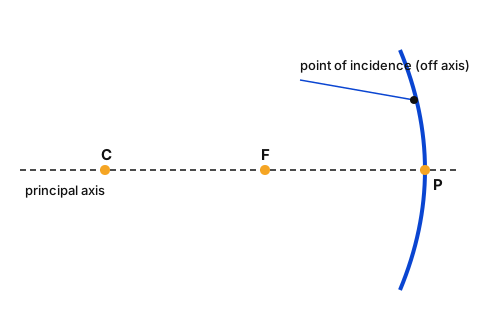
- Pole P – the centre of the mirror surface – lies on the principal axis.
- Principal focus F – where rays parallel to the axis meet – lies on the axis midway between P and C.
- Point of incidence can be anywhere on the mirror, so it does not always lie on the axis.
Yaad rakhein: On the axis always: P, F, C.
Answer: (A) Both (i) and (iii)
अवधारणा: मुख्य अक्ष गोलीय दर्पण के ध्रुव (P) और वक्रता केंद्र (C) से गुजरने वाली सीधी रेखा है।
- ध्रुव P (दर्पण सतह का केंद्र) मुख्य अक्ष पर होता है।
- मुख्य फोकस F (जहाँ अक्ष के समांतर किरणें मिलती हैं) अक्ष पर P और C के मध्य होता है।
- आपतन बिंदु दर्पण पर कहीं भी हो सकता है, अतः सदैव अक्ष पर नहीं।
याद रखें: अक्ष पर सदैव: P, F, C।
उत्तर: (A) (i) और (iii) दोनों
RRB Technician Grade IIIGeneral ScienceSpherical MirrorsRRB Technician Grade III 2024 · 23 Dec Shift 2
Q1154.If a train travelling with a velocity of 20 m/s undergoes a uniform acceleration of 4 , what is the value of its velocity in 5 seconds?
यदि 20 m/s के वेग से चल रही एक रेलगाड़ी 4 का एकसमान त्वरण प्राप्त करती है, तो 5 सेकंड में उसके वेग का मान क्या होगा?
- A40 m/s
- B80 m/s
- C16 m/s
- D60 m/s
Show answer
Concept: First equation of motion: .
- , , .
- .
Trick: Gain in speed ; add it to the initial speed.
Answer: (A) 40 m/s
अवधारणा: गति का प्रथम समीकरण: ।
- , , ।
- ।
ट्रिक: वेग में वृद्धि ; इसे प्रारंभिक वेग में जोड़ें।
उत्तर: (A) 40 m/s
RRB Technician Grade IIIGeneral ScienceEquations of MotionRRB Technician Grade III 2024 · 23 Dec Shift 2
Q1155.Electromagnetic Induction was discovered by:
विद्युत चुंबकीय प्रेरण (Electromagnetic Induction) की खोज किसने की थी?
- AEinsteinआइंस्टीन
- BEdisonएडिसन
- CFaradayफैराडे
- DNewtonन्यूटन
Show answer
Concept: Electromagnetic induction: a changing magnetic field linked with a coil induces a current in it.
- Discovered by Michael Faraday in 1831.
- It is the working principle of the electric generator (dynamo) and transformer.
- Einstein – photoelectric effect/relativity; Edison – electric bulb; Newton – laws of motion and gravitation.
Yaad rakhein: Faraday → induction → generator.
Answer: (C) Faraday
अवधारणा: विद्युत चुंबकीय प्रेरण: कुंडली से जुड़े चुंबकीय क्षेत्र में परिवर्तन से उसमें धारा प्रेरित होती है।
- माइकल फैराडे ने 1831 में इसकी खोज की।
- यह विद्युत जनित्र (डायनेमो) और ट्रांसफॉर्मर का सिद्धांत है।
- आइंस्टीन – प्रकाश-विद्युत प्रभाव/सापेक्षता; एडिसन – बल्ब; न्यूटन – गति व गुरुत्व के नियम।
याद रखें: फैराडे → प्रेरण → जनित्र।
उत्तर: (C) फैराडे
RRB Technician Grade IIIGeneral ScienceElectromagnetic InductionRRB Technician Grade III 2024 · 23 Dec Shift 2
Q1156.Select the correct equation(s) that relate(s) the final and initial velocity of a freely falling object with respect to time.
(A)
(B)
(C)
मुक्त रूप से गिरती हुई वस्तु के अंतिम और प्रारंभिक वेग को समय के सापेक्ष संबंधित करने वाले सही समीकरण/समीकरणों का चयन कीजिए।
(A)
(B)
(C)
- AOnly (A)केवल (A)
- B(A) and (B)(A) और (B)
- C(B) and (C)(B) और (C)
- DOnly (C)केवल (C)
Show answer
Concept: The velocity–time relation is the first equation of motion: ; for free fall .
- Rearranging gives – statement (C) is correct.
- (A) is wrong: correct form is , and it relates distance, not velocities.
- (B) is wrong: is not a valid equation.
Yaad rakhein: – relation has no : .
Answer: (D) Only (C)
अवधारणा: वेग-समय संबंध गति का प्रथम समीकरण है: ; मुक्त पतन में ।
- को पुनर्व्यवस्थित करने पर – कथन (C) सही।
- (A) गलत: सही रूप है, और यह दूरी का संबंध है।
- (B) गलत: कोई मान्य समीकरण नहीं।
याद रखें: – संबंध में नहीं होता: ।
उत्तर: (D) केवल (C)
RRB Technician Grade IIIGeneral ScienceEquations of MotionRRB Technician Grade III 2024 · 23 Dec Shift 2
Q1157.Which of the following tissues is present in stems, around vascular bundles, in the veins of leaves and the hard covering of seeds and nuts?
निम्नलिखित में से कौन-सा ऊतक तनों में, संवहन बंडलों के चारों ओर, पत्तियों की शिराओं में तथा बीजों और गिरीदार फलों (nuts) के कठोर आवरण में उपस्थित होता है?
- AApical meristemशीर्षस्थ विभज्योतक (Apical meristem)
- BParenchymaमृदूतक (Parenchyma)
- CSclerenchymaदृढ़ोतक (Sclerenchyma)
- DEpidermisबाह्यत्वचा (Epidermis)
Show answer
Concept: Sclerenchyma is a dead, thick-walled (lignified) simple permanent tissue that makes plant parts hard and stiff.
- Found in stems, around vascular bundles, in leaf veins and in the hard covering of seeds and nuts (e.g. husk of coconut).
- Parenchyma – living, thin-walled, stores food.
- Apical meristem – growing tips; epidermis – outer protective layer.
Trick: Sclero = hard → sclerenchyma = hardness (coconut husk, nut shells).
Answer: (C) Sclerenchyma
अवधारणा: दृढ़ोतक (स्क्लेरेनकाइमा) मृत, मोटी (लिग्निनयुक्त) भित्ति वाला सरल स्थायी ऊतक है जो पौधे के भागों को कठोर बनाता है।
- तनों में, संवहन बंडलों के चारों ओर, पत्तियों की शिराओं में तथा बीजों व मेवों के कठोर आवरण (जैसे नारियल का छिलका) में पाया जाता है।
- मृदूतक (पैरेनकाइमा) – जीवित, पतली भित्ति, भोजन संचय।
- शीर्षस्थ विभज्योतक – वृद्धि बिंदु; एपिडर्मिस – बाहरी सुरक्षात्मक परत।
ट्रिक: स्क्लेरो = कठोर → स्क्लेरेनकाइमा = कठोरता (नारियल का छिलका)।
उत्तर: (C) दृढ़ोतक (Sclerenchyma)
RRB Technician Grade IIIGeneral SciencePlant TissuesRRB Technician Grade III 2024 · 23 Dec Shift 2
Q1158.If an object with a mass of 0.1 kg moves with a uniform velocity of , its kinetic energy is _____.
यदि 0.1 kg द्रव्यमान की एक वस्तु के एकसमान वेग से गति करती है, तो उसकी गतिज ऊर्जा _____ है।
- A0.1 joule0.1 जूल
- B0.4 joule0.4 जूल
- C0.05 joule0.05 जूल
- D0.2 joule0.2 जूल
Show answer
Concept: Kinetic energy .
- , .
- .
Trick: Square the velocity first: , then .
Answer: (D) 0.2 joule
अवधारणा: गतिज ऊर्जा ।
- , ।
- ।
ट्रिक: पहले वेग का वर्ग: , फिर ।
उत्तर: (D) 0.2 जूल
RRB Technician Grade IIIGeneral ScienceKinetic EnergyRRB Technician Grade III 2024 · 23 Dec Shift 2
Q1159.Silver ornaments become black after some time because silver reacts with ______ present in the air.
चाँदी के आभूषण कुछ समय बाद काले पड़ जाते हैं क्योंकि चाँदी वायु में उपस्थित ______ के साथ अभिक्रिया करती है।
- Aoxygenऑक्सीजन
- Bnitrogenनाइट्रोजन
- Csulphurसल्फर
- Dcarbon dioxideकार्बन डाइऑक्साइड
Show answer
Concept: Corrosion of silver is called tarnishing.
- Silver reacts with sulphur compounds (hydrogen sulphide, ) present in air.
- A black coating of silver sulphide () forms on the surface.
- Copper turns green (basic copper carbonate) and iron rusts (needs oxygen and moisture).
Yaad rakhein: Silver – black (); Copper – green; Iron – reddish-brown rust.
Answer: (C) sulphur
अवधारणा: चाँदी के संक्षारण को मलिनता (टार्निशिंग) कहते हैं।
- चाँदी वायु में उपस्थित सल्फर यौगिकों (हाइड्रोजन सल्फाइड, ) से अभिक्रिया करती है।
- सतह पर सिल्वर सल्फाइड () की काली परत बन जाती है।
- तांबा हरा (क्षारीय कॉपर कार्बोनेट) और लोहे पर जंग (ऑक्सीजन + नमी) लगता है।
याद रखें: चाँदी – काली (); तांबा – हरा; लोहा – भूरा-लाल जंग।
उत्तर: (C) सल्फर
RRB Technician Grade IIIGeneral ScienceCorrosionRRB Technician Grade III 2024 · 23 Dec Shift 2
Q1160.C2H2, C2H4, and C2H6 belong to which group of hydrocarbons?
C2H2, C2H4 और C2H6 हाइड्रोकार्बन के किस समूह से संबंधित हैं?
- AAlkane, alkyne, and alkene hydrocarbons, respectivelyक्रमशः ऐल्केन, ऐल्काइन और ऐल्कीन हाइड्रोकार्बन
- BAlkane, alkene, and alkyne hydrocarbons, respectivelyक्रमशः ऐल्केन, ऐल्कीन और ऐल्काइन हाइड्रोकार्बन
- CAlkene, alkyne, and alkane hydrocarbons, respectivelyक्रमशः ऐल्कीन, ऐल्काइन और ऐल्केन हाइड्रोकार्बन
- DAlkyne, alkene, and alkane hydrocarbons, respectivelyक्रमशः ऐल्काइन, ऐल्कीन और ऐल्केन हाइड्रोकार्बन
Show answer
Concept: Alkanes (single bonds), alkenes (double bond), alkynes (triple bond).
- : → alkyne (ethyne).
- : → alkene (ethene).
- : → alkane (ethane).
Trick: Fewer H atoms = more bonds between C: alkyne (least H) → alkene → alkane (most H).
Answer: (D) Alkyne, alkene, and alkane hydrocarbons, respectively
अवधारणा: एल्केन (एकल बंध), एल्कीन (द्विबंध), एल्काइन (त्रिबंध)।
- : → एल्काइन (एथाइन)।
- : → एल्कीन (एथीन)।
- : → एल्केन (एथेन)।
ट्रिक: H परमाणु जितने कम, C के बीच बंध उतने अधिक: एल्काइन → एल्कीन → एल्केन।
उत्तर: (D) क्रमशः ऐल्काइन, ऐल्कीन और ऐल्केन हाइड्रोकार्बन
RRB Technician Grade IIIGeneral ScienceHydrocarbonsRRB Technician Grade III 2024 · 23 Dec Shift 2

