Q1161.The focal length of a spherical mirror is 12 cm, then the radius of curvature of this mirror will be:
एक गोलीय दर्पण की फोकस दूरी 12 cm है, तो इस दर्पण की वक्रता त्रिज्या होगी:
- A3cm
- B24cm
- C2cm
- D6cm
Show answer
Concept: For a spherical mirror of small aperture, the radius of curvature is twice the focal length: .
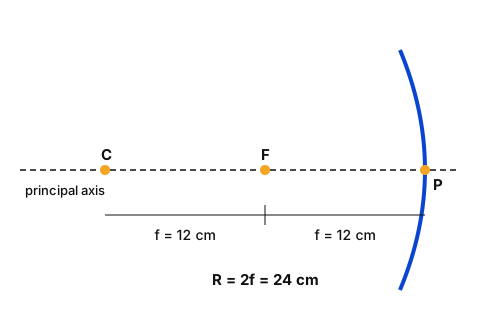
- .
- .
- F lies midway between the pole P and the centre of curvature C.
Yaad rakhein: , .
Answer: (B) 24cm
अवधारणा: छोटे द्वारक वाले गोलीय दर्पण के लिए वक्रता त्रिज्या फोकस दूरी की दोगुनी होती है: ।
- ।
- ।
- F ध्रुव P और वक्रता केंद्र C के ठीक मध्य में होता है।
याद रखें: , ।
उत्तर: (B) 24cm
RRB Technician Grade IIIGeneral ScienceSpherical MirrorsRRB Technician Grade III 2024 · 23 Dec Shift 2
Q1162.The atomic number of an element is determined by the number of:
किसी तत्व की परमाणु संख्या (atomic number) किसकी संख्या द्वारा निर्धारित होती है?
- Aelectronsइलेक्ट्रॉन
- Bprotonsप्रोटॉन
- Cneutronsन्यूट्रॉन
- Dboth protons and neutronsप्रोटॉन और न्यूट्रॉन दोनों
Show answer
Concept: Atomic number () is the number of protons in the nucleus of an atom; it fixes the identity of the element.
- Every atom of an element has the same number of protons.
- Electrons can be gained or lost (ions), so they do not define the element.
- Neutrons vary in isotopes; protons + neutrons give the mass number (), not .
Yaad rakhein: , . Change protons → element changes.
Answer: (B) protons
अवधारणा: परमाणु क्रमांक () नाभिक में उपस्थित प्रोटॉनों की संख्या है; यही तत्व की पहचान तय करता है।
- किसी तत्व के सभी परमाणुओं में प्रोटॉन की संख्या समान होती है।
- इलेक्ट्रॉन घट-बढ़ सकते हैं (आयन बनते हैं), इसलिए वे तत्व तय नहीं करते।
- समस्थानिकों में न्यूट्रॉन बदलते हैं; प्रोटॉन + न्यूट्रॉन = द्रव्यमान संख्या (), न कि ।
याद रखें: , । प्रोटॉन बदले तो तत्व बदल जाता है।
उत्तर: (B) प्रोटॉन
RRB Technician Grade IIIGeneral ScienceAtomic numberRRB Technician Grade III 2024 · 23 Dec Shift 1
Q1163.__________ are found in the epidermis of a leaf.
पत्ती की बाह्यत्वचा (epidermis) में __________ पाए जाते हैं।
- AVascular bundleसंवहन बंडल (Vascular bundle)
- BAerenchymaवायूतक (Aerenchyma)
- CStomataरंध्र (Stomata)
- DChlorenchymaहरितोतक (Chlorenchyma)
Show answer
Concept: The epidermis is the outermost protective layer of a leaf. It contains tiny pores called stomata, each surrounded by two guard cells.
- Stomata allow exchange of gases ( in, out) during photosynthesis.
- Water vapour is lost through them in transpiration.
- Vascular bundles, chlorenchyma and aerenchyma lie inside the leaf/stem, not in the epidermis.
Yaad rakhein: Stomata = 'mouths' of the leaf, mostly on the lower epidermis.
Answer: (C) Stomata
अवधारणा: बाह्यत्वचा (एपिडर्मिस) पत्ती की सबसे बाहरी सुरक्षात्मक परत है। इसमें छोटे-छोटे छिद्र होते हैं जिन्हें रंध्र (स्टोमेटा) कहते हैं, प्रत्येक दो द्वार कोशिकाओं से घिरा होता है।
- प्रकाश संश्लेषण में गैसों का आदान-प्रदान ( अंदर, बाहर) रंध्रों से होता है।
- वाष्पोत्सर्जन में जल-वाष्प भी इन्हीं से निकलती है।
- संवहन बंडल, हरित ऊतक (क्लोरेनकाइमा) और वायु ऊतक (एरेनकाइमा) अंदर के ऊतक हैं, बाह्यत्वचा में नहीं।
याद रखें: रंध्र = पत्ती का 'मुँह', अधिकतर निचली बाह्यत्वचा पर।
उत्तर: (C) रंध्र (Stomata)
RRB Technician Grade IIIGeneral ScienceLeaf epidermis – stomataRRB Technician Grade III 2024 · 23 Dec Shift 1
Q1164.Which of the following represents the correct formula for calcium oxide?
निम्नलिखित में से कौन-सा कैल्शियम ऑक्साइड का सही सूत्र दर्शाता है?
- A
- B
- C
- DCaO
Show answer
Concept: Write a formula by crossing over valencies of the ions and simplifying.
- Calcium ion: (valency 2).
- Oxide ion: (valency 2).
- Cross-over gives , which simplifies to (ratio ).
Trick: Equal valencies ( and ) → simple formula, e.g. , , .
Answer: (D) CaO
अवधारणा: सूत्र लिखने के लिए आयनों की संयोजकता का क्रॉस-ओवर करें और सरल करें।
- कैल्शियम आयन: (संयोजकता 2)।
- ऑक्साइड आयन: (संयोजकता 2)।
- क्रॉस-ओवर से मिलता है, जो सरल होकर (अनुपात ) बनता है।
ट्रिक: समान संयोजकता ( और ) → सरल सूत्र, जैसे , , ।
उत्तर: (D) CaO
RRB Technician Grade IIIGeneral ScienceChemical formula – valencyRRB Technician Grade III 2024 · 23 Dec Shift 1
Q1165.A current of 1 A is drawn by a filament of an electric bulb. The number of electrons passing through a cross-section of the filament in 8 mins would be equal to _____.
(Given, charge of electron (e) is equal to C)
एक विद्युत बल्ब का तंतु (filament) 1 A धारा लेता है। 8 मिनट में तंतु के किसी अनुप्रस्थ काट से गुजरने वाले इलेक्ट्रॉनों की संख्या _____ के बराबर होगी।
(दिया गया है, इलेक्ट्रॉन का आवेश (e) C के बराबर है)
- A
- B
- C
- D
Show answer
Concept: Charge and number of electrons .
- .
- .
- .
Trick: electrons per coulomb; .
Answer: (B)
अवधारणा: आवेश तथा इलेक्ट्रॉनों की संख्या ।
- ।
- ।
- ।
ट्रिक: 1 कूलॉम में इलेक्ट्रॉन; ।
उत्तर: (B)
RRB Technician Grade IIIGeneral ScienceElectric current and chargeRRB Technician Grade III 2024 · 23 Dec Shift 1
Q1166.The tissue which makes the plant hard and stiff and provides strength to the plant parts is the:
वह ऊतक जो पौधे को कठोर और सख्त बनाता है तथा पौधे के भागों को मजबूती प्रदान करता है, कौन-सा है?
- Asclerenchymaदृढ़ोतक (sclerenchyma)
- Bchlorenchymaहरितोतक (chlorenchyma)
- Caerenchymaवायूतक (aerenchyma)
- Dcollenchymaस्थूलकोणोतक (collenchyma)
Show answer
Concept: Sclerenchyma is a dead simple permanent tissue whose cell walls are thickened with lignin, making plant parts hard and stiff.
- Cells are long, narrow and dead with almost no intercellular space.
- Found in stems, around vascular bundles, in leaf veins and in hard seed coats/husks.
- Collenchyma gives flexibility, chlorenchyma does photosynthesis, aerenchyma gives buoyancy.
Yaad rakhein: Sclero = hard → strength & stiffness (dead, lignified).
Answer: (A) sclerenchyma
अवधारणा: दृढ़ोतक (स्क्लेरेनकाइमा) एक मृत सरल स्थायी ऊतक है जिसकी कोशिका भित्ति लिग्निन से मोटी होती है, जिससे पौधे के भाग कठोर और सख्त बनते हैं।
- कोशिकाएँ लंबी, पतली और मृत होती हैं, अंतरकोशिकीय स्थान लगभग नहीं।
- तने, संवहन बंडलों के चारों ओर, पत्ती की शिराओं और बीज के कठोर आवरण/छिलके में पाया जाता है।
- स्थूलकोण ऊतक (कॉलेनकाइमा) लचीलापन, हरित ऊतक प्रकाश संश्लेषण और वायु ऊतक उत्प्लावकता देता है।
याद रखें: स्क्लेरो = कठोर → मज़बूती व सख्ती (मृत, लिग्निनयुक्त)।
उत्तर: (A) दृढ़ोतक (sclerenchyma)
RRB Technician Grade IIIGeneral SciencePlant tissues – sclerenchymaRRB Technician Grade III 2024 · 23 Dec Shift 1
Q1167.Which of the following is equal to 1 Ohm (If V and A are volt and ampere, respectively)?
निम्नलिखित में से कौन-सा 1 ओम के बराबर है (यदि V और A क्रमशः वोल्ट और एम्पियर हैं)?
- A1V/2A
- B1V * 1A
- C1V/1A
- D1A/1V
Show answer
Concept: From Ohm's law, , so the unit of resistance is volt per ampere.
- .
- A conductor has resistance if across it drives current.
- is the unit of conductance (siemens), is watt.
Yaad rakhein: , , .
Answer: (C) 1V/1A
अवधारणा: ओम के नियम से , अतः प्रतिरोध का मात्रक वोल्ट प्रति ऐम्पियर है।
- ।
- यदि चालक के सिरों पर लगाने से धारा बहे तो उसका प्रतिरोध है।
- चालकता (सीमेंस) का और वाट का मात्रक है।
याद रखें: , , ।
उत्तर: (C) 1V/1A
RRB Technician Grade IIIGeneral ScienceOhm's law – unit of resistanceRRB Technician Grade III 2024 · 23 Dec Shift 1
Q1168.A constant force of 4 N acts on a box of mass 2 kg for a duration of 2 s. If its initial velocity is 2 m/s, then the final velocity of this box will be:
2 kg द्रव्यमान के एक बक्से पर 2 s की अवधि तक 4 N का एक नियत बल कार्य करता है। यदि इसका प्रारंभिक वेग 2 m/s है, तो इस बक्से का अंतिम वेग कितना होगा?
- A6 m/s
- B2 m/s
- C3 m/s
- D4 m/s
Show answer
Concept: Use , then .
- .
- .
Trick: Impulse method: → → .
Answer: (A) 6 m/s
अवधारणा: लगाएँ, फिर ।
- ।
- ।
ट्रिक: आवेग विधि: → → ।
उत्तर: (A) 6 m/s
RRB Technician Grade IIIGeneral ScienceNewton's second law and kinematicsRRB Technician Grade III 2024 · 23 Dec Shift 1
Q1169.Which of the following statements is/are correct related to eco-system?
(i) UV radiation is not damaging to organisms.
(ii) Ozone at the higher levels of the atmosphere is a product of UV radiation acting on oxygen molecule.
(iii) The amount of ozone in the atmosphere began to drop sharply in 1980.
पारितंत्र (eco-system) से संबंधित निम्नलिखित में से कौन-सा/से कथन सही है/हैं?
(i) UV विकिरण जीवों के लिए हानिकारक नहीं है।
(ii) वायुमंडल के उच्च स्तरों पर ओज़ोन, ऑक्सीजन अणु पर UV विकिरण की क्रिया का उत्पाद है।
(iii) वायुमंडल में ओज़ोन की मात्रा 1980 में तेजी से घटने लगी।
- AOnly (ii) and (iii)केवल (ii) और (iii)
- B(i), (ii) and (iii)(i), (ii) और (iii)
- COnly (i) and (ii)केवल (i) और (ii)
- DOnly (i)केवल (i)
Show answer
Concept: Ozone () in the upper atmosphere shields the earth from harmful ultraviolet (UV) radiation of the sun.
- (i) is wrong – UV radiation is highly damaging (e.g. skin cancer).
- (ii) is correct – UV splits into O atoms, which combine with : .
- (iii) is correct – ozone levels began to drop sharply in the 1980s, mainly due to CFCs.
Yaad rakhein: Ozone depletion ← CFCs; ozone forms from UV acting on .
Answer: (A) Only (ii) and (iii)
अवधारणा: ऊपरी वायुमंडल की ओज़ोन () सूर्य के हानिकारक पराबैंगनी (UV) विकिरण से पृथ्वी की रक्षा करती है।
- (i) गलत – UV विकिरण बहुत हानिकारक है (जैसे त्वचा कैंसर)।
- (ii) सही – UV, को O परमाणुओं में तोड़ता है, जो से मिलकर ओज़ोन बनाते हैं: ।
- (iii) सही – 1980 के दशक में ओज़ोन की मात्रा तेज़ी से घटने लगी, मुख्यतः CFC के कारण।
याद रखें: ओज़ोन क्षय ← CFC; ओज़ोन बनती है UV + से।
उत्तर: (A) केवल (ii) और (iii)
RRB Technician Grade IIIGeneral ScienceOzone layerRRB Technician Grade III 2024 · 23 Dec Shift 1
Q1170.Select the correct IUPAC names for and compounds, respectively.
यौगिकों और के सही IUPAC नाम क्रमशः चुनिए।
- APropanoic acid and ethanolप्रोपेनोइक अम्ल और एथेनॉल
- BPropanone and ethanolप्रोपेनोन और एथेनॉल
- CPropanone and methanolप्रोपेनोन और मेथेनॉल
- DEthanol and propanoneएथेनॉल और प्रोपेनोन
Show answer
Concept: IUPAC name = word root (number of C atoms) + suffix of the functional group.
- : 3 carbons (prop-) + ketone ( inside chain, suffix -one) → propanone (acetone).
- : 2 carbons (eth-) + alcohol (–OH, suffix -ol) → ethanol.
- Propanoic acid would need –COOH; methanol is .
Yaad rakhein: -ol = alcohol, -al = aldehyde, -one = ketone, -oic acid = carboxylic acid.
Answer: (B) Propanone and ethanol
अवधारणा: IUPAC नाम = मूल शब्द (C परमाणुओं की संख्या) + क्रियात्मक समूह का प्रत्यय।
- : 3 कार्बन (प्रोप-) + कीटोन (श्रृंखला के बीच , प्रत्यय -ओन) → प्रोपेनोन (ऐसीटोन)।
- : 2 कार्बन (एथ-) + ऐल्कोहॉल (–OH, प्रत्यय -ऑल) → एथेनॉल।
- प्रोपेनोइक अम्ल में –COOH होता है; मेथेनॉल है।
याद रखें: -ऑल = ऐल्कोहॉल, -ऐल = ऐल्डिहाइड, -ओन = कीटोन, -ओइक अम्ल = कार्बोक्सिलिक अम्ल।
उत्तर: (B) प्रोपेनोन और एथेनॉल
RRB Technician Grade IIIGeneral ScienceIUPAC nomenclatureRRB Technician Grade III 2024 · 23 Dec Shift 1
Q1171.The chemical reaction represents which type of reaction?
रासायनिक अभिक्रिया किस प्रकार की अभिक्रिया को दर्शाती है?
- ACombination reactionसंयोजन अभिक्रिया (Combination reaction)
- BCombustion reactionदहन अभिक्रिया (Combustion reaction)
- CDisplacement reactionविस्थापन अभिक्रिया (Displacement reaction)
- DDouble Displacement reactionद्वि-विस्थापन अभिक्रिया (Double Displacement reaction)
Show answer
Concept: In a displacement reaction, a more reactive element pushes out a less reactive element from its compound.
- Iron is more reactive than copper.
- Fe displaces Cu from forming ; copper is deposited.
- Blue solution turns pale green and the iron nail gets a brownish coat.
Trick: Single element + compound → new element + new compound = displacement; two compounds swapping ions = double displacement.
Answer: (C) Displacement reaction
अवधारणा: विस्थापन अभिक्रिया में अधिक क्रियाशील तत्व, कम क्रियाशील तत्व को उसके यौगिक से बाहर निकाल देता है।
- लोहा, ताँबे से अधिक क्रियाशील है।
- Fe, से Cu को हटाकर बनाता है; ताँबा जमा हो जाता है।
- नीला विलयन हल्का हरा हो जाता है और कील पर भूरी परत चढ़ जाती है।
ट्रिक: एक तत्व + यौगिक → नया तत्व + नया यौगिक = विस्थापन; दो यौगिक आयन बदलें = द्वि-विस्थापन।
उत्तर: (C) विस्थापन अभिक्रिया (Displacement reaction)
RRB Technician Grade IIIGeneral ScienceTypes of chemical reactionsRRB Technician Grade III 2024 · 23 Dec Shift 1
Q1172.Which of the following is an example of a mixture?
निम्नलिखित में से कौन-सा मिश्रण का उदाहरण है?
- ASalt (NaCl)नमक (NaCl)
- BWater ()जल ()
- CIron (Fe)लोहा (Fe)
- DAirवायु
Show answer
Concept: A mixture contains two or more substances physically mixed in any proportion, keeping their own properties.
- NaCl and are compounds (fixed ratio, chemically combined).
- Fe is an element.
- Air is a mixture of , , Ar, , water vapour etc. in varying amounts.
Yaad rakhein: Has a chemical formula with fixed ratio → compound/element; variable composition → mixture (air, brass, milk).
Answer: (D) Air
अवधारणा: मिश्रण में दो या अधिक पदार्थ किसी भी अनुपात में भौतिक रूप से मिले होते हैं और अपने गुण बनाए रखते हैं।
- NaCl और यौगिक हैं (निश्चित अनुपात, रासायनिक रूप से जुड़े)।
- Fe एक तत्व है।
- वायु , , Ar, , जल-वाष्प आदि का परिवर्ती अनुपात वाला मिश्रण है।
याद रखें: निश्चित अनुपात वाला सूत्र → यौगिक/तत्व; परिवर्ती संघटन → मिश्रण (वायु, पीतल, दूध)।
उत्तर: (D) वायु
RRB Technician Grade IIIGeneral ScienceMixtures and compoundsRRB Technician Grade III 2024 · 23 Dec Shift 1
Q1173.The atomic number of phosphorus atom is:
फॉस्फोरस परमाणु की परमाणु संख्या क्या है?
- A17
- B14
- C16
- D15
Show answer
Concept: Phosphorus (P) is in group 15, period 3 of the periodic table.
- Period 3: Na 11, Mg 12, Al 13, Si 14, P 15, S 16, Cl 17, Ar 18.
- So phosphorus has 15 protons; configuration 2, 8, 5 (valency 3 or 5).
Yaad rakhein: 14 = Si, 15 = P, 16 = S, 17 = Cl.
Answer: (D) 15
अवधारणा: फॉस्फोरस (P) आवर्त सारणी के समूह 15, आवर्त 3 में है।
- आवर्त 3: Na 11, Mg 12, Al 13, Si 14, P 15, S 16, Cl 17, Ar 18।
- अतः फॉस्फोरस में 15 प्रोटॉन; इलेक्ट्रॉनिक विन्यास 2, 8, 5 (संयोजकता 3 या 5)।
याद रखें: 14 = Si, 15 = P, 16 = S, 17 = Cl।
उत्तर: (D) 15
RRB Technician Grade IIIGeneral ScienceAtomic numbers of elementsRRB Technician Grade III 2024 · 23 Dec Shift 1
Q1174.Chlorination of alkane is an example of:
एल्केन का क्लोरीनीकरण किसका उदाहरण है?
- Aaddition reactionयोगात्मक अभिक्रिया (addition reaction)
- Brearrangement reactionपुनर्विन्यास अभिक्रिया (rearrangement reaction)
- Cboth addition and substitution chain reactionयोगात्मक और प्रतिस्थापन श्रृंखला अभिक्रिया दोनों
- Dsubstitution reactionप्रतिस्थापन अभिक्रिया (substitution reaction)
Show answer
Concept: Alkanes are saturated (only single bonds), so they cannot add atoms; instead an H atom is replaced.
- In sunlight: .
- One H is replaced by Cl – this is substitution.
- Further steps give , , .
Yaad rakhein: Saturated (alkane) → substitution; unsaturated (alkene/alkyne) → addition.
Answer: (D) substitution reaction
अवधारणा: ऐल्केन संतृप्त होते हैं (केवल एकल आबंध), अतः इनमें योग नहीं होता; बल्कि H परमाणु प्रतिस्थापित होता है।
- सूर्य के प्रकाश में: ।
- एक H की जगह Cl आ जाता है – यह प्रतिस्थापन है।
- आगे , , बनते हैं।
याद रखें: संतृप्त (ऐल्केन) → प्रतिस्थापन; असंतृप्त (ऐल्कीन/ऐल्काइन) → योगात्मक।
उत्तर: (D) प्रतिस्थापन अभिक्रिया (substitution reaction)
RRB Technician Grade IIIGeneral ScienceSubstitution reactionRRB Technician Grade III 2024 · 23 Dec Shift 1
Q1175.Plant cells change shape by changing the amount of _______ in them, resulting in swelling or shrinking, and therefore in changing shapes.
पादप कोशिकाएँ अपने अंदर _______ की मात्रा बदलकर अपना आकार बदलती हैं, जिसके परिणामस्वरूप वे फूलती या सिकुड़ती हैं और इस प्रकार उनका आकार बदलता है।
- Achlorophyllपर्णहरित (chlorophyll)
- Bfatवसा
- Cwaterजल
- Dcarbon dioxideकार्बन डाइऑक्साइड
Show answer
Concept: Plant cells lack muscles; they move by changing their water content (turgor pressure).
- Water entering cells makes them swell (turgid); water leaving makes them shrink (flaccid).
- This changes cell shape, e.g. leaves of touch-me-not (Mimosa) folding, opening/closing of stomata by guard cells.
Yaad rakhein: Plant movement without growth = water (turgor) changes.
Answer: (C) water
अवधारणा: पादप कोशिकाओं में पेशियाँ नहीं होतीं; वे जल की मात्रा (स्फीति दाब) बदलकर गति करती हैं।
- जल के अंदर आने से कोशिका फूलती (स्फीत) है; जल निकलने से सिकुड़ती (श्लथ) है।
- इससे कोशिका का आकार बदलता है, जैसे छुई-मुई की पत्तियों का मुड़ना, द्वार कोशिकाओं द्वारा रंध्रों का खुलना-बंद होना।
याद रखें: वृद्धि रहित पादप गति = जल (स्फीति) परिवर्तन।
उत्तर: (C) जल
RRB Technician Grade IIIGeneral SciencePlant movement – turgorRRB Technician Grade III 2024 · 23 Dec Shift 1
Q1176.The phenomenon of scattering of light by the colloidal particles gives rise to:
कोलॉइडी कणों द्वारा प्रकाश के प्रकीर्णन की परिघटना से क्या उत्पन्न होता है?
- Adelay in sunsetसूर्यास्त में विलंब
- BTyndall effectटिंडल प्रभाव (Tyndall effect)
- Crainbowइंद्रधनुष
- Dtwinkling of starsतारों का टिमटिमाना
Show answer
Concept: When a beam of light passes through a colloid, its particles scatter the light and the path becomes visible. This is the Tyndall effect.
- Colloidal particles are big enough to scatter light, unlike particles of a true solution.
- Examples: sunbeam in a dusty room, light through forest canopy/mist, headlight beam in fog.
Yaad rakhein: Visible light path in colloid = Tyndall; twinkling = refraction; rainbow = dispersion + reflection.
Answer: (B) Tyndall effect
अवधारणा: जब प्रकाश किरण किसी कोलॉइड से गुज़रती है, तो उसके कण प्रकाश का प्रकीर्णन करते हैं और किरण का मार्ग दिखाई देता है। यही टिंडल प्रभाव है।
- कोलॉइडी कण इतने बड़े होते हैं कि प्रकाश प्रकीर्णित करें, वास्तविक विलयन के कण नहीं।
- उदाहरण: धूल भरे कमरे में सूर्य-किरण, घने जंगल/कोहरे में प्रकाश, कोहरे में हेडलाइट की किरण।
याद रखें: कोलॉइड में प्रकाश मार्ग दिखना = टिंडल; तारों का टिमटिमाना = अपवर्तन; इंद्रधनुष = विक्षेपण + परावर्तन।
उत्तर: (B) टिंडल प्रभाव (Tyndall effect)
RRB Technician Grade IIIGeneral ScienceTyndall effectRRB Technician Grade III 2024 · 23 Dec Shift 1
Q1177.What will be the atomicity of oxygen and phosphorous?
ऑक्सीजन और फॉस्फोरस की परमाणुकता (atomicity) क्या होगी?
- ADiatomic and monoatomicद्विपरमाणुक और एकपरमाणुक
- BDiatomic and diatomicद्विपरमाणुक और द्विपरमाणुक
- CDiatomic and tetra-atomicद्विपरमाणुक और चतुष्परमाणुक
- DDiatomic and triatomicद्विपरमाणुक और त्रिपरमाणुक
Show answer
Concept: Atomicity is the number of atoms in one molecule of an element.
- Oxygen exists as → diatomic.
- Phosphorus exists as → tetra-atomic.
- For comparison: Ar is monoatomic, triatomic, poly-atomic.
Yaad rakhein: – 4, – 8; noble gases – 1.
Answer: (C) Diatomic and tetra-atomic
अवधारणा: किसी तत्व के एक अणु में परमाणुओं की संख्या उसकी परमाणुकता कहलाती है।
- ऑक्सीजन के रूप में रहती है → द्विपरमाणुक।
- फॉस्फोरस के रूप में रहता है → चतुष्परमाणुक।
- तुलना: Ar एकपरमाणुक, त्रिपरमाणुक, बहुपरमाणुक।
याद रखें: – 4, – 8; उत्कृष्ट गैसें – 1।
उत्तर: (C) द्विपरमाणुक और चतुष्परमाणुक
RRB Technician Grade IIIGeneral ScienceAtomicityRRB Technician Grade III 2024 · 23 Dec Shift 1
Q1178.Which of the following options does NOT represent a characteristic of solids?
निम्नलिखित में से कौन-सा विकल्प ठोसों की विशेषता को नहीं दर्शाता है?
- ASolids have a definite shape.ठोसों का एक निश्चित आकार होता है।
- BSolids have negligible compressibility.ठोसों की संपीड्यता नगण्य होती है।
- CSolids have fixed volume.ठोसों का आयतन निश्चित होता है।
- DSolids have indistinct boundaries.ठोसों की सीमाएँ अस्पष्ट होती हैं।
Show answer
Concept: Particles in solids are tightly packed with strong attractive forces, so solids keep their shape and volume.
- Solids have a definite shape and fixed volume.
- They have negligible compressibility.
- They have distinct (clear) boundaries – so 'indistinct boundaries' is NOT a property of solids.
Yaad rakhein: Solid: definite shape + fixed volume + distinct boundary + rigid.
Answer: (D) Solids have indistinct boundaries.
अवधारणा: ठोसों में कण पास-पास और प्रबल आकर्षण बल से बंधे होते हैं, इसलिए ठोस अपना आकार और आयतन बनाए रखते हैं।
- ठोसों का निश्चित आकार और निश्चित आयतन होता है।
- इनकी संपीड्यता नगण्य होती है।
- इनकी सीमाएँ स्पष्ट होती हैं – अतः 'अस्पष्ट सीमाएँ' ठोस का गुण नहीं है।
याद रखें: ठोस: निश्चित आकार + निश्चित आयतन + स्पष्ट सीमा + दृढ़।
उत्तर: (D) ठोसों की सीमाएँ अस्पष्ट होती हैं।
RRB Technician Grade IIIGeneral ScienceProperties of solidsRRB Technician Grade III 2024 · 23 Dec Shift 1
Q1179.What is the unit of refractive index?
अपवर्तनांक (refractive index) का मात्रक क्या है?
- AUnitlessमात्रकहीन (Unitless)
- Bm/s
- C
- D
Show answer
Concept: Refractive index is the ratio of two speeds: (speed of light in vacuum ÷ speed in the medium).
- Both and are in .
- Units cancel, so has no unit (dimensionless).
Yaad rakhein: Any ratio of like quantities (refractive index, relative density, strain) is unitless.
Answer: (A) Unitless
अवधारणा: अपवर्तनांक दो चालों का अनुपात है: (निर्वात में प्रकाश की चाल ÷ माध्यम में चाल)।
- और दोनों में हैं।
- मात्रक कट जाते हैं, अतः मात्रकहीन है।
याद रखें: समान राशियों का अनुपात (अपवर्तनांक, आपेक्षिक घनत्व, विकृति) मात्रकहीन होता है।
उत्तर: (A) मात्रकहीन (Unitless)
RRB Technician Grade IIIGeneral ScienceRefractive indexRRB Technician Grade III 2024 · 23 Dec Shift 1
Q1180.Which of the following statements is/are correct regarding the ecosystem?
(i) Non-biodegradable substances harm the various members of the ecosystem.
(ii) Non-biodegradable substances are broken down by biological processes.
(iii) Non-biodegradable substances never persist in the environment.
पारितंत्र के संबंध में निम्नलिखित में से कौन-सा/से कथन सही है/हैं?
(i) अजैव निम्नीकरणीय पदार्थ पारितंत्र के विभिन्न सदस्यों को हानि पहुँचाते हैं।
(ii) अजैव निम्नीकरणीय पदार्थ जैविक प्रक्रमों द्वारा विघटित हो जाते हैं।
(iii) अजैव निम्नीकरणीय पदार्थ पर्यावरण में कभी भी बने नहीं रहते।
- AOnly (i) and (ii)केवल (i) और (ii)
- BOnly (ii) and (iii)केवल (ii) और (iii)
- COnly (i)केवल (i)
- D(i), (ii) and (iii)(i), (ii) और (iii)
Show answer
Concept: Non-biodegradable substances (plastics, DDT, glass) cannot be broken down by microbes/biological processes.
- (i) correct – they harm members of the ecosystem (e.g. biomagnification of pesticides).
- (ii) wrong – by definition they are NOT broken down biologically.
- (iii) wrong – they persist in the environment for a long time.
Yaad rakhein: Non-biodegradable = not decomposed + persists + harms.
Answer: (C) Only (i)
अवधारणा: अजैव निम्नीकरणीय पदार्थ (प्लास्टिक, DDT, काँच) सूक्ष्मजीवों/जैविक प्रक्रमों से अपघटित नहीं होते।
- (i) सही – ये पारितंत्र के सदस्यों को हानि पहुँचाते हैं (जैसे कीटनाशकों का जैव आवर्धन)।
- (ii) गलत – परिभाषा से ही ये जैविक रूप से नहीं टूटते।
- (iii) गलत – ये पर्यावरण में लंबे समय तक बने रहते हैं।
याद रखें: अजैव निम्नीकरणीय = अपघटन नहीं + लंबे समय तक बने + हानिकारक।
उत्तर: (C) केवल (i)
RRB Technician Grade IIIGeneral ScienceBiodegradable and non-biodegradable substancesRRB Technician Grade III 2024 · 23 Dec Shift 1

