Q101.Which of the following is correct for substitution reaction?
प्रतिस्थापन अभिक्रिया के लिए निम्नलिखित में से कौन-सा सही है?
- AA reaction where hydrogen is added to a compound.वह अभिक्रिया जिसमें किसी यौगिक में हाइड्रोजन जोड़ा जाता है।
- BA reaction where a compound breaks down into simpler substances.वह अभिक्रिया जिसमें एक यौगिक सरल पदार्थों में टूट जाता है।
- CA reaction where atoms or groups in a molecule are replaced by another atom or group.वह अभिक्रिया जिसमें किसी अणु के परमाणु या समूह किसी अन्य परमाणु या समूह द्वारा प्रतिस्थापित हो जाते हैं।
- DA reaction where two compounds combine to form one.वह अभिक्रिया जिसमें दो यौगिक मिलकर एक यौगिक बनाते हैं।
Show answer
Concept: In substitution, one atom/group in a molecule is replaced by another.
- Example: (in sunlight) – H replaced by Cl
- Adding H₂ = addition (hydrogenation); breaking down = decomposition; two combine = combination
Yaad rakhein: Saturated hydrocarbons (alkanes) show substitution; unsaturated ones show addition.
Answer: (C) A reaction where atoms or groups in a molecule are replaced by another atom or group.
अवधारणा: प्रतिस्थापन में अणु का एक परमाणु/समूह दूसरे से बदल जाता है।
- उदाहरण: (सूर्य प्रकाश में)
- H₂ जोड़ना = योगात्मक; टूटना = अपघटन; दो का मिलना = संयोजन
याद रखें: संतृप्त हाइड्रोकार्बन प्रतिस्थापन, असंतृप्त योगात्मक अभिक्रिया देते हैं।
उत्तर: (C) वह अभिक्रिया जिसमें किसी अणु के परमाणु या समूह किसी अन्य परमाणु या समूह द्वारा प्रतिस्थापित हो जाते हैं।
RRB Technician Grade IIIGeneral ScienceSubstitution reactionRRB Technician Grade III 2025 · 10 Mar Shift 1
Q102.If the speed of light in a medium is 2.25 × 10⁸ m/s, its refractive index is ________.
यदि किसी माध्यम में प्रकाश की चाल 2.25 × 10⁸ m/s है, तो उसका अपवर्तनांक ________ है।
- A0.75
- B1.33
- C1.75
- D1.50
Show answer
Concept: n = speed of light in vacuum ÷ speed in medium.
Yaad rakhein: is the refractive index of water.
Answer: (B) 1.33
अवधारणा: n = निर्वात में प्रकाश की चाल ÷ माध्यम में चाल।
याद रखें: जल का अपवर्तनांक है।
उत्तर: (B) 1.33
RRB Technician Grade IIIGeneral ScienceRefractive indexRRB Technician Grade III 2025 · 10 Mar Shift 1
Q103.The motion of an athlete running along a circular path with constant speed is an example of accelerated motion because ___________.
एक वृत्ताकार पथ पर स्थिर चाल से दौड़ते हुए धावक की गति त्वरित गति का एक उदाहरण है क्योंकि ___________।
- AThe mass of the athlete is constantधावक का द्रव्यमान स्थिर है
- BThe athlete's speed is increasingधावक की चाल बढ़ रही है
- CA constant external force is appliedएक स्थिर बाह्य बल लगाया जाता है
- DThe direction of motion changes continuouslyगति की दिशा निरंतर बदलती रहती है
Show answer
Concept: Velocity has direction; changing direction means changing velocity → acceleration.
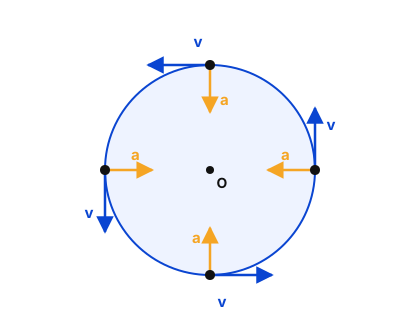
- On a circle, the direction of motion changes at every point
- So velocity changes even when speed is constant
- Hence uniform circular motion is accelerated
Yaad rakhein: This acceleration points towards the centre (centripetal acceleration).
Answer: (D) The direction of motion changes continuously
अवधारणा: वेग में दिशा शामिल है; दिशा बदले तो वेग बदलता है → त्वरण।
- वृत्त पर हर बिंदु पर गति की दिशा बदलती है
- चाल नियत होने पर भी वेग बदलता है
- इसलिए एकसमान वृत्तीय गति त्वरित है
याद रखें: यह त्वरण केंद्र की ओर होता है (अभिकेंद्र त्वरण)।
उत्तर: (D) गति की दिशा निरंतर बदलती रहती है
RRB Technician Grade IIIGeneral ScienceCircular motion is acceleratedRRB Technician Grade III 2025 · 10 Mar Shift 1
Q104.How much energy will be available to the tertiary consumer if a food chain begins with 5000 J of energy at the producer level?
यदि किसी आहार श्रृंखला का आरंभ उत्पादक स्तर पर 5000 J ऊर्जा से होता है, तो तृतीयक उपभोक्ता को कितनी ऊर्जा उपलब्ध होगी?
- A0.5 J
- B500 J
- C5 J
- D50 J
Show answer
Concept: Only about 10% of energy passes to the next trophic level.
- Producer 5000 J → primary consumer 500 J
- → secondary consumer 50 J
- → tertiary consumer 5 J
Trick: Tertiary = 3 steps up → divide by : J.
Answer: (C) 5 J
अवधारणा: अगले पोषी स्तर तक केवल लगभग 10% ऊर्जा पहुँचती है।
- उत्पादक 5000 J → प्राथमिक उपभोक्ता 500 J
- → द्वितीयक 50 J
- → तृतीयक 5 J
ट्रिक: तृतीयक = 3 स्तर ऊपर → J।
उत्तर: (C) 5 J
RRB Technician Grade IIIGeneral Science10% law of energy transferRRB Technician Grade III 2025 · 10 Mar Shift 1
Q105.Which of the following pairs are isotopes?
निम्नलिखित में से कौन-से युग्म समस्थानिक हैं?
- A¹H and ²H¹H और ²H
- B¹⁶O and ¹⁶F¹⁶O और ¹⁶F
- C¹²C and ¹⁴N¹²C और ¹⁴N
- D⁴⁰Ca and ⁴⁰Ar⁴⁰Ca और ⁴⁰Ar
Show answer
Concept: Isotopes: same atomic number (same element), different mass numbers.
- and are both hydrogen () with mass 1 and 2 → isotopes
- and : same mass, different elements → isobars
- and : different elements
Trick: Isotopes must be the same element symbol – only / has that.
Answer: (A) ¹H and ²H
अवधारणा: समस्थानिक: समान परमाणु क्रमांक (एक ही तत्व), भिन्न द्रव्यमान संख्या।
- और दोनों हाइड्रोजन (), द्रव्यमान 1 और 2 → समस्थानिक
- और : समान द्रव्यमान, भिन्न तत्व → समभारिक
- और : भिन्न तत्व
ट्रिक: समस्थानिक में तत्व का प्रतीक एक ही होगा – केवल /।
उत्तर: (A) ¹H और ²H
RRB Technician Grade IIIGeneral ScienceIsotopesRRB Technician Grade III 2025 · 10 Mar Shift 1
Q106.A constant force of 21 N moves a body through 3 m in its own direction. Work done is _____.
21 N का एक स्थिर बल किसी पिंड को उसकी अपनी दिशा में 3 m तक विस्थापित करता है। किया गया कार्य _____ है।
- A24 J
- B63 J
- C18 J
- D7 J
Show answer
Concept: (force along displacement).
- J
Yaad rakhein: 1 joule = work done when 1 N moves a body 1 m in its direction.
Answer: (B) 63 J
अवधारणा: कार्य (बल की दिशा में विस्थापन)।
- J
याद रखें: 1 जूल = 1 N बल से 1 m विस्थापन में किया गया कार्य।
उत्तर: (B) 63 J
RRB Technician Grade IIIGeneral ScienceWork done by a forceRRB Technician Grade III 2025 · 10 Mar Shift 1
Q107.How much work is required to move a charge of 3 C between two points that have a potential difference of 15 V?
15 V विभवांतर वाले दो बिंदुओं के बीच 3 C आवेश को ले जाने में कितना कार्य आवश्यक है?
- A21 J
- B45 J
- C14 J
- D5 J
Show answer
Concept: .
- J
Yaad rakhein: 1 volt = 1 joule per coulomb.
Answer: (B) 45 J
अवधारणा: ।
- J
याद रखें: 1 वोल्ट = 1 जूल प्रति कूलॉम।
उत्तर: (B) 45 J
RRB Technician Grade IIIGeneral ScienceWork done in moving a chargeRRB Technician Grade III 2025 · 10 Mar Shift 1
Q108.Which of the following correctly represents a diatomic element?
निम्नलिखित में से कौन-सा एक द्विपरमाणुक तत्व को सही रूप से दर्शाता है?
- AH₂
- BHe
- CH
- DCO
Show answer
Concept: A diatomic element has two atoms of the same element in one molecule.
- H₂: two H atoms → diatomic element
- He: monoatomic; H: a single atom
- CO: diatomic but a compound, not an element
Yaad rakhein: Common diatomic elements: H₂, N₂, O₂, F₂, Cl₂, Br₂, I₂.
Answer: (A) H₂
अवधारणा: द्विपरमाणुक तत्व के एक अणु में उसी तत्व के दो परमाणु होते हैं।
- H₂: दो H परमाणु → द्विपरमाणुक तत्व
- He: एकपरमाणुक; H: एक परमाणु
- CO: द्विपरमाणुक पर यौगिक है, तत्व नहीं
याद रखें: द्विपरमाणुक तत्व: H₂, N₂, O₂, F₂, Cl₂, Br₂, I₂।
उत्तर: (A) H₂
RRB Technician Grade IIIGeneral ScienceAtomicity – diatomic elementsRRB Technician Grade III 2025 · 10 Mar Shift 1
Q109.Which condition is required for methane to undergo a substitution reaction with chlorine?
मेथेन की क्लोरीन के साथ प्रतिस्थापन अभिक्रिया होने के लिए कौन-सी परिस्थिति आवश्यक है?
- AAcidic mediumअम्लीय माध्यम
- BHeatऊष्मा
- CElectric currentविद्युत धारा
- DSunlightसूर्य का प्रकाश
Show answer
Concept: Methane reacts with chlorine only in the presence of sunlight.
- CH₄ + Cl₂ —sunlight→ CH₃Cl + HCl
- Sunlight breaks Cl₂ into reactive Cl atoms that replace H
- In the dark at room temperature there is no reaction
Yaad rakhein: Repeating it gives CH₂Cl₂, CHCl₃ (chloroform) and CCl₄.
Answer: (D) Sunlight
अवधारणा: मेथेन क्लोरीन से केवल सूर्य के प्रकाश में अभिक्रिया करता है।
- CH₄ + Cl₂ —सूर्य प्रकाश→ CH₃Cl + HCl
- प्रकाश Cl₂ को सक्रिय Cl परमाणुओं में तोड़ता है
- अंधेरे में अभिक्रिया नहीं होती
याद रखें: आगे CH₂Cl₂, CHCl₃ (क्लोरोफॉर्म), CCl₄ बनते हैं।
उत्तर: (D) सूर्य का प्रकाश
RRB Technician Grade IIIGeneral ScienceChlorination of methaneRRB Technician Grade III 2025 · 10 Mar Shift 1
Q110.The principal focus of a concave mirror is:
अवतल दर्पण का मुख्य फोकस है:
- AThe point where rays parallel to the principal axis converge after reflectionवह बिंदु जहाँ मुख्य अक्ष के समांतर किरणें परावर्तन के बाद अभिसरित होती हैं
- BThe pole of the mirrorदर्पण का ध्रुव
- CThe center of curvature of the mirrorदर्पण का वक्रता केंद्र
- DA point on the mirror where all rays meetदर्पण पर वह बिंदु जहाँ सभी किरणें मिलती हैं
Show answer
Concept: Rays parallel to the principal axis meet at the principal focus after reflection.
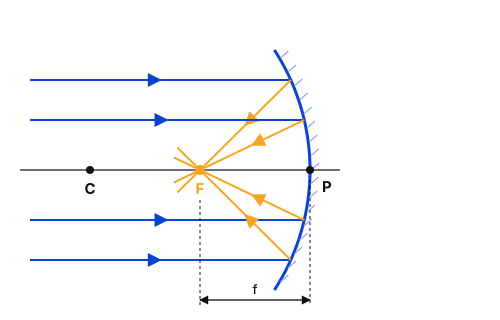
- Concave mirror converges parallel rays to a real point F
- F lies midway between pole P and centre of curvature C:
- Pole and C are different points
Yaad rakhein: For a convex mirror, the rays only appear to diverge from F (virtual focus).
Answer: (A) The point where rays parallel to the principal axis converge after reflection
अवधारणा: मुख्य अक्ष के समांतर किरणें परावर्तन के बाद मुख्य फोकस पर मिलती हैं।
- अवतल दर्पण समांतर किरणों को वास्तविक बिंदु F पर मिलाता है
- F, ध्रुव P और वक्रता केंद्र C के बीच:
- ध्रुव और C अलग बिंदु हैं
याद रखें: उत्तल दर्पण में किरणें F से फैलती प्रतीत होती हैं (आभासी फोकस)।
उत्तर: (A) वह बिंदु जहाँ मुख्य अक्ष के समांतर किरणें परावर्तन के बाद अभिसरित होती हैं
RRB Technician Grade IIIGeneral SciencePrincipal focus of a concave mirrorRRB Technician Grade III 2025 · 10 Mar Shift 1
Q111.Which of the following statements is true with respect to the reaction of a metal ‘A’ with metal ‘B’ of its solution, in which metal ‘A’ displaces metal ‘B’?
धातु ‘A’ की धातु ‘B’ के विलयन के साथ अभिक्रिया, जिसमें धातु ‘A’ धातु ‘B’ को विस्थापित करती है, के संबंध में निम्नलिखित में से कौन-सा कथन सत्य है?
- A‘A’ is more reactive than ‘B’.‘A’, ‘B’ से अधिक अभिक्रियाशील है।
- B‘B’ is more reactive than ‘A’.‘B’, ‘A’ से अधिक अभिक्रियाशील है।
- CBoth ‘A’ and ‘B’ have the same reactivity.‘A’ और ‘B’ दोनों की अभिक्रियाशीलता समान है।
- DThe reaction cannot take place at all.यह अभिक्रिया बिल्कुल नहीं हो सकती।
Show answer
Concept: A more reactive metal displaces a less reactive metal from its salt solution.
- Example: Fe + CuSO₄ → FeSO₄ + Cu (Fe is more reactive than Cu)
- So if A displaces B, A is more reactive
Yaad rakhein: Reactivity order: K > Na > Ca > Mg > Al > Zn > Fe > Pb > H > Cu > Hg > Ag > Au.
Answer: (A) ‘A’ is more reactive than ‘B’.
अवधारणा: अधिक सक्रिय धातु कम सक्रिय धातु को उसके लवण विलयन से विस्थापित करती है।
- उदाहरण: Fe + CuSO₄ → FeSO₄ + Cu
- A ने B को हटाया → A अधिक सक्रिय
याद रखें: सक्रियता क्रम: K > Na > Ca > Mg > Al > Zn > Fe > Pb > H > Cu > Hg > Ag > Au।
उत्तर: (A) ‘A’, ‘B’ से अधिक अभिक्रियाशील है।
RRB Technician Grade IIIGeneral ScienceDisplacement reaction and reactivityRRB Technician Grade III 2025 · 10 Mar Shift 1
Q112.Which of the following isotopes is used in the treatment of cancer?
निम्नलिखित में से किस समस्थानिक का उपयोग कैंसर के उपचार में किया जाता है?
- AIsotope of uraniumयूरेनियम का समस्थानिक
- BIsotope of iodineआयोडीन का समस्थानिक
- CIsotope of cobaltकोबाल्ट का समस्थानिक
- DIsotope of carbonकार्बन का समस्थानिक
Show answer
Concept: Cobalt-60 emits strong gamma rays used in cancer radiotherapy.
- Co-60 → cancer treatment (radiotherapy)
- Iodine-131 → thyroid (goitre) treatment
- U-235 → nuclear reactor fuel; C-14 → dating of fossils
Trick: C for Cobalt, C for Cancer.
Answer: (C) Isotope of cobalt
अवधारणा: कोबाल्ट-60 तीव्र गामा किरणें देता है, जो कैंसर की रेडियोथेरेपी में उपयोगी हैं।
- Co-60 → कैंसर उपचार
- I-131 → थायरॉइड (घेंघा) उपचार
- U-235 → परमाणु ईंधन; C-14 → जीवाश्मों की आयु
ट्रिक: C से Cobalt, C से Cancer।
उत्तर: (C) कोबाल्ट का समस्थानिक
RRB Technician Grade IIIGeneral ScienceUses of radioactive isotopesRRB Technician Grade III 2025 · 10 Mar Shift 1
Q113.Match the elements in Column I with their correct electron distribution in Column II according to the Bohr–Bury rules.
ElementElectron Distribution
A. Sodium (Na)1. 2, 8, 2
B. Magnesium (Mg)2. 2, 8, 1
C. Aluminium (Al)3. 2, 8, 3
D. Calcium (Ca)4. 2, 8, 8, 2
बोर–बरी नियमों के अनुसार स्तंभ I के तत्वों का स्तंभ II में उनके सही इलेक्ट्रॉन वितरण से मिलान कीजिए।
तत्वइलेक्ट्रॉन वितरण
A. सोडियम (Na)1. 2, 8, 2
B. मैग्नीशियम (Mg)2. 2, 8, 1
C. ऐलुमिनियम (Al)3. 2, 8, 3
D. कैल्शियम (Ca)4. 2, 8, 8, 2
- AA–2, B–1, C–3, D–4
- BA–2, B–3, C–1, D–4
- CA–2, B–3, C–4, D–1
- DA–1, B–3, C–2, D–4
Show answer
Concept: Fill shells K, L, M, N with max 2, 8, 8 (outermost shell max 8).
- Na (11) = 2, 8, 1 → 2
- Mg (12) = 2, 8, 2 → 1
- Al (13) = 2, 8, 3 → 3; Ca (20) = 2, 8, 8, 2 → 4
Trick: Na → 2, 8, 1 fixes A–2; Mg → 2, 8, 2 then fixes B–1, leaving only one option.
Answer: (A) A–2, B–1, C–3, D–4
अवधारणा: कोश K, L, M, N में अधिकतम 2, 8, 8 (बाह्यतम कोश में अधिकतम 8)।
- Na (11) = 2, 8, 1 → 2
- Mg (12) = 2, 8, 2 → 1
- Al (13) = 2, 8, 3 → 3; Ca (20) = 2, 8, 8, 2 → 4
ट्रिक: Na से A–2, Mg से B–1 – केवल एक विकल्प बचता है।
उत्तर: (A) A–2, B–1, C–3, D–4
RRB Technician Grade IIIGeneral ScienceElectronic configuration (Bohr–Bury)RRB Technician Grade III 2025 · 10 Mar Shift 1
Q114.Choose a term to complete the analogy.
Chlorenchyma : Photosynthesis :: Aerenchyma : _______________
सादृश्यता को पूरा करने के लिए एक पद चुनिए।
हरित ऊतक (Chlorenchyma) : प्रकाश संश्लेषण :: वायूतक (Aerenchyma) : _______________
- AFood storageभोजन भंडारण
- BWater absorptionजल अवशोषण
- CBuoyancyउत्प्लावकता
- DMechanical strengthयांत्रिक शक्ति
Show answer
Concept: Parenchyma with chloroplasts = chlorenchyma; with large air cavities = aerenchyma.
- Chlorenchyma carries out photosynthesis
- Aerenchyma has large air spaces → gives buoyancy to aquatic plants (e.g. lotus, hydrilla)
Trick: Aer = air → air makes plants float.
Answer: (C) Buoyancy
अवधारणा: हरितलवक युक्त मृदूतक = हरित ऊतक; बड़े वायु-स्थान वाला = वायूतक।
- क्लोरेंकाइमा → प्रकाश संश्लेषण
- एरेंकाइमा में बड़े वायु-स्थान → जलीय पौधों को उत्प्लावकता (तैरना), जैसे कमल, हाइड्रिला
ट्रिक: Aer = हवा → हवा से पौधा तैरता है।
उत्तर: (C) उत्प्लावकता
RRB Technician Grade IIIGeneral ScienceSpecialised parenchyma – aerenchymaRRB Technician Grade III 2025 · 10 Mar Shift 1
Q115.Which of the following is NOT explained by the Universal Law of Gravitation?
निम्नलिखित में से किसकी व्याख्या गुरुत्वाकर्षण के सार्वत्रिक नियम द्वारा नहीं होती?
- AFormation of tidesज्वार-भाटा का बनना
- BWeight of objects on Earthपृथ्वी पर वस्तुओं का भार
- CResistance offered by air to a moving objectगतिशील वस्तु पर वायु द्वारा लगाया गया प्रतिरोध
- DFalling of apples from a treeपेड़ से सेबों का गिरना
Show answer
Concept: Gravitation explains attraction between masses, not frictional forces.
- Tides – Moon's gravity; weight – Earth's gravity; falling apples – gravity
- Air resistance is a frictional (drag) force due to air molecules, not gravity
Trick: The odd force is the one that opposes motion – that's friction, not gravitation.
Answer: (C) Resistance offered by air to a moving object
अवधारणा: गुरुत्वाकर्षण द्रव्यमानों के बीच आकर्षण बताता है, घर्षण बल नहीं।
- ज्वार – चंद्रमा का गुरुत्व; भार – पृथ्वी का गुरुत्व; सेब गिरना – गुरुत्व
- वायु प्रतिरोध एक घर्षण (कर्षण) बल है, गुरुत्व नहीं
ट्रिक: जो बल गति का विरोध करे वह घर्षण है, गुरुत्वाकर्षण नहीं।
उत्तर: (C) गतिशील वस्तु पर वायु द्वारा लगाया गया प्रतिरोध
RRB Technician Grade IIIGeneral ScienceUniversal law of gravitation – applicationsRRB Technician Grade III 2025 · 10 Mar Shift 1
Q116.What causes only the animal cell to burst when both plant and animal cells are placed in pure water?
जब पादप और जंतु दोनों कोशिकाओं को शुद्ध जल में रखा जाता है, तो केवल जंतु कोशिका क्यों फट जाती है?
- APlant cells can actively pump out water.पादप कोशिकाएँ सक्रिय रूप से जल को बाहर पंप कर सकती हैं।
- BOsmosis occurs only in animal cells.परासरण केवल जंतु कोशिकाओं में होता है।
- CAnimal cells have a thicker membrane.जंतु कोशिकाओं की झिल्ली अधिक मोटी होती है।
- DPlant cells have a rigid cell wall.पादप कोशिकाओं में एक दृढ़ कोशिका भित्ति होती है।
Show answer
Concept: In pure water (hypotonic), water enters both cells by osmosis.
- Animal cell has only a thin membrane → swells and bursts
- Plant cell's rigid cell wall resists swelling → it only becomes turgid
Yaad rakhein: Osmosis occurs in both cells – the cell wall is the only difference here.
Answer: (D) Plant cells have a rigid cell wall.
अवधारणा: शुद्ध जल (अल्पपरासारी) में परासरण से दोनों कोशिकाओं में पानी घुसता है।
- जंतु कोशिका में केवल पतली झिल्ली → फूलकर फट जाती है
- पादप कोशिका की दृढ़ कोशिका भित्ति फूलने से रोकती है → केवल स्फीत होती है
याद रखें: परासरण दोनों में होता है – अंतर केवल कोशिका भित्ति का है।
उत्तर: (D) पादप कोशिकाओं में एक दृढ़ कोशिका भित्ति होती है।
RRB Technician Grade IIIGeneral ScienceOsmosis – plant vs animal cellsRRB Technician Grade III 2025 · 10 Mar Shift 1
Q117.What is the concentration of H⁺ ions in pure water at 25°C ?
25°C पर शुद्ध जल में H⁺ आयनों की सांद्रता कितनी होती है?
- A1×10−5 M
- B1×10−1 M
- C1×10−4 M
- D1×10−7 M
Show answer
Concept: At 25 °C, and pure water is neutral.
- in pure water
- M
Trick: pH 7 ↔ M – the power is just minus the pH.
Answer: (D) 1×10⁻⁷ M
अवधारणा: 25 °C पर , शुद्ध जल उदासीन।
- शुद्ध जल में
- M
ट्रिक: pH 7 ↔ M – घात = ।
उत्तर: (D) 1×10⁻⁷ M
RRB Technician Grade IIIGeneral ScienceIonic product of water / pHRRB Technician Grade III 2025 · 10 Mar Shift 1
Q118.Which of the following combinations best explains why waste generation has become a major environmental issue in modern societies?
निम्नलिखित में से कौन-सा संयोजन सबसे अच्छी तरह स्पष्ट करता है कि आधुनिक समाजों में अपशिष्ट उत्पादन एक प्रमुख पर्यावरणीय समस्या क्यों बन गया है?
- AGovernment regulations that limit the collection of biodegradable waste and its recyclingसरकारी विनियम जो जैव-निम्नीकरणीय अपशिष्ट के संग्रहण और उसके पुनर्चक्रण को सीमित करते हैं
- BIncreased use of biodegradable materials and better disposal habitsजैव-निम्नीकरणीय पदार्थों का बढ़ता उपयोग और निपटान की बेहतर आदतें
- CReduced use of packaging materials and enhanced recyclingपैकेजिंग सामग्री का कम उपयोग और बेहतर पुनर्चक्रण
- DImproved lifestyles leading to more disposable and non-biodegradable materialsबेहतर जीवनशैली, जिसके कारण अधिक उपयोग करके फेंकी जाने वाली और जैव-अनिम्नीकरणीय सामग्रियाँ
Show answer
Concept: Changing lifestyles have increased use-and-throw, non-biodegradable materials.
- More packaging, plastics and disposable items → more waste
- Non-biodegradable waste persists and harms soil, water and animals
- Other options describe improvements, which reduce the problem
Yaad rakhein: Follow the 3 Rs – Reduce, Reuse, Recycle.
Answer: (D) Improved lifestyles leading to more disposable and non-biodegradable materials
अवधारणा: बदली जीवनशैली से 'उपयोग करो और फेंको' वाली अजैव-निम्नीकरणीय वस्तुएँ बढ़ी हैं।
- अधिक पैकेजिंग, प्लास्टिक, डिस्पोज़ेबल वस्तुएँ → अधिक कचरा
- अजैव-निम्नीकरणीय कचरा लंबे समय तक रहता है
- बाकी विकल्प सुधार बताते हैं, समस्या नहीं
याद रखें: 3R अपनाएँ – Reduce, Reuse, Recycle।
उत्तर: (D) बेहतर जीवनशैली, जिसके कारण अधिक उपयोग करके फेंकी जाने वाली और जैव-अनिम्नीकरणीय सामग्रियाँ
RRB Technician Grade IIIGeneral ScienceWaste generation – environmental issueRRB Technician Grade III 2025 · 10 Mar Shift 1
Q119.The deeply folded inner membrane of mitochondria helps to increase the __________ for ATP generation.
माइटोकॉन्ड्रिया की गहराई से वलित आंतरिक झिल्ली ATP निर्माण के लिए __________ बढ़ाने में सहायता करती है।
- ASurface areaपृष्ठीय क्षेत्रफल
- BCell wall thicknessकोशिका भित्ति की मोटाई
- CColourरंग
- DVolumeआयतन
Show answer
Concept: The inner membrane folds (cristae) increase surface area for ATP-forming reactions.
- Mitochondria = powerhouse of the cell (make ATP)
- More folds → more space for enzymes of respiration → more ATP
Yaad rakhein: Mitochondria have their own DNA and ribosomes.
Answer: (A) Surface area
अवधारणा: आंतरिक झिल्ली की तहें (क्रिस्टी) ATP बनाने के लिए सतही क्षेत्रफल बढ़ाती हैं।
- माइटोकॉन्ड्रिया = कोशिका का पावरहाउस (ATP)
- अधिक तहें → श्वसन एंजाइमों के लिए अधिक जगह → अधिक ATP
याद रखें: माइटोकॉन्ड्रिया का अपना DNA और राइबोसोम होता है।
उत्तर: (A) पृष्ठीय क्षेत्रफल
RRB Technician Grade IIIGeneral ScienceMitochondria – cristaeRRB Technician Grade III 2025 · 10 Mar Shift 1
Q120.Which of the following pairs of compounds contain the same total number of atoms per molecule?
निम्नलिखित में से यौगिकों के किन युग्मों में प्रति अणु परमाणुओं की कुल संख्या समान है?
- ANH₃ and CH₄NH₃ और CH₄
- BH₂SO₄ and N₂O₅H₂SO₄ और N₂O₅
- CCO₂ and H₂O₂CO₂ और H₂O₂
- DC₂H₆O and PCl₃C₂H₆O और PCl₃
Show answer
Concept: Add the subscripts to count atoms per molecule.
- H₂SO₄ = 2 + 1 + 4 = 7; N₂O₅ = 2 + 5 = 7 ✓
- NH₃ = 4, CH₄ = 5; CO₂ = 3, H₂O₂ = 4
- C₂H₆O = 9, PCl₃ = 4
Trick: Check each pair quickly by adding subscripts – only H₂SO₄ and N₂O₅ match.
Answer: (B) H₂SO₄ and N₂O₅
अवधारणा: प्रति अणु परमाणु गिनने के लिए अधोलेख जोड़ें।
- H₂SO₄ = 7; N₂O₅ = 7 ✓
- NH₃ = 4, CH₄ = 5; CO₂ = 3, H₂O₂ = 4
- C₂H₆O = 9, PCl₃ = 4
ट्रिक: हर युग्म के अधोलेख जोड़ें – केवल H₂SO₄ और N₂O₅ बराबर।
उत्तर: (B) H₂SO₄ और N₂O₅
RRB Technician Grade IIIGeneral ScienceAtomicity of compoundsRRB Technician Grade III 2025 · 10 Mar Shift 1

