Q1181.Which of the following is/are NOT related to the phenomenon of the universal law of gravitation?
(A) The motion of the moon around the earth.
(B) The tides caused by the moon.
(C) The motion of electron around the nucleus.
निम्नलिखित में से कौन-सा/से गुरुत्वाकर्षण के सार्वत्रिक नियम की परिघटना से संबंधित नहीं है/हैं?
(A) पृथ्वी के चारों ओर चंद्रमा की गति।
(B) चंद्रमा के कारण आने वाले ज्वार-भाटे।
(C) नाभिक के चारों ओर इलेक्ट्रॉन की गति।
- AOnly (C)केवल (C)
- B(A) and (B)(A) और (B)
- C(B) and (C)(B) और (C)
- DOnly (B)केवल (B)
Show answer
Concept: Gravitation explains the force that binds the moon to the earth, planets to the sun, and the tides.
- (A) Moon's motion around the earth – gravitation.
- (B) Tides – due to the moon's (and sun's) gravitational pull.
- (C) Electron around the nucleus – held by electrostatic (Coulomb) attraction, not gravitation.
Yaad rakhein: Gravitation explains: weight, motion of moon/planets, tides. Atomic level → electric force.
Answer: (A) Only (C)
अवधारणा: गुरुत्वाकर्षण वह बल बताता है जो चंद्रमा को पृथ्वी से, ग्रहों को सूर्य से बाँधता है और ज्वार-भाटा उत्पन्न करता है।
- (A) पृथ्वी के चारों ओर चंद्रमा की गति – गुरुत्वाकर्षण।
- (B) ज्वार-भाटा – चंद्रमा (और सूर्य) के गुरुत्वाकर्षण से।
- (C) नाभिक के चारों ओर इलेक्ट्रॉन – स्थिरवैद्युत (कूलॉम) आकर्षण से, गुरुत्वाकर्षण से नहीं।
याद रखें: गुरुत्वाकर्षण से: भार, चंद्रमा/ग्रहों की गति, ज्वार-भाटा। परमाणु स्तर पर → विद्युत बल।
उत्तर: (A) केवल (C)
RRB Technician Grade IIIGeneral ScienceUniversal law of gravitationRRB Technician Grade III 2024 · 23 Dec Shift 1
Q1182.Sometimes, when there is a lack of oxygen in our muscle cells, the pyruvate by anaerobic respiration is converted into:
कभी-कभी, जब हमारी पेशी कोशिकाओं में ऑक्सीजन की कमी होती है, तो अवायवीय श्वसन द्वारा पायरूवेट किसमें परिवर्तित हो जाता है?
- Aethyl alcoholएथिल ऐल्कोहॉल
- Bmethyl alcoholमेथिल ऐल्कोहॉल
- Cacetic acidएसीटिक अम्ल
- Dlactic acidलैक्टिक अम्ल
Show answer
Concept: Glucose is first broken into pyruvate (3-carbon) in the cytoplasm. Its fate depends on oxygen availability.
- Plenty of (mitochondria): pyruvate → + water + energy.
- Yeast (no ): pyruvate → ethanol + .
- Muscle cells with lack of : pyruvate → lactic acid; its build-up causes cramps.
Yaad rakhein: Yeast → alcohol; muscle → lactic acid (cramps).
Answer: (D) lactic acid
अवधारणा: ग्लूकोज़ पहले कोशिकाद्रव्य में पाइरुवेट (3-कार्बन) में टूटता है। आगे क्या बनेगा, यह ऑक्सीजन पर निर्भर है।
- पर्याप्त (माइटोकॉन्ड्रिया): पाइरुवेट → + जल + ऊर्जा।
- यीस्ट ( के बिना): पाइरुवेट → एथेनॉल + ।
- पेशी कोशिकाओं में की कमी: पाइरुवेट → लैक्टिक अम्ल; इसके जमाव से ऐंठन (क्रैम्प) होती है।
याद रखें: यीस्ट → ऐल्कोहॉल; पेशी → लैक्टिक अम्ल (ऐंठन)।
उत्तर: (D) लैक्टिक अम्ल
RRB Technician Grade IIIGeneral ScienceAnaerobic respiration in musclesRRB Technician Grade III 2024 · 23 Dec Shift 1
Q1183.Ferrous sulphate decomposes to which of the following substances?
फेरस सल्फेट विघटित होकर निम्नलिखित में से किन पदार्थों में परिवर्तित होता है?
- AFerric oxide (), sulphur dioxide () and sulphur trioxide ()फेरिक ऑक्साइड (), सल्फर डाइऑक्साइड () और सल्फर ट्राइऑक्साइड ()
- BFerric oxide () and sulphur dioxide () onlyकेवल फेरिक ऑक्साइड () और सल्फर डाइऑक्साइड ()
- CFerric oxide () onlyकेवल फेरिक ऑक्साइड ()
- DFerric oxide () and sulphur trioxide () onlyकेवल फेरिक ऑक्साइड () और सल्फर ट्राइऑक्साइड ()
Show answer
Concept: On heating, green ferrous sulphate crystals first lose water, then decompose (thermal decomposition).
- .
- .
- Products: ferric oxide (brown solid), sulphur dioxide and sulphur trioxide (smell of burning sulphur).
Yaad rakhein: : one pair gives , and .
Answer: (A) Ferric oxide (), sulphur dioxide () and sulphur trioxide ()
अवधारणा: गर्म करने पर हरे फेरस सल्फेट क्रिस्टल पहले जल खोते हैं, फिर अपघटित होते हैं (तापीय अपघटन)।
- ।
- ।
- उत्पाद: फेरिक ऑक्साइड (भूरा ठोस), सल्फर डाइऑक्साइड और सल्फर ट्राइऑक्साइड (जलते गंधक की गंध)।
याद रखें: : दो से , और ।
उत्तर: (A) फेरिक ऑक्साइड (), सल्फर डाइऑक्साइड () और सल्फर ट्राइऑक्साइड ()
RRB Technician Grade IIIGeneral ScienceThermal decomposition of ferrous sulphateRRB Technician Grade III 2024 · 23 Dec Shift 1
Q1184.The energy possessed by a ball of mass 5 kg when it is raised to a height of 5 m above the ground is (take ):
5 kg द्रव्यमान की एक गेंद को जमीन से 5 m की ऊँचाई तक उठाने पर उसमें निहित ऊर्जा कितनी होगी? ( लें)
- A10 J
- B2.5 J
- C2 J
- D250 J
Show answer
Concept: Energy due to height is gravitational potential energy: .
- , , .
- .
Trick: Just multiply the three numbers: .
Answer: (D) 250 J
अवधारणा: ऊँचाई के कारण ऊर्जा गुरुत्वीय स्थितिज ऊर्जा है: ।
- , , ।
- ।
ट्रिक: तीनों संख्याओं का गुणा करें: ।
उत्तर: (D) 250 J
RRB Technician Grade IIIGeneral SciencePotential energyRRB Technician Grade III 2024 · 23 Dec Shift 1
Q1185.Which of the following were found as dominant traits by Mendel in his experiment with pea plants?
मटर के पौधों पर अपने प्रयोग में मेंडल ने निम्नलिखित में से किन्हें प्रभावी लक्षणों (dominant traits) के रूप में पाया?
- ATall plant and round seedलंबा पौधा और गोल बीज
- BShort plant and round seedबौना पौधा और गोल बीज
- CShort plant and wrinkled seedबौना पौधा और झुर्रीदार बीज
- DTall plant and wrinkled seedलंबा पौधा और झुर्रीदार बीज
Show answer
Concept: A dominant trait is the one that appears in the generation when two contrasting pure traits are crossed.
- Tall × short pea plants → all tall, so tall is dominant.
- Round × wrinkled seeds → all round, so round is dominant.
- Short and wrinkled reappear only in (recessive).
Yaad rakhein: Mendel's dominant set: tall, round, yellow seed, violet flower, axial flower, green pod, inflated pod.
Answer: (A) Tall plant and round seed
अवधारणा: दो विपरीत शुद्ध लक्षणों के संकरण से पीढ़ी में जो लक्षण दिखाई देता है, वह प्रभावी लक्षण है।
- लंबा × बौना मटर → में सभी लंबे, अतः लंबा प्रभावी।
- गोल × झुर्रीदार बीज → में सभी गोल, अतः गोल प्रभावी।
- बौना और झुर्रीदार केवल में फिर दिखते हैं (अप्रभावी)।
याद रखें: मेंडल के प्रभावी लक्षण: लंबा, गोल, पीला बीज, बैंगनी फूल, अक्षीय फूल, हरी फली, फूली फली।
उत्तर: (A) लंबा पौधा और गोल बीज
RRB Technician Grade IIIGeneral ScienceMendel's experiments – dominant traitsRRB Technician Grade III 2024 · 23 Dec Shift 1
Q1186.In the digestive system, which of the following releases hydrochloric acid, a protein digesting enzyme called pepsin, and mucus?
पाचन तंत्र में, निम्नलिखित में से कौन हाइड्रोक्लोरिक अम्ल, पेप्सिन नामक प्रोटीन पाचक एंजाइम और श्लेष्मा (mucus) स्रावित करता है?
- APancreasअग्न्याशय (Pancreas)
- BGall bladderपित्ताशय (Gall bladder)
- CGastric glandsजठर ग्रंथियाँ (Gastric glands)
- DSalivary glandsलार ग्रंथियाँ (Salivary glands)
Show answer
Concept: The gastric glands in the wall of the stomach secrete gastric juice.
- HCl – makes the medium acidic and activates pepsin.
- Pepsin – digests proteins.
- Mucus – protects the stomach lining from the acid.
- Pancreas gives pancreatic juice; gall bladder stores bile; salivary glands give salivary amylase.
Yaad rakhein: Stomach (gastric glands) = HCl + pepsin + mucus.
Answer: (C) Gastric glands
अवधारणा: आमाशय की भित्ति में स्थित जठर ग्रंथियाँ जठर रस स्रावित करती हैं।
- HCl – माध्यम को अम्लीय बनाता है और पेप्सिन को सक्रिय करता है।
- पेप्सिन – प्रोटीन का पाचन करता है।
- श्लेष्मा – अम्ल से आमाशय की परत की रक्षा करता है।
- अग्न्याशय अग्न्याशयी रस देता है; पित्ताशय पित्त संग्रहित करता है; लार ग्रंथियाँ लार एमाइलेज देती हैं।
याद रखें: आमाशय (जठर ग्रंथियाँ) = HCl + पेप्सिन + श्लेष्मा।
उत्तर: (C) जठर ग्रंथियाँ (Gastric glands)
RRB Technician Grade IIIGeneral ScienceDigestion in stomachRRB Technician Grade III 2024 · 23 Dec Shift 1
Q1187.Hydrophobic end and hydrophilic end of soap molecule:
साबुन के अणु का जलविरागी (hydrophobic) सिरा और जलरागी (hydrophilic) सिरा:
- Ainteracts with hydrocarbons and interacts with base, respectivelyक्रमशः हाइड्रोकार्बन के साथ और क्षारक के साथ अन्योन्यक्रिया करते हैं
- Binteracts with water and interacts with hydrocarbons, respectivelyक्रमशः जल के साथ और हाइड्रोकार्बन के साथ अन्योन्यक्रिया करते हैं
- Cinteracts with hydrocarbons and interacts with water, respectivelyक्रमशः हाइड्रोकार्बन के साथ और जल के साथ अन्योन्यक्रिया करते हैं
- Dinteracts with water and interacts with acid, respectivelyक्रमशः जल के साथ और अम्ल के साथ अन्योन्यक्रिया करते हैं
Show answer
Concept: A soap molecule is a sodium salt of a long-chain fatty acid with two ends: a long hydrocarbon tail and an ionic head ().
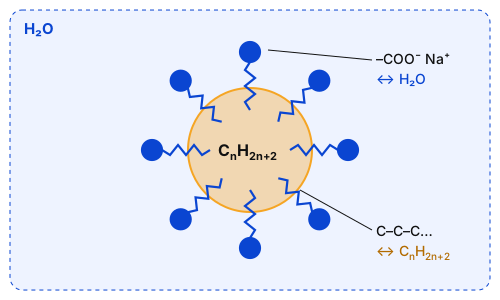
- Hydrophobic tail (water-hating) dissolves in hydrocarbons – oil/grease.
- Hydrophilic ionic head (water-loving) faces and interacts with water.
- Many molecules form a micelle: tails trap oily dirt inside, heads outside; rinsing water washes it away.
Yaad rakhein: Hydro-phobic = fears water → goes to oil; hydro-philic = loves water.
Answer: (C) interacts with hydrocarbons and interacts with water, respectively
अवधारणा: साबुन का अणु लंबी श्रृंखला वाले वसीय अम्ल का सोडियम लवण है जिसके दो सिरे हैं: लंबी हाइड्रोकार्बन पूँछ और आयनिक सिरा ()।
- जलविरागी (हाइड्रोफोबिक) पूँछ हाइड्रोकार्बन – तेल/चिकनाई – में घुलती है।
- जलरागी (हाइड्रोफिलिक) आयनिक सिरा जल की ओर रहता है और जल से अन्योन्यक्रिया करता है।
- अनेक अणु मिसेल बनाते हैं: पूँछ अंदर तेलीय मैल को फँसाती है, सिरे बाहर; पानी से धोने पर मैल निकल जाता है।
याद रखें: जलविरागी = पानी से दूर → तेल की ओर; जलरागी = पानी पसंद।
उत्तर: (C) क्रमशः हाइड्रोकार्बन के साथ और जल के साथ अन्योन्यक्रिया करते हैं
RRB Technician Grade IIIGeneral ScienceCleansing action of soapRRB Technician Grade III 2024 · 23 Dec Shift 1
Q1188.What is the value of 1 kWh in Joule(J)?
1 kWh का मान जूल (J) में कितना है?
- A
- B
- C
- D3.6
Show answer
Concept: is the energy used by a device in one hour; energy power time.
- , .
- .
- .
Yaad rakhein: .
Answer: (C)
अवधारणा: वह ऊर्जा है जो का उपकरण एक घंटे में खर्च करता है; ऊर्जा शक्ति समय।
- , ।
- ।
- ।
याद रखें: ।
उत्तर: (C)
RRB Technician Grade IIIGeneral ScienceCommercial unit of energyRRB Technician Grade III 2024 · 23 Dec Shift 1
Q1189.Which of the following organisms is commonly referred to as bread mould?
निम्नलिखित में से किस जीव को सामान्यतः ब्रेड मोल्ड (रोटी का कवक) कहा जाता है?
- ASpirogyraस्पाइरोगाइरा
- BPlanariaप्लेनेरिया
- CRhizopusराइज़ोपस
- DYeastयीस्ट (खमीर)
Show answer
Concept: Rhizopus is a fungus that grows on moist bread as a white cottony mass with black dots – hence called bread mould.
- Thread-like hyphae spread over the bread; black dots are sporangia containing spores.
- Spirogyra is an alga, Planaria a flatworm, and yeast a unicellular fungus (used in baking, not the mould).
Yaad rakhein: Bread mould = Rhizopus; reproduces by spore formation.
Answer: (C) Rhizopus
अवधारणा: राइज़ोपस एक कवक है जो नम ब्रेड पर सफ़ेद रुई जैसे जाल और काले बिंदुओं के रूप में उगता है – इसलिए इसे ब्रेड मोल्ड कहते हैं।
- धागे जैसी कवक तंतु (हाइफ़ी) ब्रेड पर फैलती हैं; काले बिंदु बीजाणुधानी हैं जिनमें बीजाणु होते हैं।
- स्पाइरोगायरा एक शैवाल है, प्लेनेरिया चपटा कृमि और यीस्ट एककोशिकीय कवक (बेकिंग में प्रयुक्त, मोल्ड नहीं)।
याद रखें: ब्रेड मोल्ड = राइज़ोपस; बीजाणु निर्माण से प्रजनन।
उत्तर: (C) राइज़ोपस
RRB Technician Grade IIIGeneral ScienceFungi – RhizopusRRB Technician Grade III 2024 · 23 Dec Shift 1
Q1190.In which simple multi-cellular organism does sporangia develop on hyphae and spore formation occurs in sporangia?
किस सरल बहुकोशिकीय जीव में कवक-तंतुओं (hyphae) पर बीजाणुधानी (sporangia) विकसित होती है और बीजाणुधानी में बीजाणु निर्माण होता है?
- AYeastयीस्ट (खमीर)
- BAmoebaअमीबा
- CLeishmaniaलीशमैनिया
- DRhizopusराइज़ोपस
Show answer
Concept: Spore formation is an asexual method in which sporangia produce many spores.
- In Rhizopus, thread-like hyphae bear knob-like sporangia.
- Sporangia contain spores that, released in moist conditions, grow into new Rhizopus.
- Yeast reproduces by budding; Amoeba and Leishmania by binary fission (and are unicellular).
Yaad rakhein: Spores → Rhizopus; budding → yeast/Hydra; binary fission → Amoeba/Leishmania.
Answer: (D) Rhizopus
अवधारणा: बीजाणु निर्माण एक अलैंगिक विधि है जिसमें बीजाणुधानी अनेक बीजाणु बनाती है।
- राइज़ोपस में धागे जैसी कवक तंतुओं पर घुंडी जैसी बीजाणुधानियाँ बनती हैं।
- इनमें बीजाणु होते हैं जो नमी मिलने पर नए राइज़ोपस में विकसित होते हैं।
- यीस्ट मुकुलन से, अमीबा और लीशमैनिया द्विविभाजन से प्रजनन करते हैं (और एककोशिकीय हैं)।
याद रखें: बीजाणु → राइज़ोपस; मुकुलन → यीस्ट/हाइड्रा; द्विविभाजन → अमीबा/लीशमैनिया।
उत्तर: (D) राइज़ोपस
RRB Technician Grade IIIGeneral ScienceSpore formationRRB Technician Grade III 2024 · 23 Dec Shift 1
Q1191.The roots of a plant always grow downwards while the shoots usually grow upwards and away from the earth. This upward and downward growth of shoots and roots is known as:
पौधे की जड़ें सदैव नीचे की ओर वृद्धि करती हैं जबकि प्ररोह सामान्यतः ऊपर की ओर तथा पृथ्वी से दूर वृद्धि करते हैं। प्ररोह और जड़ों की इस ऊपर और नीचे की ओर होने वाली वृद्धि को क्या कहा जाता है?
- Ageotropismगुरुत्वानुवर्तन (geotropism)
- Bhydrotropismजलानुवर्तन (hydrotropism)
- Cphototropic movementप्रकाशानुवर्ती गति (phototropic movement)
- Dchemotropismरसायनानुवर्तन (chemotropism)
Show answer
Concept: Growth movement of a plant part in response to gravity is called geotropism (gravitropism).
- Roots grow towards gravity (downwards) → positively geotropic.
- Shoots grow away from gravity (upwards) → negatively geotropic.
- Hydro = water, photo = light, chemo = chemicals (e.g. pollen tube).
Yaad rakhein: Geo = earth (gravity). Root +ve geo, shoot +ve photo.
Answer: (A) geotropism
अवधारणा: गुरुत्व बल की प्रतिक्रिया में पौधे के भाग की वृद्धि गति को गुरुत्वानुवर्तन कहते हैं।
- जड़ें गुरुत्व की ओर (नीचे) बढ़ती हैं → धनात्मक गुरुत्वानुवर्ती।
- तने गुरुत्व से दूर (ऊपर) बढ़ते हैं → ऋणात्मक गुरुत्वानुवर्ती।
- जलानुवर्तन = जल, प्रकाशानुवर्तन = प्रकाश, रसायनानुवर्तन = रसायन (जैसे पराग नलिका)।
याद रखें: जियो = पृथ्वी (गुरुत्व)। जड़ धनात्मक गुरुत्वानुवर्ती, तना धनात्मक प्रकाशानुवर्ती।
उत्तर: (A) गुरुत्वानुवर्तन (geotropism)
RRB Technician Grade IIIGeneral ScienceTropic movements – geotropismRRB Technician Grade III 2024 · 23 Dec Shift 1
Q1192.There are dead tissues in the ____________.
____________ में मृत ऊतक होते हैं।
- Abanana peelकेले के छिलके
- Borange peelसंतरे के छिलके
- Cguava peelअमरूद के छिलके
- Dcoconut huskनारियल के रेशे (भूसी)
Show answer
Concept: Sclerenchyma is a dead tissue with lignified walls, giving hardness to plant parts.
- The fibrous husk of coconut is made of sclerenchyma fibres.
- Its cells are dead, long and thick-walled.
- Peels of banana, orange and guava are made mainly of living cells.
Yaad rakhein: Coconut husk, nut shells, seed coats, jute fibres → sclerenchyma (dead).
Answer: (D) coconut husk
अवधारणा: दृढ़ोतक (स्क्लेरेनकाइमा) लिग्निनयुक्त भित्ति वाला मृत ऊतक है, जो पौधे के भागों को कठोरता देता है।
- नारियल का रेशेदार छिलका दृढ़ोतक रेशों से बना है।
- इसकी कोशिकाएँ मृत, लंबी और मोटी भित्ति वाली होती हैं।
- केला, संतरा और अमरूद के छिलके मुख्यतः जीवित कोशिकाओं से बने होते हैं।
याद रखें: नारियल का छिलका, गिरियों के कवच, बीज-आवरण, जूट रेशे → दृढ़ोतक (मृत)।
उत्तर: (D) नारियल के रेशे (भूसी)
RRB Technician Grade IIIGeneral ScienceSclerenchyma – dead tissueRRB Technician Grade III 2024 · 23 Dec Shift 1
Q1193.Which statement is true for solid matter?
ठोस पदार्थ के लिए कौन-सा कथन सत्य है?
- ASolids do not have a definite shape, distinct boundary and fixed volume.ठोसों का कोई निश्चित आकार, स्पष्ट सीमा और निश्चित आयतन नहीं होता।
- BSolids have only definite shape, but not fixed volume.ठोसों का केवल निश्चित आकार होता है, परंतु निश्चित आयतन नहीं होता।
- CSolids have only definite shape, but not distinct boundary.ठोसों का केवल निश्चित आकार होता है, परंतु स्पष्ट सीमा नहीं होती।
- DSolids have a definite shape, distinct boundary and fixed volume.ठोसों का निश्चित आकार, स्पष्ट सीमा और निश्चित आयतन होता है।
Show answer
Concept: Strong interparticle forces and close packing make solids rigid.
- They have a definite shape.
- They have distinct boundaries.
- They have a fixed volume and negligible compressibility.
- Options A, B, C each deny one of these, so they are false.
Yaad rakhein: Solid = shape ✔, boundary ✔, volume ✔; liquid = volume only; gas = none.
Answer: (D) Solids have a definite shape, distinct boundary and fixed volume.
अवधारणा: कणों के बीच प्रबल आकर्षण बल और सघन व्यवस्था ठोसों को दृढ़ बनाती है।
- इनका निश्चित आकार होता है।
- इनकी सीमाएँ स्पष्ट होती हैं।
- इनका आयतन निश्चित और संपीड्यता नगण्य होती है।
- विकल्प A, B, C में से प्रत्येक इनमें से किसी गुण को नकारता है, अतः गलत।
याद रखें: ठोस = आकार ✔, सीमा ✔, आयतन ✔; द्रव = केवल आयतन; गैस = कुछ नहीं।
उत्तर: (D) ठोसों का निश्चित आकार, स्पष्ट सीमा और निश्चित आयतन होता है।
RRB Technician Grade IIIGeneral ScienceProperties of solidsRRB Technician Grade III 2024 · 23 Dec Shift 1
Q1194.All of the following are signals that sexual maturation is taking place, EXCEPT:
निम्नलिखित में से कौन-सा लैंगिक परिपक्वता होने का संकेत नहीं है?
- Adifferent patterns of hair growthबालों की वृद्धि के भिन्न प्रतिरूप
- Bincreased size and shape of breast or penisस्तन या शिश्न के आकार और आकृति में वृद्धि
- Cgirls begin to menstruate at around this timeलगभग इसी समय लड़कियों में ऋतुस्राव (मासिक धर्म) आरंभ होना
- Dblue colour of eyesआँखों का नीला रंग
Show answer
Concept: During puberty, sex hormones (testosterone, oestrogen) bring changes that indicate sexual maturation.
- New patterns of hair growth (armpits, genital area, facial hair in boys).
- Increase in size of breasts in girls and of penis in boys.
- Girls begin to menstruate.
- Eye colour is a genetically fixed trait and does not change at puberty.
Yaad rakhein: Puberty signs are hormone-driven body changes; inherited traits like eye colour stay the same.
Answer: (D) blue colour of eyes
अवधारणा: यौवनारंभ में लैंगिक हॉर्मोन (टेस्टोस्टेरॉन, एस्ट्रोजन) ऐसे परिवर्तन लाते हैं जो लैंगिक परिपक्वता दर्शाते हैं।
- बालों की वृद्धि के नए प्रतिरूप (बगल, जननांग क्षेत्र, लड़कों में चेहरे पर बाल)।
- लड़कियों में स्तनों और लड़कों में शिश्न के आकार में वृद्धि।
- लड़कियों में ऋतुस्राव आरंभ होता है।
- आँखों का रंग आनुवंशिक रूप से तय होता है, यौवनारंभ में नहीं बदलता।
याद रखें: यौवनारंभ के संकेत हॉर्मोन-जनित शारीरिक बदलाव हैं; आँखों का रंग जैसे वंशागत लक्षण नहीं बदलते।
उत्तर: (D) आँखों का नीला रंग
RRB Technician Grade IIIGeneral SciencePuberty – sexual maturationRRB Technician Grade III 2024 · 23 Dec Shift 1
Q1195.An object with a mass of 10 kg is moving with an initial velocity of 3 m/s and its final velocity becomes 5 m/s. Then the change in its kinetic energy is:
10 kg द्रव्यमान की एक वस्तु 3 m/s के प्रारंभिक वेग से गति कर रही है और उसका अंतिम वेग 5 m/s हो जाता है। तो उसकी गतिज ऊर्जा में परिवर्तन कितना है?
- A160 J
- B40 J
- C50 J
- D80 J
Show answer
Concept: , so .
- .
- .
Trick: .
Answer: (D) 80 J
अवधारणा: , अतः ।
- ।
- ।
ट्रिक: ।
उत्तर: (D) 80 J
RRB Technician Grade IIIGeneral ScienceKinetic energy – work-energyRRB Technician Grade III 2024 · 23 Dec Shift 1
Q1196.Which of the following is specialised for conducting information via electrical impulses from one part of the body to another?
निम्नलिखित में से कौन शरीर के एक भाग से दूसरे भाग तक विद्युत आवेगों के माध्यम से सूचना का संचालन करने के लिए विशिष्टीकृत है?
- ANeuronतंत्रिका कोशिका (Neuron)
- BSpinal cordमेरुरज्जु (Spinal cord)
- CAlveoliकूपिकाएँ (Alveoli)
- DGlomerulusकेशिकागुच्छ (Glomerulus)
Show answer
Concept: The neuron (nerve cell) is the structural and functional unit of the nervous system, specialised to carry information as electrical impulses.
- Dendrites receive the signal → cell body → long axon carries the electrical impulse.
- At the synapse it is passed on chemically to the next cell.
- Spinal cord is an organ made of many neurons; alveoli are for gas exchange in lungs; glomerulus filters blood in kidney.
Yaad rakhein: Dendrite → cell body → axon → axon ending → synapse.
Answer: (A) Neuron
अवधारणा: न्यूरॉन (तंत्रिका कोशिका) तंत्रिका तंत्र की संरचनात्मक व क्रियात्मक इकाई है, जो सूचना को विद्युत आवेग के रूप में ले जाने के लिए विशिष्ट है।
- द्रुमिका (डेंड्राइट) संकेत ग्रहण करती है → कोशिका काय → लंबा तंत्रिकाक्ष (एक्सॉन) विद्युत आवेग ले जाता है।
- सिनेप्स पर यह रासायनिक रूप से अगली कोशिका को जाता है।
- मेरुरज्जु अनेक न्यूरॉनों से बना अंग है; कूपिकाएँ फेफड़ों में गैस विनिमय, ग्लोमेरुलस वृक्क में रक्त निस्यंदन करते हैं।
याद रखें: द्रुमिका → कोशिका काय → तंत्रिकाक्ष → तंत्रिका सिरा → सिनेप्स।
उत्तर: (A) तंत्रिका कोशिका (Neuron)
RRB Technician Grade IIIGeneral ScienceNervous tissue – neuronRRB Technician Grade III 2024 · 23 Dec Shift 1
Q1197.Consider a long conducting wire carrying a current. Which of the following statements is NOT true?
धारावाही एक लंबे चालक तार पर विचार कीजिए। निम्नलिखित में से कौन-सा कथन सत्य नहीं है?
- AThe strength of the magnetic field increases if we increase the current.यदि हम धारा बढ़ाते हैं तो चुंबकीय क्षेत्र की तीव्रता बढ़ जाती है।
- BThe magnetic field decreases as we move away from the wire.तार से दूर जाने पर चुंबकीय क्षेत्र घटता जाता है।
- CThe magnetic field will reverse the direction if we reverse the current.यदि हम धारा की दिशा उलट दें तो चुंबकीय क्षेत्र की दिशा भी उलट जाएगी।
- DWe can use Fleming’s left-hand rule to determine the direction of magnetic field.चुंबकीय क्षेत्र की दिशा ज्ञात करने के लिए हम फ्लेमिंग के वामहस्त नियम का उपयोग कर सकते हैं।
Show answer
Concept: A straight current-carrying wire produces concentric circular magnetic field lines around it.
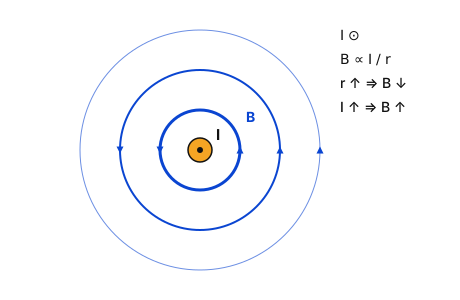
- Field strength : more current → stronger field (A true); farther away → weaker (B true).
- Reversing current reverses field direction (C true).
- Field direction is found by the right-hand thumb rule; Fleming's left-hand rule gives the direction of FORCE on a conductor in a field. So D is NOT true.
Trick: Right thumb along current, curled fingers = field. Left hand (FBI) = force (motor).
Answer: (D) We can use Fleming’s left-hand rule to determine the direction of magnetic field.
अवधारणा: सीधे धारावाही तार के चारों ओर संकेंद्री वृत्ताकार चुंबकीय क्षेत्र रेखाएँ बनती हैं।
- क्षेत्र की प्रबलता : धारा बढ़े → क्षेत्र प्रबल (A सत्य); दूर जाने पर → दुर्बल (B सत्य)।
- धारा उलटने पर क्षेत्र की दिशा उलट जाती है (C सत्य)।
- क्षेत्र की दिशा दक्षिण-हस्त अंगुष्ठ नियम से मिलती है; फ्लेमिंग का वाम-हस्त नियम क्षेत्र में चालक पर लगने वाले बल की दिशा बताता है। अतः D सत्य नहीं।
ट्रिक: दाएँ हाथ का अंगूठा धारा की ओर, मुड़ी उँगलियाँ = क्षेत्र। बायाँ हाथ (FBI) = बल (मोटर)।
उत्तर: (D) चुंबकीय क्षेत्र की दिशा ज्ञात करने के लिए हम फ्लेमिंग के वामहस्त नियम का उपयोग कर सकते हैं।
RRB Technician Grade IIIGeneral ScienceMagnetic field of a straight wireRRB Technician Grade III 2024 · 23 Dec Shift 1
Q1198.An object A with a mass m and velocity v has a kinetic energy of 100 J. Then the kinetic energy of an object B with a mass of 2 m and velocity v is:
m द्रव्यमान और v वेग वाली एक वस्तु A की गतिज ऊर्जा 100 J है। तो 2 m द्रव्यमान और v वेग वाली वस्तु B की गतिज ऊर्जा कितनी होगी?
- A50 J
- B200 J
- C400 J
- D300 J
Show answer
Concept: ; at the same velocity, KE is directly proportional to mass.
- For A: .
- For B: .
Trick: Mass doubled → KE doubled; velocity doubled → KE four times.
Answer: (B) 200 J
अवधारणा: ; समान वेग पर गतिज ऊर्जा द्रव्यमान के अनुक्रमानुपाती है।
- A के लिए: ।
- B के लिए: ।
ट्रिक: द्रव्यमान दोगुना → KE दोगुनी; वेग दोगुना → KE चार गुनी।
उत्तर: (B) 200 J
RRB Technician Grade IIIGeneral ScienceKinetic energy and massRRB Technician Grade III 2024 · 23 Dec Shift 1
Q1199.Which of the following statements is true about the free fall of an object under gravitational force?
गुरुत्वीय बल के अधीन किसी वस्तु के मुक्त पतन के संबंध में निम्नलिखित में से कौन-सा कथन सत्य है?
- AThe acceleration experienced by an object is independent of its mass.वस्तु द्वारा अनुभव किया गया त्वरण उसके द्रव्यमान पर निर्भर नहीं करता।
- BThe acceleration experienced by an object is opposite to the direction of motion.वस्तु द्वारा अनुभव किया गया त्वरण गति की दिशा के विपरीत होता है।
- CThe acceleration experienced by an object depends on its mass.वस्तु द्वारा अनुभव किया गया त्वरण उसके द्रव्यमान पर निर्भर करता है।
- DThe velocity of the object remains constant during free fall.मुक्त पतन के दौरान वस्तु का वेग स्थिर रहता है।
Show answer
Concept: In free fall only gravity acts. From and : , which has no term for the falling body's mass.
- So all bodies fall with the same acceleration (ignoring air resistance) – A is true.
- Acceleration is downward, same as the direction of motion of a falling body; velocity keeps increasing – B, C, D are false.
Yaad rakhein: Galileo: a feather and a coin fall together in vacuum.
Answer: (A) The acceleration experienced by an object is independent of its mass.
अवधारणा: मुक्त पतन में केवल गुरुत्व बल कार्य करता है। और से: , जिसमें गिरती वस्तु का द्रव्यमान नहीं है।
- अतः सभी वस्तुएँ समान त्वरण से गिरती हैं (वायु प्रतिरोध नगण्य) – A सत्य।
- त्वरण नीचे की ओर, यानी गिरती वस्तु की गति की दिशा में ही; वेग लगातार बढ़ता है – B, C, D असत्य।
याद रखें: गैलीलियो: निर्वात में पंख और सिक्का साथ-साथ गिरते हैं।
उत्तर: (A) वस्तु द्वारा अनुभव किया गया त्वरण उसके द्रव्यमान पर निर्भर नहीं करता।
RRB Technician Grade IIIGeneral ScienceFree fallRRB Technician Grade III 2024 · 23 Dec Shift 1
Q1200.If the thrust experienced by an object of area 1000 cm² is 50 N, then the pressure exerted on the object is:
यदि 1000 cm² क्षेत्रफल वाली किसी वस्तु द्वारा अनुभव किया गया प्रणोद 50 N है, तो वस्तु पर लगने वाला दाब कितना है?
- A500 Pa
- B20 Pa
- C5 Pa
- D30 Pa
Show answer
Concept: Pressure , with area in to get pascal.
- .
- .
Trick: – always convert area first.
Answer: (A) 500 Pa
अवधारणा: दाब ; पास्कल में उत्तर हेतु क्षेत्रफल में लें।
- ।
- ।
ट्रिक: – पहले क्षेत्रफल बदलें।
उत्तर: (A) 500 Pa
RRB Technician Grade IIIGeneral ScienceThrust and pressureRRB Technician Grade III 2024 · 23 Dec Shift 1

