Q1201.Which of the following is the most reactive metal in the reactivity series?
सक्रियता श्रेणी में निम्नलिखित में से सबसे अधिक अभिक्रियाशील धातु कौन-सी है?
- AGoldसोना (Gold)
- BZincजिंक (Zinc)
- CPotassiumपोटैशियम (Potassium)
- DSodiumसोडियम (Sodium)
Show answer
Concept: The reactivity series arranges metals from most to least reactive.
- Order: K > Na > Ca > Mg > Al > Zn > Fe > Pb > H > Cu > Hg > Ag > Au.
- Potassium is at the top – it reacts violently even with cold water.
- Sodium is next; zinc is moderate; gold is least reactive (noble metal).
Trick: 'Please Stop Calling Me A Zebra…' → K, Na, Ca, Mg, Al, Zn…
Answer: (C) Potassium
अवधारणा: सक्रियता श्रेणी धातुओं को सबसे अधिक से सबसे कम क्रियाशील के क्रम में रखती है।
- क्रम: K > Na > Ca > Mg > Al > Zn > Fe > Pb > H > Cu > Hg > Ag > Au।
- पोटैशियम सबसे ऊपर है – यह ठंडे जल से भी तीव्र अभिक्रिया करता है।
- उसके बाद सोडियम; जिंक मध्यम; सोना सबसे कम क्रियाशील (उत्कृष्ट धातु)।
ट्रिक: 'Please Stop Calling Me A Zebra…' → K, Na, Ca, Mg, Al, Zn…
उत्तर: (C) पोटैशियम (Potassium)
RRB Technician Grade IIIGeneral ScienceReactivity series of metalsRRB Technician Grade III 2024 · 23 Dec Shift 1
Q1202.What will be the effect of surface area on the evaporation process?
वाष्पीकरण (evaporation) की प्रक्रिया पर पृष्ठीय क्षेत्रफल का क्या प्रभाव पड़ेगा?
- AEvaporation decreases with increase in surface area.पृष्ठीय क्षेत्रफल में वृद्धि के साथ वाष्पीकरण घटता है।
- BEvaporation increases with decrease in surface area.पृष्ठीय क्षेत्रफल में कमी के साथ वाष्पीकरण बढ़ता है।
- CEvaporation increases with increase in surface area.पृष्ठीय क्षेत्रफल में वृद्धि के साथ वाष्पीकरण बढ़ता है।
- DNo effect of surface area on evaporation process.वाष्पीकरण प्रक्रिया पर पृष्ठीय क्षेत्रफल का कोई प्रभाव नहीं पड़ता।
Show answer
Concept: Evaporation is a surface phenomenon – only particles at the surface escape into the air.
- Larger surface area → more particles exposed at the surface.
- More exposed particles → more of them escape per second.
- So the rate of evaporation increases with surface area (e.g. clothes are spread out to dry).
Yaad rakhein: Evaporation ↑ with surface area, temperature and wind speed; ↓ with humidity.
Answer: (C) Evaporation increases with increase in surface area.
अवधारणा: वाष्पीकरण एक सतही प्रक्रिया है – केवल सतह के कण ही हवा में निकलते हैं।
- सतह का क्षेत्रफल बड़ा → अधिक कण सतह पर।
- अधिक कण सतह पर → प्रति सेकंड अधिक कण वाष्पित।
- इसलिए क्षेत्रफल बढ़ने पर वाष्पीकरण बढ़ता है (जैसे कपड़े फैलाकर सुखाते हैं)।
याद रखें: वाष्पीकरण ↑ : क्षेत्रफल, ताप, हवा की गति; ↓ : आर्द्रता।
उत्तर: (C) पृष्ठीय क्षेत्रफल में वृद्धि के साथ वाष्पीकरण बढ़ता है।
RRB Technician Grade IIIGeneral ScienceEvaporationRRB Technician Grade III 2024 · 20 Dec Shift 3
Q1203.Who was the first to use a glass prism to obtain a spectrum of sunlight?
सूर्य के प्रकाश का स्पेक्ट्रम प्राप्त करने के लिए काँच के प्रिज़्म का उपयोग करने वाले पहले व्यक्ति कौन थे?
- AIsaac Newtonआइज़क न्यूटन
- BFermiफर्मी
- CEinsteinआइंस्टीन
- DEdisonएडिसन
Show answer
Concept: When white light passes through a glass prism it splits into seven colours (VIBGYOR) – this is dispersion.
- Isaac Newton was the first to use a glass prism to obtain the spectrum of sunlight.
- He then placed a second, inverted prism and recombined the colours into white light.
- This proved that sunlight is made of seven colours.
Yaad rakhein: Newton – prism and spectrum; Raman – scattering of light.
Answer: (A) Isaac Newton
अवधारणा: श्वेत प्रकाश काँच के प्रिज्म से गुजरकर सात रंगों (VIBGYOR) में बँट जाता है – इसे विक्षेपण कहते हैं।
- सूर्य के प्रकाश का स्पेक्ट्रम पाने के लिए प्रिज्म का सबसे पहले प्रयोग आइज़ैक न्यूटन ने किया।
- उन्होंने दूसरा उल्टा प्रिज्म रखकर रंगों को फिर से श्वेत प्रकाश में मिला दिया।
- इससे सिद्ध हुआ कि सूर्य का प्रकाश सात रंगों से बना है।
याद रखें: न्यूटन – प्रिज्म व स्पेक्ट्रम; रमन – प्रकाश का प्रकीर्णन।
उत्तर: (A) आइज़क न्यूटन
RRB Technician Grade IIIGeneral ScienceDispersion of lightRRB Technician Grade III 2024 · 20 Dec Shift 3
Q1204.In a circuit, a 10 volt battery and three resistors , , and are connected in parallel to each other. Which of the following is the correct value of effective resistance and current I flowing through the circuit?
एक परिपथ में, एक 10 वोल्ट की बैटरी और तीन प्रतिरोधक , और एक-दूसरे से पार्श्वक्रम (parallel) में जुड़े हैं। निम्नलिखित में से कौन-सा प्रभावी प्रतिरोध और परिपथ में प्रवाहित धारा I का सही मान है?
- A
- B
- C
- D
Show answer
Concept: For resistors in parallel, , and current (Ohm\'s law).
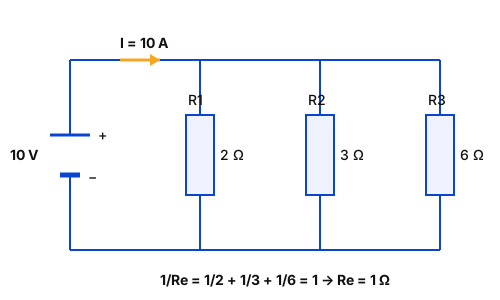
Trick: Parallel is always smaller than the smallest resistor () – only options with survive; then .
Answer: (D)
अवधारणा: समानांतर क्रम में तथा ओम के नियम से ।
ट्रिक: समानांतर में सबसे छोटे प्रतिरोध से भी कम होता है () – अतः वाले विकल्प ही बचते हैं; फिर ।
उत्तर: (D)
RRB Technician Grade IIIGeneral ScienceResistors in parallelRRB Technician Grade III 2024 · 20 Dec Shift 3
Q1205.Which of the following connects the kidney with the urinary bladder?
निम्नलिखित में से कौन वृक्क (kidney) को मूत्राशय (urinary bladder) से जोड़ता है?
- APelvisश्रोणि (Pelvis)
- BPenisशिश्न (Penis)
- CUreterमूत्रवाहिनी (Ureter)
- DUrethraमूत्रमार्ग (Urethra)
Show answer
Concept: The excretory system has: kidneys → ureters → urinary bladder → urethra.
- Kidneys filter blood and form urine.
- A pair of ureters carries urine from each kidney to the urinary bladder.
- The bladder stores urine; the urethra carries it out of the body.
Yaad rakhein: UreTER = kidney To bladder; urethRA = bladder to outside.
Answer: (C) Ureter
अवधारणा: उत्सर्जन तंत्र: वृक्क → मूत्रवाहिनी (ureter) → मूत्राशय → मूत्रमार्ग (urethra)।
- वृक्क रक्त को छानकर मूत्र बनाते हैं।
- मूत्रवाहिनी (ureter) मूत्र को वृक्क से मूत्राशय तक ले जाती है।
- मूत्राशय मूत्र जमा करता है; मूत्रमार्ग उसे शरीर से बाहर निकालता है।
याद रखें: Ureter = वृक्क से मूत्राशय; Urethra = मूत्राशय से बाहर।
उत्तर: (C) मूत्रवाहिनी (Ureter)
RRB Technician Grade IIIGeneral ScienceHuman excretory systemRRB Technician Grade III 2024 · 20 Dec Shift 3
Q1206.What is the chemical composition of washing soda?
धावन सोडा (washing soda) का रासायनिक संघटन क्या है?
- A
- B
- C
- D
Show answer
Concept: Washing soda is hydrated sodium carbonate with 10 molecules of water of crystallisation.
- Washing soda = .
- is Glauber\'s salt, not washing soda.
- Aluminium compounds (options A, C) are not washing soda.
Yaad rakhein: Washing soda ; baking soda ; gypsum .
Answer: (D)
अवधारणा: धोने का सोडा सोडियम कार्बोनेट है जिसमें क्रिस्टलन जल के 10 अणु होते हैं।
- धोने का सोडा = ।
- ग्लॉबर लवण है, धोने का सोडा नहीं।
- विकल्प A व C ऐलुमिनियम यौगिक हैं।
याद रखें: धोने का सोडा ; खाने का सोडा ; जिप्सम ।
उत्तर: (D)
RRB Technician Grade IIIGeneral ScienceWashing sodaRRB Technician Grade III 2024 · 20 Dec Shift 3
Q1207.In which of the following organisms is fragmentation common?
निम्नलिखित में से किन जीवों में खंडन (fragmentation) सामान्य है?
- AOnly in few unicellular organismsकेवल कुछ एककोशिकीय जीवों में
- BOnly a few multicellular organismsकेवल कुछ बहुकोशिकीय जीवों में
- CIn all multicellular organismsसभी बहुकोशिकीय जीवों में
- DIn all unicellular organismsसभी एककोशिकीय जीवों में
Show answer
Concept: In fragmentation, a simple multicellular organism breaks into pieces and each piece grows into a new individual.
- It needs a body made of many cells – so it does not occur in unicellular organisms.
- Complex multicellular organisms (like humans) cannot reproduce this way.
- So it is seen only in a few simple multicellular organisms, e.g. Spirogyra.
Yaad rakhein: Fragmentation – Spirogyra; budding – Hydra, yeast; binary fission – Amoeba.
Answer: (B) Only a few multicellular organisms
अवधारणा: खंडन में सरल बहुकोशिकीय जीव टुकड़ों में टूट जाता है और हर टुकड़ा नया जीव बन जाता है।
- इसके लिए अनेक कोशिकाओं वाला शरीर चाहिए – अतः एककोशिकीय जीवों में नहीं होता।
- जटिल बहुकोशिकीय जीव (जैसे मनुष्य) इस विधि से जनन नहीं करते।
- अतः यह केवल कुछ सरल बहुकोशिकीय जीवों में होता है, जैसे स्पाइरोगाइरा।
याद रखें: खंडन – स्पाइरोगाइरा; मुकुलन – हाइड्रा, यीस्ट; द्विखंडन – अमीबा।
उत्तर: (B) केवल कुछ बहुकोशिकीय जीवों में
RRB Technician Grade IIIGeneral ScienceAsexual reproduction – fragmentationRRB Technician Grade III 2024 · 20 Dec Shift 3
Q1208.Which of the following grows rapidly and ripens to form a fruit?
निम्नलिखित में से कौन तेजी से वृद्धि करता है और पककर फल बनाता है?
- AAntherपरागकोश (Anther)
- BStigmaवर्तिकाग्र (Stigma)
- COvaryअंडाशय (Ovary)
- DPollen tubeपराग नलिका (Pollen tube)
Show answer
Concept: After fertilisation, different parts of the flower change into seed and fruit.
- The fertilised ovule (zygote inside) develops into the seed.
- The ovary grows rapidly and ripens to form the fruit.
- Petals, sepals, stamens and style usually wither and fall off.
Yaad rakhein: Ovule → seed; ovary → fruit; ovary wall → fruit wall (pericarp).
Answer: (C) Ovary
अवधारणा: निषेचन के बाद पुष्प के विभिन्न भाग बीज और फल में बदलते हैं।
- निषेचित बीजांड (ovule) बीज बनता है।
- अंडाशय (ovary) तेजी से बढ़कर पकता है और फल बनाता है।
- पंखुड़ियाँ, बाह्यदल, पुंकेसर व वर्तिका प्रायः मुरझाकर गिर जाते हैं।
याद रखें: बीजांड → बीज; अंडाशय → फल; अंडाशय भित्ति → फलभित्ति।
उत्तर: (C) अंडाशय (Ovary)
RRB Technician Grade IIIGeneral ScienceFertilisation in flowersRRB Technician Grade III 2024 · 20 Dec Shift 3
Q1209.Which of the following metals reacts only with steam NOT with cold or hot water?
निम्नलिखित में से कौन-सी धातु केवल भाप के साथ अभिक्रिया करती है, ठंडे या गर्म जल के साथ नहीं?
- AAluminiumऐलुमिनियम
- BMagnesiumमैग्नीशियम
- CPotassiumपोटैशियम
- DSodiumसोडियम
Show answer
Concept: Reactivity with water falls down the reactivity series.
- Sodium and potassium react violently even with cold water.
- Magnesium reacts with hot water.
- Aluminium, iron and zinc react neither with cold nor hot water – only with steam, forming metal oxide and hydrogen.
Yaad rakhein: Cold water: K, Na, Ca; hot water: Mg; steam: Al, Zn, Fe; no reaction: Pb, Cu, Ag, Au.
Answer: (A) Aluminium
अवधारणा: जल के साथ अभिक्रियाशीलता सक्रियता श्रेणी में नीचे जाने पर घटती है।
- सोडियम व पोटैशियम ठंडे जल से ही तीव्र अभिक्रिया करते हैं।
- मैग्नीशियम गर्म जल से अभिक्रिया करता है।
- ऐलुमिनियम, आयरन व जिंक न ठंडे न गर्म जल से – केवल भाप से अभिक्रिया कर धातु ऑक्साइड व हाइड्रोजन बनाते हैं।
याद रखें: ठंडा जल: K, Na, Ca; गर्म जल: Mg; भाप: Al, Zn, Fe; कोई अभिक्रिया नहीं: Pb, Cu, Ag, Au।
उत्तर: (A) ऐलुमिनियम
RRB Technician Grade IIIGeneral ScienceReaction of metals with waterRRB Technician Grade III 2024 · 20 Dec Shift 3
Q1210.The main thinking part of the brain that receives sensory impulses from various receptors is the:
मस्तिष्क का मुख्य सोचने वाला भाग, जो विभिन्न ग्राहियों (receptors) से संवेदी आवेग प्राप्त करता है, कौन-सा है?
- Ahind-brainपश्चमस्तिष्क (hind-brain)
- Bfore-brainअग्रमस्तिष्क (fore-brain)
- Cspinal cordमेरुरज्जु (spinal cord)
- Dmid-brainमध्यमस्तिष्क (mid-brain)
Show answer
Concept: The brain has three parts – fore-brain, mid-brain and hind-brain.
- The fore-brain (cerebrum) is the main thinking part.
- It has areas that receive sensory impulses from receptors (sight, hearing, smell etc.).
- Mid-brain and hind-brain mostly control involuntary actions (reflexes of eye, heartbeat, balance).
Yaad rakhein: Thinking, memory, intelligence → fore-brain (cerebrum); balance/posture → cerebellum (hind-brain).
Answer: (B) fore-brain
अवधारणा: मस्तिष्क के तीन भाग हैं – अग्रमस्तिष्क, मध्यमस्तिष्क और पश्चमस्तिष्क।
- अग्रमस्तिष्क (प्रमस्तिष्क) सोचने वाला मुख्य भाग है।
- इसमें ग्राही (receptors) से संवेदी आवेग प्राप्त करने वाले क्षेत्र होते हैं।
- मध्य व पश्च मस्तिष्क अधिकतर अनैच्छिक क्रियाएँ (आँख की प्रतिवर्ती क्रिया, हृदय गति, संतुलन) नियंत्रित करते हैं।
याद रखें: सोचना, स्मृति, बुद्धि → अग्रमस्तिष्क; संतुलन → अनुमस्तिष्क (पश्चमस्तिष्क)।
उत्तर: (B) अग्रमस्तिष्क (fore-brain)
RRB Technician Grade IIIGeneral ScienceHuman brainRRB Technician Grade III 2024 · 20 Dec Shift 3
Q1211.Select the correct option related to the function of villi in the small intestine.
छोटी आँत में दीर्घरोमों (villi) के कार्य से संबंधित सही विकल्प का चयन करें।
- AProtection from acidअम्ल से सुरक्षा
- BSecretion of mineralsखनिजों का स्रावण
- CIncreases absorptive surface areaअवशोषण के लिए सतही क्षेत्रफल बढ़ाते हैं
- DHelps in excretionउत्सर्जन में सहायता करते हैं
Show answer
Concept: Villi are finger-like projections on the inner wall of the small intestine.
- They greatly increase the surface area of the intestinal wall.
- They are rich in blood vessels, which take the digested food to every cell.
- So their function is to increase the absorptive surface area.
Yaad rakhein: Villi in intestine = absorption; alveoli in lungs = gas exchange – both increase surface area.
Answer: (C) Increases absorptive surface area
अवधारणा: दीर्घरोम (villi) छोटी आँत की भीतरी दीवार पर उँगली जैसे उभार हैं।
- ये आँत की दीवार का सतही क्षेत्रफल बहुत बढ़ा देते हैं।
- इनमें रक्त वाहिकाएँ अधिक होती हैं जो पचा भोजन कोशिकाओं तक पहुँचाती हैं।
- अतः इनका कार्य अवशोषण के लिए सतह का क्षेत्रफल बढ़ाना है।
याद रखें: आँत में दीर्घरोम = अवशोषण; फेफड़ों में कूपिकाएँ = गैस विनिमय – दोनों क्षेत्रफल बढ़ाते हैं।
उत्तर: (C) अवशोषण के लिए सतही क्षेत्रफल बढ़ाते हैं
RRB Technician Grade IIIGeneral ScienceVilli in small intestineRRB Technician Grade III 2024 · 20 Dec Shift 3
Q1212.Who developed the planetary model of the atom with electrons orbiting the nucleus in discrete energy levels?
परमाणु का ग्रहीय मॉडल, जिसमें इलेक्ट्रॉन नाभिक के चारों ओर विविक्त ऊर्जा स्तरों में परिक्रमा करते हैं, किसने विकसित किया?
- AErnest Rutherfordअर्नेस्ट रदरफोर्ड
- BJ.J. Thomson (Joseph John Thomson)जे.जे. थॉमसन (जोसेफ जॉन थॉमसन)
- CNiels Bohrनील्स बोर
- DDmitri Mendeleevदमित्री मेंडेलीव
Show answer
Concept: Different scientists gave different models of the atom.
- Thomson – plum-pudding model.
- Rutherford – nucleus at the centre, electrons revolving around it (but could not explain stability).
- Niels Bohr (1913) – electrons revolve in fixed orbits (discrete energy levels/shells K, L, M…) without radiating energy.
Yaad rakhein: Discrete energy levels / fixed shells = Bohr; nucleus discovery = Rutherford.
Answer: (C) Niels Bohr
अवधारणा: विभिन्न वैज्ञानिकों ने परमाणु के अलग-अलग मॉडल दिए।
- टॉमसन – प्लम-पुडिंग मॉडल।
- रदरफोर्ड – केंद्र में नाभिक, उसके चारों ओर इलेक्ट्रॉन (स्थायित्व की व्याख्या नहीं)।
- नील्स बोर (1913) – इलेक्ट्रॉन निश्चित ऊर्जा स्तरों (कक्षाओं K, L, M…) में घूमते हैं और ऊर्जा नहीं खोते।
याद रखें: निश्चित ऊर्जा स्तर/कक्षा = बोर; नाभिक की खोज = रदरफोर्ड।
उत्तर: (C) नील्स बोर
RRB Technician Grade IIIGeneral ScienceAtomic modelsRRB Technician Grade III 2024 · 20 Dec Shift 3
Q1213.Which organism uses regenerative cells for reproduction in the process of budding?
मुकुलन (budding) की प्रक्रिया में जनन के लिए कौन-सा जीव पुनर्जनी कोशिकाओं (regenerative cells) का उपयोग करता है?
- AAmoebaअमीबा
- BLeishmaniaलीशमैनिया
- CYeastयीस्ट
- DHydraहाइड्रा
Show answer
Concept: Hydra reproduces asexually by budding using its regenerative cells.
- A bud develops as an outgrowth due to repeated cell division at one specific site.
- The bud grows into a tiny individual and detaches when mature.
- Yeast also buds, but the use of regenerative cells is described for Hydra; Amoeba and Leishmania use fission.
Yaad rakhein: Hydra – budding and regeneration; Planaria – regeneration; Amoeba – binary fission; Plasmodium – multiple fission.
Answer: (D) Hydra
अवधारणा: हाइड्रा अपनी पुनर्जनी (regenerative) कोशिकाओं की सहायता से मुकुलन द्वारा जनन करता है।
- एक विशिष्ट स्थान पर बार-बार कोशिका विभाजन से मुकुल (bud) बनता है।
- मुकुल नन्हे जीव में विकसित होकर परिपक्व होने पर अलग हो जाता है।
- यीस्ट में भी मुकुलन होता है, पर पुनर्जनी कोशिकाओं का उल्लेख हाइड्रा के लिए है; अमीबा व लीशमैनिया विखंडन करते हैं।
याद रखें: हाइड्रा – मुकुलन व पुनर्जनन; प्लेनेरिया – पुनर्जनन; अमीबा – द्विखंडन; प्लाज्मोडियम – बहुखंडन।
उत्तर: (D) हाइड्रा
RRB Technician Grade IIIGeneral ScienceBudding in HydraRRB Technician Grade III 2024 · 20 Dec Shift 3
Q1214.Which of the following will be the average velocity of the particle with initial velocity and final velocity in the given time interval?
दिए गए समय अंतराल में प्रारंभिक वेग और अंतिम वेग वाले कण का औसत वेग निम्नलिखित में से क्या होगा?
- A
- B
- C
- D0
Show answer
Concept: For uniformly accelerated motion, velocity changes at a steady rate, so the average velocity is the mean of initial and final velocities.
- Total displacement then .
Trick: If (uniform motion), the formula should give – only does.
Answer: (C)
अवधारणा: समान त्वरित गति में वेग समान दर से बदलता है, इसलिए औसत वेग प्रारंभिक और अंतिम वेग का औसत होता है।
- कुल विस्थापन ।
ट्रिक: यदि हो (एकसमान गति), तो सूत्र से आना चाहिए – केवल ही देता है।
उत्तर: (C)
RRB Technician Grade IIIGeneral ScienceAverage velocityRRB Technician Grade III 2024 · 20 Dec Shift 3
Q1215.Which of the following reactions is NOT an example of oxidation?
निम्नलिखित में से कौन-सी अभिक्रिया ऑक्सीकरण का उदाहरण नहीं है?
- A
- B
- C
- D
Show answer
Concept: Oxidation = gain of oxygen (or loss of hydrogen) by a substance.
- , and combine with to form oxides → oxidation (A, C, D).
- – silver chloride breaks down in sunlight.
- No oxygen is added; it is a (photo)decomposition reaction in which silver is reduced.
Trick: Look for on the reactant side – the only reaction without it is the answer.
Answer: (B)
अवधारणा: ऑक्सीकरण = किसी पदार्थ द्वारा ऑक्सीजन ग्रहण करना (या हाइड्रोजन खोना)।
- , और ऑक्सीजन से जुड़कर ऑक्साइड बनाते हैं → ऑक्सीकरण (A, C, D)।
- – सूर्य के प्रकाश में सिल्वर क्लोराइड का अपघटन।
- इसमें ऑक्सीजन नहीं जुड़ती; यह (प्रकाश) अपघटन अभिक्रिया है जिसमें सिल्वर का अपचयन होता है।
ट्रिक: अभिकारक में देखें – जिसमें नहीं है वही उत्तर।
उत्तर: (B)
RRB Technician Grade IIIGeneral ScienceOxidation and reductionRRB Technician Grade III 2024 · 20 Dec Shift 3
Q1216.Which of the following is an example of an object moving in uniform circular motion?
निम्नलिखित में से कौन-सा एकसमान वृत्तीय गति (uniform circular motion) में गतिमान वस्तु का उदाहरण है?
- AA bird flying in the skyआकाश में उड़ता हुआ पक्षी
- BA person walking on a sidewalkफुटपाथ पर चलता हुआ व्यक्ति
- CA satellite in a circular orbit around the earth.पृथ्वी के चारों ओर वृत्तीय कक्षा में एक उपग्रह।
- DA car driving straight on a highwayराजमार्ग पर सीधी चलती हुई कार
Show answer
Concept: Uniform circular motion = motion along a circular path with constant speed (direction keeps changing).
- A bird flies along an irregular path – not circular.
- A walking person or a car on a straight highway moves in a straight line.
- A satellite in a circular orbit moves round the earth at constant speed → uniform circular motion.
Yaad rakhein: In uniform circular motion speed is constant but velocity changes, so it is accelerated motion.
Answer: (C) A satellite in a circular orbit around the earth.
अवधारणा: एकसमान वृत्तीय गति = वृत्ताकार पथ पर नियत चाल से गति (दिशा लगातार बदलती है)।
- उड़ता पक्षी अनियमित पथ पर चलता है – वृत्तीय नहीं।
- फुटपाथ पर चलता व्यक्ति या सीधे हाईवे पर कार सरल रेखा में चलते हैं।
- वृत्ताकार कक्षा में उपग्रह नियत चाल से पृथ्वी की परिक्रमा करता है → एकसमान वृत्तीय गति।
याद रखें: एकसमान वृत्तीय गति में चाल नियत पर वेग बदलता है, अतः यह त्वरित गति है।
उत्तर: (C) पृथ्वी के चारों ओर वृत्तीय कक्षा में एक उपग्रह।
RRB Technician Grade IIIGeneral ScienceUniform circular motionRRB Technician Grade III 2024 · 20 Dec Shift 3
Q1217.Which of the following substances is in solid form in the given reaction?
Sodium sulphate + barium chloride sodium chloride + barium sulphate
दी गई अभिक्रिया में निम्नलिखित में से कौन-सा पदार्थ ठोस रूप में है?
सोडियम सल्फेट + बेरियम क्लोराइड सोडियम क्लोराइड + बेरियम सल्फेट
- ABarium chlorideबेरियम क्लोराइड
- BBarium sulphateबेरियम सल्फेट
- CSodium sulphateसोडियम सल्फेट
- DSodium chlorideसोडियम क्लोराइड
Show answer
Concept: A reaction in which an insoluble solid (precipitate) is formed is a precipitation (double displacement) reaction.
- Sodium sulphate, barium chloride and sodium chloride stay dissolved (aqueous).
- Barium sulphate is insoluble and appears as a white precipitate (solid).
Yaad rakhein: Double displacement + white ppt = .
Answer: (B) Barium sulphate
अवधारणा: जिस अभिक्रिया में अघुलनशील ठोस (अवक्षेप) बनता है उसे अवक्षेपण (द्विविस्थापन) अभिक्रिया कहते हैं।
- सोडियम सल्फेट, बेरियम क्लोराइड व सोडियम क्लोराइड विलयन (जलीय) में रहते हैं।
- बेरियम सल्फेट अघुलनशील है और सफेद अवक्षेप (ठोस) बनाता है।
याद रखें: द्विविस्थापन + सफेद अवक्षेप = ।
उत्तर: (B) बेरियम सल्फेट
RRB Technician Grade IIIGeneral SciencePrecipitation reactionRRB Technician Grade III 2024 · 20 Dec Shift 3
Q1218.Which of the following metals is found in a free state in the earth's crust?
निम्नलिखित में से कौन-सी धातु भूपर्पटी (earth's crust) में मुक्त अवस्था में पाई जाती है?
- AAluminiumऐलुमिनियम
- BSodiumसोडियम
- CZincजिंक
- DGoldसोना (Gold)
Show answer
Concept: Metals at the bottom of the reactivity series are least reactive and occur in the free (native) state.
- Sodium, aluminium and zinc are reactive – found only as compounds (oxides, sulphides, carbonates).
- Gold is very unreactive – it does not combine with oxygen or water.
- So gold is found in the free state in the earth's crust.
Yaad rakhein: Native metals: Au, Pt, Ag, Cu (Cu and Ag also as sulphides/oxides).
Answer: (D) Gold
अवधारणा: सक्रियता श्रेणी में सबसे नीचे की धातुएँ सबसे कम अभिक्रियाशील होती हैं और मुक्त (प्राकृत) अवस्था में मिलती हैं।
- सोडियम, ऐलुमिनियम व जिंक अभिक्रियाशील हैं – केवल यौगिकों (ऑक्साइड, सल्फाइड, कार्बोनेट) के रूप में मिलते हैं।
- सोना बहुत कम अभिक्रियाशील है – ऑक्सीजन या जल से नहीं जुड़ता।
- अतः सोना भूपर्पटी में मुक्त अवस्था में मिलता है।
याद रखें: मुक्त अवस्था की धातुएँ: Au, Pt, Ag, Cu (Cu व Ag यौगिक रूप में भी)।
उत्तर: (D) सोना (Gold)
RRB Technician Grade IIIGeneral ScienceOccurrence of metalsRRB Technician Grade III 2024 · 20 Dec Shift 3
Q1219.According to the reactivity series of metals, which metal pair is found in native state?
धातुओं की सक्रियता श्रेणी के अनुसार, कौन-सा धातु युग्म प्राकृत (मुक्त) अवस्था में पाया जाता है?
- ACalcium and magnesiumकैल्शियम और मैग्नीशियम
- BCalcium and aluminiumकैल्शियम और ऐलुमिनियम
- CGold and platinumसोना और प्लैटिनम
- DSodium and potassiumसोडियम और पोटैशियम
Show answer
Concept: Least reactive metals at the bottom of the reactivity series occur in the native (free) state.
- Na, K, Ca, Mg, Al are at the top – highly reactive, never found free.
- Gold and platinum are at the bottom – they are not attacked by air, water or most acids.
- So gold and platinum are found in native state.
Yaad rakhein: Top of series (K, Na, Ca, Mg, Al) → electrolysis; bottom (Au, Pt) → native.
Answer: (C) Gold and platinum
अवधारणा: सक्रियता श्रेणी में सबसे नीचे की कम अभिक्रियाशील धातुएँ प्राकृत (मुक्त) अवस्था में मिलती हैं।
- Na, K, Ca, Mg, Al सबसे ऊपर – अत्यधिक अभिक्रियाशील, मुक्त अवस्था में कभी नहीं।
- सोना और प्लैटिनम सबसे नीचे – वायु, जल व अधिकांश अम्लों का प्रभाव नहीं।
- अतः सोना और प्लैटिनम प्राकृत अवस्था में मिलते हैं।
याद रखें: श्रेणी में ऊपर (K, Na, Ca, Mg, Al) → विद्युत अपघटन; नीचे (Au, Pt) → मुक्त अवस्था।
उत्तर: (C) सोना और प्लैटिनम
RRB Technician Grade IIIGeneral ScienceReactivity seriesRRB Technician Grade III 2024 · 20 Dec Shift 3
Q1220.What is the power of this combination of lens placed together when the power of the converging lens is 4.50 D and diverging lens is 3.00 D?
जब अभिसारी लेंस की क्षमता 4.50 D और अपसारी लेंस की क्षमता 3.00 D हो, तो एक साथ रखे गए इन लेंसों के संयोजन की क्षमता क्या है?
- A
- B
- C
- D
Show answer
Concept: For lenses in contact, net power ; a converging (convex) lens has positive power and a diverging (concave) lens has negative power.
- ,
- (net converging)
Trick: Convex = plus, concave = minus; then just add.
Answer: (B)
अवधारणा: सटे हुए लेंसों की कुल क्षमता ; अभिसारी (उत्तल) लेंस की क्षमता धनात्मक और अपसारी (अवतल) की ऋणात्मक होती है।
- ,
- (कुल अभिसारी)
ट्रिक: उत्तल = धन, अवतल = ऋण; फिर बस जोड़ दें।
उत्तर: (B)
RRB Technician Grade IIIGeneral SciencePower of lens combinationRRB Technician Grade III 2024 · 20 Dec Shift 3

