Q141.What will be the pH of a 0.01 M HCl solution?
0.01 M HCl विलयन का pH क्या होगा?
- A8
- B18
- C2
- D12
Show answer
Concept: ; HCl is a strong acid and ionises completely.
- .
- .
Trick: For M strong monobasic acid, . Acid → pH must be below 7, so 8 and 12 are out at once.
Answer: (C) 2
अवधारणा: ; HCl प्रबल अम्ल है, पूर्ण आयनित होता है।
ट्रिक: M प्रबल एकक्षारकी अम्ल का । अम्ल का pH 7 से कम — 8 और 12 तुरंत बाहर।
उत्तर: (C) 2
RRB Technician Grade IIIGeneral SciencepH of strong acidRRB Technician Grade III 2025 · 9 Mar Shift 3
Q142.Which of the following describes a key function of lysosomal enzymes?
निम्नलिखित में से कौन-सा लयनकायी (lysosomal) एंज़ाइमों के एक प्रमुख कार्य का वर्णन करता है?
- ABreaking down proteins, lipids, and carbohydratesप्रोटीन, लिपिड और कार्बोहाइड्रेट को तोड़ना (विघटित करना)
- BCreating new proteins for the cellकोशिका के लिए नए प्रोटीन बनाना
- CTransporting molecules across the membraneझिल्ली के आर-पार अणुओं का परिवहन करना
- DStoring genetic materialआनुवंशिक पदार्थ का भंडारण करना
Show answer
Concept: Lysosomes hold hydrolytic (digestive) enzymes.
- These enzymes break down proteins, lipids, carbohydrates and nucleic acids, and worn-out organelles.
- Protein synthesis = ribosomes; membrane transport = plasma membrane; genetic material = nucleus.
Yaad rakhein: Lyso = 'to break/digest' — lysosome = digestive bag of the cell.
Answer: (A) Breaking down proteins, lipids, and carbohydrates
अवधारणा: लाइसोसोम में जल-अपघटनी (पाचक) एंजाइम होते हैं।
- ये प्रोटीन, वसा, कार्बोहाइड्रेट, न्यूक्लिक अम्ल और पुराने कोशिकांगों को तोड़ते हैं।
- प्रोटीन निर्माण = राइबोसोम; परिवहन = प्लाज्मा झिल्ली; आनुवंशिक पदार्थ = केंद्रक।
याद रखें: Lyso = तोड़ना/पचाना — लाइसोसोम = कोशिका की पाचक थैली।
उत्तर: (A) प्रोटीन, लिपिड और कार्बोहाइड्रेट को तोड़ना (विघटित करना)
RRB Technician Grade IIIGeneral ScienceLysosomal enzymes – functionRRB Technician Grade III 2025 · 9 Mar Shift 3
Q143.What are the two main categories of factors responsible for storage losses in
agricultural produce?
कृषि उपज में भंडारण
हानि के लिए उत्तरदायी कारकों की दो मुख्य श्रेणियाँ कौन-सी हैं?
- ABiotic and Abioticजैविक और अजैविक
- BMechanical and Thermalयांत्रिक और तापीय
- CHarvesting and Processingकटाई और प्रसंस्करण
- DChemical and Electricalरासायनिक और विद्युत
Show answer
Concept: Storage losses come from living and non-living factors.
- Biotic: insects, rodents, fungi, mites, bacteria.
- Abiotic: inappropriate moisture and temperature.
Yaad rakhein: Prevention: dry grains well, clean storage, and fumigation with chemicals.
Answer: (A) Biotic and Abiotic
अवधारणा: भंडारण में हानि सजीव और निर्जीव कारकों से होती है।
- जैविक (Biotic): कीट, कृंतक (चूहे), कवक, माइट, जीवाणु।
- अजैविक (Abiotic): अनुचित नमी और तापमान।
याद रखें: बचाव: अनाज को सुखाना, साफ भंडार और धूमन (fumigation)।
उत्तर: (A) जैविक और अजैविक
RRB Technician Grade IIIGeneral ScienceStorage of grains – factors causing lossRRB Technician Grade III 2025 · 9 Mar Shift 3
Q144.If a sample of air is compressed to half its volume, which of the following statements is correct?
यदि वायु के एक नमूने को संपीडित करके उसका आयतन आधा कर दिया जाए, तो निम्नलिखित में से कौन-सा कथन सही है?
- AThe composition of air remains same because it is a mixture.वायु का संघटन समान रहता है क्योंकि यह एक मिश्रण है।
- BAir becomes a compound on compression.संपीडन पर वायु एक यौगिक बन जाती है।
- CThe composition of air changes.वायु का संघटन बदल जाता है।
- DThe proportion of gases changes.गैसों का अनुपात बदल जाता है।
Show answer
Concept: Compression is a physical change; it cannot alter the composition of a mixture.
- Air is a homogeneous mixture of N₂, O₂, Ar, CO₂ etc.
- Halving the volume only brings molecules closer; the proportion of gases stays the same.
- No chemical reaction occurs, so no compound forms.
Trick: Options B, C, D all claim a change in composition — only A is consistent with a physical process.
Answer: (A) The composition of air remains same because it is a mixture.
अवधारणा: संपीडन भौतिक परिवर्तन है; मिश्रण का संघटन नहीं बदलता।
- वायु N₂, O₂, Ar, CO₂ आदि का समांगी मिश्रण है।
- आयतन आधा करने से अणु केवल पास आते हैं; गैसों का अनुपात वही रहता है।
- कोई रासायनिक अभिक्रिया नहीं → कोई यौगिक नहीं बनता।
ट्रिक: B, C, D सभी संघटन बदलने की बात करते हैं — भौतिक प्रक्रिया से केवल A मेल खाता है।
उत्तर: (A) वायु का संघटन समान रहता है क्योंकि यह एक मिश्रण है।
RRB Technician Grade IIIGeneral ScienceAir as a mixtureRRB Technician Grade III 2025 · 9 Mar Shift 3
Q145.In the process of electrolytic refining of copper, which of the following is correctly matched?
कॉपर (ताँबे) के विद्युत-अपघटनी परिष्करण की प्रक्रिया में, निम्नलिखित में से कौन-सा सही सुमेलित है?
- ACathode – Impure copperकैथोड – अशुद्ध कॉपर
- BElectrolyte – Acidified Copper sulphate solutionविद्युत-अपघट्य – अम्लीकृत कॉपर सल्फेट विलयन
- CCathode Mud – Pure copper crystalsकैथोड पंक – शुद्ध कॉपर के क्रिस्टल
- DAnode – Pure copperऐनोड – शुद्ध कॉपर
Show answer
Concept: Impure metal = anode, pure metal = cathode, salt solution of the metal = electrolyte.
- Electrolyte: acidified copper sulphate solution ✓.
- Anode = impure Cu, cathode = pure Cu (A and D reversed).
- Impurities settle below the anode as anode mud, not cathode mud.
Trick: 'Pure goes to cathode' — anything saying pure copper at anode is wrong.
Answer: (B) Electrolyte – Acidified Copper sulphate solution
अवधारणा: अशुद्ध धातु = एनोड, शुद्ध धातु = कैथोड, उसी धातु का लवण विलयन = विद्युत अपघट्य।
- विद्युत अपघट्य: अम्लीकृत कॉपर सल्फेट विलयन ✓
- एनोड = अशुद्ध Cu, कैथोड = शुद्ध Cu (A, D उल्टे हैं)।
- अशुद्धियाँ एनोड के नीचे 'एनोड मड' बनाती हैं, कैथोड मड नहीं।
ट्रिक: 'शुद्ध धातु कैथोड पर जमती है' — एनोड पर शुद्ध Cu कहने वाला विकल्प गलत।
उत्तर: (B) विद्युत-अपघट्य – अम्लीकृत कॉपर सल्फेट विलयन
RRB Technician Grade IIIGeneral ScienceElectrolytic refining of copperRRB Technician Grade III 2025 · 9 Mar Shift 3
Q146.Refer to the two statements given below and choose the CORRECT option.
Statement A: Nervous tissue is responsible for rapid transmission of electrical impulses in the body.
Statement B: Nervous tissue mainly provides structural and mechanical support to organs.
नीचे दिए गए दो कथनों को देखिए और सही विकल्प चुनिए।
कथन A: तंत्रिका ऊतक शरीर में विद्युत आवेगों के तीव्र संचरण के लिए उत्तरदायी है।
कथन B: तंत्रिका ऊतक मुख्य रूप से अंगों को संरचनात्मक और यांत्रिक सहारा प्रदान करता है।
- AStatement A is correct but B is incorrect.कथन A सही है लेकिन B गलत है।
- BBoth statements A and B are correct.कथन A और B दोनों सही हैं।
- CBoth statements A and B are incorrect.कथन A और B दोनों गलत हैं।
- DStatement A is incorrect but B is correct.कथन A गलत है लेकिन B सही है।
Show answer
Concept: Nervous tissue is specialised for receiving and conducting impulses.
- Statement A: neurons transmit electrical impulses rapidly → correct.
- Statement B: structural/mechanical support is the job of connective tissue (bone, cartilage) → incorrect.
Yaad rakhein: Neuron = cell body (cyton) + dendrites + axon; it is the longest cell in the body.
Answer: (A) Statement A is correct but B is incorrect.
अवधारणा: तंत्रिका ऊतक आवेग ग्रहण करने और संचारित करने के लिए विशेष है।
- कथन A: न्यूरॉन विद्युत आवेग तेजी से भेजते हैं → सही।
- कथन B: संरचनात्मक/यांत्रिक सहारा संयोजी ऊतक (अस्थि, उपास्थि) का काम है → गलत।
याद रखें: न्यूरॉन = कोशिका काय + द्रुमिकाएँ + तंत्रिकाक्ष; यह शरीर की सबसे लंबी कोशिका है।
उत्तर: (A) कथन A सही है लेकिन B गलत है।
RRB Technician Grade IIIGeneral ScienceNervous tissue – functionRRB Technician Grade III 2025 · 9 Mar Shift 3
Q147.An object's mass remains constant everywhere (on the Earth or the Moon), whereas its weight changes because ___________.
किसी वस्तु का द्रव्यमान हर जगह (पृथ्वी पर या चंद्रमा पर) स्थिर रहता है, जबकि उसका भार बदल जाता है क्योंकि ___________।
- AThe SI unit of weight is Newtons, while mass is kilogramsभार का SI मात्रक न्यूटन है, जबकि द्रव्यमान का किलोग्राम है
- BWeight depends on the local value of g, which varies with locationभार g के स्थानीय मान पर निर्भर करता है, जो स्थान के साथ बदलता है
- CMass is dependent on inertia, but weight is notद्रव्यमान जड़त्व पर निर्भर है, लेकिन भार नहीं
- DWeight is a scalar quantity, while mass is vectorभार एक अदिश राशि है, जबकि द्रव्यमान सदिश है
Show answer
Concept: ; mass is the amount of matter, g depends on location.
- Mass is constant everywhere.
- g on the Moon ≈ of Earth's → weight changes.
- Option A is a true fact but doesn't explain why; weight is a vector and mass a scalar (D reversed).
Trick: Choose the option that gives the cause (g varies), not just a related fact.
Answer: (B) Weight depends on the local value of g, which varies with location
अवधारणा: ; द्रव्यमान पदार्थ की मात्रा है, g स्थान पर निर्भर है।
- द्रव्यमान हर जगह समान।
- चंद्रमा पर g ≈ पृथ्वी का → भार बदलता है।
- A सही तथ्य है पर कारण नहीं बताता; भार सदिश और द्रव्यमान अदिश है (D उल्टा)।
ट्रिक: वह विकल्प चुनें जो कारण बताए (g बदलता है), केवल संबंधित तथ्य नहीं।
उत्तर: (B) भार g के स्थानीय मान पर निर्भर करता है, जो स्थान के साथ बदलता है
RRB Technician Grade IIIGeneral ScienceMass and weightRRB Technician Grade III 2025 · 9 Mar Shift 3
Q148.Which of the following epithelial tissues is specialised for absorption and lines the inner surface of the intestine?
निम्नलिखित में से कौन-सा उपकला ऊतक अवशोषण के लिए विशिष्टीकृत है और आंत की भीतरी सतह को आस्तरित करता है?
- AColumnar epitheliumस्तंभाकार उपकला
- BCuboidal epitheliumघनाकार उपकला
- CStratified epitheliumस्तरित उपकला
- DCiliated epitheliumपक्ष्माभी उपकला
Show answer
Concept: Tall pillar-like cells increase surface for absorption and secretion.
- Columnar epithelium lines the inner surface of the intestine → absorption.
- Cuboidal → mechanical support; stratified → protects skin from wear and tear.
- Ciliated columnar is found in the respiratory tract, not intestine.
Yaad rakhein: Columnar ↔ absorption (intestine) — the same pair appears in analogy questions.
Answer: (A) Columnar epithelium
अवधारणा: लंबी स्तंभ जैसी कोशिकाएँ अवशोषण व स्रावण के लिए सतह बढ़ाती हैं।
- स्तंभाकार उपकला आंत की भीतरी सतह पर → अवशोषण।
- घनाकार → यांत्रिक सहारा; स्तरित → त्वचा को टूट-फूट से बचाना।
- पक्ष्माभी स्तंभाकार श्वसन मार्ग में होती है, आंत में नहीं।
याद रखें: स्तंभाकार ↔ अवशोषण (आंत) — यही जोड़ी सादृश्य प्रश्नों में भी आती है।
उत्तर: (A) स्तंभाकार उपकला
RRB Technician Grade IIIGeneral ScienceEpithelial tissue – columnar epitheliumRRB Technician Grade III 2025 · 9 Mar Shift 3
Q149.Read the given assertion and reason and select the correct option based on the analysis of these statements.
Assertion: Stethoscope uses the concept of multiple reflection of sound waves for its working.
Reason: Sound waves require a material medium for their propagation.
दिए गए अभिकथन और कारण को पढ़िए तथा इन कथनों के विश्लेषण के आधार पर सही विकल्प का चयन कीजिए।
अभिकथन: स्टेथोस्कोप अपनी कार्यप्रणाली के लिए ध्वनि तरंगों के बहुल परावर्तन की अवधारणा का उपयोग करता है।
कारण: ध्वनि तरंगों को अपने संचरण के लिए एक द्रव्यात्मक माध्यम की आवश्यकता होती है।
- ABoth assertion and reason are true and the reason is the correct explanation of the assertion.अभिकथन और कारण दोनों सत्य हैं और कारण, अभिकथन की सही व्याख्या है।
- BAssertion is false and reason is true.अभिकथन असत्य है और कारण सत्य है।
- CBoth assertion and reason are true and the reason is not the correct explanation of the assertion.अभिकथन और कारण दोनों सत्य हैं और कारण, अभिकथन की सही व्याख्या नहीं है।
- DAssertion is true but reason is false.अभिकथन सत्य है लेकिन कारण असत्य है।
Show answer
Concept: In a stethoscope, the heartbeat sound travels along the tube by repeated (multiple) reflections.
- Assertion: true.
- Reason: true — sound is a mechanical wave and needs a medium.
- But the reason does not explain why multiple reflection is used → not the correct explanation.
Trick: Ask 'Assertion because Reason?' — 'stethoscope uses reflection because sound needs a medium' doesn't make sense → option C.
Answer: (C) Both assertion and reason are true and the reason is not the correct explanation of the assertion.
अवधारणा: स्टेथोस्कोप में हृदय की ध्वनि नली में बार-बार (बहुल) परावर्तन से कान तक पहुँचती है।
- कथन (A): सही।
- कारण (R): सही — ध्वनि यांत्रिक तरंग है, माध्यम चाहिए।
- पर R, A की व्याख्या नहीं करता।
ट्रिक: 'A क्योंकि R?' पूछें — 'स्टेथोस्कोप परावर्तन का उपयोग करता है क्योंकि ध्वनि को माध्यम चाहिए' अर्थहीन है → विकल्प C।
उत्तर: (C) अभिकथन और कारण दोनों सत्य हैं और कारण, अभिकथन की सही व्याख्या नहीं है।
RRB Technician Grade IIIGeneral ScienceMultiple reflection of sound – stethoscopeRRB Technician Grade III 2025 · 9 Mar Shift 3
Q150.When several rays parallel to the principal axis fall on a concave mirror, how do the reflected rays behave?
जब मुख्य अक्ष के समांतर कई किरणें एक अवतल दर्पण पर पड़ती हैं, तो परावर्तित किरणें किस प्रकार व्यवहार करती हैं?
- AThey spread out and appear to come from behind the mirror.वे फैल जाती हैं और दर्पण के पीछे से आती हुई प्रतीत होती हैं।
- BThey are reflected back along the same path.वे उसी पथ के अनुदिश वापस परावर्तित हो जाती हैं।
- CThey travel parallel to the principal axis after reflection.परावर्तन के बाद वे मुख्य अक्ष के समांतर चलती हैं।
- DThey all meet at a single point on the principal axis.वे सभी मुख्य अक्ष पर एक ही बिंदु पर मिलती हैं।
Show answer
Concept: Rays parallel to the principal axis converge at the principal focus after reflection from a concave mirror.
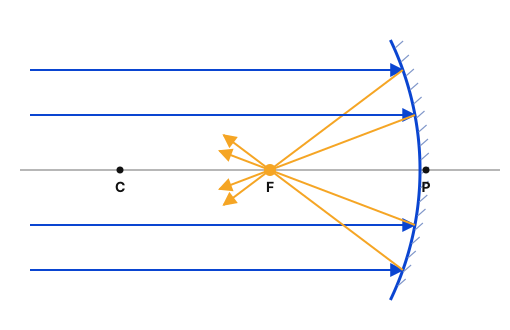
- Concave mirror is a converging mirror.
- All parallel rays meet at one point F on the principal axis.
- Option A describes a convex mirror (rays appear to diverge from F behind it).
Yaad rakhein: Concave → converge (real F in front); Convex → diverge (virtual F behind).
Answer: (D) They all meet at a single point on the principal axis.
अवधारणा: मुख्य अक्ष के समांतर किरणें अवतल दर्पण से परावर्तन के बाद मुख्य फोकस पर मिलती हैं।
- अवतल दर्पण अभिसारी है।
- सभी समांतर किरणें मुख्य अक्ष के एक बिंदु F पर मिलती हैं।
- विकल्प A उत्तल दर्पण का वर्णन है।
याद रखें: अवतल → अभिसरण (सामने वास्तविक F); उत्तल → अपसरण (पीछे आभासी F)।
उत्तर: (D) वे सभी मुख्य अक्ष पर एक ही बिंदु पर मिलती हैं।
RRB Technician Grade IIIGeneral ScienceConcave mirror – principal focusRRB Technician Grade III 2025 · 9 Mar Shift 3
Q151.When sound propagates through air, the region of high pressure created by the vibrating object pushing air forward is called a __________.
जब ध्वनि वायु में संचरित होती है, तो कंपित वस्तु द्वारा वायु को आगे धकेलने से बने उच्च दाब वाले क्षेत्र को __________ कहते हैं।
- AMedium boundaryमाध्यम सीमा
- BTransverse waveअनुप्रस्थ तरंग
- CRarefaction (R)विरलन (R)
- DCompression (C)संपीडन (C)
Show answer
Concept: Sound in air is a longitudinal wave of compressions and rarefactions.
- Object moves forward → pushes and crowds air → high pressure/density region = compression (C).
- Object moves back → low pressure region = rarefaction (R).
Yaad rakhein: Compression = crest-like (high density); rarefaction = trough-like (low density).
Answer: (D) Compression (C)
अवधारणा: वायु में ध्वनि संपीडन और विरलन वाली अनुदैर्ध्य तरंग है।
- वस्तु आगे → वायु दबती है → उच्च दाब/घनत्व क्षेत्र = संपीडन (C)।
- वस्तु पीछे → निम्न दाब क्षेत्र = विरलन (R)।
याद रखें: संपीडन = शृंग जैसा (अधिक घनत्व); विरलन = गर्त जैसा (कम घनत्व)।
उत्तर: (D) संपीडन (C)
RRB Technician Grade IIIGeneral ScienceSound waves – compression and rarefactionRRB Technician Grade III 2025 · 9 Mar Shift 3
Q152.Which of the following best describes the primary function of nervous tissue?
निम्नलिखित में से कौन-सा तंत्रिका ऊतक के प्राथमिक कार्य का सबसे अच्छा वर्णन करता है?
- AAbsorption of nutrientsपोषक तत्वों का अवशोषण
- BTransmission of electrical impulsesविद्युत आवेगों का संचरण
- CProviding support and bindingसहारा प्रदान करना और बाँधना
- DContraction for movementगति के लिए संकुचन
Show answer
Concept: Nervous tissue conducts messages as electrical impulses.
- Neurons receive stimuli and transmit impulses quickly between body parts.
- Absorption = epithelium; support/binding = connective tissue; contraction = muscle tissue.
Trick: Match each option to a tissue — only 'transmission of impulses' belongs to nervous tissue.
Answer: (B) Transmission of electrical impulses
अवधारणा: तंत्रिका ऊतक संदेश को विद्युत आवेग के रूप में भेजता है।
- न्यूरॉन उद्दीपन ग्रहण कर आवेग तेजी से शरीर के भागों तक भेजते हैं।
- अवशोषण = उपकला; सहारा/जोड़ना = संयोजी ऊतक; संकुचन = पेशी ऊतक।
ट्रिक: हर विकल्प को एक ऊतक से मिलाएँ — 'आवेग संचरण' केवल तंत्रिका ऊतक का।
उत्तर: (B) विद्युत आवेगों का संचरण
RRB Technician Grade IIIGeneral ScienceNervous tissue – functionRRB Technician Grade III 2025 · 9 Mar Shift 3
Q153.Which of the following statements is/are correct regarding Rutherford’s model of the atom?
Statement 1: The atom has a positively charged dense nucleus at its centre.
Statement 2: Electrons revolve in circular orbits around the nucleus without losing energy.
Statement 3: Most of the space inside the atom is empty.
रदरफोर्ड के परमाणु मॉडल के संबंध में निम्नलिखित में से कौन-सा/से कथन सही है/हैं?
कथन 1: परमाणु के केंद्र में एक धनावेशित सघन नाभिक होता है।
कथन 2: इलेक्ट्रॉन ऊर्जा खोए बिना नाभिक के चारों ओर वृत्ताकार कक्षाओं में परिक्रमा करते हैं।
कथन 3: परमाणु के अंदर का अधिकांश स्थान रिक्त होता है।
- AOnly 1, 2 and 3केवल 1, 2 और 3
- BOnly 1 and 3केवल 1 और 3
- COnly 2 and 3केवल 2 और 3
- DOnly 1 and 2केवल 1 और 2
Show answer
Concept: α-particle scattering showed a tiny, dense, positive nucleus and mostly empty space.
- Statement 1 ✓ – positive dense nucleus at centre.
- Statement 3 ✓ – most α-particles passed straight → atom mostly empty.
- Statement 2 ✗ – 'orbits without losing energy' is Bohr's postulate; in Rutherford's model a revolving electron should radiate energy and fall into the nucleus (its main drawback).
Trick: 'Without losing energy / stationary orbits' → always Bohr, never Rutherford.
Answer: (B) Only 1 and 3
अवधारणा: α-कण प्रकीर्णन से पता चला कि केंद्र में छोटा, सघन, धनावेशित नाभिक है और अधिकतर स्थान खाली है।
- कथन 1 ✓ – केंद्र में धनावेशित सघन नाभिक।
- कथन 3 ✓ – अधिकांश α-कण सीधे निकल गए → परमाणु ज्यादातर खाली।
- कथन 2 ✗ – 'ऊर्जा खोए बिना कक्षा में घूमना' बोर का अभिगृहीत है; रदरफोर्ड मॉडल में घूमता इलेक्ट्रॉन ऊर्जा खोकर नाभिक में गिर जाना चाहिए (मुख्य कमी)।
ट्रिक: 'ऊर्जा नहीं खोते / स्थिर कक्षाएँ' → हमेशा बोर, रदरफोर्ड नहीं।
उत्तर: (B) केवल 1 और 3
RRB Technician Grade IIIGeneral ScienceRutherford's model of atomRRB Technician Grade III 2025 · 9 Mar Shift 3
Q154.Isotopes are atoms of the same element that have:
समस्थानिक (Isotopes) एक ही तत्व के वे परमाणु हैं जिनकी:
- Athe same atomic number but different mass numbersपरमाणु संख्या समान होती है लेकिन द्रव्यमान संख्याएँ भिन्न होती हैं
- Bdifferent number of protonsप्रोटॉनों की संख्या भिन्न होती है
- Cdifferent chemical propertiesरासायनिक गुण भिन्न होते हैं
- Dthe same mass number but different atomic numbersद्रव्यमान संख्या समान होती है लेकिन परमाणु संख्याएँ भिन्न होती हैं
Show answer
Concept: Isotopes = same element (same protons) but different neutrons.
- Same atomic number, different mass numbers (e.g. ¹H, ²H, ³H; ¹²C, ¹⁴C).
- Same electronic configuration → similar chemical properties.
- Option D defines isobars.
Trick: isotoPes → same Protons; isobArs → same mAss number.
Answer: (A) the same atomic number but different mass numbers
अवधारणा: समस्थानिक = एक ही तत्व (समान प्रोटॉन) पर न्यूट्रॉन अलग।
- परमाणु क्रमांक समान, द्रव्यमान संख्या अलग (उदा. ¹H, ²H, ³H; ¹²C, ¹⁴C)।
- इलेक्ट्रॉनिक विन्यास समान → रासायनिक गुण समान।
- विकल्प D समभारिक (isobars) की परिभाषा है।
ट्रिक: isotoPes → समान Protons; isobArs → समान mAss number।
उत्तर: (A) परमाणु संख्या समान होती है लेकिन द्रव्यमान संख्याएँ भिन्न होती हैं
RRB Technician Grade IIIGeneral ScienceIsotopesRRB Technician Grade III 2025 · 9 Mar Shift 3
Q155.Six resistors of 3Ω each are connected in parallel in a circuit. What will be their effective resistance?
प्रत्येक 3Ω के छह प्रतिरोधक (resistors) एक परिपथ में पार्श्वक्रम (समांतर क्रम) में जुड़े हैं। उनका प्रभावी प्रतिरोध क्या होगा?
- A18 Ω
- B3 Ω
- C2 Ω
- D0.5 Ω
Show answer
Concept: n equal resistors R in parallel → .
- .
- .
Trick: Parallel resistance is always less than the smallest resistor (3 Ω) → only 0.5 Ω fits.
Answer: (D) 0.5 Ω
अवधारणा: n समान प्रतिरोध R समांतर में → ।
ट्रिक: समांतर का कुल प्रतिरोध सबसे छोटे प्रतिरोध (3 Ω) से भी कम होता है → केवल 0.5 Ω।
उत्तर: (D) 0.5 Ω
RRB Technician Grade IIIGeneral ScienceResistors in parallelRRB Technician Grade III 2025 · 9 Mar Shift 3
Q156.Which of the following is the best method to prevent corrosion of iron in coastal areas?
तटीय क्षेत्रों में लोहे के संक्षारण को रोकने की सबसे अच्छी विधि निम्नलिखित में से कौन-सी है?
- AImmersing in cold waterठंडे पानी में डुबोना
- BPainting with oil-based paintsतेल-आधारित पेंट से रंगना
- CGalvanisationयशदलेपन (Galvanisation)
- DHeating the iron periodicallyलोहे को समय-समय पर गर्म करना
Show answer
Concept: Galvanisation = coating iron with a thin layer of zinc.
- Coastal air is humid and salty → fast rusting.
- Zinc protects iron even if the coating is scratched (zinc, being more reactive, corrodes first).
- Paint can chip off; water and heating speed up rusting.
Yaad rakhein: Galvanised = zinc coat; tinning = tin coat; stainless steel = alloy of Fe with Cr and Ni.
Answer: (C) Galvanisation
अवधारणा: यशदलेपन (Galvanisation) = लोहे पर जिंक की पतली परत चढ़ाना।
- तटीय वायु नम और लवणीय → तेजी से जंग।
- परत खरोंचने पर भी जिंक (अधिक सक्रिय) पहले संक्षारित होकर लोहे को बचाता है।
- पेंट उखड़ सकता है; पानी और गर्म करना जंग बढ़ाते हैं।
याद रखें: यशदलेपन = जिंक परत; कलई = टिन परत; स्टेनलेस स्टील = Fe + Cr + Ni मिश्रधातु।
उत्तर: (C) यशदलेपन (Galvanisation)
RRB Technician Grade IIIGeneral SciencePrevention of corrosion – galvanisationRRB Technician Grade III 2025 · 9 Mar Shift 3
Q157.Which group of organisms is responsible for breaking down dead bodies and waste into simpler substances that return to the soil?
जीवों का कौन-सा समूह मृत शरीरों और अपशिष्ट को सरल पदार्थों में तोड़ने के लिए उत्तरदायी है, जो मिट्टी में वापस लौट जाते हैं?
- ADecomposersअपघटक
- BConsumersउपभोक्ता
- CProducersउत्पादक
- DParasite onlyकेवल परजीवी
Show answer
Concept: Decomposers break down dead organic matter into simple substances.
- Bacteria and fungi are the main decomposers.
- They return nutrients to the soil for reuse by producers.
- Producers make food; consumers eat others; parasites live on living hosts.
Yaad rakhein: Decomposers = nature's cleaners; they complete the nutrient cycle.
Answer: (A) Decomposers
अवधारणा: अपघटक मृत कार्बनिक पदार्थों को सरल पदार्थों में तोड़ते हैं।
- जीवाणु और कवक मुख्य अपघटक हैं।
- ये पोषक तत्व मिट्टी में लौटाते हैं, जिन्हें उत्पादक फिर उपयोग करते हैं।
- उत्पादक भोजन बनाते हैं; उपभोक्ता दूसरों को खाते हैं; परजीवी जीवित पोषी पर रहते हैं।
याद रखें: अपघटक = प्रकृति के सफाईकर्मी; पोषक चक्र पूरा करते हैं।
उत्तर: (A) अपघटक
RRB Technician Grade IIIGeneral ScienceEcosystem – decomposersRRB Technician Grade III 2025 · 9 Mar Shift 3
Q158.The compound with molecular formula C₂H₄O can belong to which of the following functional group, and what is its IUPAC name?
आण्विक सूत्र C₂H₄O वाला यौगिक निम्नलिखित में से किस प्रकार्यात्मक समूह से संबंधित हो सकता है, और इसका IUPAC नाम क्या है?
- AAldehyde, ethanolऐल्डिहाइड, एथेनॉल
- BAldehyde, ethanalऐल्डिहाइड, एथेनैल
- CEther, ethaneईथर, एथेन
- DAlcohol, ethanolऐल्कोहॉल, एथेनॉल
Show answer
Concept: C₂H₄O = CH₃CHO, which has the –CHO group.
- –CHO = aldehyde; IUPAC suffix '-al'.
- 2 carbons → eth + anal → ethanal (acetaldehyde).
- Ethanol is C₂H₅OH (C₂H₆O) — an alcohol, so A and D are wrong.
Trick: Aldehyde ends in '-al', alcohol in '-ol' — option A mixes them, so it's a trap.
Answer: (B) Aldehyde, ethanal
अवधारणा: C₂H₄O = CH₃CHO, जिसमें –CHO समूह है।
- –CHO = एल्डिहाइड; IUPAC प्रत्यय '-al'।
- 2 कार्बन → एथेनैल (एसीटैल्डिहाइड)।
- एथेनॉल C₂H₅OH (C₂H₆O) है — ऐल्कोहॉल, इसलिए A, D गलत।
ट्रिक: एल्डिहाइड '-al', ऐल्कोहॉल '-ol' — विकल्प A दोनों को मिलाता है, जाल है।
उत्तर: (B) ऐल्डिहाइड, एथेनैल
RRB Technician Grade IIIGeneral ScienceFunctional groups – aldehyde (ethanal)RRB Technician Grade III 2025 · 9 Mar Shift 3
Q159.A body travelling in a straight line with a constant velocity of 50 m/s. What is the displacement of the car in 10 sec and the type of motion followed by the car,
respectively?
एक वस्तु 50 m/s के नियत वेग से एक सीधी रेखा में चल रही है। 10 सेकंड में कार का विस्थापन और कार द्वारा अनुसरित गति का प्रकार,
क्रमशः क्या है?
- A5 m and Uniform Motion5 m और समान गति
- B5 m and Non-Uniform Motion5 m और असमान गति
- C500 m and Uniform Motion500 m और समान गति
- D500 m and Non-Uniform Motion500 m और असमान गति
Show answer
Concept: Constant velocity → uniform motion; displacement = velocity × time.
- Displacement = m.
- Velocity is constant (no change in speed or direction) → uniform motion.
Trick: 'Constant velocity' already tells you uniform motion → only A or C; picks C.
Answer: (C) 500 m and Uniform Motion
अवधारणा: नियत वेग → समान गति; विस्थापन = वेग × समय।
- विस्थापन = m
- वेग नियत (चाल व दिशा नहीं बदलती) → समान गति।
ट्रिक: 'नियत वेग' से ही समान गति → A या C; → C।
उत्तर: (C) 500 m और समान गति
RRB Technician Grade IIIGeneral ScienceUniform motion – displacementRRB Technician Grade III 2025 · 9 Mar Shift 3
Q160.What is the main difference between isobars and isotopes?
समभारिकों (isobars) और समस्थानिकों (isotopes) के बीच मुख्य अंतर क्या है?
- AIsobars have the same mass number but different atomic numbersसमभारिकों की द्रव्यमान संख्या समान होती है लेकिन परमाणु संख्याएँ भिन्न होती हैं
- BIsobars have the same number of electrons; isotopes do notसमभारिकों में इलेक्ट्रॉनों की संख्या समान होती है; समस्थानिकों में नहीं
- CIsobars have the same atomic number; isotopes have different atomic numbersसमभारिकों की परमाणु संख्या समान होती है; समस्थानिकों की परमाणु संख्याएँ भिन्न होती हैं
- DIsobars are atoms of the same element; isotopes are of different elementsसमभारिक एक ही तत्व के परमाणु होते हैं; समस्थानिक भिन्न-भिन्न तत्वों के होते हैं
Show answer
Concept: Isobars – same mass number, different atomic numbers (different elements).
- Example: ⁴⁰Ca (Z = 20) and ⁴⁰Ar (Z = 18).
- Isotopes – same atomic number, different mass numbers (same element).
- Options C and D swap these definitions.
Trick: isobArs → same A (mass number); isotoPes → same Protons.
Answer: (A) Isobars have the same mass number but different atomic numbers
अवधारणा: समभारिक – द्रव्यमान संख्या समान, परमाणु क्रमांक अलग (अलग तत्व)।
- उदाहरण: ⁴⁰Ca (Z = 20) और ⁴⁰Ar (Z = 18)।
- समस्थानिक – परमाणु क्रमांक समान, द्रव्यमान संख्या अलग (एक ही तत्व)।
- C और D इन परिभाषाओं को उलट देते हैं।
ट्रिक: isobArs → समान A (द्रव्यमान संख्या); isotoPes → समान Protons।
उत्तर: (A) समभारिकों की द्रव्यमान संख्या समान होती है लेकिन परमाणु संख्याएँ भिन्न होती हैं
RRB Technician Grade IIIGeneral ScienceIsobars vs isotopesRRB Technician Grade III 2025 · 9 Mar Shift 3

