Q2141.If an Earth-orbiting satellite completes one revolution in exactly 24 hours, how does it appear from the surface of Earth?
यदि कोई पृथ्वी-परिक्रमा उपग्रह ठीक 24 घंटे में एक चक्कर पूरा करे, तो पृथ्वी की सतह से वह कैसा दिखाई देगा?
- ASlowly drifts closer to Earthधीरे-धीरे पृथ्वी के निकट आता है
- BRemains fixed over the same point on Earthपृथ्वी के एक ही बिंदु के ऊपर स्थिर दिखता है
- CMoves away into outer spaceबाह्य अंतरिक्ष में दूर चला जाता है
- DWobbles randomly across the skyआकाश में अनियमित रूप से डोलता है
Show answer
Concept: A satellite whose period equals Earth's rotation period stays above one spot.
- Earth rotates once in about 24 hours.
- A satellite with a 24-hour period (in the equatorial plane, moving eastward) keeps pace with the ground.
- So it appears fixed over the same point – a geostationary satellite.
Yaad rakhein: Geostationary orbit height ≈ 35,786 km above the equator; used for communication and weather (e.g. INSAT, GSAT).
Answer: (B) Remains fixed over the same point on Earth
अवधारणा: जिस उपग्रह का परिक्रमण काल पृथ्वी के घूर्णन काल के बराबर हो, वह एक ही जगह के ऊपर रहता है।
- पृथ्वी लगभग 24 घंटे में एक बार घूमती है।
- 24 घंटे वाला उपग्रह (भूमध्य रेखा तल में, पूर्व की ओर) ज़मीन के साथ-साथ चलता है।
- इसलिए वह एक ही बिंदु के ऊपर स्थिर दिखता है – भूस्थिर उपग्रह।
याद रखें: भूस्थिर कक्षा की ऊँचाई ≈ 35,786 km; संचार व मौसम उपग्रह (INSAT, GSAT) इसमें रहते हैं।
उत्तर: (B) पृथ्वी के एक ही बिंदु के ऊपर स्थिर दिखता है
SSC CGLGeneral AwarenessGeostationary satelliteSSC CGL 2025 · 20 Sep Shift 3
Q2142.After attaining 60 years of age, what is the fixed monthly pension guaranteed to enrolled small and marginal farmers under the Pradhan Mantri Kisan Maandhan Yojana (PM-KMY)?
प्रधानमंत्री किसान मानधन योजना (PM-KMY) के अंतर्गत 60 वर्ष की आयु के बाद पंजीकृत लघु एवं सीमांत किसानों को कितनी निश्चित मासिक पेंशन मिलती है?
- A₹1,000
- B₹2,000
- C₹3,000
- D₹5,000
Show answer
Concept: Pension scheme for small and marginal farmers (launched 2019).
- Voluntary, contributory scheme for farmers aged 18–40.
- After 60 years, a fixed pension of ₹3,000 per month.
- Centre contributes an amount equal to the farmer's contribution.
Yaad rakhein: PM-SYM (unorganised workers) and PM-KMY both give ₹3,000/month after 60 – remember '3000 at 60'.
Answer: (C) ₹3,000
अवधारणा: छोटे व सीमांत किसानों की पेंशन योजना (2019)।
- 18–40 वर्ष के किसानों के लिए स्वैच्छिक, अंशदायी योजना।
- 60 वर्ष के बाद ₹3,000 मासिक निश्चित पेंशन।
- किसान जितना अंशदान करता है, उतना ही केंद्र देता है।
याद रखें: PM-SYM और PM-KMY दोनों में 60 के बाद ₹3,000 मासिक – '60 पर 3000' याद रखें।
उत्तर: (C) ₹3,000
SSC CGLGeneral AwarenessPM Kisan Maandhan Yojana – pensionSSC CGL 2025 · 20 Sep Shift 3
Q2143.The World Bank's Logistics Performance Index (LPI) is used as a benchmark to measure a nation's capability in which of the following areas?
विश्व बैंक का लॉजिस्टिक्स परफॉर्मेंस इंडेक्स (LPI) किसी देश की किस क्षमता को मापने का मानक है?
- AEnsuring financial system resilienceवित्तीय प्रणाली की सुदृढ़ता
- BManaging trade and transportation logistics efficientlyव्यापार और परिवहन लॉजिस्टिक्स का कुशल प्रबंधन
- CEnhancing agricultural yieldकृषि उपज बढ़ाना
- DStrengthening cybersecurity networksसाइबर सुरक्षा नेटवर्क मज़बूत करना
Show answer
Concept: World Bank indices and what they measure.
- LPI measures how efficiently a country moves goods – customs, infrastructure, shipments, tracking and timeliness.
- So it is a benchmark for trade and transport logistics, not finance, farming or cybersecurity.
Yaad rakhein: India ranked 38th out of 139 countries in LPI 2023.
Answer: (B) Managing trade and transportation logistics efficiently
अवधारणा: विश्व बैंक के सूचकांक और उनका मापन।
- LPI मापता है कि देश माल कितनी कुशलता से भेजता है – सीमा शुल्क, ढाँचा, शिपमेंट, ट्रैकिंग, समयबद्धता।
- यानी यह व्यापार-परिवहन लॉजिस्टिक्स का मानक है।
याद रखें: LPI 2023 में भारत 139 देशों में 38वें स्थान पर रहा।
उत्तर: (B) व्यापार और परिवहन लॉजिस्टिक्स का कुशल प्रबंधन
SSC CGLGeneral AwarenessLogistics Performance IndexSSC CGL 2025 · 20 Sep Shift 3
Q2144.The Revenue Deficit of a government is obtained by calculating the excess of:
सरकार का राजस्व घाटा किसके आधिक्य से निकाला जाता है?
- ARevenue expenditure over Revenue receiptsराजस्व व्यय का राजस्व प्राप्तियों पर आधिक्य
- BRevenue receipts over Capital receiptsराजस्व प्राप्तियों का पूँजीगत प्राप्तियों पर आधिक्य
- CTotal expenditure over Total receiptsकुल व्यय का कुल प्राप्तियों पर आधिक्य
- DCapital expenditure over Revenue expenditureपूँजीगत व्यय का राजस्व व्यय पर आधिक्य
Show answer
Concept: Different deficits compare different parts of the budget.
- Revenue Deficit = Revenue expenditure − Revenue receipts.
- Fiscal Deficit = Total expenditure − (Revenue receipts + non-debt capital receipts), i.e. total borrowing.
- Primary Deficit = Fiscal deficit − Interest payments.
Trick: The word in the name tells you the account: 'Revenue' deficit uses only revenue items on both sides.
Answer: (A) Revenue expenditure over Revenue receipts
अवधारणा: अलग-अलग घाटे बजट के अलग हिस्सों की तुलना करते हैं।
- राजस्व घाटा = राजस्व व्यय − राजस्व प्राप्तियाँ।
- राजकोषीय घाटा = कुल व्यय − (राजस्व प्राप्ति + गैर-ऋण पूँजी प्राप्ति)।
- प्राथमिक घाटा = राजकोषीय घाटा − ब्याज भुगतान।
ट्रिक: नाम ही बताता है: 'राजस्व' घाटे में दोनों ओर केवल राजस्व मदें।
उत्तर: (A) राजस्व व्यय का राजस्व प्राप्तियों पर आधिक्य
SSC CGLGeneral AwarenessBudget deficits – revenue deficitSSC CGL 2025 · 20 Sep Shift 3
Q2145.With reference to Tamasha, a traditional folk-theatre form, consider the following statements:
1. It is a Marathi folk performance usually held in rural areas during the Shimga (Holika) festival.
2. The Kolhati community has a historical association with Tamasha troupes.
Which of the statements is/are correct?
पारंपरिक लोक नाट्य "तमाशा" के संदर्भ में निम्न कथनों पर विचार कीजिए:
1. यह मराठी लोक प्रस्तुति है, जो प्रायः ग्रामीण क्षेत्रों में शिमगा (होलिका) पर्व के समय होती है।
2. कोल्हाटी समुदाय का तमाशा मंडलियों से ऐतिहासिक संबंध रहा है।
कौन-सा/से कथन सही है/हैं?
- AOnly 1केवल 1
- BOnly 2केवल 2
- CBoth 1 and 21 और 2 दोनों
- DNeither 1 nor 2न 1 न 2
Show answer
Concept: Regional folk theatre forms of India.
- Tamasha is the folk theatre of Maharashtra, performed in villages, often around Shimga (Holi) – Statement 1 correct.
- Communities like the Kolhati have traditionally formed Tamasha troupes – Statement 2 correct.
Yaad rakhein: Lavani (song-dance with dholki) is the heart of Tamasha; other folk theatres: Nautanki (UP), Jatra (Bengal), Bhavai (Gujarat).
Answer: (C) Both 1 and 2
अवधारणा: भारत के क्षेत्रीय लोक नाट्य।
- तमाशा महाराष्ट्र का लोक नाट्य है, गाँवों में शिमगा (होली) के आसपास होता है – कथन 1 सही।
- कोल्हाटी जैसे समुदाय पारंपरिक रूप से तमाशा मंडलियाँ चलाते रहे हैं – कथन 2 सही।
याद रखें: लावणी (ढोलकी के साथ गीत-नृत्य) तमाशा की जान है; नौटंकी (UP), जात्रा (बंगाल), भवाई (गुजरात)।
उत्तर: (C) 1 और 2 दोनों
SSC CGLGeneral AwarenessFolk theatre – TamashaSSC CGL 2025 · 20 Sep Shift 3
Q2146.Pingali Venkayya, an Indian freedom fighter, is best remembered for his pivotal role in the conception of which national symbol?
भारतीय स्वतंत्रता सेनानी पिंगली वेंकैया किस राष्ट्रीय प्रतीक की परिकल्पना में अपनी भूमिका के लिए जाने जाते हैं?
- ANational Flower of Indiaभारत का राष्ट्रीय पुष्प
- BNational Anthem of Indiaभारत का राष्ट्रगान
- CNational Flag of Indiaभारत का राष्ट्रीय ध्वज
- DNational Emblem of Indiaभारत का राष्ट्रीय प्रतीक चिह्न
Show answer
Concept: Personalities behind national symbols.
- Pingali Venkayya designed a flag and presented it to Gandhiji at Vijayawada in 1921.
- His design became the base for the Tiranga adopted on 22 July 1947.
- National Anthem – Rabindranath Tagore.
Yaad rakhein: National Flag adopted 22 July 1947; Flag Code of India 2002; Har Ghar Tiranga campaign began 2022 (Venkayya's 146th birth anniversary year).
Answer: (C) National Flag of India
अवधारणा: राष्ट्रीय प्रतीकों से जुड़े व्यक्तित्व।
- पिंगली वेंकय्या ने 1921 में विजयवाड़ा में गांधीजी को ध्वज का प्रारूप दिया।
- उनका डिज़ाइन 22 जुलाई 1947 को अपनाए गए तिरंगे का आधार बना।
- राष्ट्रगान – रवींद्रनाथ टैगोर।
याद रखें: राष्ट्रीय ध्वज 22 जुलाई 1947 को अपनाया गया; भारतीय ध्वज संहिता 2002।
उत्तर: (C) भारत का राष्ट्रीय ध्वज
SSC CGLGeneral AwarenessPingali Venkayya – National FlagSSC CGL 2025 · 20 Sep Shift 3
Q2147.Which of the following statements about K. Sivan is correct?
के. सिवन के संबंध में निम्न में से कौन-सा कथन सही है?
- ALed DRDO and founded a rocket startupDRDO का नेतृत्व किया और एक रॉकेट स्टार्टअप की स्थापना की
- BServed as Chairman of Hindustan Aeronautics Limited (HAL) and ISROहिंदुस्तान एयरोनॉटिक्स लिमिटेड (HAL) और ISRO के अध्यक्ष रहे
- CInvented a new satellite-propulsion methodउपग्रह-नोदन की नई विधि का आविष्कार किया
- DLed ISRO and its parent department (Department of Space)ISRO और उसके मूल विभाग (अंतरिक्ष विभाग) का नेतृत्व किया
Show answer
Concept: Heads of India's space programme.
- K. Sivan was Chairman of ISRO (2018–2022).
- The ISRO Chairman is also Secretary, Department of Space and Chairman of the Space Commission.
- He led Chandrayaan-2 and is called the 'Rocket Man' for cryogenic engine work; he never headed DRDO or HAL.
Yaad rakhein: ISRO chiefs after him: S. Somanath (2022–25), V. Narayanan (from January 2025).
Answer: (D) Led ISRO and its parent department (Department of Space)
अवधारणा: भारत के अंतरिक्ष कार्यक्रम के प्रमुख।
- के. सिवन 2018–2022 तक इसरो अध्यक्ष रहे।
- इसरो अध्यक्ष ही अंतरिक्ष विभाग का सचिव होता है।
- चंद्रयान-2 उनके समय हुआ; क्रायोजेनिक इंजन कार्य से 'रॉकेट मैन' कहलाए; वे DRDO/HAL प्रमुख नहीं रहे।
याद रखें: उनके बाद: एस. सोमनाथ (2022–25), वी. नारायणन (जनवरी 2025 से)।
उत्तर: (D) ISRO और उसके मूल विभाग (अंतरिक्ष विभाग) का नेतृत्व किया
SSC CGLGeneral AwarenessK. Sivan – ISRO chiefSSC CGL 2025 · 20 Sep Shift 3
Q2148.In the history of India’s Five-Year Plans, the term "plan holiday" refers to which of the following?
भारत की पंचवर्षीय योजनाओं के इतिहास में "योजना अवकाश" (plan holiday) का अर्थ क्या है?
- AEmergency loan disbursementsआपात ऋण वितरण
- BSuspension of annual budget formulationवार्षिक बजट निर्माण का निलंबन
- CA break in the continuity of Five-Year Planningपंचवर्षीय योजना की निरंतरता में विराम
- DA policy shift from socialism to capitalismसमाजवाद से पूँजीवाद की ओर नीतिगत बदलाव
Show answer
Concept: Breaks in India's planning cycle.
- After the Third Plan (1961–66), war with Pakistan (1965) and droughts strained resources.
- From 1966 to 1969 no Five-Year Plan was launched; three Annual Plans were run instead – the 'Plan Holiday'.
- The Fourth Plan started in 1969.
Yaad rakhein: Another gap: 1990–92 (two Annual Plans) before the Eighth Plan (1992–97).
Answer: (C) A break in the continuity of Five-Year Planning
अवधारणा: भारत के नियोजन चक्र में विराम।
- तीसरी योजना (1961–66) के बाद 1965 युद्ध और सूखे से संसाधन घटे।
- 1966–69 में पंचवर्षीय योजना नहीं बनी; तीन वार्षिक योजनाएँ चलीं – यही 'योजना अवकाश'।
- चौथी योजना 1969 में शुरू हुई।
याद रखें: दूसरा विराम: 1990–92 (दो वार्षिक योजनाएँ), फिर आठवीं योजना (1992–97)।
उत्तर: (C) पंचवर्षीय योजना की निरंतरता में विराम
SSC CGLGeneral AwarenessFive-Year Plans – Plan HolidaySSC CGL 2025 · 20 Sep Shift 3
Q2149.Scientific studies suggest that the Atlantic Meridional Overturning Circulation (AMOC) may be weakening. Which of the following is NOT considered a direct outcome of a major slowdown or collapse of the AMOC?
वैज्ञानिक अध्ययनों के अनुसार अटलांटिक मेरिडियनल ओवरटर्निंग सर्कुलेशन (AMOC) कमज़ोर हो रहा है। इसके बड़े मंदन या पतन का प्रत्यक्ष परिणाम निम्न में से कौन नहीं माना जाता?
- ADisruption of tropical monsoon systemsउष्णकटिबंधीय मानसून प्रणालियों में व्यवधान
- BEnhanced cooling over parts of the North Atlanticउत्तरी अटलांटिक के कुछ भागों में अधिक ठंडक
- CIncreased warming of the Arctic regionआर्कटिक क्षेत्र में अधिक गर्मी
- DA rise in sea levels along the eastern coast of the United Statesअमेरिका के पूर्वी तट पर समुद्र-स्तर में वृद्धि
Show answer
Concept: AMOC carries warm tropical water north in the Atlantic; weakening it reduces northward heat transport.
- Less heat to the north ⇒ North Atlantic cools (option b is an outcome).
- Shift of the tropical rain belt ⇒ monsoons disrupted (a is an outcome); sea level rises on the US east coast (d is an outcome).
- Extra Arctic warming is not caused by AMOC slowdown – it would reduce heat reaching the north.
Trick: 'NOT' questions: an AMOC slowdown means less heat going north, so any option claiming more northern warming is the misfit.
Answer: (C) Increased warming of the Arctic region
अवधारणा: AMOC अटलांटिक में गर्म पानी उत्तर की ओर ले जाता है; इसके कमज़ोर होने से उत्तर की ओर ऊष्मा कम पहुँचती है।
- उत्तर में ऊष्मा कम ⇒ उत्तरी अटलांटिक ठंडा (b परिणाम है)।
- उष्णकटिबंधीय वर्षा पट्टी खिसकती है ⇒ मानसून प्रभावित (a); अमेरिका के पूर्वी तट पर समुद्र-स्तर बढ़ता है (d)।
- आर्कटिक का अधिक गर्म होना AMOC मंदी का परिणाम नहीं – उलटे उत्तर में ऊष्मा घटेगी।
ट्रिक: 'NOT' प्रश्न: AMOC धीमा = उत्तर में कम ऊष्मा, इसलिए 'अधिक गर्मी' वाला विकल्प बेमेल है।
उत्तर: (C) आर्कटिक क्षेत्र में अधिक गर्मी
SSC CGLGeneral AwarenessAMOC slowdown – effectsSSC CGL 2025 · 20 Sep Shift 3
Q2150.With reference to the constitutional provisions governing the tenure and protection of civil servants in India, consider the following statements:
1. Article 310 is inspired by British constitutional conventions.
2. Article 310 provides unrestricted authority to dismiss civil servants without any procedural safeguard.
3. Article 311 imposes limitations on the exercise of power under Article 310.
Which of the above statements is/are correct?
भारत में सिविल सेवकों के कार्यकाल और संरक्षण संबंधी संवैधानिक उपबंधों के संदर्भ में निम्न कथनों पर विचार कीजिए:
1. अनुच्छेद 310 ब्रिटिश संवैधानिक परंपराओं से प्रेरित है।
2. अनुच्छेद 310 बिना किसी प्रक्रियात्मक संरक्षण के सिविल सेवकों को हटाने का असीमित अधिकार देता है।
3. अनुच्छेद 311, अनुच्छेद 310 की शक्ति के प्रयोग पर सीमाएँ लगाता है।
उपर्युक्त में से कौन-से कथन सही हैं?
- A1 and 2 onlyकेवल 1 और 2
- B1 and 3 onlyकेवल 1 और 3
- C2 and 3 onlyकेवल 2 और 3
- D1, 2 and 31, 2 और 3
Show answer
Concept: Doctrine of pleasure and its constitutional limits.
- Art. 310: civil servants hold office during the pleasure of the President/Governor – borrowed from British practice. Statement 1 ✓
- Art. 311: no dismissal/removal/reduction in rank without inquiry and a reasonable hearing; not by an authority subordinate to the appointing one. Statement 3 ✓
- Hence the power under Art. 310 is not unrestricted – Statement 2 ✗
Trick: Statements 2 and 3 contradict each other – both cannot be true, so options (c) and (d) go out immediately.
Answer: (B) 1 and 3 only
अवधारणा: प्रसाद का सिद्धांत (doctrine of pleasure) और उसकी संवैधानिक सीमाएँ।
- अनु. 310: लोक सेवक राष्ट्रपति/राज्यपाल के प्रसादपर्यंत पद पर – ब्रिटिश परंपरा से लिया गया। कथन 1 ✓
- अनु. 311: जाँच और सुनवाई के बिना बर्खास्तगी नहीं; नियुक्ति अधिकारी से निचला अधिकारी नहीं हटा सकता। कथन 3 ✓
- इसलिए अनु. 310 की शक्ति असीमित नहीं – कथन 2 ✗
ट्रिक: कथन 2 और 3 परस्पर विरोधी हैं – दोनों सही नहीं हो सकते, इसलिए (c) और (d) तुरंत बाहर।
उत्तर: (B) केवल 1 और 3
SSC CGLGeneral AwarenessCivil servants – Articles 310 & 311SSC CGL 2025 · 20 Sep Shift 3
Q2151.Find the value of x in the given equation:
= 5
दिए गए समीकरण में x का मान ज्ञात कीजिए:
= 5
- A
- B
- C
- D
Show answer
Concept: If , then .
- Here , , .
- Square:
Trick: Componendo-dividendo turns the whole fraction into a simple ratio in one step – then just square.
Answer: (C)
अवधारणा: यदि , तो ।
- , ,
- वर्ग करें:
ट्रिक: योगांतरानुपात से पूरा भिन्न एक ही चरण में सरल अनुपात बन जाता है – फिर बस वर्ग करें।
उत्तर: (C)
SSC CGLQuantitative AptitudeSurd equation – componendo-dividendoSSC CGL 2025 · 20 Sep Shift 3
Q2152.How much will the compound interest on ₹24,000 at 20% per annum for 9 months be, if it is compounded quarterly?
₹24,000 पर 20% वार्षिक दर से 9 माह का चक्रवृद्धि ब्याज कितना होगा, यदि ब्याज तिमाही चक्रवृद्धि हो?
- A₹3,222
- B₹3,422
- C₹1,622
- D₹3,783
Show answer
Concept: Quarterly: rate ÷ 4, number of periods = quarters.
- Rate per quarter = ; 9 months = 3 quarters.
- ⇒ growth factor over 9 months
- CI = ₹3,783
Trick: Effective rate for 3 periods at 5% = 15.7625% . 15.7625% of 24,000 = ₹3,783.
Answer: (D) ₹3,783
अवधारणा: त्रैमासिक: दर ÷ 4, अवधि = तिमाहियों की संख्या।
- प्रति तिमाही दर = 5%; 9 महीने = 3 तिमाही।
- मिश्रधन = ₹27,783
- CI = ₹3,783
ट्रिक: 5% पर 3 वर्ष की प्रभावी दर = 15.7625%; 24,000 का 15.7625% = ₹3,783।
उत्तर: (D) ₹3,783
SSC CGLQuantitative AptitudeCompound interest – quarterlySSC CGL 2025 · 20 Sep Shift 3
Q2153.15 women can do a work in 14 days. 30 men can complete the same work in 10 days. What is the ratio between the efficiency of a man and a woman?
15 महिलाएँ एक कार्य 14 दिनों में करती हैं। 30 पुरुष वही कार्य 10 दिनों में पूरा करते हैं। एक पुरुष और एक महिला की कार्यक्षमता का अनुपात क्या है?
- A7 : 10
- B8 : 4
- C7 : 9
- D10 : 9
Show answer
Concept: Same work ⇒ (persons × days) × efficiency is equal.
- 15 women × 14 days = 210 woman-days.
- 30 men × 10 days = 300 man-days.
Trick: Efficiency is inversely proportional to the person-days needed: M : W = 210 : 300 = 7 : 10.
Answer: (A) 7 : 10
अवधारणा: एक ही काम ⇒ (व्यक्ति × दिन) × दक्षता बराबर।
- 15 महिला × 14 दिन = 210 महिला-दिन
- 30 पुरुष × 10 दिन = 300 पुरुष-दिन
ट्रिक: दक्षता ज़रूरी व्यक्ति-दिनों के व्युत्क्रमानुपाती है: 210 : 300 = 7 : 10।
उत्तर: (A) 7 : 10
SSC CGLQuantitative AptitudeWork – man vs woman efficiencySSC CGL 2025 · 20 Sep Shift 3
Q2154.Which of the following numbers is an integer but NOT a natural number?
निम्न में से कौन-सी संख्या पूर्णांक है परंतु प्राकृत संख्या नहीं है?
- A2
- B0
- C7
- D9
Show answer
Concept: Natural numbers: 1, 2, 3, …; integers: …, −2, −1, 0, 1, 2, ….
- 2, 7, 9 are natural numbers (and integers).
- 0 is an integer but natural numbers start from 1.
- So 0 is the required number.
Yaad rakhein: Whole numbers = 0 + natural numbers. So 0 is whole and integer, but not natural.
Answer: (B) 0
अवधारणा: प्राकृत संख्याएँ: 1, 2, 3, …; पूर्णांक: …, −1, 0, 1, …।
- 2, 7, 9 प्राकृत संख्याएँ हैं।
- 0 पूर्णांक है, पर प्राकृत संख्याएँ 1 से शुरू होती हैं।
- अतः उत्तर 0।
याद रखें: पूर्ण संख्याएँ = 0 + प्राकृत संख्याएँ। 0 पूर्ण व पूर्णांक है, प्राकृत नहीं।
उत्तर: (B) 0
SSC CGLQuantitative AptitudeNumber system – integers vs naturalsSSC CGL 2025 · 20 Sep Shift 3
Q2155.Naveen covers half of his journey at 18 km/h and the remaining half at 9 km/h. His average speed is:
नवीन अपनी यात्रा का आधा भाग 18 km/h और शेष आधा 9 km/h की चाल से तय करता है। उसकी औसत चाल क्या है?
- A12 km/h
- B11 km/h
- C14 km/h
- D13 km/h
Show answer
Concept: Equal distances at speeds a and b ⇒ average = .
- ,
- Average =
- = 12 km/h
Trick: Take the half-distance as 18 km: times 1 h + 2 h = 3 h for 36 km ⇒ 12 km/h.
Answer: (A) 12 km/h
अवधारणा: समान दूरियाँ a और b चाल से ⇒ औसत = ।
- ,
- औसत =
- = 12 km/h
ट्रिक: आधी दूरी 18 km मानें: समय 1 + 2 = 3 घंटे, कुल 36 km ⇒ 12 km/h।
उत्तर: (A) 12 km/h
SSC CGLQuantitative AptitudeAverage speed – equal distancesSSC CGL 2025 · 20 Sep Shift 3
Q2156.A hemisphere is inscribed in a cube of side 12 cm. What is the volume of the hemisphere?
12 cm भुजा वाले घन में एक अर्धगोला अंतर्निहित है। अर्धगोले का आयतन क्या है?
- A356.55 cm³
- B354.24 cm³
- C350.26 cm³
- D452.16 cm³
Show answer
Concept: Largest hemisphere in a cube: flat face on a cube face, diameter = side.
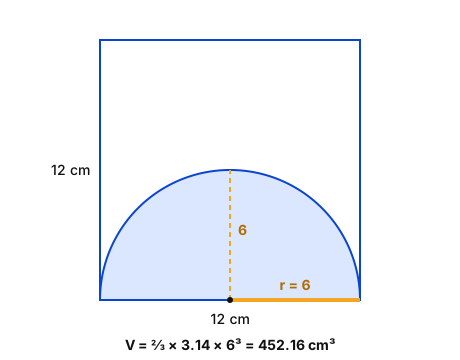
- Diameter = 12 cm ⇒ r = 6 cm
- Volume =
- = cm³
Trick: , so just multiply – the decimal .16 matches only option (d).
Answer: (D) 452.16 cm³
अवधारणा: घन में बड़ा अर्धगोला: समतल सतह घन की एक सतह पर, व्यास = भुजा।
- व्यास = 12 cm ⇒ r = 6 cm
- आयतन =
- = cm³
ट्रिक: ; का दशमलव .16 केवल (d) में है।
उत्तर: (D) 452.16 cm³
SSC CGLQuantitative AptitudeMensuration – hemisphere in a cubeSSC CGL 2025 · 20 Sep Shift 3
Q2157.A bus travels 11.9 km using 1.4 litres of fuel. How many kilometres does it travel per litre?
एक बस 1.4 लीटर ईंधन में 11.9 km चलती है। वह प्रति लीटर कितने किलोमीटर चलती है?
- A8.25 km
- B8.5 km
- C8.75 km
- D8.0 km
Show answer
Concept: Distance per litre = total distance ÷ fuel used.
- Mileage =
- =
- = 8.5 km per litre
Trick: Check backwards: ✓.
Answer: (B) 8.5 km
अवधारणा: प्रति लीटर दूरी = कुल दूरी ÷ ईंधन।
- माइलेज =
- =
- = 8.5 km प्रति लीटर
ट्रिक: उल्टा जाँचें: ✓।
उत्तर: (B) 8.5 km
SSC CGLQuantitative AptitudeUnitary method – mileageSSC CGL 2025 · 20 Sep Shift 3
Q2158.A venture has three stakeholders. P brought 60% of the capital and Q brought the rest. R joined later and was promised 30% of the total profit for branding. If the total profit was ₹3,50,000, how much was Q's share?
एक उद्यम में तीन साझेदार हैं। P ने 60% पूँजी लगाई और शेष Q ने। R बाद में जुड़ा और उसे ब्रांडिंग हेतु कुल लाभ का 30% देना तय हुआ। यदि कुल लाभ ₹3,50,000 है, तो Q का हिस्सा कितना होगा?
- A₹84,000
- B₹90,000
- C₹98,000
- D₹1,05,000
Show answer
Concept: Give R's fixed share first; split the rest in the capital ratio.
- R = 30% of 3,50,000 = ₹1,05,000
- Remaining = ₹2,45,000; P : Q =
- Q = ₹98,000
Trick: Q's share = of total ⇒ ₹98,000.
Answer: (C) ₹98,000
अवधारणा: पहले R का निश्चित हिस्सा दें, बचा लाभ पूँजी अनुपात में बाँटें।
- R = 3,50,000 का 30% = ₹1,05,000
- शेष = ₹2,45,000; P : Q = 3 : 2
- Q = ₹98,000
ट्रिक: Q का हिस्सा = = कुल का 28% ⇒ ₹98,000।
उत्तर: (C) ₹98,000
SSC CGLQuantitative AptitudePartnership – fixed share to a third partnerSSC CGL 2025 · 20 Sep Shift 3
Q2159.A vessel contains milk and water in the ratio 6 : 5. If 10 litres of milk are removed and 9 litres of water are added, the new ratio becomes 2 : 3. What was the original quantity of the mixture in the vessel?
एक बर्तन में दूध और पानी 6 : 5 के अनुपात में हैं। यदि 10 लीटर दूध निकालकर 9 लीटर पानी मिलाया जाए, तो नया अनुपात 2 : 3 हो जाता है। बर्तन में मिश्रण की मूल मात्रा कितनी थी?
- A67 L
- B66 L
- C68 L
- D78 L
Show answer
Concept: Write milk and water as multiples of x and form the new ratio.
- Milk = 6x, water = 5x
- Total = L
Trick: Total must be a multiple of 11 (6 + 5) – only 66 among the options.
Answer: (B) 66 L
अवधारणा: दूध और पानी को x के गुणज मानकर नया अनुपात बनाएँ।
- दूध = 6x, पानी = 5x
- कुल = L
ट्रिक: कुल मात्रा 11 (6 + 5) का गुणज होगी – विकल्पों में केवल 66।
उत्तर: (B) 66 L
SSC CGLQuantitative AptitudeMixture – remove milk, add waterSSC CGL 2025 · 20 Sep Shift 3
Q2160.A triangular window has an area equal to 35% of a square window of area 300 m². If its base is 20 m, find its height.
एक त्रिभुजाकार खिड़की का क्षेत्रफल 300 m² वाली वर्गाकार खिड़की के क्षेत्रफल का 35% है। यदि उसका आधार 20 m है, तो ऊँचाई ज्ञात कीजिए।
- A12.5 m
- B18.6 m
- C10.5 m
- D24.5 m
Show answer
Concept: Area of triangle = base height.
- Triangle area = 35% of 300 = 105 m²
- m
Trick: Area base .
Answer: (C) 10.5 m
अवधारणा: त्रिभुज का क्षेत्रफल = आधार ऊँचाई।
- क्षेत्रफल = 300 का 35% = 105 m²
- m
ट्रिक: h = 2 × क्षेत्रफल ÷ आधार = ।
उत्तर: (C) 10.5 m
SSC CGLQuantitative AptitudeArea – triangle from percentageSSC CGL 2025 · 20 Sep Shift 3

