Q3941.If: - Then evaluate: ?
यदि: - तो मान ज्ञात कीजिए: ?
- A15
- B16
- C17
- D18
Show answer
Concept: Replace signs as given (+ → ×, − → +, × → +, / → −), then simplify.
- 17
Trick: Brackets stay where they are – only the signs change.
Answer: (C) 17
अवधारणा: दिए अनुसार चिह्न बदलें (+ → ×, − → +, × → +, / → −), फिर हल करें।
- 17
ट्रिक: कोष्ठक अपनी जगह रहते हैं – केवल चिह्न बदलते हैं।
उत्तर: (C) 17
SSC CHSL Tier-1General IntelligenceSymbol substitution – bracketsSSC CHSL Tier-1 2025 · 15 Nov Shift 3
Q3942.In the word DAUGHTER (in both forward and backward directions), how many pairs of letters are there such that the number of letters between them in the word is the same as the number of letters between them in the English alphabet?
शब्द DAUGHTER में (आगे तथा पीछे दोनों दिशाओं में) अक्षरों के ऐसे कितने युग्म हैं, जिनमें से प्रत्येक में उनके बीच उतने ही अक्षर हैं जितने अंग्रेज़ी वर्णमाला में उनके बीच आते हैं?
- AFourचार
- Bfiveपाँच
- CTwoदो
- DThreeतीन
Show answer
Concept: Gap in the word must equal gap in the alphabet (either direction).
- Alphabet positions: D4 A1 U21 G7 H8 T20 E5 R18.
- Forward: D–G (3 = 3), D–H (4 = 4), G–H (1 = 1).
- Backward: T–R (word gap 2, alphabet R←T gap 2).
- Total = 4.
Trick: Write the alphabet rank under each letter; a pair works when |position difference| = |rank difference|.
Answer: (A) Four
अवधारणा: शब्द में दूरी = वर्णमाला में दूरी (आगे या पीछे किसी भी दिशा में)।
- वर्णमाला क्रम: D4 A1 U21 G7 H8 T20 E5 R18
- आगे की दिशा: D–G (3 = 3), D–H (4 = 4), G–H (1 = 1)
- पीछे की दिशा: T–R (दोनों में दूरी 2)
- कुल = 4
ट्रिक: हर अक्षर के नीचे उसका वर्णमाला क्रम लिखें; जहाँ स्थान का अंतर = क्रम का अंतर, वही युग्म है।
उत्तर: (A) चार
SSC CHSL Tier-1General IntelligenceLetter pairs – DAUGHTERSSC CHSL Tier-1 2025 · 15 Nov Shift 3
Q3943.From the given alternative words, select the word that cannot be formed using letters of the given word only once. PARALLELOGRAM
दिए गए वैकल्पिक शब्दों में से उस शब्द का चयन कीजिए, जिसे दिए गए शब्द के अक्षरों का केवल एक बार प्रयोग करके नहीं बनाया जा सकता। PARALLELOGRAM
- AROLE
- BLARGE
- CLEAP
- DALERT
Show answer
Concept: A word can be formed only if every letter (with count) is in the given word.
- Letters: P, A×3, R×2, L×3, E, O, G, M.
- ROLE, LARGE, LEAP – all letters available.
- ALERT needs T – not present ✗
Trick: First scan options for a letter missing altogether (here T) – the fastest elimination.
Answer: (D) ALERT
अवधारणा: शब्द तभी बनेगा जब उसका हर अक्षर (गिनती सहित) दिए शब्द में हो।
- अक्षर: P, A×3, R×2, L×3, E, O, G, M
- ROLE, LARGE, LEAP – सब अक्षर मौजूद।
- ALERT में T चाहिए – जो नहीं है ✗
ट्रिक: पहले देखें कि किस विकल्प में ऐसा अक्षर है जो दिए शब्द में है ही नहीं (यहाँ T)।
उत्तर: (D) ALERT
SSC CHSL Tier-1General IntelligenceWord formation – PARALLELOGRAMSSC CHSL Tier-1 2025 · 15 Nov Shift 3
Q3944.How many letter pairs are there in the word 'CLUSTERS' which has as many letters in both the forward as well as the backward direction) as there are between them in the English alphabetical series?
शब्द 'CLUSTERS' में अक्षरों के ऐसे कितने युग्म हैं, जिनमें आगे तथा पीछे दोनों दिशाओं में उनके बीच उतने ही अक्षर हैं जितने अंग्रेज़ी वर्णमाला क्रम में उनके बीच आते हैं?
- ATwoदो
- BOneएक
- CZeroशून्य
- DThreeतीन
Show answer
Concept: Count pairs whose gap in the word equals their gap in the alphabet.
- Ranks: C3 L12 U21 S19 T20 E5 R18 S19.
- S–T (adjacent, 19→20) ✓; R–S (adjacent, 18→19) ✓.
- T–R: word gap 2, alphabet gap 2 (T→S→R backward) ✓
- Total = 3.
Trick: Start with adjacent letters that are also alphabet neighbours, then check gaps of 2, 3 … – most pairs fail fast.
Answer: (D) Three
अवधारणा: ऐसे युग्म गिनें जिनकी शब्द में दूरी = वर्णमाला में दूरी।
- क्रम: C3 L12 U21 S19 T20 E5 R18 S19
- S–T (सटे हुए, 19→20) ✓; R–S (18→19) ✓
- T–R: शब्द में दूरी 2, वर्णमाला में भी 2 (पीछे की ओर) ✓
- कुल = 3
ट्रिक: पहले सटे हुए अक्षर देखें जो वर्णमाला में भी पड़ोसी हों, फिर 2, 3 की दूरी जाँचें।
उत्तर: (D) तीन
SSC CHSL Tier-1General IntelligenceLetter pairs – CLUSTERSSSC CHSL Tier-1 2025 · 15 Nov Shift 3
Q3945.Identify the next number.
7, 14, 42, 168, ?
अगली संख्या ज्ञात कीजिए।
7, 14, 42, 168, ?
- A840
- B850
- C860
- D830
Show answer
Concept: Fast growth → check ratios.
- .
- Next → 840.
Trick: These are , so next = .
Answer: (A) 840
अवधारणा: तेज़ी से बढ़ती श्रृंखला → अनुपात देखें।
- अगला → 840
ट्रिक: ये हैं, अगला = ।
उत्तर: (A) 840
SSC CHSL Tier-1General IntelligenceNumber series – increasing multiplierSSC CHSL Tier-1 2025 · 15 Nov Shift 3
Q3946.What comes next in the sequence? 2, 5, 11, 17, 23, 31, 41, ?
इस अनुक्रम में आगे क्या आएगा? 2, 5, 11, 17, 23, 31, 41, ?
- A43
- B47
- C45
- D46
Show answer
Concept: All terms are primes; check which primes are skipped.
- Skipped primes: 3, 7, 13, 19, 29, 37 – each lies between two terms.
- Every alternate prime is taken → after 41 skip 43 → 47.
Trick: If differences look random, test whether every term is prime – a very common SSC pattern.
Answer: (B) 47
अवधारणा: सभी पद अभाज्य हैं; देखें कौन-से अभाज्य छोड़े गए।
- छोड़े गए अभाज्य: 3, 7, 13, 19, 29, 37 – हर दो पदों के बीच एक।
- एक छोड़कर एक अभाज्य → 41 के बाद 43 छोड़ें → 47
ट्रिक: अंतर बेतरतीब लगें तो जाँचें कि क्या सभी पद अभाज्य हैं – SSC का आम पैटर्न।
उत्तर: (B) 47
SSC CHSL Tier-1General IntelligenceSeries – alternate prime numbersSSC CHSL Tier-1 2025 · 15 Nov Shift 3
Q3947.Which of the following is true ?
निम्नलिखित में से कौन-सा कथन सत्य है?
- AAll real numbers are either rational or irrationalसभी वास्तविक संख्याएँ या तो परिमेय होती हैं या अपरिमेय
- BAll rational numbers are irrationalसभी परिमेय संख्याएँ अपरिमेय होती हैं
- CNo real number is rationalकोई भी वास्तविक संख्या परिमेय नहीं होती
- DAll integers are irrationalसभी पूर्णांक अपरिमेय होते हैं
Show answer
Concept: Real numbers = rational numbers ∪ irrational numbers (no overlap).
- So every real number is either rational or irrational ✓
- (B) false – rationals can be written as , irrationals cannot.
- (C) false – , 5 are real and rational; (D) false – every integer is rational.
Yaad rakhein: Natural ⊂ Whole ⊂ Integer ⊂ Rational ⊂ Real; irrational numbers (, ) sit outside the rationals but inside the reals.
Answer: (A) All real numbers are either rational or irrational
अवधारणा: वास्तविक संख्याएँ = परिमेय ∪ अपरिमेय (दोनों में कोई साझा संख्या नहीं)।
- अतः हर वास्तविक संख्या या तो परिमेय है या अपरिमेय ✓
- (B) गलत – परिमेय को लिख सकते हैं, अपरिमेय को नहीं।
- (C) गलत – , 5 वास्तविक भी हैं और परिमेय भी; (D) गलत – हर पूर्णांक परिमेय है।
याद रखें: प्राकृत ⊂ पूर्ण ⊂ पूर्णांक ⊂ परिमेय ⊂ वास्तविक; अपरिमेय (, ) परिमेय से बाहर पर वास्तविक के अंदर हैं।
उत्तर: (A) सभी वास्तविक संख्याएँ या तो परिमेय होती हैं या अपरिमेय
SSC CHSL Tier-1Quantitative AptitudeNumber system – real numbersSSC CHSL Tier-1 2025 · 15 Nov Shift 3
Q3948.A solid right prism has a base that is a regular hexagon of side 4 cm . The height of the prism is 15 cm . A square cavity of side 2 cm is carved vertically through the center of the prism from top to bottom. Calculate the volume of the material remaining in the prism.
(Use )
एक ठोस लंब प्रिज़्म का आधार 4 cm भुजा वाला एक सम षट्भुज है। प्रिज़्म की ऊँचाई 15 cm है। प्रिज़्म के केंद्र से होकर ऊपर से नीचे तक 2 cm भुजा वाली एक वर्गाकार गुहा काटी गई है। प्रिज़्म में शेष बचे पदार्थ का आयतन ज्ञात कीजिए।
( का प्रयोग कीजिए)
- A
- B
- C
- D
Show answer
Concept: Remaining volume = prism volume − cavity volume.
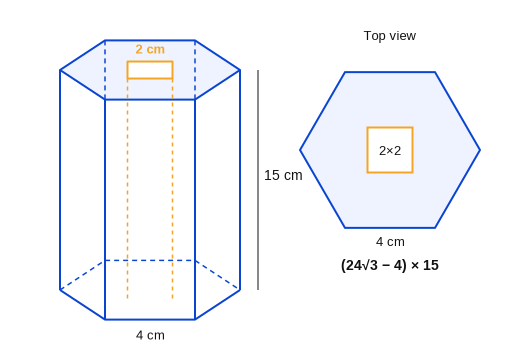
- Hexagon area = .
- Prism volume = .
- Cavity = .
- Remaining = .
Trick: Since the cavity runs the full height: in one step.
Answer: (A)
अवधारणा: बचा आयतन = प्रिज़्म का आयतन − खोखले भाग का आयतन।
- षट्भुज क्षेत्रफल =
- प्रिज़्म आयतन =
- खोखला भाग =
- बचा =
ट्रिक: छेद पूरी ऊँचाई में है: ।
उत्तर: (A)
SSC CHSL Tier-1Quantitative AptitudeMensuration – hexagonal prism with cavitySSC CHSL Tier-1 2025 · 15 Nov Shift 3
Q3949.A glass manufacturer produces transparent right prism blocks with a square base of side 12 cm and height 30 cm . If the selling price is ₹ 0.80 per and the cost price is ₹0.50 per , what is the total profit earned on selling 20 such prisms?
एक काँच निर्माता 12 cm भुजा वाले वर्गाकार आधार तथा 30 cm ऊँचाई वाले पारदर्शी लंब प्रिज़्म खंड बनाता है। यदि विक्रय मूल्य ₹0.80 प्रति है और क्रय मूल्य ₹0.50 प्रति है, तो ऐसे 20 प्रिज़्म बेचने पर कुल कितना लाभ होगा?
- A₹15400
- B₹16000
- C₹18500
- D₹25920
Show answer
Concept: .
- Volume of one prism = .
- Profit per cm³ = ₹0.30.
- Total = ₹25920.
Trick: Combine the small numbers first: , then .
Answer: (D) ₹25920
अवधारणा: ।
- एक प्रिज़्म का आयतन =
- प्रति cm³ लाभ = ₹0.30
- कुल = ₹25920
ट्रिक: पहले छोटी संख्याएँ मिलाएँ: , फिर ।
उत्तर: (D) ₹25920
SSC CHSL Tier-1Quantitative AptitudeVolume and profit – square prismSSC CHSL Tier-1 2025 · 15 Nov Shift 3
Q3950.A and B invest ₹40,000 and ₹30,000 respectively. After 8 months, A withdraws all of his capital. At the end of the year, what is their profit-sharing?
A और B क्रमशः ₹40,000 और ₹30,000 निवेश करते हैं। 8 महीने बाद A अपनी संपूर्ण पूँजी निकाल लेता है। वर्ष के अंत में उनका लाभ-विभाजन क्या होगा?
- A
- B8 : 7
- C
- D8 : 9
Show answer
Concept: Profit ratio = capital × months each capital stayed.
- A: .
- B: .
- Ratio = 32 : 36 = 8 : 9.
Trick: Cancel common zeros first: .
Answer: (D) 8 : 9
अवधारणा: लाभ का अनुपात = पूँजी × जितने महीने पूँजी लगी रही।
- A:
- B:
- अनुपात = 32 : 36 = 8 : 9
ट्रिक: पहले शून्य हटाएँ: ।
उत्तर: (D) 8 : 9
SSC CHSL Tier-1Quantitative AptitudePartnership – withdrawal of capitalSSC CHSL Tier-1 2025 · 15 Nov Shift 3
Q3951.A started a business with ₹50,000. B joined after 6 months with ₹20,000. At the end of the year, what is their profit-sharing ratio?
A ने ₹50,000 से एक व्यवसाय आरंभ किया। B, 6 महीने बाद ₹20,000 के साथ इसमें सम्मिलित हुआ। वर्ष के अंत में उनका लाभ-विभाजन अनुपात क्या होगा?
- A
- B
- C
- D
Show answer
Concept: Multiply each capital by the months it was invested.
- A: .
- B joins after 6 months → .
- Ratio = 6 : 1.2 = 5 : 1.
Trick: In thousands: .
Answer: (A)
अवधारणा: हर पूँजी को उतने महीनों से गुणा करें जितने वह लगी रही।
- A:
- B 6 महीने बाद जुड़ा →
- अनुपात = 600 : 120 = 5 : 1
ट्रिक: हज़ार में सोचें: ।
उत्तर: (A)
SSC CHSL Tier-1Quantitative AptitudePartnership – partner joins laterSSC CHSL Tier-1 2025 · 15 Nov Shift 3
Q3952.A sphere and a cone have the same base radius and the same height. What is the ratio of their volumes (sphere : cone) ?
एक गोले और एक शंकु के आधार की त्रिज्या तथा ऊँचाई समान हैं। उनके आयतनों का अनुपात (गोला : शंकु) क्या है?
- A1 : 3
- B1 : 2
- C2 : 1
- D3 : 1
Show answer
Concept: Height of a sphere = its diameter = 2r, so the cone also has .
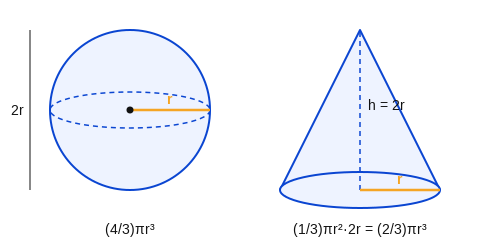
- Sphere = .
- Cone = .
- Ratio = 2 : 1.
Trick: Same r and : cone : sphere : cylinder = 1 : 2 : 3 (Archimedes' ratio).
Answer: (C) 2 : 1
अवधारणा: गोले की ऊँचाई = व्यास = 2r, इसलिए शंकु की ऊँचाई भी 2r।
- गोला =
- शंकु =
- अनुपात = 2 : 1
ट्रिक: समान r और पर शंकु : गोला : बेलन = 1 : 2 : 3 (आर्किमिडीज़ का अनुपात)।
उत्तर: (C) 2 : 1
SSC CHSL Tier-1Quantitative AptitudeVolume ratio – sphere and coneSSC CHSL Tier-1 2025 · 15 Nov Shift 3
Q3953.The point of intersection of the perpendicular bisectors of the three sides of a triangle is called:
किसी त्रिभुज की तीनों भुजाओं के लंब समद्विभाजकों का प्रतिच्छेद बिंदु कहलाता है:
- AIncenterअंतःकेंद्र
- BCircumcenterपरिकेंद्र
- CCentroidकेंद्रक
- DOrthocenterलंबकेंद्र
Show answer
Concept: Perpendicular bisectors meet at the point equidistant from all three vertices.
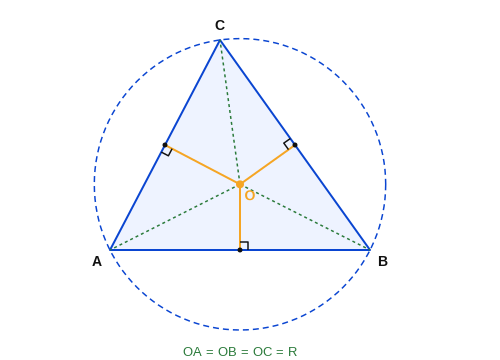
- That point is the centre of the circle through A, B, C → circumcentre.
- Incentre – angle bisectors; centroid – medians; orthocentre – altitudes.
Trick: Pairs: Bisector of Angle → Incentre; Perpendicular bisector → Circumcentre; Median → Centroid; Altitude → Orthocentre.
Answer: (B) Circumcenter
अवधारणा: भुजाओं के लंब समद्विभाजक उस बिंदु पर मिलते हैं जो तीनों शीर्षों से समान दूरी पर है।
- वह बिंदु A, B, C से होकर जाने वाले वृत्त का केंद्र है → परिकेंद्र
- अंतःकेंद्र – कोण समद्विभाजक; केंद्रक – माध्यिकाएँ; लंबकेंद्र – शीर्षलंब।
ट्रिक: कोण समद्विभाजक → अंतःकेंद्र; लंब समद्विभाजक → परिकेंद्र; माध्यिका → केंद्रक; शीर्षलंब → लंबकेंद्र।
उत्तर: (B) परिकेंद्र
SSC CHSL Tier-1Quantitative AptitudeTriangle centres – circumcentreSSC CHSL Tier-1 2025 · 15 Nov Shift 3
Q3954.If a sphere is inscribed in a cylinder with the same radius and height, what is the ratio of the volume of the sphere to the volume of the cylinder?
यदि किसी बेलन में समान त्रिज्या और ऊँचाई वाला एक गोला अंतर्निहित है, तो गोले के आयतन और बेलन के आयतन का अनुपात क्या होगा?
- A
- B
- C3 : 2
- D1 : 3
Show answer
Concept: A sphere fitting exactly in a cylinder gives cylinder radius r and height 2r.
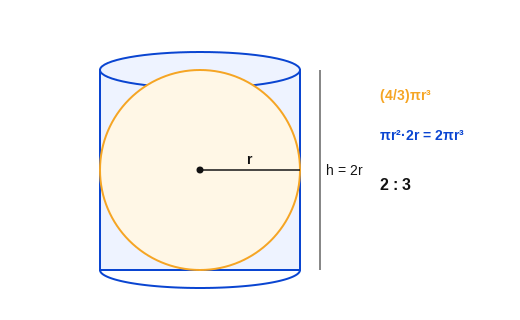
- Sphere = .
- Cylinder = .
- Ratio = 2 : 3.
Trick: Use the 1 : 2 : 3 rule (cone : sphere : cylinder) → sphere : cylinder = 2 : 3 instantly.
Answer: (A)
अवधारणा: बेलन में ठीक फिट गोला → बेलन की त्रिज्या r और ऊँचाई 2r।
- गोला =
- बेलन =
- अनुपात = 2 : 3
ट्रिक: 1 : 2 : 3 नियम (शंकु : गोला : बेलन) से सीधे गोला : बेलन = 2 : 3।
उत्तर: (A)
SSC CHSL Tier-1Quantitative AptitudeVolume ratio – sphere in a cylinderSSC CHSL Tier-1 2025 · 15 Nov Shift 3
Q3955.If ' x ' and ' y ' = , then find the value of .
यदि ' x ' और ' y ' = है, तो का मान ज्ञात कीजिए।
- A1250
- B1150
- C1350
- D1160
Show answer
Concept: .
- Cross terms cancel on adding.
- .
- 1250.
Trick: Put : → – answer in seconds.
Answer: (A) 1250
अवधारणा:
- जोड़ने पर वाले पद कट जाते हैं।
- 1250
ट्रिक: रखें: → – तुरंत उत्तर।
उत्तर: (A) 1250
SSC CHSL Tier-1Quantitative AptitudeTrigonometry – sum of squares identitySSC CHSL Tier-1 2025 · 15 Nov Shift 3
Q3956.The ratio of the two angles of a triangle is , respectively. If the third angle of the triangle is more than the sum of the given two angles of the triangle, then find the largest angle of the triangle.
किसी त्रिभुज के दो कोणों का अनुपात क्रमशः है। यदि त्रिभुज का तीसरा कोण दिए गए इन दोनों कोणों के योग से अधिक है, तो त्रिभुज का सबसे बड़ा कोण ज्ञात कीजिए।
- A108°
- B110*
- C120*
- D100°
Show answer
Concept: Angle sum of a triangle = 180°.
- Two angles = x and 3x, sum = 4x.
- Third = .
- ; angles .
- Largest = 108°.
Trick: Third angle is , so it takes .
Answer: (A) 108°
अवधारणा: त्रिभुज के कोणों का योग = 180°।
- दो कोण = x और 3x, योग = 4x
- तीसरा =
- ; कोण
- सबसे बड़ा = 108°
ट्रिक: तीसरा कोण = , यानी ।
उत्तर: (A) 108°
SSC CHSL Tier-1Quantitative AptitudeTriangle – angles in ratioSSC CHSL Tier-1 2025 · 15 Nov Shift 3
Q3957.PQR is a triangle where and .Point S lies on QR such that .
If the perimeter of triangle is 54 cm , find the length of PS.
PQR एक त्रिभुज है जिसमें तथा है। बिंदु S, QR पर इस प्रकार स्थित है कि है।
यदि त्रिभुज का परिमाप 54 cm है, तो PS की लंबाई ज्ञात कीजिए।
- A
- B
- C
- D
Show answer
Concept: For median PS: .
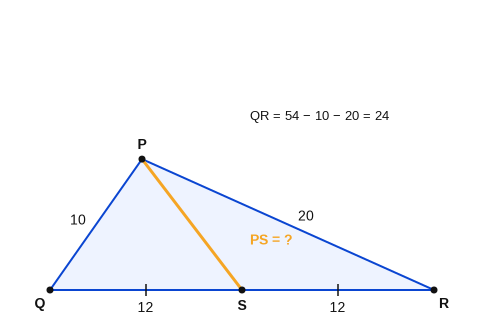
- cm.
- .
- cm.
Trick: Median formula: .
Answer: (D)
अवधारणा: माध्यिका PS के लिए: ।
- cm
- cm
ट्रिक: सूत्र: ।
उत्तर: (D)
SSC CHSL Tier-1Quantitative AptitudeApollonius theorem – median lengthSSC CHSL Tier-1 2025 · 15 Nov Shift 3
Q3958.In , points M and N lie on sides PQ and PR respectively, such that .
If , and , find NR.
में, बिंदु M और N क्रमशः भुजाओं PQ और PR पर इस प्रकार स्थित हैं कि है।
यदि तथा है, तो NR ज्ञात कीजिए।
- A10 cm
- B6 cm
- C8 cm
- D4 cm
Show answer
Concept: A line parallel to one side divides the other two sides in the same ratio.
- .
- 10 cm.
Trick: PM : MQ = 1 : 2, so NR must be – no cross-multiplying needed.
Answer: (A) 10 cm
अवधारणा: एक भुजा के समांतर रेखा बाकी दो भुजाओं को समान अनुपात में बाँटती है।
- 10 cm
ट्रिक: PM : MQ = 1 : 2, इसलिए NR = ।
उत्तर: (A) 10 cm
SSC CHSL Tier-1Quantitative AptitudeBasic proportionality theoremSSC CHSL Tier-1 2025 · 15 Nov Shift 3
Q3959.An alloy contains gold, silver and brass in the ratio and another contains silver, brass and tin in the ratio 3 : 5 : 2. If equal weights of both alloys are melted together to form a third alloy, then the weight of tin per kg in new alloy will be:
एक मिश्रधातु में सोना, चाँदी और पीतल के अनुपात में हैं तथा दूसरी मिश्रधातु में चाँदी, पीतल और टिन 3 : 5 : 2 के अनुपात में हैं। यदि दोनों मिश्रधातुओं के समान भार को एक साथ पिघलाकर तीसरी मिश्रधातु बनाई जाती है, तो नई मिश्रधातु में प्रति kg टिन का भार होगा:
- A0.25 kg
- B0.5 kg
- C0.1 kg
- D0.20 kg
Show answer
Concept: Take 1 kg of each alloy; only the second contains tin.
- Alloy 2: tin = → 0.2 kg in 1 kg.
- Alloy 1 has no tin.
- New alloy = 2 kg with 0.2 kg tin → per kg = 0.1 kg.
Trick: Equal weights mixed → fraction in the new alloy = average of fractions = .
Answer: (C) 0.1 kg
अवधारणा: दोनों मिश्रधातु 1-1 kg लें; टिन केवल दूसरी में है।
- मिश्रधातु 2: टिन = → 1 kg में 0.2 kg
- मिश्रधातु 1 में टिन नहीं।
- नई मिश्रधातु 2 kg, टिन 0.2 kg → प्रति kg = 0.1 kg
ट्रिक: बराबर भार मिलाने पर नया भाग = दोनों भागों का औसत = ।
उत्तर: (C) 0.1 kg
SSC CHSL Tier-1Quantitative AptitudeAlloys – mixing equal weightsSSC CHSL Tier-1 2025 · 15 Nov Shift 3
Q3960.The cost of Type 1 rice is Rs. 32 per kg, and Type 2 rice is Rs. 48 per kg. If both Type 1 and Type 2 are mixed in the ratio of , then the price per kg of the mixed variety of rice is:
टाइप 1 चावल का मूल्य ₹32 प्रति kg है तथा टाइप 2 चावल का मूल्य ₹48 प्रति kg है। यदि टाइप 1 और टाइप 2 दोनों को के अनुपात में मिलाया जाता है, तो मिश्रित किस्म के चावल का प्रति kg मूल्य है:
- A43.4 kg
- B42.5 kg
- C41.6 kg
- D44.8 kg
Show answer
Concept: Mixture price = .
- ₹41.6 per kg.
Trick: Mean price lies closer to the bigger share: .
Answer: (C) 41.6 kg
अवधारणा: मिश्रण मूल्य = ।
- ₹41.6 प्रति kg
ट्रिक: – एक पंक्ति में।
उत्तर: (C) 41.6 kg
SSC CHSL Tier-1Quantitative AptitudeMixture – weighted average priceSSC CHSL Tier-1 2025 · 15 Nov Shift 3

