Q3961.Aman started a juice (sugar syrup
water) counter. Initially, he had 120 liters of juice, which contained 25% water. He sold 24 liters of the juice. Then he added an equal amount of sugar syrup and water. Now the ratio of water to sugar syrup becomes . How much water was added later on?
अमन ने एक जूस (शुगर सिरप
पानी) काउंटर शुरू किया। आरंभ में उसके पास 120 लीटर जूस था, जिसमें 25% पानी था। उसने 24 लीटर जूस बेच दिया। इसके बाद उसने बराबर मात्रा में शुगर सिरप और पानी मिलाया। अब पानी और शुगर सिरप का अनुपात हो जाता है। बाद में कितना पानी मिलाया गया?
- A12 litres12 लीटर
- B30 Litres30 लीटर
- C24 litres24 लीटर
- D20 litres20 लीटर
Show answer
Concept: Selling part of a mixture keeps the ratio; then add equal amounts x.
- Water 25% of 120 = 30 L, syrup 90 L (ratio 1 : 3).
- Selling 24 L leaves 96 L → water 24 L, syrup 72 L.
- 24 L.
Trick: Adding equal amounts keeps the difference same: must equal 1 part of the new 1 : 2 ratio → water = 48 → added 24.
Answer: (C) 24 litres
अवधारणा: मिश्रण का कुछ भाग बेचने पर अनुपात वही रहता है; फिर बराबर मात्रा x मिलाएँ।
- पानी = 120 का 25% = 30 L, सिरप 90 L (1 : 3)।
- 24 L बेचने पर 96 L बचा → पानी 24 L, सिरप 72 L
- 24 L
ट्रिक: बराबर मात्रा मिलाने पर अंतर नहीं बदलता: = नए अनुपात 1 : 2 का 1 भाग → पानी 48 → मिलाया 24।
उत्तर: (C) 24 लीटर
SSC CHSL Tier-1Quantitative AptitudeMixture – sell some, then addSSC CHSL Tier-1 2025 · 15 Nov Shift 3
Q3962.8 liters of lemon syrup is mixed in liters of water. If the syrup is 25% of the mixture, what is the value of ?
8 लीटर लेमन सिरप को लीटर पानी में मिलाया जाता है। यदि सिरप मिश्रण का 25% है, तो का मान क्या है?
- A22 litres22 लीटर
- B24 litres24 लीटर
- C12 litres12 लीटर
- D30 litres30 लीटर
Show answer
Concept: .
- .
- 24 L.
Trick: 25% syrup means syrup : water = 1 : 3 → water = .
Answer: (B) 24 litres
अवधारणा: ।
- 24 L
ट्रिक: 25% सिरप = सिरप : पानी = 1 : 3 → पानी = ।
उत्तर: (B) 24 लीटर
SSC CHSL Tier-1Quantitative AptitudeMixture – percentage of syrupSSC CHSL Tier-1 2025 · 15 Nov Shift 3
Q3963.Ravi can finish a task in 12 days, and Sohan can finish the same task in 18 days. They work together for 4 days. The remaining work was finished by Ravi and Kiran in 4 days. How much time would Kiran alone take to finish the entire work?
रवि एक कार्य को 12 दिनों में तथा सोहन उसी कार्य को 18 दिनों में पूरा कर सकता है। वे 4 दिनों तक एक साथ कार्य करते हैं। शेष कार्य रवि और किरण ने 4 दिनों में पूरा किया। किरण अकेले संपूर्ण कार्य को कितने समय में पूरा करेगी?
- A22 days22 दिन
- B18 days18 दिन
- C36 days36 दिन
- D15 days15 दिन
Show answer
Concept: Take total work = LCM and use per-day units.
- Work = 36 units; Ravi 3/day, Sohan 2/day.
- 4 days together: → left 16.
- Ravi + Kiran = /day → Kiran = 1/day.
- Kiran alone = 36 days.
Trick: LCM-unit method turns every work problem into simple addition and subtraction of daily rates.
Answer: (C) 36 days
अवधारणा: कुल कार्य = LCM मानें और प्रतिदिन इकाइयों से हल करें।
- कार्य = 36 इकाई; रवि 3/दिन, सोहन 2/दिन
- 4 दिन साथ: → बचा 16
- रवि + किरण = /दिन → किरण = 1/दिन
- किरण अकेले = 36 दिन
ट्रिक: LCM इकाई विधि से हर कार्य प्रश्न केवल दैनिक दर के जोड़-घटाव में बदल जाता है।
उत्तर: (C) 36 दिन
SSC CHSL Tier-1Quantitative AptitudeTime and work – replacing a workerSSC CHSL Tier-1 2025 · 15 Nov Shift 3
Q3964.X can do a certain work in the same time that Y and Z together can do it. If X and Y together can complete the work in 12 days and Z alone can complete it in 36 days, then X alone can complete the work in:
X किसी कार्य को उतने ही समय में कर सकता है जितने समय में Y और Z मिलकर उसे कर सकते हैं। यदि X और Y मिलकर उस कार्य को 12 दिनों में पूरा कर सकते हैं तथा Z अकेला उसे 36 दिनों में पूरा कर सकता है, तो X अकेला उस कार्य को कितने दिनों में पूरा कर सकता है:
- A18 days18 दिन
- B16 days16 दिन
- C15 days15 दिन
- D14 days14 दिन
Show answer
Concept: Let work = 36 units and use efficiencies.
- X + Y = /day; Z = /day.
- .
- /day.
- X alone = 18 days.
Trick: When , all three together , so X's rate = half of the total rate.
Answer: (A) 18 days
अवधारणा: कुल कार्य = 36 इकाई मानें, क्षमता से हल करें।
- X + Y = /दिन; Z = /दिन
- /दिन
- X अकेले = 18 दिन
ट्रिक: जब हो, तो तीनों मिलकर , यानी X की दर = कुल दर का आधा।
उत्तर: (A) 18 दिन
SSC CHSL Tier-1Quantitative AptitudeTime and work – X equals Y + ZSSC CHSL Tier-1 2025 · 15 Nov Shift 3
Q3965.P can finish a work in 20 days, and Q can finish the same work in 15 days.Q worked for 6 days and then left the job. In how many days can alone finish the remaining work?
P एक कार्य को 20 दिनों में तथा Q उसी कार्य को 15 दिनों में पूरा कर सकता है। Q ने 6 दिनों तक कार्य किया और फिर कार्य छोड़ दिया। अकेला शेष कार्य को कितने दिनों में पूरा कर सकता है?
- A15 days15 दिन
- B12 days12 दिन
- C8 days8 दिन
- D6 days6 दिन
Show answer
Concept: Work done by Q is subtracted; P finishes the rest.
- Work = 60 units; P = 3/day, Q = 4/day.
- Q in 6 days = 24 → left 36.
- P alone = 12 days.
Trick: Fraction way: Q does , so is left; P needs days.
Answer: (B) 12 days
अवधारणा: Q द्वारा किया कार्य घटाएँ; शेष P पूरा करता है।
- कार्य = 60 इकाई; P = 3/दिन, Q = 4/दिन
- Q 6 दिन में = 24 → बचा 36
- P अकेले = 12 दिन
ट्रिक: भिन्न से: Q ने किया, बचा ; P को दिन।
उत्तर: (B) 12 दिन
SSC CHSL Tier-1Quantitative AptitudeTime and work – remaining workSSC CHSL Tier-1 2025 · 15 Nov Shift 3
Q3966.A rectangular tile having a perimeter of 200 cm has been used to pave a floor of length and breadth 32.4 m and 19.6 m , respectively. If the ratio of length to breadth of each tile is , then find the number of tiles required to pave the floor completely.
200 cm परिमाप वाली एक आयताकार टाइल का उपयोग क्रमशः 32.4 m लंबाई और 19.6 m चौड़ाई वाले फर्श पर टाइल लगाने के लिए किया गया है। यदि प्रत्येक टाइल की लंबाई और चौड़ाई का अनुपात है, तो फर्श को पूरी तरह से ढकने के लिए आवश्यक टाइलों की संख्या ज्ञात कीजिए।
- A1896
- B2544
- C1676
- D2646
Show answer
Concept: Number of tiles = floor area ÷ tile area (same units).
- , l : b = 3 : 2 → tile 60 cm × 40 cm.
- Floor = 3240 cm × 1960 cm.
- Tiles = 2646.
Trick: Divide side by side instead of multiplying big areas: and .
Answer: (D) 2646
अवधारणा: टाइलों की संख्या = फर्श का क्षेत्रफल ÷ टाइल का क्षेत्रफल (एक ही इकाई में)।
- , l : b = 3 : 2 → टाइल 60 cm × 40 cm
- फर्श = 3240 cm × 1960 cm
- टाइलें = 2646
ट्रिक: बड़े क्षेत्रफल गुणा करने के बजाय भुजा-भुजा से भाग दें: ।
उत्तर: (D) 2646
SSC CHSL Tier-1Quantitative AptitudeArea – number of tilesSSC CHSL Tier-1 2025 · 15 Nov Shift 3
Q3967.The curved surface area of a cylindrical pillar is and its volume is . The ratio between its radius and height is .
एक बेलनाकार खंभे का वक्र पृष्ठीय क्षेत्रफल है तथा उसका आयतन है। उसकी त्रिज्या और ऊँचाई का अनुपात है।
- A9 : 10
- B
- C7:3
- D
Show answer
Concept: Volume ÷ CSA = .
- m.
- m.
- r : h = 7 : 12.
Trick: Remember – it gives the radius in one division.
Answer: (B)
अवधारणा: आयतन ÷ CSA = ।
- m
- m
- r : h = 7 : 12
ट्रिक: याद रखें – एक भाग से त्रिज्या मिल जाती है।
उत्तर: (B)
SSC CHSL Tier-1Quantitative AptitudeCylinder – radius and height from CSA and volumeSSC CHSL Tier-1 2025 · 15 Nov Shift 3
Q3968.Two circles and have radii 4 and 5 units, and their centers are 15 units apart. Then the number of common tangents they have is:
दो वृत्तों और की त्रिज्याएँ 4 और 5 इकाई हैं तथा उनके केंद्रों के बीच की दूरी 15 इकाई है। तब उनकी उभयनिष्ठ स्पर्श रेखाओं की संख्या है:
- A4
- B3
- C2
- D1
Show answer
Concept: Compare distance between centres d with r₁ + r₂ and |r₁ − r₂|.
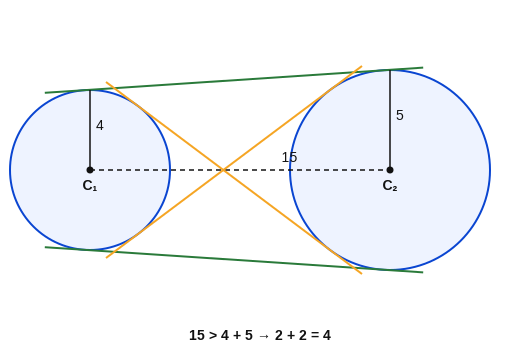
- r₁ + r₂ = 9, d = 15 → d > r₁ + r₂.
- Circles are separate (no touching) → 2 direct + 2 transverse = 4.
Trick: d > sum → 4; d = sum → 3; between → 2; d = difference → 1; d < difference → 0.
Answer: (A) 4
अवधारणा: केंद्रों की दूरी d की तुलना r₁ + r₂ और |r₁ − r₂| से करें।
- r₁ + r₂ = 9, d = 15 → d > r₁ + r₂
- वृत्त पूरी तरह अलग → 2 सीधी + 2 तिर्यक = 4
ट्रिक: d > योग → 4; d = योग → 3; बीच में → 2; d = अंतर → 1; d < अंतर → 0।
उत्तर: (A) 4
SSC CHSL Tier-1Quantitative AptitudeCircles – number of common tangentsSSC CHSL Tier-1 2025 · 15 Nov Shift 3
Q3969.One of the angles of a quadrilateral is . If the ratio of the remaining angles of a quadrilateral is , respectively, then find the difference between the smallest and largest angles.
एक चतुर्भुज का एक कोण है। यदि चतुर्भुज के शेष कोणों का अनुपात क्रमशः है, तो सबसे छोटे और सबसे बड़े कोण के बीच का अंतर ज्ञात कीजिए।
- A36°
- B50°
- C57°
- D26°
Show answer
Concept: Angle sum of a quadrilateral = 360°.
- Remaining = 360° − 94° = 266° = 14 parts → 1 part = 19°.
- Angles: 114°, 95°, 57° (and 94°).
- Largest − smallest = 114° − 57° = 57°.
Trick: Check the given 94° too – it is neither largest nor smallest here, so the answer is (6 − 3) × 19 = 57°.
Answer: (C) 57°
अवधारणा: चतुर्भुज के कोणों का योग = 360°।
- शेष = 360° − 94° = 266° = 14 भाग → 1 भाग = 19°
- कोण: 114°, 95°, 57° (और 94°)
- सबसे बड़ा − सबसे छोटा = 114° − 57° = 57°
ट्रिक: दिया गया 94° भी जाँचें – यहाँ वह न सबसे बड़ा है न सबसे छोटा, इसलिए (6 − 3) × 19 = 57°।
उत्तर: (C) 57°
SSC CHSL Tier-1Quantitative AptitudeQuadrilateral – angles in ratioSSC CHSL Tier-1 2025 · 15 Nov Shift 3
Q3970.If the graph of a linear equation passes through and has a slope 5 , what is its equation?
यदि किसी रैखिक समीकरण का आलेख से होकर जाता है तथा उसकी प्रवणता (slope) 5 है, तो उसका समीकरण क्या है?
- A
- B
- C
- D
Show answer
Concept: Point-slope form: y − y₁ = m(x − x₁).
- y − 3 = 5(x − 2) → y = 5x − 10 + 3.
- y = 5x − 7.
Trick: Slope 5 removes the '−5x' options; then put x = 2: 5(2) − 7 = 3 ✓ while 5(2) + 7 = 17 ✗.
Answer: (A)
अवधारणा: बिंदु-ढाल रूप: y − y₁ = m(x − x₁)।
- y − 3 = 5(x − 2) → y = 5x − 10 + 3
- y = 5x − 7
ट्रिक: ढाल 5 है, तो '−5x' वाले विकल्प हटें; x = 2 रखें: 5(2) − 7 = 3 ✓।
उत्तर: (A)
SSC CHSL Tier-1Quantitative AptitudeCoordinate geometry – line from point and slopeSSC CHSL Tier-1 2025 · 15 Nov Shift 3
Q3971.P can complete a work in 10 days, Q in 12 days, and R in 15 days. They work in the following manner:
On the 1st day, P works. On the 2nd day, Q works. On the 3rd day, R works. This cycle continues in the same order.In how many days will the work be completed?
P एक कार्य को 10 दिनों में, Q उसे 12 दिनों में तथा R उसे 15 दिनों में पूरा कर सकता है। वे निम्नलिखित प्रकार से कार्य करते हैं:
पहले दिन P कार्य करता है। दूसरे दिन Q कार्य करता है। तीसरे दिन R कार्य करता है। यह चक्र इसी क्रम में चलता रहता है। कार्य कितने दिनों में पूरा होगा?
- A6 days6 दिन
- B9 days9 दिन
- C10 days10 दिन
- D12 days12 दिन
Show answer
Concept: Find work done in one full cycle, then count cycles.
- Work = ; P = 6, Q = 5, R = 4 per day.
- One 3-day cycle = 15 units.
- 4 cycles exactly → 12 days.
Trick: If total ÷ cycle-work is a whole number, no partial-day check is needed – days = cycles × cycle length.
Answer: (D) 12 days
अवधारणा: एक पूरे चक्र का कार्य निकालें, फिर चक्र गिनें।
- कार्य = ; P = 6, Q = 5, R = 4 प्रतिदिन
- 3 दिन के एक चक्र में = 15 इकाई
- पूरे 4 चक्र → 12 दिन
ट्रिक: कुल ÷ चक्र-कार्य पूर्णांक हो तो अधूरे दिन की जाँच ज़रूरी नहीं – दिन = चक्र × चक्र की लंबाई।
उत्तर: (D) 12 दिन
SSC CHSL Tier-1Quantitative AptitudeTime and work – working on alternate daysSSC CHSL Tier-1 2025 · 15 Nov Shift 3
Q3972.During the 7th century, rulers commonly rewarded Brahmanas with which of the following forms of patronage?
7वीं शताब्दी के दौरान, शासक सामान्यतः ब्राह्मणों को निम्नलिखित में से किस रूप में संरक्षण प्रदान करते थे?
- APrecious ornamentsबहुमूल्य आभूषण
- BLand grantsभूमि अनुदान
- CMilitary titlesसैन्य उपाधियाँ
- DTrade privilegesव्यापारिक विशेषाधिकार
Show answer
Concept: Early medieval kings rewarded Brahmanas mainly with land.
- From about the 7th century, rulers gave revenue-free land to Brahmanas, recorded on copper plates.
- Such grants were called brahmadeya (and Brahmana settlements, agrahara).
- Ornaments, titles or trade rights were not the standard form of this patronage.
Yaad rakhein: Copper-plate inscriptions are a major source for these grants – they record the village, boundaries and taxes given up.
Answer: (B) Land grants
अवधारणा: पूर्व मध्यकाल में राजा ब्राह्मणों को मुख्यतः भूमि देकर संरक्षण देते थे।
- लगभग 7वीं शताब्दी से कर-मुक्त भूमि दान दी जाती थी, जो ताम्रपत्रों पर अंकित होती थी।
- इसे ब्रह्मदेय कहा जाता था; ब्राह्मण बस्ती को अग्रहार।
- आभूषण, सैन्य उपाधि या व्यापार अधिकार इस संरक्षण का सामान्य रूप नहीं थे।
याद रखें: इन दानों का मुख्य स्रोत ताम्रपत्र अभिलेख हैं – इनमें गाँव, सीमा और छोड़े गए कर लिखे होते थे।
उत्तर: (B) भूमि अनुदान
SSC CHSL Tier-1General AwarenessEarly medieval India – land grants to BrahmanasSSC CHSL Tier-1 2025 · 15 Nov Shift 3
Q3973.In the early 16th century, which ruler became famous for the successful battlefield use of artillery (cannons) in India ?
16वीं शताब्दी के प्रारंभ में, कौन-सा शासक भारत में युद्धभूमि पर तोपखाने (तोपों) के सफल प्रयोग के लिए प्रसिद्ध हुआ?
- ARana Sangaराणा सांगा
- BBaburबाबर
- CSikandar Lodiसिकंदर लोदी
- DHumayunहुमायूँ
Show answer
Concept: Babur introduced effective field artillery in Indian warfare.
- First Battle of Panipat, 1526: Babur defeated Ibrahim Lodi using cannons and matchlocks with the Tulughma tactic.
- He used artillery again at Khanwa (1527) against Rana Sanga.
- Humayun came later; Sikandar Lodi and Rana Sanga did not rely on cannons.
Yaad rakhein: Babur's gunners: Ustad Ali Quli and Mustafa – remember 'Panipat 1526 = guns arrive'.
Answer: (B) Babur
अवधारणा: बाबर ने भारतीय युद्ध में तोपखाने का सफल प्रयोग किया।
- पानीपत का पहला युद्ध (1526): तोप, बंदूक और तुलुगमा नीति से इब्राहिम लोदी को हराया।
- खानवा (1527) में राणा सांगा के विरुद्ध भी तोपखाने का उपयोग।
- हुमायूँ बाद में आया; सिकंदर लोदी और राणा सांगा तोपों पर निर्भर नहीं थे।
याद रखें: बाबर के तोपची: उस्ताद अली कुली और मुस्तफ़ा – 'पानीपत 1526 = तोपों का आगमन'।
उत्तर: (B) बाबर
SSC CHSL Tier-1General AwarenessMughal history – Babur's artillerySSC CHSL Tier-1 2025 · 15 Nov Shift 3
Q3974.The Petrapole-Benapole rail link serves as an important cross-border railway connection between two nations?
पेट्रापोल-बेनापोल रेल संपर्क किन दो देशों के बीच एक महत्वपूर्ण सीमा-पार रेलवे संपर्क के रूप में कार्य करता है?
- AIndia and Sri Lankaभारत और श्रीलंका
- BIndia and Pakistanभारत और पाकिस्तान
- CIndia and Bangladeshभारत और बांग्लादेश
- DIndia and Nepalभारत और नेपाल
Show answer
Concept: Petrapole is in West Bengal; Benapole is across the border in Bangladesh.
- So the rail link connects India and Bangladesh.
- Petrapole–Benapole is also the busiest land port on this border.
- India–Pakistan rail crossing is at Attari–Wagah; Sri Lanka has no land/rail link.
Yaad rakhein: Other India–Bangladesh rail links: Gede–Darshana, Agartala–Akhaura, Haldibari–Chilahati.
Answer: (C) India and Bangladesh
अवधारणा: पेट्रापोल पश्चिम बंगाल में है, बेनापोल सीमा पार बांग्लादेश में।
- अतः यह रेल लिंक भारत और बांग्लादेश को जोड़ता है।
- यह इस सीमा का सबसे व्यस्त स्थलीय बंदरगाह भी है।
- भारत–पाकिस्तान रेल मार्ग अटारी–वाघा पर है; श्रीलंका से स्थल/रेल संपर्क नहीं है।
याद रखें: अन्य भारत–बांग्लादेश रेल लिंक: गेदे–दर्शना, अगरतला–अखौरा, हल्दीबाड़ी–चिलाहाटी।
उत्तर: (C) भारत और बांग्लादेश
SSC CHSL Tier-1General AwarenessCross-border links – Petrapole-BenapoleSSC CHSL Tier-1 2025 · 15 Nov Shift 3
Q3975.India's first high-speed rail (bullet train) project between Mumbai and Ahmedabad is being developed with technical and financial support from which country?
मुंबई और अहमदाबाद के बीच भारत की पहली हाई-स्पीड रेल (बुलेट ट्रेन) परियोजना किस देश की तकनीकी और वित्तीय सहायता से विकसित की जा रही है?
- AGermanyजर्मनी
- BSouth Koreaदक्षिण कोरिया
- CJapanजापान
- DSpainस्पेन
Show answer
Concept: India's first high-speed rail is built with Japanese help.
- Technology: Japan's Shinkansen system.
- Funding: soft loan from JICA (Japan International Cooperation Agency).
- Executing agency: National High Speed Rail Corporation Ltd (NHSRCL).
Trick: Shinkansen + JICA = Japan – the two keywords answer any bullet-train question.
Answer: (C) Japan
अवधारणा: भारत की पहली हाई-स्पीड रेल जापान की सहायता से बन रही है।
- तकनीक: जापान की शिंकानसेन प्रणाली।
- वित्त: JICA (जापान अंतरराष्ट्रीय सहयोग एजेंसी) का सस्ता ऋण।
- क्रियान्वयन: नेशनल हाई स्पीड रेल कॉरपोरेशन लिमिटेड (NHSRCL)।
ट्रिक: शिंकानसेन + JICA = जापान – बुलेट ट्रेन के हर प्रश्न का संकेत।
उत्तर: (C) जापान
SSC CHSL Tier-1General AwarenessInfrastructure – Mumbai-Ahmedabad bullet trainSSC CHSL Tier-1 2025 · 15 Nov Shift 3
Q3976.Which Indian scientist became the first woman to receive a Doctor of Science (DSc) degree from an Indian university (University of Calcutta) in 1944?
कौन-सी भारतीय वैज्ञानिक 1944 में किसी भारतीय विश्वविद्यालय (कलकत्ता विश्वविद्यालय) से डॉक्टर ऑफ साइंस (DSc) की उपाधि प्राप्त करने वाली पहली महिला बनीं?
- AAsima Chatterjeeअसीमा चटर्जी
- BAnna Maniअन्ना मणि
- CJanaki Ammalजानकी अम्मल
- DE. K. Janakiई. के. जानकी
Show answer
Concept: First Indian woman awarded a DSc by an Indian university (Calcutta, 1944).
- Asima Chatterjee was an organic chemist known for work on vinca alkaloids and medicinal plants.
- Her research led to the anti-epileptic drug Ayush-56.
- Anna Mani – meteorology; Janaki Ammal (E. K. Janaki Ammal) – botany; options C and D are the same person.
Yaad rakhein: In 1975 she became the first woman to head the Indian Science Congress Association as its President.
Answer: (A) Asima Chatterjee
अवधारणा: किसी भारतीय विश्वविद्यालय (कलकत्ता, 1944) से DSc पाने वाली पहली भारतीय महिला।
- असीमा चटर्जी कार्बनिक रसायनज्ञ थीं – विंका एल्कलॉइड और औषधीय पौधों पर काम।
- उनके शोध से मिर्गी-रोधी दवा आयुष-56 बनी।
- अन्ना मणि – मौसम विज्ञान; जानकी अम्मल (ई. के. जानकी अम्मल) – वनस्पति विज्ञान; C और D एक ही व्यक्ति हैं।
याद रखें: असीमा चटर्जी 1975 में भारतीय विज्ञान कांग्रेस की पहली महिला अध्यक्ष भी बनीं।
उत्तर: (A) असीमा चटर्जी
SSC CHSL Tier-1General AwarenessIndian scientists – Asima ChatterjeeSSC CHSL Tier-1 2025 · 15 Nov Shift 3
Q3977.Who held the office of Prime Minister of India during the period 1991 to 1996, a phase known for major economic reforms?
1991 से 1996 की अवधि में भारत के प्रधानमंत्री पद पर कौन आसीन थे, जो बड़े आर्थिक सुधारों के लिए जाना जाने वाला दौर था?
- AMorarji Desaiमोरारजी देसाई
- BIndira Gandhiइंदिरा गांधी
- CAtal Bihari Vajpayeeअटल बिहारी वाजपेयी
- DP. V. Narasimha Raoपी. वी. नरसिम्हा राव
Show answer
Concept: The 1991 LPG reforms came under P. V. Narasimha Rao.
- He was PM from June 1991 to May 1996, with Manmohan Singh as Finance Minister.
- His government launched liberalisation, privatisation and globalisation.
- Morarji Desai (1977–79), Indira Gandhi (till 1984), Vajpayee (1996, 1998–2004) – other periods.
Yaad rakhein: 73rd and 74th Amendments (1992, Panchayats and Municipalities) also came during Rao's tenure.
Answer: (D) P. V. Narasimha Rao
अवधारणा: 1991 के LPG सुधार पी. वी. नरसिम्हा राव के समय हुए।
- वे जून 1991 से मई 1996 तक प्रधानमंत्री रहे; वित्त मंत्री मनमोहन सिंह थे।
- उदारीकरण, निजीकरण और वैश्वीकरण की नीति शुरू हुई।
- मोरारजी देसाई (1977–79), इंदिरा गांधी (1984 तक), वाजपेयी (1996, 1998–2004) – अन्य अवधि।
याद रखें: 73वाँ और 74वाँ संशोधन (1992 – पंचायत व नगरपालिका) भी राव के कार्यकाल में आया।
उत्तर: (D) पी. वी. नरसिम्हा राव
SSC CHSL Tier-1General AwarenessIndian polity – PM during 1991 reformsSSC CHSL Tier-1 2025 · 15 Nov Shift 3
Q3978.In 2025, Pusapati Ashok Gajapathi Raju was sworn in as the Governor of which Indian state?
2025 में पुसापति अशोक गजपति राजू ने किस भारतीय राज्य के राज्यपाल के रूप में शपथ ली?
- AKeralaकेरल
- BGoaगोवा
- CKarnatakaकर्नाटक
- DHaryanaहरियाणा
Show answer
Concept: Ashok Gajapathi Raju became Governor of Goa in July 2025.
- He is a senior TDP leader from Vizianagaram (Andhra Pradesh) and a former Union Civil Aviation Minister.
- In the same reshuffle, Rajendra Arlekar moved to Kerala and Ashim Kumar Ghosh became Governor of Haryana.
Yaad rakhein: Governors are appointed by the President under Article 155 and hold office during the President's pleasure (Art. 156).
Answer: (B) Goa
अवधारणा: अशोक गजपति राजू जुलाई 2025 में गोवा के राज्यपाल बने।
- वे आंध्र प्रदेश के विजयनगरम से TDP के वरिष्ठ नेता और पूर्व केंद्रीय नागर विमानन मंत्री हैं।
- उसी फेरबदल में राजेंद्र आर्लेकर केरल और असीम कुमार घोष हरियाणा के राज्यपाल बने।
याद रखें: राज्यपाल की नियुक्ति राष्ट्रपति करते हैं (अनुच्छेद 155) और वे राष्ट्रपति के प्रसादपर्यंत पद पर रहते हैं (अनु. 156)।
उत्तर: (B) गोवा
SSC CHSL Tier-1General AwarenessCurrent affairs – Governor of Goa 2025SSC CHSL Tier-1 2025 · 15 Nov Shift 3
Q3979.The Bharatiya Nagrik Suraksha Sanhita (BNSS), 2023, which replaced the Code of Criminal Procedure, contains how many total sections?
भारतीय नागरिक सुरक्षा संहिता (BNSS), 2023, जिसने दंड प्रक्रिया संहिता का स्थान लिया, में कुल कितनी धाराएँ हैं?
- A475
- B498
- C531
- D600
Show answer
Concept: BNSS 2023 replaced the CrPC 1973.
- BNSS has 531 sections (old CrPC had 484).
- All three new laws came into force on 1 July 2024.
Trick: Section counts: BNS 358 (replaced IPC), BNSS 531 (replaced CrPC), BSA 170 (replaced Evidence Act).
Answer: (C) 531
अवधारणा: BNSS 2023 ने दंड प्रक्रिया संहिता (CrPC) 1973 का स्थान लिया।
- BNSS में 531 धाराएँ हैं (पुरानी CrPC में 484)।
- तीनों नए कानून 1 जुलाई 2024 से लागू हुए।
ट्रिक: धाराएँ याद रखें: BNS 358 (IPC की जगह), BNSS 531 (CrPC की जगह), BSA 170 (साक्ष्य अधिनियम की जगह)।
उत्तर: (C) 531
SSC CHSL Tier-1General AwarenessNew criminal laws – BNSS 2023SSC CHSL Tier-1 2025 · 15 Nov Shift 3
Q3980.The centrally sponsored initiative "ULLAS", highlighted in 2024, primarily focuses on which sector?
वर्ष 2024 में चर्चा में रही केंद्र प्रायोजित पहल "ULLAS" मुख्य रूप से किस क्षेत्र पर केंद्रित है?
- ARural infrastructure developmentग्रामीण अवसंरचना विकास
- BRenewable energy promotionनवीकरणीय ऊर्जा संवर्धन
- CEducationशिक्षा
- DAnimal healthcare servicesपशु स्वास्थ्य सेवाएँ
Show answer
Concept: ULLAS = Understanding of Lifelong Learning for All in Society.
- It is the Education Ministry's adult literacy scheme (Nav Bharat Saksharta Karyakram) → education sector.
- Targets non-literate adults aged 15+ with foundational literacy, numeracy and life skills.
Yaad rakhein: ULLAS follows NEP 2020; the slogan of the programme is 'Jan Jan Saakshar'.
Answer: (C) Education
अवधारणा: ULLAS = Understanding of Lifelong Learning for All in Society।
- यह शिक्षा मंत्रालय का नव भारत साक्षरता कार्यक्रम है → शिक्षा क्षेत्र।
- 15 वर्ष से अधिक आयु के निरक्षरों को बुनियादी साक्षरता, संख्या ज्ञान और जीवन कौशल।
याद रखें: ULLAS राष्ट्रीय शिक्षा नीति 2020 पर आधारित है; इसका नारा 'जन जन साक्षर' है।
उत्तर: (C) शिक्षा
SSC CHSL Tier-1General AwarenessGovernment schemes – ULLASSSC CHSL Tier-1 2025 · 15 Nov Shift 3

