Q3121.Choose the correct passive voice transformation of the sentence: The archaeologists claimed to have discovered an ancient city beneath the desert sands.
- AAn ancient city was claimed to have been discovered by the archaeologists beneath the desert sands.
- BIt was claimed by the archaeologists that an ancient city was discovered beneath the desert sands.
- CThe archaeologists claimed that an ancient city had been discovered beneath the desert by them.
- DAn ancient city claimed to be discovered by the archaeologists beneath the desert sands.
Show answer
Concept: claim/say + to have + V3: both verbs turn passive.
- Object 'an ancient city' becomes the subject.
- claimed → was claimed; to have discovered → to have been discovered.
- (B) loses the perfect infinitive, (C) stays active, (D) has no 'was'.
Trick: 'to have + V3' in active = 'to have been + V3' in passive.
Answer: (A) An ancient city was claimed to have been discovered by the archaeologists beneath the desert sands.
अवधारणा: claim/say + to have + V3 वाले वाक्य में दोनों क्रियाएँ passive बनती हैं।
हल:
- कर्म 'an ancient city' कर्ता बनेगा।
- claimed → was claimed; to have discovered → to have been discovered।
- (B) में perfect infinitive गायब, (C) active ही है, (D) में 'was' नहीं है।
ट्रिक: Active में 'to have + V3' = passive में 'to have been + V3'।
उत्तर: (A) An ancient city was claimed to have been discovered by the archaeologists beneath the desert sands.
SSC CHSLEnglish LanguagePassive voice – perfect infinitiveSSC CHSL 2025 · 19 Nov Shift 2
Q3122.Select the option that expresses the given sentence in direct voice. He asked her if she had visited the museum that had opened the previous month, and whether she felt it was larger than the gallery they had been visiting for years.
- A"Have you visited the museum that opened last month, and whether you felt it is larger than the gallery they had been visiting for years?" he asked her.
- B"Had you visited the museum that opened the previous month, and did you feel it was larger than the gallery we had been visiting for years?" he asked her.
- C"Did you visit the museum that had opened last month, and do you feel it was larger than the gallery we have been visiting for years?' he asked her.
- D"Have you visited the museum that opened last month, and do you feel it is larger than the gallery we have been visiting for years?' he asked her.
Show answer
Concept: Reverse the back-shift of tense, pronouns and time words.
- had visited → have you visited; had opened → opened; previous month → last month.
- felt → do you feel; was → is; had been visiting → have been visiting; they → we.
- Only option (D) makes all the changes.
Trick: Look for 'last month' + 'we' + present tense together – that removes A, B, C fast.
Answer: (D) "Have you visited the museum that opened last month, and do you feel it is larger than the gallery we have been visiting for years?' he asked her.
अवधारणा: काल, सर्वनाम और समय-शब्दों का बदलाव उल्टा करें।
हल:
- had visited → have you visited; had opened → opened; previous month → last month।
- felt → do you feel; was → is; had been visiting → have been visiting; they → we।
- सारे बदलाव केवल विकल्प (D) में हैं।
ट्रिक: 'last month' + 'we' + वर्तमान काल – तीनों एक साथ देखें, A, B, C तुरंत हटेंगे।
उत्तर: (D) "Have you visited the museum that opened last month, and do you feel it is larger than the gallery we have been visiting for years?' he asked her.
SSC CHSLEnglish LanguageIndirect to direct speech – questionSSC CHSL 2025 · 19 Nov Shift 2
Q3123.Select the option that expresses the given sentence in direct voice. The professor told the researchers that they must publish the findings that week, because it contained the evidence that had been missing from the archives for decades.
- A"You must publish the findings this week, because it contains the evidence that has been missing from the archives for decades," the professor said to the researchers.
- B"You must publish the findings that week, because it contained the evidence that had been missing from the archives for decades," the professor said to the researchers.
- C'We must publish the findings this week, because it contained the evidence that has been missing from the archives for decades," the professor said to the researchers.
- D"You had to publish the findings this week, because it contains the evidence that was missing from the archives for decades," the professor said to the researchers.
Show answer
Concept: told … that → said to; undo tense back-shift; 'that week' → 'this week'.
- they (researchers) → you; 'must' stays 'must'.
- contained → contains; had been missing → has been missing.
- Option (A) has all these; (B) keeps past forms, (C) uses 'We', (D) uses 'had to'.
Trick: Pronoun first: listeners 'they' → 'you'. Then time word 'this week' – one option remains.
Answer: (A) "You must publish the findings this week, because it contains the evidence that has been missing from the archives for decades," the professor said to the researchers.
अवधारणा: told … that → said to; काल का बदलाव उल्टा करें; 'that week' → 'this week'।
हल:
- they (शोधकर्ता) → you; 'must' वैसा ही रहेगा।
- contained → contains; had been missing → has been missing।
- ये सब केवल (A) में हैं; (B) में भूतकाल, (C) में 'We', (D) में 'had to'।
ट्रिक: पहले सर्वनाम देखें: सुनने वाले 'they' → 'you'; फिर 'this week' – एक ही विकल्प बचेगा।
उत्तर: (A) "You must publish the findings this week, because it contains the evidence that has been missing from the archives for decades," the professor said to the researchers.
SSC CHSLEnglish LanguageIndirect to direct speech – statementSSC CHSL 2025 · 19 Nov Shift 2
Q3124.Which of the following pairs of homonyms can be used to fill in the blanks most suitably?She received a lovely on her new dress, which was chosen specifically to
the color of her eyes.
- Acompliment, complement
- Bcomplement, compliment
- Ccompliment, compliment
- Dcomplement, complement
Show answer
Concept: Compliment = praise; complement = something that completes/suits.
- She 'received a lovely ___' → praise → compliment.
- Dress chosen to suit her eye colour → complement.
Trick: complIment – 'I like your dress' (praise); complEment – complEtes.
Answer: (A) compliment, complement
अवधारणा: Compliment = प्रशंसा; complement = पूरक/मेल खाने वाला।
हल:
- उसे 'lovely ___' मिली → प्रशंसा → compliment।
- पोशाक आँखों के रंग से मेल खाने के लिए चुनी → complement।
ट्रिक: complIment – 'I like it' (प्रशंसा); complEment – complEte (पूरा करना)।
उत्तर: (A) compliment, complement
SSC CHSLEnglish LanguageConfusable words – compliment/complementSSC CHSL 2025 · 19 Nov Shift 2
Q3125.Which of the following pairs of homonyms can be used to fill in the blanks most suitably?
The new legislation aims to the use of hazardous materials in toys, while simultaneously helping to safer manufacturing standards.
- Aproscribe, prescribe
- Bprescribe, proscribe
- Cproscribe, proscribe
- Dprescribe, prescribe
Show answer
Concept: Proscribe = ban; prescribe = lay down/recommend.
- Hazardous materials in toys → to be banned → proscribe.
- Safer standards → to be laid down → prescribe.
Trick: PRO-scribe = PROhibit; PRE-scribe = a doctor's PREscription (recommend).
Answer: (A) proscribe, prescribe
अवधारणा: Proscribe = प्रतिबंध लगाना; prescribe = निर्धारित करना/सुझाना।
हल:
- खिलौनों में खतरनाक पदार्थ → रोकना → proscribe।
- सुरक्षित मानक → तय करना → prescribe।
ट्रिक: PRO-scribe = PROhibit (रोकना); PRE-scribe = डॉक्टर का PREscription (सुझाना)।
उत्तर: (A) proscribe, prescribe
SSC CHSLEnglish LanguageConfusable words – proscribe/prescribeSSC CHSL 2025 · 19 Nov Shift 2
Q3126.If in a certain coding system, PEN is coded as 112213, INK as 181316, then how will BOOK be coded following this numerical coding pattern?
यदि किसी निश्चित कूट प्रणाली में PEN को 112213 तथा INK को 181316 लिखा जाता है, तो इसी संख्यात्मक कूट पैटर्न के अनुसार BOOK को किस प्रकार लिखा जाएगा?
- A25121216
- B24131216
- C25121418
- D25161615
Show answer
Concept: Each letter is written as the position of its opposite letter (27 − position).
- PEN = positions 16, 5, 14 → opposites 11, 22, 13 ⇒ 112213 ✔
- INK = positions 9, 14, 11 → opposites 18, 13, 16 ⇒ 181316 ✔
- BOOK = positions 2, 15, 15, 11 → opposites 25, 12, 12, 16 ⇒ 25121216
Trick: Opposite pairs add to 27 (A+Z = 1+26). B→25 alone matches options A, C, D; O→12 leaves only A and C; K→16 picks A.
Answer: (A) 25121216
अवधारणा: हर अक्षर को उसके विपरीत अक्षर के स्थान-मान (27 − स्थान) से लिखा गया है।
हल:
- PEN के स्थान 16, 5, 14 → विपरीत 11, 22, 13 ⇒ 112213 ✔
- INK के स्थान 9, 14, 11 → विपरीत 18, 13, 16 ⇒ 181316 ✔
- BOOK के स्थान 2, 15, 15, 11 → विपरीत 25, 12, 12, 16 ⇒ 25121216
ट्रिक: विपरीत अक्षरों का योग 27 होता है। O→12 और K→16 से तुरंत विकल्प A मिल जाता है।
उत्तर: (A) 25121216
SSC CHSLGeneral IntelligenceCoding – opposite letter positionsSSC CHSL 2025 · 19 Nov Shift 2
Q3127.In a particular code language, if SCIENTIST is coded as TDJFOUJTU and BIOLOGIST is coded as CJPMPHJTU, then what is the code for GEOLOGIST ?
किसी विशेष कूट भाषा में, यदि SCIENTIST को TDJFOUJTU तथा BIOLOGIST को CJPMPHJTU लिखा जाता है, तो GEOLOGIST का कूट क्या होगा?
- AHFMP PHJTU
- BHFPM PHJTU
- CHFPM HPJTU
- DHFPM PHJUT
Show answer
Concept: Every letter is replaced by the next letter of the alphabet.
- SCIENTIST → TDJFOUJTU (each +1); BIOLOGIST → CJPMPHJTU (same).
- GEOLOGIST +1 each: GEO → HFP, LOGIST → MPHJTU ⇒ HFPMPHJTU.
Trick: 'LOGIST' is common to BIOLOGIST and GEOLOGIST, so its code 'MPHJTU' can be copied directly – only GEO→HFP is new.
Answer: (B) HFPM PHJTU
अवधारणा: हर अक्षर को वर्णमाला में उसके अगले अक्षर से बदला गया है।
हल:
- SCIENTIST → TDJFOUJTU (हर अक्षर +1); BIOLOGIST → CJPMPHJTU (वही नियम)।
- GEOLOGIST में हर अक्षर +1: GEO → HFP, LOGIST → MPHJTU ⇒ HFPMPHJTU।
ट्रिक: BIOLOGIST और GEOLOGIST में 'LOGIST' समान है – उसका कोड 'MPHJTU' सीधे उठा लें, केवल GEO→HFP निकालें।
उत्तर: (B) HFPM PHJTU
SSC CHSLGeneral IntelligenceLetter coding – +1 shiftSSC CHSL 2025 · 19 Nov Shift 2
Q3128.You are the leader of a project team. There has been a serious disagreement between two senior members of the team over a technical idea, leading to increasing tension in the meeting. What would you do?
आप एक परियोजना दल के नेता हैं। दल के दो वरिष्ठ सदस्यों के बीच एक तकनीकी विचार को लेकर गंभीर मतभेद हो गया है, जिससे बैठक में तनाव बढ़ता जा रहा है। आप क्या करेंगे?
- AAsk them to sit down and resolve the matter themselves and end the meeting.उनसे कहेंगे कि वे बैठकर स्वयं ही मामला सुलझा लें और बैठक समाप्त कर देंगे।
- BEnd the dispute by taking the side of the member who is more experienced than you.जो सदस्य आपसे अधिक अनुभवी है, उसका पक्ष लेकर विवाद समाप्त कर देंगे।
- CListen patiently to the views of both, discuss their positive and negative aspects and find a middle path with the consensus of the team.दोनों के विचार धैर्यपूर्वक सुनेंगे, उनके सकारात्मक और नकारात्मक पक्षों पर चर्चा करेंगे तथा दल की सहमति से बीच का रास्ता निकालेंगे।
- DRefer the matter to your boss immediately because you do not want a dispute.विवाद नहीं चाहते, इसलिए मामला तुरंत अपने वरिष्ठ अधिकारी को सौंप देंगे।
Show answer
Concept: A good leader resolves technical disputes on merit, with team agreement.
- Hear both members, weigh pros and cons of each idea, reach a team-agreed middle path – option (C).
- (A) runs away from the problem, (B) decides by seniority not merit, (D) passes the leader's own job upward.
Trick: In leadership questions, pick the option that is fair to all, solves the issue and keeps team spirit – avoid 'escape', 'side-taking' and 'complain' options.
Answer: (C) Listen patiently to the views of both, discuss their positive and negative aspects and find a middle path with the consensus of the team.
अवधारणा: अच्छा नेता तकनीकी विवाद को गुण-दोष के आधार पर, टीम की सहमति से सुलझाता है।
हल:
- दोनों की बात धैर्य से सुनें, दोनों विचारों के गुण-दोष परखें और सहमति से बीच का रास्ता निकालें – विकल्प (C)।
- (A) समस्या से भागना, (B) गुण नहीं वरिष्ठता से फ़ैसला, (D) अपना काम बॉस पर डालना।
ट्रिक: नेतृत्व वाले प्रश्नों में वह विकल्प चुनें जो सबके साथ न्याय करे, समस्या हल करे और टीम भावना बनाए रखे।
उत्तर: (C) दोनों के विचार धैर्यपूर्वक सुनेंगे, उनके सकारात्मक और नकारात्मक पक्षों पर चर्चा करेंगे तथा दल की सहमति से बीच का रास्ता निकालेंगे।
SSC CHSLGeneral IntelligenceSituational judgement – team conflictSSC CHSL 2025 · 19 Nov Shift 2
Q3129.A member of your team has been making frequent mistakes lately. You realize that he is going through personal stress. What would you do?
आपके दल का एक सदस्य हाल ही में बार-बार गलतियाँ कर रहा है। आपको ज्ञात होता है कि वह व्यक्तिगत तनाव से गुजर रहा है। आप क्या करेंगे?
- AExpose his mistakes to everyoneउसकी गलतियाँ सबके सामने उजागर करेंगे
- Bwarn him and report him immediatelyउसे चेतावनी देंगे और तुरंत उसकी शिकायत करेंगे
- CTalk personally, understand the situation and offer cooperationव्यक्तिगत रूप से बात करेंगे, स्थिति को समझेंगे और सहयोग की पेशकश करेंगे
- DRecommend his removal from the teamदल से उसे हटाने की सिफारिश करेंगे
Show answer
Concept: Address the root cause (personal stress) with empathy, not punishment.
- Speak to him privately, understand his problem and offer help – this protects his dignity and improves work.
- Public exposure (A), immediate warning/report (B) and removal (D) only punish the symptom.
Trick: Cause known + human problem ⇒ the empathetic, private-talk option is almost always right.
Answer: (C) Talk personally, understand the situation and offer cooperation
अवधारणा: समस्या की जड़ (व्यक्तिगत तनाव) को सहानुभूति से संभालें, सज़ा से नहीं।
हल:
- उससे अकेले में बात करें, परेशानी समझें और मदद दें – इससे सम्मान भी बचता है और काम भी सुधरता है।
- सबके सामने गलती दिखाना (A), तुरंत चेतावनी/शिकायत (B) या हटाना (D) केवल सज़ा है।
ट्रिक: कारण पता हो और समस्या मानवीय हो ⇒ सहानुभूति व निजी बातचीत वाला विकल्प सही।
उत्तर: (C) व्यक्तिगत रूप से बात करेंगे, स्थिति को समझेंगे और सहयोग की पेशकश करेंगे
SSC CHSLGeneral IntelligenceSituational judgement – supporting a stressed colleagueSSC CHSL 2025 · 19 Nov Shift 2
Q3130.Pointing to a man in a photograph, Gita said, 'His mother is the only daughter of my mother's father." How is the man in the photograph related to Gita?
एक तस्वीर में एक व्यक्ति की ओर संकेत करते हुए गीता ने कहा, 'इसकी माँ मेरी माँ के पिता की इकलौती पुत्री है।' तस्वीर में दिखाई देने वाला व्यक्ति गीता से किस प्रकार संबंधित है?
- AFatherपिता
- BBrotherभाई
- CGrand Fatherनाना
- DUncleचाचा
Show answer
Concept: Decode the phrase from the end: 'my mother's father' first.
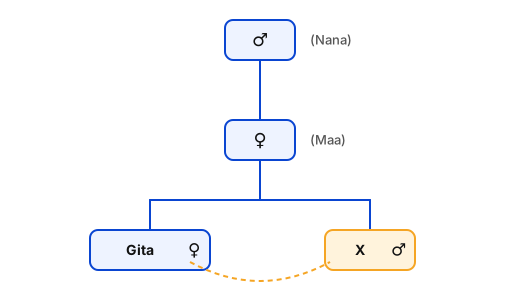
- Gita's mother's father = Gita's maternal grandfather (nana).
- His only daughter = Gita's mother.
- Man's mother = Gita's mother, and he is male ⇒ brother.
Trick: 'Only daughter of my mother's father' is just a long way of saying 'my mother'.
Answer: (B) Brother
अवधारणा: वाक्य को अंत से खोलें – पहले 'my mother's father'।
हल:
- गीता की माँ के पिता = गीता के नाना।
- उनकी इकलौती पुत्री = गीता की माँ।
- व्यक्ति की माँ = गीता की माँ और वह पुरुष है ⇒ भाई।
ट्रिक: 'मेरी माँ के पिता की इकलौती पुत्री' = सीधे 'मेरी माँ'।
उत्तर: (B) भाई
SSC CHSLGeneral IntelligenceBlood relation – photograph puzzleSSC CHSL 2025 · 19 Nov Shift 2
Q3131.The price of an item increased from ₹700 to ₹1060. What is the percentage increase?
एक वस्तु का मूल्य ₹700 से बढ़कर ₹1060 हो गया। प्रतिशत वृद्धि कितनी है?
- A
- B50.42 %
- C48.42 %
- D49.42 %
Show answer
Concept: .
- Increase = ₹360.
Trick: : , remainder 3 → , so ≈ 51.4% – only option A starts with 51.
Answer: (A)
अवधारणा:
हल:
- वृद्धि = ₹360
ट्रिक: में – उत्तर 51 से शुरू होगा, केवल विकल्प A।
उत्तर: (A)
SSC CHSLGeneral IntelligencePercentage increaseSSC CHSL 2025 · 19 Nov Shift 2
Q3132.A car travels at for the first 3 hours and for the next 4 hours. What is the average speed of the car for the entire journey?
एक कार पहले 3 घंटों तक की चाल से तथा अगले 4 घंटों तक की चाल से चलती है। पूरी यात्रा के लिए कार की औसत चाल क्या है?
- A
- B74.28 km/h
- C
- D
Show answer
Concept: .
- Distance = km.
- Time = h.
- Average = 74.28 km/h.
Trick: When times are given, average speed is a weighted mean: .
Answer: (B) 74.28 km/h
अवधारणा:
हल:
- दूरी = km
- समय = घंटे
- औसत = 74.28 km/h
ट्रिक: समय दिया हो तो भारित औसत: ; उत्तर 70 और 80 के बीच ही होगा।
उत्तर: (B) 74.28 km/h
SSC CHSLGeneral IntelligenceAverage speed – different timesSSC CHSL 2025 · 19 Nov Shift 2
Q3133.Few of the letters are given followed by a question mark (?) these letters are following a specific pattern you have to give the correct option which can replace question mark.
Choose the next term: P, M, J, G, ?
कुछ अक्षर दिए गए हैं जिनके बाद एक प्रश्नवाचक चिह्न (?) है। ये अक्षर एक विशिष्ट पैटर्न का अनुसरण कर रहे हैं, आपको वह सही विकल्प चुनना है जो प्रश्नवाचक चिह्न के स्थान पर आ सके।
अगला पद चुनिए: P, M, J, G, ?
- AE
- BD
- CJ
- DM
Show answer
Concept: Positions decrease by 3 each step.
- P(16), M(13), J(10), G(7) – each −3.
- Next: 7 − 3 = 4 → D.
Trick: Skip two letters backward each time: P (o n) M (l k) J (i h) G (f e) D.
Answer: (B) D
अवधारणा: अक्षरों के स्थान-मान हर बार 3 घटते हैं।
हल:
- P(16), M(13), J(10), G(7) – हर बार −3
- अगला: 7 − 3 = 4 → D
ट्रिक: हर बार पीछे की ओर दो अक्षर छोड़ें: G के बाद f, e छोड़कर D।
उत्तर: (B) D
SSC CHSLGeneral IntelligenceLetter series – −3 patternSSC CHSL 2025 · 19 Nov Shift 2
Q3134.If 789 $ and 797 $ 80 , then what is the value of 399 $ 45!15?
यदि 789 $ तथा 797 $ 80 है, तो 399 $ 45!15 का मान क्या होगा?
- A407
- B402
- C406
- D408
Show answer
Concept: Find which operations make both given equations true ($ = +, ! = ÷).
- ✔
- ✔
- 402
Trick: Result is only a little more than the first number ⇒ '+ small quotient'. 42 and 14 → 3 hints at ÷.
Answer: (B) 402
अवधारणा: वे संक्रियाएँ खोजें जिनसे दोनों समीकरण सही हों ($ = +, ! = ÷)।
हल:
- ✔
- ✔
- 402
ट्रिक: परिणाम पहली संख्या से थोड़ा ही बड़ा है ⇒ '+ छोटा भागफल'; 42 और 14 से 3 बनता है।
उत्तर: (B) 402
SSC CHSLGeneral IntelligenceSymbol substitutionSSC CHSL 2025 · 19 Nov Shift 2
Q3135.Few of the letters are given followed by a question mark (?) these letters are following a specific pattern you have to give the correct option which can replace question mark. Which letter completes:T, P, L, H, ?
कुछ अक्षर दिए गए हैं जिनके बाद एक प्रश्नवाचक चिह्न (?) है। ये अक्षर एक विशिष्ट पैटर्न का अनुसरण कर रहे हैं, आपको वह सही विकल्प चुनना है जो प्रश्नवाचक चिह्न के स्थान पर आ सके। कौन-सा अक्षर शृंखला पूरी करता है: T, P, L, H, ?
- AC
- BD
- CM
- DE
Show answer
Concept: Positions decrease by 4 each step.
- T(20), P(16), L(12), H(8) – each −4.
- Next: 8 − 4 = 4 → D.
Trick: All positions are multiples of 4 (20, 16, 12, 8) → next multiple 4 = D.
Answer: (B) D
अवधारणा: स्थान-मान हर बार 4 घटते हैं।
हल:
- T(20), P(16), L(12), H(8) – हर बार −4
- अगला: 8 − 4 = 4 → D
ट्रिक: सभी स्थान-मान 4 के गुणज हैं (20, 16, 12, 8) → अगला 4 = D।
उत्तर: (B) D
SSC CHSLGeneral IntelligenceLetter series – −4 patternSSC CHSL 2025 · 19 Nov Shift 2
Q3136.Which of the following numbers would replace the question mark (?) in the given number series? 7, 10, 15, 22, 31, ?
निम्नलिखित संख्या शृंखला में प्रश्नवाचक चिह्न (?) के स्थान पर निम्नलिखित में से कौन-सी संख्या आएगी? 7, 10, 15, 22, 31, ?
- A45
- B40
- C42
- D36
Show answer
Concept: Differences are consecutive odd numbers.
- Differences: 3, 5, 7, 9.
- Next difference 11 ⇒ 42.
Trick: Terms = (1+6, 4+6, 9+6, 16+6, 25+6) → .
Answer: (C) 42
अवधारणा: क्रमागत पदों के अंतर लगातार विषम संख्याएँ हैं।
हल:
- अंतर: 3, 5, 7, 9
- अगला अंतर 11 ⇒ 42
ट्रिक: पद = (1, 4, 9, 16, 25 में 6 जोड़ें) → ।
उत्तर: (C) 42
SSC CHSLGeneral IntelligenceNumber series – odd differencesSSC CHSL 2025 · 19 Nov Shift 2
Q3137.What will be the 50th term in the following series?
22, 26, 30, 34, ....
निम्नलिखित शृंखला का 50वाँ पद क्या होगा?
22, 26, 30, 34, ....
- A215
- B218
- C212
- D220
Show answer
Concept: AP: .
- , .
- 218.
Trick: here, so . Also, every term is even and leaves remainder 2 on ÷4 – only 218 fits.
Answer: (B) 218
अवधारणा: समांतर श्रेणी:
हल:
- ,
- 218
ट्रिक: यहाँ ⇒ ; हर पद को 4 से भाग देने पर शेष 2 – केवल 218 फिट।
उत्तर: (B) 218
SSC CHSLGeneral IntelligenceArithmetic progression – nth termSSC CHSL 2025 · 19 Nov Shift 2
Q3138.Select the related letter from the given alternatives.
DHL: NRV:: HLP: ?
दिए गए विकल्पों में से संबंधित अक्षर-समूह चुनिए।
DHL: NRV:: HLP: ?
- AGKP
- BRVZ
- CIMO
- DNPS
Show answer
Concept: Each letter moves 10 places forward.
- D(4)→N(14), H(8)→R(18), L(12)→V(22): +10 each.
- HLP: H(8)→18 R, L(12)→22 V, P(16)→26 Z ⇒ RVZ.
Trick: The second term of the first pair (H) begins the second pair, so its answer starts with what H became – R. Only RVZ starts with R.
Answer: (B) RVZ
अवधारणा: हर अक्षर 10 स्थान आगे जाता है।
हल:
- D(4)→N(14), H(8)→R(18), L(12)→V(22): हर एक +10
- HLP: H(8)→R(18), L(12)→V(22), P(16)→Z(26) ⇒ RVZ
ट्रिक: H का कोड पहले ही R मिल चुका है – R से शुरू होने वाला एकमात्र विकल्प RVZ।
उत्तर: (B) RVZ
SSC CHSLGeneral IntelligenceLetter cluster analogy – +10SSC CHSL 2025 · 19 Nov Shift 2
Q3139.Pick the correct options from the given alternatives
DELHI : I H LED :: PATNA : ?
दिए गए विकल्पों में से सही विकल्प चुनिए
DELHI : I H LED :: PATNA : ?
- AAPNAT
- BA T N A P
- CATANP
- DANTAP
Show answer
Concept: The code is the word written backwards.
- DELHI reversed = IHLED ✔
- PATNA reversed = ANTAP.
Trick: Check only the last letter of the word: PATNA ends in A and starts with P → code must be A…P; then middle T-N reversed = N-T.
Answer: (D) ANTAP
अवधारणा: कोड = शब्द को उल्टे क्रम में लिखना।
हल:
- DELHI उल्टा = IHLED ✔
- PATNA उल्टा = ANTAP
ट्रिक: PATNA उल्टा पढ़ें: A-N-T-A-P; बीच में N पहले, T बाद में।
उत्तर: (D) ANTAP
SSC CHSLGeneral IntelligenceAnalogy – word reversalSSC CHSL 2025 · 19 Nov Shift 2
Q3140.Choose the correct letter cluster to complete the series.
BCDE, HIJK, NOPQ, ?
शृंखला को पूरा करने के लिए सही अक्षर-समूह चुनिए।
BCDE, HIJK, NOPQ, ?
- AU T V W
- BT U V W
- CT U W V
- DT V U W
Show answer
Concept: Each group = 4 consecutive letters; first letters jump +6.
- Starting letters: B(2), H(8), N(14) → +6 each.
- Next start = 20 → T; group = TUVW (in order).
Trick: Gap between groups is always 2 letters (F G, L M, R S) – after Q skip R, S → start at T.
Answer: (B) T U V W
अवधारणा: हर समूह में 4 लगातार अक्षर; पहले अक्षर +6 बढ़ते हैं।
हल:
- पहले अक्षर: B(2), H(8), N(14) → हर बार +6
- अगला = 20 → T; समूह = TUVW (क्रम से)
ट्रिक: दो समूहों के बीच हमेशा 2 अक्षर छूटते हैं – Q के बाद R, S छोड़कर T से शुरू।
उत्तर: (B) T U V W
SSC CHSLGeneral IntelligenceLetter cluster seriesSSC CHSL 2025 · 19 Nov Shift 2

