Q5901.The given bar graph shows the sales of cars from six branches of a dealer B1, B2, B3, B4, B5, B6, during two consecutive years 2018 and 2019 (values read from the graph are given below).
| Branch | B1 | B2 | B3 | B4 | B5 | B6 |
|---|
| 2018 | 80 | 75 | 95 | 85 | 75 | 70 |
| 2019 | 105 | 65 | 110 | 95 | 95 | 80 |
The average sale of cars (from all branches) for the year 2018 is:
दिया गया दंड आलेख (bar graph) एक डीलर की छह शाखाओं B1, B2, B3, B4, B5, B6 से लगातार दो वर्षों 2018 और 2019 के दौरान कारों की बिक्री दर्शाता है (आलेख से पढ़े गए मान नीचे दिए गए हैं)।
| शाखा | B1 | B2 | B3 | B4 | B5 | B6 |
|---|
| 2018 | 80 | 75 | 95 | 85 | 75 | 70 |
| 2019 | 105 | 65 | 110 | 95 | 95 | 80 |
वर्ष 2018 के लिए (सभी शाखाओं से) कारों की औसत बिक्री है:
- A78
- B90
- C85
- D80
Show answer
Concept: Average . Read the 2018 (blue) bar of each branch.
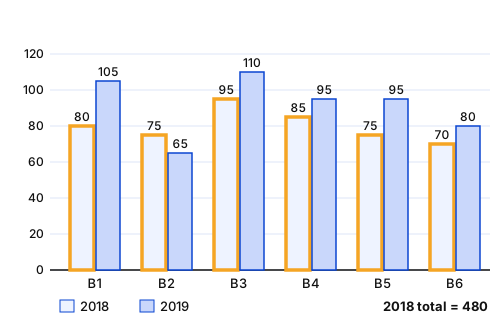
- 2018 sales: .
- Total .
- Average .
Trick: Take 80 as base: deviations sum to , so the average is exactly .
Answer: (D)
अवधारणा: औसत । हर शाखा का 2018 (नीला) बार पढ़ें।
- 2018 की बिक्री: ।
- कुल ।
- औसत ।
ट्रिक: 80 को आधार लें: विचलन का योग है, अतः औसत ठीक ।
उत्तर: (D)
SSC CPO Paper IQuantitative AptitudeData Interpretation – Bar GraphSSC CPO Paper I 2020 · 24 Nov Shift 3
Q5902.On the marked price of ₹1,250 of an article, three successive discounts of 5%, 15% and 20% are offered. What will be the selling price (in ₹) after all discounts?
किसी वस्तु के ₹1,250 के अंकित मूल्य पर 5%, 15% और 20% की तीन क्रमिक छूट दी जाती हैं। सभी छूटों के बाद विक्रय मूल्य (₹ में) क्या होगा?
- A1,000
- B807.50
- C975.75
- D950.25
Show answer
Concept: After successive discounts, .
- ;
- , so SP = ₹807.50.
Trick: Multiply the easiest factor first () – the order of successive discounts does not matter.
Answer: (B) ₹807.50
अवधारणा: क्रमिक बट्टों के बाद ।
- ;
- , अतः SP = ₹807.50।
ट्रिक: सबसे आसान गुणा पहले करें () – क्रमिक बट्टों का क्रम मायने नहीं रखता।
उत्तर: (B) ₹807.50
SSC CPO Paper IQuantitative AptitudeSuccessive DiscountSSC CPO Paper I 2020 · 24 Nov Shift 3
Q5903.The base of a triangle is equal to the perimeter of a square whose diagonal is cm, and its height is equal to the side of a square whose area is 144 cm2. The area of the triangle (in cm2) is:
एक त्रिभुज का आधार उस वर्ग के परिमाप के बराबर है जिसका विकर्ण cm है, और इसकी ऊँचाई उस वर्ग की भुजा के बराबर है जिसका क्षेत्रफल 144 cm2 है। त्रिभुज का क्षेत्रफल (cm2 में) है:
- A288
- B216
- C144
- D72
Show answer
Concept: Square: ; triangle area .
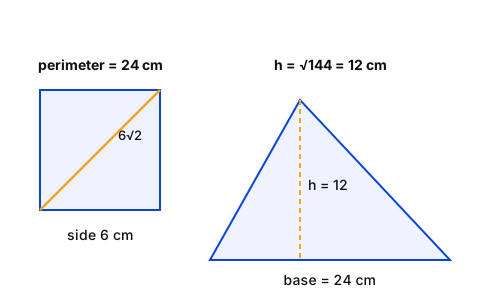
- Diagonal side cm, perimeter cm = base.
- Area side cm = height.
- Area .
Trick: Diagonal → just drop the to get the side.
Answer: (C)
अवधारणा: वर्ग: ; त्रिभुज का क्षेत्रफल ।
- विकर्ण भुजा cm, परिमाप cm = आधार।
- क्षेत्रफल भुजा cm = ऊँचाई।
- क्षेत्रफल ।
ट्रिक: विकर्ण हो तो हटाते ही भुजा मिल जाती है।
उत्तर: (C)
SSC CPO Paper IQuantitative AptitudeMensuration – Triangle and SquareSSC CPO Paper I 2020 · 24 Nov Shift 3
Q5904.The area of a square and rectangle are equal. The length of the rectangle is greater than the length of a side of the square by 10 cm and the breadth is less than 5 cm. The perimeter (in cm) of the rectangle is:
एक वर्ग और एक आयत के क्षेत्रफल बराबर हैं। आयत की लंबाई वर्ग की भुजा की लंबाई से 10 cm अधिक है और चौड़ाई 5 cm कम है। आयत का परिमाप (cm में) है:
- A50
- B40
- C80
- D100
Show answer
Concept: Let the side of the square be ; the rectangle is by (breadth is 5 cm less than the side). Equate the areas.
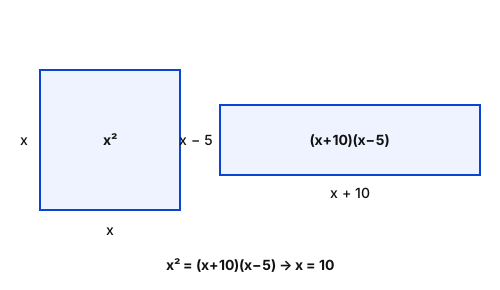
- cm
- Rectangle: cm cm, perimeter cm.
Trick: Check: square and rectangle – equal areas confirm the answer.
Answer: (A)
अवधारणा: वर्ग की भुजा मानें; आयत और का है (चौड़ाई भुजा से 5 cm कम)। दोनों क्षेत्रफल बराबर करें।
- cm
- आयत: cm cm, परिमाप cm।
ट्रिक: जाँच: वर्ग , आयत – क्षेत्रफल बराबर।
उत्तर: (A)
SSC CPO Paper IQuantitative AptitudeMensuration – Rectangle and SquareSSC CPO Paper I 2020 · 24 Nov Shift 3
Q5905.P and Q together can do a work in 12 days. P alone can do the same work in 18 days. In how many days can Q alone complete two-third part of the same work?
P और Q मिलकर एक कार्य को 12 दिनों में कर सकते हैं। P अकेले उसी कार्य को 18 दिनों में कर सकता है। Q अकेले उसी कार्य के दो-तिहाई भाग को कितने दिनों में पूरा कर सकता है?
- A30
- B21
- C24
- D36
Show answer
Concept: One-day work of Q .
- Q's one-day work → Q alone takes days.
- Two-thirds of the work: days.
Trick: LCM method: total work units, P+Q /day, P /day ⇒ Q /day; of 36 units → 24 days.
Answer: (C)
अवधारणा: Q का एक दिन का काम ।
- Q का एक दिन का काम → Q अकेला दिन।
- दो-तिहाई काम: दिन।
ट्रिक: LCM विधि: कुल काम इकाई, P+Q /दिन, P /दिन ⇒ Q /दिन; 36 का इकाई → 24 दिन।
उत्तर: (C)
SSC CPO Paper IQuantitative AptitudeTime and WorkSSC CPO Paper I 2020 · 24 Nov Shift 3
Q5906.Study the given histogram that shows the marks obtained by students in an examination and answer the question that follows (class frequencies read from the histogram are given below).
| Marks | 150–200 | 200–250 | 250–300 | 300–350 | 350–400 | 400–450 |
|---|
| Number of students | 30 | 45 | 60 | 35 | 40 | 35 |
The number of students who obtained less than 250 marks is:
दिए गए आयतचित्र (histogram) का अध्ययन कीजिए, जो एक परीक्षा में विद्यार्थियों द्वारा प्राप्त अंकों को दर्शाता है, और उसके बाद पूछे गए प्रश्न का उत्तर दीजिए (आयतचित्र से पढ़ी गई वर्ग बारंबारताएँ नीचे दी गई हैं)।
| अंक | 150–200 | 200–250 | 250–300 | 300–350 | 350–400 | 400–450 |
|---|
| विद्यार्थियों की संख्या | 30 | 45 | 60 | 35 | 40 | 35 |
250 से कम अंक प्राप्त करने वाले विद्यार्थियों की संख्या है:
- A135
- B75
- C30
- D45
Show answer
Concept: “Less than 250” means all class intervals that end at or before 250.
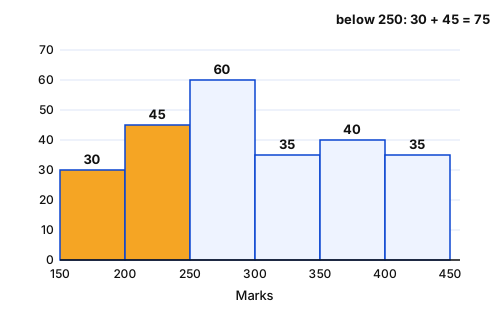
- Intervals below 250: and .
- Students .
Trick: Do not include the bar – it starts at 250, so those students scored 250 or more.
Answer: (B)
अवधारणा: “250 से कम” = वे सभी वर्ग जो 250 पर या उससे पहले समाप्त होते हैं।
- 250 से नीचे के वर्ग: और ।
- विद्यार्थी ।
ट्रिक: वाला बार न जोड़ें – वह 250 से शुरू होता है।
उत्तर: (B)
SSC CPO Paper IQuantitative AptitudeData Interpretation – HistogramSSC CPO Paper I 2020 · 24 Nov Shift 3
Q5907.The value of is:
का मान है:
- A
- B
- C
- D
Show answer
Concept: If , then , so and .
- : numerator .
- : denominator .
- Value .
Trick: Spot angle pairs adding to – each or pair becomes 1.
Answer: (D)
अवधारणा: यदि तो , अतः तथा ।
- : अंश ।
- : हर ।
- मान ।
ट्रिक: जिन कोणों का योग हो, उनके या का योग 1 होता है।
उत्तर: (D)
SSC CPO Paper IQuantitative AptitudeTrigonometry – Complementary AnglesSSC CPO Paper I 2020 · 24 Nov Shift 3
Q5908.On the marked price of an article, the sum of selling prices with a discount of 35% and two successive discounts of 20% and 15%, is ₹1,995. The marked price of the article (in ₹) is:
किसी वस्तु के अंकित मूल्य पर 35% की छूट और 20% तथा 15% की दो क्रमिक छूटों के साथ विक्रय मूल्यों का योग ₹1,995 है। वस्तु का अंकित मूल्य (₹ में) है:
- A1,550
- B1,800
- C1,500
- D1,600
Show answer
Concept: Write both selling prices as fractions of the marked price .
- 35% discount: .
- 20% and 15%: .
- .
Trick: Option check: ✓.
Answer: (C) ₹1,500
अवधारणा: दोनों विक्रय मूल्यों को अंकित मूल्य के रूप में लिखें।
- 35% बट्टा: ।
- 20% व 15% क्रमिक: ।
- ।
ट्रिक: विकल्प जाँच: ✓।
उत्तर: (C) ₹1,500
SSC CPO Paper IQuantitative AptitudeDiscountSSC CPO Paper I 2020 · 24 Nov Shift 3
Q5909.If 49% of X = Y, then Y% of 50 is:
यदि X का 49% = Y है, तो 50 का Y% है:
- A40% of YY का 40%
- B24.5% of YY का 24.5%
- C50% of XX का 50%
- D24.5% of XX का 24.5%
Show answer
Concept: Convert “ of 50” to a multiple of , then substitute .
- of .
Trick: of of : of 50 of = half of .
Answer: (D) 24.5% of X
अवधारणा: “50 का ” को के रूप में लिखें, फिर रखें।
- का ।
ट्रिक: का = का : 50 का = का 50% = का आधा।
उत्तर: (D) 24.5% of X
SSC CPO Paper IQuantitative AptitudePercentageSSC CPO Paper I 2020 · 24 Nov Shift 3
Q5910.Chord AB of a circle is produced to a point P, and C is a point on the circle such that PC is a tangent to the circle. If PC = 12 cm, and BP = 10 cm, then the length of AB (in cm) is:
एक वृत्त की जीवा AB को एक बिंदु P तक बढ़ाया गया है, और C वृत्त पर एक ऐसा बिंदु है कि PC वृत्त की स्पर्श रेखा है। यदि PC = 12 cm और BP = 10 cm है, तो AB की लंबाई (cm में) है:
- A5.4
- B6
- C5
- D4.4
Show answer
Concept: Tangent-secant theorem: .
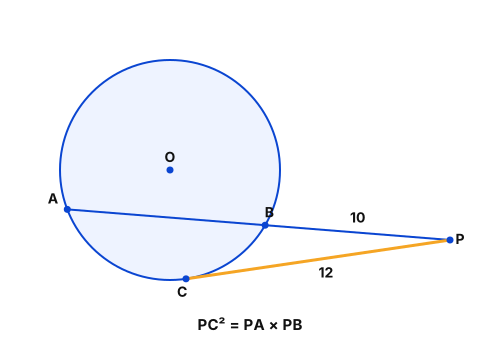
- cm.
- B lies between A and P, so cm.
Trick: Square of tangent = (whole secant) × (outside part).
Answer: (D)
अवधारणा: स्पर्शरेखा-छेदक प्रमेय: ।
- cm।
- B, A और P के बीच है, अतः cm।
ट्रिक: ।
उत्तर: (D)
SSC CPO Paper IQuantitative AptitudeCircle – Tangent-Secant TheoremSSC CPO Paper I 2020 · 24 Nov Shift 3
Q5911.A ladder is resting against a wall. The angle between the foot of the ladder and wall is 60°, and the foot of the ladder is 3.6 m away from the wall. The length of the ladder (in m) is:
एक सीढ़ी एक दीवार के सहारे टिकी हुई है। सीढ़ी के पाद और दीवार के बीच का कोण 60° है, और सीढ़ी का पाद दीवार से 3.6 m दूर है। सीढ़ी की लंबाई (m में) है:
- A5.4
- B3.6
- C14.4
- D7.2
Show answer
Concept: The 60° is the angle the ladder makes at its foot (with the ground); the distance from the wall is the adjacent side, so .
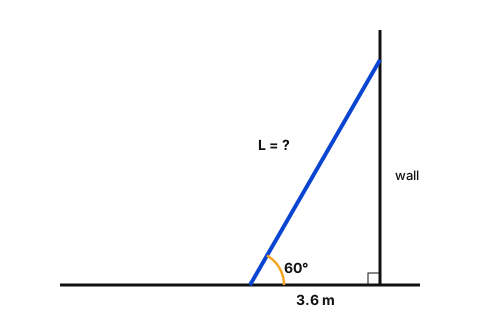
- m.
Trick: In a 30-60-90 triangle the side next to the angle is half the hypotenuse.
Answer: (D)
अवधारणा: वह कोण है जो सीढ़ी अपने पाद पर ज़मीन से बनाती है; दीवार से दूरी आसन्न भुजा है, अतः ।
- m।
ट्रिक: 30-60-90 त्रिभुज में के पास वाली भुजा कर्ण की आधी होती है।
उत्तर: (D)
SSC CPO Paper IQuantitative AptitudeHeights and DistancesSSC CPO Paper I 2020 · 24 Nov Shift 3
Q5912.A pump can fill a tank with water in 3 hours. Because of a leak, it took hours to fill the tank. In how many hours can the leak alone drain all the water of the tank when it is full?
एक पंप किसी टंकी को 3 घंटे में पानी से भर सकता है। एक रिसाव के कारण, टंकी को भरने में घंटे लगे। पूरी भरी होने पर रिसाव अकेले टंकी का सारा पानी कितने घंटों में खाली कर सकता है?
- A21
- B15
- C30
- D10
Show answer
Concept: Leak rate = pump rate − net rate.
- Pump: per hour; net with leak: per hour.
- Leak .
- Leak empties the tank in hours.
Trick: Leak time .
Answer: (C)
अवधारणा: रिसाव की दर = पंप की दर − शुद्ध दर।
- पंप: प्रति घंटा; रिसाव सहित: प्रति घंटा।
- रिसाव ।
- रिसाव पूरी टंकी घंटे में खाली करेगा।
ट्रिक: रिसाव समय ।
उत्तर: (C)
SSC CPO Paper IQuantitative AptitudePipes and CisternsSSC CPO Paper I 2020 · 24 Nov Shift 3
Q5913.In , . If I is the incentre of the triangle, then the measure of is:
में, है। यदि I त्रिभुज का अंतःकेंद्र है, तो का माप है:
- A
- B
- C
- D
Show answer
Concept: For the incentre I: .
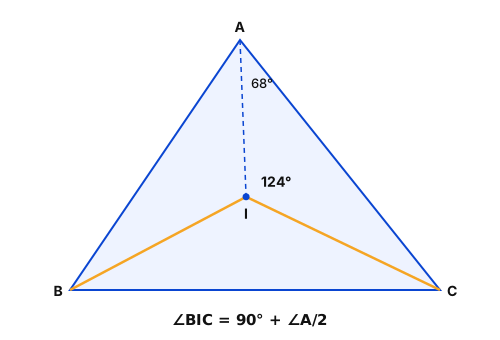
- .
Yaad rakhein: Incentre: ; excentre: ; circumcentre: .
Answer: (A)
अवधारणा: अंतःकेंद्र I के लिए: ।
- ।
याद रखें: अंतःकेंद्र: ; बाह्यकेंद्र: ; परिकेंद्र: ।
उत्तर: (A)
SSC CPO Paper IQuantitative AptitudeTriangle – IncentreSSC CPO Paper I 2020 · 24 Nov Shift 3
Q5914.If the selling price of 50 articles is equal to the cost price of 42 articles, then what is the approximate loss or profit percentage?
यदि 50 वस्तुओं का विक्रय मूल्य 42 वस्तुओं के क्रय मूल्य के बराबर है, तो लगभग हानि या लाभ प्रतिशत क्या है?
- A8% profit8% लाभ
- B16% loss16% हानि
- C10% loss10% हानि
- D20% profit20% लाभ
Show answer
Concept: If SP of articles = CP of articles, then (negative = loss).
- Let CP of 1 article = ₹1: CP of 50 = ₹50, SP of 50 = ₹42.
- Loss = ₹8 on ₹50.
- Loss% .
Trick: Fewer articles' CP received (42 < 50) means loss.
Answer: (B) 16% loss
अवधारणा: यदि वस्तुओं का SP = वस्तुओं का CP, तो (ऋणात्मक = हानि)।
- 1 वस्तु का CP = ₹1: 50 का CP = ₹50, SP = ₹42।
- हानि = ₹8।
- हानि% ।
ट्रिक: 42, 50 से कम है – इसलिए हानि।
उत्तर: (B) 16% loss
SSC CPO Paper IQuantitative AptitudeProfit and LossSSC CPO Paper I 2020 · 24 Nov Shift 3
Q5915.The following pie chart shows percentage expenditure of a country on different heads. The total expenditure is ₹1,680 (in billions). Study the chart and answer the question.
| Head | Expenditure (%) |
|---|
| Subsidy | 21 |
| Interest Payment | 15 |
| Health | 4 |
| Education | 6 |
| Proceeds to states | 34 |
| Defence | 12 |
| Employee | 7 |
| Misc | 1 |
The amount of expenditure on Defence is what percentage more than the expenditure on Education?
निम्नलिखित पाई चार्ट किसी देश के विभिन्न मदों पर प्रतिशत व्यय को दर्शाता है। कुल व्यय ₹1,680 (बिलियन में) है। चार्ट का अध्ययन कीजिए और प्रश्न का उत्तर दीजिए।
| मद | व्यय (%) |
|---|
| सब्सिडी | 21 |
| ब्याज भुगतान | 15 |
| स्वास्थ्य | 4 |
| शिक्षा | 6 |
| राज्यों को अंतरण | 34 |
| रक्षा | 12 |
| कर्मचारी | 7 |
| विविध | 1 |
रक्षा पर व्यय की राशि, शिक्षा पर व्यय से कितने प्रतिशत अधिक है?
- A50%
- B125%
- C150%
- D100%
Show answer
Concept: Compare the percentages directly – the total (₹1,680 billion) cancels.
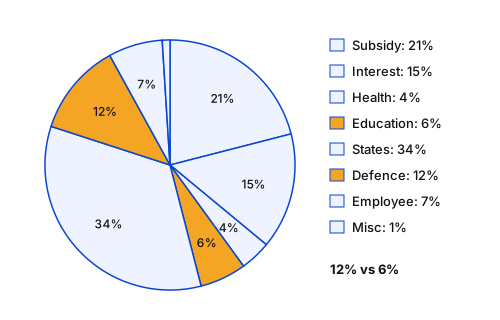
- Defence , Education .
- More by .
Trick: Defence is exactly double Education → 100% more.
Answer: (D) 100%
अवधारणा: सीधे प्रतिशत की तुलना करें – कुल राशि कट जाती है।
- Defence , Education ।
- अधिक ।
ट्रिक: दोगुना = 100% अधिक।
उत्तर: (D) 100%
SSC CPO Paper IQuantitative AptitudeData Interpretation – Pie ChartSSC CPO Paper I 2020 · 24 Nov Shift 3
Q5916.If , and , then the value of is:
यदि , और है, तो का मान है:
- A
- B
- C
- D
Show answer
Concept: .
- .
- .
- , so .
Trick: A negative product is possible, so a negative cube root is not a mistake: .
Answer: (D)
अवधारणा: ।
- ।
- ।
- ।
ट्रिक: गुणनफल ऋणात्मक हो सकता है: ।
उत्तर: (D)
SSC CPO Paper IQuantitative AptitudeAlgebraic IdentitiesSSC CPO Paper I 2020 · 24 Nov Shift 3
Q5917.Three partners shared the profit in a business in the ratio 8 : 7 : 5. They invested their capitals for 7 months, 8 months and 14 months, respectively. What was the ratio of their capitals?
तीन साझेदारों ने एक व्यवसाय में लाभ को 8 : 7 : 5 के अनुपात में बाँटा। उन्होंने अपनी पूँजी क्रमशः 7 माह, 8 माह और 14 माह के लिए निवेश की थी। उनकी पूँजियों का अनुपात क्या था?
- A49 : 64 : 20
- B20 : 49 : 64
- C20 : 64 : 49
- D64 : 49 : 20
Show answer
Concept: Profit capital time, so capital .
- Capitals .
- Multiply by LCM 56: .
Trick: Largest profit with the shortest time ⇒ largest capital – only option (D) starts with the largest number 64.
Answer: (D) 64 : 49 : 20
अवधारणा: लाभ पूँजी समय, अतः पूँजी ।
- पूँजी ।
- LCM 56 से गुणा: ।
ट्रिक: सबसे ज़्यादा लाभ, सबसे कम समय ⇒ सबसे बड़ी पूँजी (64)।
उत्तर: (D) 64 : 49 : 20
SSC CPO Paper IQuantitative AptitudePartnershipSSC CPO Paper I 2020 · 24 Nov Shift 3
Q5918.A number is first increased by 40% and then decreased by 25%, again increased by 15% and then decreased by 20%. What is the net increase/decrease per cent in the number?
एक संख्या में पहले 40% की वृद्धि की जाती है और फिर 25% की कमी की जाती है, पुनः 15% की वृद्धि की जाती है और फिर 20% की कमी की जाती है। संख्या में निवल प्रतिशत वृद्धि/कमी कितनी है?
- A7.2% decrease7.2% कमी
- B6.4% increase6.4% वृद्धि
- C3.4% increase3.4% वृद्धि
- D3.4% decrease3.4% कमी
Show answer
Concept: Multiply the multiplying factors of each change.
- Factor .
- ; .
- → change .
Trick: Start with 100: → 3.4% decrease.
Answer: (D) 3.4% decrease
अवधारणा: हर परिवर्तन के गुणक का गुणनफल लें।
- गुणक ।
- ।
- परिवर्तन अर्थात कमी।
ट्रिक: 100 से शुरू: → 3.4% कमी।
उत्तर: (D) 3.4% decrease
SSC CPO Paper IQuantitative AptitudeSuccessive Percentage ChangeSSC CPO Paper I 2020 · 24 Nov Shift 3
Q5919.The average temperature for Monday, Wednesday and Friday was 41°C. The average for Wednesday, Friday and Thursday was 42°C. If the temperature on Thursday was 43°C, then the temperature on Monday was:
सोमवार, बुधवार और शुक्रवार का औसत तापमान 41°C था। बुधवार, शुक्रवार और गुरुवार का औसत 42°C था। यदि गुरुवार का तापमान 43°C था, तो सोमवार का तापमान था:
- A43°C
- B41°C
- C42°C
- D40°C
Show answer
Concept: Convert averages to sums; the common days cancel.
- ; .
- Subtract: .
Trick: Difference of averages 3 = difference of the odd days: .
Answer: (D)
अवधारणा: औसत को योग में बदलें; साझा दिन कट जाते हैं।
- ; ।
- घटाएँ: ।
ट्रिक: औसत का अंतर 3 = अलग दिनों का अंतर: ।
उत्तर: (D)
SSC CPO Paper IQuantitative AptitudeAverageSSC CPO Paper I 2020 · 24 Nov Shift 3
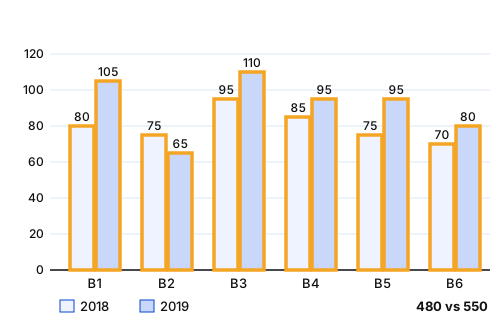
Q5920.The given bar graph shows the sales of cars from six branches of a dealer B1, B2, B3, B4, B5, B6, during two consecutive years 2018 and 2019 (values read from the graph are given below).
| Branch | B1 | B2 | B3 | B4 | B5 | B6 |
|---|
| 2018 | 80 | 75 | 95 | 85 | 75 | 70 |
| 2019 | 105 | 65 | 110 | 95 | 95 | 80 |
The total sale of cars from all the branches in the year 2018 is what percentage less than the total sales of cars from all the branches in the year 2019? (correct to one decimal place)
दिया गया दंड आलेख (bar graph) एक डीलर की छह शाखाओं B1, B2, B3, B4, B5, B6 से लगातार दो वर्षों 2018 और 2019 के दौरान कारों की बिक्री दर्शाता है (आलेख से पढ़े गए मान नीचे दिए गए हैं)।
| शाखा | B1 | B2 | B3 | B4 | B5 | B6 |
|---|
| 2018 | 80 | 75 | 95 | 85 | 75 | 70 |
| 2019 | 105 | 65 | 110 | 95 | 95 | 80 |
वर्ष 2018 में सभी शाखाओं से कारों की कुल बिक्री, वर्ष 2019 में सभी शाखाओं से कारों की कुल बिक्री से कितने प्रतिशत कम है? (एक दशमलव स्थान तक सही)
- A12.7%
- B14.3%
- C11.9%
- D13.5%
Show answer
Concept: “Less than 2019” → divide the difference by the 2019 total.
- 2018 total .
- 2019 total .
- Less by .
Trick: Base = the quantity after “than” (here 2019).
Answer: (A) 12.7%
अवधारणा: “2019 से कम” → अंतर को 2019 के योग से भाग दें।
- 2018 का योग ।
- 2019 का योग ।
- कम ।
ट्रिक: आधार = “से” के बाद वाली राशि (यहाँ 2019)।
उत्तर: (A) 12.7%
SSC CPO Paper IQuantitative AptitudeData Interpretation – Bar GraphSSC CPO Paper I 2020 · 24 Nov Shift 3

